
[Bureaucracies will always expand far beyond the “problem” they were instituted to address] was, anyway, the view of that “Austrian school economist”, Ludwig von Mises, proponent like the rest in that school of “classical liberalism”. His hatred of bureaucracy was a wonderful, animated thing. In his great book, Human Action, and many others, he could become almost boring on the topic. What distinguishes the Austrian school from, say, the famous Chicago school of Milton Friedman and his ilk, was its European origin. (They were, however, consciously allied.) The “Austrians” go back, to Catholic antecedents, and their interests are not reducible to “pure economics” (scare quotes because there is no such thing). Over time it extended to broad social questions, and through a constant interest in the history of ideas. These were multilingual and multicultural, in the manner of the old Habsburg empire; where our American classical liberalism has been almost unilingually English, provincially distrustful of foreign thinkers, and buzzing with statistics. (You’ll need a degree in math.)
War propelled the “Austrian” thinkers westward, and the fall of the Berlin wall propelled the “Chicago” school east. The terms no longer have geographical significance.
What all classical liberals have in common is the passionate vindication and defence of human freedom. That is what makes them, unlike progressives, readable in subsequent generations. Their subject matter cannot become dated. The “Austrians” are also necessary to understand modern history, positively as well as negatively, in the evolution of, for instance, the Christian Democratic movement that conceived a peaceful post-war Europe, in defiance of secularizing bureaucratic trends and mass-man “ideals”. Alas, this was overall defeated by the Eurocratic trend-setters, determined to build a magnificent autocratic monument to themselves.
I have the most enchanting memory of opening the box that contained an American reprint of Human Action (big thick book), which I had ordered at the age of fifteen. I no longer own a copy, but gather it still stands as a monument to the resistance — a study of “praxeology”, or purposeful human choices, stretching so wide that even religion and morality could be touched. (Conventional economics has no time for either.) A half-century later, I can even remember the construction of an earnest reading list, that was soon abandoned when I went on the road.
One may see the great division in Western thought and politics, which the Austrian-school Friedrich Hayek traced back to Bacon and Descartes, and can be traced farther to the Nominalists of the later Middle Ages. Humans live in freedom and make choices, to be restrained only by the plainest moral codes. Or, by the alternative thesis, we are components of a machine, which the man with Power can monkey with, by implanting stimuli here and there.
We are creatures of God, or — we are replaceable parts in a bureaucracy.
David Warren, “Austrian schoolboy”, Essays in Idleness, 2019-09-17.
November 23, 2023
QotD: The Austrian and Chicago schools of economics
November 4, 2023
QotD: The munificent benefits of big government
This is the argument that government should run more of the economy of course.
No, don’t laugh, it is. Because these things are rising in price is exactly why, so the argument goes, government must regulate and control more, so as to lower the price.
Tim Worstall, “Ain’t Capitalism Great? Price Changes Over The Last 20 Years”, Continental Telegraph, 2019-07-13.
October 5, 2021
QotD: Entrepreneurship
In fact, one could almost create a new economic law: the amount of abuse raining down on entrepreneurs is directly proportional to the good they do. I haven’t seen much reason to doubt this law yet.
Johnathan Pearce, “Gordon Gekko goes to Germany”, Samizdata.net, 2005-05-05.
November 27, 2019
QotD: The evolution of markets
We believe that there is a natural inclination to promote our own welfare and that of our loved ones. We further believe that, given reasonable security of life and property, this inclination will lead to the emergence of a system of voluntary exchange. That is, we will seek to trade the things we have or can create for other things that we regard as of greater value to ourselves.
In doing so, ratios of exchange that we call prices will be revealed. These prices, in turn, will provide general information about what should be produced, in what ways and in what quantities. Furthermore, changes in price will provide information about changes in preferences or in abilities to produce. Custom will set aside one or more goods to serve as money. Institutions will emerge that channel savings into productive investment, that spread risk, and that moderate expected fluctuations in price. Laws will develop to police the transfer of property and performance of contracts.
We believe that market economies emerge spontaneously and are self-regulating and self-sustaining. This is not to say that all market societies will be the same. Their exact shape will depend on the intellectual and moral qualities of the individuals who comprise them. They will reflect pre-existing patterns of trust and honesty and the general cultural and religious values of a people. They will also be more or less distorted by government intervention. But we do say that market behaviour is natural — that, in the absence of extreme government coercion, or extreme disorder, buying and selling to increase our own welfare is what we naturally do.
Sean Gabb, “Market Behaviour in the Ancient World: An Overview of the Debate”, 2008-05.
November 23, 2019
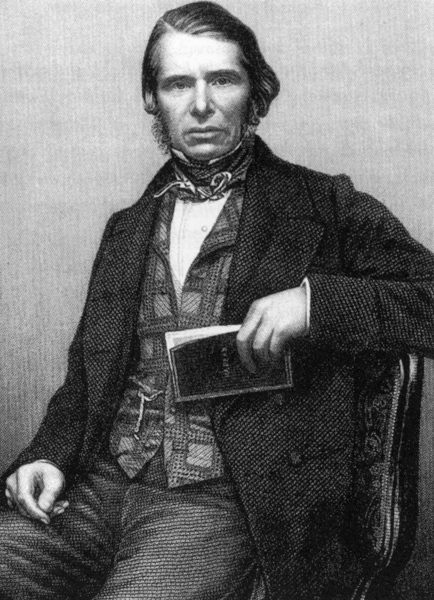
Sir Charles Trevelyan, head of the Irish relief efforts during the potato famine, and creator of the modern civil service
By happenstance, after posting the OSP video on the history of Ireland, a post at Samizdata covered one of the questions I had from OSP’s summary, specifically that the famine was worsened by British “laissez-faire mercantilism”. Mercantilism is rather different from any kind of laissez-faire system, so it was puzzling to hear Blue link them together as though they were the same thing. Of course, I live in a province currently governed by the Progressive Conservative party, so it’s not like I’m unable to process oxymorons as they go by…
Anyway, this post by Paul Marks looks at the man in charge of the relief efforts:
Part of the story of Sir Charles Trevelyan is fairly well known and accurately told. Charles Trevelyan was head of the relief efforts in Ireland under Russell’s government in the late 1840s – on his watch about a million Irish people died and millions more fled the country. But rather than being punished, or even dismissed in disgrace, Trevelyan was granted honours, made a Knight Commander of the Order of the Bath (KCB) and later made a Baronet, not bad for the son of the Cornishman clergyman. He went on to the create the modern British Civil Service – which dominates modern life in in the United Kingdom.
Charles Edward Trevelyan (contemporary lithograph). This appeared in one of the volumes of “The drawing-room portrait gallery of eminent personages principally from photographs by Mayall, many in Her Majesty’s private collection, and from the studios of the most celebrated photographers in the Kingdom / engraved on steel, under the direction of D.J. Pound; with memoirs by the most able authors”. Many libraries own copies.
Public domain, via Wikimedia.With Sir Edwin Chadwick (the early 19th century follower of Jeremy Bentham who wrote many reports on local and national problems in Britain – with the recommended solution always being more local or central government officials, spending and regulations), Sir Charles Trevelyan could well be described as one of the key creators of modern government. If, for example, one wonders why General Douglas Haig was not dismissed in disgrace after July 1st 1916, the first day of the Battle of the Somme when twenty thousand British soldiers were killed and thirty thousand wounded for no real gain (the only officers being sent home in disgrace being those officers who had saved some of them men by ordering them stop attacking – against the orders of General Haig), then the case of Sir Charles Trevelyan is key – the results of his decisions were awful, but his paperwork was always perfect (as was the paperwork of Haig and his staff). The United Kingdom had ceased to be a society that always judged someone on their success or failure in their task – it had become, at least partly, a bureaucratic society where people were judged on their words and their paperwork. A General, in order to be great, did not need to win battles or capture important cities – what they needed to do was write official reports in the correct administrative manner, and a famine relief administrator did not have to actually save the population he was in charge of saving – what he had to do was follow (and, in the case of Sir Charles, actually invent) the correct administrative procedures.
But here is where the story gets strange – every source I have ever seen in my life, has described Sir Charles Trevelyan as a supporter of “Laissez Faire” (French for, basically, “leave alone”) “non-interventionist” “minimal government” and his policies are described in like manner. […]
Which probably explains why Blue used the term in the previous video. Then these “laissez-faire” policies are summarized, which leads to this:
None of the above is anything to do with “laissez faire” it is, basically, the opposite. Reality is being inverted by the claim that a laissez faire policy was followed in Ireland. A possible counter argument to all this would go as follows – “Sir Charles Trevelyan was a supporter of laissez faire – he did not follow laissez faire in the case of Ireland, but because he was so famous for rolling back the state elsewhere (whilst spawning the modern Civil Service) – it was assumed that he must have done so in the case of Ireland“, but does even that argument stand up? I do not believe it does. Certainly Sir Charles Trevelyan could talk in a pro free market way (just as General Haig could talk about military tactics – and sound every inch the “educated soldier”), but what did he actually do when he was NOT in Ireland?
I cannot think of any aspect of government in the bigger island of the then UK (Britain) that Sir Charles Trevelyan rolled back. And in India (no surprise – the man was part of “the Raj”) he is most associated with government road building (although at least the roads went to actual places in India – they were not “from nowhere to nowhere”) and other government “infrastructure”, and also with the spread of government schools in India. Trevelyan was passionately devoted to the spread of government schools in India – this may be a noble aim, but it is not exactly a roll-back-the-state aim. Still less a “radical”, “fanatical” devotion to “laissez faire“.
August 10, 2019
QotD: Progressives and spontaneous order
Conduct an on-going experiment: whenever well-meaning “Progressives” (of which there are very many) propose this government intervention or oppose that policy of reducing government’s role in the economy, ask if these “Progressives'” stated reasons can be understood to be nothing more than a reflection of a failure to understand the power and range of spontaneous-ordering forces in private-property settings. The answer will almost always be “yes.” Very often, no further explanation for “Progressives'” policy stances is necessary.
“Progressives” simply don’t “get” spontaneous order in human society. They see a problem and leap to the only conclusion that for them is sensible – namely, that that problem’s only realistic “solution” is that it be directly addressed by government officials. Indeed, even “Progressives'” frequent misdiagnoses of the results of trade-offs as being “problems” (or “market failures”) reflect a failure to understand spontaneous-ordering processes. Many phenomena and patterns that “Progressives” assume to be problems – for example, increasing inequality of monetary incomes – are often the benign results of the countless and nuanced individual trade-offs made by individuals. For “Progressives,” though, these “outcomes” are often assumed to be the consequence of sinister designs.
Don Boudreaux, “Bonus Quotation of the Day…”, Café Hayek, 2017-06-24.
July 8, 2019
QotD: Orwell on capitalism versus socialism
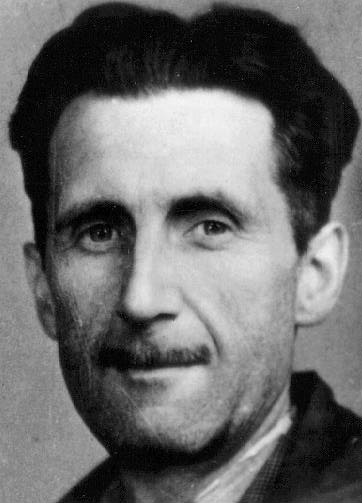
Orwell’s press card portrait, 1943
No one can question the dirtiness of international politics from 1870 onwards: it does not follow that it would have been a good thing to allow the German army to rule Europe. It is just possible that some rather sordid transactions are going on behind the scenes now, and that current propaganda “against Nazism” (cf. “against Prussian militarism”) will look pretty thin in 1970, but Europe will certainly be a better place if Hitler and his followers are removed from it. Between them these two books sum up our present predicament. Capitalism leads to dole queues, the scramble for markets, and war. Collectivism leads to concentration camps, leader worship, and war. There is no way out of this unless a planned economy can somehow be combined with the freedom of the intellect, which can only happen if the concept of right and wrong is restored to politics.
Both of these writers are aware of this, more or less; but since they can show no practicable way of bringing it about the combined effect of their books is a depressing one.
George Orwell, “The Road to Serfdom by F.A. Hayek / The Mirror of the Past by K. Zilliacus”, Observer, 1944-04-09.
May 25, 2019
February 26, 2019
Laissez-faire versus “Fairtrade”
In the Guardian, a sad tale of the fading bright hopes of the (relatively small number of) affluent westerners who passionately supported the “Fairtrade” movement:
When, in 2017, Sainsbury’s announced that it was planning to develop its own “fairly traded” mark, more than 100,000 people signed a petition condemning the move. Today, on the eve of Fairtrade Fortnight, the fact that most supermarkets have moved away from the standards developed by the Fairtrade Foundation is worrying.
While some grocery chains have sought the foundation’s stamp of approval, many have gone their own way. This means most consumers have little sense of which organisation is doing what to protect the wages and rights of developing world workers. Over the next two weeks, the foundation plans to focus its publicity efforts on cocoa farmers in west Africa and the way the Fairtrade mark can improve their lives.[…]
That is a sad situation. After the great financial crash of 2008, a commodity boom that lasted from 2013 to 2017 turned into a slump that has robbed farmers and developing world governments of vital cash. Just as they were managing to stabilise their finances and set aside money to invest, the world price tumbled and wiped out their profit. Fairtrade practices protect farmers from this sort of setback and allow them to plan for the future.
Of course they have their critics. These are most mostly from the US – people who favour unfettered markets and seek to undermine the Fairtrade ideal, saying it is a form of protectionism that dampens innovation and ultimately ruins farms.
Theirs is an almost religious adherence to the free market that discounts the gains in stability and security that Fairtrade provides, and the scope of the community premium to promote universal education and the rights of women.
But without large employers making strides to adopt the standardised and transparent Fairtrade practices put forward by the foundation, it will be left to consumers to drive the project forward.
At the Continental Telegraph, Tim Worstall responds:
The Guardian tells us that the Great White Hope of global trade, Fairtrade, isn’t in fact working. On the basis that no one seems to be doing very much of it. To which the answer is great – for the only fair trade is laissez faire.
This does not mean that Fairtrade should not have been tried – to insist upon that would be to breach our basic insistence upon the value of peeps just getting on with doing what they want, laissez faire itself. But the very value of that last is that we go try things out, see whether they work and if they don’t we stop doing them. If they do then great, we do more of them.
[…]
So, trying out Fairtrade, why not? Let’s go see how many other people feel the same way? In exactly the same way we find out whether people like Pet Rocks, skunk or Simon Cowell. Product gets put on the market we see whether it adds to human welfare or not. If people value it – and revealed preferences please, by actually buying it – at more than the use of those scarce resources in other uses then that’s adding to human welfare and long may it thrive. If it doesn’t, if it’s subtracting value from the human experience, then we’ll stop doing it as those trying go bust.
This is not an aberration of the system it is the system and it’s why laissez faire works. Peeps get to do whatever and we keep doing more of what works, less of what doesn’t.
Fairtrade? No, I never thought it was going to work as anything other than virtue signalling for Tarquin and Jocasta but that’s fine. Why shouldn’t Tarquin and Jocasta gain their jollies by virtue signalling? As it turns out, now that we’ve tried it, no one else gives a faeces*. So, we can stop. Except, obviously enough, for those specialist outlets like the Co Op where the odd can still gain their jollies. It being that very mark of a laissez faire, liberal, society that the jollies of the odd are still catered to in due proportion to the desire for them.
*From Gibbon, all the fun stuff’s in Latin.
October 1, 2017
Deirdre McCloskey on the rise of economic liberty
Samizdata‘s Johnathan Pearce linked to this Deirdre McCloskey article I hadn’t seen yet:
Since the rise during the late 1800s of socialism, New Liberalism, and Progressivism it has been conventional to scorn economic liberty as vulgar and optional — something only fat cats care about. But the original liberalism during the 1700s of Voltaire, Adam Smith, Tom Paine, and Mary Wollstonecraft recommended an economic liberty for rich and poor understood as not messing with other peoples’ stuff.
Indeed, economic liberty is the liberty about which most ordinary people care.
Adam Smith spoke of “the liberal plan of [social] equality, [economic] liberty, and [legal] justice.” It was a good idea, new in 1776. And in the next two centuries, the liberal idea proved to be astonishingly productive of good and rich people, formerly desperate and poor. Let’s not lose it.
Well into the 1800s most thinking people, such as Henry David Thoreau, were economic liberals. Thoreau around 1840 invented procedures for his father’s little factory making pencils, which elevated Thoreau and Son for a decade or so to the leading maker of pencils in America. He was a businessman as much as an environmentalist and civil disobeyer. When imports of high-quality pencils finally overtook the head start, Thoreau and Son graciously gave way, turning instead to making graphite for the printing of engravings.
That’s the economic liberal deal. You get to offer in the first act a betterment to customers, but you don’t get to arrange for protection later from competitors. After making your bundle in the first act, you suffer from competition in the second. Too bad.
In On Liberty (1859) the economist and philosopher John Stuart Mill declared that “society admits no right, either legal or moral, in the disappointed competitors to immunity from this kind of suffering; and feels called on to interfere only when means of success have been employed which it is contrary to the general interest to permit — namely, fraud or treachery, and force.” No protectionism. No economic nationalism. The customers, prominent among them the poor, are enabled in the first through third acts to buy better and cheaper pencils.
[…]
Indeed, economic liberty is the liberty about which most ordinary people care. True, liberty of speech, the press, assembly, petitioning the government, and voting for a new government are in the long run essential protections for all liberty, including the economic right to buy and sell. But the lofty liberties are cherished mainly by an educated minority. Most people — in the long run foolishly, true — don’t give a fig about liberty of speech, so long as they can open a shop when they want and drive to a job paying decent wages. A majority of Turks voted in favour of the rapid slide of Turkey after 2013 into neo-fascism under Erdoğan. Mussolini and Hitler won elections and were popular, while vigorously abridging liberties. Even a few communist governments have been elected — witness Venezuela under Chavez.
September 19, 2017
Even in a progressive educational bubble, this isn’t correct
Holly Nicholas shared this photo, which is said to be from an Alberta school:
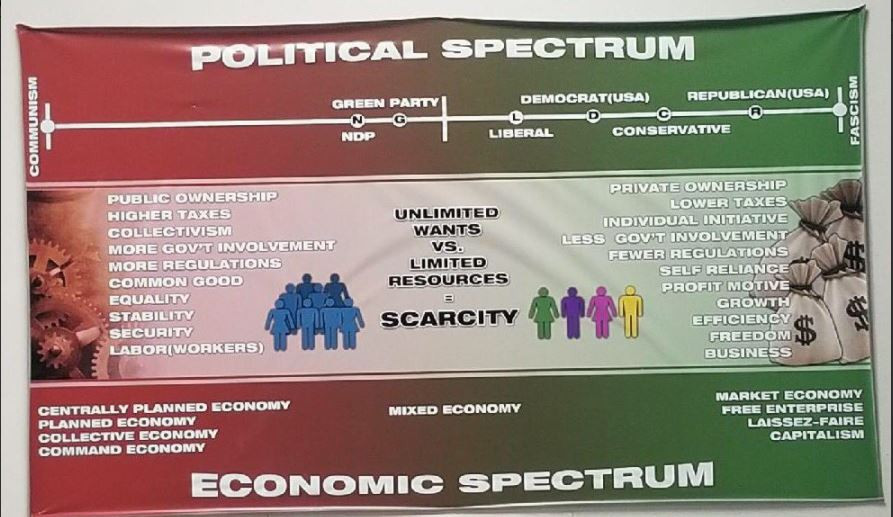
If this is indeed how public schools are presenting the political spectrum (and it’s unfortunately easy to believe that they do), the closest thing to a “centrist” party in Canada is the loony left Green Party … who somehow pip the NDP on the right. The far right end of the spectrum, Fascism, is graphically indicated to be all about “Market Economy, Free Enterprise, and Laissez-Faire Capitalism”, because as we all remember, Hitler and Mussolini were in no way fans of state intervention in the economy, right?
The graphic does, however, support certain shibboleths of the left including implying that libertarians (who are actually in favour of market economies, free enterprise, and laissez-faire capitalism) are in the same economic and political basket as actual fascists. Nice work, faceless agitprop graphic artist!
August 4, 2017
Harry Potter and the Economic Segregation of Muggles
Published on 3 Aug 2017
Harry Potter contains a ton of incredible lessons about society, authoritarianism, and the power of love and individualism in the face of people who would exclude others based on group identity. But something people don’t think about as much are some of the economic lessons that we can draw from a world segregated into wizards and muggles.
On this episode of Out of Frame, we take a look at what the world might look like if magic and non-magic people were actually allowed to trade and interact with each other without the Ministry of Magic obliviating and arresting people for it.
For a transcript of this episode and more engaging content, visit:
www.FEE.org
July 20, 2017
Deirdre McCloskey defines libertarianism as “Liberalism 1.0”
The introduction to her “Manifesto for a New American Liberalism, or How to Be a Humane Libertarian” [PDF] states:
I make the case for a new and humane American “libertarianism.”
Outside the United States libertarianism is still called plain “liberalism,” as in the usage of the president of France, Emmanuel Macron, with no “neo-” about it. That’s the L-word I’ll use here. The economist Daniel Klein calls it “Liberalism 1.0,” or, channeling the old C. S. Lewis book Mere Christianity on the minimum commitments of faith (1942-44, 1952), “mere Liberalism.” David Boaz of the Cato Institute wrote a lucid guide, Libertarianism — A Primer (1997), reshaped in 2015 as The Libertarian Mind. I wish David had called it The Liberal Mind.
In desperate summary for you Americans, Liberalism 1.0 is Democratic in social policy and Republican in economic policy and non-interventionist in foreign policy. It is in fact mainly against “policy,” which has to be performed, if there is to be a policy at all, through the government’s monopoly of violence. (To confirm this experimentally, try not paying your taxes; then try to escape from prison.) Liberals 1.0 believe that having little or no policy is a good policy.
That does not put the Liberals 1.0 anywhere along the conventional one-dimensional left-right line, stretching from a compelled right-conservative policy to a compelled left-”liberal” policy. The real liberals instead sit happily up on a second dimension, the non-policy apex of a triangle, so to speak, the base of which is the conventional axis of policy by violence. We Liberals 1.0 are neither conservatives nor socialists — both of whom believe, with the legal mind, as the liberal economist and political philosopher Friedrich Hayek put it in 1960, that “order [is] … the result of the continuous attention of authority.” Both conservatives and socialists, in other words, “lack the faith in the spontaneous forces of adjustment which makes the liberal accept changes without apprehension, even though he does not know how the necessary adaptations will be brought about.”
Liberals 1.0 don’t like violence. They are friends of the voluntary market order, as against the policy-heavy feudal order or bureaucratic order or military-industrial order. They are, as Hayek declared, “the party of life, the party that favors free growth and spontaneous evolution,” against the various parties of left and right which wish “to impose [by violence] upon the world a preconceived rational pattern.”
At root, then, Liberals 1.0 believe that people should not push other people around. As Boaz says at the outset of The Libertarian Mind, “In a sense, there have always been but two political philosophies: liberty and power.” Real, humane Liberals 1.0 […] believe that people should of course help and protect other people when we can. That is, humane liberals are very far from being against poor people. Nor are they ungenerous, or lacking in pity. Nor are they strictly pacifist, willing to surrender in the face of an invasion. But they believe that in achieving such goods as charity and security the polity should not turn carelessly to violence, at home or abroad, whether for leftish or rightish purposes, whether to help the poor or to police the world. We should depend chiefly on voluntary agreements, such as exchange-tested betterment, or treaties, or civil conversation, or the gift of grace, or a majority voting constrained by civil rights for the minority.
To use a surprising word, we liberals, whether plain 1.0 or humane, rely chiefly on a much-misunderstood “rhetoric,” despised by the hard men of the seventeenth century such as Bacon and Hobbes and Spinoza, but a practice anciently fitted to a democratic society. Liberalism is deeply rhetorical, the exploration (as Aristotle said) of the available means of non-violent persuasion. For example, it’s what I’m doing for you now. For you, understand, not to you. It’s a gift, not an imposition. (You’re welcome.)
June 21, 2017
June 8, 2017
Words & Numbers: Earning Profits is Your Social Responsibility
Published on 7 Jun 2017
“We tend to demonize people who make money – how dare they have more than us? But that negative reaction forgets the voluntary role we play in profit-making every day. This week in Words and Numbers, Antony Davies and James R. Harrigan discuss just how good it is to earn a profit, and the vital difference between that and forcing money from people.”


