Overly Sarcastic Productions
Published 31 Oct 2019Some monsters are undead creatures of the night. Some monsters are cosmic horror nightmare gods. Some monsters are existential personifications of dread and decay. But perhaps the greatest monster of all… is man.
Have a very spooky Halloween! And don’t forget the explicit moral of Jekyll and Hyde — that the greatest danger you’ll ever face comes from wealthy middle-aged white men who get away with their crimes because society refuses to believe they would ever do such horrible things. … Hm. Are we SURE this was written in 1886 …?
(Topic originally requested by patron Kyakan!)
MERCH LINKS: https://www.redbubble.com/people/OSPY…
OUR WEBSITE: https://www.OverlySarcasticProduction…
October 31, 2025
Halloween Special: Doctor Jekyll and Mister Hyde
October 13, 2025
Stephen Fry’s Odyssey weighed in the balance and found wanting
Bryan Mercadente received a copy of Stephen Fry’s latest foray into Greek mythology and not only is not impressed, he writes, “Every page wasted on Fry is a page stolen from the real thing. The copy my aunt has given me for my birthday is already skimmed with disgust and thrown into the dustbin: it is too disgusting for the charity shops.”
The Iliad and Odyssey are the founding works of our civilisation. They are poems of war, loss, exile, and return. The hero of The Odyssey is a liar, a man of cunning and cruelty, but also a survivor who longs for home. The Homeric poems have come to us out of the Bronze Age. They have survived the collapse of at least two civilisations, and will survive the collapse of our own. They survive because they are already perfect. The hexameters carry an austere music. Their formulaic epithets — “ῥοδοδάκτυλος Ἠώς“, “πόδας ὠκὺς Ἀχιλλεύς“, “δῖος Ὀδυσσεύς” — are the memory-tricks of a sung tradition, but they also give the poems a dignity that no one who reads them can ever forget. Like The Iliad, The Odyssey was not written to be read in comfort with a cup of tea. It was composed to be chanted in smoky halls to men who might be dead tomorrow.
Stephen Fry knows none of this. Or if he knows it, he does not care. His Odyssey is Homer without the difficulty. It is Homer stripped of his grandeur, reduced to banter and “relatable” anecdotes. The Observer praised it for bringing “contemporary relevance” to the myths. That line is damning enough. Homer does not need contemporary relevance. A book that has spoken to audiences across three thousand years already possesses the only relevance that matters. To make Homer relevant is to make him trivial.
The Guardian called the book “relatable and full of humour“. Again, the praise condemns. Relatable? Homer is not relatable. The world he describes is harsh and alien. His heroes live by honour and die by the sword. They weep like children and sacrifice to gods who may or may not answer. That strangeness is the point. It is what makes Homer worth reading. To make him “relatable” is to gut him of meaning.
The Irish Independent calls Fry “A born storyteller“. This blurb, like the others, is the language of people who cannot read. No serious critic would praise a reteller of Homer as “a born storyteller”, as if the original poet were not the greatest storyteller of them all. These blurbs are not criticism. They are advertising slogans. And they work. The book is a bestseller.
Why, then, is Fry’s book a bestseller? Not because of merit. It sells because of Stephen Fry himself. For thirty years, he has been cultivated as a “national treasure”. He is the ideal leftist intellectual: clever enough to appear learned, shallow enough never to disturb. He quotes Wilde, sprinkles in Latin tags, and sprinkles them badly. His claque tells us that he is bipolar, gay, witty, and charming. He is on panel shows, chat shows, and literary festivals. He is always agreeable, always moderate, and always applauded.
Fry has built a career on the fact that the English middle classes like to feel cultured without effort. They want Plato without philosophy, Shakespeare without metre, Wagner without subversion, Homer without Greek. They want to be reassured that the classics are not difficult or dangerous, but fun. Fry gives them what they want. He domesticates the wild. He reduces epic to anecdote. He packages civilisation as entertainment.
It is not enough to call this dumbing down. It is worse. Dumbing down implies a reduction in complexity. What Fry does is not simplification but falsification. The Odyssey is not a sequence of funny stories about gods and monsters. It is about endurance and the fragility of human life under the indifference of the divine. To make it “funny” is to destroy it. It is as if someone rewrote the Inferno as a travel blog or recast the Iliad as a football commentary. The whole point of the work is lost.
Popularity, however, is not a defence. It is an indictment. Books that sell by the million are almost always worthless. They are consumed because they flatter the prejudices of the public. They make readers feel clever without having to be clever. They make them feel cultured without culture. They are the literary equivalent of processed food: cheap, sweet, addictive, fattening.
What, then, is the harm? Why not let people have their Fry and be happy? So what if his writing is as inconsequential as his suicide attempts? The harm is that time is short. Every hour spent on Stephen Fry is an hour not spent on Homer. It is an hour subtracted from Gibbon, Johnson, or Shakespeare. It is an hour less of life. The opportunity cost is everything. Bad books are not neutral. They are parasites. They feed on the hours that might have been spent on good ones.
August 25, 2025
The Sharpest Pen of the Edwardian Age | Who Was Saki?
Vault of Lost Tales
Published 5 Apr 2025Delve into the razor-sharp world of Saki in this engaging author talk exploring his chillingly clever short story, “The Open Window”. Discover the man behind the pen name — H.H. Munro — and uncover how his biting satire, Edwardian upbringing, and darkly humorous worldview shaped this unforgettable tale. Perfect for fans of classic literature, Oscar Wilde-style wit, and unsettling plot twists, this literary deep dive offers historical context, thematic insights, and just enough spookiness to keep you on edge. Whether you’re a student, a short story lover, or just curious about the mind that created one of literature’s most deviously satisfying endings, this talk is your open invitation.
“Saki”, the wickedly sharp pen name of Hector Hugh Munro, masked a man whose wit could slice through Edwardian society like a silver butter knife through scandal.
Born in 1870 in British Burma and raised in England, Munro brought an acerbic wit to the drawing rooms of empire, crafting tales that balanced dry humor, social critique, and sudden, often shocking twists. Writing under the name “Saki”, he produced short stories that mocked the pretensions of the upper class, exposed the darkness beneath genteel facades, and made readers laugh — sometimes uncomfortably. His life, marked by loss, repressed identity, and service in World War I, ended tragically in 1916 on the battlefield, but his stories continue to delight and disturb to this day.
(more…)
August 18, 2025
QotD: Dostoevsky’s Demons can be read as “one long, savage parody of Fathers and Sons“
To understand what happens next [in Dostoevsky’s Demons], it helps to have read some Turgenev. His most famous work, Fathers and Sons, is of a piece with the most lurid boomer fantasies. The basic plot is that there are some genteel Russian liberals, good New York Times readers, people with all the right views. Their kids come back from college and are espousing all this weird stuff: stuff about white fragility and transgenderism and boycotting Israel, stuff that makes their nice liberal parents extremely uncomfortable. But it’s okay, you see? The kids magnanimously realize that their parents were once cool revolutionaries too, and the parents make peace with the fact that the kids are just further out ahead than they are, and everybody feels good about themselves because if the kids have seen far, it’s only by standing on the shoulders of giants. The important thing to understand is that everything about this plot is identity validation wish-fulfillment for the boomer liberal parents (like Turgenev himself). It’s the political equivalent of that YouTube genre where Gen Z Afro-American kids rock out to Phil Collins.
The macro-structure of Demons mirrors this so closely, you can almost read the book as one long, savage parody of Fathers and Sons.1 The sunny opening section is a satire of the boomer liberals, and the big vibe shift part way in is their kids coming back from college. But that’s where things go off the rails. In this book, the next generation shares their parents’ anti-religious and anti-monarchist attitudes, but unlike in Fathers and Sons, the kids in Demons are disgusted by the hypocrisy and cowardice of their genteel liberal parents, and eager to plunge Russia into a hyper-totalitarian nightmare. The exact contours of that nightmare are something they frequently argue about and change their minds over, but they can all agree that it will need to begin with an enormous mountain of skulls, and that their town is as good a place as any to start.
Dostoevsky’s other works put individuals front and center, his stories have unbelievably rich characterization (Nietzsche once said that Dostoevsky was the greatest psychologist to ever live), because for Dostoevsky the very highest stakes, the most important questions in the world, were about the damnation or salvation of individual souls. But Demons is different: here the characters all blur together, their names are disgorged to you in a never-ending torrent, and only a few of them are distinctive in any way.2 How could Dostoevsky think these people don’t matter? It’s because they aren’t real people anymore. It’s because they’re possessed. Their brains have been scooped out and all you can see in their eyes is a writhing mass of worms. Their ideas and ideologies have hollowed them out and are wearing their skins as suits.
But what if the ideas don’t matter either? It’s easy to interpret the second half of Demons as a novel of ideas, but it really isn’t. Your first clue is that the ideas are just so goofy. There’s one guy who thinks that by killing himself he will become God (don’t ask, it’s Dostoevsky, man). Another has written a book with ten chapters, explaining how “Beginning with the principle of unlimited freedom I arrive at unlimited despotism”, and proposing a method of brainwashing for reducing ninety percent of humanity to a mindless “herd”. Yet another thinks that everything can be solved by killing one hundred million people, but laments that even with very efficient methods of execution this will take at least thirty years.3 My own favorite might be the guy who refuses to explain what his system is, but just smugly declares that since everybody is going to end up following it eventually, it’s pointless for him to explain it.
John Psmith, “REVIEW: Demons, by Fyodor Dostoevsky”, Mr. and Mrs. Psmith’s Bookshelf, 2023-07-17.
- Further evidence for this reading: the book contains a character, the great writer “Karmazinov”, who is a straightforward expy of Turgenev himself.
- That said if you do need to keep track of them, this alignment chart made by some genius on the internet is a pretty handy guide: link.
- This one probably seems less funny after the 20th century than it did when Dostoevsky wrote it.
August 8, 2025
The Rise and Fall of Books in Ancient Rome
toldinstone
Published 21 Mar 2025This video explores how books were published and distributed in ancient Rome.
Chapters
0:00 Introduction
0:30 Literacy and texts
1:19 Libraries
2:09 Scrolls and codices
3:13 Bookstores and booksellers
4:07 Helix
5:13 Publication
6:17 Luxury and vintage books
7:14 Bestsellers
8:10 The end of the book trade
July 23, 2025
The Most Bitter Man In All Of Ancient Rome: Meet JUVENAL
MoAn Inc.
Published 27 Feb 2025
(more…)
June 24, 2025
Fandom Has Always Been UNHINGED
Jill Bearup
Published 23 Jun 2025Listen, nobody asked for a history of fanfiction but here we are regardless. From Helen of Troy fix-it fic to Holmes fans unsubscribing en masse when the detective was killed in The Final Problem, fandom has always been this chaotic, and fanfiction has always been with us. In one form or another.
00:00 Did you ask for this? Nah.
01:20 Ancient authors ripping off other ancient authors
03:06 Virgil was a Homer fanboy
04:10 Dante was a Virgil fanboy
05:18 Don Quixote and the Case of the Unauthorised Sequel
08:01 The Statute of Anne
12:35 Gulliver’s Travels NSFW fanart
14:40 Geniuses and Originality
16:51 The Berne Convention
17:20 Character Vibes are not Copyrightable
20:46 The First Modern Fandoms (were Genuinely Unhinged)Link to Der Spiegel article on copyright and innovation: https://www.spiegel.de/international/…
May 12, 2025
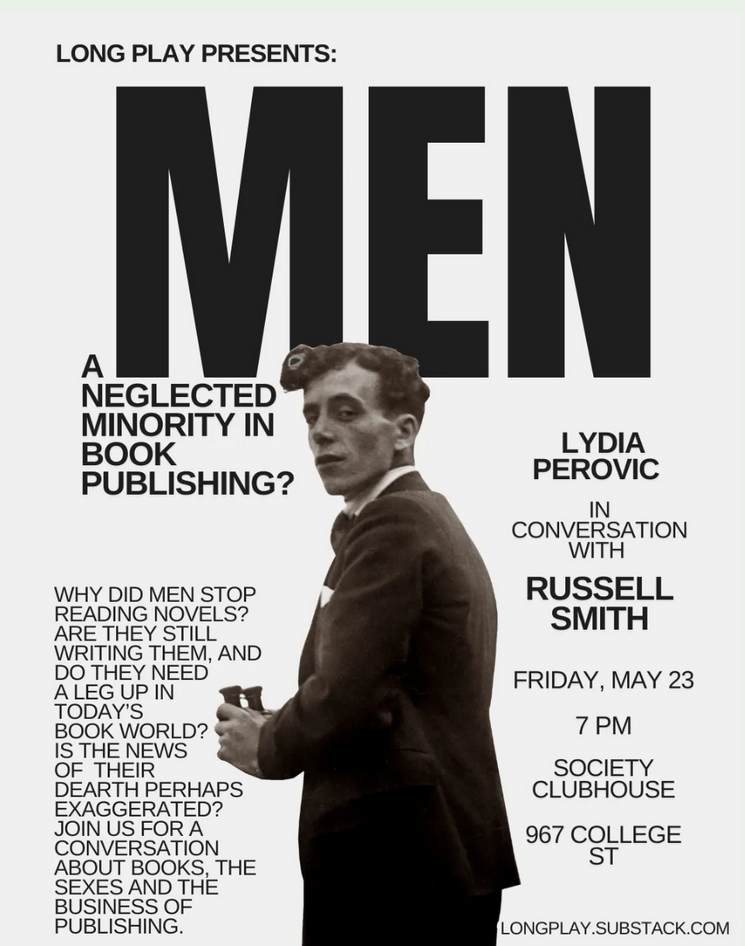
Is modern fiction in any way intended to be read by a male audience?
I belong to several genre-specific groups on various social media platforms, most of which appear to be disproportionally female in membership, and I read very little new fiction of any sort these days, partly for diminished interest and largely from diminished disposable income. I’ve often seen the assertion that men no longer read much fiction, but is it actually true?
You can see here some of the challenges involved in measuring reading habits. Are we talking reading books or purchasing books? Does buying correlate to reading or are women better gift givers? What about those hugely popular 20-part, 60-page-per-instalment romance series that might ratchet up purchases by women — anything like that in the fiction market for men? Should we base assumptions about readership of literary fiction on data about readership of general fiction, as many of the articles I’ve read do?
All we can safely say is that it does seem men read somewhat less fiction than women; they also read fewer books of any kind. As a person in the book industry, I wish that weren’t so, but it may not be a cultural calamity.
The most interesting article I came across in last night’s binge was published in 2009 by the University of Saskatchewan’s Virginia Wilson in Evidence Based Library and Information Practice. She undertook a small study of boys aged four through twelve, interviewing them about their reading habits. Her theoretical perspective was that if anyone was ever going to understand the reading habits of boys, they needed to recognize that the experts were the boys themselves. She quizzed forty-three of them about their book collections, what they liked and didn’t like, and their motives for reading.
Each of the boys had a personal collection of books. These ranged from eight to 398 volumes, with a median of 98. All but one of the boys had fiction in his collection. The most prominent genres were fantasy, science fiction, sports stories, and humour. The boys had no time for love stories, books about groups of girls, and such classic children’s fiction as The Adventures of Robin Hood.
Asked about their favourite books, most of the boys pointed to a non-fiction title: joke books, magic books, sports books, survival guides, science books, references, atlases, dinosaur books.
The boys also read a good deal of non-book material: comics, manga, magazines, sticker books, puzzle books, and catalogues. A number mentioned reading video game manuals, both to learn more about the games, but also to heighten their enjoyment of the narratives within the games.
The manuals were part of a bent toward pragmatic reading, something they found useful as much as pleasurable. The boys often read to support another hobby — Pokémon, for instance. They also appreciated non-linear texts and plenty of illustrations.
Interestingly, many of the boys tended to discount their own reading. They often described the informational stuff they liked—those video game manuals or computer guides or research materials for science projects—as “not really being reading”. Serious reading, in their minds, involved novels and conventional non-fiction books.
Wilson’s conclusion was that at least part of the “boys and reading problem” might come down to what counts as reading. Informational nonfiction, comic books, computer magazines, graphic novels, and role-playing game manuals were “not necessarily privileged by libraries, schools, or even by the boys themselves”.
Of course, as Wilson notes, one shouldn’t generalize too much from a small qualitative study involving forty-three boys. There’s nothing definitive to be learned here about Trump or contemporary masculinity (although I’ve read several lengthy screeds based on less).
Wilson’s paper simply reminds us that reading is complicated, and most of the available research on reading habits isn’t. Survey respondents are typically asked if they read books for leisure, or if they’ve read a book in the last year. There are many reasons to read other than for leisure. There are many things to read other than books. And not all books are equal.
I haven’t seen a study that tracks if men spend more minutes per day reading sentences than women. Or one that drills down to find who reads the most newspapers, magazines, websites, newsletters, contracts, annual reports, research papers, instruction manuals, catalogues, and cereal boxes. Each of those formats is as potentially edifying (if not as much fun) as Morning Glory Milking Farm: A Monster Bait Romance, with its 47,570 enthusiastic ratings on Goodreads.
I read so many concerns for and condemnations of contemporary males last night that it came as a surprise to learn that our most reliable measure of reading competence, the Program for the International Assessment of Adult Competencies, finds no real difference in literacy of men and women aged 16 to 64 in the US or Canada. We should all revisit that baseline before assigning responsibility for the state of civilization to whoever is or isn’t reading or buying contemporary fiction. (PIAAC did find that while Canadian literacy scores have been stable, US scores have slipped 5 percent since Trump was first elected. Make of that what you will.)
Does the men-and-fiction problem exist? I think yes, and my sense is that it’s one of both supply (what’s getting published) and demand (what men will read). I thought I’d have more than that to say. This is my kind of issue — the whole point of SHuSH is ill-considered opinion drawn from shaky evidence on a weekly timetable — but I can’t compete with what I’m reading, so I’m backing off for now.
I certainly find myself reading almost nothing that has been published recently with a few exceptions for well-researched and well-written histories and military histories. My preferred genre reading got taken over by the “jam the narrative into every story” crowd a few decades back, so I stopped buying SF and fantasy titles except those from authors I’d already read.
May 4, 2025
Everyday Life in the Roman Empire – Culture and Literacy in the Roman Empire
seangabb
Published 28 Dec 2024This is the eighth video in my series on Everyday Life in the Roman Empire. In this, I wander about at the beginning, with talk of poetry and philosophy, before realising that the real theme is the extent of ancient literacy. The whole of the remainder is given over to this, and how it enabled a literary civilisation wholly different from our own.
Introduction – 00:00:00
Our perceptions of culture in the Ancient world – 00:01:40
Virgil – 00:03:45
Catullus – 00:05:17
Philosophy in Rome – 00:06:23
The Romans and Stoicism – 00:08:40
The Romans and Epicureanism – 00:10:27
Pretty silver things from Roman Britain – 00:16:25
Broad-based cultural participation in the Ancient World? – 00:19:26
The Ancient World: a largely illiterate civilisation (no spectacles) – 00:28:27
The Ancient World: a largely illiterate civilisation (expensive education, expensive books) – 00:35:40
The Ancient World: a largely illiterate civilisation (economic imperatives) – 00:42:35
The Ancient World: a largely illiterate civilisation (expensive writing materials) – 00:44:44
The Ancient World: a largely illiterate civilisation (difficulties of reading) – 00:49:16
The Ancient memory – 00:53:14
The primacy of oral communication – 00:55:23
The Ancient World: a largely illiterate civilisation (the Second Sophistic and linguistic change) – 00:59:53
Bibliography – 01:08:10
(more…)
April 18, 2025
QotD: Literature in (and after) the late Western Roman Empire
… But surely the barbarians burned all of the libraries, right? Or the church, bent on creating a “Christian dark age” tore up all of the books?
Well, no.
Here I think the problem is the baseline we assess this period against. Most people are generally aware that the Greeks and Romans wrote a lot of things and that we have relatively few of them. Even if we confine ourselves only to very successful, famous Greek and Roman literature, we still only have perhaps a low single-digit percentage of it, possibly only a fraction of a percent of it. In our post-printing-press and now post-internet world, famous works of literature do not simply vanish, generally and it is intuitive to assume that all of these lost works must have been the result of some catastrophe or intentional sabotage.
I am regularly, for instance, asked how I feel about the burning of the Library of Alexandria. The answer is … not very much. The library burned more than once and by the time it did it was no longer the epicenter of learning in the Mediterranean world. Instead, the library slowly declined as it became less unique because other libraries amassed considerable collections. There was no great, tragic moment where countless works were all lost in an instant. That’s not how the chain of transmission breaks. Because a break in the chain of transmission requires no catastrophe – it merely requires neglect.
The literature of the Greeks and Romans (and the rest of the ancient iron age Mediterranean) were largely written on papyrus paper, arranged into scrolls. The problem here is that papyrus is quite vulnerable to moisture and decay; in the prevailing conditions in much of Europe papyrus might only last a few decades. Ancient papyri really only survive to the present in areas of hard desert (like Egypt, conveniently), but even in antiquity, books written on papyrus would have been constantly wearing out and needing to be replaced.
Consequently, it didn’t require anyone going out and destroying books to cause a break in the chain of transmission: all that needed to happen was for the copying to stop, even fairly briefly. Fortunately for everyone, Late Antiquity was bringing with it a new writing material, parchment, and a new way of putting it together, the codex or book. The transition from papyrus to parchment begins in the fourth century, but some books are still being produced in papyrus in the 7th century, particularly in the Eastern Mediterranean. Whereas papyrus is a paper made of papyrus stalks pressed together, parchment is essentially a form of leather, cleaned, soaked in calcium lye and scraped very thin. The good news is that as a result, parchment lasts – I have read without difficulty from 1200 year old books written on parchment (via microfilm) and paged through 600 year old books with my own hands. Because making it requires animal hide, parchment was extremely expensive (and still is) but its durability is a huge boon to us because it means that works that got copied onto parchment during the early middle ages often survive on that parchment down to the present.
But of course that means that the moment of technological transition from short-lived papyrus to long-lasting parchment was always going to be the moment of loss in transition: works that made it to parchment would largely survive to the present, while works that were not copied in that fairly narrow window (occupying Late Antiquity and the Early Middle Ages) would be permanently lost. And that copying was no simple thing: it was expensive and slow. The materials were expensive, but producing a book also required highly trained scribes (often these were monks) who would hand copy, letter by letter, the text for hundreds of pages. And, for reasons we’ll talk about later in this series, the resources available for this kind of copying would hit an all-time-low during the period from the fifth to the seventh centuries – this was expensive work for poor societies to engage in.
And here it is worth thus stopping to note how exceptional a moment of preservation this period is. The literary tradition of Mediterranean antiquity represents the oldest literary tradition to survive in an unbroken line of transmission to the present (alongside Chinese literature). The literary traditions of the Bronze Age (c. 3000-1200 BC and the period directly before antiquity broadly construed) were all lost and had to be rediscovered, with stone and clay tablets recovered archaeologically and written languages reconstructed. The Greeks and Romans certainly made little effort to preserve the literature of those who went before them!
In that context, what is actually historically remarkable here is not that the people of Late Antiquity and the Early Middle Ages lost some books – books had always been being lost, since writing began – but that they saved some books. Never before had a literary tradition been saved in this way. Of course these early copyists didn’t always copy what we might like. Unsurprisingly, Christian monks copying books tended to copy a lot more religious texts (both scriptures but also patristic texts). Moreover, works that were seen as important for teaching good Latin (Cicero, Vergil, etc.) tended to get copied more as well, though this is nothing new; the role of the Iliad and the Odyssey in teaching Greek is probably why their manuscript traditions are so incredibly robust. In any event, far from destroying the literature of classical antiquity, it was the medieval Church itself that was the single institution most engaged in the preservation of it.
At the same time, writers in the fifth, sixth and seventh centuries did not stop writing (or stop reading). Much of the literature of this period was religious in nature, but that is no reason to dismiss it (far more of the literature of the Classical world was religious in nature than you likely think, by the by). St. Augustine of Hippo was writing during the fifth century; indeed his The City of God, one of the foundational works of Christian literature, was written in response to the news of the sack of Rome in 410. Isidore of Seville (560-636) was famous for his Etymologies, an encyclopedia of sorts which would form the foundation for much of medieval learning and which in its summaries preserves for us quite a lot of classical bits and bobs which would have otherwise been lost; he also invented the period, comma and colon. Pope Gregory I (540-604) was also a prolific writer, writing hundreds of letters, a collection of four books of dialogues, a life of St. Benedict, a book on the role of bishops, a commentary on the Book of Job and so on. The Rule of St. Benedict, since we’ve brought the fellow up, written in 516 established the foundation for western monasticism.
And while we’ve mostly left the East off for this post, we should also note that writing hardly stopped there. Near to my heart, the emperor Maurice (r. 582-602) wrote the Strategikon, an important and quite informative manual of war which presents, among other things, a fairly sophisticated vision of combined arms warfare. Roman law also survived in tremendous quantities; the emperor Theodosius II (r. 402-450) commissioned the creation of a streamlined law code compiling all of the disparate Roman laws into the Codex Theodosianus, issued in 439. Interestingly, Alaric II (r. 457-507), king of the Visigoths in much of post-Roman Spain would reissue the code as past of the law for his own kingdom in 506 as part of the Breviary of Alaric. Meanwhile, back at Constantinople, Justinian I (r. 527-565) commissioned an even more massive collection of laws, the Corpus Iuris Civilis, issued from 529 to 534 in four parts; a colossal achievement in legal scholarship, it is almost impossible to overstate how important the Corpus Iuris Civilis is for our knowledge of Roman law.
And it is not hard again to see how these sorts of literary projects represented a continuing legacy of Roman culture too (particularly the Roman culture of the third and fourth century), concerned with Roman law, Roman learning and the Roman religion, Christianity. And so when it comes to culture and literature, it seems that the change-and-continuity knight holds the field – there is quite a lot of evidence for the survival of elements of Roman culture in post-Roman western Europe, from language, to religion, to artwork and literature. Now we haven’t talked about social and economic structures (that’s part III), so one might argue we haven’t quite covered all of “culture” just yet, and it is necessary to note that this continuity was sometimes uneven. Nevertheless, the fall of Rome can hardly be said to have been the end of Roman culture.
Bret Devereaux, “Collections: Rome: Decline and Fall? Part I: Words”, A Collection of Unmitigated Pedantry, 2022-01-14.

December 31, 2024
QotD: Pre-revolution Russia satirized by Dostoevsky
The opening of Demons tries to fool you into thinking it’s a comedy of manners about liberal, cosmopolitan Russian aristocrats in the 1840s. The vibe is that of a Jane Austen novel, but hidden within the comforting shell of a society tale, there’s something dark and spiky. Dostoevsky pokes fun at his characters in ways that translate alarming well into 2020s America. Everybody wants to #DefundTheOkhrana and free the serfs, but is terrified that the serfs might move in next door. Characters move to Brookl … I mean to St. Petersburg to start a left-wing magazine and promptly get canceled by other leftists for it. Academics endlessly posture as the #resistance to a tyrannical sovereign (who is unaware of their existence), and try to get exiled so they can cash in on that sweet exile clout. There are polycules.1
As the book unfolds, the satire gets more and more brutal. The real Dostoevsky knew this scene well — remember he spent his early years as a St. Petersburg hipster literary magazine guy himself — and he roasts it with exquisite savagery. As a friend who read the book with me put it: the men are fatuous, deluded about their importance, lazy, their liberal politics a mere extension of their narcissism. The woman are bitchy, incurious about the world except as far as it’s relevant to their status-chasing, viewing everyone and everything instrumentally. Nobody has any actual beliefs, and everybody is motivated solely by pretension and by the desire to sneer at their country.
But this is no conservative apologia for the system these people are rebelling against either, Dostoevsky’s poison pen is omnidirectional. Many right-wing satirists are good at showing us the debased preening and backbiting, like crabs in a bucket, that surplus elites fall into when there’s a vacuum of authority. But Dostoevsky admits what too many conservatives won’t, that the libs can only do this stuff because the society they despise is actually everything that they say it is: rotting from the inside, unjust, corrupt, and worst of all ridiculous. Thus he introduces representatives of the old order, like the conceited and slow-witted general who constantly misses the point and gets offended by imagined slights. Or like the governor of the podunk town where the action takes place, who instead of addressing the various looming disasters, sublimates his anxiety over them into constructing little cardboard models.2 If there’s a vacuum of authority, it’s because men like these are undeserving of it, failing to exercise it, allowing it to slip through their fingers.
All of this is very fun,3 and yet not exactly what I expect from a Dostoevsky novel. It’s a little … frivolous? Where are the agonizingly complex psychological portraits, the weighty metaphysical debates, the surreal stroboscopic fever-dreams culminating in murder, the 3am vodka-fueled conversations about damnation? Don’t worry, it’s coming, he’s just lulling you into a false sense of security. After a few hundred pages a thunderbolt falls, the book takes a screaming swerve into darkness, and you realize that the whole first third of this novel is like the scenes at the beginning of a horror movie where everybody is walking around in the daylight, acting like stuff is normal and ignoring the ever-growing threat around them.
John Psmith, “REVIEW: Demons, by Fyodor Dostoevsky”, Mr. and Mrs. Psmith’s Bookshelf, 2023-07-17.
1. In an incredible bit of translation-enabled nominative determinism, the main cuckold is a character named Virginsky. I kept waiting for a “Chadsky” to show up, but alas he never did.
2. Look, the fact that he’s sitting there painting minis while the world burns makes the guy undeniably relatable. If you transported him to the present day he would obviously be an autistic gamer, and some of my best friends, etc., etc. Nevertheless, though, he should not be the governor.
3. For some reason, there are people who are surprised that Demons is funny. I don’t know why they’re surprised, Dostoevsky is frequently funny. The Brothers Karamazov is hilarious!
November 26, 2024
Orwell is more relevant now than at any time since his death
I’m delighted to find that Andrew Doyle shares my preference for Orwell the essayist over Orwell the novelist:
It is not without justification that Animal Farm (1945) and Nineteen Eighty-Four (1949) have become the keystones of George Orwell’s legacy. Personally, I’ve always favoured his essays, more often quoted than read in full. I recently wrote an article about his essays for the Washington Post, focusing on their relevance to today’s febrile political climate. You can read the article here. I would draw particular attention to the multitude of comments from left-wing readers who are apparently outraged at my argument (actually, Orwell’s argument) that authoritarianism is not specific to any one political tribe. They seem oddly determined to prove the point.
Orwell is unrivalled on the topic of the human instinct for oppressive behaviour, but his essays are far more wide-ranging than that. In these little masterworks, one senses a great thinker testing his own theses, forever fluctuating, refining his views in the very act of writing. The essays span the last two decades of his life, offering us the most direct possible insight into this unique mind.
[…]
I find Orwell’s disquisitions on literature to be among his most rewarding. “All art is propaganda”, he declares in his extended piece on Charles Dickens (1940) [link]. This conviction, flawed as is it, accounts for his determination to focus less on Dickens’s literary merits and more on his class consciousness, which is found wanting. Even better is Orwell’s rebuttal to Tolstoy’s strangely literal-minded reading of Shakespeare (1947’s “Lear, Tolstoy and the Fool” [link]), which is so rhetorically deft that it seems to settle the matter for good.
Another impressive essay, “Inside the Whale” (1940) [link], opens with a glowing assessment of Henry Miller’s Tropic of Cancer (1935) but soon broadens its range to cover many contemporary novelists and their approach to social commentary. The title is a reference to Miller’s remarks on the Biblical tale of Jonah, suggesting that life inside the whale has much to recommend it. Orwell puts it this way:
There you are, in the dark, cushioned space that exactly fits you, with yards of blubber between yourself and reality, able to keep up an attitude of the completest indifference, no matter what happens.
Orwell invites us to imagine that the whale is transparent, and so writers of Miller’s ilk may snuggle contentedly within, observing without interacting, recording snapshots of the world as it bounces by. This kind of inaction is anathema to Orwell, whose every written word seems to be driving towards the enactment of social change.
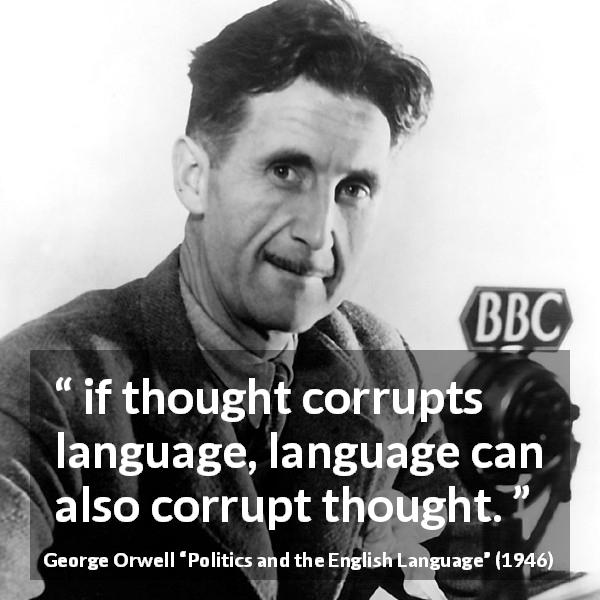
Orwell’s essays often serve as a cudgel to batter his detractors. He dislikes homosexuals, or those “fashionable pansies” who lack the masculine vigour to take up arms in defence of their country. He displays a similar lack of patience for the imperialistic middle-class “Blimps” and the anti-patriotic left-wing intelligentsia, or indeed anyone who adheres slavishly to any given political ideology. His work bears much of the stamp of the old left; that mix of social conservatism and economic leftism that we see most powerfully expressed in his 1941 essay “The Lion and the Unicorn” [link]. Bad writing is also a recurring bugbear; Orwell’s loathing of cliché and “ready-made metaphors” is one of the reasons his own prose style is so effervescent.
[…]
When Orwell pessimistically refers to “the remaining years of free speech”, one cannot help but be reminded of the increasingly authoritarian tendencies of today’s British government. He expresses irritation that more writers are not wielding their pens in the service of improving society. His own work, by contrast, is what he would term “constructive”, profoundly moral, and purposefully crafted in the hope of actuating real-world change. While other writers resigned themselves to a life inside the whale, Orwell was determined to cut his way out.
September 20, 2024
QotD: The Matrix, Harry Potter and “The One Pop Culture Thing”
Part of the appeal of Harry Potter must be that can somehow be intellectualized, though — at least, if the number of people incorporating it, in all apparent seriousness, into college classes can be believed. Here again, I’m not talking the English Department, which might have a legitimate reason — to study the narrative technique or whatever (for certain stretched-farther-than-Trigglypuff’s-sweatpants values of “legitimate”, anyway). I mean classes like “PHIL 101: Harry Potter and Philosophy”, which started showing up first in goofy California colleges, then all over the damn place, somewhere around 2002.
That certainly seems to be the appeal of The Matrix, and indeed The Matrix stopped being The One Pop Culture Thing very quickly, I hypothesize, because it made “intellectualizing” it too easy. The Matrix is pretty much just Jean Baudrillard: The Movie, and while that’s fun and even useful — Baudrillard did have a point, despite it all — it’s just too clever … by which I mean, The Matrix did too much of the heavy lifting, so that you don’t get too many Very Clever Persyn points for noting that we’re all, just, like, simulations in other people’s minds, dude. Descartes can go fuck himself; Keanu Reeves has solved the mind-body problem with kung fu.
Also, Baudrillard-lite is everywhere now. We’re all Postmodernists, in the same way we’re all Marxists, so even the kids who slept through most of their one required Humanities course has at least vaguely heard of this stuff. A show like True Detective, on the other hand, hearkens back to much older philosophy — as tiresome as the wannabe-Foucaults were back in the late 1980s, as a culture we’ve pretty much forgotten about them, so the brooding wannabe existentialist douchebag seems new now. I just googled up “best true detective quotes”. Here’s a small sampling:
This is a world where nothing is solved. You know, someone once told me time is a flat circle. Everything we’ve ever done or will do, we’re gonna do over and over and over again.
Also:
… to realize that all your life, all your love, all your hate, all your memory, all your pain, it was all the same thing. It was all the same dream you had inside a locked room — a dream about being a person. And like a lot of dreams, there’s a monster at the end of it.
That “flat circle” thing is a direct quote from Schopenhauer, I’m pretty sure, and the idea of “eternal recurrence” came from Vedic philosophy via him to Nietzsche. Here, for instance, the Manly Mustache Man summarizes the plot of True Detective, season 1:
What, if some day or night a demon were to steal after you into your loneliest loneliness and say to you: “This life as you now live it and have lived it, you will have to live once more and innumerable times more; and there will be nothing new in it, but every pain and every joy and every thought and sigh and everything unutterably small or great in your life will have to return to you, all in the same succession and sequence — even this spider and this moonlight between the trees, and even this moment and I myself. The eternal hourglass of existence is turned upside down again and again, and you with it, speck of dust!”
Would you not throw yourself down and gnash your teeth and curse the demon who spoke thus? Or have you once experienced a tremendous moment when you would have answered him: “You are a god and never have I heard anything more divine.” If this thought gained possession of you, it would change you as you are or perhaps crush you. The question in each and every thing, “Do you desire this once more and innumerable times more?” would lie upon your actions as the greatest weight. Or how well disposed would you have to become to yourself and to life?
Here again, I don’t blame the average HBO viewer for having their minds blown by this (or at least pretending to), but people with PhDs should damn well know better. This is existentialism for dummies, but since they spent most of their off hours in grad school reading Harry Potter …
Severian, “The One Pop Culture Thing”, Rotten Chestnuts, 2021-09-16.
July 13, 2024
“Canada has disclosure issues”
The recent revelations about Nobel Prize winner Alice Munro’s family have certainly roiled the turgid waters of Canada’s tiny literati community, but was the scandal actually all that well hidden beforehand?

Alice Munro accepting the 2006 Edward MacDowell Medal, 13 August 2006.
Screenshot from a video of the event via Wikimedia Commons.
The Toronto Star ran two articles last weekend revealing that Andrea Skinner, third and youngest daughter of Nobel-prize-winning author Alice Munro, was sexually assaulted as a nine-year-old by her stepfather, Gerald Fremlin, Alice’s second husband.
The assaults occurred in the 1970s. Alice learned of them in 1992 when Andrea, then twenty-five, wrote her a letter detailing the abuse. After briefly leaving Fremlin, Alice returned to him. Andrea, feeling her mother had chosen her abuser over her, eventually cut ties with Alice and went to the police. Fremlin was convicted of indecent assault in 2005.
I’m not going to dwell on the abuse. It’s all here, and it’s distressing to read. One can only hope that recognition of what she suffered as a child and the pain she’s carried throughout her life brings some solace to Andrea.
I wish that had been my first reaction to the stories, but I was too long a journalist. My first thought was sordid. Good on the Star for getting the scoop.
My second thought was, how was this not reported earlier? It’s obviously a big story, and it all played out in open court. It’s surprising that it didn’t make headlines.
In yesterday’s Star, the always interesting Stephen Marche put the blame on “a specifically Canadian conspiracy of silence” amounting to “a national pathology”. He recalls that CBC radio star Peter Gzowski’s dirty laundry wasn’t aired until he’d passed; that CBC radio star Jian Ghomeshi’s outrageous behavior was not immediately called out; that author Joseph Boyden and singer Buffy Sainte-Marie both passed as Indigenous for a long time (Boyden does, in fact, have Indigenous blood). “Everybody knew but nobody knew,” Marche writes of each of these cases, adding that the Canadian arts and entertainment community “has been a breeding ground for monsters”.
I think Stephen has a low bar for monstrosity, but I am susceptible to his broader argument. Part of the reason I was happy that the Star got the scoop (and sincere congratulations to editor Deborah Dundas and reporter Betsy Powell on landing it) was that we sometimes first read of our biggest scandals in the international press. Toronto mayor Rob Ford’s crack scandal was revealed by Gawker, Justin Trudeau’s blackface habit by Time. Canada has disclosure issues.
The more I think about those issues, however, the less it seems we’re alone with them. How long did it take Harvey Weinstein’s crimes to make headlines? Bill Cosby’s? The US has had its share of long-running identity hoaxes: Elizabeth Warren, Hilaria Baldwin, Rachel Dolezal, and Jessica Krug. We didn’t learn that Kerouac was a thug and Salinger a creep until after they were gone. And it’s especially hard to sustain Marche’s argument that Canada is an outlier when the White House has been playing Weekend at Bernie’s for the last couple of years.
Certain stories are just slow to break. People keep secrets. Others abet them. Not many journalists frequent courtrooms way out there in Goderich, Ontario, and Fremlin’s name on the docket would not have sent off flares. Most people I’ve spoken to this week couldn’t have named Mr. Alice Munro last week.
There was no conspiracy, or at least not a broad one. I’m confident that any newsroom I was a part of would have run with the Munro story had we caught a whiff of Fremlin’s conviction. It’s not impossible to imagine other newsrooms making different editorial choices, perhaps arguing that Fremlin’s assaults didn’t merit coverage: he was a nobody apart from his association with Alice Munro; the offence was minor in a criminal sense (he served no time); Alice was not a party to the assaults; publishing the story would only serve to smear her by association. But I’ve not seen any evidence that any news outlet had a whiff of this story.
Only a small circle of people knew of Fremlin’s crime, most of them in the Munro family, and they weren’t talking. I contacted a few of the best Canadian literary gossips I know and they had heard nothing until last weekend. It’s not true that “everybody knew”.
Two who did know were Alice’s publisher, Douglas Gibson, and her biographer, Robert Thacker.
April 3, 2024
Canada’s The Idler was intended for “a sprightly, octogenarian spinster with a drinking problem, and an ability to conceal it”
David Warren had already shuttered The Idler by the time I met him, but I was an avid reader of the magazine in the late 80s and early 90s. I doubt he remembers meeting me, as I was just one of a cluster of brand-new bloggers at the occasional “VRWC pub nights” in Toronto in the early aughts, but I always felt he was one of our elder statesmen in the Canadian blogosphere. He recalls his time as the prime mover behind The Idler at The Hub:

Some late Idler covers from 1991-92. I’ve got most of the magazine’s run … somewhere. These were the ones I could lay my hands on for a quick photo.
This attitude was clinched by our motto, “For those who read.” Note that it was not for those who can read, for we were in general opposition to literacy crusades, as, instinctively, to every other “good cause”. We once described the ideal Idler reader as “a sprightly, octogenarian spinster with a drinking problem, and an ability to conceal it”.
It was to be a magazine of elevated general interest, as opposed to the despicable tabloids. We — myself and the few co-conspirators — wished to address that tiny minority of Canadians with functioning minds. These co-conspirators included people like Eric McLuhan, Paul Wilson, George Jonas, Ian Hunter, Danielle Crittenden, and artists Paul Barker and Charles Jaffe. David Frum, Andrew Coyne, Douglas Cooper, Patricia Pearson, and Barbara Amiel also graced our pages.
I was the founder and would be the first editor. I felt I had the arrogance needed for the job.
I had spent much of my life outside the country and recently returned to it from Britain and the Far East. I had left Canada when I dropped out of high school because there seemed no chance that a person of untrammelled spirit could earn a living in Canadian publishing or journalism. Canada was, as Frum wrote in an early issue of The Idler, “a country where there is one side to every question”.
But there were several young people, and possibly many, with some literary talent, kicking around in the shadows, who lacked a literary outlet. These could perhaps be co-opted. (Dr. Johnson: “Much can be made of a Scotchman, if he be caught young.”)
The notion of publishing non-Canadians also occurred to me. The idea of not publishing the A.B.C. of official CanLit (it would be invidious to name them) further appealed.
We provided elegant 18th-century design, fine but not precious typography, tastefully dangerous uncaptioned drawings, shrewd editorial judgement, and crisp wit. I hoped this would win friends and influence people over the next century or so.
We would later be described as an “elegant, brilliant and often irritating thing, proudly pretentious and nostalgic, written by philosophers, curmudgeons, pedants, intellectual dandies. … There were articles on philosophical conundrums, on opera, on unjustifiably unknown Eastern European and Chinese poets.”
We struck the pose of 18th-century gentlemen and gentlewomen and used sentences that had subordinate clauses. We reviewed heavy books, devoted long articles to subjects such as birdwatching in Kenya or the anthropic cosmological principle, and we printed mottoes in Latin or German without translating them. This left our natural ideological adversaries scratching their heads.