Both Vergil and Livy begin by putting down Homeric roots and anchoring their stories in the Trojan War. That makes a good deal of sense from a mythic perspective: the Iliad and the Odyssey were the most illustrious legends of the Hellenic world and so it made sense for the Romans, looking to claim a place in the Mediterranean, to make that claim through connection to this most illustrious of tales (and of course later, when Rome was a colossus astride the Mediterranean, which the Romans by then called mare nostrum, “our sea”, it made sense they would prefer a heroic origin with grandeur to match their power at the time). And so both Vergil and Livy begin their story with Aeneas and his plucky band of Trojan refugees, fleeing the fall of Troy (though interesting, while Vergil tells the tale as a harrowing escape, Livy politely suggests that perhaps Homer’s Achaeans let Aeneas go, Liv. 1.1).
Aeneas (son of Aphrodite/Venus and a mortal man, Anchises) does appear, by the by, in the Iliad, though he isn’t a particularly notable or impressive hero (naturally Vergil will embroider Aeneas until he is presented as the equal of an Achilles or Odysseus because … well, wouldn’t you?). The Aeneid follows (with the aid of a major flashback) Aeneas as he shepherds his surviving Trojans from Troy to their prophesied new homeland in Italy (with a minor stopover in Carthage) and then covers also the war that breaks out between Aeneas’ Trojans and the local inhabitants (the Latins) when he arrives. Vergil cuts off at the climactic moment of the war (which in turn presents Aeneas as rather morally grey, a feature that is also present, as we’ll see, in Livy’s retelling of Rome’s legends), but Livy provides the denouement. After a period of conflict (Livy presents two different versions of the exact sequence), Aeneas ends up married to Lavinia, the daughter of Latinus, king of the Latins (Livy calls them the Aborigines – lit, “the native inhabitants”, Vergil the Latins; in both cases Latinus is their king) and the Trojan exiles and Latinus’ people form a single community at Lavinium, which in turn founds a colony at Alba Longa, both in Latium (the region of Italy in which Rome is, although note we haven’t founded Rome yet).
We then fast forward a few generations. Rhea Silvia, a priestess of Vesta at Alba Longa gives birth to twins, Romulus and Remus by (Livy expresses some doubt) the god Mars. The twins are exposed (for complicated royal-family-drama reasons we needn’t get into) and rescued by either a she-wolf or a woman of ill-repute (Livy isn’t sure which on account of Latin lupa having both meanings and clearly both legends existed, Liv. 1.4) and raised among shepherds in the hills of northern Latium. More politics ensues, Romulus and Remus, having grown to adulthood, right some wrongs in their home city of Alba Longa and set out to found their own city.
At which point Romulus promptly gets into a fight with and murders Remus over who is going to be in charge (this sort of intense moral ambiguity where the venerated legendary founder figures are also quick to violence and deeply flawed is also a feature of the Aeneid and can be read either as a commentary on Augustus or as some lingering Roman discomfort with their own recent history of civil wars running from 88 to 31 BC; we are not the first people in history to have very mixed feelings about how well people in our country’s past lived up to our ideals). Crucially, Romulus forms his new settlement (prior to the fratricide) out of – as Livy has it – “the excess multitudes of the Albans and Latins, to which were added the shepherds” (Liv. 1.6.3). After this, desiring to increase the population of the city, Romulus sets a place of refuge in the city so that “a crowd of people from neighboring places, altogether without distinction, free and slave, fled there eager for new things” (Liv. 1.8.6) and were incorporated into Romulus’ growing city. Livy approves of this, by the by, declaring it the first step towards rising greatness.
Romulus quickly has another problem because all of these new settlers were men, so he concocts a plot to carry off all of the unmarried women of the neighboring people, the Sabines – an Umbrian people (we’ll come back to this, for now we’ll note they are ethnically and linguistically distinct from the Latins) – who lived in the hills north of Rome under the guise of a religious ceremony (Liv. 1.9-13). At a festival where the Sabines had been lured to under false pretenses, the Romans abduct and forcibly marry the Sabine women, while using hidden weapons to chase away their families (I should note Livy goes to some length to assure the reader that the captured maidens were subsequently persuaded to marry their Roman captors, rather than forced (Liv. 1.9.14-16), though what choice he imagines the unarmed, captive women to have had is left for the reader to wonder at in vain; in any event, we need not share Livy’s judgement or his effort at patriotic euphemism and may simply note that bride-capture is a form of rape). The Sabines naturally go to war over this but (according to Livy) a peace is mediated by the captured women (according to Livy, unwilling to see their new husbands and old fathers kill each other) and the two communities instead merge on equal terms. In the midst of all of this, Livy does have Romulus set down a set of common customs for his people, which he thinks to have been mostly Etruscan (Liv. 1.8.3), the Etruscans being the people inhabiting Etruria (modern Tuscany) the region directly north of Rome (Rome sits, in essence, on the dividing line between Latium to the South and Etruria to the North).
Now we want to note two things here from this high-speed trip through the first few chapters of Livy. First is the deep ambivalence towards Roman violence here. Livy presents Rome as a city founded on fratricide, conquest, rape and sacrilege. Livy occasionally attempts to soften the impact of these legends (particular with the Sabines), but only so far. This isn’t really the place to unpack of all of that but suffice to say that I think that Livy’s willingness to open his history of Rome – practically an official history of Rome – so darkly speaks to a literary project still attempting to come to grips with the stunning civil violence which had gripped Rome for Livy’s entire adult life and had, as he wrote, only recently ended. And one day we also ought to come back and do a deeper look at how women function in Livy’s legends and histories (Livy’s account becomes much more properly historical as he gets closer to his own time); women, mostly Roman women, suffering (often sexual) violence so that in their sacrifice the Roman state might be enhanced is a repeated motif in Livy (e.g. Lucretia, Verginia).
But more directly to our topic today, I want to note at this point exactly the sort of society Livy is imagining the earliest Rome, under its first king Romulus, in particular that it consists of a lot of different peoples and heritages. We’ll come back to exactly who all of these peoples are (historically speaking) in a moment. But Livy and Vergil first create a Trojan-Latin fusion community, which produces both Romulus and Remus and their initial core of settlers (mixed in with other, apparently purely Latin communities), who then gather up shepherds from all around, and then invite literally anyone from nearby communities to join them (which must include Etruscan communities to the north as well as Umbrians and Falisci of various sorts from the hills) and then finally fuses that community with the Sabines (an Umbrian people).
So we have our very first Romans, as the first Senate is being set up (1.8.7) and the very first spolia opima – the prize for when one commander defeats his opposite number in single combat – being won (1.10.7) and the very first temple being founded in the city (1.10.7). And those very first Romans, as Livy imagines them, are not autochthonous (that is, the original inhabitants of the place they live), nor ethnically homogeneous, but rather a Trojan-Aborigines-Latin-Faliscian-Umbrian-Etruscan-Sabine fusion community. For Livy, diversity – ethnic, linguistic, religious – defines Rome, from its very first days.
But of course this is all legends – important for understanding how the Romans viewed themselves, but necessarily less valuable for understanding the actual conditions in Rome at its earliest. Unfortunately, we lack reliable written sources for this part of the world so early (most of the “regal” period, when Rome was ruled by kings, notionally from 753 – the legendary founding date for the city – to 509, is beyond historical reconstruction).
Bret Devereaux, “Collections: The Queen’s Latin or Who Were the Romans? Part I: Beginnings and Legends”, A Collection of Unmitigated Pedantry, 2021-06-11.

October 3, 2022
QotD: The foundation of Rome, as recounted by Vergil and Livy
September 12, 2022
QotD: On the nature of our evidence of the ancient world
As folks are generally aware, the amount of historical evidence available to historians decreases the further back you go in history. This has a real impact on how historians are trained; my go-to metaphor in explaining this to students is that a historian of the modern world has to learn how to sip from a firehose of evidence, while the historian of the ancient world must learn how to find water in the desert. That decline in the amount of evidence as one goes backwards in history is not even or uniform; it is distorted by accidents of preservation, particularly of written records. In a real sense, we often mark the beginning of “history” (as compared to pre-history) with the invention or arrival of writing in an area, and this is no accident.
So let’s take a look at the sort of sources an ancient historian has to work with and what their limits are and what that means for what it is possible to know and what must be merely guessed.
The most important body of sources are what we term literary sources, which is to say long-form written texts. While rarely these sorts of texts survive on tablets or preserved papyrus, for most of the ancient world these texts survive because they were laboriously copied over the centuries. As an aside, it is common for students to fault this or that later society (mostly medieval Europe) for failing to copy this or that work, but given the vast labor and expense of copying and preserving ancient literature, it is better to be glad that we have any of it at all (as we’ll see, the evidence situation for societies that did not benefit from such copying and preservation is much worse!).
The big problem with literary evidence is that for the most part, for most ancient societies, it represents a closed corpus: we have about as much of it as we ever will. And what we have isn’t much. The entire corpus of Greek and Latin literature fits in just 523 small volumes. You may find various pictures of libraries and even individuals showing off, for instance, their complete set of Loebs on just a few bookshelves, which represents nearly the entire corpus of ancient Greek and Latin literature (including facing English translation!). While every so often a new papyrus find might add a couple of fragments or very rarely a significant chunk to this corpus, such additions are very rare. The last really full work (although it has gaps) to be added to the canon was Aristotle’s Athenaion Politeia (“Constitution of the Athenians”) discovered on papyrus in 1879 (other smaller but still important finds, like fragments of Sappho, have turned up as recently as the last decade, but these are often very short fragments).
In practice that means that, if you have a research question, the literary corpus is what it is. You are not likely to benefit from a new fragment or other text “turning up” to help you. The tricky thing is, for a lot of research questions, it is in essence literary evidence or bust. […] for a lot of the things people want to know, our other forms of evidence just aren’t very good at filling in the gaps. Most information about discrete events – battles, wars, individual biographies – are (with some exceptions) literary-or-bust. Likewise, charting complex political systems generally requires literary evidence, as does understanding the philosophy or social values of past societies.
Now in a lot of cases, these are topics where, if you have literary evidence, then you can supplement that evidence with other forms […], but if you do not have the literary evidence, the other kinds of evidence often become difficult or impossible to interpret. And since we’re not getting new texts generally, if it isn’t there, it isn’t there. This is why I keep stressing in posts how difficult it can be to talk about topics that our (mostly elite male) authors didn’t care about; if they didn’t write it down, for the most part, we don’t have it.
Bret Devereaux, “Fireside Friday: March 26, 2021 (On the Nature of Ancient Evidence”, A Collection of Unmitigated Pedantry, 2021-03-26.
September 5, 2022
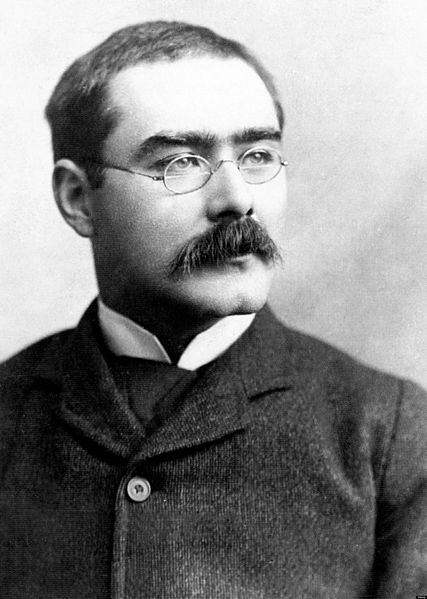
The Tragic Life of Rudyard Kipling
The History Guy: History Deserves to Be Remembered
Published 14 Aug 2019The life of the youngest-ever winner of the Nobel Prize for literature, Rudyard Kipling, was filled with tragedy. He survived a difficult childhood to go on to become one of the most celebrated authors of his day, penning such classics as The Jungle Book and Just So Stories. But only one of his children would survive him and his legacy has been tied to some of his out-dated political beliefs. The History Guy remembers the tragic life of Rudyard Kipling.
(more…)
September 4, 2022
Who was reading during Plague Year Two, and what format did they prefer?
In the latest edition of the SHuSH newsletter, Kenneth Whyte summarizes some of the findings of the most recent Booknet survey:

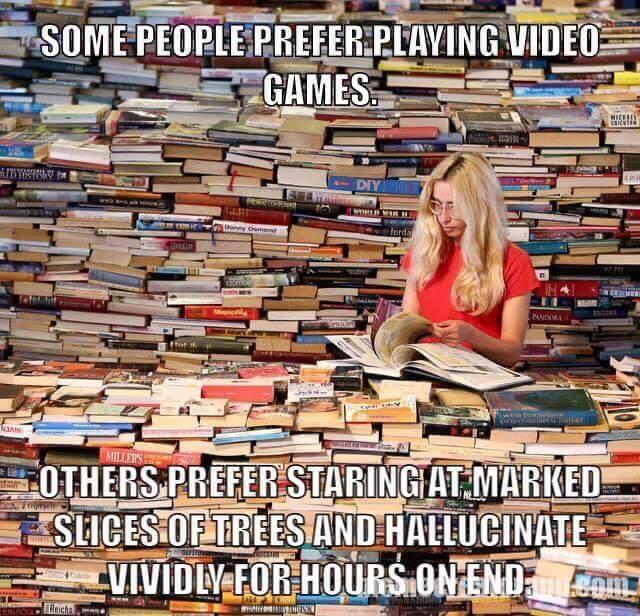
H/T to Marc Adkins who shared this meme at the perfect moment for me to steal it, file off the serial number and repost it here.
A few months ago, BookNet Canada, which does a lot of valuable research into the book market, released the 2021 edition of its annual survey of Canadian leisure and reading habits. It’s always an interesting study. I was slow getting to it this year because there’s been so much else going on. Here are the ten most interesting findings.
- Canadians have had plenty of time on their hands: 81 per cent report having enough or more than enough leisure. Pre-COVID, about 25 per cent of respondents said they had more-than-enough; during COVID, that jumped to about 35 per cent. The pandemic wasn’t all bad.
- Canadians read books more than they listen to radio or play video games but less than they shop or cook; 42 per cent of us (led by 58 per cent of the 65-plus crowd) read books daily; 35 per cent of the 18-29 age group read daily and 57 per cent of that cohort read at least once a week. Young people are no more likely to read books less than once a month than any other under-65 segment, which bodes well for the future of the industry.
- The statement “books are for enjoyment, entertainment, or leisure” received a ‘yes’ from 62 per cent of respondents, and a ‘sometimes’ from 34 per cent; the statement “books are for learning or education” received a ‘yes’ from 41 per cent of respondents and a ‘sometimes’ from 50 per cent.
- The top reasons for selecting a book to read are the author (40 per cent), the book’s description (30 per cent), recommendations (25 per cent), the main character or the series (20 per cent), its bestselling status (14 per cent), and reference needs (13 per cent). “Recommendations and the impact of bestseller lists have trended down from 2019 to 2021.”
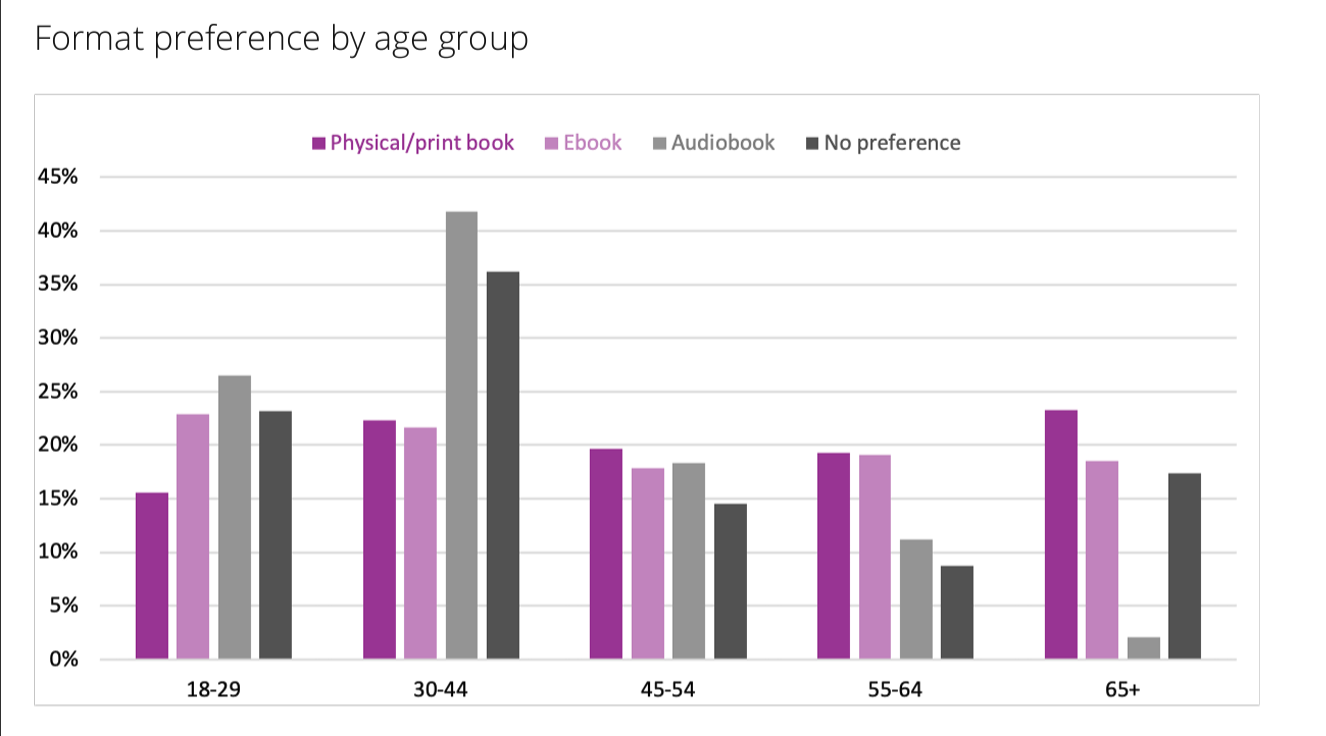
- The love affair with print continues with 68 per cent of readers citing hard copies as their preferred format. Ebooks came in at 16 per cent and audiobooks at 10 per cent Interestingly, readers had a marked preference for paperbacks over hardcovers. Format preferences differ from age group to age group, with some evidence that the kids might not be keen on physical books:
I was interested in that apparent rejection of physical books by the 18-29 cohort so I looked back at the last two years of the survey […] The results are quite different, suggesting a methodological shortcoming (the survey sample is 1,282 adults so the margin of error will be large when you eliminate those who don’t read a given format, those without format preferences, and break the remainder down into five age groups).
August 9, 2022
QotD: Fusty old literary archaism
For as long as I can remember, readers have been trained to associate literary archaism with the stuffy and Victorian. Shielded thus, they may not realize that they are learning to avoid a whole dimension of poetry and play in language. Poets, and all other imaginative writers, have been consciously employing archaisms in English, and I should think all other languages, going back at least to Hesiod and Homer. The King James Version was loaded with archaisms, even for its day; Shakespeare uses them not only evocatively in his Histories, but everywhere for colour, and in juxtaposition with his neologisms to increase the shock.
In fairy tales, this “once upon a time” has always delighted children. Novelists, and especially historical novelists, need archaic means to apprise readers of location, in their passage-making through time. Archaisms may paradoxically subvert anachronism, by constantly yet subtly reminding the reader that he is a long way from home.
Get over this adolescent prejudice against archaism, and an ocean of literary experience opens to you. Among other things, you will learn to distinguish one kind of archaism from another, as one kind of sea from another should be recognized by a yachtsman.
But more: a particular style of language is among the means by which an accomplished novelist breaks the reader in. There are many other ways: for instance by showering us with proper nouns through the opening pages, to slow us down, and make us work on the family trees, or mentally squint over local geography. I would almost say that the first thirty pages of any good novel will be devoted to shaking off unwanted readers; or if they continue, beating them into shape. We are on a voyage, and the sooner the passengers get their sea legs, the better life will be all round.
David Warren, “Kristin Lavransdatter”, Essays in Idleness, 2019-03-21.
June 25, 2022
Kenneth Whyte announces the Sutherland House Prize
If the Canada Council for the Arts — the most important prize-awarding organization in Canadian literature — decides to ignore the majority of works of history in their award schemes, what can the Canadian literary community do about it? Sutherland House reacts by creating their own prize for those works deemed no longer prize-worthy by the Canada Council:
Almost from the start of this newsletter in May 2019, we’ve been concerned with the crisis in Canadian nonfiction publishing.
It began with our realization (SHuSH 10 and SHuSH 17) that the Canada Council had decided that books relying primarily on facts as opposed to the author’s voice are not art. Personal history, personal memoir, personal essay meet the Canada Council’s standard for art and are therefore eligible for grants and awards. Objective fact-based journalism, essays, histories, biographies, business and science writing, not so much.
We were bothered by the notion that the distance an author chooses to take from a subject (first person, say, versus third-person) is what makes or breaks a work of art. Same goes for an author’s fidelity, or lack thereof, to verifiable fact.
It also seemed bonkers that a government agency like the Canada Council would bail on researched nonfiction in favor of works in which the subjective experience of the writer is primary at a time when the rest of the government was so panicked over the lack of reliable fact-based information in the public sphere that it was pumping more than $500 million into our failing newspaper chains. If Ottawa was genuinely concerned about the quality of public discourse in Canada and the information available to the electorate, it would be directing the Canada Council to rescind its policy and support fact-based nonfiction to the same levels as fiction, poetry, and personal literature.
SHuSH pursued the issue. We explained why Canada Council funding matters: most publishers in Canada would be out of business or much reduced without their grants, so they naturally produce books that keep them in the money. Researched nonfiction is expensive and time-consuming to produce at the best of times; when it’s relatively disadvantaged by arts funders, it begins to disappear. It’s no accident that the shortlists of all the major nonfiction prizes in Canada have been dominated by memoir in recent years.
(We’ve always been at pains to add that we have nothing against memoir — we publish our share — but it is no substitute for well-researched, fact-based nonfiction. We need investigative journalism, history, biography, politics, current affairs, science & health books if we’re going to understand ourselves and our times.)
May 1, 2022
Despite the ever-present smartphone, people are still reading actual books in pretty good numbers
In the latest SHuSH newsletter, Kenneth Whyte provides some mildly hopeful numbers for both readers and writers:
I was having coffee this week with a former star journalist who now (like so many) works in a journalist-adjacent industry. “Who reads books?” she wondered.
It’s a question I’m often asked by journalists who these days get a lot of their information from Twitter. The chore of keeping up with their feed leaves little time for anything else. My guest still read books and belongs to a book club, but she asked the question all the same.
According to the authorities at the PEW Institute, 77% of Americans read books in 2021 (or, to be more precise, read one or more books in one or more format—print, audiobook, ebook). That’s not bad considering only 86% of American adults can read.
Only 21% of women read no books, and 26% of men. Eighty per cent of white people read books (as compared to 62% of Hispanics).
Good news for the future of book reading: 81% of adults under the age of fifty read books compared to 72% of adults over the age of fifty.
More on the demographics: 69% of those earning less than $30,000 a year read books, while 85% of those earning over $75,000 read books; 61% of those with a high-school (or less) education read books; 89% of college graduates read books.
According to PEW, the average reader manages twelve a year.
There is some evidence that reading is a declining habit: according to the Bureau of Labor Statistics, average time spent reading for pleasure declined from twenty-three minutes a day to seventeen minutes a day from 2005 to 2017. But the least decline was among young adults, 18 to 34 (less than 1%).
In fact, there is good evidence that the much-maligned millennials read more than their parents, and they overwhelmingly prefer hard copies to digital books. Even better, the millennials pay for their books:
March 14, 2022
Legends Summarized: Journey To The West (Part IX)
Overly Sarcastic Productions
Published 26 Nov 2021Journey to the West Kai, episode 6: Two Weddings And An Asskicking
FIRST EPISODE: https://www.youtube.com/watch?v=61nuX…
PREVIOUS EPISODE: https://youtu.be/xFD_0PIfHHA
FULL SERIES: https://www.youtube.com/playlist?list…Our content is intended for teenage audiences and up.
PATREON: https://www.Patreon.com/OSP
PODCAST: https://overlysarcasticpodcast.transi…
DISCORD: https://discord.gg/osp
MERCH LINKS: http://rdbl.co/osp
OUR WEBSITE: https://www.OverlySarcasticProductions.com
Find us on Twitter https://www.Twitter.com/OSPYouTube
Find us on Reddit https://www.Reddit.com/r/OSP/
November 14, 2021
November 3, 2021
QotD: English literature
Here one comes back to two English characteristics that I pointed out, seemingly rather at random, at the beginning of the last chapter. One is the lack of artistic ability. This is perhaps another way of saying that the English are outside the European culture. For there is one art in which they have shown plenty of talent, namely literature. But this is also the only art that cannot cross frontiers. Literature, especially poetry, and lyric poetry most of all, is a kind of family joke, with little or no value outside its own language-group. Except for Shakespeare, the best English poets are barely known in Europe, even as names. The only poets who are widely read are Byron, who is admired for the wrong reasons, and Oscar Wilde, who is pitied as a victim of English hypocrisy. And linked up with this, though not very obviously, is the lack of philosophical faculty, the absence in nearly all Englishmen of any need for an ordered system of thought or even for the use of logic.
George Orwell, “The Lion And The Unicorn: Socialism and the English Genius”, 1941-02-19.
October 8, 2021
Critical Race Studies go international — “what was once considered an American eccentricity has gone global, and Britain’s curriculum engineers are doing their utmost to make up for lost time”
In The Critic, Frank Furedi looks at how quickly American elite fascination with the various incarnations of Critical Theory has spread beyond the US:
“My child has been told in a series of assemblies that she ‘has white privilege’, that she ‘subconsciously perpetuates it’, may even ‘consciously enjoy it’ and that she ought to be ‘starting to address it’. She has been shown slides of white BLM protesters holding placards that say ‘I will never understand’, told she needs to listen and educate herself and that intersectional theory shows that ‘whiteness will always insulate and protect her from racism’.”
Ten years ago, this mother’s story would likely be considered a joke; a parody of the culture wars that were starting to simmer across the Atlantic. But a lot can happen in a decade: the child whose mother recently reported the above attends an academy in London. Indeed, what was once considered an American eccentricity has gone global, and Britain’s curriculum engineers are doing their utmost to make up for lost time.
In the UK, curriculum engineers have embraced the approach of their American colleagues and are now busy targeting what they describe as outdated views and ideals. The term “outdated” serves as a euphemism for describing ideas and sentiments that do not accord with their project of distancing children from the traditions and way of life of their parents and grandparents. Under the banner of “relevance”, they wish to cancel the classics of literature and replace them with stories written by contemporary writers. Even the works of Shakespeare have been denounced for their outdated racist, antisemitic and misogynist views.
One of the most important and unremarked feature of recent developments in British classrooms is the uncritical and slavish manner with which curriculum experts imitate the cultural crusade of their American colleagues. Earlier this year it was reported that numerous American schools (including the prestigious $45,000-a-year Brentwood School in Los Angeles) were scrapping the apparently outdated To Kill a Mockingbird.
Evidently, some British curriculum leaders swiftly got the message. For example, the James Gillespie High School in Edinburgh decided that it no longer wants to teach classics like Of Mice and Men or to To Kill A Mockingbird in its English classes. The school claims that the “dated” approach to race of these wonderful novels disqualifies them from a place in the English literature curriculum.
Advocates of the project of decolonising schools target what they perceive as outdated views on issues as diverse as gender, trans culture, race and what it means to be British. School subjects as diverse as history, literature, geography and religious education are now used as vehicles for countering what they describe as “white privilege”. They encourage pupils to acknowledge their whiteness and perceive Britain as a society defined by its systemic racism.
July 10, 2021
The early growth of “Dianetics”, later known as Scientology
In Quillette, David S. Wills outlines the early years of L. Ron Hubbard’s quasi-religion that eventually turned into a full-fledged cult:
In the 21st century, Scientology has become a synonym for “cult”. Thanks to an array of investigative exposés and testimony from former members, few people in the Western world are unaware of at least some of the Church’s fantastical beliefs and more alarming behaviours. Sixty years ago, however, it was viewed quite differently. Scientology — or dianetics, as it was originally known — was an appealing idea to many intellectuals and creatives at a time when the world was rapidly changing and notions that had once been taken for granted were suddenly being tossed out of the window. In science, art, and philosophy, accepted norms were being turned on their heads, and in the 1950s and ’60s, L. Ron Hubbard’s ideas — peddled as an alternative to psychiatry — fit quite nicely among the emerging doctrines dreamed up by his contemporary thinkers.
Indeed, the original concepts that launched Hubbard’s movement were not as outrageous as those that define it today. Among these, the idea of “engrams” and the “reactive mind” were perhaps the most appealing. Hubbard theorised that humans are marked by unconscious traumas that essentially pre-determine “aberrant” behaviour. Naturally, he claimed that his organisation held the key to removing these traumas and freeing people from a great deal of suffering. Stripped down to its fundamentals, dianetics seemed to be no more implausible than the strange new ideas espoused by Freud and Jung, or even those previously espoused by Nietzsche.
Of course, there were always oddball beliefs bundled in as well, and as the years went by, these became more prominent. Hubbard — a science fiction author prior to his metamorphosis into quasi-religious guru — enjoyed adding new elements of fantasy to his central theories, layering sci-fi storylines on top of one another until his movement had become an extravagant sort of space opera. The more obvious cult-like elements would emerge in due course: charging adherents for advancement in the organisation; trapping them with manipulation and blackmail; the development of esoteric jargon known as “Scientologese” that made it almost impossible for real communication to take place between members and outsiders; and shocking campaigns of harassment against critics and apostates.
In the early days, however, none of this was particularly obvious. Hard as it is to believe now, many intelligent people were once drawn to Scientology out of an overabundance of curiosity, and its absurdities were generally perceived as harmless, affable eccentricities. Among those lured into the fold of this mysterious new organisation were two of the most important authors of the 20th century: Aldous Huxley and William S. Burroughs. Although Hubbard’s own novels elicit little more than derision from critics, his ideas wormed their way into some very influential books and left an indelible mark on American literature.
When people first hear about Huxley’s and Burroughs’s interest in Scientology, they typically express some degree of shock and/or scepticism. These men were highly intelligent thinkers famous for their insightful criticisms of the dominant culture. And both wrote extensively on the topic of coercion — Huxley was keenly aware of how humans could be manipulated into subservience by technodictators, and Burroughs was fascinated by the idea that language could be employed for the purposes of mind control. How then could they have fallen for the very thing they critiqued?
June 29, 2021
History Summarized: Rise of Islam
Overly Sarcastic Productions
Published 16 Nov 2016Note to viewers: This video contains images of the *Blue Mosque* in Istanbul, which is Not the Hagia Sophia. The Hagia Sophia was a church, later converted into a mosque, but the Blue Mosque, which, to be fair, looks fairly similar to the Hagia Sophia, is a totally different building, and was built by the Ottomans.
HE LIVES! … by at least a few medical metrics. Blue went on a huge training montage for the entirety of Autumn and is back to talk about the history of Islam!
If you have any questions about anything in the video and would like to learn more, leave them in the comments and I’ll do my best to answer!
MERCH LINKS:
Shirts – https://overlysarcasticproducts.threa…
All the other stuff – http://www.cafepress.com/OverlySarcas…Follow us on Twitter @OSPYouTube!
June 14, 2021
Movies based on “classic literature”
Severian considers the relative glut of movies more-or-less based on the classics of literature from his formative years:
When I was a young buck, there was a fad for making movies out of “classic literature”. Scads of chick flicks, of course — Jane Austen’s complete works, the Brontës, and so on — but they also took a stab at Shakespeare. Mostly they stuck to the comedies — and trust me, watching Keanu Reeves trying to handle Much Ado About Nothing is hilarious, in all the wrong ways — but they’d occasionally give the tragedies a shot. Kenneth Branagh’s Hamlet is pretty good despite all the distracting cameos, his Othello is at least sincere (ye gods, imagine trying to make that today!), I think I’m forgetting a few. Mel Gibson gave Hamlet a go back in the early 1990s, and so on. Again, I’m pretty sure I’m forgetting a few.
It always struck me as odd. Unless they timed the theatrical releases to midterm and finals week, hoping to hoover up the dollars of desperate sophomores who didn’t do the homework, it didn’t make much sense, marketing-wise. We were a much more culturally literate people once, it’s true*, but there’s just not much of an audience for the Bard anymore. Nor was it a case of SJWs trying to destroy something good just on general principles. I’m sure Gwyneth Paltrow was bad as Emma, but the idea of retconning every single female in the Western Canon into a Strong, Confident Woman(TM) was still in its infancy. My only other guess was that, since college enrollments were skyrocketing, maybe the parents of all those first-gen college kids were feeling mal-educated and trying to catch up …? Lame, I know, but it was the best I could do.
Looking back on it now, I see my problem: I was looking at it from the demand side. Silly and naive as I was, I assumed that Hollywood’s primary concern was making money, so they went out and found what the people wanted to see, then gave it to them. For instance, I thought Titanic was going to be a huge flop. I mean, the boat sinks. We know that. How do you squeeze any dramatic tension out of it? I should’ve realized they’d be playing it as a doomed-lovers tragedy — girls love that shit, what with the big flouncy costumes and all. Once I realized that, I thought I had it all figured out — every girl I, personally, knew found the works of Jane Austen tedious, but that’s because (I reasoned) you have to supply the images for yourself. Put Hunky McBeef up there in breeches and a peruke, Waify Beecup in a Regency dress, and it’s chick crack …
Or so I thought. Looking back on it now, that’s as dumb as my opinion that Titanic would bomb. Hollywood doesn’t care what you want. I doubt if Hollywood has ever cared what you want, but if they ever did, that time probably ended in tandem with Clara Bow’s career. Hollywood wants what they want, and so will you, because whaddaya gonna do, not watch it? The reason they made all those “classic literature” films in the 1990s, then, wasn’t because they thought we wanted (or needed) some cultural uplift.
No, the reason was: By the 1990s, the last of the old guard in Hollywood was dying off, replaced by the new guard, the Baby Boomers. As we know, it’s not enough for Boomers to control everything while making a shitload of money. No no, for them everything has to be deep and meaningful. They thought of themselves as artistes, not entertainers, so they had to put out a bunch of highbrow stuff, and we had to watch it. This is the sole reason goofy-looking Kenneth Branagh and his horse-faced wife (at the time) were a big cultural force. They made Shakespeare sexy, by which I mean, they allowed the studio heads to think of themselves as the arbiters of culture, not the carny trash they were and are. That some decent movies got made because of it, is entirely incidental.**
*Last summer, during the worst of lockdown mania, I introduced my little nephews to Bugs Bunny. The real ones, from the 40s and 50s, not the crap they put out ten, twenty years ago. I am an educated man by modern standards, but a lot of that stuff flew over my head … and they used to show these in front of popular movies, on military bases, etc.! There’s the classic Wagner one, of course — kill da wabbit!! — but another one involves The Barber of Seville, which I haven’t seen performed and had to look up. Even the “throwaway” music was classical — they could assume, in other words, that your average workaday guy or GI had a fairly large repertoire of classical pieces in his head, enough to recognize bits from Strauss, Chopin, Schumann, etc.
**I do kinda regret bashing Sir Kenneth, as wiki tells me he now is. I enjoyed Hamlet (again, despite the annoying cameos), and some of his other work was pretty entertaining, even, in a limited way, visionary — a quirky little picture like Dead Again didn’t do much in 1991, but it would clean up now (a PoMo costume drama!). I’m one of the few people who liked Mary Shelley’s Frankenstein, which again despite terrible casting (Robert De Niro? Seriously?) was loads of fun. Shelley’s novel as written is ludicrous, therefore unfilmable, but Branagh admirably captured the spirit of it. It’s as Goth as can be, in the original sense of “Gothic”. Wonderful stuff.
June 5, 2021
Pssst! Wanna try some Stephen Leacock? Three bucks, and cheap at twice the price!
Colby Cosh from the Friday edition of the NP Platformed newsletter:
In his Substack newsletter this morning, the editor/historian Ken Whyte shares a neat discovery: a publisher called Delphi Classics has made the complete works of Stephen Leacock available in a Kindle edition for the exquisitely reasonable price of $3 (Canadian!).
Leacock’s oeuvre is in the public domain, so technically you could save the money for a down payment on a coffee. But Delphi is said to take professional care in collating and editing public-domain works of past masters, and it would have to do a pretty poor job not to make it worth the $3 to have 10,000-plus pages in readable condition and in one file.
The collection includes Leacock’s non-fiction, which appears to make up about half its volume. I am just old enough to have run across the humorous fiction that made Leacock a global celebrity, one who influenced artists ranging from F. Scott Fitzgerald to Groucho Marx. I know next to nothing of him as an economist, which was his everyday trade (his thesis supervisor was Thorstein Veblen). He also wrote history books about early Canada, and one’s instinct is that these must be lively presentations of material that Canadians ordinarily meet in the worst possible circumstances, and yes, I do mean “a classroom.”
I have to doff the editorial “we” here to confess that I have not plumbed very deeply into the many aspects of Stephen Leacock, even as someone who regards him, on the basis of Sunshine Sketches of a Little Town and other much-anthologized stories, as easily the greatest prose artist in Canada’s history. Leacock is our Mark Twain, and it’s a small miracle that we have someone who could be described this way, without any hint of exaggeration or partiality. (Commercially, at his peak, Leacock enjoyed nearly the same level of renown: the joke was that he was better known than Canada itself.)
His humorous short stories, like Mark Twain’s, overflow with cynicism and masked darkness, matched with an equal quantity of sympathy. His ability to find just the right off-kilter adjective to make a sentence’s logic explode or capsize was just as strong. And, in his day, the small-town Canadian life he satirized was nearly the entirety of Canadian life, period. You can learn things about early 20th-century Canada from Leacock, and maybe some things about your own forebears, that nobody could insert into a serious book.
Despite having spent most of my school years in Canada, I can only think of one or two Leacock stories that I had to read in that time … and I’m afraid like most things we’re forced to read, I resented the hell out of the teacher, the school board, and the author so if I actually did read them, I instantly forgot them as soon as the quiz or test was over and had no intention of ever picking up the author’s work again. This general pattern has been handy for me in that the Canadian authors I’ve read in the decades since then I’ve been able to evaluate on their own merits rather than through the “I already hate you” filter that got applied to assigned texts in school. My friend and former co-worker Jon — who used to comment on the blog occasionally — was a big fan of Leacock and regularly encouraged me to get past the ancient resentments … it worked to the point that I bought a copy of Sunshine Sketches, but I still haven’t gotten around to reading it.