Quotulatiousness

September 16, 2025

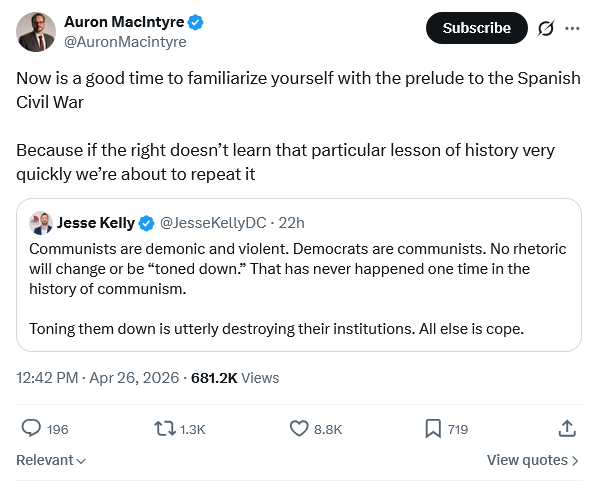
No sensible person wants to start a civil war

Filed under: Media, Politics, USA, Weapons — Tags: , , , — Nicholas @ 04:00

There are always angry folks online who take any current event as a conversational pretext for talking about taking up arms against … whoever they always seem to want to take up arms against. In decades past, you could more easily find tantrums like that among the conspiratorial right but today it seems that the left is leading the charge, so to speak. As a bit of a follow-on to this post, here’s more from Tom Kratman and Harry Kitchener on what might need to be done to start that unwanted-by-all-sensible-folks conflict:

Let’s assume, though, that you people want to kick off what we might call a hard debate – that you plan to use organized and precise violence to combat your enemies and promote your views.

Actually doing it is pretty easy – a patsy with a hunting rifle has a pretty good chance, assuming a bit of talent, to take out any given public figure (assuming no Secret Service protection, that makes things much more difficult). He’ll almost certainly be caught, of course; in a best case, arrested, tried and sentenced to life … or death, in a worst case, killed during the arrest. If you’ve got an inexhaustible supply of these patsies I suppose that’s sustainable – it’s meaningless, of course, as it’ll just bring the other side to the conclusion that if this is the game in future, they’ll happily play along (and they have more guns, more training and probably more immediate support than you do. And they’re starting to really hate you, too).

If you actually *want* to kick off a low-level civil war (I have to say I can’t understand why you would want this, but, hey ho, your call), you need to think in more sustainable terms. Read back on our pieces for some hints on the operational, logistic and security considerations you need to establish a covert, violent organization. Particularly consider the issue of finance – this stuff costs big money to organize and execute and I’m not sure you have access to the sort of volumes of laundered cash you’re going to need.

You’re also going to need to be tough, properly tough in order to cope with the immense pressure you’re going to feel from government and the Right alike, to say nothing of the moral (and morale) impact of inevitable casualties, not just those arrested and sentenced, but also those killed and maimed. Don’t underestimate the impact on one of your “active service units” losing one or two of their members, or of the occasional need just to abandon them in order to get away.

Assuming – and, to be frank, I don’t see this working – but, assuming you do manage to organize some sort of covert violent organization, what would it be *for*? What’s the end state you’re looking to achieve? Proletarian revolution, the righteous rage of the mobilized working class? Not a fucking chance, not in the USA. Every historical example we have of the left trying this kind of thing to raise an oppressive right wing government, to mobilize the masses for the left, shows, instead, massive cheering from those masses for the government that then proceeds to exterminate you.

Cowing the Right through violence? Again, not a hope – the Right (as you call it, a better term might be “the majority of the US population”) tends to be pretty much OK with justified violence, tends to have a larger proportion of people who’ve seen the elephant (this is military slang for “the greatest show on earth”, which is to say, war) and tends to be much better armed than your folks are. On the plus side, you’re in America so becoming better armed is easy. Becoming better armed without leaving a trail pointing straight at you, on the other hand, is hard. And you don’t have the criminal connections to avoid this.

Your base is relatively small and relatively concentrated in certain areas and in certain sectors – soft states, academia, the media, that kind of thing. Don’t believe a word big tech says, they’ll drop you and switch immediately as their share price is adversely affected. And note that the “disciplines” your sort of people tend to undertake in college – gender studies, ethnic studies, gay studies, feminist interpretive dance – are great for motivation to act for the left, but not very good for competence in action.

This makes your base incredibly vulnerable. No matter how effective your “active service units” might be in doing dreadful things to individuals on the Right, you’ll always be outgunned – and every single successful operation you carry out will generate greater support for your opponents. What’s that? Yes, of course it’s unfair and unjust. Deal with it.

What you have, always, to remember is that however important some things are to you, most people are either indifferent to them, or actively hostile to them. No amount of killing is going to change that, probably quite the contrary.

Update, 17 September: Welcome, Instapundit readers! Please do have a look around at some of my other posts you may find of interest. I send out a daily summary of posts here through my Substackhttps://substack.com/@nicholasrusson that you can subscribe to if you’d like to be informed of new posts in the future.

September 15, 2025

HBO’s Rome – Ep 11 “The Spoils” – History and Story

Filed under: History, Media, Military — Tags: , , , , , , — Nicholas @ 02:00

Adrian Goldsworthy. Historian and Novelist
Published 23 Apr 2025

This time we look at episode 11 — and only this episode as there is more to talk about when it comes to the historical background. Some of the plot doesn’t fit too well to the actual history, but there are some nice details that crop up and make it worthwhile. In the main, I get excited about a coin and a court.

September 5, 2025

BBC’s new King and Conqueror series

Filed under: Britain, France, History, Media — Tags: , , , , , — Nicholas @ 03:00

In The Critic, Sebastian Milbank discusses the BBC’s latest attempt to recast British history in a way more pleasing to, as the Critical Drinker would say, “modern audiences”:

If you care about truth, beauty or goodness, I have bad news for you: the BBC has just created a historical drama set in the Middle Ages. Yes, this is the arrival of King and Conqueror, which depicts the events leading up to the Battle of Hastings and the Norman Conquest. The raw matter of the historical record is incredibly promising: ferocious royal intrigues, hagiographical piety, civil and not so civil war, and all the strange poetics and ceremony of French and Anglo-Saxon courtly life. The culture that gave us Lincoln Cathedral and the culture that gave us Sutton Hoo, should be reason alone for the most spectacular of costumes, battles and speeches.

But anyone hoping for a moving epic or a gripping thriller would be equally disappointed, as the brainless BBC tramples cheerfully into a sordid pastiche even more gormless than Game of Thrones (which at least had a decent budget). Future King of England Harold Godwinson (played by James Norton) is introduced to audiences uttering the admittedly pretty Anglo-Saxon phrase “it’s a fucking massacre”, in the manner of someone commenting on an especially brutal 3-nil football match.

I could induce miserable groaning from readers at this point by listing every meta-level historical inaccuracy from the almost entirely fictitious events of the coronation, to the succession of geographical and biographical distortions that rain down on viewers like so many 11th century arrows, to the inexplicable but inevitable (it’s the BBC) presence of black Anglo-Saxons. But none of these departures from the historical record are inherently unforgivable and might in theory be justified in the name of telling a compelling story.

What is truly egregious is not the fictionalisation of details, but the outright misrepresentation of the morals, manners and minds of medieval man. If the past really was a foreign country, then the BBC would be rightly besieged by those outraged at the bigoted, hate-filled and slanderous portrayal of that alien nation in this drama. Edward the Confessor, a man who has been quite literally beatified, is depicted beating his own mother to death. Duke William of Normandy, is shown murdering a man in broad daylight for setting a captured enemy free. Later on, when the enemy — rebellious vassal Guy of Burgundy — is recaptured, he is personally tortured by William’s wife Matilda.

The modern imagination has rendered these figures, and the times they lived in, as more brutal than they truly were. Even the famously ruthless William, who grew up dodging assassins and facing down rebellious barons, is not the thuggish hard man the series would present. The historical accounts suggest that he was a strict adherent to chivalric custom and a deeply pious man. In the real world, William banishes Guy then declares the “peace of God” in Normandy, bringing an end to violence and retribution for the crimes of the past decades. King Edward, who is presented as a snivelling, cowardly mother’s boy, was by every contemporary account a heroic, forceful and gregarious ruler, one who had his mother exiled, and certainly not murdered.

August 30, 2025

HBO’s Rome – Ep 9 “Utica” and Ep 10 “Triumph” – History and Story

Filed under: History, Media, Military — Tags: , , , , , , — Nicholas @ 02:00

Adrian Goldsworthy. Historian and Novelist
Published 26 Mar 2025

This time we look at Episode 9, which begins with the aftermath of the Battle of Thapsus in 46 BC and also Episode 10 which focuses on Caesar’s Triumph — one rather than the four he celebrated over the course of several weeks in 46 BC. There is less history and more character-driven elements in these two episodes, so to make the video the same sort of length as the others in the series, I have combined the two.

00:00 Episode 9 “Utica”
19:48 Episode 10 “Triumph”

August 28, 2025

History of Britain VII: Fall of Roman Britain

Filed under: Britain, History, Military — Tags: , , , , , — Nicholas @ 02:00

Thersites the Historian
Published 23 Feb 2025

After its efflorescence during the 2nd Century, Roman Britain entered steep decline during the 3rd Century and the benefits of Roman civilization had all but vanished by the time that the Romans withdrew their forces and support.

August 18, 2025

Confederate Morse Carbine: Centerfire Cartridges Ahead of Their Time

Filed under: History, Military, USA, Weapons — Tags: , , , , — Nicholas @ 02:00

Forgotten Weapons
Published 23 Oct 2017

George Morse of Baton Rouge patented a design for a remarkably modern centerfire cartridge and breechloading rifle action in 1856 and 1858, using a standard percussion cap as a primer. This was coupled with a gutta percha washer for sealing and a rolled brass cartridge body that was strong and robust — easily reloaded, if somewhat complex to manufacture.

After positive trials by the Army and Navy, Morse received a contract to make first complete guns and then a royalty contract for the conversion of existing muskets to his system. Work began at the Harper’s Ferry Arsenal, but money ran out with only 60 conversion completed. When the Civil War broke out, Morse chose to side with the Confederacy, and the tooling for his conversions was taken from the captured Armory to be put to use. He initially set up in Nashville, but the city fell to the Union in 1862, and he was forced to relocate to Atlanta and the Greenville South Carolina. It was in Greenville that Morse was finally able to manufacture guns in quantity, and he built approximately a thousand brass-framed single shot cartridge carbines for the South Carolina state militia.

Unfortunately for the Confederacy, the infrastructure to supply a modern type of cartridge ammunition really did not exist in the South, and this crippled any chance of Morse’s carbines becoming a significant factor in the war. The best technology in the world is still of no use if ammunition cannot be provided!

This Morse carbine is of the third type, using a sliding latch on the breechblock to hold the action closed when firing. Two previous versions used different and less secure systems, but this third type was introduced around serial number 350 and would comprise the remaining 2/3rds of the production run.

Cool Forgotten Weapons merch! http://shop.bbtv.com/collections/forg…

August 5, 2025

Origin of the China-Taiwan Conflict: Chinese Civil War 1945-1949

Filed under: China, History, Military, USA — Tags: , , , , , — Nicholas @ 02:00

Real Time History
Published 21 Feb 2025

With the Japanese surrender in September 1945, the Second World War comes to an end. But for China there won’t be peace right away because the nationalists under Chiang Kai-Shek and the communists under Mao Zedong still haven’t resolved their struggle and so the Chinese Civil War will flare up once again.

Chapters:
00:00 Japanese Surrender
03:44 Opposing Forces
07:33 KMT Offensives
12:18 CCP vs KMT Strategy
14.45 CCP Counterattack
19:19 Civilian Experience
23:23 CCP Huaihai Campaign
26:30 Final CCP Offensives
29:31 KMT Escape to Taiwan
31:59 Why did the Communists Win?
36:07 The United States and Taiwan
(more…)

August 4, 2025

HBO’s Rome – Ep 8 “Caesarion” – History and Story

Adrian Goldsworthy. Historian and Novelist
Published 19 Feb 2025

Continuing series looking at the HBO/BBC co production drama series ROME. We will look at how they chose to tell the story, at what they changed and where they stuck closer to the history.

QotD: The impeachment of Andrew Johnson

Filed under: Government, History, Law, Politics, Quotations, USA — Tags: , , , , — Nicholas @ 01:00

Over the past few weeks, it has surprised me how seldom the name Andrew Johnson has come up. Sure, every time it has been mentioned that Donald Trump is the third (or fourth — or third and a halfth) President to be impeached, Johnson, the first, is given a brief mention, but very few details are offered of a story almost as stupid, insane, villainous, and corrupt as what’s going on now.

Almost.

I am greatly obliged to my old friend revisionist historian Jeffrey Rogers Hummel, who encouraged me to look into the Johnson impeachment. Johnson was the 17th President of the United States, rising to that office when his predecessor, Abraham Lincoln, was assassinated. Johnson had been a southern Democrat Senator, unjustly reviled by both sides, but remained in the Senate throughout the War Between the States and was chosen by Lincoln to help spread the appeal of a crypto-Republican “National Union” party dedicated to the peaceful and humane reintegration of those states that had seceded and been militarily crushed.

Lincoln’s Secretary of War, Edwin M. Stanton, however, held a somewhat different view. He thought he should be running the government. For various unsavory reasons — that would fill a book or two by themselves (hint: look up Grenville M. Dodge) — Stanton wanted to grind the South down even further under the Northern boot-heel, establishing, for example, extra-constitutional military zones to supervise the phony replacement “carpet-bag” state governments that the North had imposed on Southern states.

Once Johnson became President, he fired Stanton — whom more than one historian believes actually engineered Lincoln’s assassination — immediately running afoul of a little ditty called the 1867 Tenure of Office Act, which it appears was specifically cobbled together to keep Johnson from operating his own Presidency, leaving the nascent Stantonian Police State intact. Stanton and his cohorts impeached Johnson; his conviction failed by one vote in the U.S. Senate. Stanton resigned and skulked off to the garbage-heap of history.

L. Neil Smith, “Andrew and Donald”, Libertarian Enterprise, 2019-12-22.

July 17, 2025

HBO’s Rome – Ep 7 “Pharsalia” – History and Story

Filed under: Europe, History — Tags: , , , , , — Nicholas @ 02:00

Adrian Goldsworthy. Historian and Novelist
Published 22 Jan 2025
Half way through the first season, we take a look at Episode 7, set during the summer of 48 BC amid the campaign between Pompey and Julius Caesar in Macedonia. For once, most of the action takes place away from Rome. Central is the Battle of Pharsalus, where in reality 80,000 or more men clashed in August and Caesar decisively defeated Pompey and his supporters. So today we talk about the reality of the campaign and battle, its political context, and then consider how this is presented for TV in a series where they did not have the option of vast numbers of extras and big set piece battle scenes.

July 13, 2025

Q&A: Finland and Finnish Small Arms (From Berdan to New Sako AR)

Forgotten Weapons
Published 19 Feb 2025

Today’s Q&A is brought to you by the fine folks at Patreon!

I figured that Finland would be a good subject for this month’s Q&A, as I am visiting the country to shoot Finnish Brutality this month. In fact, this video was filmed during the trip (the match took place last weekend, and its video coverage will be coming soon!).

00:39 – Development of the Suomi and PPSh-41 submachine guns
03:24 – Oldest guns used in Finnish Independence War
04:40 – Biggest strength and weakness of the Suomi
06:43 – Soviet use of captured Suomis?
08:52 – Finnish Maxim guns
11:41 – Finnish alcohol
17:05 – Finnish small arms that could have been globally popular but weren’t?
20:04 – Benefits of a small invaded country using the same weapons as its invader?
23:07 – Favorite and least favorite Finnish customs?
25:57 – Finnish Mosin Nagant book by Matt DiRisio
27:26 – Sisu movie
28:28 – Are the Finns masters of improving other peoples’ guns?
30:08 – Pre-independence Finnish arms production
31:47 – Shower beer or sauna beer?
32:20 – Why so few RK95 rifles made, and RK95 vs RK62M?
35:35 – Swedish Mausers in Finland
37:54 – Commercial Sako rifles before and after Beretta bought Sako
39:19 – Finnish gun laws, specifically CCW
40:58 – Interlude: Finnish Brutality 2025 match update w/ Jari Laine
42:24 – Did Finland improve the PKM and SVD like they did the AK and Mosin?
44:57 – 7.62x54R vs 7.62x53R
47:56 – Thoughts on new Sako AR for Swedish and Finnish militaries
(more…)

June 29, 2025

Does Russia Always Win Its Wars?

Real Time History
Published 17 Jan 2025

The Russian Federation is at war with Ukraine, and some of its supporters insist it will win because Russia doesn’t lose wars. They point to its vast territory, its cold climate, its manpower reserves, or its peoples’ ability to endure hardship and accept death – and they point to great Russian victories of the past. So let’s put this claim to the test and see what history has to say about Russia’s record on the battlefield.

Chapters:
00:00 Intro
02:03 Mongol Invasion of Kyivan Rus’
03:29 Livonian War
04:52 Time of Troubles
06:13 3rd and 4th Coalition Wars
08:12 Crimean War
09:31 Russo-Japanese War
11:44 First World War & Russian Civil War
14:07 Polish-Soviet War
15:25 Winter War
16:48 Soviet-Afghan War
18:34 First Chechen War
19:33 Conclusion
(more…)

June 20, 2025

QotD: The innate appeal of socialism

Filed under: Economics, History, Quotations, USA — Tags: , , , — Nicholas @ 01:00

It’s easy to understand Socialism’s emotional appeal. It’s undiminished, even now, despite it all, because it touches something deep — something good — in the human soul. Read Oliver Twist and you’ll see it right away. Or if Dickens isn’t your thing, do an image search for Jacob Riis’s How the Other Half Lives. It’ll break your heart. No matter if their parents are gutter drunks […] no child deserves to live like that.

And the material side of Socialism is technically feasible. Obviously so, and indeed it was obvious by 1865. Consider what the Union Army had to do to keep one million men in the field, simultaneously, spread over hundreds of thousands of square miles. This was not without its problems, of course — soldiers finally receiving their back pay spurred a minor economic boom in 1865-6 — but it was not just possible, but an everyday occurrence, for hundreds of thousands of men, dispersed over a huge geographic area, to receive their entire subsistence from the government. Clothes, shoes, food — the stuff Riis’s “street Arabs” would’ve killed for — all at public expense, delivered with clockwork efficiency.

If Socialism were just that, then indeed we could’ve “built Socialism”, as the Bolsheviks would have it, by the end of the 19th century. And cheaply, too — by the late 1880s, the US Treasury’s massive surplus was a major campaign issue for both parties. The “Yankee Leviathan“, as political historian Richard Bensel put it, was as close to actual Fascism as has ever been put into practice (alas, the term hadn’t been invented yet), and it was just aces at delivering the material goods. (It’s Alanis-level ironic that the Confederacy was even more actual capital-F Fascistic than the Union, given the whole “states’ rights” thing, but that’s what happens in totaler Krieg — win first, sort the theory out later).

Severian, “Purpose”, Founding Questions, 2021-12-06.

June 19, 2025

The Guns of the South: Checkmate, Alt-Hist Plausibility Sticklers

Filed under: Africa, Books, History, Military, USA, Weapons — Tags: , , , , , — Nicholas @ 02:00

Feral Historian
Published 24 Jan 2025

Harry Turtledove’s The Guns of the South gives us a look at a victorious Confederate States as they grapple with the consequences of slavery, war, and the challenges of building a new nation. It also skewers a favorite activity of alt-history readers, the nitpicking of plausibility in the points of divergence, by dropping South African time travelers with AKs into the middle of the Civil War.

00:00 Intro
02:08 America Will Break
04:49 Right and Left
05:36 CSA at odds with AWB
08:08 Forrest
10:16 Technology
13:16 “Why then …”

June 15, 2025

QotD: Four stages of revolutions

Filed under: Books, History, Politics, Quotations — Tags: , , , — Nicholas @ 01:00

Considering how often revolutions have produced cataclysms, the word revolutionary has — at least for many people, especially when young — surprisingly positive connotations. The author of this short book [You Say You Want A Revolution by Daniel Chirot], more extended essay than a history of revolutions in the two centuries that followed the French Revolution, sets out to explain why revolutions have so often been followed by slaughter on an unprecedented scale. Pascal said that he who sets out to be an angel ends a beast: to which we might add that he who sets out to create a heaven-on-earth creates a hell.

Professor Chirot writes extremely well and is never less than clear. He uses no jargon and he has a gift for condensing complex historical events into a short compass without resort to procrustean simplification. I would imagine that he is an excellent teacher.

He does not claim to have found a universal law of history that applies at all times and in all places, but he says that large-scale revolutions in the modern world have had a tendency to go through four discernible stages. First, an outmoded governing power refuses to accept that change is necessary and consequently refuses to make the necessary concessions to save itself. This leads to overthrow by relatively moderate leaders who would once have accepted compromise but see that change can only come about by revolution. Second, there is a counter-revolutionary reaction by those who do not accept their loss of power and who provoke a civil war or call for foreign intervention, or both. As a result, much more radical revolutionary leaders come to the fore and defend the revolution by increasing repression of enemies or supposed enemies. Third, the radical leaders, because they hold extreme views and are imbued with unrealistic notions of the complete redemption of mankind from all its earthly ills, impose experimentation on the population which is economically and socially disastrous. Fourth, in the case of its evident failure, the revolutionary regime loses its ideological ardour, and settles down to a kind of routine and less violent authoritarianism accompanied by large-scale corruption and cronyism.

Theodore Dalrymple, “Longing for Revolution”, Law & Liberty, 2020-05-13.

« Newer PostsOlder Posts »

Powered by WordPress