Quotulatiousness

October 17, 2025

Stellantis took the bribe, left Canada anyway

Filed under: Business, Cancon, Government, Politics, USA — Tags: , , , , , — Nicholas @ 04:00

The former American Motors plant in Brampton, now owned by Stellantis, was supposed to be the manufacturing site for a new Jeep vehicle. The federal government under Justin Trudeau handed about $15 billion to Stellantis to build an EV battery complex in Windsor, Ontario. It was apparently just assumed that this meant that Stellantis would keep the Brampton facility open and operating, but that assumption was faulty:

Stellantis has announced they’re leaving Brampton. That’s it. End of story.

Three thousand workers. Gone. A manufacturing base gutted. A city thrown into economic chaos. And a federal government left holding a $15 billion bag it handed over like a drunk tourist at a rigged poker table.

The Jeep Compass — the very vehicle they promised would anchor Ontario’s role in the so-called “EV transition” — will no longer be built in Canada. Production is moving to Belvidere, Illinois. The same company that cashed billions of your tax dollars under the banner of “green jobs” and “economic transformation” has slammed the door and walked out. And no, this isn’t a surprise. This was baked into the cake from day one.

Let’s rewind.

In April 2023, under Justin Trudeau’s government, Chrystia Freeland — then Finance Minister — and François-Philippe Champagne, the Industry Minister, announced what they called a “historic” agreement: a multi-billion-dollar subsidy package to Stellantis and LG Energy Solution to build an EV battery plant in Windsor, Ontario.

It was sold as a turning point. The future. A Green Revolution. Thousands of jobs. A new industrial strategy for Canada. But in reality? It was a Hail Mary pass by a government that had already crippled Canada’s energy sector and needed a shiny new narrative heading into an election cycle.

And here’s what they didn’t tell you: the deal had no enforceable commitment to keep auto production in Brampton. There were performance-based incentives — yes — but only for the battery plant. Not for the Brampton assembly line. Not for the existing workforce. And certainly not for ensuring the long-term health of Canada’s domestic auto industry.

They tied this country’s future to a globalist fantasy. A fantasy that assumed the United States would remain under the control of climate-obsessed technocrats like Joe Biden. A fantasy that required a compliant America pushing carbon neutrality, electric vehicle mandates, and billions in matching subsidies for green infrastructure.

But in November 2024, Americans said no.

Donald Trump was elected president. And just as he promised, he tore Biden’s green agenda to shreds. He pulled out of the Paris Climate Accord — again. He dismantled the EV mandates. He unleashed American oil and gas. But he didn’t stop there. Trump imposed a sweeping America First manufacturing policy, pairing 25% tariffs on imported goods with aggressive incentives to bring factories, jobs, and supply chains back onto U.S. soil.

And, as Conservative deputy leader Melissa Lantsman points out, it’s just the beginning:

You probably heard the news by now: Stellantis is cancelling its opening of a Jeep factory planned in Brampton, taking over 3,000 jobs and USD $600 million of investment out of Canada and moving it to the U.S.

This is the latest development in the growing trend of companies scaling back their operations in our country and choosing instead to grow in the US. Whisky maker Diageo found its name in the headlines last month when they announced they’d move their Crown Royal bottling facility south. GM laid off or cut down shifts for 750 autoworkers in Oshawa and 900 in Ingersoll while sending $4 billion to the U.S. Those are the ones that drew the headlines.

Why is this happening? Well – the reason on everyone’s mind right now is tariffs. And it’s true – tariffs are having a big impact on the Canadian economy and on our trading relationships. But there are other, deeper reasons at play, too.

Companies don’t just make decisions on a whim – especially those related to long-run production and fixed investments totalling hundreds of millions or even billions of dollars. Those decisions are made as part of detailed, multi-year analyses that take into account predicted economic conditions, market forces, and many other factors. A massive move of your production facility isn’t a temporary, six-month decision to be trifled over – it’s a permanent thing and that means they aren’t coming back.

The objective is to decrease uncertainty, cut costs, increase production, etc. etc. all to work in favour of any company’s ultimate goal, which is, of course, to make money.

So let me translate what all these investment and job cuts really mean: they’re not a knee-jerk reaction to the tariffs, although those play a part. They’re a statement about the long-term trajectory of the Canadian economy and the kind of climate that a decade of Liberal government has built for businesses in this country.

If these companies thought the U.S. tariffs would be transitory, a six-month blip, an economic fad – then they’d have no reason to cancel factories that will be producing goods for 20 or 30 years. That wouldn’t make financial sense.

[…]

If things get worse, the government might resort to its favourite strategy of just offering more hand-outs for businesses to try and entice them to stay here, but that only works for so long. That Stellantis plant in Brampton? The one that’s moving to the U.S.? The Ontario government promised them over $500 million just a few years ago – and the feds followed.

Turns out, you can promise to cut somebody a giant cheque and it’s still unprofitable for them to do business here.

As I mentioned, the continued trade uncertainty doesn’t help our situation, and the Prime Minister’s failure to get a deal is costing us big-time – especially as he promises to drive a trillion dollars of investment southbound at the expense of our workers here.

But as long as the Liberals keep the same old approach towards economics and business in this country, as long as the Liberals keep the taxes high, the productivity low, and the red tape piled up high — expect to see more headlines like the one about Stellantis, not fewer.

How many more job losses will it take for our leaders to realize that?

September 4, 2025

Net Zero targets and Britain’s ever-declining car industry

Filed under: Britain, Business, China, Environment, Government, USA — Tags: , , , , , — Nicholas @ 03:00

At the Foundation for Economic Education, Jake Scott charts the decline of the British auto manufacturing centres and the government’s allegiance to its Net Zero programs:

Custom image by FEE

Britain was once a giant of car manufacturing. In the 1950s, we were the second-largest producer in the world and the biggest exporter. Coventry, Birmingham, and Oxford built not just cars, but the reputation of an industrial nation; to this day, it is a source of great pride that Jaguar–Land Rover, a global automotive icon, still stands between Coventry and Birmingham. By the 1970s, we were producing more than 1.6 million vehicles a year.

Today? We have fallen back to 1950s levels. Last year, Britain built fewer than half our peak output—800,000 cars, and the lowest outside the pandemic since 1954. Half a year later, by mid-2025, production has slumped a further 12%. The country that once led the automotive revolution is now struggling to stay afloat, and fighting to remain relevant.

This is why the news that BMW will end car production at Oxford’s Mini plant, shifting work to China, is so damning, bringing this decline into sharp focus. The Mini is not only a classic British car; Alec Issigonis’s original design made it an international icon. For decades, the Mini has been the bridge between British design flair and foreign investment. Its departure leaves 1,500 jobs at risk at a time when the government is desperate to fuel growth and convince a wavering consumer market that there is no tension between industrial production and Net Zero goals.

It’s a bitter reminder that we in Britain have been here before: letting an industrial crown jewel slip away.

The usual explanations will be offered: global competition, exchange rates, supply chains. All true, in the midst of a global trade war that is heating up and damaging major British exports. But such a diagnosis is incomplete. The truth is that Britain’s car industry is being squeezed by a mix of geopolitical realignment and government missteps.

The car industry has become the frontline of a new trade war. Washington has already moved aggressively to shield its own firms: the Inflation Reduction Act offers vast subsidies for US-made EVs and batteries, an unapologetic attempt to onshore production, and something that became a flashpoint of tension in Trump’s negotiation with the EU in the latest trade deal. On the production side, the Act has poured billions into US manufacturing: investment in EV and battery plants hit around $11 billion per quarter in 2024.

Ripples have been sent across the world in the US’s wake: Europe, faced with a flood of cheap Chinese EVs, has imposed tariffs of up to 35% after an anti-subsidy investigation. Talks have even turned to a system of minimum import prices instead of tariffs. Unsurprisingly, China has threatened retaliation against European luxury marques, while experts warn the tariffs may slow the EU’s green transition by raising prices.

This is no longer a free market: cars are treated as strategic assets, the 21st-century equivalent of shipbuilding or steel. Whoever controls the supply chains, particularly for EV batteries and the mining of lithium, controls not only the future of the industry but an important lever of national power.

The results are visible. In July 2025, Tesla’s UK sales collapsed nearly 60%, while Chinese giant BYD’s deliveries quadrupled. Europe responded by talking up new tariffs. Britain did nothing. In this asymmetric contest, our market risks becoming a showroom for foreign producers — subsidizing both sides of the trade war without defending our own.

August 23, 2025

“Trump … sees transshipment and nearshoring as sneaky workarounds”

Filed under: China, Economics, Government, Politics, USA — Tags: , , , — Nicholas @ 05:00

At the Foundation for Economic Education, Jake Scott explains Donald Trump’s latest anti-trade moves:

President Donald Trump’s executive order of July 31st, effective August 7th, has upended global trade dynamics in a single stroke. Slapping a 40% tariff on all “transshipped goods” — products rerouted through third countries to dodge US duties — this is merely the natural development of his evolving protectionist agenda.

Just a week after the order, the move is a clear shot at China’s sprawling manufacturing empire, which has long exploited methods like transshipment and “nearshoring” to skirt American tariffs in general, and Trump’s tariff policies in particular.

While applied globally, China stands to take the biggest hit (and likely already is), with its vast factory networks and knack for rerouting goods through Southeast Asia, Mexico, and beyond. This isn’t just a tariff hike; it’s a calculated escalation in Trump’s ongoing crusade to reshape US trade policy and the global economy in the United States’ favor. But ripple effects that bruise consumers are already visible — and this move is likely to strain relationships with key allies as well.

The new tariffs build on Trump’s first-term strategy — so extensive that it now has a Wikipedia entry — when he wielded America’s economic heft like a sledgehammer to renegotiate or smash trade deals he deemed unfair. Back then, Chinese firms sidestepped US tariffs by setting up shop in countries like Vietnam and Mexico, funneling goods through these hubs to mask their origins.

This nearshoring strategy buoyed many economies that had pre-existing arrangements with the United States or were treated more favorably than China, such as Canada and Latin American nations. It is also seen as a natural part of globalization: shipping parts from where they are constructed (like China), assembling them in developing nations (like Mexico), and then exporting to high-value markets (like the United States). Nearshoring has a long history, but the fragility of extended global supply chains was exposed in the Covid pandemic; since then, manufacturers have sought to mitigate their damage.

The US trade deficit with China (roughly $295 billion) has long been a sore point for Trump, who sees transshipment and nearshoring as sneaky workarounds. The 40% duty on these goods, layered atop existing tariffs, aims to plug this loophole. As Stephen Olson, a former US trade negotiator, noted in the New York Times, China will likely view this as a direct attempt to “box them in”, potentially souring already tense talks.

August 8, 2025

China’s short- to medium-term reaction to Trump’s tariffs

Filed under: China, Economics, Government, USA — Tags: , , — Nicholas @ 03:00

In Reason, Liz Wolfe outlines some of the reasons China has not been suffering under the tariffs President Trump has levied on them over the last few months (unlike, say, Canada):

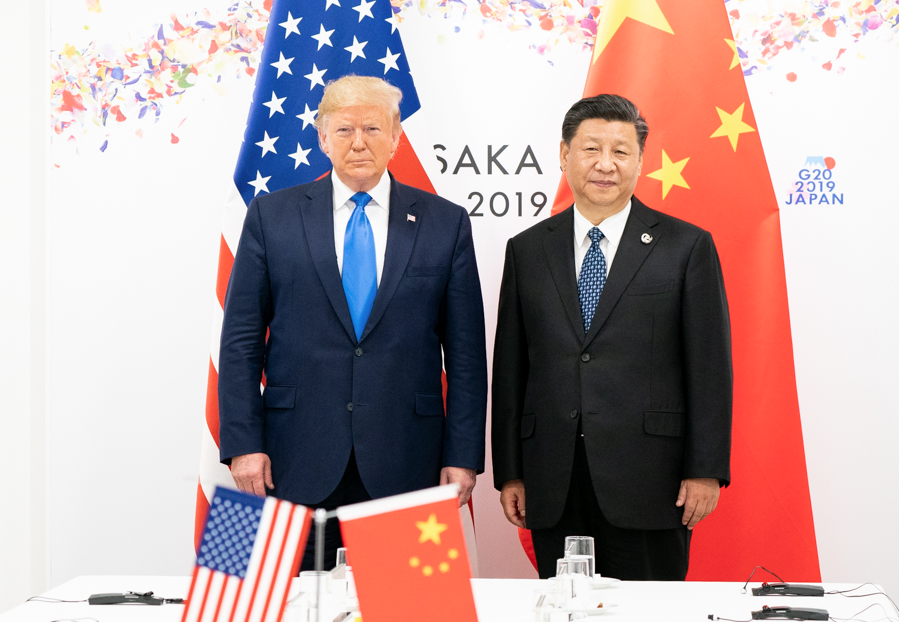
President Donald Trump and PRC President Xi Jinping at the G20 Japan Summit in Osaka, 29 June, 2019.
Cropped from an official White House photo by Shealah Craighead via Wikimedia Commons.

Total Chinese exports surged in July … but not to us. Compared to July 2024, Chinese exports were up 7.2 percent last month. “Its exports to Southeast Asia and Africa, key regions for reshipment to the United States, rose more than twice as fast as its overall exports”, per The New York Times‘ reading of the data. “China’s exports to the European Union, its main alternative to the American market, were also up very strongly.”

Specifically, “data released Thursday by the customs authorities showed the pickup was driven by strong growth in shipments to the European Union, Southeast Asia, Australia, Hong Kong and other markets, which more than made up for the fourth month of double-digit declines in US purchases”, reports Bloomberg.

Predictably, even the threat of tariffs has been enough to dampen trade. Remember, Washington and Beijing are still operating under a 90-day truce — set to expire on August 12, though it could be extended if a new agreement is reached — that holds off the imposition of higher tariff levels, namely, the tit-for-tat tariff increases that both countries had threatened. The truce also staves off export controls on certain critical rare-earth minerals and items that fall into the technology category. But still, current tariff levels mean a baseline 30 percent tariff on Chinese imports, which has been enough to depress trade.

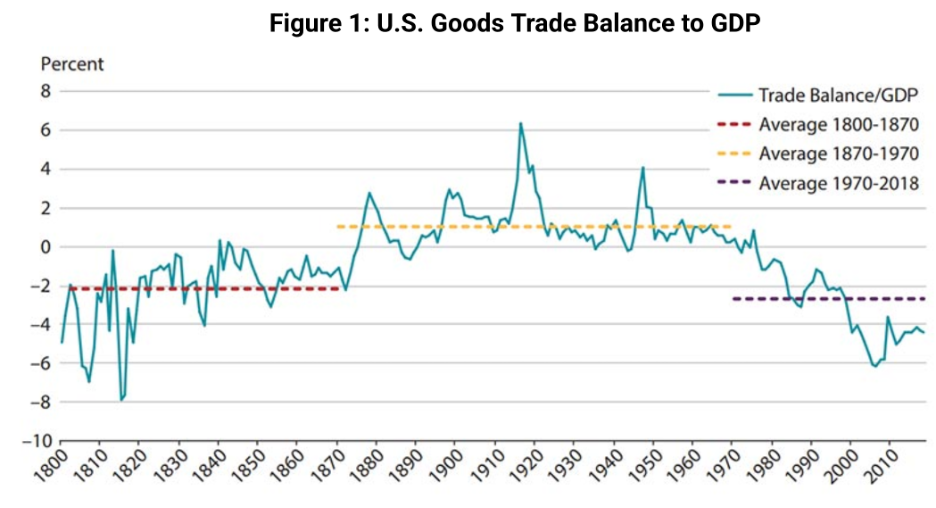
For those in the Trump administration who are worried about trade deficits in particular, I suppose the good news is that we’ve made progress there: “For the last several decades, China has been selling as much as $4 worth of goods to the United States for each $1 of American goods that it buys”, reports The New York Times. Following China’s admission into the World Trade Organization, the trade deficit rose. Now, “tariffs have begun to reduce the imbalance. The United States announced on Tuesday that its overall trade deficit had narrowed in June to $60.2 billion, the smallest in nearly two years.”

It’s not clear why Trump administration officials, and the president himself, are so worried about trade deficits as something to eliminate for their own sake. We are dependent on Chinese goods to a rather substantial degree, which would pose a problem in the event of war with China (which is why the previous administration focused on improving our semiconductor manufacturing capabilities back in 2022). But you can just as easily make the case that it’s the vast volume of trade between the two countries — the deeply intertwined economies so reliant on each other (despite China’s claims of autarky and, more amusingly, communism) — that are incentivizing continued decent relations.

A few factors are at play that might help to explain why you likely haven’t felt a drastic increase in prices just yet. First, since there’s been a long lead-up to this trade war, many larger importers have stockpiled product over the last few months, so shortages haven’t been felt yet — they’ve just been selling off product they’ve been storing. Second, China has already managed to divert some stages of manufacturing to other countries—namely Vietnam — and some larger companies already have factories up and running in other Southeast Asian countries to avoid the “made in China” or “shipped from China” labeling. Expect more transshipping and manufacturing-locale creativity as a means of throwing customs officials off the scent.

August 5, 2025

Will the courts take away Tariff-master Trump’s favourite toy?

Filed under: Government, Law, Politics, USA — Tags: , , , — Nicholas @ 03:00

President Donald Trump’s second term in office has been dominated by his capricious and seemingly random deployment of tariffs as a bludgeon to intimidate and coerce America’s allies and enemies alike. In Reason, J.D. Tuccille considers the possibility of the courts taking away the one tool Trump has been using to get his own way in trade negotiations:

Everybody with a brain knows that tariffs are taxes. And they know that tariffs imposed on goods imported to the United States are largely paid by American businesses and consumers. The big question is whether tariffs unilaterally imposed by President Donald Trump under creative interpretations of emergency executive powers will withstand a federal court challenge. So far, the signs are promising for those hoping that a law intended to rein in the power of the presidency will not be read to permit the president to set trade policy of his own accord.

As CBS News reported this week, the U.S. Court of Appeals for the Federal Circuit in Washington, D.C. heard “oral arguments on Thursday in V.O.S. Selections v. Trump, a case brought by five small business owners and 12 states who allege they have been harmed by President Trump’s import taxes. V.O.S., the lead plaintiff in the case, is a New-York based wine importer.”

Representing the plaintiffs is the free-market Liberty Justice Center, along with co-counsel Ilya Somin, a law professor at George Mason University’s Scalia Law School. The plaintiffs are challenging the Trump administration’s invocation of the International Emergency Economic Powers Act (IEEPA) as the basis for the “Liberation Day” tariffs on much of the world as well as related tariffs on Mexico, Canada, and China.

A Law Intended To Trim Presidential Power, Not Expand It

The plaintiffs maintain that “under that law, the President may invoke emergency economic powers only after declaring a national emergency in response to an ‘unusual and extraordinary threat’ to national security, foreign policy, or the U.S. economy originating outside of the United States. The lawsuit argues that the Administration’s justification — a trade deficit in goods — is neither an emergency nor an unusual or extraordinary threat.”

What’s interesting is that Congress passed IEEPA not to expand presidential power, but to restrict it. According to a 2024 Congressional Research Service report, “following committee investigations that discovered that the United States had been in a state of emergency for more than 40 years, Congress passed the National Emergencies Act (NEA) in 1976 and IEEPA in 1977. The pair of statutes placed new limits on presidential emergency powers”. Under these laws, presidents are required to assess emergencies on an annual basis, extend them if necessary, and report on their status to Congress.

“Some experts argue that the renewal process has become pro forma“, the report acknowledges. “History shows that national emergencies invoking IEEPA often last nearly a decade, although some have lasted significantly longer — the first state of emergency declared under the NEA and IEEPA, which was declared in response to the taking of U.S. embassy staff as hostages by Iran in 1979, is in its fifth decade.”

August 2, 2025

“[T]he United States is an imperial power … it does not give foreign nations free rides and unearned favours”

Filed under: Economics, Europe, Media, Politics, USA — Tags: , , , , , , — Nicholas @ 04:00

On Substack, eugyppius discusses the European situation in a time of seemingly random and capricious tariffs from the Trump administration:

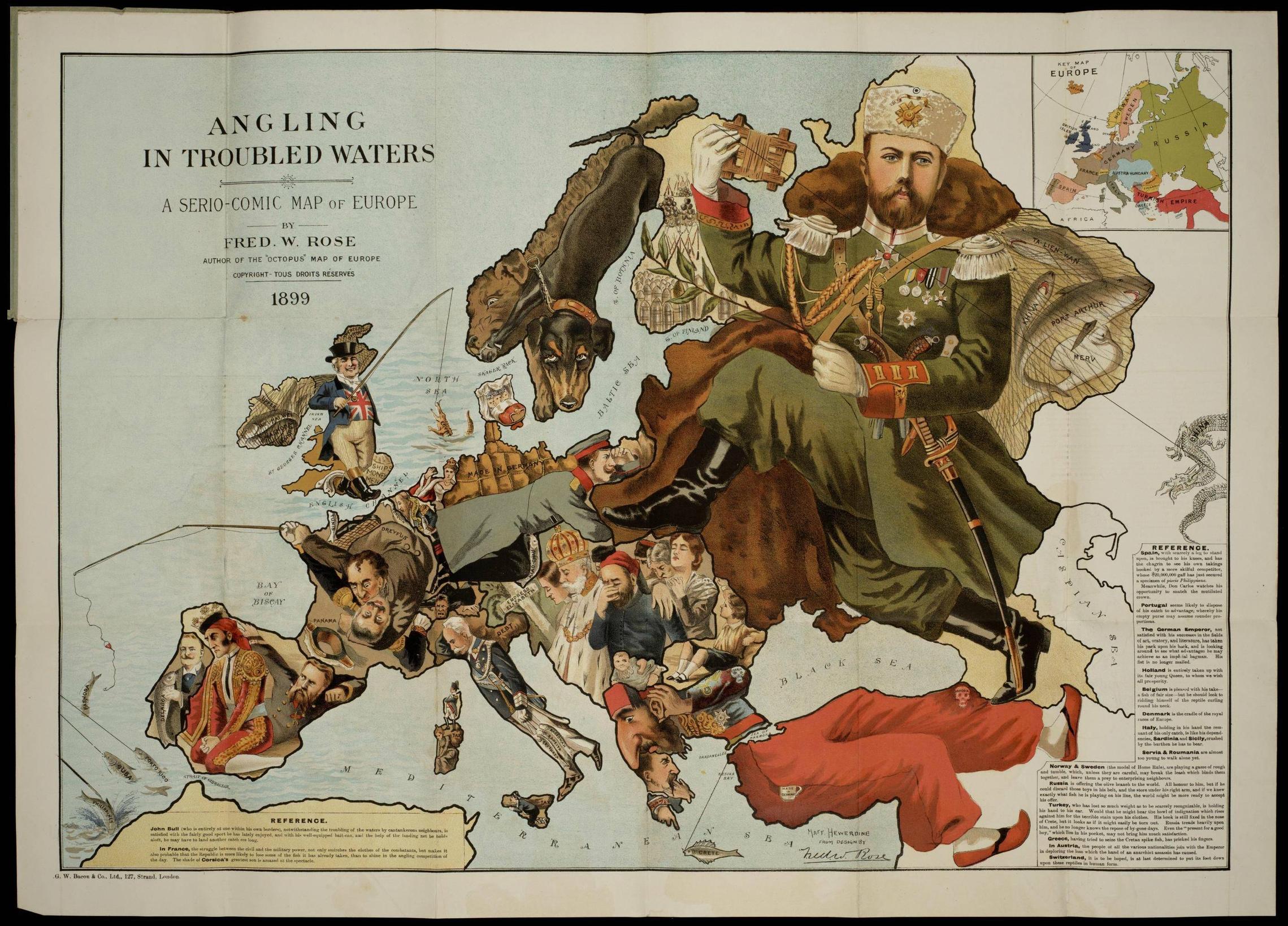
Europe in 1899, when the continent contained multiple world powers, before the rise of non-European power.

Whenever I talk about things like tariffs, Trump supporters appear in my comments to tell me that Europe has gotten a free ride for long enough and that it is time we learned to pay our way. I find it a little frustrating to read this, because in Europe it does not feel like we are getting a free ride at all. In fact it seems like the opposite: The most common complaint on the populist German right is that our political class refuses to represent our interests and will not stop carrying water for the Americans.

I recognise that I’ll never be able to put this right, but it’s worth trying, because it is important to understand the world as it is. The truth is that the United States is an imperial power. Generally speaking, it does not give foreign nations free rides and it does not hand out unearned favours. There is however a lot of confusion here, because hardly anybody bothers to describe honestly the geopolitical strategy pursued by the United States or the nature of the American empire. Western liberalism cannot conceptualise imperial politics, and while empire generally benefits political elites on both sides of the Atlantic, it is not necessarily or always in the interests of ordinary Americans or ordinary Europeans, which is yet another reason not to talk about it.

The Americans and the British before them expended enormous effort to preempt the emergence of a dominant power on the European Continent that might challenge their successive naval empires. They fought two world wars to stop Germany from becoming just such a power. This great struggle ended in 1945 with Western Europe as a fully subjugated imperial province. Since then, the Americans have coordinated the NATO alliance and guaranteed the security of European countries not out of charity, but because Europe is their provincial possession. As a rule, they have not wanted Europe to assume full responsibility for its own defence, because a world in which America no longer guarantees the security of Europe is a world in which Europe is no longer an American province. It’s that simple.

To fend off the Soviets, the Americans nevertheless rebuilt and rearmed the nations of Western Europe. Everyone involved in this project had to come up with a way to allow the Germans to become a dominant economic power again, without displacing the United States or provoking the hostilities of wary postwar neighbours like France. One solution here was the European Union, which promoted economic interdependency as a counterweight to nationalist concerns. Another solution came at the cultural level, where Germany sought to allay European anxieties over possible Teutonic aggression by developing a national cult of historical guilt for World War II, which steadily blossomed into a full-blown civic religion. This exercise in self-effacement has grown more and not less extreme over time, in part as a response to nervousness about the consequences of German reunification. Many voices on the right like to portray Germans as victims of an externally imposed guilt regime, but the truth is that we did most of this to ourselves. The German left in particular has profited from and encouraged this mindset from the beginning.

German political self-effacement had one unexpected feature, in that it proved to be contagious. Within a generation of 1945, many of the victorious allied powers were striving to develop their own historical guilt cults after the German example, in each case centred around a national original sin like slavery or colonialism. Just as the German political class found it expedient to foreground collective European concerns at the expense of a more narrowly construed German nationalism, so did the broader West develop an overarching obsession with global issues and the plight of the developing world. This has caused the proliferation of a lot of silly people in our political culture, a lot of profoundly stupid organisations, and at least two cancerous ideological systems in the form of climatism and migrationism. We have had a nearly incalculable gift in the form of 80 years of peace, which may yet be offset by the equally incalculable costs of the lunacies this peace has encouraged.

July 29, 2025

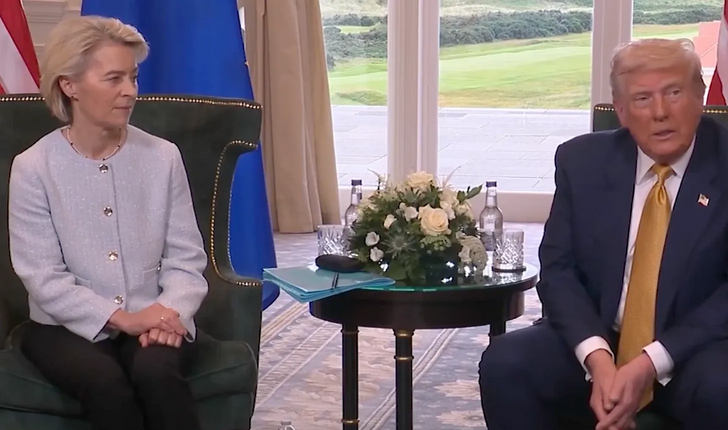
EU Commission President Ursula von der Leyen triumphantly announces EU capitulation to Trump’s demands

Filed under: Bureaucracy, Economics, Government, Media, Politics, USA — Tags: , , , , — Nicholas @ 05:00

The EU and the United States are finalizing negotiations on bilateral trade issues that basically give Trump everything he wanted with very little in return for the EU’s concessions. It’s almost as if Trump has some kind of experience in negotiating lopsided agreements, isn’t it? I guess von der Leyen didn’t get Mark Carney’s memo on the importance of keeping your eLbOwS uP:

EU Commission President Ursula von der Leyen “[learning] in real time that weakness and submission do not in fact invite conciliation”

Donald Trump has shown up the European Union. He’s revealed that the world’s largest single market is a paper tiger to be kicked around, with basically no leverage or strength to resist American demands.

All of these supposedly fierce backroom tariff negotiations have yielded an incredibly one-sided deal – really an unparalleled embarrassment. As announced yesterday, the EU promises to invest $600 billion in the U.S. economy and to make $750 billion worth of “strategic purchases” of oil, gas and the like over the next three years. We also promise to buy a bunch of American military equipment. In return for giving the Americans $1.35 trillion, we earn the privilege of a 15% baseline tariff on all of our exports to America and we drop our own tariffs to zero. At least we don’t have to pay the 30% tariffs Trump threatened!

[…]

While von der Leyen was trying weakly to put a happy face on her total failure, Trump gave her what we might call a softer Zelensky treatment. He twisted the knife in the wound, calling out the idiocy of EU wind energy in an extended soliloquy that will surely keep the fact-checkers and the regime deboonkers up late for weeks to come. I transcribe his remarks in full, because the whole moment was wonderful:

    And the other thing I say to Europe, we will not allow a windmill to be built in the United States. They’re killing us. They’re killing the beauty of our scenery, our valleys, our beautiful plains. And I’m not talking about airplanes. I’m talking about beautiful plains, the beautiful areas in the United States. And you look up and you see windmills all over the place. It’s a horrible thing. It’s the most expensive form of energy. It’s no good.

    They’re made in China, almost all of them. When they start to rust and rot in eight years, you can’t really turn them off. You can’t bury them. They won’t let you bury the propellers, you know, the props, because they’re a certain type of fiber that doesn’t go well with the land. That’s what they say. The environmentalists say you can’t bury them because the fiber doesn’t go well with the land. In other words, if you bury it, it will harm our soil.

    The whole thing is a con job. It’s very expensive. And in all fairness, Germany tried it and, wind doesn’t work. You need subsidy for wind and energy should not need subsidy. With energy, you make money. You don’t lose money.

    But more important than that is it ruins the landscape. It kills the birds. They’re noisy. You know, you have a certain place in the Massachusetts area that over the last 20 years had one or two whales wash ashore and over the last short period of time they had 18, okay, because it’s driving them loco, it’s driving them crazy. Now, windmills will not come, it’s not going to happen in the United States, and it’s a very expensive …

    I would love to see, I mean, today I’m playing the best course I think in the world, Turnberry, even though I own it, it’s probably the best course in the world, right? And I look over the horizon and I see nine windmills. It’s like right at the end of the 18. I said, “Isn’t that a shame? What a shame.” You have the same thing all over, all over Europe in particular. You have windmills all over the place.

    Some of the countries prohibit it. But, people ought to know that these windmills are very destructive. They’re environmentally unsound. Just the exact opposite. Because the environmentalists, they’re not really environmentalists, they’re political hacks. These are people that, they almost want to harm the country. But you look at these beautiful landscapes all over all, over the the world. Many countries have gotten smart. They will not allow it. They will not. It’s the worst form of energy, the most expensive form of energy. But, windmills should not be allowed. Okay?

All the while von der Leyen had to sit there, absolutely frozen except for a curiously accelerated rate of blinking, as she learned in real time that weakness and submission do not in fact invite conciliation.

In Spiked, Jacob Reynolds agrees that the deal is a humiliation for the European Union:

So this is the famous “trade superpower”. After months of tough talk, European Commission president Ursula von der Leyen announced a trade deal with Donald Trump this week which is nothing short of total capitulation. The Commission has accepted a 15 per cent baseline US tariff on most EU goods, agreed to purchase $750 billion worth of American gas and procure billions more of US military kit. What did Queen Ursula get in return? Nothing.

“VDL”, as she is known in the Brussels Bubble, tried desperately to spin this as a win. Sitting anxiously next to Trump in Scotland last weekend, she recited impressive-sounding numbers – such as the EU and US’s combined 800million consumers and the EU’s $1.7 trillion trade volume – like a nervous student. Trump cut through the spin by greeting the deal as fantastic for US cars and agriculture. He didn’t need to say much else – indeed, it was clear for all to see that there was only one winner in this deal.

For decades, even critics of the EU had to concede that whatever its many economic and democratic shortcomings, it still possessed enormous leverage when it came to trade. At the very least, it was more than capable of defending EU interests in trade deals. Evidently, this is no longer the case. When even the hapless government of Keir Starmer can negotiate a better trade deal with Trump, the problems with the EU should be clear to see. (Tariffs on most UK goods are just 10 per cent.)

Even the most ardent Europhiles have found it hard to put a positive spin on the deal. Manfred Weber, leader of the European People’s Party (a coalition of Europe’s legacy centre-right parties) described it as “damage control” and better than not reaching a deal at all. Guy Verhofstadt, former prime minister of Belgium and usually the most maniacal of EU fanboys, slammed the deal as not only “badly negotiated”, but also “scandalous” and a “disaster”, with “not one concession from the American side”. Member states, from Ireland to France, have been similarly unenthusiastic. Yet the brutal truth is that the deal reflects how America views the EU – as strategically weak and politically empty.

Trump has taught the EU a harsh lesson in statecraft. The EU has long relied on its neighbours for energy production. It has long underinvested in defence. And now it throttles its biggest industries with green dogma. This left it with little leverage for the negotiations with the US.

Of course, after Mark Carney being elected on a highly dubious platform of being “the right person to deal with Trump”, this is almost inevitable at this stage:

July 19, 2025

Trump administration records huge increase in tariff revenues

Filed under: Government, Media, Politics, USA — Tags: , , — Nicholas @ 03:00

Oddly, most of the coverage on the US government’s surge in tariff income fail to emphasize two relevant facts: first, that the money is largely being paid by American consumers and second that it’s a surge driven by the fact that higher tariffs will kick in soon. J.D. Tuccille reports:

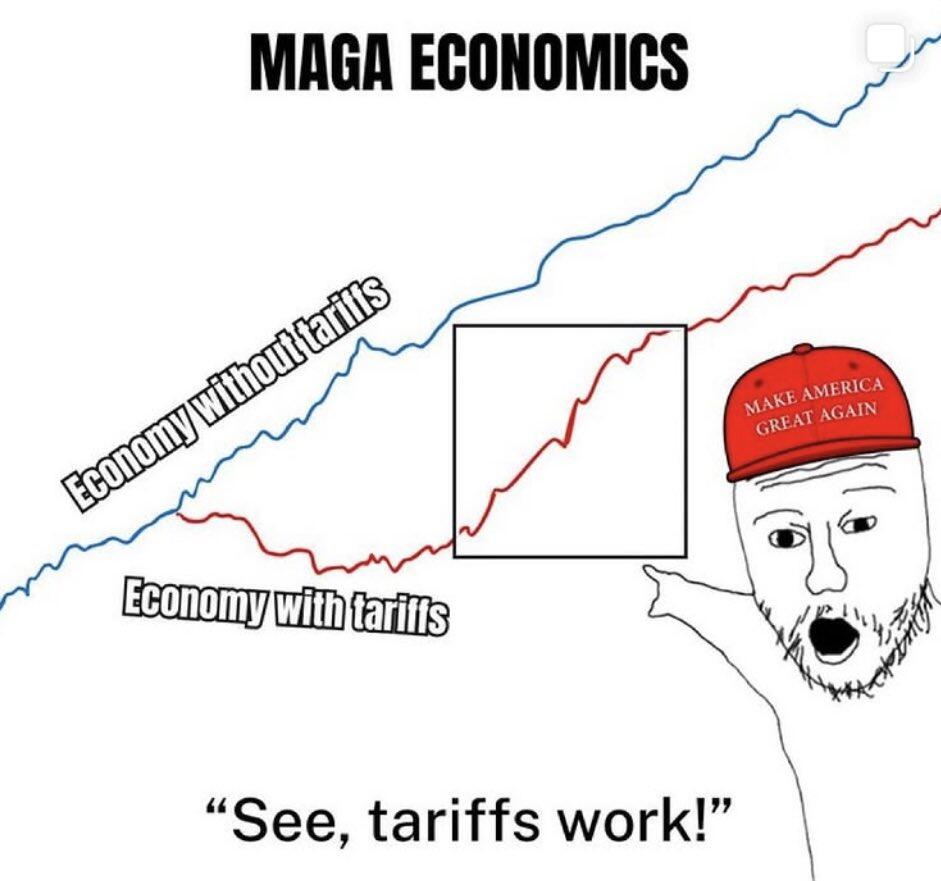
I have no idea where I saw this meme, but it makes me laugh

Last Friday, U.S. Treasury Secretary Scott Bessent took a victory lap as his department reported an unexpected increase in receipts from tariffs. The revenue undoubtedly came from a surge in imports to the U.S., which led to payments that filled federal coffers. It would seem to be a win for an administration that has staked an awful lot on waging a trade war with the entire planet to (take your pick) redress wrongs done to America, raise revenue for the government, and encourage domestic manufacturing and employment. But that victory lap comes too soon; the tariff windfall more likely represents efforts by U.S. firms to accumulate inventory before tariff rates rise even higher.

[…]

That mention of “higher prices on imported goods paid by US consumers and firms” deserves to be emphasized because it highlights the fact that tariffs are taxes on Americans. Ultimately, most of the burden of high rates is shouldered by companies and individuals within the U.S. As the Tax Foundation’s Alex Durante pointed out in February, “rather than hurting foreign exporters, the economic evidence shows American firms and consumers were hardest hit by the Trump tariffs”.

The Yale Budget Lab agrees, estimating in May that “the price level from all 2025 tariffs rises by 1.7% in the short-run, the equivalent of an average per household consumer loss of $2,800” in 2024 dollars. In particular, the Yale economists found “consumers facing 15% higher shoe prices and 14% higher apparel prices in the short-run”.

Even Walmart, which had vowed to absorb as much as possible of the tariff burden, conceded two months ago that prices would have to rise because of the trade war.

This week, the Federal Reserve Bank’s “beige book” noted that “in all twelve Districts, businesses reported experiencing modest to pronounced input cost pressures related to tariffs” and that “many firms passed on at least a portion of cost increases to consumers through price hikes or surcharges”.

Penn Wharton’s concerns, mentioned above, about “lower economic growth” are shared by the Tax Foundation and by the Yale Budget Project. The Tax Foundation’s Erica York and Alex Durante forecast that the Trump administration’s tariffs would “reduce US GDP by 0.8 percent” before taking foreign retaliation into account. Yale economists see a similar GDP reduction of 0.7 percent.

If the courts issue a final ruling against Trump’s use of the International Emergency Economic Powers Act (IEEPA) to impose tariffs, that will reduce the negative effects on the economy. But it will also take a chunk out of the revenues the administration expects to collect.

So, Secretary Bessent’s victory lap on tariff revenues was a little premature. And so are hopes that the trade war won’t damage commerce and the U.S. economy.

July 1, 2025

The Food Professor explains what Trump got right in his Trade War

On the social media site formerly known as Twitter, Dr. Sylvain Charlebois, aka @FoodProfessor explains how Trump’s Trade War strategy is working out for US interests, in contrast to the Trudeau/Carney governments’ approach:

The Globalism Hangover: What Trump’s Trade War Got Right

“Trump’s bombastic style aside, his nationalist approach to trade and food policy is forcing global institutions to justify their existence — and that’s a conversation Canada can no longer afford to ignore.”

For the past six months, President Donald Trump’s trade policies have been widely mocked, criticized, and condemned. Some of it is certainly warranted. The Wall Street Journal, for instance, recently likened his tariff-heavy approach to global trade as a direct path toward another Great Depression. But data out of the United States tells a more nuanced story — one that challenges conventional wisdom.

Despite persistent headwinds, the U.S. economy continues to outperform expectations. The Federal Reserve Bank of Atlanta projects second-quarter GDP growth at 3.8%. In May, the U.S. economy added 139,000 jobs, outpacing forecasts, while inflation remained subdued at 0.1% month-over-month and 2.4% annually. The U.S. trade deficit has been cut nearly in half, pointing to stronger export performance and a rebalancing of trade relationships.

Canada, by contrast, is showing signs of economic strain. The national economy is shrinking, manufacturing is struggling under U.S. trade pressure, and food inflation is outpacing general inflation. In short, our economy is not keeping pace—despite our public criticism of the Trump administration.

To make matters worse, the Trump administration has now halted all trade negotiations with Canada, signaling that our bilateral economic relationship holds little strategic value for Washington. For the U.S., Canada is no longer a priority — especially under a Carney-led government that has visibly pivoted toward Europe, a market still heavily invested in maintaining close ties with the United States. From an agri-food standpoint, this shift is consequential: access to our largest trading partner is narrowing, while Ottawa appears more focused on diplomatic optics than on securing stable, competitive trade channels for the Canadian agrifood economy.

This is the one thing the ‘Elbows Up’ crowd never understood — and still doesn’t. We’re not in a trade war with the U.S. There’s no war to be won. For Trump, this is about a realignment of the global order, plain and simple — one centered entirely on American supremacy.

Love him or loathe him, Trump is not destroying the U.S. economy — not yet, anyway. His unapologetically nationalist agenda extends far beyond tariffs. He has withdrawn U.S. support from key global institutions such as the WHO and is threatening to sever ties with others, including NATO and several UN-affiliated agencies. Among them is the Food and Agriculture Organization (FAO), the UN’s most authoritative body on food security.

At a recent event in Brazil, a senior FAO official acknowledged that fundraising dynamics have shifted. In the Trump era, governments are asking harder questions: Why should we fund the FAO? What domestic benefit does it provide? What used to be assumed support is now conditional — and arguably, more accountable.

This shift isn’t unique to Washington. Many countries are quietly aligning with the U.S. position, scrutinizing globalist institutions with renewed skepticism. Transparency and accountability are byproducts of this anti-globalist sentiment — something not inherently negative.

For decades, globalism pushed the world to believe that trade liberalization was the only viable path to growth and prosperity. It became conventional wisdom. But globalism has made some nations — and some people — richer, while leaving others behind. In the process, domestic sectors, including agriculture, were often sidelined or sacrificed in the name of global efficiency.

The problem with globalism, particularly in agri-food policy, is its tendency to pursue uniformity over relevance. Canada, for example, adopted the carbon tax under a globalist climate agenda that often overlooks the vital role food producers play in feeding people. Instead of being supported, the sector is too often vilified as a problem. But agriculture is not a liability — it is a necessity.

Trump’s message — wrapped, of course, in provocative and often abrasive language — is that one-size-fits-all global policies rarely work. Nations have different socio-economic realities, and those should come first. While cooperation is essential, so is recognizing local and regional priorities. In this sense, his “America First” approach is not without logic — especially when it seems to be yielding short-term economic gains.

For Canada’s agri-food sector, the lesson is clear: striking a better balance between global commitments and national imperatives is overdue. We should not abandon multilateral cooperation, but we must stop anchoring policy to global agendas we have little influence over. Instead, let’s define what works for Canadians — what supports our farmers, protects our food security, and reflects our unique landscape — while keeping the broader global context in view.

We are not there yet. But if this moment of disruption sparks a more realistic and regionally attuned approach to food policy, we’ll be better for it.

June 29, 2025

Carney’s insane determination to keep the Digital Services Tax

One of the most noted features of Prime Minister Mark Carney’s attitude toward, well, everything is his unwillingness to take the concerns of his opponents into account. He seems to feel that he always knows best and therefore any opposition is therefore, by his definition, wrong. The government had been warned by pretty much every observer that the attempt to impose a protectionist digital service levy had incredibly high chances of triggering blowback … and it has:

Mark Carney’s thought process when he encounters dissent, probably

In other words, you can have many reactions to the current DST battle, but surprise should not be one of them. Canada pushed ahead despite efforts at an international agreement on the issue and later dismissed the increasing friction over the issue with the U.S., which has been signalling its opposition to the DST for many years. Donald Trump has taken action, but his views are not dissimilar from Joe Biden’s on the issue nor Members of Congress from both parties. Further, the companies directly affected by the rules have been similarly responsive. For example, Google began levying a 2.5% DST fee on Canadian advertisers last year in anticipation of the DST taking effect in 2025, thereby passing along much of the DST cost to Canadian businesses and consumers.

To be clear, Canada is free to adopt whatever tax policies it wants and tech companies should pay their fair share of taxes. Ensuring tech companies collect and remit sales taxes on digital sales and services is now well established in Canada. But the government’s policy of “making web giants pay” by going above taxes all companies pay with a percentage of revenues to support Canadian film and television, millions for the news sector, and now the DST was always going to spark a reaction.

Further, the Canadian DST is exceptionally complex, covering a wide range of digital revenues that occur in Canada. The baseline applicability is for companies that generate 750 million euros (about C$1.1 billion) in global revenue of which at least $20 million is digital services revenue in Canada. Digital services revenue can arise from (1) online marketplace services revenue (which would cover an Ebay, Airbnb or Uber), (2) online advertising services revenue (Google or Microsoft), (3) social media services revenue (Facebook or TikTok), and (4) user data revenue (any company that collects and sells user data). Targeting these services means there is a lot stake, estimated by the Parliamentary Budget Officer at $7.2 billion over five years.

Other countries have DSTs, but Canada was the only one to introduce one despite an agreement to institute a moratorium on new DSTs years ago at the OECD. And then it was one of the only countries to reject an extension of that moratorium. The government insisted it would move ahead without delays and indicated it was confident it could avoid retaliation.

Given the trade tensions with the U.S. since the election of Donald Trump, unilaterally dropping the DST in the midst of a trade battle did not make much sense as we needed policy certainty under a broader deal. In other words, the DST was a card we had to play as part of a negotiation. But once we played that card by announcing the tax would take effect next week, it virtually guaranteed the U.S. would respond as it did. The priority should have been a broader deal. The government could have adopted a Trump-style delay for a month to give more time for negotiations. It could have have followed the UK model of weaving it into a broader agreement and committing to a larger digital trade deal. Instead, the government continued years of dismissing the trade risks associated with the DST, potentially creating bigger economic problems in the process.

Dan Knight on how Ottawa deliberately baited Trump, despite all the warnings that this was an incredibly stupid idea:

Donald Trump has officially walked away from the negotiating table. The trigger? Canada’s ill-conceived Digital Services Tax (DST) — a reckless, retroactive grab for revenue targeting U.S. tech firms. Trump isn’t mincing words: he’s calling it a “blatant, discriminatory attack” on American innovation, and now he’s moving to punish Canada economically for it.

So what exactly is this tax?

The Digital Services Tax, passed by the Liberal government and implemented under Mark Carney’s leadership, applies a 3% levy on revenue — not profits — earned by large digital firms operating in Canada. And it’s retroactive. That means it’s being applied to earnings from as far back as January 1, 2022, with companies forced to make lump-sum payments by June 30, 2025.

This tax specifically targets companies with global revenue of at least 750 million and Canadian digital revenue of at least CAD 20 million. Translation: It’s a direct hit on American giants like Google, Amazon, Meta, Airbnb, and Uber, and it spares Canadian firms and EU-based entities from equivalent exposure. It’s not tax fairness — it’s protectionism with a smiley-face sticker.

Trump has responded in kind. As of June 27, all trade negotiations with Canada are suspended. Retaliatory tariffs — already mounting since February — are set to escalate. Trump is drawing a red line, and he’s daring Canada to cross it.

What’s at stake?

Everything. Canada sends over 75% of its exports to the United States. We’re talking about nearly a trillion dollars in annual trade. With Trump now actively leveraging tariffs and ending negotiations, entire sectors — from automotive to agriculture, energy to manufacturing — are in the crosshairs.

Already this year, Trump has slapped 25% tariffs on Canadian imports, with specific hits to steel, aluminum, vehicles, and auto parts, and 10% tariffs on Canadian oil, gas, and potash. These moves have already disrupted markets. Ending trade negotiations is a body blow to an already wobbly Canadian economy — still reeling from Trudeau-era mismanagement and Carney’s corporate globalist agenda.

So who could have seen this coming?

Almost everyone.

June 17, 2025

BC is buying ferries from China … to spite Trump!

Filed under: Cancon, China, Government, Media, Politics — Tags: , , , — Nicholas @ 03:00

After all the “buy Canadian” blather of the last federal election campaign, it was only a matter of time before the feds or one of the provinces did something astoundingly out-of-step with the mantra. Smart money was always on Quebec being the first (because that often makes sense for internal provincial political reasons), but no, this time it’s British Columbia going a long way out of their way to not buy Canadian for a huge government purchase:

BC Ferries’ MV Spirit Of Vancouver Island between Galiano Island (Bluffs Park) and Mayne Island, en route from Tsawwassen to Swartz Bay, BC on April 6, 2022.
Photo by Gordon Leggett via Wikimedia Commons.

British Columbia’s transportation minister claimed Friday that buying new ferries from European shipyards would have cost roughly $1.2 billion more than buying them from a Chinese government-owned shipyard in Weihai, Shandong province, which is a city roughly the size of Montreal that I had never heard of until this week. China knows how to build cities. They burst into existence from nothing, like popcorn. China also knows how to build ships, and highways, and high-speed rail, and just about anything else you would care to name, better and more efficiently than the Canadian public service can realistically comprehend.

The four ships B.C. Ferries is fixing to replace, of 1960s and 1970s vintage, were built at Seaspan in North Vancouver (which is an active shipyard), at the Victoria Machinery Depot (which is no longer an active shipyard), and at the Burrard Dry Dock (which is also defunct). Canada’s shipyards, for better or worse — certainly for expensive! — are very busy building things for the navy.

B.C. Ferries has plenty of experience with foreign-built vessels. Its current fleet includes ships built in Romania, Poland, Germany and Greece. Other than the Baynes Sound cable ferry on Vancouver Island — which is not especially popular — the Crown corporation’s newest Canadian-built boat went into service in 1997. So “foreign” obviously isn’t the problem.

But China is China, and that’s legitimately another thing. China is not a Canadian ally. They try to screw with our democracy, and most other democracies by the sounds of it. And right now we are in a profoundly protectionist moment: Across the political spectrum, mostly because of President Donald Trump, “buy Canadian” is the only philosophy really on offer.

But does that make sense? We should pay over the odds for ferries … because of Trump? There wasn’t half of all this foofaraw when Marine Atlantic on the East Coast bought its newest ferry from Weihai. Since last year it has safely been shepherding Canadians between Nova Scotia and Newfoundland, without a whisper of controversy in the Rest of Canada.

I don’t quite get the Trump angle, which is perhaps why I’m more interested in Dean Broughton‘s take:

… I’m not just disappointed — I’m furious — about the NDP government’s decision to award the construction of four new BC Ferries vessels to a Chinese state-owned shipyard. This isn’t just outsourcing. It’s betrayal dressed up as budget management.

Back in 2021, the NDP government unveiled a “Made-in-B.C.” shipbuilding strategy with great fanfare. They formed a Shipbuilding Advisory Committee, posed for cameras, and promised to rebuild a long-neglected industry. It was supposed to be a turning point, a real investment in local jobs and industrial capacity.

Now, many of those same politicians have turned their backs on everything they claimed to support. Not only did they ship the contracts overseas, but, according to Eric McNeely, president of the BC Ferry and Marine Workers’ Union, they didn’t even give B.C. shipyards a fair shot. The procurement process was so rushed and restrictive that no local yard could realistically compete. They didn’t lose the bid — they were boxed out.

That’s not fiscal prudence. That’s political cowardice.

The hypocrisy is staggering. This is the same government that talks endlessly about investing in clean industry and supporting working families, and they just handed a massive public contract to a country with a well-documented record of environmental abuses and human rights violations.

They talk about reconciliation and sustainable development—and then funnel hundreds of millions to an authoritarian regime.

Worse still, they did this knowing full well that B.C.’s industrial base is already in decline.

We have so little left beyond resource extraction. Shipbuilding could have been part of our economic renewal. Instead, it’s another casualty of government optics and empty promises.

I remember my father’s outrage in 1990 when the federal government cancelled the Polar 8 icebreaker — a Canadian-built vessel meant to defend our Arctic sovereignty. That decision was dismissed as a “cost-saving measure” and today our claim to the North has never been weaker.

The BC Ferries decision reeks of the same short-sighted logic.

June 13, 2025

QotD: The Subaru BRAT

Filed under: Business, Government, History, Japan, Quotations, USA — Tags: , , , — Nicholas @ 01:00

Imagine, if you can, a truck with factory-mounted seats in the bed — and spotlights the size of a 747’s landing lights mounted on its T-topped roof.

If you know this truck, you also know why it’s no longer available.

Such fun things are no longer allowed.

They are not saaaaaaaaaaaaaaaaafe! “Moms” are “concerned”!

But in 1977, the Safety Cult — which ended such fun things — was still a backwater aberration, like dancing with rattlesnakes — and most people still esteemed fun over fear. There were roofless Broncos and K5 Blazers — and cars with beds.

You could buy all kinds of different stuff back when America was still a fairly free country — and the Subaru BRAT was as different as it got.

BRAT — all caps — was short for Bi-Drive Recreational All-Terrain Transporter. It was superficially similar to other small import pickups of the ’70s, such as the Datsun 620 and similar models from Toyota (SR5), Mazda (B210), and Chevy (via Isuzu) Luv.

But unlike them, it was a four seater — with two of the four in the bed, facing the other way. The seats were made of all-weather plastic and far from the most comfortable — but the view was spectacular. Watching the world recede as you progressed is another one of many freedoms denied today in the name of “safety”.

Subaru wasn’t “unconcerned” about “safety”. Grab handles — to keep passengers from bouncing out of the bed — were included. Though holding onto them made it harder to reach for a cold one in the cooler. That was another fun thing people did in pickups back in the day — before the Safety Cult put the kibosh on that, too.

The seats were actually a dodge — of a federal fatwa known as the “chicken tax”, which was a retaliatory tariff of 25 percent applied to import-brand pickups manufactured outside the United States as tit-for-tat for tariffs applied by foreign countries to American chicken exported outside the United States.

The “chicken tax” hit trucks with just two seats — at the time almost exclusively the small import models, which didn’t offer the extended and crew cab configurations that are commonplace today.

By adding the extra seats in the bed, BRAT qualified as a passenger vehicle rather than a “light truck”, and thus Subaru evaded the chicken tax on a happy technicality — and was also able to sell the BRAT for less than two-seater rivals that had the cost of the tax folded into their MSRP.

Eric Peters, “Doomed: Subaru BRAT (1977-87)”, The American Spectator, 2020-04-26.

June 12, 2025

Why it’s economically impossible for Walmart to “eat the tariffs” as Trump demands

Filed under: Business, Economics, Government, Politics, USA — Tags: , — Nicholas @ 04:00

At FEE, Peter Jacobsen shows the clear financial reason why Walmart and other big US retailers are passing along the price increases due to Trump’s tariffs rather than “eating them”:

Recently, a post from President Trump on Truth Social went viral. An attempt to convince retail giant Walmart to keep prices down despite the tariffs, it read:

    Walmart should STOP trying to blame Tariffs as the reason for raising prices throughout the chain. Walmart made BILLIONS OF DOLLARS last year, far more than expected. Between Walmart and China they should, as is said, “EAT THE TARIFFS”, and not charge valued customers ANYTHING. I’ll be watching, and so will your customers!!!

Trump’s demand here is, simply put, unreasonable, and it reflects a basic misunderstanding of how pricing decisions are made in a market economy. Let’s unpack why.

Walmart’s Thin Margins

The biggest problem with the President’s view is that it doesn’t pass a basic numbers test. To break it down, let’s look at Walmart’s financials.

It’s true that Walmart generates billions of dollars in revenue each year, but revenue alone doesn’t tell us how much Walmart makes.

To understand that, we need to consider profit, which accounts for the company’s costs. More specifically, we want to look at Walmart’s net profit margin, because that’s an extremely important indicator of whether Walmart could realistically “eat the tariffs”.

Depending on the source, Walmart’s net profit margin is somewhere between 2% and 3%. Let’s split the difference and say it’s 2.5%. What does that mean?

That means, if Walmart sells you $1 of goods, it only keeps 2.5 cents in profit. That’s right, 97.5 cents goes toward inventory, employee wages, store maintenance, and a variety of other operating costs.

Put another way, if you spend $100 at Walmart, they make $2.50 in profit.

Now let’s say you buy a $100 television that Walmart imports. A $20 tariff is imposed — an added cost Walmart has to pay to import the TV. Before the tariff, Walmart was making $2.50 in profits. After the tariff, it’s now taking a $17.50 loss.

The only way Walmart can still sell this TV is by raising the price.

At this point, a tariff supporter might respond: “The easy way to fix this is to buy US-made TVs instead!”

Sure — you can avoid tariffs by only buying domestic, but the problem is that domestic TVs tend to be more expensive. If they weren’t, Walmart wouldn’t be importing them in the first place. So even if Walmart pulls international TVs off the shelves and replaces them with US-made ones, the prices still increase.

Here’s the key point: “eating” the tariffs is not an option. Walmart operates on slim margins, barely making pennies on the dollar — there isn’t room to eat 20% cost increases!

May 31, 2025

“U.S. libertarians [are] the best friends Canada doesn’t know it has”

In the National Post, Colby Cosh sings the praises of American libertarians for their work in trying to dismantle some of Donald Trump’s dubiously Constitutional extensions of presidential power:

The James L. Watson Court of International Trade Building at 1 Federal Plaza in Lower Manhattan, New York City.
Photo by Americasroof via Wikimedia Commons.

The U.S. Court of International Trade (CIT) issued a decision Wednesday that annuls various salvos of surprise economic tariffs, including ones on Canada, that have been enacted by President Donald Trump since his inauguration in January. I won’t lie to you: I had the same initial reaction to this consequential news that you probably did, which was “Hooray!” and then “Huh, there’s a U.S. Court of International Trade?”

This court is surely unfamiliar even to most Americans, no doubt because much of its work involves settling issues like “Do hockey pants count as ‘garments’ or ‘sports equipment’ under customs law?” Nevertheless, the CIT does have exclusive jurisdiction over civil actions involving U.S. trade law. It’s just that no president has ever before rewritten the tariff schedule of the republic in the half-mad fashion of a child taking crayons to a fresh-painted wall.

The American Constitution, from day one, has unambiguously assigned the right to set international tariffs to Congress. Congress is allowed to delegate its powers to the president and his agents for limited or temporary purposes, but it can’t abandon those powers to him altogether. Defining this legal frontier is what the CIT was asked to do, and their demarcation of it will now swim upward through higher appellate courts (its decision has been put on hold in the meantime).

The lawsuit was actually two parallel suits raising overlapping objections to the tariffs. One was brought forward by 12 U.S. states, and the other was filed by a group of tariff-exposed American businesses, including manufacturers of bikes, electronics kits and fishing equipment. The latter set of plaintiffs was roped together by the usual posse of heroic libertarians and legal originalists, including George Mason University law prof Ilya Somin.

About 24 hours after Trump originally announced the “Liberation Day” worldwide tariffs, Somin quickly blogged about how insanely unconstitutional the whole idea was, and concluded his article essentially by saying “I’m darn well gonna do something about this nonsense”. I don’t mean to suggest he deserves primary credit; I only intend to call attention, once again, to U.S. libertarians being the best friends Canada doesn’t know it has.

May 25, 2025

Comparing Japan’s supply management system to the Canadian version

Colby Cosh considers the fate of a Japanese government minister who accidentally told the truth about a subject near and dear to Japanese consumers’ hearts (well, stomachs, actually):

“Japanese Girls at Work in the Rice Fields – Grand Old Fuji-Yama in the Distance, Japan” by Boston Public Library is licensed under CC BY 2.0 .

I’m sure some of you saw Wednesday’s NP headline for an Associated Press wire story: “Japan’s agriculture minister resigns after saying he ‘never had to buy rice’” AP’s Mari Yamaguchi explained this international-news nugget. A cabinet minister in a shaky minority government made a flippant comment indicating that he was light-years out of touch with ordinary people facing high grocery costs in a developed country.

Taku Eto’s political survival thus became impossible within a matter of hours, and his prime minister hastily swapped a congenial young star into the agriculture portfolio. Japan is a constitutional monarchy with a system of parliamentary government more or less like ours, so there’s nothing incomprehensible about any of this to a Canadian …

… but, of course, one almost couldn’t help flashing back to our recent election campaign, wherein the prime minister had half-boasted to a Radio-Canada reporter that he doesn’t buy his own groceries and has no earthly idea how the stuff in his fridge gets there. It struck me at the time that this was a classic mistake for an electoral neophyte like Mark Carney. Fans of the legendary American columnist Michael Kinsley will surely think of it as a “Kinsley gaffe”, i.e., an obviously true statement that is nevertheless bound to get a politician in trouble.

[…]

Eto was talking about rice because the prices for it in Japan have gone through the roof, the clouds and the stratosphere. And rice plays a role in the Japanese culture and diet for which there is no analogue in omnivorous Canada. For precisely that reason, rice is supply-managed there in much the same way our dairy, eggs and poultry are — i.e., through confiscatory tariffs on foreign products, along with a mafia of politically powerful producer cooperatives who operate under supply quotas.

If you read Canadian news, you can recite the effects of this, whether or not you’re capable of finding Japan on a map of Japan. Their supply-management system is, like ours, a major headache for counterparties in trade negotiations. Their farmers, like Canada’s, are dwindling in number and aging out of the business. They are sometimes paid to destroy crops. Farm costs for machinery and supplies are subject to inflation. And sometimes the system for domestic demand forecasting blows a tire.

It’s a constant high-wire act for Japanese governments, who still have official responsibility for the national rice supply under wartime statute. If store-shelf prices get too high, and consumers start to make trouble, the cabinet must consider loosening tariff barriers and releasing rice from the national strategic reserve. The LDP ministry has done both these things in the face of hallucinatory prices, and so the farmers are now just as ticked off as the buying public.

« Newer PostsOlder Posts »

Powered by WordPress