Quotulatiousness

May 18, 2025

Trump today, Taft a century ago – interfering with Canadian federal elections

Filed under: Cancon, Government, History, Media, Politics, USA — Tags: , , , , — Nicholas @ 03:00

In the Coolidge Review, Amity Shlaes looks at the long-ago pre-Trumpian example of US interference in Canadian federal politics:

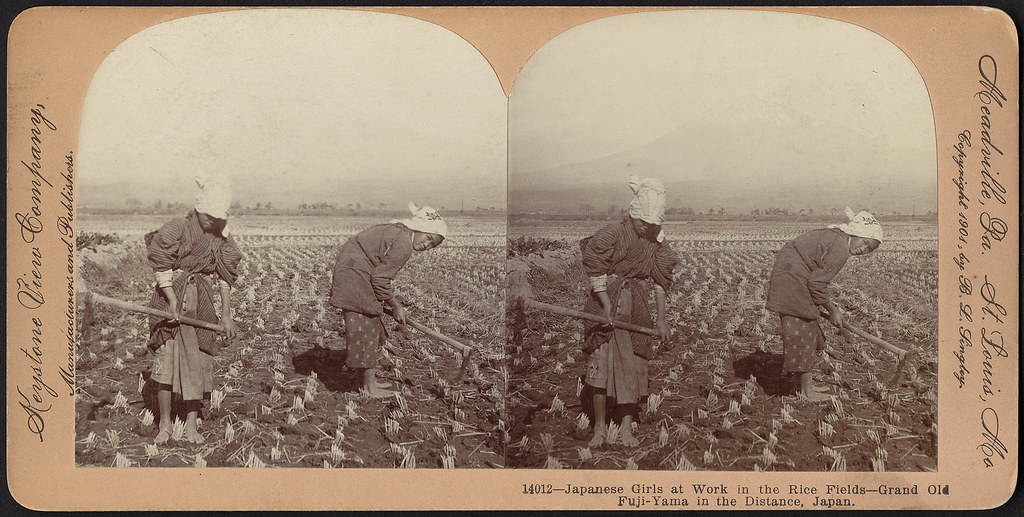
President Trump isn’t the first U.S. leader to turn a Canadian election with a few remarks. A little over a century back another president, William Howard Taft, managed the same feat.

The story starts in 1908, when outgoing president Theodore Roosevelt handpicked a successor, the lawyerly Taft. Taft won election. But from the eve of inauguration, Roosevelt began to voice doubts that Taft was up to the job. Word got around. Taft reacted to this disloyalty by attempting to prove he was no Roosevelt puppet. Where Roosevelt had invaded nations, Taft would write trade treaties. As Taft biographer Jeffrey Rosen writes, the motto of Roosevelt had been “speak softly and carry a big stick”. Taft’s maxim could have been “speak softly and carry a free-trade agreement”.

Taft’s marquee effort was to be a trade agreement with Canada, then lodged in the ambiguous status of “self-governing dominion”. As Taft noted, the dominion did have the freedom to conduct trade policy. Canada’s prime minister, Wilfrid Laurier, was a distinguished free marketeer. The political stars appeared to align. In his enthusiasm Taft praised Canada, practically crowing: “She has cost us nothing in the way of preparations for defense against her possible assault, and she never will … I therefore earnestly hope that the measure will be promptly enacted into law.” Such a treaty, Taft said, would mark a new “epoch” for North America.

In those days, tariffs represented a much more important share of U.S. federal revenues. Selling free trade was no easy work, especially not to Republicans, for whom tariffs were part of the brand. Then as now, trade treaties, unlike peace treaties, required support from both chambers of Congress. But again Taft sang his heart out, not only making the usual case for an “increase in trade on both sides of the boundary line” but also trying out wider arguments.

Early in 1911, Taft infused urgency into negotiations by threatening Canada via ultimatum: Team up with the United States, or there might be a “parting of the ways”. Hunting votes at home, Taft wrote a private letter to the still influential Roosevelt. Appealing to the imperialist in his predecessor, though not very hard, Taft suggested such a treaty might render Canada “only an adjunct of the United States”. Historians debate whether the “adjunct” letter was leaked or stayed private over the course of the 1911 negotiations. Lawmakers on the Hill, in any case, began to speak in similar tones.

Next, Taft called a special session of Congress. Congress warmed to the treaty but pounded the imperialist angle as much as Taft’s main case. “I hope to see the day when the American flag will float over every square foot of the British North American possessions, clear to the North Pole,” thundered the soon-to-be House Speaker, James Beauchamp “Champ” Clark of Missouri.

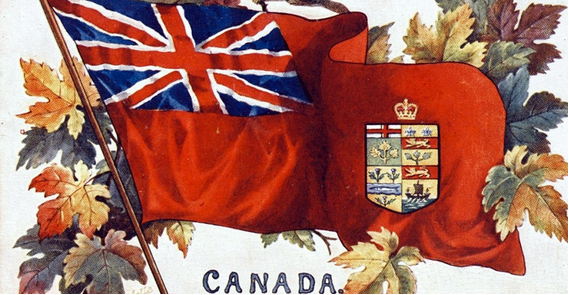
Such statements did not elude Canadian ears. Some loathed the treaty for pulling Canada farther from Britain; others, independence minded, loathed the idea of trading the thumb of one empire upon them for the thumb of another. By the time Taft signed the Tariff Reciprocity Agreement in July 1911, Canadian reciprocity opponents were on the march. By September, Canada was rejecting in a landslide referendum Taft’s and Laurier’s work.

As The Literary Digest commented in 1912, these flamboyant statements from U.S. politicians were handy weapons for Canada’s treaty opponents. They had put into Canadian Conservatives’ hands “an excellent club with which to cudgel the Liberals and their brilliant leader, Laurier”. Laurier himself was defeated in an election as well, on the argument he was pandering to the U.S.

May 6, 2025

If “a trade imbalance constitutes an American ‘subsidy’ justifying annexation of that country, then the US is going to have to annex most of the planet”

Filed under: Britain, Cancon, Government, Media, Politics, USA — Tags: , , , , , — Nicholas @ 05:00

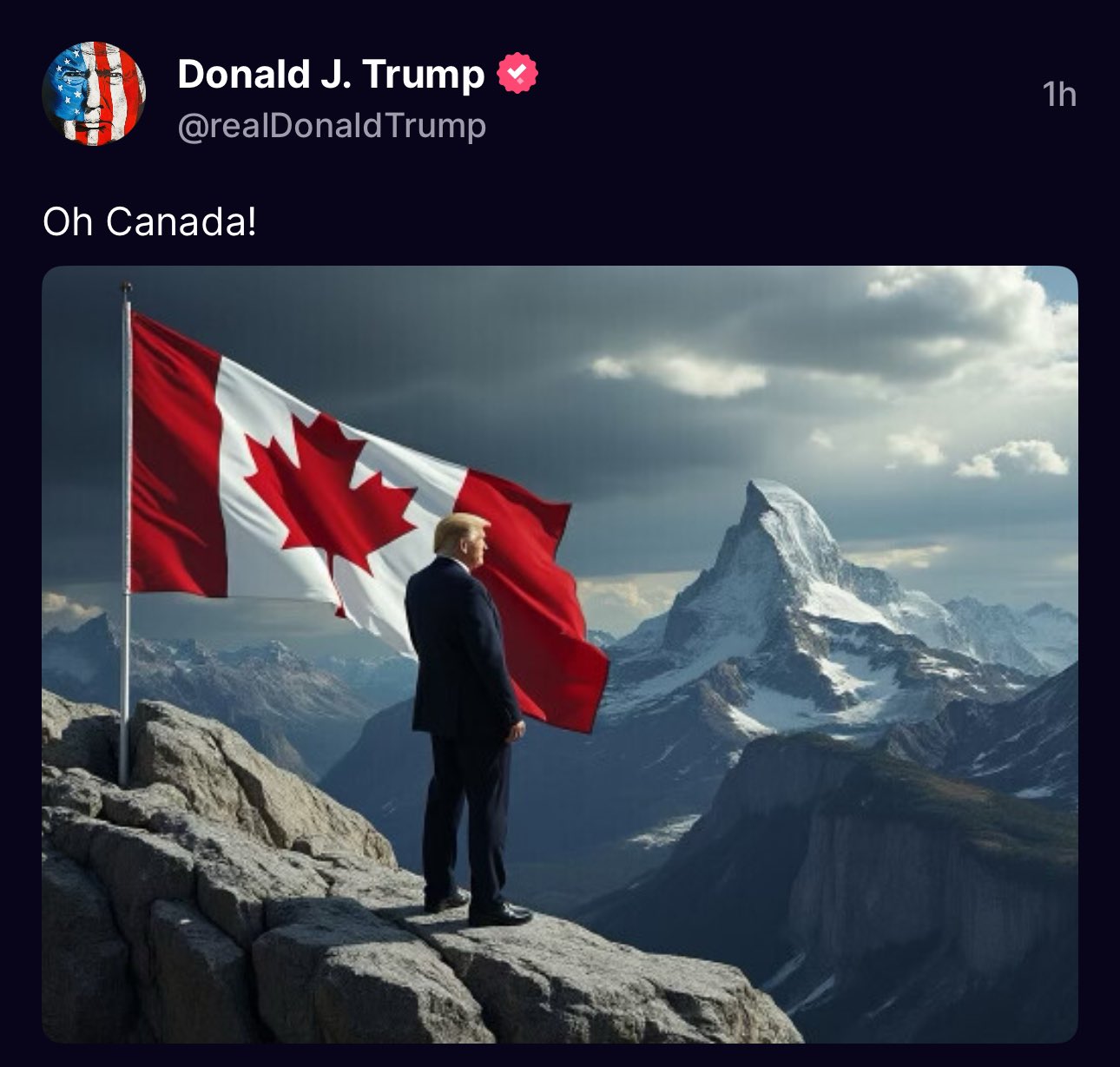
Despite getting his preferred choice elected as Canadian Prime Minister, US President Donald Trump still seems determined to troll Canadians about becoming the “51st state”. Among his shifting set of justifications for this is the trade imbalance between the US and Canada, which Trump chooses to interpet as a “huge” subsidy the US is providing to Canada. On that basis, there are going to have to be a lot more US states in the future:

So now we have serious commentators gaming out the pros and cons of war with Canada. What started out as a mildly amusing bit of presidential “trolling” is now being discussed as next year’s Donbass.

If, for the purposes of argument, one accepts the President’s line that a trade imbalance constitutes an American “subsidy” justifying annexation of that country, then the US is going to have to annex most of the planet: last year Washington had a one-and-a-quarter trillion-dollar imbalance with the world. It’s not hard to figure out why: over recent decades the uniparty turned a country that used to make things into a crappy low-wage service economy. […] The US now has trade imbalances with — or “subsidies” of — not only the countries that you’d expect (China, Mexico, Germany, Japan, India) but a lot of ones you wouldn’t (Finland, Algeria).

True, Canada is closer than Algeria, so there are national-security implications for Washington: the country and its politicians (Trudeau, Carney) have been entirely hollowed out by Peking, but then so it goes south of the border (Biden, McConnell). And Trump’s plan for a “fifty-first state” will not solve that problem.

The “fifty-first state” shtick can’t ever have been serious, can it? Geographically, the fifty-first state would be bigger than the other fifty combined, and with a bigger population than California’s. Last time they added stars to the flag, both parties got something out of it: the GOP Alaska and the Dems Hawaii. So wouldn’t it make more sense to make Canada’s ten provinces and three territories a baker’s dozen of new American states with a couple of senators apiece? Yeah, sure – if you want Republicans never to win a national election again.
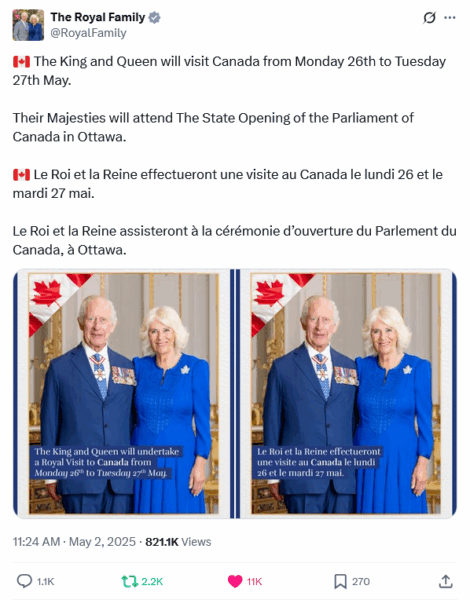
So, aside from last week’s vote, how is the other side reacting? Last Thursday’s print edition of The Spectator contained a curiously phrased squib from my old editor, Charles Moore:

    The President may be only hazily aware that the King, of whom, he says, he has the “honour to be a friend”, is also King of Canada. If, as seems likely, the King follows his mother’s twice-used precedent and opens the new Canadian parliament in person, Trump may come to see that his next-door neighbour is part of a long-standing, legitimate order which Canadian voters are happy to endorse.

Let’s just run that again:

    If, as seems likely, the King follows his mother’s twice-used precedent and opens the new Canadian parliament in person …

The last time his mother opened Parliament in Ottawa was in 1977 — her Silver Jubilee year. Trudeau-wise, Justin’s father Pierre was not keen on it, but didn’t feel he could pick and win a fight with the Palace over it. A quarter-century later, Trudeau’s successor Jean Chrétien, a towering colossus of micro-pettiness, was annoyed at being given a crappy seat at the Queen Mum’s funeral and so scuttled Her Majesty’s Golden Jubilee throne speech.

So why would Charles Moore think it “likely” that the King would be opening Parliament in Ottawa later this month? If, as it was in my day, Speccie columns for Thursday’s magazine have to be filed on Tuesday, that would make Moore the first guy in either the Canadian or UK media to know what was not revealed to the world until Friday […]

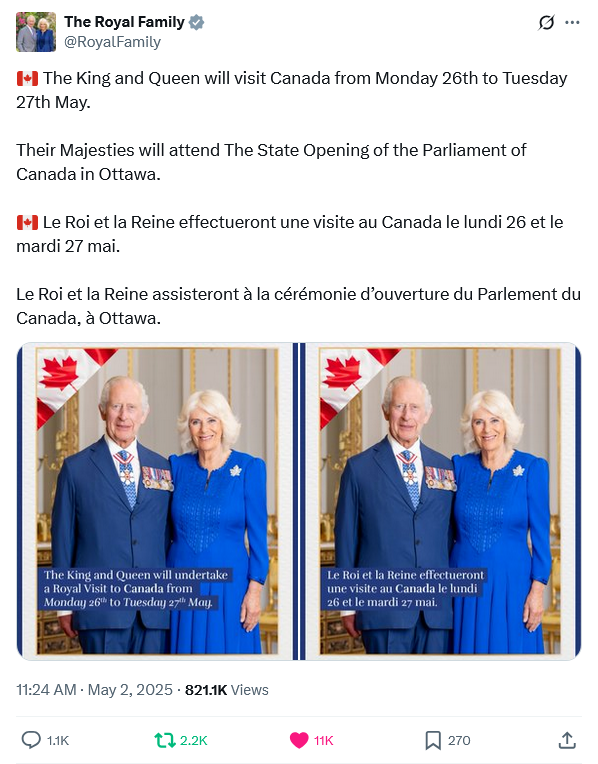
The King has travelled far less in the first three years of his reign than his mother did: shortly after her Coronation, the Queen set off on a tour of parts of the Commonwealth that kept her away from London for six months. Her son can’t do that because he’s very sick with cancer. So it’s quite something that he’ll land in Ottawa on Monday May 26th, deliver the throne speech the following day, and then fly out again. Carney wouldn’t be doing this if he weren’t going to take the opportunity to put his view of Canadian sovereignty into the Sovereign’s mouth.

So, if Trump really has the “honour to be a friend” of the King, the only point of this 24-hour flying visit is so His Majesty can send the message that friends don’t let friends threaten to steal each other’s countries. In fact, he has made a point of referring to himself as “King of Canada” quite a bit of late. […] The “King of Canada” bit was done at the instigation of Carney. Which is odd. Especially from a party that has spent half-a-century diminishing and degrading the Crown, and for a monarch who is, unlike his mother, largely unloved and unloveable. Yet Carney seems belatedly to have come around to the old-school monarchist view that, without the Sovereign, there is insufficient to distinguish Canada from its domineering southern neighbour — especially when that neighbour keeps talking about taking it. On the other hand, both the King and his Canadian prime minister are bigtime players at the World Economic Forum, so they’re not the most obvious choice for defenders of national sovereignty. On the other other hand, it’s one thing to surrender it to fellow globalists, quite another to surrender it to Donald Trump.

I have no idea where this is headed, and if anyone can enlighten me I’d be happy to hear it. But Trump has doubled down on it, and Carney is playing the King card to oppose it. As longtime readers know, I have a general preference for smaller nations as happier homes for their people. If Alberta or Quebec voted to secede, why would you take the trouble to do that just to become a minor and inconsequential part of another big country?

But, that aside, why would it be in America’s interest to absorb a hostile population of mostly lefties over a vast and unpoliceable landmass? The history of the last thirty years is that China has shown there are subtler ways of taking over the world without firing a shot, while America has persisted in doing it the old-fashioned way and, in Iraq, Afghanistan, Ukraine and elsewhere, has gotten nowhere. Why add Canada to the list?


May 5, 2025

Make America Austere Again?

Filed under: Economics, Government, Media, Politics, USA — Tags: , , , , — Nicholas @ 03:00

The first 100 days of the BOM haven’t been quite what anyone expected. Close allies and trading partners were shocked at the new administration’s devotion to 1920s tariff “diplomacy”, supporters were dismayed to not get lots and lots of perceived wrongdoers of the Biden administration getting perp-walked for the cameras, and ordinary Americans were presented with a much worse domestic economy than they were promised:

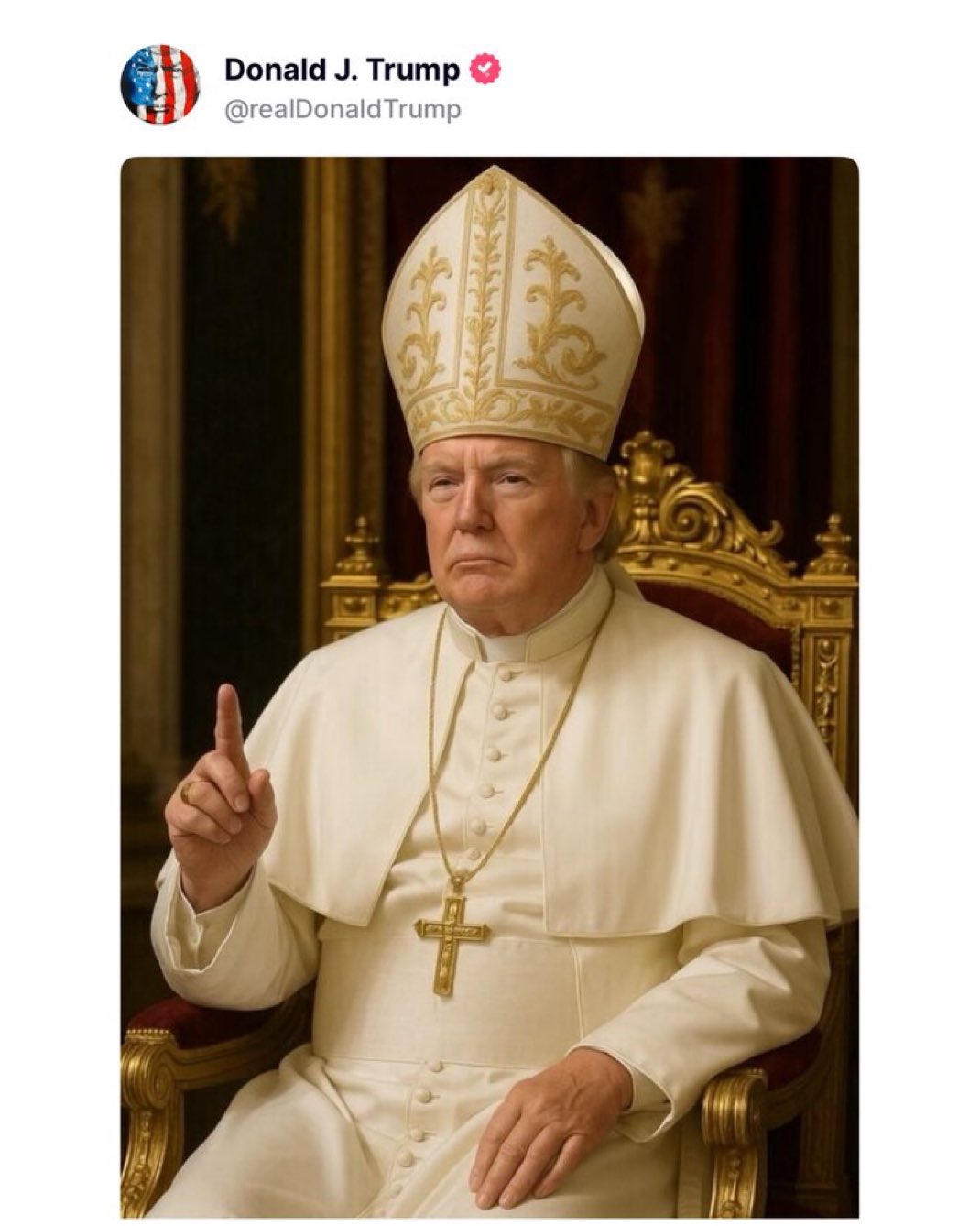
Trump wasn’t totally fixated on economic matters … he still found time in his busy schedule to troll Catholics on his Truth Social platform.

On Wednesday, in the prelude to a cabinet meeting, U.S. President Donald Trump made yet another remark to chill the blood for those concerned about his country. Trump’s cat-and-mouse game of arbitrary changes to American import tariffs is starting to raise concerns about prices and supply chains for consumer goods. The American economy has unexpectedly shrunk in the first 100 days of Trump 2.0, even though workers and businesses are scrambling to make purchases before the effects of Trump tariffs set in. The underlying state of the economy is probably worse than the short-term numbers.

Trump says this is all a matter of “get(ting) rid of the Biden ‘Overhang'”, i.e., it’s his immediate predecessor’s fault. And let’s face it: no other politician on Earth would say anything else 100 days into an executive term. If that was as far as Trump went, it wouldn’t be of unusual concern. What struck me was his separate remark implying that, yeah, tariffs might foul up supply chains a little in the transition to the glorious economy of the future, but haven’t we Americans had it too soft for too long?

“Maybe the children will have two dolls instead of 30 dolls,” the president mused. “So maybe the two dolls will cost a couple bucks more than they would normally.” The message, which brazenly puts the contentment of children front and centre, is one you can’t imagine any other American leader delivering so directly in peacetime: have you all considered being happy with less?

The answer one would expect the median American voter to give is “Hell no”. It’s crazy that I should have to write this, but consumer abundance is a defining feature of the United States! During the Cold War, American supermarkets were the unanswerable argument for economic freedom: you could summarize the United States pretty reasonably as “It’s the country that coined the word ‘super-market'”. In our hyper-interconnected social-media world, I see a dozen conversations a week in which some European boasts of affordable healthcare, walkable neighbourhoods and having July and August and half of September off work every year: the inevitable answer from Americans is “OK, but have you been inside a Buc-ee’s, Gustav?”

Of course, it’s been a very long time since media-decried austerity in government has actually meant any kind of actual reduction in outlay … it’s usually just a (very) slight decrease in the rate of increase rather than actual dollar-value reduction. But, as Chris Bray points out, this time for sure:

I was planning to spend $100 on groceries this morning, but then I decided to slash my grocery budget, so the amount I actually spent on groceries plummeted to just $99.97, plus a small eight dollar supplemental on previously deferred grocery needs, bringing the total to a shockingly parsimonious $107.97. These major cuts caused serious alarm in my household.

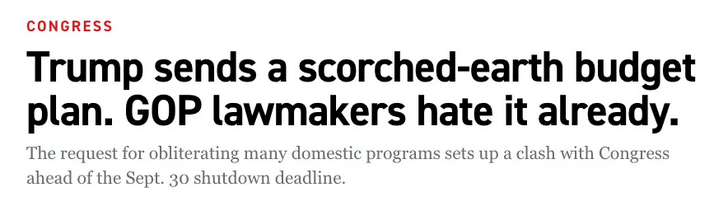
Donald Trump, Politico warns, is scorching the earth:

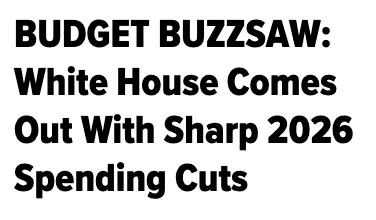
This is the common theme everywhere, as the administration offers the first not-very-detailed hints about its plans for FY ‘26 discretionary federal outlays. The Huffington Post concludes that Trump is pulling out the BUZZSAW:

The Federal News Network sums up the size of the hit, and compare the topline number to the language about scorched earth and buzzsaws:

    Overall, the administration is looking to increase national security spending next year by 13% and decrease non-defense discretionary spending by 7.6%, meaning the White House is asking for $1.7 trillion for the discretionary budget down from $1.83 trillion this year.

While the White House plans don’t get into the subject of total federal spending, focusing narrowly on discretionary spending, the implication is that federal spending overall will go from about $7 trillion to about … $7 trillion. But TBD.

You can read the entire White House proposal for discretionary funding here. Trump is proposing deep cuts in some federal departments and programs, but is also proposing to offset those cuts with sharp increases in military spending and “homeland security”, meaning border security and sending poor gentle immigrants to places where Chris Van Hollen will fly to stare into their beautiful eyes.

April 29, 2025

The US Cancels Tariffs and Saves the World – W2W 025

TimeGhost History
Published 28 Apr 2025

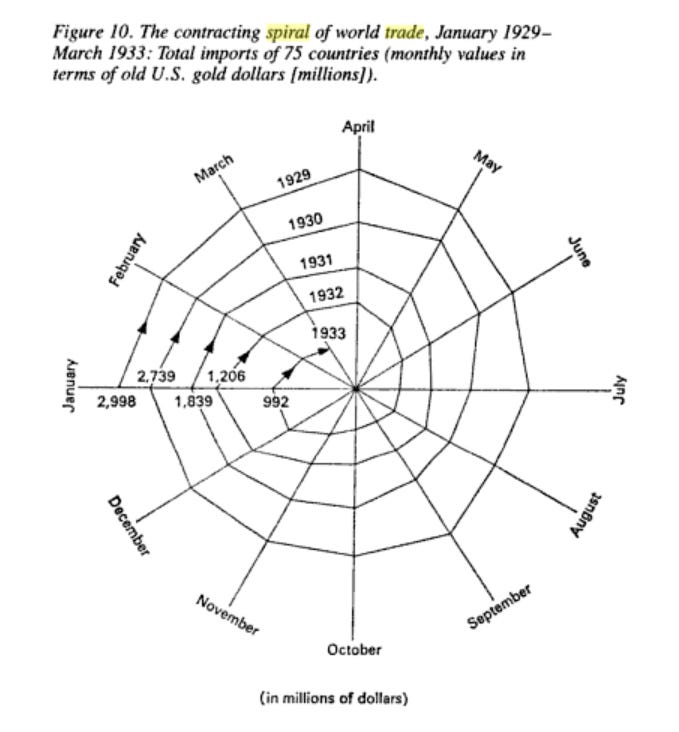
After seeing the devastating effects of the trade war that ravaged the global economy between the world wars, in 1948 the US is determined to usher in an age of free trade and global cooperation that will last until the spring of 2025.
(more…)

April 24, 2025

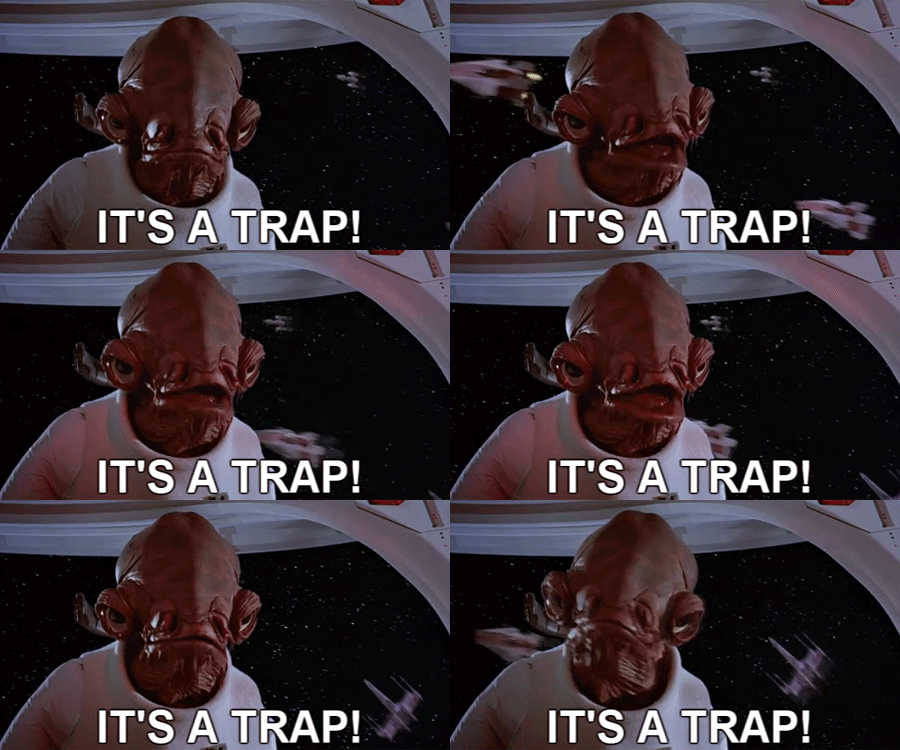
“Call for Admiral Ackbar! Paging Admiral Ackbar. Admiral Ackbar to the white courtesy phone, please.”

Filed under: Cancon, China, Media, Politics, USA — Tags: , , , — Nicholas @ 05:00

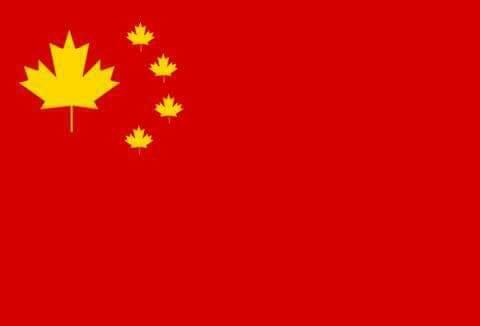
What a wonderful, heartwarming story: those cuddly folks in Beijing are reaching out to Canada to “partner with” as a way of warding off American “bullying”. How nice! What a great idea! With the best possible intentions. What could possibly go wrong?

China’s ambassador says Beijing is offering to form a partnership with Canada to push back against American “bullying”, suggesting the two countries could rally other nations to stop Washington from undermining global rules.

“We want to avoid the situation where humanity is brought back to a world of the law of the jungle again,” Chinese Ambassador Wang Di told The Canadian Press in a wide-ranging interview.

“China is Canada’s opportunity, not Canada’s threat,” he said through the embassy’s interpreter.

Wang — whose office requested the interview with The Canadian Press — said that China and Canada appear to be the only countries taking “concrete and real countermeasures against the unjustified U.S. tariffs” imposed by U.S. President Donald Trump.

“We have taken notice that, faced with the U.S.’s unilateral bullying, Canada has not backed down,” he said. “Instead, Canada is standing on the right side of the history, on the right side of international fairness and justice.”

He said Beijing and Ottawa should work together to convince other countries not to placate the Trump administration and to make Washington pay a price for breaking global trade rules.

Roland Paris, who leads the University of Ottawa’s graduate school of international affairs, said Beijing has long sought to reshape international institutions to advance its own interests — efforts that often have put China at odds with Ottawa’s foreign policy.

He said Canadian businesses should take a cautious approach to China, where they still face the risk of import bans and arbitrary detainment.

“The mercenary use of tariffs and non-tariff barriers that we’re seeing from the Trump administration has been practised for a long time by China in different forms,” Paris said.

“China has played its own version of hardball and abused trade rules in the past to coerce countries, including Canada, that have dared to displease Beijing.”

As the rivalry between the U.S. and China has intensified, Canada has generally followed Washington’s lead on restricting certain types of commerce with China.

Last fall — in an effort to protect Canadian auto sector jobs and allay American concerns about threats to supply chains — the federal government imposed 100 per cent tariffs on imports of Chinese-made electric vehicles that all but banned Chinese EVs from the Canadian market.

Canada alleged unfair trade practices including “a state-directed policy of overcapacity and oversupply,” and “lack of rigorous labour and environmental standards”.

Beijing retaliated by imposing large tariffs on Canadian canola and pork — duties Wang said Beijing is happy to drop if Ottawa drops its own tariffs.

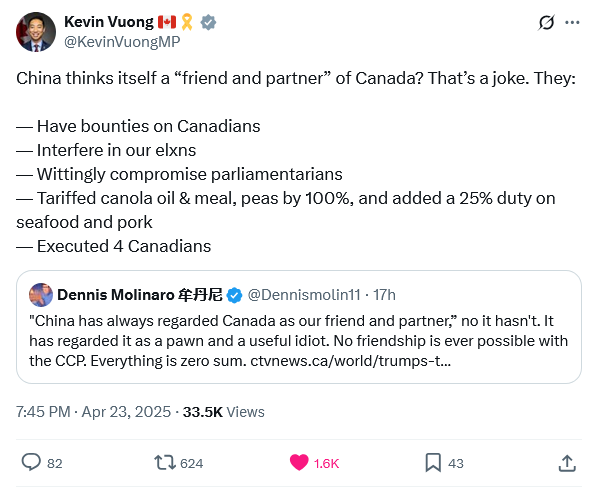
In totally unrelated news, a Conservative candidate has been advised by the RCMP to “pause in-person campaigning” in the current federal election campaign due to threats originating in the People’s Republic of China:

Joseph Tay, the Conservative candidate identified by federal authorities as the target of aggressive Chinese election interference operations, paused in-person campaigning yesterday following advice from federal police, The Bureau has learned.

Two sources with awareness of the matter said the move came after the SITE Task Force — Canada’s election-threat monitor — confirmed that Tay is the subject of a highly coordinated transnational repression operation tied to the People’s Republic of China. The campaign seeks not only to discredit Tay, but to suppress the ability of Chinese Canadian voters to access his campaign messages online, via cyber operations conducted by Beijing’s internet authorities.

Now, with six days until Canada’s pivotal vote — in an election likely to be decided across key Toronto battleground ridings — it appears that Tay’s ability to reach voters in person has also been downgraded.

Tay, a journalist and pro-democracy advocate born in Hong Kong, is running for the Conservative Party in the Don Valley North riding. Federal intelligence sources have confirmed that his political activities have made him a top target for Beijing-linked online attacks and digital suppression efforts in the lead-up to next week’s federal election.

Tay’s need to suspend door-knocking yesterday in Don Valley North echoes concerns raised in a neighbouring riding during the 2021 federal campaign — where The Bureau previously uncovered allegations of Chinese government intimidation and targeting of voters and a Conservative incumbent. According to senior Conservative sources, Chinese agents attempted to intimidate voters and monitor the door-to-door campaign of then-incumbent MP Bob Saroya in Markham–Unionville.

Update: Spotted on the social network formerly known as Twitter:

April 15, 2025

Learning from history can be helpful … if you learn the correct lessons

Filed under: Economics, Government, History, Technology, USA — Tags: , — Nicholas @ 03:00

Tim Worstall explains why Donald Trump and his advisors pointing to the historical experience of high tariffs after the US civil war fails to take into account all the technological changes that happened during that time:

Trump and his economics team clearly believe that tariffs work (at least for certain values of “work”)

Post US Civil War tariffs rose strongly. Doubled and in some cases more than that. It’s also true that the US economy expanded remarkably in that period. Went from the exploitative frontier (and slave) economy to the world’s richest manufacturing one in fact. So, yay for tariffs, obviously.

Except US trade kept increasing over this period. So, tariffs were not reducing imports. Or rather, the total level of imports did not fall because tariffs even as tariffs obviously had an effect upon limiting imports — without tariffs there would have been more.

So, what happened here? The answer is the ocean going steamship.

Tariffs are only one barrier to trade, one cost of trade. Paperwork is another, local standards a third, the theft by rapacious dockside unions a fourth and, obviously enough, the cost of transport a fifth. And we can go on — the cost of information flow a sixth and soon enough we’ll be Richard Murphy shouting eleventhly.

The ocean going steamship reduced the total costs of trade by more than the tariffs raised it. Therefore trade carried on increasing.

Now forward a century, the 1970s and following. We’re told that there’s been some grand policy turn to free trade. That everyone decided to gut the rich world of real manly jobs and ship them off to sweating coolies who could be paid peanuts. The GATT, WTO, just proof of the contention and look, look, they lowered tariffs!

But the container ship (which did for those rapacious dockside unions in most places other than the US), the jet liner, the telephone and now the internet have lowered all those other costs of trade massively. The total costs of trade have dropped massively whatever we could have, should have, done about tariffs. Global trade was going to expand by multiples whatever GATT or WTO did that is.

Which is why these tariffs now have to be so large and bigly. Because to get back to that 1970s – let alone 1870s — it’s necessary to raise total costs of trade to where they were, not just tariffs.

April 12, 2025

President Trump … or any president … shouldn’t have the unilateral power to levy tariffs

Filed under: Economics, Government, Politics, USA — Tags: , , , , — Nicholas @ 03:00

Love him or hate him — and there are lots of people in both camps — President Donald Trump has the power to randomly throw spanners into the international trade arena … because Congress ceded that power to the presidency long before Trump began his political career:

In response to Donald Trump’s tariff maneuvers, Senator Rand Paul has been arguing that presidents shouldn’t have the power to raise tariffs themselves. Taxing power belongs to Congress, and that’s where tariffs should be born. Trump’s tariffs result from the use of emergency power that Congress gave to the POTUS, and we shouldn’t normalize emergency rule. You can watch him say all of that here.

Every word of that is completely right. I don’t disagree with a single breath of it. I respect Rand Paul, and I’m inordinately fond of his dad. But it misses the point about how we got here, and why, starting with the fact that Congress gave away its taxing authority.

  1. Congress delegated its authority;
  2. Donald Trump used the authority that Congress gave him;
  3. Therefore, Donald Trump is very bad, and what he’s doing is wrong.

The core sickness at the heart of the American republic is Congress, and we keep discussing that sickness by saying that Trump sucks. He’s doing what you gave him the power to do, and he’s not the first.

See also my recent post in which I described a time when Congress made something illegal, than asked the administrative agencies to explain to them what they had just banned. Congress has delegated its authority, over and over again, and the resulting political vacuum is a serious problem. But anyway, TRUMP TRUMP TRUMP.

American political discourse keeps taking a wide range of political pathologies and assigning them to the same account. Orange Man Bad, Orange Man Bad, Orange Man Bad, they explained, with drool running down their chins. Donald Trump is our deflector object, our national excuse. [Problem name here]; OH NO WHY IS TRUMP DOING THIS TO US.

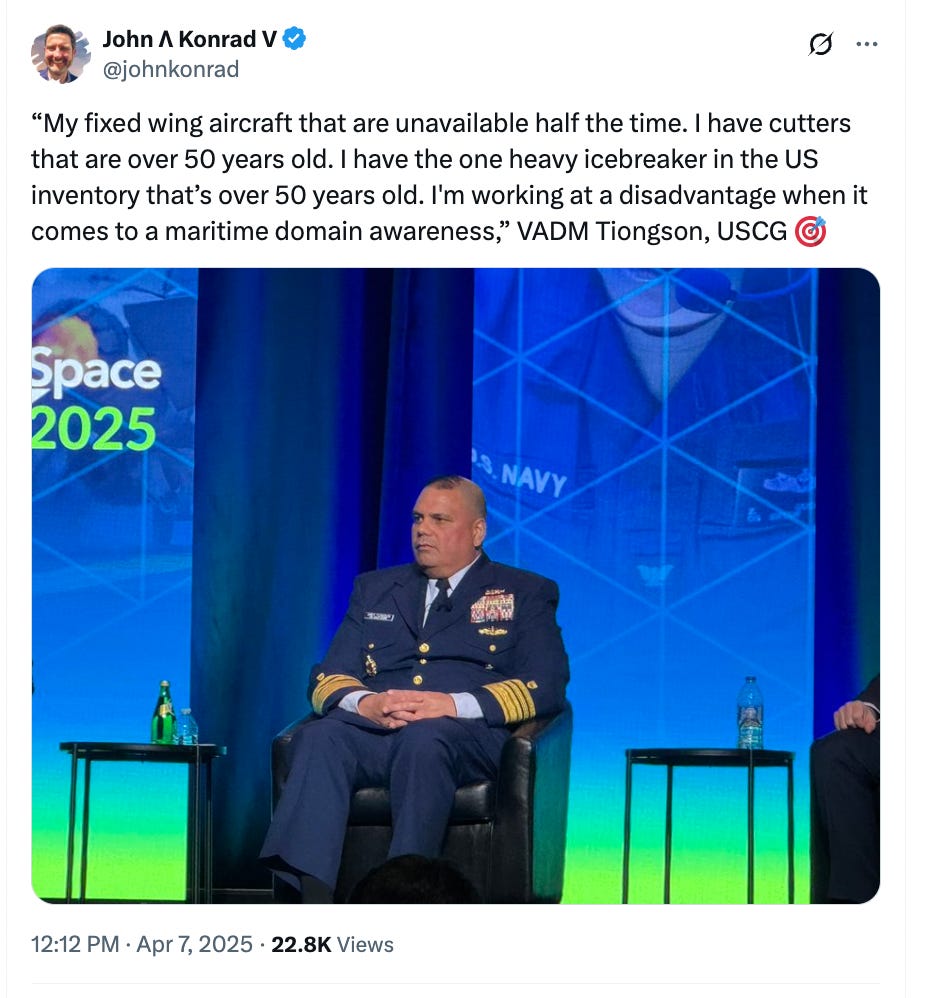
The commandant of the United States Coast Guard spoke at a maritime conference, a few days ago, and he said that the organization he runs wakes up every day and tries to keep the doors from falling off: “The US Coast Guard is less ready today than any other time since World War II. We are on a readiness spiral. Today our fleet of cutters are in significant decline. We are in repair failure mode … No ship today gets underway without cannibalizing others for parts.”

See also, from one of his subordinates:

Serious question: Did all of those problems begin at noon on January 20, 2025?

April 11, 2025

Critical Trade Theory

A discussion at the amusingly named Handwaving Freakoutery on the ongoing wave of tariff activity under the Trump II administration, characterizing them as “woke” tariffs:

The great argument playing out in the media right now about the relative value and ethical implications of reciprocal tariffs is not relevant. It is not relevant because these tariffs are not reciprocal tariffs in any measurable way. They aren’t reciprocal, they aren’t sensible, and the justification for them is Woke in every sense of the word. Let’s take a close look at what we might call Critical Trade Theory, back our way into an understanding of what a woke tariff is and how this is definitely that, and close with a quick word about how political realignments portend doom for the left even though the right is really screwing this up. Then we’ll all buy mop handle futures.

Awokening

The Great Awokening of the prior decade was founded in part on the False Cause Fallacy. Our major institutions for the better part of the last ten years were operated by wokerists, who used an Intersectional Matrix of Culturally Encouraged Race and Gender Prejudice to counteract what they viewed as hidden unmeasurable forces such as “systemic racism”. They couldn’t point to the systemic racism, but they knew it must be there because of the imbalance in socioeconomic metrics, and they denied any other possible explanation for the imbalance. Once the False Cause was in place, the devout wokerist was forced to fight the hidden prejudice with overt reverse prejudice, because they couldn’t conceive any other cause.

For example, if black folks have a hard time getting into Harvard or UNC, it must be because society is systemically racist against black people, and no other reason, therefore we should redirect admission slots from Asians who earned them to blacks who didn’t, for race balancing.

Harvard did exactly that, for exactly that reason, and admitted it, and it was sent to the Supreme Court, and the Supreme Court banned it, and then Harvard kept doing it and is still doing it using different words.

Some of our other institutions are still running this wokery program, although the Trump Administration purged much of it from the halls of federal power this year under their DEI ban, and many other institutions used Trump as cover to independently purge it from theirs. But this same smooth-brained thinking wiggled its way right into Trump’s tariff plan last week, through an equation that looks fancy but is something my middle school son could figure out.

[…]

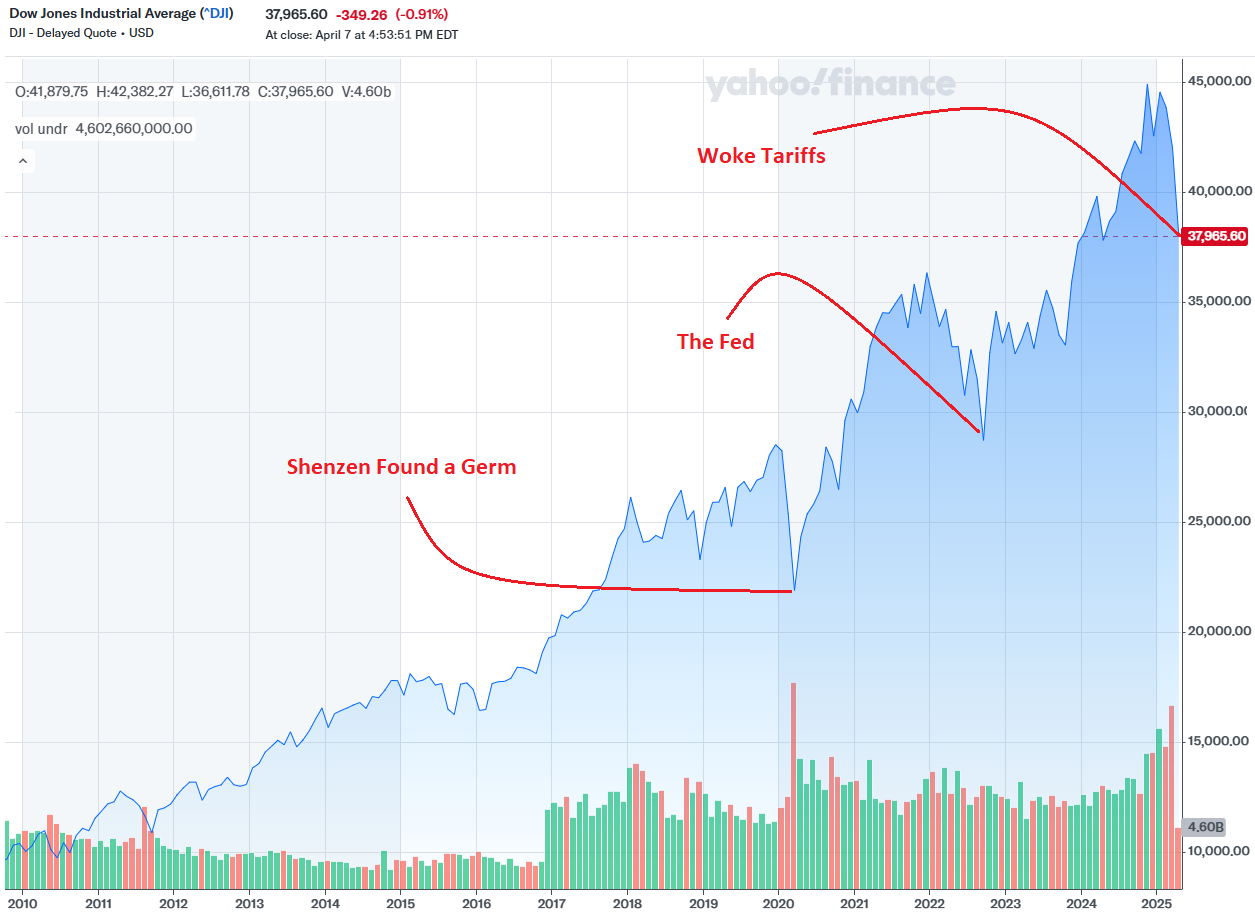
The media thinks these woke tariffs are going to bomb the economy back to the stone age, but when I make the abhorrent choice to read the graphs myself it looks more like January 2024. A 20% tariff on Chinese goods is rough. Adding 34% more to it is rougher. But a 54% tariff on Chinese goods is nothing compared to Shenzhen closing its entire manufacturing sector down because they found a germ, and probably not significantly worse than the Fed turning off the free money spigot in 2022.

These tariffs are going to do goofy shit to the economy. I don’t like the goofy shit they’re likely to do. I think that trade balancing through tariffs is an idea so stupid that only Rust Belt union workers could come up with it, which is why they probably did come up with it, and also probably why Trump won the election by flipping the Rust Belt.

April 8, 2025

Free trade, the once-and-future left wing cause

Let’s join Tim Worstall on a brief trip into economic history, when free trade was a pet issue for the left (because it helped the poor and the working class) and protectionism was the position of the right (because it helped the wealthy and the aristocracy):

The people who suffer here are the consumers in the US. The people who benefit are the capitalists in the US. Which is why free trade always has been a left wing position. True, many lefties in recent decades have somewhat strayed from the one true path but given that it’s Trump imposing them some seem to be coming back. Although how much of that is about TDS and how much about reality is still unknown.

We’ve also got that little point about what happened last time around:

That all started with eggs. There’s fuss about eggs in the US at present. My, how history echoes, eh?

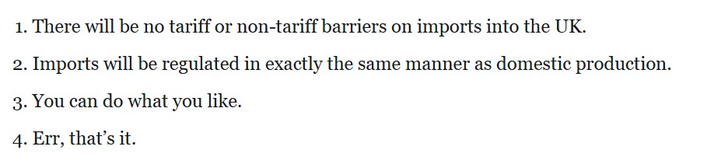
There’s only the one logical, moral or ethical position to have upon trade. As I’ve pointed out before with my model trade treaty:

Note that this applies to all ideas about tariffs — with the one exception of national security where we are indeed willing to give up direct economic benefit in order to keep the French at bay. To tariffs for industrial policy, tariffs for Green, tariffs for trade wars, tariffs as revenue raisers, tariffs, see?

We should remind ourselves that the opposition to Adam Smith and his ideas came from the conservatives. Cobden and the Manchester Liberals were the left wing betes noires of their day. The Guardian was actually set up as a newspaper to push their ideas including that dread free trade.

We did actually get free trade too, in 1846. Which, not by coincidence, is when the Engels Pause stopped happening. Which was, itself, the observation by Karl’s buddy that while the British economy had grown lots — industrialisation, capitalism, etc. — the living standards of the base people hadn’t, not very much. Of course, he was missing a bit — that ability to have a change of cotton underwear even for skivvies (aha, skivvies for skivvies even …) would only feel like an advance to those who had, previously, had to wear woollen knickers. This changed, living standards for the oiks began to rise, strongly, once we had free trade.

Now, there are a few of us still keepers of that sacred flame. But just to lay out the basic argument.

Average wages in an economy are determined by average productivity in that economy. Trade doesn’t, therefore, change wages — not nominal wages that is. Trade does change which jobs are done. That working out of comparative advantage means that we’ll do the things we’re — relative to our own abilities — less bad at and therefore are more productive at. Trade increases domestic productivity and thereby, in the second iteration, raises wages.

Trade also — obviously — gives us access to those things that J Foreigner is more productive at than we are — those things that are cheaper if Foreign, J, does them. This raises real wages again because we get more for our money. We’re better off. This is true whatever the tariffs our own exports face.

Finally, trade doesn’t affect the number of jobs in an economy — that’s determined by the balance of fiscal and monetary policy.

So, who benefits from trade restrictions? Well, the people who lose out from free trade are the domestic capitalists. Pre-1846 it was the still near feudal landlords in fact. What killed those grand aristocratic fortunes was not war nor tax — pace Piketty et al — it was free trade which destroyed agricultural rents.

The same is true today. The people who benefit from tariffs are the domestic capitalists who get to charge higher prices, make larger profits, as a result. The people who lose are all consumers plus, over time, all domestic workers as well. Tariffs increase the capitalist expropriation of the wages of the workers that is.

Tariffs are a right wing, neo-feudal, impoverishment of the people. Free trade is the ultimate leftypolicy to beat back the capitalists.

April 4, 2025

Alberta plays a separate hand

In The Line, Jen Gerson discusses the disconnects between “Team Canada” (such as it is) and Alberta that now have Alberta sending its own delegation to talk to … someone … in Washington DC:

Photo by Jen Gerson, The Line.

Alberta’s periodic bursts of secessionist sentiment operate a little like the aurora that occasionally flash across the prairie sky, in tune with decades-long solar flare cycles. The phenomenon is always fascinating, yet it’s always impossible to know how seriously to take it. It waxes and wanes in line with a number of factors, only some of which can be predicted — oil prices, the partisan stripe of the federal government, and the introduction of new regulations.

We are getting another show, of late, and The Line has responded by commissioning some fresh hot polling numbers to determine just how willing Albertans are to take up U.S. President Donald Trump’s call of becoming the 51st state.

It is not a surprise that this is being talked about again. We appear to be on the verge of a potential fourth term of loathed Liberals — after being all but promised a Conservative one. Trump has declared economic war, and openly undermines our sovereignty. Alberta has elected a premier who seems to be willing to go much further than leaders past to both threaten the federal government, and align herself with Americans. Danielle Smith has made several appearances in conservative American media institutions to argue against tariffs; she also made a public appeal to her Quebec counterpart to create a common front for greater provincial autonomy. This after threatening to form another “Fair Deal” panel if a future federal government doesn’t meet a list of requests.

In the midst of this revived inter-provincial tension, an Alberta delegation has formed, insisting that it will be travelling to the U.S. in coming weeks to meet with members of the Trump administration.

Who are they meeting? Well, they won’t say.

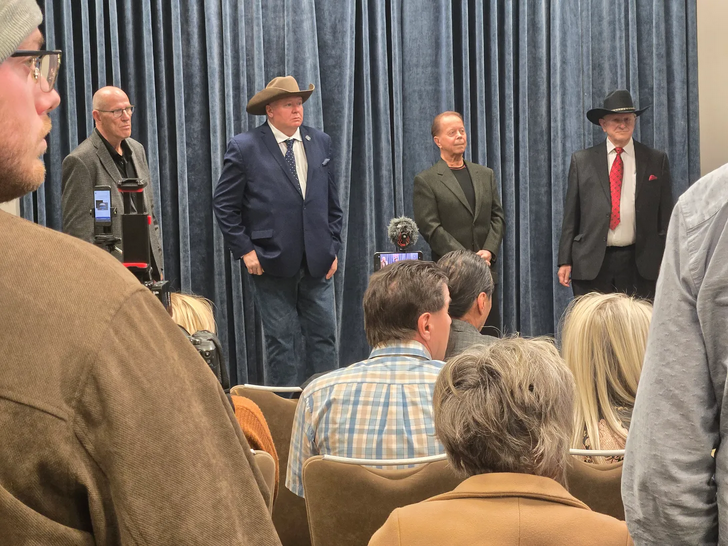
“The response that we’re getting, quite frankly, from the present U.S. administration is very positive. We’ve been advised that the interest in what we’re doing is extremely high, and certainly everything that we’ve seen indicates that this is far from a fool’s errand,” said Jeffrey Rath, an Alberta lawyer leading the delegation, during a press conference last week held just off the lobby of a well-known Calgary hotel. The conference wasn’t well publicized, and it was obscurely signed — if you knew, you knew — and was thus populated by about 80 fellow travellers of the Alberta independence movement.

“We’ve been advised by the people we’re speaking to in the States to not disclose who it is that we’re talking to at this point,” Rath said. But the goal is clear. They’re going to Washington to meet with representatives of the Trump administration to “determine the level of support that the government of the United States would be prepared to provide to an independent Alberta.”

Admittedly, they’re only independent citizens — former Premier Jason Kenney called Rath a “treasonous kook” — though the press conference featured one former Conservative MP, LaVar Payne, and the U.S. delegation will reportedly include former Conservative MP Rob Anders.

April 3, 2025

Election 2025 – Candidates overboard, biological clocks ticking, and Trump tariff letdown

Filed under: Cancon, Economics, Media, Politics — Tags: , , , , , — Nicholas @ 03:00

One of the recent events in the federal election campaign — the Liberals finally getting rid of their toxic candidate in Markham-Unionville — has been reciprocated by the Conservatives dumping their candidate in a southwestern Ontario riding and another in the Montreal area. While the Liberals dragged their feet for several days, the Conservatives have been much faster to pull the ejection handle for their bozo eruptions (some might say too fast), but Poilievre absolutely did not want the kind of media circus that Carney enabled over the Chiang scandal.

The Liberals have been doing what they can to gin up angst and outrage over a recent Pierre Poilievre comment that they’re trying to portray as being somehow misogynistic and insensitive. In The Line, Melanie Paradis says that it’s nothing of the sort and instead it highlights a genuine concern for young Canadian women and their partners:

I just turned 40. I have two beautiful children — three-and-a-half years old and eight months — and I want a third.

That statement raises eyebrows. After all, I run a successful business. I work more than full-time. I live in the same economy as you. And yet — I want another baby. Not because I’m reckless. Because I love being a mom. Because I believe in investing in the future. Because I want to.

And in today’s Canada, that feels like a radical act.

This election, the conversation is dominated by Trump’s tariffs, and understandably so. But as we analyze different sectors that will be impacted by tariffs, and develop policy prescriptions for the hundreds of thousands of jobs that could be lost, where are the policies for the millions of young Canadians pausing their hopes and plans for children because of so much uncertainty? The untold story of Trump’s tariffs and threats is that the quiet collapse of Canada’s birth rate will only worsen. Nothing kills the mood or your hormonal balance quite like Trump.

Of course, the second Pierre Poilievre mentioned this, the Liberals couldn’t resist twisting it into a tired attack line about reproductive rights.

On Monday, Poilievre said, “We will not forget that 36-year-old couple whose biological clock is running out faster than they can afford to buy a home.” This is a statement rooted in the biological and economic realities of being 30-something and trying to conceive. Yet the Liberals are tripping over themselves to condemn Poilievre for somehow insulting women.

What a total misread. Poilievre is the only politician in this campaign who is speaking openly and clearly about a real issue that is radicalizing young Canadians: it has become far, far too hard to start and support a family in this country, and that is obviously a burden that lands entirely on the young. Given the demographics of the average Liberal voter, I can get why this would be below the radar for the party, but I’m begging them, and setting politics aside when I do, to stop viewing this as a moment to launch a political attack on your rival and instead ask if this is actually a national issue that we should be talking about more, not less. Even if the politician happens to be a man.

To my Liberal friends: You are punching down on hurting people when you dismiss this issue, and since this might matter to you more, you’re hurting your electoral chances, too. Your party has a blindspot here, and the issue is too important to become a partisan football. Like, my dudes, for all your stupid rhetoric about The Handmaid’s Tale, have you read the damn book? It starts with a fertility crisis and birth rate collapse. If you don’t want the red capes, maybe we should get out in front of the issue?

The latest round of Trumpian tariffs let Canada off easier than other American allies and trading partners in President Trump’s “Liberation Day” announcement:

While the rest of the world was trying to determine the length and breadth of the shaft, Trump waved around a cardboard chart that named their country and the percentage tariff hike they could expect to be hit with.

Top of the list was China, which will see a 34 per cent increase in the tariffs on its exports to the U.S. (on top of the previous 20 per cent). Japan will be hit with a 24 per cent increase and the European Union with 20 per cent.

But half of the chart was hidden behind Trump’s podium, so it took a while to figure that Canada was not on the list.

It was only after the Rose Garden press conference concluded that it became apparent that Canada is exempt, or at least the exports to the U.S. covered by the Canada-U.S.-Mexico trade agreement are not impacted (and they account for more than 90 per cent, according to RBC Economics).

However, the previously announced 25 per cent tariffs on autos, and on steel and aluminum from Canada remain in place.

The broad-based exemption is good news but the crisis facing the Canadian economy remains dire. As has been pointed out by many industry insiders, no auto plant in Canada can survive 25 per cent tariffs for an extended period at a time when their profit margins are less than 10 per cent.

March 30, 2025

Recycling an old slogan – [Mark Carney] “didn’t come back for you”

Filed under: Cancon, Media, Politics — Tags: , , , , , , — Nicholas @ 04:00

I guess you could say that Elizabeth Nickson isn’t a Carney fan:

Doesn’t he look half-dead? Like a shroud covers his saggy emaciated face and spindly body. Indicative of lifelessness of his ideas. NOT his actual ideas because what he is currently selling are the ideas he stole from Canada’s Conservative Party. Those ideas are grass roots, labored over for decades in underfunded think tanks, all roundly mocked and slandered in our repellent media which never tells the truth when an easy lie is within reach. But now, in the hands of a “leader” who will not stop the Liberal Party and its Laurentian elite clients looting of the Canadian people, well now they are AOK. And genius. And a lie, because he will only perform the minimum to gratify the stupid, “educated” women who will elect him.

Because above everything Liberal Party looting must continue. And with Net Zero and all that elite clap trap there will be another three generations of Canadians to ruin, to steal from, to harvest their life’s energy to feed the Party’s enormous ego and the plush lifestyles in the posh suburbs of Canada. Scratch such a resident and whatever he does, his salary is boosted by government, in some form or other, via contracts which do not perform, ghost contracts, just money to play with for supporting the Liberal Party.

If Carney is elected, the country will break up.

First Alberta will go. Danielle Smith emerged grim from her last meeting with Carnage. Have you heard of stranded assets? That’s his goal for Alberta’s oil and gas. Albertas energy is responsible for one third of Canadas private sector economy and no matter what he says, he has worked for two decades for Climate Change sequestration nonsense. For solar and wind, for de-development, sliming his way around the world twisting arms. He was the grim reaper behind Justin’s authoritarianism. As a result our current economy is built on government and debt and refinancing loans and housing.

Oh he will lie and lie and lie and promise new industrial infrastructure. Sure he will. You know who will own that infrastructure? BIS, the Bank of International Settlements or some international banking outfit. They will own it because carbon credits and future use. They will retire some of our debt, not enough for us to actually grow, just to keep body and soul together. And we will grind forward another twenty years, piling up yet more debt, at which time the Liberal Party will broker off another hunk of our heritage.

Then Saskatchewan. BC and Manitoba will look at the powerhouse economy that the U.S. is building, and petition to strand the Eloi, with their banal life of ease on B.C. Coast, all as equally dumb and destructive as California’s ruinous elites. And join the U.S.

Canada has so much banked energy, so much thwarted ambition, so many lives wasted. So much potential lost. We are like a screaming adolescent banging ourselves against the wall, wanting nothing more than to get a job and get on with it. (Oh, wait, that was me)

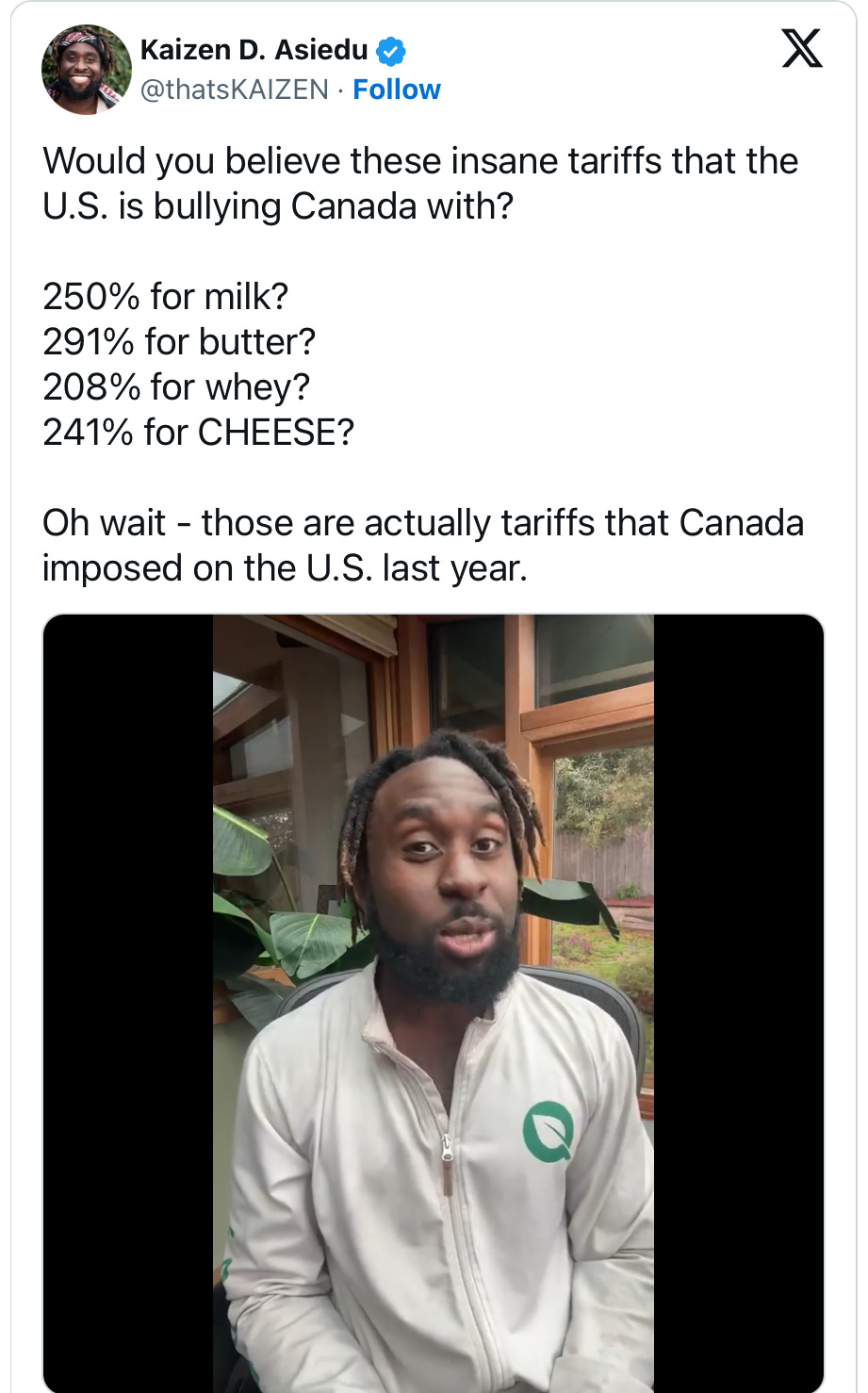
Kaizen’s video is linked [here]. I STRONGLY recommend you listen to his powerful brief encapsulation of how fast the American economy is going to grow.

We tariff because we are broke. We are broke because we have regulated ourselves into stasis. This below represents what it is to do business in Canada. I have heard this from thousands of entrepreneurs.

March 23, 2025

Tariffs versus income taxes – pick your poison

Walter Block on the pros and cons (from the government’s point of view) of income taxes and tariffs:

Every fiber of my economic being cries out against tariffs. If they are so good, why doesn’t each state in the US have one against the products of all of the other 49? That is, Ohio could “protect” its industries against the incursions from Arizona. This is obviously silly. One of the important reasons America is so prosperous is that we have a gigantic, internal, free trade area.

Donald Trump supports them on the ground that the McKinley administration was prosperous, and relied upon tariffs. But this is to commit the post hoc ergo propter hoc logical fallacy: that since A precedes B, A must be the cause of B. No, America did indeed become rich during this epoch, but that was in spite of tariffs, not due to their benign influence. If you are looking for a historical episode to shed light on this matter, the Smoot-Hawley Tariff of 1930 will do far better: it greatly worsened an already bad recession, plunging our economy into a deep depression.

Our President also claims that the US is victimized by a negative balance of trade: we buy more from Canada and other countries than they purchase from us. However, I have a horrid balance of trade with McDonald’s and Wal-Mart. I acquire several hundreds of dollars’ worth of their products every year, and neither has yet seen fit to reciprocate with any of my economic services (hint, hint!). On the other hand, I have a very strong positive balance of trade with my employer, Loyola University New Orleans. They pay me a decent salary; apart from a few lunches in their cafeteria, my expenditures to them fill their coffers to a zero degree. Should anyone worry about this sort of thing? Of course not. Ditto for international trade. If Country A buys more from B than it sells to it, money will flow from the former to the latter, reducing prices in the former and raising them in the latter, until matters balance out.

Everyone realizes the foolishness of tariffs when it comes to absolute advantage. No Canadian objects to the importation of bananas from Costa Rica. Producing this tropical product in the frozen North would be financially prohibitive (gigantic hothouses). Ditto for maple syrup in the country to the south. The only way they could produce this item would be to place maple trees in gigantic refrigerators. Ludicrous and prohibitively expensive.

But when it comes to comparative advantage, all too many people are out to lunch insofar as the teachings of Economics 101 are concerned. They fear that other countries might be more efficient than we are; with free trade, they would produce everything, we, nothing, and we would all starve to death from massive unemployment.

QotD: Herbert Hoover as president

Herbert Hoover spent his entire presidency miserable.

First, he has no doubt that the economy is going to crash. It’s been too good for too long. He frantically tries to cool down the market, begs moneylenders to stop lending and bankers to stop banking. It doesn’t work, and the Federal Reserve is less concerned than he is. So he sits back and waits glumly for the other shoe to drop.

Second, he hates politics. Somehow he had thought that if he was the President, he would be above politics and everyone would have to listen to him. The exact opposite proves true. His special session of Congress comes up with the worst, most politically venal tariff bill imaginable. Each representative declares there should be low tariffs on everything except the products produced in his own district, then compromises by agreeing to high tariffs on everything with good lobbyists. The Senate declares that the House of Representatives is corrupt nincompoops and sends the bill back in disgust. Hoover has no idea how to solve this problem except to ask the House to do some kind of rational economically-correct calculation about optimal tariffs, which the House finds hilarious. “Opposed to the House bill and divided against itself, the Senate ran out the remaining seven weeks [of the special session] in a debauch of taunts, accusations, recriminations, and procedural argument.” The public blames Hoover, pretty fairly – a more experienced president would have known how to shepherd his party to a palatable compromise.

Also, there are crime waves, prison riots, bootlegging, and a heat wave during which Washington DC is basically uninhabitable. Also, at one point the White House is literally on fire.

… and then the market finally crashes. Hoover is among the first to call it a Depression instead of a Panic – he thinks the new term might make people panic less. But in fact, people aren’t panicking. They assume Hoover has everything in hand.

At first he does. He gathers the heads of Ford, Du Pont, Standard Oil, General Electric, General Motors, and Sears Roebuck and pressures them to say publicly they won’t fire people. He gathers the AFL and all the union heads and pressures them to say publicly they won’t strike. He enacts sweeping tax cuts, and the Fed enacts sweeping rate cuts. Everyone is bedazzled […] Six months later, employment is back to its usual levels, the stock market is approaching its 1929 level, and Democrats are fuming because they expect Hoover’s popularity to make him unbeatable in the midterms. I got confused at this point in the book – did I accidentally get a biography from an alternate timeline with a shorter, milder Great Depression? No – this would be the pattern throughout the administration. Hoover would take some brilliant and decisive action. Economists would praise him. The economy would start to look better. Everyone would declare the problem solved – especially Hoover, sensitive both to his own reputation and to the importance of keeping economic optimism high. Then the recovery would stall, or reverse, or something else would go wrong.

People are still debating what made the Great Depression so long and hard. Whyte’s theory, insofar as he has one at all, is “one thing after another”. Every time the economy started to go up (thanks to Hoover), there was another shock. Most of them involved Europe – Germany threatening to default on its debts, Britain going off the gold standard. A few involved the US – the Federal Reserve made some really bad calls. The one thing Whyte is really sure about is that his idol Herbert Hoover was totally blameless.

He argues that Hoover’s bank relief plan could have stopped the Depression in its tracks – but that Congressional Democrats intent on sabotaging Hoover forced the plan to publicize the names of the banks applying. The Democrats hoped to catch Hoover propping up his plutocrat friends – but the change actually had the effect of making banks scared to apply for funding and panicking the customers of banks that were known to have applied. He argues that the “Hoover Holiday” – a plan to grant debt relief to Germany, taking some pressure off the clusterf**k that was Europe – was a masterstroke, but that France sabotaged it in the interests of bleeding a few more pennies from its arch-rival. International trade might have sparked a recovery – except that Congress finally passed the Hawley-Smoot Tariff, the end result of the corruption-plagued tariff negotiations, just in time to choke it off.

Whyte saves his barbs for the real villain: FDR. If the book is to be believed, Hoover actually had things pretty much under control by 1932. Employment was rising, the stock market was heading back up. FDR and his fellow Democrats worked to tear everything back down so he could win the election and take complete credit for the recovery. The wrecking campaign entered high gear after FDR won in 1932; he was terrified that the economy might get better before he took office, and used his President-Elect status to hint that he was going to do all sorts of awful things. The economy got skittish again and obediently declined, allowing him to get inaugurated at the precise lowest point and gain the credit for recovery he so ardently desired.

Scott Alexander, “Book Review: Hoover”, Slate Star Codex, 2020-03-17.

March 18, 2025

QotD: Lester Thurow and the other cheerleaders for “Industrial Policy” in the 1980s

Filed under: Economics, Japan, Politics, Quotations, USA — Tags: , , , — Nicholas @ 01:00

The late Lester Thurow was quite popular in the 1980s and 1990s for his incessant warnings that America was losing at the game of trade with other countries. Most ominous, Thurow (and others) warned, was our failure to compete effectively against the clever Japanese who, unlike us naive and complacent Americans, had the foresight to practice industrial policy, including the use of tariffs targeted skillfully and with precision. Trade, you see, said Thurow (and others) is indeed a contest in which the gains of the “winners” are the losses of the “losers”. Denials of this alleged reality come only from those who are bewitched by free-market ideology or blinded by economic orthodoxy.

And so – advised Thurow (and others) – we Americans really should step up our game by taking many production and consumption decisions out of the hands of short-sighted and selfish entrepreneurs, businesses, investors, and consumers and putting these decisions into the hands of the Potomac-residing wise and genius-filled faithful stewards of Americans’ interest.

Sound familiar? It should. While some of the details from decades ago of the news-making proponents of protectionism and industrial policy differ from the details harped on by today’s proponents of protectionism and industrial policy, the essence of the hostility to free trade and free markets of decades ago is, in most – maybe all – essential respects identical to the hostility that reigns today.

Markets in which prices, profits, and losses guide the decisions of producers and consumers were then – as they are today – asserted to be stupid, akin to a drunk donkey, while government officials (from the correct party, of course) alone have the knowledge, capacity, willpower, and power to allocate resources efficiently and in the national interest.

Nothing much changes but the names. Three or four decades ago protectionism and industrial policy in the name of the national interest was peddled by people with names such as Lester Thurow, Barry Bluestone, and Felix Rohatyn. Today protectionism and industrial policy in the name of the national interest is peddled by people with different names.

Don Boudreaux, “Quotation of the Day…”, Café Hayek, 2020-03-12.

« Newer PostsOlder Posts »

Powered by WordPress