
Herbert Hoover spent his entire presidency miserable.
First, he has no doubt that the economy is going to crash. It’s been too good for too long. He frantically tries to cool down the market, begs moneylenders to stop lending and bankers to stop banking. It doesn’t work, and the Federal Reserve is less concerned than he is. So he sits back and waits glumly for the other shoe to drop.
Second, he hates politics. Somehow he had thought that if he was the President, he would be above politics and everyone would have to listen to him. The exact opposite proves true. His special session of Congress comes up with the worst, most politically venal tariff bill imaginable. Each representative declares there should be low tariffs on everything except the products produced in his own district, then compromises by agreeing to high tariffs on everything with good lobbyists. The Senate declares that the House of Representatives is corrupt nincompoops and sends the bill back in disgust. Hoover has no idea how to solve this problem except to ask the House to do some kind of rational economically-correct calculation about optimal tariffs, which the House finds hilarious. “Opposed to the House bill and divided against itself, the Senate ran out the remaining seven weeks [of the special session] in a debauch of taunts, accusations, recriminations, and procedural argument.” The public blames Hoover, pretty fairly – a more experienced president would have known how to shepherd his party to a palatable compromise.
Also, there are crime waves, prison riots, bootlegging, and a heat wave during which Washington DC is basically uninhabitable. Also, at one point the White House is literally on fire.
… and then the market finally crashes. Hoover is among the first to call it a Depression instead of a Panic – he thinks the new term might make people panic less. But in fact, people aren’t panicking. They assume Hoover has everything in hand.
At first he does. He gathers the heads of Ford, Du Pont, Standard Oil, General Electric, General Motors, and Sears Roebuck and pressures them to say publicly they won’t fire people. He gathers the AFL and all the union heads and pressures them to say publicly they won’t strike. He enacts sweeping tax cuts, and the Fed enacts sweeping rate cuts. Everyone is bedazzled […] Six months later, employment is back to its usual levels, the stock market is approaching its 1929 level, and Democrats are fuming because they expect Hoover’s popularity to make him unbeatable in the midterms. I got confused at this point in the book – did I accidentally get a biography from an alternate timeline with a shorter, milder Great Depression? No – this would be the pattern throughout the administration. Hoover would take some brilliant and decisive action. Economists would praise him. The economy would start to look better. Everyone would declare the problem solved – especially Hoover, sensitive both to his own reputation and to the importance of keeping economic optimism high. Then the recovery would stall, or reverse, or something else would go wrong.
People are still debating what made the Great Depression so long and hard. Whyte’s theory, insofar as he has one at all, is “one thing after another”. Every time the economy started to go up (thanks to Hoover), there was another shock. Most of them involved Europe – Germany threatening to default on its debts, Britain going off the gold standard. A few involved the US – the Federal Reserve made some really bad calls. The one thing Whyte is really sure about is that his idol Herbert Hoover was totally blameless.
He argues that Hoover’s bank relief plan could have stopped the Depression in its tracks – but that Congressional Democrats intent on sabotaging Hoover forced the plan to publicize the names of the banks applying. The Democrats hoped to catch Hoover propping up his plutocrat friends – but the change actually had the effect of making banks scared to apply for funding and panicking the customers of banks that were known to have applied. He argues that the “Hoover Holiday” – a plan to grant debt relief to Germany, taking some pressure off the clusterf**k that was Europe – was a masterstroke, but that France sabotaged it in the interests of bleeding a few more pennies from its arch-rival. International trade might have sparked a recovery – except that Congress finally passed the Hawley-Smoot Tariff, the end result of the corruption-plagued tariff negotiations, just in time to choke it off.
Whyte saves his barbs for the real villain: FDR. If the book is to be believed, Hoover actually had things pretty much under control by 1932. Employment was rising, the stock market was heading back up. FDR and his fellow Democrats worked to tear everything back down so he could win the election and take complete credit for the recovery. The wrecking campaign entered high gear after FDR won in 1932; he was terrified that the economy might get better before he took office, and used his President-Elect status to hint that he was going to do all sorts of awful things. The economy got skittish again and obediently declined, allowing him to get inaugurated at the precise lowest point and gain the credit for recovery he so ardently desired.
Scott Alexander, “Book Review: Hoover”, Slate Star Codex, 2020-03-17.
March 23, 2025
QotD: Herbert Hoover as president
March 18, 2025
QotD: Lester Thurow and the other cheerleaders for “Industrial Policy” in the 1980s
And so – advised Thurow (and others) – we Americans really should step up our game by taking many production and consumption decisions out of the hands of short-sighted and selfish entrepreneurs, businesses, investors, and consumers and putting these decisions into the hands of the Potomac-residing wise and genius-filled faithful stewards of Americans’ interest.
Sound familiar? It should. While some of the details from decades ago of the news-making proponents of protectionism and industrial policy differ from the details harped on by today’s proponents of protectionism and industrial policy, the essence of the hostility to free trade and free markets of decades ago is, in most – maybe all – essential respects identical to the hostility that reigns today.
Markets in which prices, profits, and losses guide the decisions of producers and consumers were then – as they are today – asserted to be stupid, akin to a drunk donkey, while government officials (from the correct party, of course) alone have the knowledge, capacity, willpower, and power to allocate resources efficiently and in the national interest.
Nothing much changes but the names. Three or four decades ago protectionism and industrial policy in the name of the national interest was peddled by people with names such as Lester Thurow, Barry Bluestone, and Felix Rohatyn. Today protectionism and industrial policy in the name of the national interest is peddled by people with different names.
Don Boudreaux, “Quotation of the Day…”, Café Hayek, 2020-03-12.
March 10, 2025
Deep State delenda est
Elizabeth Nickson calls for the destruction of the deep state, Cato the Censor-style: salt the earth and leave no stone standing upon another stone:
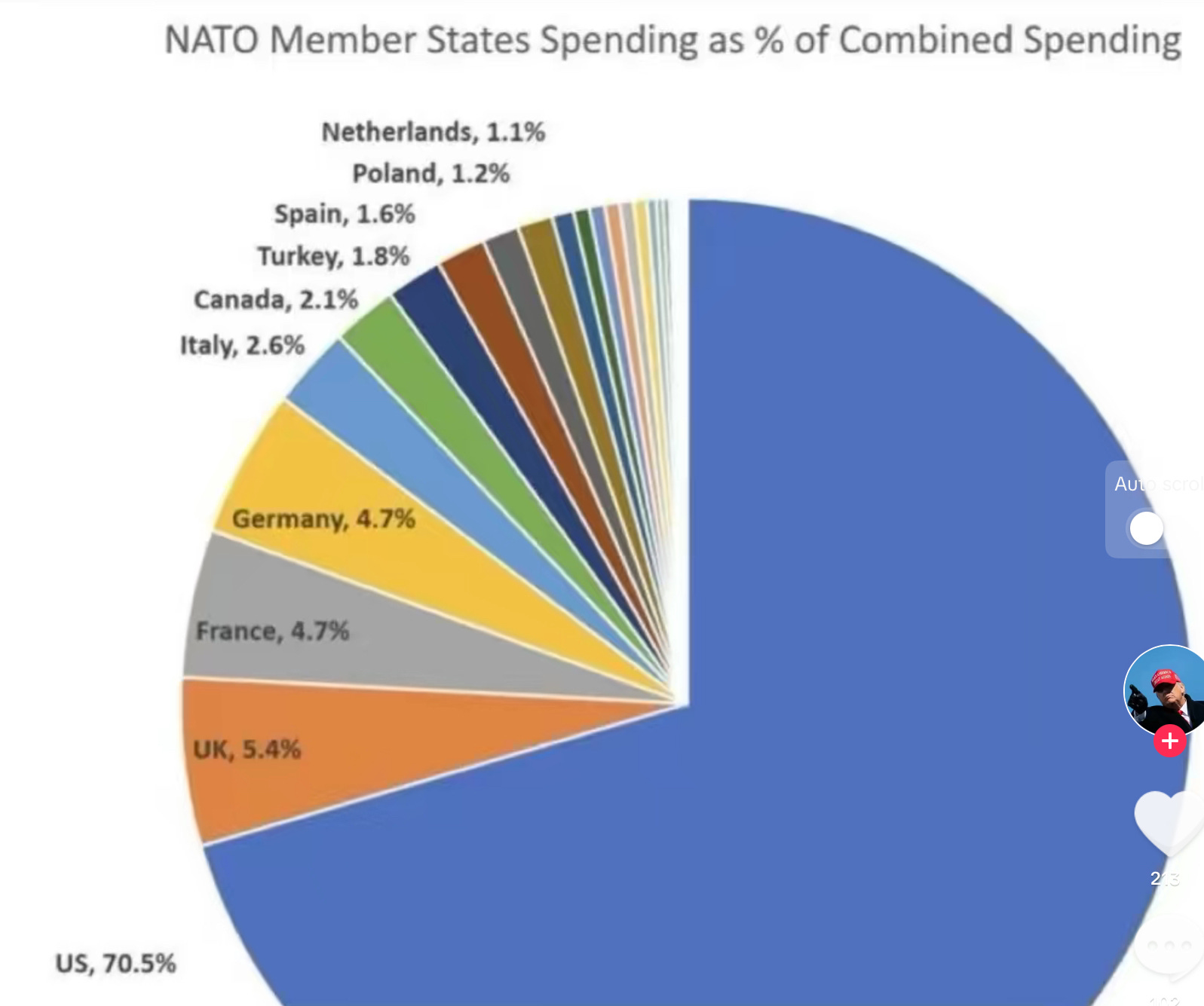
There has been some argument in my house about Trump’s tariffs on Canada, and indeed the rest of the world. I’m on the American side; why on earth should the Americans pay for everything? Because they do. They pay for Europe’s defence, they allow every single country to tariff American products while allowing their goods in for pennies. When anyone, anywhere is in trouble, who do they call? The Yanks. Where do the pleas of all the desperate people all over the world land? America. Who did the Israeli captives hope for? Trump and the Americans. (Actually just Trump. They didn’t think that the Biden people would lift a finger. Which they didn’t.)
Please explain why these countries below, numbering 550 million people, cannot defend themselves?
Why can’t they defend themselves? They are broke.
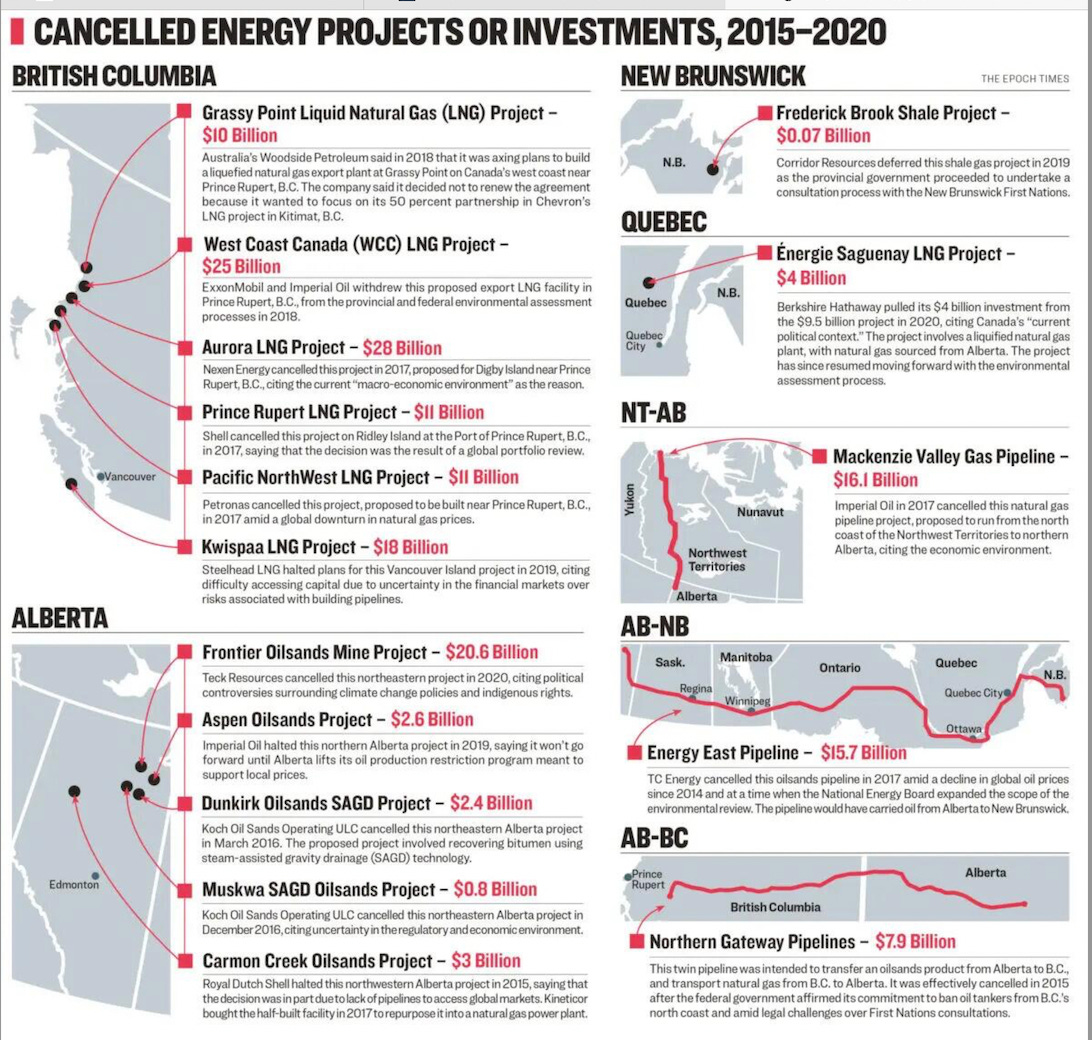
The following represents $150 billion in missed opportunity in the last FIVE years. Canada is so broke, it is broke-ass broke; it is a shriveling carbuncle on the American economy. We send 80% of our exports to you because we are TOO DAMNED LAZY to develop our own country.
If we had built those projects, Canada would be rich, the middle class would be crackling along, creativity would have soared and we would actually be proud. No one is proud of Canada except for the people paid to bloviate or who hope to be paid to bloviate, and those too stupid to bloviate. The rest of us are sullen and angry and so frustrated we don’t know what to do with ourselves.
But no. Climate Change. Look, I am sorry to say this, but anyone who “believes” in climate change being somehow catastrophic is stupid, malignant or has not done the required reading. Which means lazy. Which means childlike. There is no there there. Climate alarmism is nonsense, it is bullshit, it is utter crap made up by subsidized kids looking for “significance” and an endless supply of taxpayer dollars. The science is far too new to be reliable, there are thousands of real (not NGO) scientists in opposition to it and the policy implications are so vast we are looking at a new feudalism. Anyone promoting climate change is unserious.
Childhood is where we are. Canada is the only country in the Western Hemisphere which exacts a crippling carbon tax. And this:
The above is a perfect illustration of vanity, of a detachment from reality. And the only way people can detach from reality is that they are subsidized by the Americans. This means the Heartland people, the Flyover people. Those subsidies to the world added to a massive, unsustainable, insane, debt of thirty-seven trillion, created a giant fuzzy rainbow coloured cloud inhabited by perpetual children built by ghastly people like Samantha Powers, Al Gore, Hillary Clinton, and their legion of sick, larcenous, pedophile supporters, the ferociously stupid women on the east coat of America, the idiots at all the Ivies, and the two million federal workers who are about to be reduced by, I wish, 50%.

March 6, 2025
As Trump’s tariffs begin to bite, Canadians strike back at … King Charles and Wayne Gretzky?
As if more evidence were needed that Canadians aren’t well-served by our political leaders, social media personalities and legacy media types are pointing at uninvolved figures to be rounded up as the targets of maple-flavoured Two Minutes’ Hate sessions:

Canada’s latest Emmanuel Goldstein replacement, “The Great One” aka Wayne Gretzky
You can’t have an outburst of nationalism without purity tests coming into play, and two prominent Canadian figures have failed theirs in the court of chattering-class opinion: Wayne Gretzky and King Charles III, of all people.
In recent consecutive days, hilariously, The Globe and Mail‘s website published the following headlines to its online readers’-letters pages: “Wayne Gretzky’s fall from grace is a long time coming”; “Let Wayne Gretzky feel some pain”; and “Wayne Gretzky has always been held in the highest regard … now, he is dead to me”.
Gretzky is friendly with President Trump, you see, which is unacceptable. And if Gretzky isn’t willing to publicly disavow Trump, he should be using his influence to sit Trump down and explain that Canada will never be the 51st state … at which point, presumably, something useful is supposed to happen. It’s never clear what that useful thing would be, beyond a cheap nationalist thrill.
Gretzky’s Yankeeism was confirmed when he served as honorary captain of Team Canada in the final game of the 4 Nations tournament in Boston. (Imagine if he hadn’t served as honorary captain!) He gave the American players a thumbs up — which in any other context would have been considered simple good sportsmanship. He didn’t wear a Team Canada sweater, but rather a suit — which in any other context wouldn’t even have been noticed. He didn’t wear his Order of Canada pin — well, now we’re just grasping at straws.
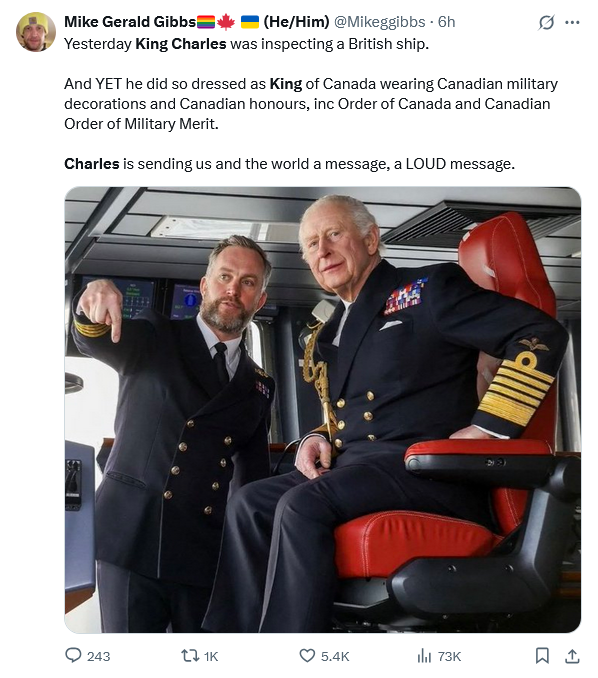
It’s funny that the same kind of people who have no time for the Crown under normal circumstances (even if they’re not quite out-and-out republicans) are delighted to pile on to any accusations that King Charles isn’t doing … something … to fight off the Bad Orange Man for us:
This brings us to our head of state, and the baffling calls in recent days for him to shake his sceptre toward Washington and declare that Canada shall never never never be the 51st state. If these calls were coming just from anti-monarchists, it would be understandable (though it’s odd to hear them suddenly demanding that the sovereign speak on our behalf). But all kinds of otherwise reasonable people jumped aboard as well, as if this was something the King should self-evidently be doing.
It is self-evidently not what the King should be doing — certainly not before receiving advice from the Canadian prime minister, and probably not at all. Charles’s mother wouldn’t have mouthed off, and I have to wonder if she would have gotten the same criticism were she still alive to see this mess.
Indeed, I think a moment like this is precisely when having an apolitical head of state — maybe even one that doesn’t live here — is most valuable. We have more than enough people, elected and unelected, completely and vocally embroiled in the Trump Tariff Wars, pursuing some combination of national, partisan and personal gain. Isn’t it nice to have precisely the sort of democratic constancy the United States now lacks? You don’t throw away an anchor, however rusty, with a gale on the horizon.
March 1, 2025
Canada’s “supply management” system – our literal “sacred cow”
In negotiations with the Trump administration to avert the threat of massive tariffs, our political leaders say that “everything” is on the table … except for one teeny-tiny little massive crony capitalist protection racket that we are apparently willing to destroy the entire national economy to preserve:
Unfortunately, Canada’s stubborn intransigence on a significant trade-related issue once again threatens to undermine our position and, with it, the possibility of a deal. I probably don’t have to tell you, but in case you couldn’t guess … yup. It’s the dairy sector.
At this point it should be noted that there are basically two agricultural industries in Canada. One of those industries relies heavily on exports, has thrived under the various free-trade deals Canada has been party to, and is filled with dread at the prospect of U.S. tariffs. Given the obvious significance of the U.S. as an export market for Canadian goods, one doesn’t have to look too far to find all kinds of nervous folks in these industries. For example, nearly $9 billion in agricultural products were exported to the U.S. in 2023 from just Alberta alone. Beef exports represent about a third of that total, and in fact the U.S. and Canada comprise the world’s largest two-way trade in beef and live cattle. There is much at stake here (pardon the terrible pun).
The other agricultural industry in this country, is, of course, the supply managed sector. That’s dairy, as noted above, but also eggs and poultry. The supply managed sectors of the agricultural industry are governed by a system of quotas, price controls, and sky-high tariffs. It’s essentially a legalized cartel system. This sector not only wants nothing to do with free trade, but actually sees free trade as a threat. To them, “tariff” is not a dirty word because they hide behind a shield of tariffs that are far higher than anything Trump has ever threatened or conceived.
Now, it should also be noted that these two sides of the agricultural sector are vastly different in size and importance. Yet, the vocal and irrational demands of the small, sheltered component seem to be the demands that our politicians remain most beholden to. Consider comments made recently by the contenders for the Liberal leadership: during this week’s debate, nearly all of them bent over backwards to declare fealty to supply management, even while expounding upon the existential threat posed by Trump’s tariffs. Even now, it’s clear that our politicians are afraid to pick this fight.
[…]
While that could have been a wake-up call for Canada, we instead went in the other direction. In the aftermath of the U.K. situation, Parliament went ahead and passed Bill C-282, which would enshrine into law the principle that supply management should never be on the table in any trade talks (the bill ended up being bogged down in the Senate and its future is unclear).
It’s naïve in the extreme to think that any trading partner, including and especially the Americans, would simply shrug and say “Well, shoot, that’s too bad. Let’s move onto other issues.” We’re needlessly harming our position even before talks begin.
February 28, 2025
Trump’s done something most of us thought impossible – giving the Canadian Liberals hope for re-election
Canadians were sick to the teeth with Liberal PM Justin Trudeau and itching to throw him out of office … until newly inaugurated US President Donald Trump tossed Trudeau a lifeline:

The BOM and the Little Potato on his way to another Taylor Swift concert.
For President Trump, making America great again in his second term includes tariff threats against Canada, along with talk of turning America’s northern neighbor into the 51st state. What that’s mainly achieved so far is to make Canada woke again.
Prior to January 20, Conservative Party leader Pierre Poilievre had been cruising in the polls, and with elections coming this year in Canada, North America seemed headed for a right-leaning political bromance between a President Trump in Washington and a Trump-lite Prime Minister Poilievre in Ottawa.
That was before Trump got elected and began talking about 25 percent tariffs on Canadian goods (10 percent for energy), which would likely wreck Canada’s economy.
One poll showed that four in ten Canadians see Poilievre and Trump as alike and that is hurting him as “Canadians increasingly associate Poilievre to Trump’s negative rhetoric aimed at Canada,” said Mark Marissen, a Liberal party strategist.
For the first time since 2021, Prime Minister Justin Trudeau’s Liberal Party is ahead of the Conservatives in the polls. If an election were held tomorrow, 38 percent of decided voters would choose the Liberals, while 36 percent would back the Conservatives. This is a massive shift — just six weeks ago, the Conservatives were leading by 26 points.
[…]
“Poilievre’s rhetoric is nothing like Trump’s. He only takes conservative positions when he’s pushed in that direction,” says Nichols. “A Poilievre government is going to be exhausting. He seems behind the curve on a lot of social issues, such as DEI and gender ideology.”
The reality is that the Canadian right generally doesn’t resemble the unruly U.S. version. This, in turn, reflects a more moderate political culture whose roots go back to Canada’s early years as a refuge for loyalists to the British crown fleeing the American revolution.
Eric Kaufman, a professor of politics at the University of Buckingham, argues that Poilievre’s reluctance to mimic Trump reflects the fact that Canadian conservatism has always been “very wet”, with Conservative politicians reluctant to challenge the progressive consensus on culture and identity.
“Poilievre only takes a stand on social issues like DEI and immigration when there’s already overwhelming momentum in the press. He still plays within the safe sandbox of talking about economic issues which is permitted for Conservative politicians in Canada,” says Kaufman.
February 25, 2025
Argentina’s experience of life with high tariffs
Marcos Falcone explains how Argentina’s unusually high tariff barriers distort ordinary economic activity for Argentines every day:

When Argentines go abroad, they usually go shopping. Many of the products they want cannot be bought at home, ranging from clothes to smartphones and all kinds of home appliances. Because of this, it has become a tradition to return from a trip with one or two extra suitcases filled with smuggled goods. Did you know that it is more expensive to buy an outdated iPhone in Argentina than it is to fly from Buenos Aires to Miami, stay for three days, and get the newest one?
[…]
Tariffs do not just make it difficult to get phones at home — they can make life dangerous as well. Argentina’s most sold car, which is artificially expensive because of protectionist measures, got 0 (zero) stars on one of Latin America’s most renowned safety tests. Cars in Argentina are not only more expensive than elsewhere in the region, but also markedly less safe.
To achieve these terrible results, the only thing Argentina had to do was enact tariffs, and now the US seems to be heading in the same direction. But in the past, protectionism has caused the same damage in the north as it caused in the south. Back in the first Trump administration, protecting the steel-production industry saved some jobs, but eliminated many more. Tariffs have also hurt businesses that rely on imports within the US and can continue to do so in a world of globally integrated supply chains. More generally, the 1933 Buy American Act, which forces the government to pay more for US-made goods, has been proven to be both ineffective and costly.
There is no escaping the negative effects of blocking outside competition. The more barriers a country enacts, the more damage it causes to itself. If we, as individuals, acted in a protectionist way, we should aim to grow our own food, build our own house, or make our own cars. But how does that make any sense? Economist Robert Solow once said, “I have a chronic deficit with my barber, who doesn’t buy a darned thing from me”. He meant it as a joke, but he had a point: What matters is to create wealth, which can be done both by selling and buying from others.
The revival of protectionism in the US is worrisome. To avoid it, Americans should take a look at the enormous destruction of wealth that tariffs have caused in other countries. Despite President Milei’s recent efforts to lift tariffs and take Argentina out of the “prison” in which it exists, the fact that the country shot itself in the foot decades ago has put it in a very delicate economic position. The US should not follow its path.
February 16, 2025
Free-market economist grapples with a new kind of tariff
With US President Donald Trump seemingly utterly entranced by the possibilities of killing off as much world trade as he can using tariffs, I did not expect to read that renowned libertarian economist David Friedman is not sure about the latest kind of tariffs being proposed:
I have finally encountered a kind of tariff that I am not sure I am against. The idea is to impose the same tariff on another country’s exports that they impose on your exports. A tariff makes the country that imposes it worse off, a fact that neither Trump or most of the media appear to understand — Vance may — but it makes the country it is imposed against worse off as well. Imposing a tariff can be in the interest of the politicians who impose it for public choice reasons, as a way of buying support from a concentrated and well organized interest group such as the auto industry at the expense of a dispersed interest group such as their customers. That is one of the two reasons tariffs exist, the other being that the false theory of trade economics is simpler and easier to understand than the true theory.1
But another country’s tariff barriers against your exports make both your country and its politicians worse off. So if imposing tariffs on their imports results in tariffs being imposed on their exports, it might be in the interest of the politicians as well as the country they rule to lower, even abolish, their tariffs — and free trade, zero tariffs, is my first best tariff policy.
Reciprocal reduction of tariffs is, of course, a routine objective of trade negotiations. What Trump appears to be proposing is to automate the process. That might have some advantages. It would reduce the amount of time and effort spent on trade negotiations. More important, it would make it harder for a government that wanted to keep its tariffs to pretend to its citizens that negotiations for mutual reductions had broken down over details.
It is not obvious what “reciprocal tariffs” means in practice, because tariffs, typically, are on particular goods. China imports oil and exports textiles. If they impose a tariff on American oil there would be no point to the US retaliating by imposing a tariff on Chinese oil — we don’t import Chinese oil.
Under the Plan, my Administration will work strenuously to counter non-reciprocal trading arrangements with trading partners by determining the equivalent of a reciprocal tariff with respect to each foreign trading partner. (Reciprocal Trade and Tariffs Memo)
It isn’t clear what “the equivalent” means. One possible approach would be to figure how much revenue a country collects from tariffs on American exports and set a uniform tariff on that country’s exports set to bring in the same amount of revenue. That would be simple and would reduce the political support for tariffs, since they could not be targeted to protect specific industries.
For which reason I don’t expect it to happen. The closest version that seems politically plausible is a nonuniform tariff schedule that brings in the equivalent revenue. Unfortunately that would let the administration protect favored industries with tariffs high enough to reduce imports, and revenue, to near zero.
Of course, the target country could, in a true system of reciprocal tariffs, solve the problem by reducing their tariffs to zero.
1. I discuss the relevant economics in Ptolemaic Trade Theory.
February 6, 2025
Trump tariff diary, day 5
The attention shifted away from the BOM kicking the Little Potato around as BOM floated the idea of annexing the Gaza Strip (as Eastern New Jersey?) on social media. There goes at least 24 hours of media hysteria …

Justin Trudeau’s vision of Canada
As I’ve pointed out a few times, the situation didn’t blow up out of nowhere (we’re back to the Trump tariffs, not the Gaza Strip), as Trump had given ample warning that this was an important issue for him. However, as Roxanne Halverson points out, Trudeau’s government paid it not the slightest bit of attention until Trump forced them:
This means Ontario Premier Doug Ford who threatened to cancel a $100 million dollar Starlink contract with Elon Musk to provide high-speed internet to northern and rural Ontario communities because of Musk’s strong ties to Trump. And perhaps BC Premier David Eby shouldn’t have threatened to take alcohol products from “red states” in the US off the shelves of BC liquor stores. And perhaps Team Trudeau shouldn’t been trying to play the mouse that roared by threatening to slap retaliatory tariffs on American products coming into Canada, given that it means Canadians will pay more for products like fruits and vegetables that we simply can’t get here in the winter. And that goes for all the provincial premiers, with the exception of Alberta Premier Danielle Smith.
And for all Canadians — particularly those who voted for Trudeau — who are so angry at Trump that they are blowing up the internet with memes, threatening never to vacation in the States, and booing the singing of the American anthem at hockey games — grow up and smarten up and rethink who your anger should be directed at.
Everyone needs to recognize the fact that Trump made it pretty clear about the tariffs when he was campaigning for the US presidency, after he won the presidency — but had yet been officially sworn in — and as soon as he entered the Oval Office. And yet everyone seemed so shocked when he did it — including Prime Minister Trudeau.
Trump also made it pretty clear what he was after — fix Canada’s porous border and fix the drug trafficking problem — and the fentanyl problem in particular. And thanks to the dithering of the Trudeau government — vacillating between “negotiating and diplomacy” and talking “tough”, as well as using the issue as a campaign tool, this is what it came to. Because, it would seem, Trump didn’t think his request was being taken seriously so he made it serious. One thing Trump recognizes is weakness, and it is something he is willing to take advantage of it. And in Canada he saw weakness — weak leadership and an weak economy. Another thing Trump is very good at, and that is rattling people and he did that in spades on Saturday — and by Sunday he got results.
For all the Canadians who are mad at Trump for starting these tariff wars, particularly those who voted for Trudeau. Remember this … if Canada had a strong economy that hadn’t been driven into the ground by ten years of Liberal economic, monetary, social engineering and “green” policies we wouldn’t be so vulnerable to Trump’s tariffs.
Trump didn’t halt the building of pipelines that could have taken our oil products to both eastern and western coasts to be shipped to markets overseas. This would have expanded markets for Canadian oil, meaning we wouldn’t be selling sell the bulk of it to the Americans at bargain prices. It wasn’t Trump who drove billions, if not trillions of dollars in investments out of the country by overtaxing businesses with ever increasing carbon taxes and various other in sundry operating costs, or stifling business growth with endless crippling green energy policies and regulations, or extinguishing any chance of expanding our natural gas production to sell to overseas markets by claiming “no business case” for it.
The business investment picture in Canada shows a clear decline dating almost exactly to the start of Trudeau’s time in office:

The Canadian government’s (and several provincial governments’) hostility to economic development and infrastructure expansion is clearly illustrated, I think.
February 5, 2025
Trump tariff diary, day 4
The Big Orange Meanie and the Little Potato had a phone call, after which the BOM announced a 30-day delay to the imposition of tariffs. In Canada, all of “peoplekind” were relieved to hear that they won’t have to give up their American-made binkies quite yet. Some appropriate snark from The Free Press:
It was actually a phone call between the BOM and the Little Potato, but we can imagine this is what it would have looked like in person.
Mexican president Claudia Sheinbaum Speedy Gonzales’d her way to a deal with Trump yesterday, promising to deploy 10,000 Mexican troops to the border to stop the flow of illegal immigrants and drugs. In return, Trump agreed to pause his 25 percent tariff on goods coming from south of the border. Soon after, he struck a seemingly identical deal with Justin Trudeau, who said he’d appoint a “fentanyl czar” and promised to send 10,000 Canadian troops to the northern border. Who knew they even had that many?! Tariffs will still be levied against Chinese goods starting today, but Trump says he plans to talk with President Xi Jinping as soon as this week.
The FP isn’t wrong … the Canadian Army doesn’t have 10,000 spare troops just hanging around their barracks who could be sent to the border, so it’s much more likely to be a combination of Canadian Border Services Agency (CBSA) agents, RCMP officers, provincial police (if the respective provinces are willing), and whatever the army can spare. (Trudeau refers only to “nearly 10,000 frontline personnel”, not “troops” as a lot of US reports state … that seems a lot more achievable.)
You may be wondering how the US President has such disruptive and antagonistic tools at his disposal. It’s yet another hangover from the Carter years, as Congress delegated these powers to the president in 1977:

Donald Trump as Napoleon the 47th.
Image generated by Grok.
The emerging on-off-on-off trade war between Canada and the United States has everyone asking “How should we fight?” — understandably enough — but we should not move too quickly beyond the question “How is this literal nonsense at all possible?” How did the U.S. Congress’s clearly specified constitutional power to regulate the country’s commerce with foreign nations fall into naked and unapologetic decrepitude? Why is every new American president now a Napoleon, and why isn’t this at all a political issue in the U.S.?
The American Constitution, it seems, has no political party apart from a handful of cranky, tireless libertarians like Gene Healy, Clyde W. Crews or Ilya Somin, who has a new article spitballing possible litigation approaches for Americans who lie in the path of the tariffs now being wishcasted into existence by Napoleon the 47th. Somin explains that President Donald Trump is using an openly contrived “national emergency” to invoke powers delegated to the White House by Congress in 1977, powers that are to be invoked only in the face of “unusual and extraordinary threats” to the Republic.
Since the president apparently has plenary power to define an emergency, and to do so without offering anything resembling a rational explanation, this act of Congress now appears to be less of a delegation and more of a surrender — a total abandonment of constitutional principle and the classical separation of powers. I pause to observe that the cheeks every Canadian should redden with slight shame at the spectacle of frivolous recourse to the law of emergencies causing obvious and sickening injury to the rule of law in the U.S. (Oh, no, that could never happen here!)
February 4, 2025
Trump tariff diary, days 2 and 3
Posted to social media yesterday:

To celebrate Groundhog Day, Governor Trudeau wore commemorative Groundhog-themed socks. Governor Trudeau’s announced counter-tariffs seem to have made no difference to the Big Orange Meany, so the Great State of Canada proceeds with plans to annex Guam and American Samoa. China has indicated interest in purchasing Vancouver Island or leasing the naval base in Esquimault. The National Post‘s Tristin Hopper suggested “Spend 10 years relentlessly kneecapping the Canadian economy for no reason to show Trump we’re not scared of him”, but we’ve already done that.
Today’s tariff diary entry was going to be:
Reports indicate that the Mexican government is folding to Trumpian pressure. Governor Trudeau insists he won’t budge, regardless of the economic damage to Canadian consumers … what a hero! A few of us may lose our jobs, our businesses, and our economic futures, but he’s willing to take that risk. Update: Trudeau folded like the cheap suit he so resembles. Tariff war on hold for 30 days as Trudeau looks for a way to sign the terms of surrender without any blame attaching to him or his party … he’ll probably blame the provincial governments and the federal NDP (who’ll still support him in Parliament, regardless).
… But the “pause” in tariff enforcement may be enough to let Trudeau and the Liberals — with the active connivance of the bought-and-paid-for Canadian legacy media propagandists — portray this as a great national victory and attempt to turn it into votes for Liberal candidates in the next federal election. I’d love to be proven too cynical here, but the Liberal track record isn’t good.
February 3, 2025
Rational response to Trumpish provocations? Don’t be silly, we must run in circles with our hair on fire!
My first entry in the “Trump tariff diary” on social media perhaps takes the situation too flippantly:
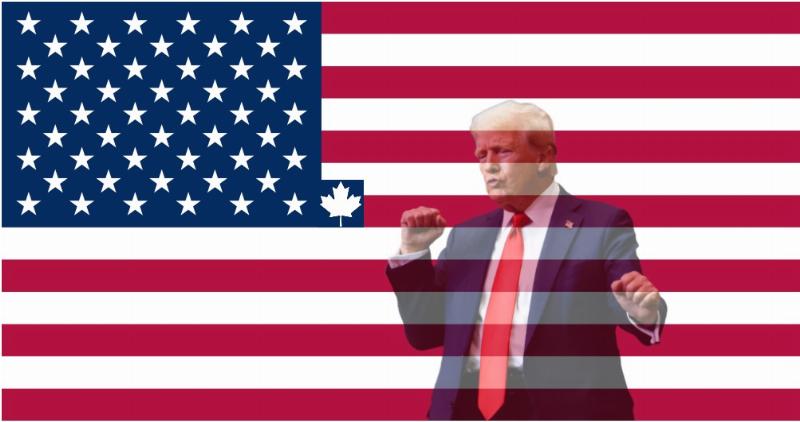
President Trump trolled Justin Trudeau about Canada becoming the 51st state.
Trump tariff diary, day 1: Governor Justin Trudeau of the Great State of Canada struck back at the Big Orange Meany by wearing particularly fashionable socks to his press conference. Ontario will remove all bottles of Jack Daniels from the government liquor monopoly distribution system. The American national anthem will be formally booed at all NHL games played in Canada from now on.
At the National Post, Tristin Hopper offers much more substantive and serious suggestions:
Order Ryan Reynolds to defame American directors until free trade is restored.
Spend 10 years relentlessly kneecapping the Canadian economy for no reason to show Trump we’re not scared of him.
Politely suggest that the U.S. may have confused us with China. Say that although both countries start with the letter C, China is the one seeking to destroy American hegemony via economic means, and we’re just an obsequious neighbour who sells them raw materials.
As a gesture of fealty to American continental supremacy, immediately adopt the U.S. Constitution as Canadian law. Uphold it about as loosely as our existing constitution so there’s no material change.
Volunteer an honour guard of Mounties to serve alongside the Secret Service. Force them to wear red serge if Trump asks.
Offer to pillory a Trudeau at Mar-a-Lago if the tariff threats stop, but don’t specify which one.
Put sugar in the crude oil so all the U.S. refineries seize up.
Instead of shutting off Canadian electricity exports, export too much electricity so that their toast burns and the coffee is too hot.
Send Trump a bentwood box filled with smoked salmon as a gesture of goodwill. When he opens it, it’s just filled with bees.
On a rather more serious note, PPC leader Maxime Bernier posted this on the social media platform formerly known as Twitter:
It’s important to understand that the 25% tariffs announced by President Trump today are NOT imposed on Canada — they will be paid by American consumers and businesses who buy goods imported from Canada. Tariffs are a tax, and Americans who will have to pay more or go without our products will be the first to suffer.
Of course, Canadian exporters of these goods will as a consequence lose clients, contracts and sales, and will be forced to cut down on production and lay off workers. Or they will lower their prices to keep market shares and will see their profits diminish.
Because 75% of our exports go south of the border, our economy will for sure be very negatively impacted by this.
The stupidest thing our government can do however to deal with this crisis is to impose the same kind of tariffs “dollar for dollar” against US imports.
The US economy is ten times bigger than ours, much less reliant on trade than ours, and much less dependent on our market than we are on theirs.
Not only would retaliatory tariffs have much less impact on American exporters, they would immediately impoverish Canadian consumers forced to pay more for imported goods, as well as destabilize Canadian businesses that need inputs from the US in their production processes. It would more than double the harm of the US tariffs to our economy.
Trade wars are bad for everyone, but they are much worse for a small country with fewer options. We simply cannot win a trade war with the US. It’s very unlikely that Trump will back down. All we will do is provoke a massive economic crisis in Canada, until we are forced to capitulate.
Another self-destructive thing to do would be to set up giant “pandemic-level” bailout plans to support everyone affected by this trade war. This will simply bankrupt our governments even more than they already are and make us even weaker.
So what should we do?
1. Double down on efforts to control our border, crack down on fentanyl dealers, deport all illegals, and impose a complete moratorium on immigration, to answer Trump’s immediate concerns about Canada.
2. Tell the US administration that we are ready to renegotiate North American free trade and put dairy supply management and other contentious issues on the table.
3. Wait and see to what extent Trump is willing to keep tariffs in place despite the harm it does to the US economy. Despite his pretenses that Americans don’t need our stuff, the reality is that on the contrary they have few other options for crucial resources like oil, lumber, uranium and other minerals, etc. He will stop acting like a bully when he sees that he can get more results by sitting down and negotiating.
3. To reduce our dependence on the US market, immediately implement an ambitious plan to tear down interprovincial trade barriers and help our impacted exporting industries find alternative markets in other countries.
4. Immediately implement a series of bold reforms to make our economy more productive, including: reduce corporate and personal taxes, abolish the capital gains tax, abolish all corporate subsidies, get rid of excessive regulation, remove impediments to the exploitation and export of natural resources, drastically cut government spending, mandate the Bank of Canada to stop printing money and start accumulating a gold reserve to prepare for the global monetary reset (which is likely part of Trump’s plan).
In short, instead of adopting a suicidal strategy to confront Trump, we must do what we should have done a long time ago to strengthen our economy and our bargaining position. The transition will be rough, but not as much as complete bankruptcy and disintegration.
My strong suspicion is that Trump’s extended tantrum directed at Canada is actually a way to provide pressure against other future tantrum targets … “if he’d do that to friendly neighbour Canada, what won’t he do to us?” An updated version of Voltaire’s quip that Britain needed to shoot an admiral every now and again pour encourager les autres.
Coyote Blog facepalms over Trump’s self-sabotage of the US economy:
Trump’s first few weeks have been a mix of good and bad for this libertarian, all against a backdrop of horror at how Imperial the presidency has become. […] Because we are all tired of those fentanyl-toting Canadians crossing the border illegally. I mean, we all saw the Proposal and know how all those Canadians are trying to cheat US immigration law.
Seriously, this is beyond awful — and not just because of the threat of retaliation, though that is real. Even if all the affected countries roll over and accept these modified tariffs without response, this is still a terrible step for the US. No matter how Trump and his very very small group of protectionist economist friends sell this, this is a tax on 300 million US consumers to benefit a small group of producers. I don’t have time right now to give an updated lesson on free trade — that will have to wait for when I am not on vacation. But I will offer a few ironies:
- After campaigning hard on inflation, Trump is slapping a 10-25% consumption tax on foreign goods. That is a straight up consumer price increase for a variety of key products including much of the lumber we use to build homes, a lot of our oil and gas, a lot of our grain and beef, and many of our cars and appliances.
- Much of this inflation is going to disproportionately hurt Trump’s base. No one is going to care much if a Hollywood actor has the fair trade coffee they buy at Whole Foods go up in price, but Trump voters are going to see a direct effect of this on prices at Wal-Mart.
- Republicans have spent 4 years (rightly) condemning Federal and State governments for the economic disruptions of COVID lockdowns and restrictions. While some of the inflation of the last 4 years was due to ridiculously high government deficits, another major cause was the COVID supply chain disruptions. And now Trump is voluntarily recreating them.
The only small hope I have is that Trump is steeped from his business career in a certain style of brinksmanship bargaining that consists of taking an entirely destructive and irrational position in hopes that they folks on the other side of the table will back down and give him more than he should. My son won poker tournaments like this because he would do so much crazy stuff that no one at the table wanted to challenge him. I have always said that I don’t think Trump is a particularly good business person — he has run business after business that has failed. But he is a good negotiator, and has exited numerous bankruptcies with his creditors giving him far more than one would think was necessary.
February 2, 2025
Captain Trumpmerica versus the Post-national Maple Protectionists
Donald Trump has made picking fights with the corrupt oligarchs of Mexico and Canada a key part of his appeal to American voters. Canada used to be a proud nation, but after years of deliberate mismanagement and stubborn opposition to innovation and growth, we’ve become — as Justin Trudeau so smugly put it — the first “post-national state” that has “no core identity [and] no mainstream”, because we’re a plaything for the WEF and other transnational organizations. Elizabeth Nickson calls us a “failed state” and that swapping in globalist WEF’er Mark Carney for globalist WEF’er Justin Trudeau will make no positive difference:
25% tariffs will ruin us. The tariffs mean one million small businesses — all which sell to the U.S. — will contract and many will close their doors. And then Trump, as he promised the unions, will pull “our” auto industry. Then we’re done.
Who is to blame for this?
The following is going to be crude because Canada is so boring (that’s deliberate) that no one cares. There are a thousand ultra-complex rationales on why Canada is failing and all they do is obfuscate. I’m not pulling punches, softening rhetoric — it is bad. It is urgent. This is the death of something that 75 years ago was shining, sunlit, exciting. That country? That country was killed by the Laurentian elite, weak, cosplaying Marxism to stay in power, themselves outwitted by investment bankers who plan to steal everything not nailed down. In so doing new elements were forcibly injected into the population: envy, resentment of the successful, sloth, the refusal to grow up, be strong and independent. We effectively sit on top of the U.S., seething with envy, in wet diapers.
We are a broken country. Everyone who understands the world knows this. The only people who don’t are deluded Canadian socialists, which is to say our entire elite and all our “knowledge class”. Dissent is ignored. Or jailed.
Central banker Mark Carney, WEFer paramount, is being parachuted into the Liberal party in order to sell us off to the investment banks who will harvest us for our resources. Our people? Future serfs in Special Enterprise Zones. We already have the regulation in place. No taxes, no worker rights, no enviro controls, no self-determination, no agency, no freedom. Time frame? Ten years, twenty at the outside. The inevitable end of hard-core socialism.
That is what Carney did to Canada in the ‘08 crisis, a crisis entirely created by larcenous government and investment bankers: he loaded us up with so much debt that the moment the economy turned, the working class — and Canada is now 75% working class — paid for it through interest rates so high they crippled and broke every middle class family with a mortgage. Then, he moved to England and did it to the English. His name there? Mark Carnage. During the ’08 crisis, he in Canada and the UK and Obama in the US transferred trillions in public wealth to the investment banks to keep them going after the worst crisis since ’29. A crisis they caused. That was the people’s money, not theirs.


However, as Peter Menzies points out, our Laurentian Elite are still 100% protecting us from the baleful influence of American culture … well, the commercial bits anyway:
Next Sunday, the federal agency responsible for the flourishing of national culture and identity will be swamped with complaints. The grumbling will emanate from Canadians enraged they can’t get more American culture. Yes, America may be in the process of humiliating Canada as its lamest of lame duck leaders, Prime Minister Justin Trudeau, waddles into the sunset. And, for sure, most of us are mortified that U.S. President Donald Trump has chosen to make an example of us as he launches his mission to bring the globe to heel and Make America Great Again.
But the bitching directed in the days to come at the Canadian Radio-television and Telecommunications (CRTC) headquarters in Gatineau will originate from Canadians angry they can’t watch American Super Bowl TV ads along with the game. A perennial contender to be the most watched TV event in Canada, the Super Bowl also has traditionally been the most controversial event on the CRTC’s calendar.
The USA can slap us silly with tariffs. It can send hundreds of thousands of us into unemployment and despair. It can mock our disinterest in maintaining the essentials of nationhood and drive us into unsustainable debt. Trump can brutalize our national esteem and taunt us for our cavalier attitudes towards the defence of our sovereignty. And he can lick his big beautiful lips while pondering our potential as the 51st state.
But what will really light us up Feb. 9 will be being unable to watch Meg Ryan and Billy Crystal reinvent their famous restaurant scene from When Harry Met Sally or Michelob Ultra’s production starring Willem Dafoe and Catherine O’Hara as a couple of pickleball hustlers. Or Matthew McConaughey channeling legendary Chicago Bears coach Mike Ditka for Uber Eats. And the Clydesdales. Everyone loves those Budweiser Clydesdales, particularly the cute little foal making a debut.
It doesn’t matter that the ads cost $7 million U.S. (which will convert into heaven only knows how many bazillion loonies in the months ahead) for a 30-second spot. Or that for more than a decade many of the commercials have been available on YouTube. Canadians don’t want to watch a Super Bowl adorned with Government of Ontario and Maple Leaf Foods ads. They want to watch the game like real Americans and relish the full, unfettered American experience.
At the National Post, a sad recounting of just how badly we’ve been let down by our politicians — and not just recently … this is a decades-long list of conscious self-harm for short-term domestic political advantage:
Bold counter-attacks against the U.S. can’t work, because all the ideas Canada could have put into action to make such a response viable are collecting dust on the cellar shelf. Drop interprovincial trade barriers that amount to a $200-billion penalty on the national economy every year? That only became a serious conversation in the last month. It should have been a serious conversation 10 years ago, if not more.
End supply management? Out of the question — think of the Quebec votes such a move would cost. The Big Milk lobby is a strong one.
How about resource development? Because Canada is ultimately a resource-exporting economy? No; we’ve been cancelling energy projects at the slightest objection and building more legislation to stand in their way. Industries like mining and fishing, already mired in growth-choking regulations, are increasingly refashioned by governments into welfare and “reconciliation” initiatives, repelling private investment that would have brought prosperity to the country as a whole.
Diversify away from the Americans? We’ve only done the opposite: since 2017, Canadian trade has become more focused on the U.S.
Canada should be a prosperous, growth-oriented economy, but instead, its government — and the people who continuously vote for economy-stagnating policy — settle for subsistence and redistribution of a shrinking pie of wealth. Their choices for the past decade have left us without enough fat to get through a cold trade winter.
Prompt retaliatory counter-tariffs are hence unwise. Such a move would put Canadians in the path of two separate blows, one from the front, the other from the back. And while immediate counter-tariffs could affect Americans whose support the president depends on — as was the case in the 1930s, when Canadian counter-tariffs prolonged the American Great Depression (while inflicting domestic pain) — those Americans have much bigger economic fat stores. In a trade war of attrition, expect Canada to lose.
That leaves us, unfortunately, with the less-glamourous immediate option: play this by the book. The United States-Canada-Mexico free trade agreement, which will be violated by any across-the-board tariff Trump applies, needs to be challenged with the mechanisms agreed upon by party states. During the process, Canada must remind Trump that it’s just following the agreement that he made.
QotD: Tariffs
Walter E. Williams, “Economics Reality”, Townhall.com, 2020-02-04.
January 22, 2025
“If this country MAIDs itself in the next 18 months, we at The Line know what slogan belongs on Canada’s epitaph”
The Line‘s editors gathered up the first day’s worth of Donald Trump II – The Trumpening and sifted out the bits particularly relevant to the dysfunctional Dominion to the north:
Donald Trump successfully trolled Canada’s hypersensitive political class about Canada becoming the 51st state of the union. The anguished butthurt still pains them.
What is happening right now was absolutely foreseeable. No one can claim with a straight face that U.S. tariffs could not have been foreseen on January 21, 2025, a full eight years to the day that Donald Trump was inaugurated for the first time. It’s not 2016, anymore. Nobody was blindsided.
Your Line editors wrote plenty of columns over the past decade noting that even if Donald Trump the man were not re-elected, the protectionist and reactionary currents that pushed him to power were still ascendant in America. The Biden admin was a reprieve, an opportunity for Canada to make necessary internal changes to withstand those currents.
And what did this country do with that time?
Jack all.
We at The Line have been scratching our noggins trying to think of single meaningful Canadian reform or improvement to come out of Trump 1. We did nothing to strengthen ourselves internally by an iota. Not a single lesson was learned.
It’s entirely possible that we were inevitably going to be dinged by some U.S. administration and, perhaps, this was not avoidable. No one can fully mitigate all risks. Granted.
But we can certainly do literally anything to address risks that are highly probable. Instead, we have absolutely degraded both our moral and financial capacity to be resilient in the face of economic threats; and that degradation is the direct result of almost ten years of Liberal party priorities, inactions, or choices ranging on files from crime, to market diversification, to being truly useful to our international allies, to failures on interprovincial trade.
This wasn’t unforeseen. We were willfully blind. That’s different.
We ignored the looming threat in part because our government was distracted by COVID. But also also because Canada’s political culture is too immature to make hard decisions, or to have real debates about trade offs or priorities.
Justin Trudeau is the kind of prime minister who would rather run the kind of country that lets him spout off on Jake Tapper about compassion and $10-day-day daycare and dental programs than NATO spending.
What about the scads of taxpayer cash we’ve squandered on things like “superclusters”? What if we had prioritized strategically crucial projects like Northern Gateway or Energy East, instead of letting them die under the mantra of: “no business case”.
Remember when Germany and Japan came asking after our natural gas supplies in the wake of the Russian invasion of Ukraine? What if we had spent oh, say, $13 billion, on fast tracking some kind of natural gas facility to supply our international allies because doing so served a strategic national interest rather than a pure economic one.
We didn’t pull that number from the air, by the way: that’s what Canada subsequently committed to subsidies for EV plants in southern Ontario — something for which there was a scant “business case” before, and virtually none now that Trump has decided to scrap EV subsidies. It’s looking not-great, Bob. Not great at all.
See, that’s the problem with running a low-productivity, highly centralized griftocracy that is more invested in expanding entitlements, symbolic action and emotional gratification than actually doing anything. We are now severely limited in our capacity to respond in the face of serious economic threats. We can talk a good game. We can bluster. We can invest in more symbolic retaliatory action; but we have utterly squandered the internal resilience required to mount a real fight in even a trade war, much less a kinetic one.
And we at The Line can’t help but note the deafening silence from our international allies as well. They think we’ve got it coming, too. Perhaps there’s “no business case” for sticking their necks out on our behalf.
The first time a big new battery plant was subsidized, I thought it was a bad idea. Then it happened again and again. This is exactly why you don’t want your government at any level “picking winners”! Ross McKitrick had a series of tweets discussing this and other noteworthy executive orders issued (thread on Threadreader, but that may not be available for long):


