Quotulatiousness

September 20, 2025

BC Ferries, federal financing and Chinese shipyards

Filed under: Cancon, China, Government — Tags: , , , , , , — Nicholas @ 03:00

As you may have heard, at the same time that Canadian politicians of all parties were thumping the tub about buying Canadian, British Columbia’s provincially owned ferry corporation decided to buy new ships from China … and the federal government not only gave the deal their blessing, they added in a billion dollar underwriting guarantee to boot:

In Ottawa they call it “arm’s-length”. Out in the real world, people call it duck-and-cover. At Meeting No. 6 of the House of Commons transport committee, MPs confronted a simple, damning timeline: Transport Canada’s top non-partisan official was warned six weeks before the public announcement that BC Ferries would award a four-ship contract to a Chinese state-owned yard. Yet the former transport minister, Chrystia Freeland, told Parliament she was “shocked”. Those two facts do not coexist in nature. One is true, or the other is.

There’s an even bigger betrayal hiding in plain sight. In the last election, this Liberal government campaigned on a Canada-first message — jobs here, supply chains here, steel here. And then, when it actually mattered, they watched a billion-dollar ferry order sail to a PRC state yard with no Canadian-content requirement attached to the federal financing. So much for “Canada first”. Turns out it was “Canada … eventually”, after the press release.

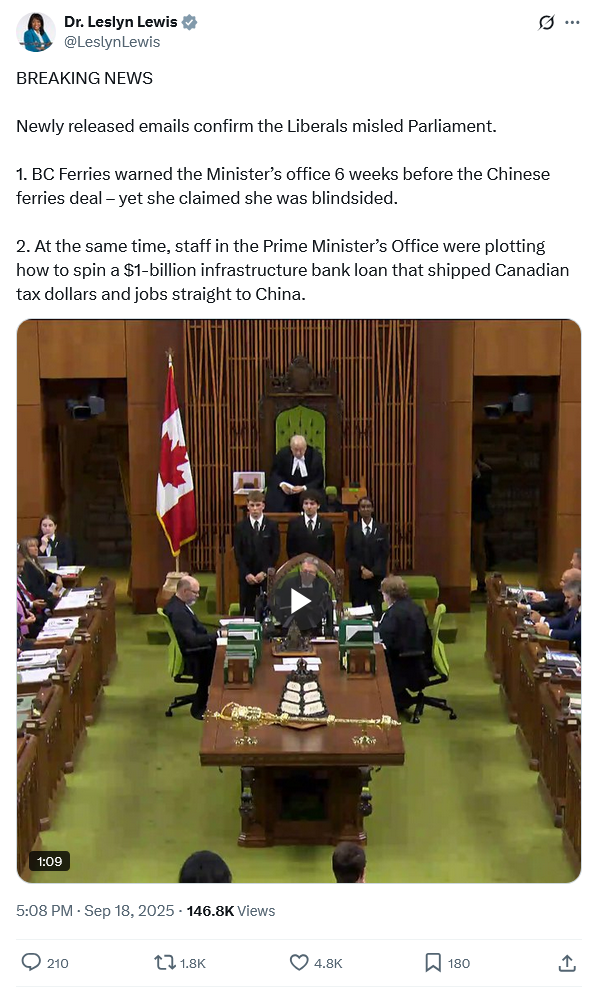
Conservatives put the revelation on the record and asked the only question that matters in a democracy: what did the minister know and when did she know it? The documents they cite don’t suggest confusion; they suggest choreography — ministerial staff emailing the Prime Minister’s Office on how to manage the announcement rather than stop the deal that offshored Canadian work to a Chinese state firm.

Follow the money and it gets worse. A federal Crown lender — the Canada Infrastructure Bank — underwrote $1 billion for BC Ferries and attached no Canadian-content requirement to the financing. In plain English: taxpayers took the risk, Beijing got the jobs. The paper trail presented to MPs is smothered in black ink — hundreds of pages of redactions — with one stray breadcrumb: a partially visible BC Hydro analysis suggesting roughly half a billion dollars in B.C. terminal upgrades to make the “green” ferry plan work. You’re not supposed to see that. You almost didn’t.

How did the government side respond? With a jurisdictional shrug. We’re told, over and over, that BC Ferries is a provincial, arm’s-length corporation; the feds didn’t pick the yard, don’t run the procurement, and therefore shouldn’t be blamed. That line is convenient, and in a technical sense it’s tidy. But it wilts under heat. The federal lender is still federal. The money is still public. If “arm’s-length” means “no accountability”, it’s not a governance model — it’s a get-out-of-jail-free card.

The fallback argument is economic fatalism: no Canadian shipyards bid, we’re told; building here would have taken longer and cost “billions” more. Maybe that’s true, maybe it isn’t — but it’s the sort of claim that demands evidence, not condescension. Because the last time Canadians heard this script, the same political class promised that global supply chains were efficient, cheap and safe. Then reality happened. If domestic capacity is too weak to compete, that’s not an argument for outsourcing permanently; it’s an indictment of the people who let that capacity atrophy. And if you swear “Canada first” on the campaign trail, you don’t bankroll “China first” from the Treasury bench.

Dr. Leslyn Lewis on X:

September 15, 2025

QotD: Federal equalization payments

Filed under: Cancon, Economics, Government, Quotations — Tags: , , — Nicholas @ 01:00

Perhaps the most fascinating component of [Prof. Thomas] Courchene’s paper is his subtle discussion of what, precisely, equalization is for. Is it meant to render every province in Canada equally well off in general? Or is it meant only to correct inequities introduced by the provinces’ different geographic and natural circumstances? Or is it meant even more narrowly, as a scheme to ensure that the federal government doesn’t accidentally worsen those inequities? Or it is meant merely to discourage culturally harmful labour migration?

There is no official answer to this question, and all the possible answers lead to moral and mathematical absurdities. It’s not just that we don’t know whether equalization works, as Terence Corcoran observed in the Financial Post yesterday. We literally don’t even know what it’s meant to accomplish

Colby Cosh, “Economist plays ethicist”, National Post, 2005-09-01.

September 4, 2025

Net Zero targets and Britain’s ever-declining car industry

Filed under: Britain, Business, China, Environment, Government, USA — Tags: , , , , , — Nicholas @ 03:00

At the Foundation for Economic Education, Jake Scott charts the decline of the British auto manufacturing centres and the government’s allegiance to its Net Zero programs:

Custom image by FEE

Britain was once a giant of car manufacturing. In the 1950s, we were the second-largest producer in the world and the biggest exporter. Coventry, Birmingham, and Oxford built not just cars, but the reputation of an industrial nation; to this day, it is a source of great pride that Jaguar–Land Rover, a global automotive icon, still stands between Coventry and Birmingham. By the 1970s, we were producing more than 1.6 million vehicles a year.

Today? We have fallen back to 1950s levels. Last year, Britain built fewer than half our peak output—800,000 cars, and the lowest outside the pandemic since 1954. Half a year later, by mid-2025, production has slumped a further 12%. The country that once led the automotive revolution is now struggling to stay afloat, and fighting to remain relevant.

This is why the news that BMW will end car production at Oxford’s Mini plant, shifting work to China, is so damning, bringing this decline into sharp focus. The Mini is not only a classic British car; Alec Issigonis’s original design made it an international icon. For decades, the Mini has been the bridge between British design flair and foreign investment. Its departure leaves 1,500 jobs at risk at a time when the government is desperate to fuel growth and convince a wavering consumer market that there is no tension between industrial production and Net Zero goals.

It’s a bitter reminder that we in Britain have been here before: letting an industrial crown jewel slip away.

The usual explanations will be offered: global competition, exchange rates, supply chains. All true, in the midst of a global trade war that is heating up and damaging major British exports. But such a diagnosis is incomplete. The truth is that Britain’s car industry is being squeezed by a mix of geopolitical realignment and government missteps.

The car industry has become the frontline of a new trade war. Washington has already moved aggressively to shield its own firms: the Inflation Reduction Act offers vast subsidies for US-made EVs and batteries, an unapologetic attempt to onshore production, and something that became a flashpoint of tension in Trump’s negotiation with the EU in the latest trade deal. On the production side, the Act has poured billions into US manufacturing: investment in EV and battery plants hit around $11 billion per quarter in 2024.

Ripples have been sent across the world in the US’s wake: Europe, faced with a flood of cheap Chinese EVs, has imposed tariffs of up to 35% after an anti-subsidy investigation. Talks have even turned to a system of minimum import prices instead of tariffs. Unsurprisingly, China has threatened retaliation against European luxury marques, while experts warn the tariffs may slow the EU’s green transition by raising prices.

This is no longer a free market: cars are treated as strategic assets, the 21st-century equivalent of shipbuilding or steel. Whoever controls the supply chains, particularly for EV batteries and the mining of lithium, controls not only the future of the industry but an important lever of national power.

The results are visible. In July 2025, Tesla’s UK sales collapsed nearly 60%, while Chinese giant BYD’s deliveries quadrupled. Europe responded by talking up new tariffs. Britain did nothing. In this asymmetric contest, our market risks becoming a showroom for foreign producers — subsidizing both sides of the trade war without defending our own.

August 21, 2025

QotD: Computer models

Filed under: Economics, Government, Media, Politics, Quotations, Technology — Tags: , , , — Nicholas @ 01:00

Should some sort of post-mortem ever be conducted on the catastrophic failure of all computer models, it will be done with the help of a computer model, that will cost billions in whatever currency to assemble. It will show the need for more computer studies. And therefore, it will be catastrophically wrong.

But note: for 100 dollars or negotiable, I will produce a minority report that will explain everything, infallibly. I will not preview the report in this Idlepost, however, because it might be worth money to me.

Aw, heck. Since I am rich beyond the dreams of avarice, let me just go ahead and blow all the beans. Let me recklessly tell gentle reader why computer models are always mistaken.

It is because their makers decide the result, before they design the model.

This does not mean they are self-interested phanatics, consciously preying on the gullibility of a drooling, ignorant public; although usually it does. For even if, by disposition, they are lofty, objective types, they will need, objectively, a lofty budget to perform a “credible” study. This means they must beg huge sums of money, and this will only be available from a source with an unhealthy interest in the result.

You see, the problem has nothing to do with computers. Even among humans, the phenomenon of “garbage in, garbage out” is well attested. The intention of following the evidence where it leads, is transient. I should think only a saint could sustain it, for longer than he could hold his breath under water.

David Warren, “A note on sternutation”, Essays in Idleness, 2020-06-19.

August 20, 2025

California’s ever-receding High Speed Rail dream

Chris Bray provides an on-the-ground update of California’s ultra-expensive high speed rail project which still has yet to deliver a single passenger from one station to another after nearly 20 years of funding:

Start with a description: “In 2008, California voters approved $9.95 billion of state bond funding as seed money to build an 800-mile high-speed rail (HSR) network connecting Los Angeles and San Francisco, and the Central Valley to coastal cities, at speeds of up to 220 miles per hour, with an expected completion date of 2020.”

Construction started in 2015. Pause for a moment and really notice the date.

Ten years later, the project has consumed $18 billion, and an effort to connect Los Angeles and San Francisco has turned into a much more modest “Phase One” plan to connect the cities of the Central Valley, well east of the coast. The modest declared cost of the proposed LA-to-SF bullet train now looks like this for the much shorter line: “a cost range of $89 billion to $128 billion.” The Trump administration has declined to provide more federal funding for the project, but California is suing to try to keep the federal spigot open.

[…]

Famously, the California High-Speed Rail Authority has been posting pictures of its huge construction successes on social media:

See, that’s … almost a whole rail line for a bullet train. Obviously!

So!

If you ever find yourself in Fresno, and I sincerely hope you don’t, the structures that have been built for “high-speed rail” are surprisingly easy to access. There are several places where those structures aren’t fenced in or guarded. At all. […] So when you see this:

…it’s not that hard to just head up onto the thing. It’s also very dangerous, legally dubious, and something you definitely shouldn’t do. Since it’s an elevated construction site, there are a lot of places without guardrails where you can just fall off the thing, and it’s a long way down.

Everyone see this part: Don’t go up there. It’s dangerous. You can fall and die. […] But if you were to climb up onto the thing, which you absolutely should never do, you would see a whole bunch of this:

That’s a section at the northern end of Fresno, looking south.

Of course, California isn’t the only jurisdiction struggling to complete big infrastructure projects: Toronto’s long-awaited Crosstown LRT project got started in 2007 and still has no confirmed completion date, although a faint possibility exists that a portion of the line may open later in 2025.

August 7, 2025

“The Beer Store seems to be going down faster than, well, a nice, cold beer”

Filed under: Business, Cancon, Government — Tags: , , , , , — Nicholas @ 04:00

In The Line Scott Stinson discusses the precipitous fall in the fortunes of Ontario’s former beer retail behemoth now that beer is available in — shock! horror! — grocery stores and even (gasp!) convenience stores:

“The Beer Store” by Like_the_Grand_Canyon is licensed under CC BY-NC 2.0

A major Ontario retailer announced last month that it would permanently close 20 locations in August. This follows the closure of 10 of its stores just over a week before that, and precedes the planned shuttering of 10 more locations in September.

What business could possibly be swooning this much? A general retailer pummelled by Amazon? An exporter battered by Trump’s tariffs?

Nope: Beer. Seriously. The Beer Store seems to be going down faster than, well, a nice, cold beer.

Welcome to the uniquely weird world of alcohol sales in the province of Ontario, where somehow selling beer has become a struggling business.

Some background is probably required, for those who, understandably, must think by this point that I am full of shit.

For ages the vast majority of Ontario’s beer sales ran through The Beer Store, a chain of 450-ish outlets that was co-owned by Canada’s largest brewers. You could also get beer at the provincially owned LCBO, but the largest size available there was a six-pack. That was it. This system was exceedingly unfriendly to consumers, but owing to our puritan roots and the fact that the brewers had excellent lobbyists at Queen’s Park, it remained that way through decades — and governments of all three major parties.

About a decade ago, the Toronto Star got its hands on one of the agreements between The Beer Store and the province, which revealed what a sweetheart deal it was getting. Among other things, the deal greatly restricted the degree to which the LCBO could compete in beer retail, which caused much frothing over the fact that The Beer Store, long since owned by multinational conglomerates, was getting preferential treatment over the province’s own booze outlet.

The Liberal government of the day responded by loosening The Beer Store’s stranglehold on beer retail, but just a little: allowing it to be sold at a limited number of grocery stores, a hilariously small step but one that in Ontario was nevertheless a great leap forward.

Doug Ford’s Conservative government had long wanted to expand alcohol sales much further, but always stumbled over the fact that The Beer Store had a deal that prohibited such expansion until 2026. But then Ford wanted to hold an election last spring and he convinced The Beer Store to let him break that deal a year early for $225 million, which always seemed like an awfully steep price to move up that expansion by what amounted to a number of months.

It’s only in recently, though, that it has become clear how spectacularly dumb that giant payment was in the first place.

May 11, 2025

Will Amtrak survive the DOGE treatment?

Filed under: Economics, Government, Railways, USA — Tags: , , , — Nicholas @ 03:00

J.D. Wong outlines Amtrak’s never-ending financial difficulties:

“Amtrak” by Mike Knell is licensed under CC BY-SA 2.0 .

Founded 54 years ago, Amtrak set out on a bold adventure to see if passenger trains could be profitable. Fast forward to today, this experiment has been unsuccessful. Politicians have often crafted routes to win votes rather than attract riders. As a result, Amtrak has been squandering taxpayer money since its start in 1971.

Take, for instance, the Infrastructure Investment and Jobs Act of 2021. It allocated a monumental $66 billion to bolster passenger rail. Yet, even with this backing, Amtrak’s losses soared from $1.12 billion in FY2019 to $2.12 billion in FY2024. This financial drain isn’t new; America’s passenger trains have lost money for 79 years.

Amtrak asserts that it is “on-track to reach operational profitability”. Yet, this is a bald-faced lie. While Amtrak reported a loss of $705.2 million for FY2024, it didn’t include:

  1. $966.2 million in depreciation;
  2. $447.3 million in “Project Related Expenses”;
  3. $314.1 million in state subsidies, which it classified as “revenue”;
  4. $26.9 million in Office of Inspector General funding

By omitting these costs, Amtrak paints an optimistic view of its financial health. In reality, Amtrak needs larger subsidies than ever before. In fact, Amtrak has been deceiving Congress with its “path to profitability” since 1990.

Although Amtrak touted a “ridership record” for FY2024, this figure is misleading too. Ridership numbers don’t reflect the average length of each passenger’s trip. A more insightful metric is passenger-miles, which measures how far people are traveling. In fact, Amtrak only transported 6.54 billion passenger-miles in FY2024. This is a decrease of 3.40 percent since FY2013.

Amtrak often attributes its financial struggles to its long-haul routes. Yet, the outlook is even bleaker for its short-haul, state-supported routes. Amtrak reported a $251.5 million loss for these routes in FY2024. Yet, with $314.1 million in state subsidies included, the true loss hits $565.6 million. This represents a shocking 94 percent increase from the $291.7 million lost in FY2019.

Amtrak’s advocates often cite highway “subsidies” to explain its financial debacles. But Amtrak guzzles about 39 times more subsidies per passenger-mile than highways do.

Amtrak asserts that freight trains “interfere” with its passenger services. However, Amtrak often makes questionable route choices despite having legal priority over freight. Between Chicago and Los Angeles, the Desert Wind lost less money than the Southwest Chief. Despite this, Amtrak favored the Southwest Chief, which passed through more congressional districts. It discontinued the Desert Wind in 1997, leaving Las Vegas with no train service.

March 19, 2025

The Trumpocalypse – “The outlook for universities has become dire”

Filed under: Education, Media, Politics, USA — Tags: , , , , , — Nicholas @ 05:00

John Carter suggests that American higher education needs to find a new funding model that doesn’t depend on governments to shower their administrative organizations with unearned loot:

Shortly after taking power, the Trump administration announced a freeze on academic grants at the National Science Foundation and the National Institute for Health. New grant proposal reviews were halted, locking up billions in research funding. Naturally, the courts pushed back, with progressive judges issuing injunctions demanding the funding be reinstated. Judicial activism has so far met with only mixed success: the NSF has resumed the flow of money to existing grants, but the NIH has continued to resist. While the grant review process has been restarted at the NSF, the pause created a huge backlog, resulting in considerable uncertainty for applicants.

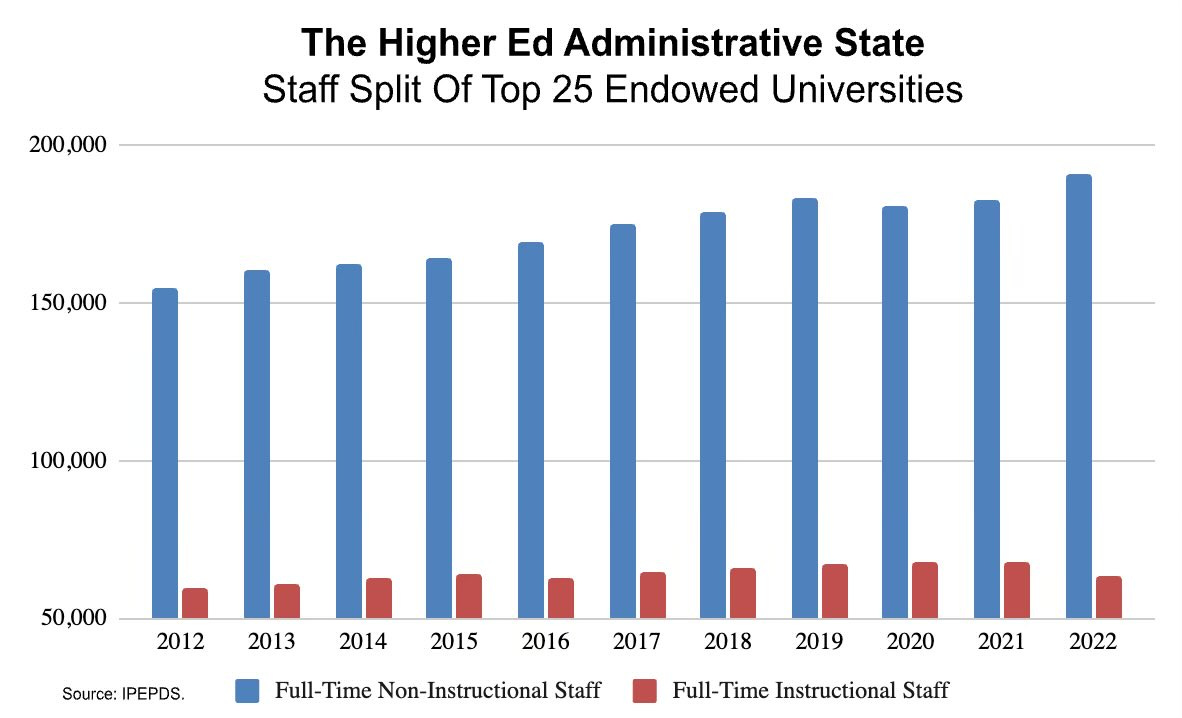
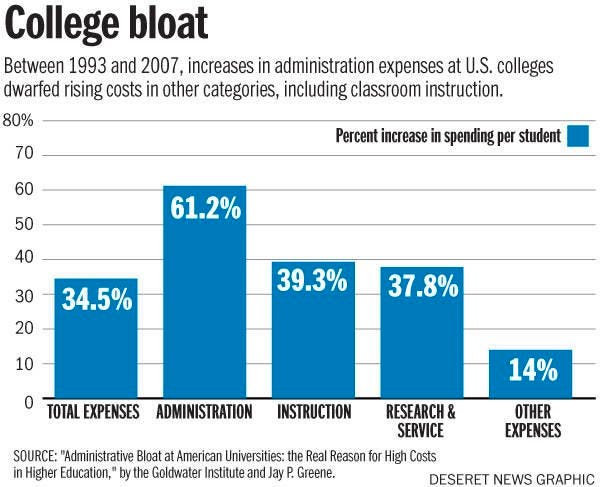
The NIH has instituted a 15% cap to indirect costs, commonly referred to as overheads. This has universities squealing. Overheads are meant to offset the budgetary strain research groups place on universities, covering the costs of the facilities they work in – maintenance, power and heating, paper for the departmental printer, that kind of thing. Universities have been sticking a blood funnel into this superficially reasonable line item for decades, gulping down additional surcharges up to 50% of the value of research grants, a bounty which largely goes towards inflating the salaries of the little armies of self-aggrandizing political commissars with titles like Associate Vice Assistant Deanlet of Advancing Excellence who infest the flesh of the modern campus like deer ticks swarming on the neck of a sick dog. Easily startled readers may wish to close their eyes and scroll past the next few images btw, but I really want to make this point here. When you look at this:

A 15% overhead cap, if applied across the board, has an effect on the parasitic university administration class similar to a diversity truck finding parking at a German Christmas market. Thoughts and prayers, everyone.

Meanwhile at the NSF, massive layoffs are ongoing, and there are apparently plans to slash the research budget by up to 50%. While specific overhead caps haven’t been announced at the NSF yet, there’s every reason to expect that these will be imposed as well, compounding the effect of budget cuts.

There is no attempt to hide the motivation behind the funding freeze, which is obvious to both the appalled and the cuts’ cheerleaders. Just as overheads serve as a blood meal for the administrative caste, scientific research funding has been getting brazenly appropriated by political activists at obscene scales. A recent Senate Commerce Committee report found that $2 billion in NSF funding had been diverted towards DEI promotion under the Biden administration. In reaction to this travesty, as this recent Nature article notes, there are apparently plans to outright cancel ongoing grants funding “research” into gay race communism. DEI programs, formerly ubiquitous across Federal agencies, have already been scrubbed both from departmental budgets and web pages. Indeed, killing those programs was one of the first actions of the MAGA administration.

The outlook for universities has become dire, and academics have been sweating bullets all over social media. Postdocs aren’t being hired, faculty offers are being rescinded, careers are on hold, research programs are in limbo. This comes at the same time that budgets are being hit by declining enrolment due to the demographic impact of an extended period of below-replacement fertility along with rapidly declining confidence in the value of university degrees, with young men in particular checking out at increasing rates as universities become tacitly understood as hostile feminine environments. They’re hitting a financial cliff at the same point that they’ve burned through the sympathy of the general public.

The entire sector is in grave danger.

Politically, going after research funding is astute. Academia is well known to be a Blue America power centre, used to indoctrinate the young with the antivalues of race Marxism, provide a halo of scholarly legitimacy to the left’s ideological pronouncements, and hand out comfortable sinecures to left-wing activists. The overwhelming left-wing bias of university faculties is proverbial. The Trump administration is using the budgetary crisis as a handy excuse to sic its attack DOGE on the unclean beast – starting with cutting off funding to the most ideological research projects, but apparently also intending to ruin the financial viability of the progressives’ academic spoils system as a whole.

Cutting the NSF budget by half may seem at first glance like punitive overkill, and no doubt the left is screeching that Orange Hitler is throwing a destructive tantrum like a vindictive child and thereby endangering American leadership in scientific research. After all, for all the attention that NASA diversity programs have received, the bulk of research funding still goes to legitimate scientific inquiry, surely? However, the problems in academic research go much deeper than its relentless production of partisan activist slop. Strip out all of the DEI funding, fire every equitied commissar and inclusioned diversity hire, and you’re still left with a sclerotic academic research landscape that has spent decades doing little of use – or interest – to anyone, and doing this great nothing at great expense.

February 6, 2025

The fascinating (domestic and) transnational role of USAID

Filed under: Government, Politics, USA — Tags: , , , , , , — Nicholas @ 05:00

One of the most interesting moves of the Trump administration so far has been the lightning strike to shut down the United States Agency for International Development (USAID):

On closing it down Musk said: “USAID is a criminal organisation. Time for it to die.”

On Friday last week, Elon Musk and DOGE wanted access to agency systems of the giant USAID. When senior officials refused, by Saturday they were put on leave.

    “Spent the weekend feeding USAID into the wood chipper,” Musk boasted on X.

    “It became apparent that it’s not an apple with a worm it in,” Musk said in a live session on X Spaces early Monday. “What we have is just a ball of worms. You’ve got to basically get rid of the whole thing. It’s beyond repair.” — AP News

Elon Musk and DOGE closed the doors, and sent the head honchos packing. One officeworker said staff rushed to take down things like Pride Flags and incriminating books (whatever that means), and now they have lost access to their computers, and the site is down.

As Donald Trump and Elon Musk cut back rogue government agencies, USAID looks more and more like a giant money laundering racket. It has (or had) 10,000 employees and a budget of $50 billion dollars. It’s presented as a humanitarian aid group, but the AID in US-AID means the US Agency for International Development which turns out to mean anything and everything. The humanitarian projects include giving $53 million dollars to the starving EcoHealth Alliance which used that to pay for bioweapon research in Wuhan, China, helping to create Covid-19. USAID also funded the production of heroin in Afghanistan. The WhiteHouse revealed that USAID also funded DEI projects in Serbia, and DEI musicals in Ireland. They spent US Taxpayer money on transgender operas in Colombia and a trans comic book in Peru.

As Mike Benz describes it, USAID was the Ultimate Nerve Center Of A Rogue Foreign Policy Establishment

Mike Benz, former State Department Cyber expert, has studied USAID closely and says:

    USAID grantee NGOs literally take their USAID money then turn around and lobby all key members of Congress to give more and more US taxpayer money to USAID each year in the budget. USAID buys an army of lobbyists with your tax dollars to give it more of your money.

He also wonders why USAID gave $27 million to the US fiscal sponsor of the group controlling Soros-funded prosecutors and telling them which American citizens and politicians to prosecute?

Indeed, somehow USAID is also one of the “BBC Media Actions” top ten donors? Go figure? It’s just the US of A helping out third world countries like the UK, right?

    As Mike Benz said: the “BBC was in direct cahoots with USAID leadership on Internet censorship efforts to crush BBC’s online populist news competitors since 2017. I went over 9 hours of receipts on this in a 3-part private livestream lecture for my X subscribers”.

The BBC part of The Blob takes Blob money to lobby to cripple the media outside The Blob’s control. The words “Self Serving” come to mind.

Ron Paul agrees — USAID is a key component of US Regime change, meddling in foreign affairs. The news from Ukraine is essentially being controlled by USAID. Ukrainian media is Blob media.

Jo Nova posted a follow-up the next day:

Hands up who is still reeling with the news that USAID had 50 thousand million dollars of political and media influence? The annual budget of $50 billion dollars in the hands of unaccountable activist NGOs buys a lot of “journalists”, editors and teenage protestors. Suddenly a lot of global patterns make more sense.

Today we found out that news outlets like Politico, and the New York Times were being given millions of dollars from the US government.

Benny Johnson says:

    This is the biggest scandal in news media history: No employee at Politico got paid yesterday. First time ever the company missed a pay period. This is a crisis. Now we learn Politico — a “news company” — which spent the last 10 years trying to destroy the MAGA Movement was being massively funded by USAID.

It seems some $27 million dollars went to Politico during the Biden years — and that’s just the subscriptions (not the USAID). Truly, Politico charges as much as $10,000 for a single “Politico Pro” subscription — and so the taxpayers fork out big bucks to pay for politicians “work expenses”, and the money ends up covering the salaries of journalists who are working hard to deceive the hapless taxpayers.

As ZeroHedge reminds us, Politico went in hard in the 2020 election to cover for the Hunter Biden laptop from hell.

They also point out that the Blob has many other ways to keep newspapers toeing the line…

    It’s not just the subscriptions: there are huge “ad contracts”, dinner parties DC throws itself under the guise of “media conferences”, sponsorships, etc all paid for by taxpayers. Once done with Politico look at its spawn Axios, founded by Politico veterans

Niccolo Soldo included some commentary on the USAID shutdown in his weekend post a few days back:

Today I learned that all NGOs working in foreign countries that are funded by the USGov are having their funding suspended for 90 days. This is already sending shock waves around the world, as not only are State Department officials losing their shit, but local NGO employees are wondering how they can continue operating in the meantime:

People are quickly learning just how much of a footprint the USA has in their countries and how significant an influence they have on politics in their homelands. All of their Trojan horses are being exposed at the same time, meaning that it will take some time for most people to digest the sheer scale and size of US meddling abroad.

Mainstream media is already beginning to push back against this funding suspension, using their typical tricks to try and paint this order as potentially “risking the safety of millions“:

    Marocco strode into the offices of USAid this week flanked by members of Elon Musk’s “department of government efficiency”, a special group Trump created, with clipboards in hand. Several hours later, almost 60 senior officials from the office had been put on paid leave. Veteran aid officials with decades of experience at the agency were escorted from the building by security, according to current and former USAid officials, and their email accounts were frozen.

    “They wanted to decapitate the organisation,” said a current USAid employee. “And they did it by pushing aside the leadership and decades of experience.”

    The purge followed confusion within USAid over the stop-work orders drafted by Marocco and signed by Marco Rubio, the new secretary of state, leading some to believe that limited actions could continue if funds had already been committed.

The Guardian UK has decided to focus its attacks on Mr. Marocco.

    “We have identified several actions within USAid that appear to be designed to circumvent the president’s executive orders and the mandate from the American people,” wrote Jason Gray, USAid’s acting administrator, saying the relevant staff would be put on administrative leave.

    Some employees have openly rebelled. In an email to all staff seen by the Guardian, Nicholas Gottlieb, USAid’s director of employee and labor relations, said that appointees at USAid and “Doge” had “instructed me to violate the due process of our employees by issuing immediate termination notices”.

    Calling the requests “illegal”, Gottlieb said he “will not be a party to a violation of [due process]”. Hours later, he was put on administrative leave.

    In a separate email to the sidelined USAid senior staff, Gottlieb wrote that the “materials show no evidence that you engaged in misconduct”.

Fight! Fight! Fight!

    The chaotic rollout of the ban has led to whiplash for critical programs around the world, from emergency Aids relief (which has been granted a waiver), to clean-water and sanitation programs, to the Famine Early Warning Systems Network, which the Washington Post reported on Friday had gone offline.

    Yet there are few details of a vast review program, which is supposed to evaluate thousands of foreign aid grants as well as an expected torrent of waiver requests. And a number of the senior USAid staff put on administrative leave were lawyers who had helped prepare requests for exemptions from the foreign aid freeze, sources said.

Demoralization:

    Previous cables indicated that the people involved would include Marocco or the new director of policy planning, Michael Anton, another political appointee. The state department declined to answer questions from the Guardian about who is evaluating the reviews and how many staff had been detailed to the process.

    “We’re all trying to figure out, is there a review process? Who’s part of that review?” said the former senior USAid official. “Is it Pete Marocco and his two best friends?”

    At USAid, other directives have been enacted that have both defunded and demoralised staff. Photographs of aid programs around the world have been literally stripped off the walls after a “directive has been issued to remove all artwork and photographs from the offices and common spaces across all buildings”.

    Musk’s “efficiency department” has crowed about slashing $45m in scholarships for students from authoritarian Burma.

    The $40bn a year that the US spends on foreign aid is less than 1% of its budget. But the US spends $4 out of every $10 spent globally on humanitarian aid, according to the state department, and the sudden cutoff has led to thousands of layoffs among US contractors and local partners around the world.

And of course:

    A former USAid official said the decisions could put millions of people around the world at risk.

    “If there’s a tropical cyclone that hits Cox’s Bazar tomorrow, then how are you going to save all those people, and then how are you going to rebuild if there’s a stop-work order?” said a former senior USAid official, referring to the city in Bangladesh where more than 1 million Rohingya refugees are living. “You could have people sitting there for 90 days and sitting and waiting for what? That’s what worries more.”

Critics who say that this order effectively reduces US influence abroad are absolutely correct … but what if this is part of a widely-assumed fundamental change in how the USA conducts its foreign policy?

Seen on the social media network formerly known as Twitter:

January 22, 2025

“If this country MAIDs itself in the next 18 months, we at The Line know what slogan belongs on Canada’s epitaph”

The Line‘s editors gathered up the first day’s worth of Donald Trump II – The Trumpening and sifted out the bits particularly relevant to the dysfunctional Dominion to the north:

Donald Trump successfully trolled Canada’s hypersensitive political class about Canada becoming the 51st state of the union. The anguished butthurt still pains them.

What is happening right now was absolutely foreseeable. No one can claim with a straight face that U.S. tariffs could not have been foreseen on January 21, 2025, a full eight years to the day that Donald Trump was inaugurated for the first time. It’s not 2016, anymore. Nobody was blindsided.

Your Line editors wrote plenty of columns over the past decade noting that even if Donald Trump the man were not re-elected, the protectionist and reactionary currents that pushed him to power were still ascendant in America. The Biden admin was a reprieve, an opportunity for Canada to make necessary internal changes to withstand those currents.

And what did this country do with that time?

Jack all.

We at The Line have been scratching our noggins trying to think of single meaningful Canadian reform or improvement to come out of Trump 1. We did nothing to strengthen ourselves internally by an iota. Not a single lesson was learned.

It’s entirely possible that we were inevitably going to be dinged by some U.S. administration and, perhaps, this was not avoidable. No one can fully mitigate all risks. Granted.

But we can certainly do literally anything to address risks that are highly probable. Instead, we have absolutely degraded both our moral and financial capacity to be resilient in the face of economic threats; and that degradation is the direct result of almost ten years of Liberal party priorities, inactions, or choices ranging on files from crime, to market diversification, to being truly useful to our international allies, to failures on interprovincial trade.

This wasn’t unforeseen. We were willfully blind. That’s different.

We ignored the looming threat in part because our government was distracted by COVID. But also also because Canada’s political culture is too immature to make hard decisions, or to have real debates about trade offs or priorities.

Justin Trudeau is the kind of prime minister who would rather run the kind of country that lets him spout off on Jake Tapper about compassion and $10-day-day daycare and dental programs than NATO spending.

What about the scads of taxpayer cash we’ve squandered on things like “superclusters”? What if we had prioritized strategically crucial projects like Northern Gateway or Energy East, instead of letting them die under the mantra of: “no business case”.

Remember when Germany and Japan came asking after our natural gas supplies in the wake of the Russian invasion of Ukraine? What if we had spent oh, say, $13 billion, on fast tracking some kind of natural gas facility to supply our international allies because doing so served a strategic national interest rather than a pure economic one.

We didn’t pull that number from the air, by the way: that’s what Canada subsequently committed to subsidies for EV plants in southern Ontario — something for which there was a scant “business case” before, and virtually none now that Trump has decided to scrap EV subsidies. It’s looking not-great, Bob. Not great at all.

See, that’s the problem with running a low-productivity, highly centralized griftocracy that is more invested in expanding entitlements, symbolic action and emotional gratification than actually doing anything. We are now severely limited in our capacity to respond in the face of serious economic threats. We can talk a good game. We can bluster. We can invest in more symbolic retaliatory action; but we have utterly squandered the internal resilience required to mount a real fight in even a trade war, much less a kinetic one.

And we at The Line can’t help but note the deafening silence from our international allies as well. They think we’ve got it coming, too. Perhaps there’s “no business case” for sticking their necks out on our behalf.

The first time a big new battery plant was subsidized, I thought it was a bad idea. Then it happened again and again. This is exactly why you don’t want your government at any level “picking winners”! Ross McKitrick had a series of tweets discussing this and other noteworthy executive orders issued (thread on Threadreader, but that may not be available for long):

(more…)

January 9, 2025

Trump plays fast and loose with numbers over US/Canadian trade

Filed under: Cancon, Economics, Media, Politics, USA — Tags: , , , , — Nicholas @ 03:00

On her Substack, Tasha Kheiriddin refutes some of the big numbers US President-elect Donald Trump has been using in his “make Canada the 51st state” campaign:

US President-elect Donald Trump successfully trolled Justin Trudeau about Canada becoming the 51st state of the union.

“We don’t need their cars. … We don’t need their lumber”, Trump said. “We have massive fields of lumber … We don’t need their dairy products. We have more than they have.”

This is, of course, a giant lie. Canada has plenty of things America needs, including raw materials like oil and food that it refines and transforms. That transformation generates millions of well-paying US industrial and manufacturing jobs. The US also imports nearly $5 billion in fertilizer to boost agricultural production.

And if we don’t have anything America needs, why would Trump want to annex us? Because, he claims, the US trade deficit with Canada is a “subsidy.” Trump asks, “Why are we losing $200 billion dollars a year and more to protect Canada?”

This is a second lie. First of all, trade deficits are not subsidies. A trade deficit represents the difference in the value of imports and exports. Second, the US trade deficit with Canada isn’t $200 billion, or even the $100 billion figure Trump has previously used. In 2023, according to the US Bureau of Economic Analysis, it was $USD 41 billion. And if you remove energy exports, the US actually runs a surplus with us, not a deficit. Energy exports accounted for over $177 billion of Canada’s exports south of the border. Twenty-eight per cent of what we export is energy, namely, over four million barrels per day of oil, the largest amount from any country in the world.

Trump is correct that Canada has benefitted from the American military’s umbrella. We benefit by proximity, because we happen to be next to the US – just like Americans benefit from buying our discounted crude oil, because they happen to be next to us. The US would maintain their military whether we were neighbours or not. They wouldn’t have a smaller military if they annexed Canada; if anything, they’d spend more, because they would be actively engaged across our entire landmass, directly defending our borders. We have also been a steadfast ally in times of war, a fact Trump handily omits.

So Trump’s argument is a lie, but a clever lie. It’s something that will resonate with his voters, with the average American struggling to pay their bills. It’s purportedly about fairness, doing what’s right. Not taking over a sovereign nation, but returning to Americans what’s rightfully theirs.

It’s like Putin saying that the Donbas is full of Russians, so it really should be part of Russia. Or Xi Jinping saying that Taiwan is really part of China, so the two countries should be “reunified”.

It’s also cover for the real reason Trump would like to take over Canada: because we do have a lot of what the US needs, namely oil, water, and critical minerals. He would love to take control of the Arctic, ostensibly for security reasons, but really for the resources that lie beneath. Drill, baby, drill. But Trump can’t say that part out loud, because then he sounds like a communist dictator, not the leader of the free world.

Trump wants to use tariffs to break Canada. Our GDP could drop by two to four per cent and put us in an official recession. Two and half million jobs would be at risk. People would get poorer at a time when two million of us are already using food banks. Throw in a simultaneous diet of pro-annexation propaganda pumped out by Trump’s friends on social media, and the blathering of front groups funded by vested interests, and the 13% of Canadians who favour joining the US could swell to the point where they put political pressure on Ottawa to cave to Trump’s demands.

And then, all bets are off. Trump figures Canadians will beg to join the US, and he may not be wrong. Manifest destiny, achieved — and a YUGE legacy for him.

In the National Post, Carson Jerema wishes the Canadian media would calm the hell down and recognize that Trump is still trolling the heck out of them:

So it turns out Donald Trump doesn’t really want to annex Canada. Seriously. Anyone who watched his news conference Tuesday, and not just the short clip shared on social media, should come away assured, as much as one can be with Trump anyway, that his comments about this country becoming the 51st state really are little more than trolling. Certainly, the U.S. president-elect repeatedly musing about absorbing Canada has never been funny, and the words themselves undermine Canadian sovereignty, but nothing Trump said Tuesday was much different than what he’s been saying for weeks.

Yes, I’m aware that we are supposed to be in crisis mode at Trump’s latest musings, which the Toronto Star called “explosive”, and the Globe and Mail referred to as an “escalation”. Even the National Post’s Wednesday front page played up the president-elect’s comments. A similar response came from Prime Minister Justin Trudeau, who posted on social media that “There isn’t a snowball’s chance in hell” that Canada would merge with the U.S., and Conservative Leader Pierre Poilievre, who posted that “Canada will never be the 51st state. Period”.

As is so often the case, what Trump actually said is less exciting than the reaction it generated.

When asked by a reporter if he was “considering military force to annex and acquire Canada?” Trump responded, “No. Economic force because Canada and the United States, that would really be something. You get rid of that artificially drawn line and you take a look at what that looks like and it would also be much better for national security.”

That response is the sum total of the so-called “escalation”.

It is, at a brief glance, easy to see why so many felt compelled to react the way they did to the president-elect’s comments, but it was the reporter, not Trump, who used the word “force” first, and getting “rid” of the border could mean any number of arrangements, short of a merger. Beyond that, however, there isn’t much in the way of a new development in the supposed annexation crisis of 2025.

November 29, 2024

Dr. Jay Bhattacharya nominated as Director of the US National Institutes of Health

From the point of view of the establishment, the barbarians are well and truly inside the gates, as President-elect Donald Trump has nominated Stanford epidemiologist Dr. Jay Bhattacharya as the next director of the National Institutes of Health:

Dr. Jay Bhattacharya, Donald Trump’s nominee as Director of the National Health Institutes.
Photo by Taleed Brown, 2020, via Wikimedia Commons.

Four years ago, Jay Bhattacharya was ostracized by his colleagues at Stanford and censored on social media platforms thanks to a campaign against him by the public-health establishment. The director of the National Institutes of Health, Francis Collins, sent an email to another NIH official, Anthony Fauci, urging a “quick and devastating published takedown” of Bhattacharya and his fellow “fringe epidemiologists”.

Bhattacharya is far from the fringe today. Donald Trump nominated him this week for Collins’s old job, director of the NIH. Assuming the Senate confirms him, it will be a major victory for science and academic freedom — and a serious threat to the universities that suppressed scientific debate and promoted disastrous policies during the pandemic, causing public trust in science to plummet. Academic researchers and administrators have mostly refused to acknowledge their mistakes, much less make amends, but Bhattacharya promised yesterday to “reform American scientific institutions so that they are worthy of trust again”.

As NIH director, he would wield a potent tool to induce reform: money. Stanford and more than a dozen other universities each get more than $500 million annually in grants from the NIH, the world’s largest funder of biomedical research. The NIH grants support not only researchers but also their universities’ bureaucracies, which collect a hefty surcharge to cover supposed overhead costs. The federal largesse has helped finance the administrative bloat at universities, including the expansion of diversity, equity, and inclusion bureaucracies under the Biden administration, which took into account a university’s commitment to DEI principles when deciding whether to award grants from the NIH and other agencies.

Those priorities are about to change. Trump has vowed to rescind immediately Biden’s executive order directing federal agencies to promote DEI. During his first term, Trump threatened to issue an executive order barring universities from receiving federal funds if they suppressed free speech. He didn’t issue that order, but whether or not he does so in his next term, the NIH director will already have the power to consider a university’s commitment to academic freedom in deciding whether or not to award funds.

“For science to thrive and progress, we must be open-minded and allow vigorous and passionate debate,” says Martin Kulldorff, a former professor of medicine at Harvard. “Why should taxpayers subsidize universities that don’t allow that?” Kulldorff, an eminent epidemiologist, lost his job at Harvard after he became an early and outspoken critic of pandemic policies. In 2020, he joined with Bhattacharya and Sunetra Gupta, an epidemiologist at Oxford, to write the Great Barrington Declaration, a critique of lockdowns that was signed by tens of thousands of scientists and physicians.

Bhattacharya, who has a Ph.D. in economics as well as an M.D. from Stanford, hung on to his job as professor of health policy at the latter’s medical school, but his views were taboo on campus. After he and colleagues did a field study at the start of the pandemic showing that the Covid fatality rate was much lower than the doomsday number used to justify lockdowns, they were vilified by academics and journalists, and Stanford subjected them to a two-month inquiry by an outside legal firm. (They were vindicated by the inquiry and also by subsequent research confirming their findings.)

QotD: Why nothing gets done in the Current Year

… we do gain a lovely illustration of why nothing ever really gets done in this modern world. Sure, the politicians have demanded more [advanced logic] chips in a country that doesn’t have any spare chip technicians — TSMC has had to import their own from Taiwan — and so on and so on. But there’s also this:

    Having pumped billions of dollars into building the next generation of computer chip factories in the US, the Biden administration is facing new pressure over the health and safety risks those facilities could pose. Environmental reviews for the new projects need to be more thorough, advocates say. They lack transparency around what kinds of toxic substances factory workers might handle, and plans to keep hazardous waste like forever chemicals from leaching into the environment have been vague.

    A coalition of influential labor unions and environmental groups, including the Sierra Club, have since submitted comments to the Department of Commerce on draft environmental assessments, saying that the assessments fall short. The coalition’s comments flag lists of potential issues at several projects in Arizona and Idaho, including how opaque the safety measures that manufacturers will take to protect both workers and nearby residents are.

This is not a serious complaint. This is actually the national association of environmental studies writers spotting a gravy train passing by and desiring to dip their ladle in. And that’s all it is too. But it’s also that excellent example of why fuck all ever gets built. We’ve an entire — and politically powerful — class that makes their living producing the hundred tonne reports that accompany building anything. And they’re not going to allow anything to be built unless they get paid for writing hundred tonne reports. And, to complete the circle, if every activity requires a hundred tonne report then fuck all will ever get done.

There was, back a time, a law passed about blood minerals. The law said anyone who might use them must write to all suppliers to ask if they do. Then those said anyones must tell consumers whether they do. This cost $4 billion just in the first year. From what I’ve heard — and might take the trouble to prove one day — the bloke who led the campaign for the law requiring the letters now runs a very profitable consultancy advising large corporates on how to write the letters. $4 billion spent by society so that one bloke can gain a minor summer place in the Hamptons. This doesn’t make us richer as a whole, it’s pissing the wealth of the nation up the wall.

Carthage, it’s the only solution. The biggest problem who is who the hell would buy our nice new stock of enslaved environmental bureaucrats? Razing, salt, ploughs, these are easy but who’s mad enough to offer a positive price for the last part of the process?

Tim Worstall, “Why Fuck All Ever Gets Done In This Modern World”, It’s all obvious or trivial except …, 2024-08-28.

November 8, 2024

“The Science™, that thing we’re supposed to believe in and obey – is distinctly and increasingly political”

President-elect Donald Trump has a vast array of options to tackle in the traditional first hundred days of his administration. Chris Bray says that one of the very first of these should be the depoliticization of the federal science agencies:

Donald Trump has spoken very clearly about his day-one determination to end the mutilation of children in the service of gender ideology, but let’s look for the roots of that poison tree. Via Billboard Chris, here’s a sample descriptive section from a National Institutes of Health grant given to a pediatric gender physician in Los Angeles, and read this carefully to find the most important sentence:

Dr. Johanna Olson-Kennedy has worked to push gender hormone treatment down to eight year-olds, with research funding from the federal government. Now, big finish: the dates on the NIH grant that Billboard Chris highlighted:

This is a project — gender hormones for eight year-olds — that operated with federal funding during the first Trump administration. Policy expressed in words meets policy expressed in cash. This is what matters, year after year, through Republican and Democratic administrations alike (click to enlarge):

The money, the money, and the money. What you fund is what you’re doing. It may not seem like a big target, but the politicization of federal science funding is a root cause of institutional decay and pathological narrative-making, and cutting the money pipeline to politicized science is the policy action that will matter for decades. Remaking the funding pipeline for federal science grants is a day one priority, because the money will shape policy far more than any declaration of intent.

The problem is everywhere: the NIH, the NSF, NASA, NOAA, and so on. SpaceX is catching rockets; NASA is funding this: “21-EEJ21-0020 ASSESSMENT OF THE GULF COAST ENVIRONMENTAL JUSTICE LANDSCAPE FOR EQUITY.”

And this: “EXPLORING SYNERGISTIC OPPORTUNITIES BETWEEN CHARLOTTE-AREA ENVIRONMENTAL JUSTICE INITIATIVES AND NASA EARTH SCIENCE INFORMATION.”

Pick a federal science grant website and spend some time exploring it. Here’s the National Science Foundation’s funding opportunities page. Sample grant program: “Growing Research Compliance Support and Service Infrastructure for Nationally Transformative Equity and Diversity”.

Today’s funded program for transformative science equity and environmental justice is tomorrow’s new policy measures. This is the pipeline to programs. What you fund today is what you’re going to do in five years.

October 26, 2024

Our solar energy future – “In September alone, Germany paid 2.6 billion Euro to renewables producers for electricity that had a market value of a mere 145 million Euro”

Checking in with what’s been happening in Germany, eugyppius explains why solar power is far from the cost-free energy source that politicians and scam artists try to claim:

Photovoltaic panels on a roof, 28 April, 2015.
Photo by Antonio Chaves, via Wikimedia Commons.

Climatism in Germany is attended by all manner of naive ideas and bright pink fairytale slogans. Among the latter is a dubious proverb proclaiming that “The sun doesn’t send any bills” (in German: “Die Sonne schickt keine Rechnung“). Such proverbs always seem initially plausible (is there anything freer and more democratic than sunshine?) while proving to be basically the opposite of the truth. In fact, the energy transition has landed German taxpayers in the position of paying billions of Euros for the sun to shine. It is becoming an unmitigated disaster, and what is worse, the more we expand solar capacity, the more we will have to pay. For something that does not send any bills, sunshine has sure become very expensive here in the Federal Republic.

Welt calls it “the solar trap,” and it works like this: Our Renewable Energy Sources Act (EEG) pledges to pay renewables producers fixed tariffs for every kilowatt hour of electricity their installations feed into the grid. Whether you are an ordinary climate-conscious person with solar panels on your house or you run massive solar farms, the EEG entitles you to receive these fixed “feed-in tariffs” for a period of twenty years. The EEG also requires grid operators to accept your electricity regardless of demand and to sell it on the electricity exchange.

Now the sun, although it may not charge for its services, turns out to have this naughty habit of shining in many places all at once. When this happens, electricity supply often exceeds electricity demand and exchange prices fall. They can fall all the way to zero, or in extreme situations of excessive sunshine they can even go negative. Negative prices mean that you have to actually pay “buyers” to take the excess power off your hands. Whether the prices are merely very low, or zero, or negative, the German taxpayer has obligated himself, via the EEG, to pay these producers of unwanted if extremely green and climate-friendly electricity their fixed feed-in tariffs anyway. That is, we are on the hook for the difference between the actual exchange value of excess electricity and the feed-in tariffs promised to producers. In this way we have ended up literally paying for the sun to shine.

In September alone, Germany paid 2.6 billion Euro to renewables producers for electricity that had a market value of a mere 145 million Euro. Our sunny autumn is destroying our already-fragile government budget. Federal number-crunchers had originally allocated 10.6 billion Euros for feed-in tariffs in 2024, but already the government owes 15 billion and the year is not yet over. Scholz’s cabinet are thus trying to allocate an additional 8.8 billion Euro for the rest of the year. The parliament have yet to approve the additional funds, though, and also the damned sun will just not stop fucking shining, and so probably even this supplementary allocation won’t be enough. We’re bleeding money, all for a sun that doesn’t send any bills.

This problem will get worse before it gets better. The more solar panels we install, the greater oversupply we’ll face when the sun shines, and the larger the spread between the fixed feed-in tariffs and the actual market value of this green electricity. In 2024, as I said, the government projected that feed-in tariffs would cost 10.6 billion Euros, but they’ll probably end up costing 20 billion at least. Next year, the costs are projected to be even higher, and the year after that, they will be higher still. As Welt report, the German government plans to triple our solar capacity to 215 gigawatts over the next six years – “the equivalent of 215 nuclear power plants” every time the sun emerges from behind a blessed cloud.

The energy transitioners know they messed up. The new plan is to change the rules for solar subsidies. When prices go negative, larger producers won’t receive their fixed tariffs, and they’ll also have to sell their electricity themselves. In this way, they will become newly sensitive to market demand and stop overproducing electricity when nobody wants it. It is almost like creating a blind system totally oblivious to market incentives was a bad idea. Unfortunately, the new rules will apply only to new solar installations. The German government will still have to honour its insane agreement to pay the operators of older solar plants for years to come. We will light billions on fire for nothing.

« Newer PostsOlder Posts »

Powered by WordPress