
HardThrasher
Published 24 Oct 2025Just getting into a bomber took guts. To do it twice required balls of steel. What happened when men wouldn’t or couldn’t continue to fly? We’ll look at the dangers they faced, what the RAF and the USAAF did to tackle the problem and talk about the infamous “LMF” cases in the RAF
00:00 – Come with Me
03:51 – Intro
04:16 – Shell Shock
06:00 – Inter War vs Early War
09:17 – Night Terrors
10:31 – Death in the Daylight
11:00 – Common Fears
13:22 – Raw Numbers
14:55 – The Mew Who Flew
16:35 – In The Hands of the CO
18:53 – LMF
21:01 – Combat Stress in the USAAF
22:03 – Attempts at treatment
24:47 – Wrap up and Closing Message
(more…)
October 30, 2025
Cowardice & Courage – Fear, Flying & Combat Stress
Comments Off on Cowardice & Courage – Fear, Flying & Combat Stress
September 29, 2025
Screen addiction – “No drug cartel makes as much money as the screen-and-app companies”
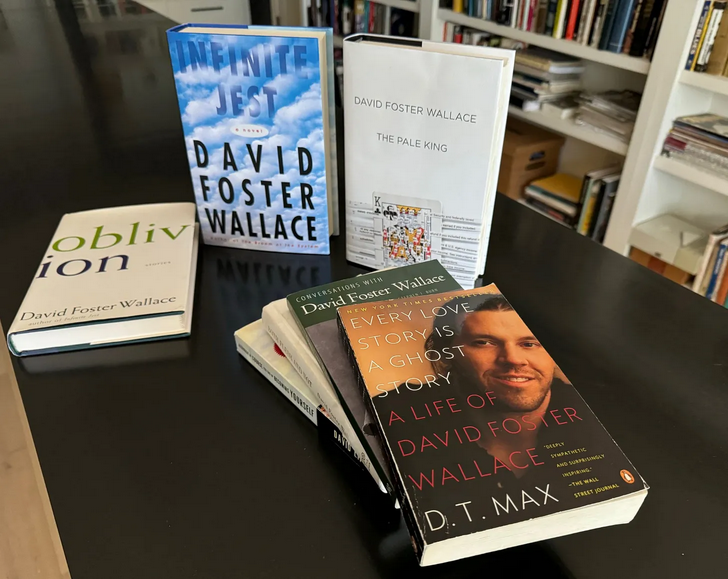
Ted Gioia on the eight things about screen addiction that David Foster Wallace tried to warn us about before he took his own life in 2008:
Those same youngsters are now showing up on college campuses, and we can begin to gauge the societal impact of a screen-driven life. It ain’t pretty.
So this is a good time to revisit what Wallace tried to warn us about thirty years ago. He was ahead of his time in the worst possible way, experiencing firsthand all the debilitating symptoms that now plague millions.
That’s why his writings feel so eerily contemporary. They read like commentaries on what’s happening right now.
Of course, Wallace knew very little about the Internet — he deliberately avoided it. He also refused to own a television. He understood how susceptible he was to screen addiction, and took drastic steps to reduce his exposure to all screens.
But he wrote about it — most tellingly in his huge novel Infinite Jest. The title refers to a film that is so addictive that people who watch it can’t stop. They literally watch it to death. It’s an infinite diversion, much like the endless scrolls on today’s social media apps.
He returned to the topic in his final book The Pale King, and also discussed it in interviews and essays. I’ve read through all of these including more than thirty interviews with the author. These allow me to put together a point-by-point summary of what Wallace tried to tell us.
We ignore his warnings at great risk.
(1) Screen technology will cause a crisis of loneliness, especially among young people.
In almost every interview, Wallace eventually talks about loneliness. It was a looming crisis, he insisted. But he was one of the first to link this to the ways we divert ourselves via screens. […](2) This will lead to widespread depression.
Wallace also knew this firsthand. He suffered intensely from depression. His inability to find a suitable treatment led to his suicide in 2008. […](3) This will also happen at a larger scale. Society will grow more fragmented and disconnected.
As each person falls into an isolated relationship with a screen, larger communities begin to fray. Wallace anticipated a “new vision of the U.S.A. as an atomized mass of watchers and appearers”. […](4) Screen technology promises to liberate us, but the reality is that it controls us for the benefit of others.
The most dangerous part of the screen entertainment is the illusion that it serves us. But the reality is that we actually serve tech platforms and their advertisers. […](5) The people who control the technology work to hide their purposes and goals.
“They’re trying to lock us tighter into certain conventions, in this case habits of consumption,” Wallace told Larry McCaffery in 1993. “This is McLuhan right? ‘The medium is the message’ and all that? But notice that TV’s mediated message is never that the medium is the message.” […](6) Our survival will depend on our ability to remain independent of these forces.
If we abandon ourselves completely to the tech (as many now do), we become pawns in the corporate agenda to monetize us — at a tremendous cost in loneliness, depression, and social disconnection. […](7) We don’t have many tools, but kindness and compassion will be the starting point.
We need to replace irony, sarcasm, and cynicism — which have contributed to our self-debasement — with softer, gentler attitudes. Cynicism is useful in criticizing, but is impotent when we need to build something better. Irony only destroys, never builds. […](8) Art can help us heal.
He wrote his big books with the hope that they would help us find a way back to a more caring and connected world — but connected via people, not screens. […]
Comments Off on Screen addiction – “No drug cartel makes as much money as the screen-and-app companies”
August 24, 2025
Much of our prosperity is based on trust, and we’re rapidly losing it
Ted Gioia foresees a precipitous fall in trust coming at us very soon, and I’m afraid he might be being too optimistic:
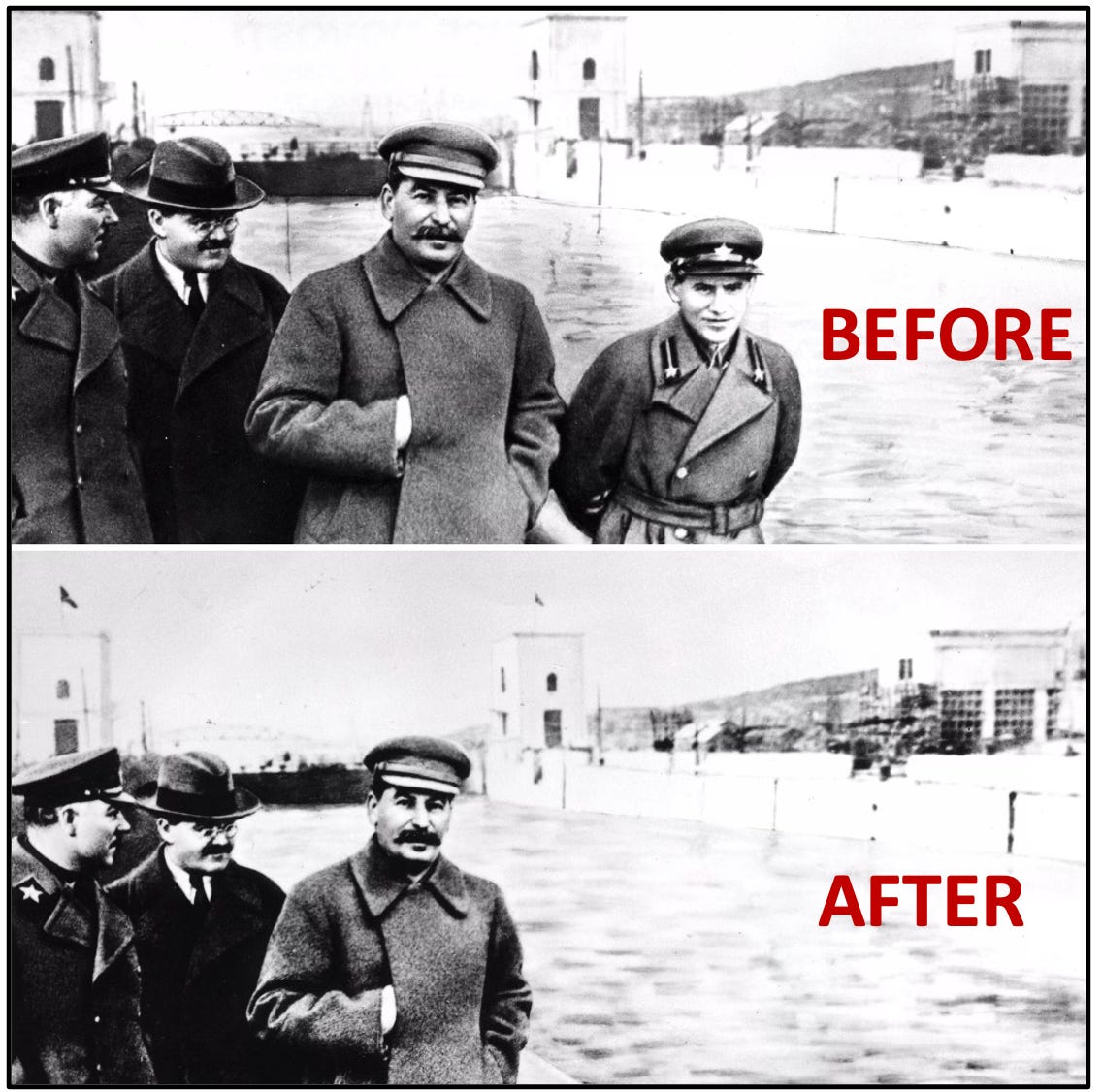
During the great purges of the 1930s, Stalin ordered the execution of a million people, including some of his closest associates. But it wasn’t enough to kill these victims — they also had to disappear from photographs.
In a famous case, Nikolai Yezhov got removed from his position next to Stalin in a photo taken by the Moscow Canal. This erasure alarmed many party elites because Yezhov, head of the secret police, had been one of the most feared men in the Soviet Union.
And now he got totally deleted.
Well, not totally. In those days of print media, original photos survived, and a paper trail made it difficult to erase history.
So this photo was later used to mock Stalin, and the pretensions of dictators. They can try to change reality, but that’s not possible.
Or is it? Maybe dictators now get the last laugh. Because in the last few months, reality has been defeated — totally, completely, unquestionably.
It is now possible to alter reality and every kind of historical record — and perhaps irrevocably. The technology for creating fake audio, video, and text has improved enormously in just the last few months. We will soon reach — or may have already reached — a tipping point where it’s impossible to tell the difference between truth and deception.
- Can I tell the difference between a fake AI video and a real video? A few months ago, I would have said yes. But now I’m not so sure.
- Can I tell the difference between fake AI music and human music? I still think I can discern a difference in complex genres, but this is a lot harder than it was just a few months ago.
- Can I tell the difference between a fake AI book and a real book by a human author? I’m fairly confident I can do this for a book on a subject I know well, but if I’m operating outside my core expertise, I might fail.
At the current rate of technological advance, all reliable ways of validating truth will soon be gone. My best guess is that we have another 12 months to enjoy some degree of confidence in our shared sense of reality.
But what happens when it’s gone?
Back in 2023, I asserted that trust is the most scarce thing in society. But that was before all these tech deceptions came online. Trust will soon get even more scarce — or perhaps disappear completely from the public sphere.
This is not a small matter.
Most discussions of this issue focus on the technology. I believe that’s a mistake. The real turmoil will take place in social cohesion and individual psychology. They will both fracture in a world where our shared benchmarks of truth and actuality disappear.
We will be — already are — in desperate need of Robert Heinlein’s Fair Witnesses:
A Fair Witness is an individual trained to observe events and report exactly what is seen and heard, making no extrapolations or assumptions. While wearing the Fair Witness uniform of a white robe, they are presumed to be observing and opining in their professional capacity. Works that refer to the Fair Witness emphasize the profession’s impartiality, integrity, objectivity, and reliability.
An example from the book [Stranger in a Strange Land] illustrates the role of Fair Witness when Anne is asked what color a house is. She answers, “It’s white on this side.” The character Jubal then explains, “You see? It doesn’t occur to Anne to infer that the other side is white, too. All the King’s horses couldn’t force her to commit herself … unless she went there and looked – and even then she wouldn’t assume that it stayed white after she left.”
Comments Off on Much of our prosperity is based on trust, and we’re rapidly losing it
July 25, 2025
Autism, then and now
At Psychobabble, Hannah Spier traces the rise of autism from its first formal definition to something that 1 in 36 kids is diagnosed with:
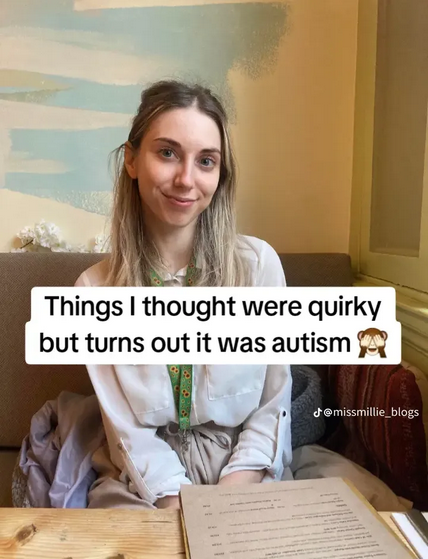
When Leo Kanner first defined autism in 1943, it was estimated that 4 to 5 children per 10,000 were affected. Today, the CDC puts that number at 1 in 36, almost one child in every classroom. If any other medical condition, blindness, epilepsy or paralysis showed a spike like this, it would trigger a pandemic-level outcry. But with autism, we see at best a curious murmuring as to what this is, and at worst, a growing chorus of people insisting, they too, belong in the group.
From experts, instead of raised alarms or calls for serious public health investigation (as would be expected for any other childhood disorder) we get calls for inclusivity and a self-congratulatory attitude toward their advancement in diagnostic understanding and tools. Another example of ideological capture of psychiatry by cultural sentiment.
Characters like Sheldon Cooper and Sherlock Holmes have helped turn the image of autism into a badge of honour. It means you’re socially odd, intellectually superior, and emotionally detached in an edgy and endearing way. For many, especially mothers with narcissistic tendencies hungry for a narrative of exceptionalism, this offered a seductive reframing of their child’s misbehaviour and non-conformity as evidence of giftedness. She could thus become the one who gave birth to the quirky but special genius. She alone saw the hidden brilliance beneath the “weird” behaviour. She became the martyr and the insider to an elite subculture. It’s Munchausen by proxy, 2025 edition.
People with narcissism and psychopathic traits exploit wherever they can, we know this. And yet again, psychiatry, the ones who should be the best at recognizing these, made it easy pickings by flinging the diagnostic gates wide open. Longtime readers will recognize the pattern: I’ve written before about the diagnostic creep in trauma, expanding definitions that blur the line between disorder and ordinary variation. The same diagnostic creep has unfolded here. Autism, once narrowly defined, was steadily loosened through each revision of the DSM.
The Great Diagnostic Expansion
Originally, Kanner’s autism was unmistakable: nonverbal children, socially disconnected, cognitively impaired, often with seizures. These were not quirky introverts. These were children who required full-time care and specialized schooling. In the DSM-III of the 1980s, it was called infantile autism. The criteria required clear onset before 30 months, marked language delays, gross deficits in social interaction, and repetitive behaviours. These were developmental dysfunctions, not misunderstood personalities. And neither clinicians nor parents had a problem naming them as such.
Then came the DSM-III-R in 1987, which introduced pervasive developmental disorder not otherwise specified (PDD-NOS) and broadened the field significantly. Suddenly, language delay and intellectual disability were no longer central. Subclinical cases were included. Asperger’s Syndrome followed in the DSM-IV in 1994, adding high-IQ individuals with no language delays but poor social functioning. A child who spoke on time but didn’t understand jokes, had poor eye contact, and rigid routines was now also autistic.
But the most dramatic change came with DSM-5 in 2013. The subtypes were eliminated. Autism became one spectrum. The criteria were thinned down to two domains: social communication difficulties and restrictive, repetitive behaviours. A person needed to meet just six out of twelve traits, spread across these two clusters. Language and cognitive delay? Optional. Even the requirement for early onset was removed. A diagnosis could now be given based on historical symptoms. Questionnaires like the Autism Spectrum Quotient (AQ) are so broad and subjective they can be easily gamed. This made it possible for 30-year-olds to recall feeling “socially overwhelmed” in school and not liking itchy clothing to receive the same diagnosis as a nonverbal child requiring lifelong care.
The diagnostic category has become a black hole, pulling in people with no clinical resemblance, collapsing distinction into sameness. From what I’ve observed, three distinct autism “patients” now account for much of the increased prevalence, none of whom would have qualified under the original criteria.
Comments Off on Autism, then and now
July 21, 2025
Caligula: Was He Really Mad?
The Rest Is History
Published 3 Feb 2025Enough of the Princeps, what remains to be described, is the monster …
The Roman emperor Caligula endures as one of the most notorious figures in not only Roman history, but the history of the world. Famed as a byword for sexual degeneracy, cruelty and corruption, the account of his life written by the Roman historian Suetonius has, above all, enshrined him as such for posterity. Throughout the biography there is a whiff of dark comedy, as Caligula is cast as the ultimate demented Caesar, corrupted absolutely by his absolute power and driven into depravity. Born of a sacred and illustrious bloodline to adored parents, his early life — initially so full of promise — was shadowed by tragedy, death, and danger, the members of his family picked off one by one by the emperor Tiberius. Nevertheless, Caligula succeeded, through his own cynical intelligence and cunning manipulation of public spectacle, to launch himself from the status of despised orphan, to that of master of Rome. Yet, before long his seemingly propitious reign, was spiralling into a nightmare of debauchery and terror …
Join Tom and Dominic as they discuss the most notorious emperor in Rome: Caligula, a man said to have slept with his sister, transformed his palace into a brothel, cruelly humiliated senators, and even made his horse into a consul. But what is the truth behind these horrific legends? Was Caligula really more monster than man …?
00:00 A mysterious emperor
05:18 Why are the stories about Caligula so bad?
08:40 Germanicus: the best man in Rome
16:20 Caligula is the heir
19:30 The death of Tiberius
20:55 Caligula’s cynical intelligence
22:50 Caligula’s skill playing to the gallery
28:39 Caligula’s turn to evil (according to Suetonius)…
31:35 Caligula as Suetonius’ monster
37:22 Caligula confronts the senate
45:10 The conspiracy against him moves
48:14 Did all this actually happen?
58:43 Did he make his horse a consul?Producer: Theo Young-Smith
Assistant Producer: Tabby Syrett
Video Editor: Jack Meek
Social Producer: Harry Balden
Executive Producers: Jack Davenport + Tony Pastor
Comments Off on Caligula: Was He Really Mad?
June 22, 2025
QotD: “Autism stolen valor”
“Autism stolen valor”. What a concept.
The very concept that anyone would ever claim to be autistic as a status move would have seemed incomprehensibly bizarre to me when I was growing up.
I get it, though. In the intervening decades, somehow a lot of people have developed the notion that anybody above the middle range of IQ must be autistic-spectrum.
It’s not true. I’ve met enough autists, brights and super-brights to know differently. I’ve read a fair bit of the literature on psychometrics and MBD syndromes. And I’ve been a guest for faculty tea at the Institute for Advanced Study, which is very illuminating if you’re even a little bit observant about people.
Here’s what I think I know:
Many autists are seriously damaged and non-functional, to the point where they need to be institutionalized or have semi-institutional special care. Few people outside the mental-health profession know this. The “autists” we encounter in daily life are a selected high-functioning group.
HFAs (high functioning autists) have one advantage over average-IQ neurotypicals: they can really concentrate on things that aren’t social-status games or sexual maneuvers.
Average-IQ neurotypicals can only just barely manage that, so it’s difficult for them to compete with HFAs in fields where you have to be able to concentrate for long periods in order to do decent work.
Like, say, writing software. The upper reaches of software engineering are stiff with HFAs. This has become well known.
This doesn’t mean your typical HFA is actually brighter than a median average-IQ neurotypical. In fact, if you put a whole bunch of HFAs through a psychometric battery you’ll find their average IQ is lower than for neurotypicals, not higher.
HFA is actually a drag on general intelligence that HFAs overcome by being obsessive — grinding really hard on intelligent-people stuff.
The result is that HFAs as a population excel over average-IQ neurotypicals, compete fairly evenly with bright neurotypicals, but top out lower than super-bright neurotypicals do.
This is hard to notice because there are so few super-brights that many people never meet one at all. Very few people have observed enough super-brights to make valid generalizations about them. And of the few people who have a large enough observational sample, still fewer are themselves bright enough to comprehend what they see.
But I have been to faculty tea at the IAS. (I had been an invited speaker that day.)
Most of my friends and peers are people in the tippy-top end of the HFA cohort. Top 1% software engineers and people like that. So at the IAS, people-watching a bunch of Nobel laureates and people bright enough to work with Nobel laureates day-to-day, my jaw dropped open.
Because compared to who I usually hang out with, these people are mostly *normal*. Neurotypical. As near as I can tell, the people in the crowd showing HFA tells are the slow ones.
Imagine if you can being so natively intelligent that even though your brain is constantly trying to distract you into playing monkey socio-sexual status games, you can still think rings around 99.9% of the people in the world.
That’s what actual super-brights are like. They’re not brain-damaged. They’re not obsessive or compulsive or neurotic. They don’t have sensory disabilities. And they leave high-functioning autists in their dust.
Because I know this, I find the concept of people faking being autists amusing. They think they’re positioning themselves as the superior, smartest people. They are hilariously wrong.
Eric S. Raymond, Twitter, 2024-05-27.
Comments Off on QotD: “Autism stolen valor”
June 10, 2025
The limits of female empathy
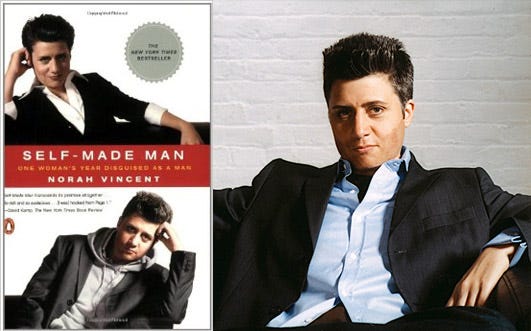
Janice Fiamengo discusses the 2006 book Self-Made Man: One Woman’s Year Disguised As A Man by journalist Norah Vincent. Intended as a kind of exposé of male privilege, her investigations turned into something rather different than she originally intended:
Many men are lonely. Many don’t like the work they do. Many are unhappily married. They struggle with an at-times overwhelming sex drive. Their encounters with women, romantic or otherwise, often involve rejection and contradictory tests of their masculinity. They are the objects of blame and bigotry in their societies, yet are expected to remain stoic and put women’s needs first.
It’s a strange world in which the above observations — by a woman — are seen as outstanding insights, but it’s the one we’re in.
In 2006, American journalist Norah Vincent published Self-Made Man: One Woman’s Year Disguised As A Man, an under-cover adventure in which the author, a mannish lesbian with big feet, spent close to 18 months periodically disguised as a man named Ned, notching up about 150 episodes in drag.
With breasts flattened, fake stubble on her chin, and a stuffed jock strap in her pants, having hired a tutor to teach her how to pitch her voice low and move like a man, she set out to “infiltrate exclusive all-male environments and if possible learn their secrets” (p. 18). She joined a bowling league, went on dates, did sales calls, spent some weeks at a monastery, and attended a Robert Bly-influenced men’s wilderness retreat.
Expecting to learn something about male power, she found instead “the hidden pain of masculinity and my own sex’s symbiotic role in it” (p. 254). The planned exposé became a feminist mea culpa.
The book got a lot of attention when it was published, and many men expressed gratitude and appreciation for the empathy and insight in Vincent’s work.
Reading the many accolades, I felt sadness, tenderness, and amazement. Wasn’t this a bit much? Was it really so remarkable that a woman could develop sympathy for the opposite sex?
Most men are so unaccustomed to any empathy from a woman, even when it’s mixed with patronizing descriptions and questionable conclusions, that they respond as if to heroism. The woman who cares, even within circumscribed limits, is catapulted into the company of the saints.
Imagine the reaction if a man had masqueraded as a woman for a year or more, and then pretended to understand women (even sympathetically) using a shop-worn ideological framework? Imagine a white person putting on blackface in order to become an expert, even a well-intentioned one, on the need for black self-improvement? There would be howls of outrage and indignant rebuttals, especially by members of the impersonated group.
Not in Vincent’s case. So rare is a woman’s attempt to understand male experiences that she doesn’t need to be consistently sympathetic or accurate.
Even when someone goes beyond temporary male drag, there is a palpable surprise that mens’ lives are not a well-watered garden of male privilege:
Today, of course, there is still always a reason to look away from men’s pain. Feminist-inclined men and women routinely “bathe in male tears“. They claim that discussing men’s issues is misogynistic, and ask “Can White Men Finally Stop Complaining?” No wonder it seems that the only time men can be heard is when women speak for them.
Notably, women who “transition” to male through hormone treatments and surgery are often shocked by the indifference and unkindness they encounter in public, where men are not eager to help and women expect deference. Zander Keig wrote as a trans man in “Crossing the Divide” of a pronounced sense of aloneness: “No one, outside of family and close friends, is paying any attention to my well-being”.
Comments Off on The limits of female empathy
May 20, 2025
Joe Biden’s cancer diagnosis
News broke the other day that former President Joe Biden is suffering from a highly advanced cancer and it only reinforces the questions about who was really performing the role of the President during Biden’s term in office:
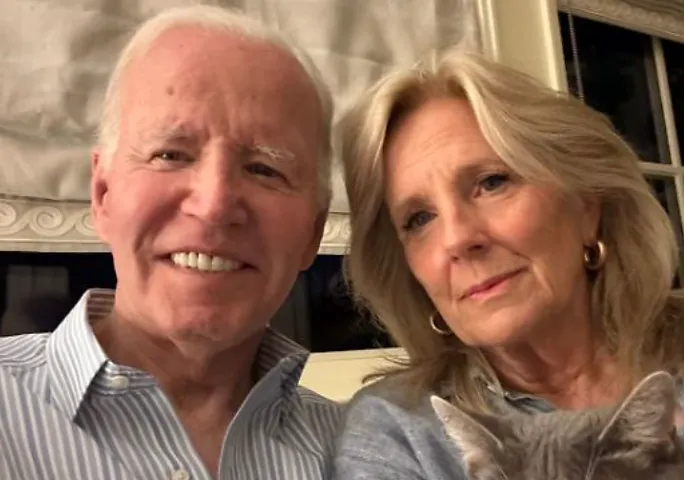
Well, now it almost isn’t funny anymore.
Here’s the progression of the Democrats’ desperate attempts to shame you out of talking about Joe Biden’s mental and physical health:
“Stop talking about this because it’s not true.”
“Stop talking about this because he’s not the president anymore.”
“Stop talking about this because he has cancer.”You may notice a pattern.
I think it was Andrew Klavan who made me realize the First Commandment of the Democratic Party: Thou shalt STFU. All their gaslighting, shaming, whataboutism, and other dishonest rhetorical techniques are attempts to stop you from talking about whichever lie they’re telling at that particular moment.
Why would they stop at cancer?
A lot of medical professionals are pointing out that a prostate cancer diagnosis doesn’t just come out of the blue like this. It’s easily detectable in blood work, it takes years and years to progress, and it should’ve been detected at his last annual physical.
Even Dr. Ezekiel Emanuel (an oncologist, Rahm’s older brother, and certainly no MAGA-head) says Biden must have learned of this diagnosis many years ago.
If Biden was undergoing cancer treatments during his presidency — remember all those unexplained trips to Delaware? — it would explain a lot of his behavior. “Chemo brain”. And of course he and Jill would keep it under wraps, because it would only strengthen a 25th Amendment challenge.
Who else knew about this, and when did they know it?
And who the hell was performing the duties of the president of the United States for four years?
Keep in mind that Joe Biden loves using his personal tragedies as a Get Out of Jail Free card. We heard it in that just-released Robert Hur audio from October 2023, when Biden deflected a question he didn’t want to answer about his handling of classified documents by complaining that his son Beau died. He couldn’t remember the exact year, but he used it as an excuse anyway.
If he’ll use his dead son, why wouldn’t he use a cancer diagnosis?
eugyppius also notes that such an advanced case can’t have just popped up recently, reinforcing the notion that his term in office was partially or completely a “regency”:
Yesterday evening, Joe Biden’s office announced that the former president had been diagnosed “with an aggressive form of prostate cancer that has spread to his bones“. Biden must have had this cancer for a long time for it to have spread that far, and thus it seems very strange that someone receiving presidential levels of medical care should have been diagnosed only just last week. Many in our circles posit that insiders have known about Biden’s illness for years, but that they have kept his diagnosis and treatment under wraps for political reasons. Among other things, they argue that this explains a July 2022 gaffe in which Biden complained that environmental pollution is “why I and so damn many other people I grew up with have cancer“.1
In fact, I think a simple cover-up is the most harmless possibility here. It’s likely that doctors have diagnosed Biden’s cancer so late because the former president was subject to a high degree of isolation and medical neglect while in office. Perhaps family and close advisers carefully managed Biden’s annual physicals to avoid any inconvenient findings as part of a broader campaign to hide his dementia. Alternatively, it’s possible that signs of cancer were discovered at some point, but that Biden’s inner circle avoided confirming the diagnosis or pursuing treatment. Either way, the late diagnosis and the advanced cancer together suggest that Biden has been left sick and untreated for a long time.
As I wrote last year, Biden’s presidency was an informal and unacknowledged regency. Biden himself did not have the mental capacity to rule on his own, and so a confined circle of close advisers and family effectively directed the actions of the presidential office on his behalf.
Importantly, this regency was not “the White House” or “Biden’s staff” or “the Democratic Party” in general. It was much smaller than all of those things. The regents worked hard to obscure Biden’s dementia from Congress, from large parts of Biden’s own campaign, from the Democratic Party and from many others within Biden’s White House. They ensured that even internal meetings unfolded in highly scripted and predetermined ways, so that cabinet and other officials could not gain a clear idea of Biden’s mental state. They berated and intimidated anyone voicing concern about the president’s health behind the scenes. And they had very simple reasons for doing all of this: If Biden’s dementia were to become common knowledge and not merely an object of private suspicion (however widespread), the regency would be shown up as illegitimate and potentially broken.
Regents exercise power by restricting access to their charge and restricting their charge’s access to information and the outside world. It is thus unsurprising to find that Biden’s regents subjected him to strict social isolation, particularly towards the end of his term …
1. The White House clarified that Biden was referencing his earlier diagnoses for non-melanoma skin cancer.
Comments Off on Joe Biden’s cancer diagnosis
May 4, 2025
QotD: Women and depression
Why wouldn’t powerlessness cause depression in women too?
Well, in a backwards sort of way it actually does.
The difference is this: women feel powerful when they are loved, and powerless when they are not, because their instinct wiring tells them that safety lies in being able to form social coalitions and attract a strong mate.
Women, in general (there are always outlier exceptions) don’t get major antidepressive help from just going outside and chopping up a cord of firewood, the way men do. Because the woman’s game is to give a man a good reason to chop firewood for her.
It’s when she can’t do *that* that she feels powerless.
ESR, Twitter, 2024-05-06.
Comments Off on QotD: Women and depression
April 16, 2025
The “medicalization” or “syndromization” of aspects of the normal human condition
On his Substack, Freddie deBoer wonders why we can’t be honest about the rise of bespoke “mental disorders” that look remarkably like typical human reaction to stimuli:

I just found a cost-free way to farm sympathy and attention 😊
I will never not be fascinated by those issues or arguments or perspectives that are studiously ignored by the media generally and the New York Times in particular. I’ve whinged about this many times when it comes to education, as the NYT is simply not going to consider the notion that different individual people have fundamentally different levels of academic potential in its pages, not even in an attempt to rebut the idea. I suppose that notion is just too challenging to the elite meritocratic liberalism that the Times epitomizes; the idea that we are all ultimately capable of achieving academic and professional greatness flatters the high-achievers who read and write the paper, and the “anyone can be anything” ethos is pleasant and unchallenging. It’s also destructive, which is the point. Bad ideas grow like weeds in the shade, or whatever the saying is. Disability issues are another place where the Grey Lady is very picky about what ideas to consider, and as usual they set the rhythm for many other publications.
This weekend the Times released a long piece looking at the ever-escalating rates of ADHD diagnoses and what exactly they tell us. What’s in the piece is fine — of course, the ADHD activist class doesn’t like it — but what’s remarkable is what isn’t in it. Once again, there’s just about zero consideration of ADHD as a social contagion, any recognition that there is now a vast and deeply annoying ADHD culture online that acts as a kind of evangelical movement for a neurodevelopment disorder. There are millions of people on ADHD TikTok and ADHD Tumblr and ADHD Twitter. There’s a vast universe of facile memes, dubious statistics, and self-flattering nostrums about ADHD floating around out there, and increasingly they’re penetrating into broader internet culture. (I am genuinely unaware of a subculture that is more directly and shamelessly self-celebrating than the online ADHD community, and I’ve read the comments at LessWrong.) Unsurprisingly, a big subsidiary industry has sprung up, with all kinds of products and services for sale, books and apparel and tchotchkes and conferences and boutique forms of therapy and exclusive members-only Discords … Whether neurodevelopmental disorders should have merch is an open question. What’s not subject to questioning is that this is happening. Five minutes of cursory searching would reveal the remarkable scope of online ADHD culture.
And yet the piece’s author, Paul Tough, is just about totally silent on this glaring reality. I find it genuinely bizarre. In a long and rambling (in a good way) piece where he kicks the various rocks of ADHD and asks good-faith questions about how diagnostic rules and social perception of the disorder influence medical practice, he still somehow fails to ever refer to the large, influential, and growing online movement that has raised the profile of the disorder even beyond its prior notoriety and in doing so injected a ton of money into the equation. You can dismiss that community as an online sideshow if you choose, but of course the online world has become profoundly influential on real life, and in other contexts neither the New York Times specifically nor the elite media generally has any problem acknowledging that fact. Why not here?
This tendency extends beyond ADHD. Recently Holden Thorp, editor in chief of the prestigious journal Science, wrote an essay for the NYT that explores the rise of autism diagnoses, which have expanded at truly ludicrous rates. To the extent that it’s referenced at all, the idea of social contagion is dismissed without argument. A couple years ago the Times published a piece by Azeen Ghorayshi about the absurd case of Tourette’s spreading (or “spreading”) among too-online adolescent girls via TikTok; though Ghorayshi is admirably clear that those young women did not in fact have Tourette’s, her piece is also slavishly, almost comically sympathetic to them, never bothering to suggest that maybe these were just bored teenagers who engaged in a frivolous and offensive bit of minstrelsy. (Imagine, judging teenagers for doing something stupid!) The idea that anyone could ever have unserious and wrongheaded motivations for adopting a disability seems to be one of those stories that the New York Times absolutely refuses to tell.
But why? People make up fake illnesses all the time, both consciously and unconsciously. Factitious disorders are real; we have references to what we might now call psychosomatic illnesses that stretch back to antiquity. Munchausen by internet is real. Hypochondria, factitious illness, Munchausen’s, the worried well … these have represented a major challenge for psychiatry for as long as the field has been formalized and integrated into the larger medical project. Why does no one ever talk about this stuff in our stuffy elite publications? Why do so many people in our media dance and shuffle rather than ask direct questions like “How many of these diagnoses are fundamentally faulty?” Why can’t anyone point out that saying you have a medical disorder is a shortcut to getting sympathy and attention, and that human beings crave sympathy and attention the way they crave water and air? We’ve lived through something like a “vibe shift,” and previously-unchallengeable social justice pieties are increasingly challenged, in good ways and bad. Yet under the broad umbrella of disability rhetoric, it’s always 2018, with both traditional and social media operating under a cloud of fear of giving offense. As I’ve said many times, the number of people who privately agree with me about all this is legion. The number who are willing to say so publicly are very few indeed. Nobody wants to paint that target on their back, I suppose. But why do these issues make people feel like targets at all?
Comments Off on The “medicalization” or “syndromization” of aspects of the normal human condition
April 8, 2025
QotD: The sad plight of the modern day “radical”
Whatever the cause, they cannot “smoak a jest”, recognize other forms of humour, or distinguish the parts of speech. This makes them appear batty (in the old sense, when it would have attracted institutional attention). They are frequently convulsed with anger, then sullen when they have exhausted themselves. Alas, they cannot be left in normal company, for they will immediately and raucously demand a “safe space”, and then not go away. They will accuse the normal person of “racism”, “fascism”, “sexism”, and “microaggressions”. Their spittle represents a health hazard.
It is hard to know what to do with these people, in the absence of the traditional arrangements. When world markets open again, we could sell them into slavery. But in the meantime, I suppose, we must keep them in group homes, ideally under armed guard. Maybe feed them okra; surely there is a surplus, and I’m told it has calming properties.
But that’s just me, always looking for solutions.
David Warren, “Keeping one’s peace”, Essays in Idleness, 2020-04-18.
Comments Off on QotD: The sad plight of the modern day “radical”
March 26, 2025
QotD: Therapy that works for women doesn’t necessarily work for men
This is completely wrong. Men cope with feeling unloved relatively easily. What destroys them is feeling powerless.
So yeah. Swing a sword. Restore a steam engine. Climb a rock. Do something — anything — that asserts your competence and control over your environment.
For men, this is much better therapy than talking about feelings.
ESR, Twitter, 2024-05-06.
Comments Off on QotD: Therapy that works for women doesn’t necessarily work for men
March 1, 2025
“There were always scapegoats … and they were always driven out one way or another”
The second part of Nigel Biggar‘s look at the culture war in Britain includes a look at how the professional approach to young peoples’ gender issues became monomaniacal because nobody involved stopped to think for fear of being ostracized (or fired):
On the gender front, there’s plenty of reason to doubt the intellectual coherence of transgender-self-identification. When a biological male believes that his inner, authentic self is female, what exactly does he think being ‘female’ is? I’m still waiting for someone to persuade me that this doesn’t trade on gender stereotypes that feminists rightly taught us to throw overboard decades ago.
Observe how that has nothing at all to do with the care of patients, and how it has everything to do with the self-regard and political standing of the managers.
There’s even more reason to doubt that the well-being of young people is well served by taking their asserted genders at face value and allowing them to align their bodies by making irrevocable physical changes. According to Hannan Barnes’ shocking chronicle of the scandal at the Gender Identity Development Service (or GIDS) at the Tavistock Institute here in London, there was widespread doubt among clinicians about young people’s claims of “an inborn ‘trans’ nature”, awareness that these were sometimes correlated with eating disorders and self-harm, and suspicion that they might be caused by abuse or trauma. Furthermore, the long-term effects of using puberty-blockers were “largely unknown”, there was considerable uncertainty about which patients would benefit from them, and the health of some young patients actually seemed to worsen while on them.
Notwithstanding all this, “the clinical team … never discussed as a group what it even understood by the word ‘transgender'”, clinicians “never dream[t] of telling a young person that they weren’t trans”, and they always prescribed puberty-blockers unless the patient actively refused them. What’s more, expressions of doubt by staff were discouraged. “Someone would raise concerns, and someone else would move in to shut it down”, writes Barnes. “Those who persisted in asking difficult questions were not received well … those who spoke out were labelled troublemakers. [According to one witness,] ‘There were always scapegoats … and they were always driven out one way or another'”. “Junior staff looked on and learnt”.
Note the chilling effect.
The Tavistock Institute in London
Barnes’ book bears the title, Time to Think, because she identifies the general problem at GIDS as that of “not stopping to think”. That, of course, raises the question, Why? Barnes gives several reasons. One was the fact that the GIDS was propping up the Tavistock financially and that senior managers had a material interest in not disturbing its assumptions. Another was the unwillingness to offend transgender lobby groups such as Mermaids for “fear of a backlash”. But, most important of all was concern for the ‘progressive’ reputation of the management. According to David Bell, consultant adult psychiatrist at the Trust and whistleblower, “The senior management regarded [GIDS] as a star in our crown, because they saw it as a way of showing that we weren’t crusty old conservatives; that we were up with the game and cutting-edge. That was very important to the management to show we were like that”. Observe how that has nothing at all to do with the care of patients, and how it has everything to do with the self-regard and political standing of the managers. Not for the first time, the basic narcissism of progressive virtue-signaling is exposed.

Update: Added missing URL.
Comments Off on “There were always scapegoats … and they were always driven out one way or another”
December 9, 2024
“… liberalism has become a political ideology that is utterly incapable of policing itself for its own worst excesses”
Freddie deBoer patiently explains why outrageous over-the-top emoting isn’t a useful or productive way to argue for your political views:
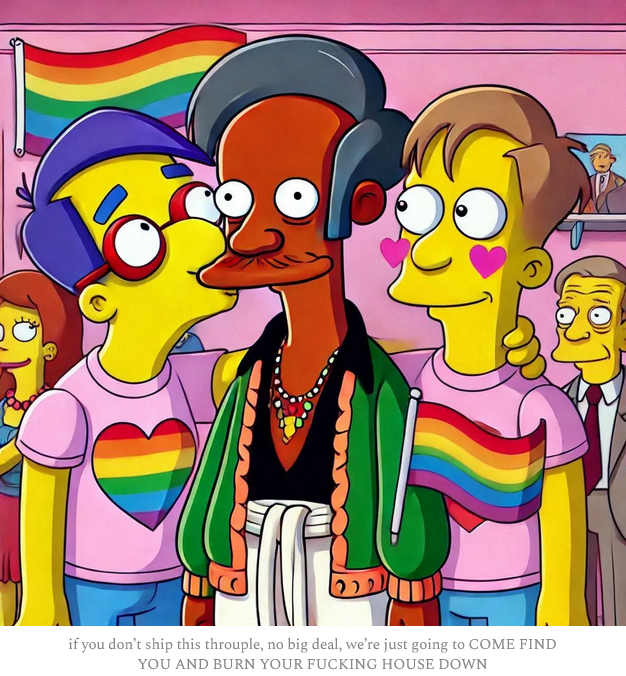
I’ve written several times about the phenomenon of adolescent women on TikTok pretending to have dissociative identity disorder for social media clout and attention. I’ve focused on it not because I necessarily think the issue itself is particularly important, but rather because it’s so emblematic of what liberalism has become: a political ideology that is utterly incapable of policing itself for its own worst excesses, a collection of well-intentioned people who mistake the responsibility to fight discrimination for a broad, vague duty to shield certain groups of people from any criticism.
For the book I’m currently writing, I’m talking to a ton of people in the broad world of mental health — psychiatrists, therapists, researchers, policymakers, journalists, fellow patients — and I’ve brought up the TikTok DID community over and over again. Remarkably, not one person defends the phenomenon as a true expression of genuine illness, not even a few disability rights activists I’ve talked to, who usually have an ethic of never questioning a disability claim. Countless normie liberals I’ve chatter with, over the past several years, have also accepted my basic position that these young women don’t actually have dissociative identity disorder. But, also, almost no one is willing to affirmatively say anything about this dynamic themselves. Indeed, The Verge reported that many experts have decided that the costs of speaking out about that whole culture just aren’t worth it. And so you have a set of behaviors that no one defends but that no one feels comfortable criticizing, thanks to the pathologies of 21st century liberalism and online rage. That’s what I’m really here to talk to you about today.
I don’t, of course, want to be too harsh on the individual young women who have turned a debilitating and controversial disorder into an opportunity to put on vertical video fashion shows; they’re just kids and kids do stupid shit, sometimes even genuinely offensive shit. What you usually have, or used to have, is the ability to tell someone doing stupid shit to knock it off. Not oppress anyone, not humiliate anyone, not permanently shun anyone. But just to say, “You don’t have dissociative identity disorder, pretending you do is unhealthy and offensive towards people who actually have serious mental illnesses, knock it off“. I find that very easy to say. But clearly a lot of people don’t, and the reasons are fairly obvious. First, despite whatever vibe shift we may be living through, it remains the case that in progressive discursive spaces, saying the wrong thing is still very fraught and can result in accusations of bigotry that are personally and professionally damaging. Second, liberals have trained themselves to avoid any position at all that might be construed as siding with the enemy, as a matter of in-group identification. Take it from me: “A lot of people in Gen Z appear to be lacking in emotional resilience, in a way that’s unhealthy for them” has become, in the internet-soaked mind, “Gen Z is a bunch of snowflakes”, and so a ton of liberals recoil at that idea. Can’t appear to make a concession to the enemy! I’m afraid we do not have a vocabulary for critical solidarity anymore.
All of this is bad, and you only have to look at how incredibly harsh certain slices of “queer fandom” can be to see what I’m talking about.
Comments Off on “… liberalism has become a political ideology that is utterly incapable of policing itself for its own worst excesses”
November 20, 2024
QotD: The Chads, the Staceys, and the Incels
These boys have their own vocabulary and belief systems. Pretty girls (Staceys) all sleep with the same few Alpha men (Chads). The Staceys ride the Cock Carousel, ie, have sex with the same few Chads. All this sluttish behaviour gives the Staceys something called A Thousand Cock Stare.
It is a grim world, in which women are evil and manipulative, and hated both for being sluts and for being virgins. It is a world in which pictures of pretty girls with their pet dogs are unbelievably sinister. These boys choose to live in this bleak world. They are culpable. But, if you tell all young, white boys that they are damned, why should they not behave as if they are damned?
A society which does not allow for people to atone, to be redeemed, and to be judged on their intent and actions is a miserable place. Most people interact with each other without antagonism most of the time. We should start being a bit more forgiving to each other, ditch the Puritanism and learn to cherish the well-meaning stumble towards decency. Even if, sometimes, we fall.
Antonia Senior, “Identity politics is Christianity without the redemption”, UnHerd, 2020-01-20.
Comments Off on QotD: The Chads, the Staceys, and the Incels


