Naturally this all made me think of 4chan. The swirling chaos that dominates the more subaltern corners of online bears an eerie resemblance to the mutability of identity that [James C.] Scott chronicles as a form of resistance to domination. If the channers and the Twitter anons seem a little barbaric (in the less descriptive, more judgmental sense of the word), well, they are, but hill people frequently are too. “Self-barbarization” can be be a very effective conscious or unconscious strategy of resistance while simultaneously making a group unpleasant to be around (in fact these things are linked).
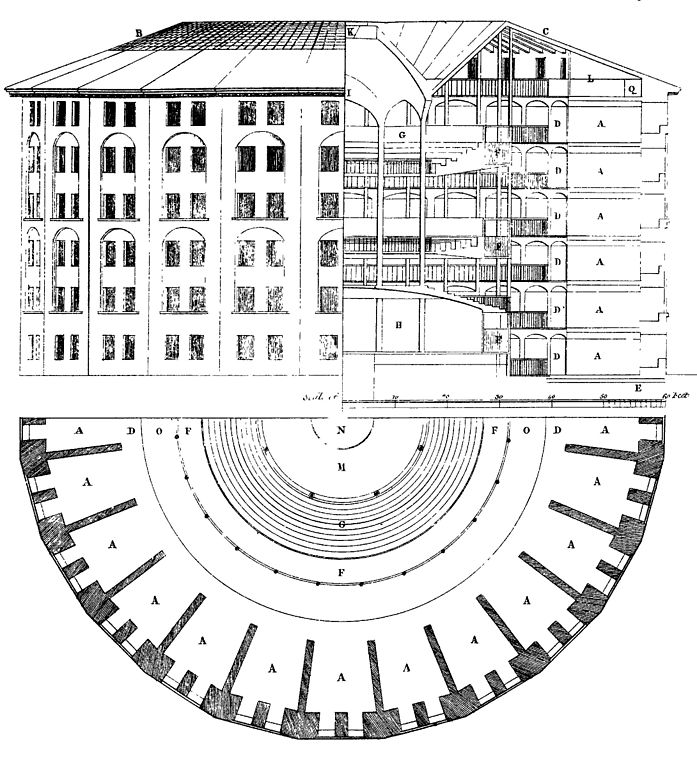
The digital barbarians have for now made themselves illegible to the hyper-surveillance, algorithmic discipline, and intrusive analytics that loom like the hundred-eyed Argos over all online interactions. In fact, insofar as a key technique of the cyber-panopticon is the construction of predictive models of user behavior, to be unpredictable is an important component of being ungovernable. The other option is to hide.
Hiding is a strategy that some people attempt offline as well, either by building a compound in the woods or by adopting protective coloration and hiding in plain sight. But as the bots grow ever more omniscient, hiding gets more expensive and less effective. Another classic barbarian-inspired strategy is to maximize mobility, and indeed contemporary economic and technological conditions seem ripe for a renaissance of nomadism. But the trouble with always being ready to pack your bags is it makes it hard for anybody to count on you.1 Is there anything that can be done for those of us who want to live marginally more barbarically, but still sip lattes and put down roots? Yes, because the ultimate lesson of Scott’s book is that barbarism is really more of a state of mind that can be practiced anywhere. Three brief examples of ways to increase your Barbarism Quotient (BQ), suitable for the discerning urban barbarian:
- Keep your identity small. Paul Graham once said this, but we can go much further. An expansive identity implies its contrapositive: a similarly expansive set of ideas, behaviors, and lifestyles which we cannot adopt without incurring psychic damage. This limits our space for action, and makes us easier for the machines to predict and for the man to control. Better far to figure out what you really care about, figure out what the real red lines are, and convert everything else from a non-negotiable into a piece of the optimization frontier. The ethnic and cultural mutability of barbarous peoples is an example of this kind of suppleness, but there are other sorts of mutability that can be useful too.
- The great Boston T. Party once declared: “it’s better to have $1,000 of ammunition in your garage than $1,000 in your bank account; but it’s even better to have only $100 of ammunition in your garage and $900 of practice.” A lot of would-be modern barbarians daydream about burying gold bars in the ground or sewing them into the lining of their clothes (like the barbarians of yore hiding their tubers in the ground), but Mr. Party’s insight generalizes well here. Physical gold is admittedly a less legible form of wealth than T-bills or CBDC; but skills, knowledge, and relationships are even harder to seize than bullion, and even easier to transport across borders. The wise barbarian judiciously transmutes a fixed percentage of his financial capital into human capital. Nothing improves your ultimate BATNA like having friends or being useful.
- Barbarians have a deserved reputation for not taking too kindly to strangers, but this xenophobia and clannishness is tactical. For the hill dweller, most strangers are in one way or another the representatives of hostile alien entities that are out to conscript, tax, and subjugate. The situation for we cosmopolitan, urban, dare I say urbane barbarians is a little bit different. We’ve already reached an accommodation with centralized despotic states, having found the advantages they offer to be worth the tradeoffs. Be that as it may, states have a tendency to try to unilaterally change the terms of the deal. To protect ourselves from this form of encroachment, the correct attitude is not xenophobia, but rather paranoia. The toolkit of modern states is to direct all our enthusiasm towards the Current Thing whilst deadening our senses towards everything else. “We had no idea it could get this bad” is a recurring theme in testimonies given by survivors of oppression and genocide, to which a family culture of “they really are out to get us” is a salutary corrective. Every pinprick ought to raise an alarm, because it could be the prick that precedes the onset of anesthesia. Finally, the cultured barbarian remembers that states are not the only hostile, alien entities waiting for us in the night with drooling jaws.
I could come up with a dozen more such practices, inspired by the hill people Scott documents, and ready for incorporation into the family culture you’re creating. But barbarism is a state of mind, and reflecting on how to keep yourself distinct and aloof from the fat, decadent agriculturalists is part of it. So read this book, and then begin carving out your cultural mountain fastness or your ideological swamp hideout. The barbarians are within the gates, they live among us, and we welcome you to join our ranks.
John Psmith, “REVIEW: The Art of Not Being Governed by James C. Scott”, Mr. and Mrs. Psmith’s Bookshelf, 2023-01-16.
1. Unless, that is, you all move together. If somebody wants to pitch me on peripatetic cyber-gypsy life, I am all ears.
October 31, 2024
QotD: How to increase your Barbarism Quotient (BQ)
October 12, 2024
Government-mandated backdoor access – “weakening security for anybody weakens it for everybody”
After all this time, it’s no surprise to discover that unlike the police — who theoretically only use these government-required “backdoors” with a legal warrant — foreign hackers have been merrily using these “law enforcement tools” for their own purposes:

“I Hear You wiretapping poster, Mad Magazine, NYC” by gruntzooki is licensed under CC BY-SA 2.0 .
For as long as law enforcement has sought a way to monitor people’s conversations — though they’d only do so with a court order, we’re supposed to believe — privacy experts have warned that building backdoors into communications systems to ease government snooping is dangerous. A recent Chinese incursion into U.S. internet providers using infrastructure created to allow police easy wiretap access offers evidence, and not for the first time, that weakening security for anybody weakens it for everybody.
Subverted Wiretapping Systems
“A cyberattack tied to the Chinese government penetrated the networks of a swath of U.S. broadband providers, potentially accessing information from systems the federal government uses for court-authorized network wiretapping requests,” The Wall Street Journal reported last week. “For months or longer, the hackers might have held access to network infrastructure used to cooperate with lawful U.S. requests for communications data.”
Among the companies breached by the hacker group, dubbed “Salt Typhoon” by investigators, are Verizon, AT&T, and Lumen Technologies. The group is just one of several linked to the Chinese government that has targeted data and communications systems in the West.
While the Journal report doesn’t specify, Joe Mullin and Cindy Cohn of the Electronic Frontier Foundation (EFF) believe the wiretap-ready systems penetrated by the Chinese hackers were “likely created to facilitate smooth compliance with wrong-headed laws like CALEA”. CALEA, known in full as the Communications Assistance for Law Enforcement Act, dates back to 1994 and “forced telephone companies to redesign their network architectures to make it easier for law enforcement to wiretap digital telephone calls,” according to an EFF guide to the law. A decade later it was expanded to encompass internet service providers, who were targeted by Salt Typhoon.
“That’s right,” comment Mullin and Cohn. “The path for law enforcement access set up by these companies was apparently compromised and used by China-backed hackers.”
Ignored Precedents
This isn’t the first time that CALEA-mandated wiretapping backdoors have been exploited by hackers. As computer security expert Nicholas Weaver pointed out for Lawfare in 2015, “any phone switch sold in the US must include the ability to efficiently tap a large number of calls. And since the US represents such a major market, this means virtually every phone switch sold worldwide contains ‘lawful intercept’ functionality.”
September 30, 2024
QotD: Compound eyes as models of how the surveillance state operates
Compound eyes, common with insects and crustaceans, are made up of thousands of individual visual receptors, called ommatidia. Each ommatidium is a fully functioning eye in itself. The insect’s “eye” is thousands of ommatidium that together create a broad field of vision. Every ommatidium has its own nerve fiber connecting to the optic nerve, which relays information to the brain. The brain then processes these inputs to create a three-dimensional understanding the surrounding space.
The compound eye is a good way to imagine how the surveillance state will keep tabs on the subjects in the near future. Unlike the dystopian future imagined by science fiction, it will not be one eye focusing on one heretic, following him around as he goes about his business. Instead it will be tens of millions of eyes obtaining various bits of information, sending it back to the data-centers run by Big Tech. That information will be assembled into the broad mosaic that is daily life.
For example, rather than use informants and undercover operatives to flesh out conspiracies against the state, the surveillance state will use community detection to model the network of heretics. Since everyone is hooked into the grid in some fashion and everyone addresses nodes of the grid on a regular basis, keeping track of someone is now something that can be done from a cubicle. There is no need to actually follow someone around as they go about their life.
For example, everyone has a mobile phone. At every point, the phone is tracking its location, which means it is tracking your location. It also knows the time and day when you go into various businesses. Most people use cards to pay miscellaneous items, so just that information would tell the curious a lot about you. Combine that information with the same information from other phones that come into close proximity with your phone and figuring out the community structure is simple.
Of course, the mobile phone is not the only input device. Over Christmas, millions of Americans were encouraged to install surveillance devices in their homes by friends and family. Maybe it was an Alexa listening device from Amazon or a Nest Doorbell surveillance device from Google. All of these gadgets are collecting data on your life inside and around your home. It is then fed to the same data-centers that have all of your movements and associations collected from your phone.
The Z Man, “The Compound Eye”, The Z Blog, 2020-01-08.
August 29, 2024
Pavel Durov’s arrest isn’t for a clear crime, it’s for allowing everyone access to encrypted communications services
J.D. Tuccille explains the real reason the French government arrested Pavel Durov, the CEO of Telegram:
It’s appropriate that, days after the French government arrested Pavel Durov, CEO of the encrypted messaging app Telegram, for failing to monitor and restrict communications as demanded by officials in Paris, Meta CEO Mark Zuckerberg confirmed that his company, which owns Facebook, was subjected to censorship pressures by U.S. officials. Durov’s arrest, then, stands as less of a one-off than as part of a concerted effort by governments, including those of nominally free countries, to control speech.
“Telegram chief executive Pavel Durov is expected to appear in court Sunday after being arrested by French police at an airport near Paris for alleged offences related to his popular messaging app,” reported France24.
A separate story noted claims by Paris prosecutors that he was detained for “running an online platform that allows illicit transactions, child pornography, drug trafficking and fraud, as well as the refusal to communicate information to authorities, money laundering and providing cryptographic services to criminals”.
Freedom for Everybody or for Nobody
Durov’s alleged crime is offering encrypted communications services to everybody, including those who engage in illegality or just anger the powers that be. But secure communications are a feature, not a bug, for most people who live in a world in which “global freedom declined for the 18th consecutive year in 2023”, according to Freedom House. Fighting authoritarian regimes requires means of exchanging information that are resistant to penetration by various repressive police agencies.
“Telegram, and other encrypted messaging services, are crucial for those intending to organise protests in countries where there is a severe crackdown on free speech. Myanmar, Belarus and Hong Kong have all seen people relying on the services,” Index on Censorship noted in 2021.
And if bad people occasionally use encrypted apps such as Telegram, they use phones and postal services, too. The qualities that make communications systems useful to those battling authoritarianism are also helpful to those with less benign intentions. There’s no way to offer security to one group without offering it to everybody.
As I commented on a post on MeWe the other day, “Somehow the governments of the west are engaged in a competition to see who can be the most repressive. Canada and New Zealand had the early lead, but Australia, Britain, Germany, and France have all recently moved ahead in the standings. I’m not sure what the prizes might be, but I strongly suspect “a bloody revolution” is one of them (if not all of them).”
August 27, 2024
Britain as the modern Panopticon
Jeremy Bentham proposed a new kind of prison in the 1700s, one where all of the prisoners in their cells were under constant observation by the guards. What sounds like a horrific way to live to any sensible rational person seems to have a fascinating appeal to the kind of micromanaging, busybody control freak who runs for office in British politics today:
In Britain authorities use cameras to monitor private individuals in real time. They track cars using number plate software, and human beings using facial recognition software and analysis of gait.
The rationale for these intrusive measures is to prevent illegal activity as well as recording crimes for use in trials.
This troubles many since it places unsupervised control mechanisms in the hands of politicians and authorities increasingly out of touch with the interests of the majority.
Full-spectrum surveillance
The British Government has recently threatened to use this surveillance technology to clamp down on “extremists”.
Currently that means anti-immigration protestors, although there is provision for “anti-establishment” protestors too.
There is much Britain’s political class will not tolerate in the people who elevate them to power.
They have promised to relentlessly hound detestables using advanced spy technology, principally facial recognition software. This is specifically designed to identify individuals and track their movements in real time.
None of this has been requested by the public, and polls reflect considerable unease, particularly with facial recognition software, a powerful tool few are comfortable with.
Advocates of surveillance claim this erosion to our privacy is a necessary step to tackle crime. Cameras enable the police and authorities to identify criminals as well as detect and record the crimes they commit.
To the casual observer it sounds plausible and even reasonable. We won’t be using it to spy on you, only them. It has some public benefits.
This seems like a workable idea. So why is it so useless at stopping a very visible crime?
August 21, 2024
The Great Enshittification – technological progress is now actually regressing
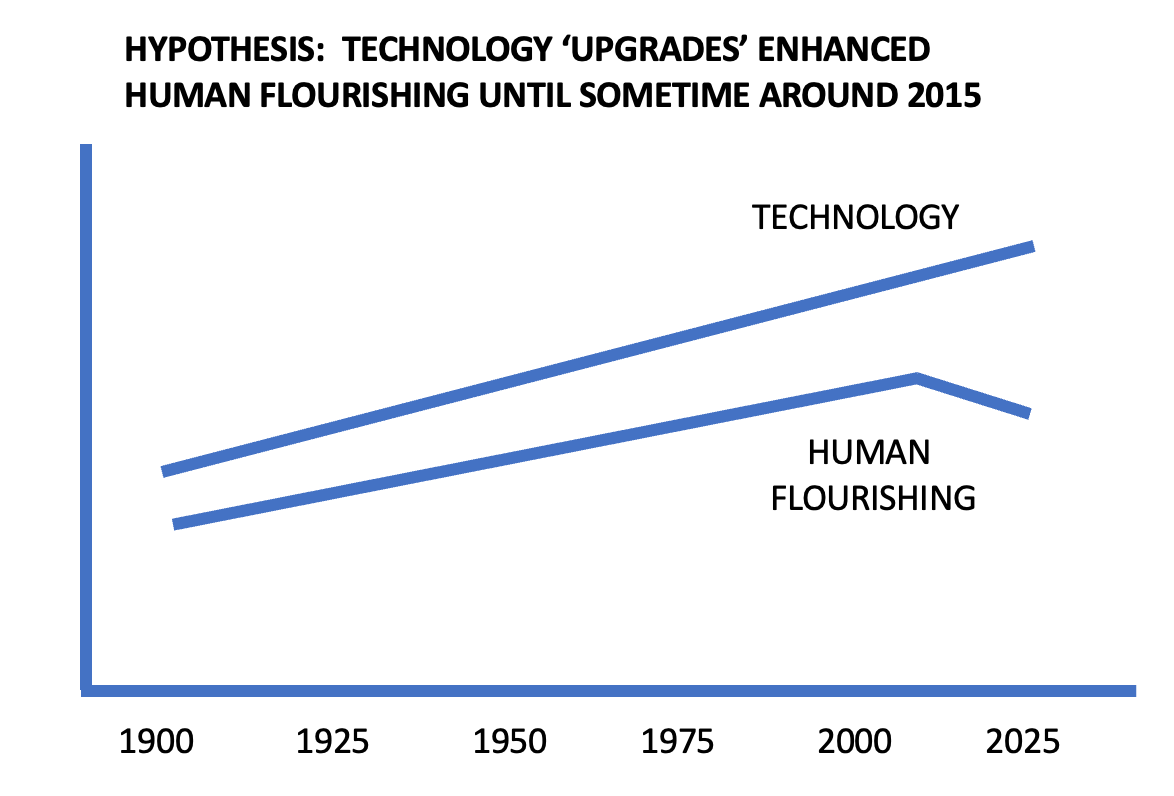
Ted Gioia provides ten reasons why all our lovely shiny technological improvements have turned into a steady stream of enshittified “updates” that reduce functionality, add unwanted “improvements” and make things significantly less reliable:
By my measure, this reversal started happening around a decade ago. If I had to sum things up in a conceptual chart, it would look like this:
The divergence was easy to ignore at first. We’re so familiar with useful tech that many of us were slow to notice when upgrades turned into downgrades.
But the evidence from the last couple years is impossible to dismiss. And we can’t blame COVID (or other extraneous factors) any longer. Technology is increasingly making matters worse, not better — and at an alarming pace.
[…]
But I have avoided answering, up until now, the biggest question — which is why is this happening?
Or, to be more specific, why is this happening now?
Until recently, most of us welcomed innovation, but something changed. And now a huge number of people are anxious and fearful about the same tech companies they once trusted.
What caused this shift?
That’s a big issue. Unless we understand how things went wrong, we can’t begin to fix them. Otherwise we’re just griping — about bad software or greedy CEOs or whatever.
It’s now time to address the causes, not just complain about symptoms.
Once we do that, we can move to the next steps, namely outlining a regimen for recovery and an eventual cure.
So let me try to lay out my diagnosis as clearly as I can. Below are the ten reasons why tech is now breaking bad.
I apologize in advance for speaking so bluntly. Many will be upset by my frankness. But the circumstances — and the risks involved — demand it.
August 8, 2024
May 20, 2024
March 15, 2024
QotD: The ever-growing state
“Inconvenience would seem to be a small price to pay for peace of mind.”
That one phrase sums up all the problems we are having with government in this country. It justifies the humiliating personal searches at airports. It justifies the police state tactics of “sobriety checkpoints” or “identification stops”. It justifies the Patriot Act, and the new Intelligence Reform Act, with all their draconian intrusions on personal privacy, including the repulsive, illegal and un-Constitutional parts, such as no-warrant-required searches, a national ID card, federal snooping into our reading habits at libraries and book stores. It justifies any intrusion into private, personal, or intimate matters. After all, if someone has more than one wife (or husband), doesn’t your peace of mind require that that person be harassed, jailed, or otherwise punished for violation of your religious or moral code? It doesn’t matter that the people involved are adults who freely and willingly consent to live in that situation. For that matter, if two men or women live together, doesn’t your peace of mind require that their “immoral and ungodly” lifestyle be exposed, and the people involved publicly pilloried?
Ron Beatty, “Peace of Mind”, Libertarian Enterprise, 2005-03-06.
January 3, 2024
They all spy on you, the FBI, RCMP, MI5 … and apparently your Subaru
JoNova linked to this disturbing little article explaining what legal rights you give away merely by being a passenger in a modern Subaru vehicle:
Subaru is a Japanese car company started back in the 1950s. Their all-wheel drive, sporty SUVs and cars are popular with outdoor types and the LGBT+ community (and your privacy researcher’s Mom … Mom swears by Subaru and has since the 1980s). Popular models in the Outback, Forester, Crosstrek, Impreza, Legacy, the sporty WRX, and the electric Solterra. The MySubaru app and Subaru’s Starlink connected services offer up all the usual connected car things like remote start/stop, lock/unlock, honk your horn and flash your lights from bedroom, automatic collision notification, multimedia services like navigation and news, trip logs, and a way to manage other people who might drive your Subaru with boundary, speed, and curfew alerts. So, do we love Subaru’s privacy? Not really. But hey, they aren’t the worst car company we reviewed, so there’s that.
Here’s something you might not realize. The moment you sit in the passenger seat of a Subaru that uses connected services, you’ve consented to allow them to use — and maybe even sell — your personal information. According to their privacy policy, that means things like your name, location, “Audio recordings of Vehicle Occupants“, and inferences they can draw about things like your “characteristics, predispositions, behavior, or attitudes“. Call us bonkers, but we don’t think that simply sitting in the passenger seat of someone’s Subaru should mean you consent to having any of your personal information use for, well, pretty much anything at all. Let alone potentially sold to data brokers or shared with third party marketers so they can target you with ads about who knows what based on the the inferences they draw about you because you sat in the back seat of a Subaru in the mountains of Colorado. We’re gonna really call out Subaru for this, because they lay it out so clearly in their privacy policy, but please know, Subaru isn’t the only car company doing this sort of icky thing.
If you go read Subaru’s privacy policy (or don’t, we did it for you, you can just read our review here), you’ll see at the very start they say this: “This Privacy Policy applies to each user of the Services, including any ‘Vehicle Occupant’, which includes each driver or passenger in a Subaru vehicle that uses Connected Vehicle Services, such as Subaru Starlink (such vehicle, a ‘Connected Vehicle’), whether or not such driver or passenger is the vehicle owner or a registered user of the Connected Vehicle Services. For the avoidance of doubt, for purposes of this Privacy Policy, ‘using’ the Services includes being a Vehicle Occupant in a Connected Vehicle.” So yeah, they don’t want there to be any doubt that when you sit in a connected Subaru, you’ve entered the world of using their services.
December 31, 2023
QotD: Orwell as a “failed prophet”
Some critics do not fault [Nineteen Eighty-Four] on artistic grounds, but rather judge its vision of the future as wildly off-base. For them, Orwell is a naïve prophet. Treating Orwell as a failed forecaster of futuristic trends, some professional “futurologists” have catalogued no fewer than 160 “predictions” that they claim are identifiable in Orwell’s allegedly poorly imagined novel, pertaining to the technical gadgetry, the geopolitical alignments, and the historical timetable.
Admittedly, if Orwell was aiming to prophesy, he misfired. Oceania is a world in which the ruling elite espouses no ideology except the brutal insistence that “might makes right”. Tyrannical regimes today still promote ideological orthodoxy — and punish public protest, organized dissidence, and conspicuous deviation. (Just ask broad swaths of the citizenry in places such as North Korea, Venezuela, Cuba, and mainland China.) Moreover, the Party in Oceania mostly ignores “the proles”. Barely able to subsist, they are regarded by the regime as harmless. The Party does not bother to monitor or indoctrinate them, which is not at all the case with the “Little Brothers” that have succeeded Hitler and Stalin on the world stage.
Rather than promulgate ideological doctrines and dogmas, the Party of Oceania exalts power, promotes leader worship, and builds cults of personality. In Room 101, O’Brien douses Winston’s vestigial hope to resist the brainwashing or at least to leave some scrap of a legacy that might give other rebels hope. “Imagine,” declares O’Brien, “a boot stamping on a human face — forever.” That is the future, he says, and nothing else. Hatred in Oceania is fomented by periodic “Hate Week” rallies where the Outer Party members bleat “Two Minutes Hate” chants, threatening death to the ever-changing enemy. (Critics of the Trump rallies during and since the presidential campaign compare the chants of his supporters — such as “Lock Her Up” about “Crooked Hillary” Clinton and her alleged crimes — to the Hate Week rallies in Nineteen Eighty-Four.)
Yet all of these complaints about the purported shortcomings of Nineteen Eighty-Four miss the central point. If Orwell “erred” in his predictions about the future, that was predictable — because he wasn’t aiming to “predict” or “forecast” the future. His book was not a prophecy; it was — and remains — a warning. Furthermore, the warning expressed by Orwell was so potent that this work of fiction helped prevent such a dire future from being realized. So effective were the sirens of the sentinel that the predictions of the “prophet” never were fulfilled.
Nineteen Eighty-Four voices Orwell’s still-relevant warning of what might have happened if certain global trends of the early postwar era had continued. And these trends — privacy invasion, corruption of language, cultural drivel and mental debris (prolefeed), bowdlerization (or “rectification”) of history, vanquishing of objective truth — persist in our own time. Orwell was right to warn his readers in the immediate aftermath of the defeat of Hitler and the still regnant Stalin in 1949. And his alarms still resound in the 21st century. Setting aside arguments about forecasting, it is indisputable that surveillance in certain locales, including in the “free” world of the West, resembles Big Brother’s “telescreens” everywhere in Oceania, which undermine all possibility of personal privacy. For instance, in 2013, it was estimated that England had 5.9 million CCTV cameras in operation. The case is comparable in many European and American places, especially in urban centers. (Ironically, it was revealed not long ago that the George Orwell Square in downtown Barcelona — christened to honor him for his fighting against the fascists in the Spanish Civil War — boasts several hidden security cameras.)
Cameras are just one, almost old-fashioned technology that violates our privacy, and our freedoms of speech and association. The power of Amazon, Google, Facebook, and other web systems to track our everyday activities is far beyond anything that Orwell imagined. What would he think of present-day mobile phones?
John Rodden and John Rossi, “George Orwell Warned Us, But Was Anyone Listening?”, The American Conservative, 2019-10-02.
December 1, 2023
“I considered shopping a proposal for an anti-helicopter parenting book called Your Kid Sucks, but for some strange reason my agent dissuaded me”
Freddie deBoer on the modern phenomenon of “helicopter parenting”:

Collapse in childhood freedom – Graphic showing the diminishing “free ranges” of each generation of an English family.
For the New York Times, Jessica Grose details how new online grading systems allow parents to track the progress of their children not from year to year, semester to semester, report card to report card, but week to week or even day by day. The results are depressingly predictable, in today’s parenting environment. There’s stress for students and teachers alike, a collapse in interest in learning in and of itself, an adversarial relationship between parents and teachers, and the rise of “hyperchecking”, where parents complain about each and every single grade that isn’t an A. The piece is about K-12, but Grose notes that parents are increasingly seeking access to college online gradebooks, which seems crazy to me; as someone who’s taught a lot of college classes, the idea of someone constantly monitoring a student’s grade with the mindset of a litigious lawyer sounds awful. But then again, perhaps I shouldn’t be surprised. Here’s a piece about helicopter parenting extending into the college years to the extent that the parents are arranging social calendars. Of their college-age children.
I’ve been thinking about these issues for some time — I considered shopping a proposal for an anti-helicopter parenting book called Your Kid Sucks, but for some strange reason my agent dissuaded me — and what I can’t stop wondering is why parents don’t stop doing this stuff for the good of their kids themselves. There are social and philosophical critiques to be made of helicopter parenting, some very good ones. But we never need to wonder why people choose to pursue selfish interests over social or philosophical ones. What consistently surprises me is that parents keep puttering along in the clouds above their kids, binoculars in hand, when there seem to be really compelling arguments against doing that for reasons that are completely aligned with the selfish interests of the kids. I get ignoring social responsibility for the sake of your kid; it’s hard to understand ignoring what’s best for your kid for the sake of your kid.
There’s the social case to be made against helicopter parenting, of course. If you wanted to define the essential moral project of human beings in the broadest terms possible, you could do worse than “put others before self”. Aggressive parenting allows people to juke this basic logic — parents who act as though their child’s best interest is the only important criterion are, in a literal sense, putting someone else before themselves. “Hey, I may be disadvantaging already-disadvantaged kids with my hyperactive parenting, but I’m doing it for a greater cause than myself.” And the intrinsic (genetic) dedication to the good of one’s child obliterates the broader social concerns once freed from the guilt of traditional for-myself selfishness. But hyper-parenting still reflects selfishness, putting your own kin above the interest of everyone else, especially in cases where the harm done to society is a lot bigger than the benefit to your child. Academic malfeasance like the Varsity Blues scandal has obvious negative social consequences, for example, while those specific kids faced only going to slightly less competitive or desirable schools had there been no fraud in their applications. Less directly illicit behavior, like grade grubbing — which, among other things, inevitably benefits the students with the parents who are the most aggressive and who hold the most social capital — are a greyer area, but ultimately do more to unbalance an already-unbalanced system. If these parents were confronted with the opportunity to do this for themselves, I genuinely think that most of them would decline, out of a sense of social obligation. But once it’s “for my kid”, it’s no holds barred.
I think absolutely all parenting contains a little narcissism, and that’s OK; it’s probably a part of our genetic endowment that helps compel parents to nurture their children, and anyway parenting is a tough job that we shouldn’t expect people to perform with no sense of self-satisfaction. But it is one of those quirks of our social order that the parents who are the most politically progressive, who most ardently advocate for a society that serves all of our people, are often also the most unapologetic about putting their thumb on the scale for their own children. Plus, the sort of second-order selfishness of parenting allows for the sidestepping of more philosophical objections to helicopter parenting. These objections are less about the social good of others and more about the content of our individual characters. These include personal values such as the notion that we just should, as human beings, be able to live with a degree of independence in youth; that we just should experience hardship and the consequences of our actions to better appreciate what it means to be alive; that we just should, as human beings, secure our own interests to whatever degree we’re able, without help from above, including in school; that we just should operate as though we are but one in a broad collection of human beings, all of whom matter as much as we do, for our own spiritual good. The thing about these personal values is that they’re only motivating if they are indeed personal — that is, these might sway an individual, but not even occur to their parents, and in our system parents have remarkable ability to obstruct the agency of their kids. They can do the dirty work the kids might not do for themselves.
November 8, 2023
Details from the day of the Hamas terror attack on Israel
Matt Gurney in The Line:
On Nov. 6, one-month-less-a-day after the Hamas assault on southern Israel, I was one of a small number of journalists to receive a briefing by a senior Israeli government official at the Israeli consulate in Toronto. Part of the briefing was the showing of a film, approximately 42 minutes long, that contained video and audio records of the attack. The sights and sounds came from many sources, including home security footage, survivor footage, surveillance cameras at private residences, military facilities and in public places, as well as cameras and Go-Pro-style body worn cameras carried by Hamas. Later in the film, we also see footage taken by Israeli first responders — some of it informally, via body worn cameras and smartphones, but some of it also deliberately and meticulously, as part of the documenting of the attack’s aftermath. The video also included audio portions of what the Israeli government claims is intercepted Hamas communications sent during the attack.
I have to preface this near the top: I can’t vouch for the authenticity of the videos, or of the translations. I believe that the videos are authentic and the translations accurate — the latter is easier, since it has by now been shown to enough people that any false translations would have been noted by members of the audience, but I don’t speak Hebrew or Arabic, and had to rely on the captions. As for the videos, while some of what I saw on Monday was new to me, other clips have already been shared widely on social media. There’s a decent chance you’ve seen some of them, too. For further disclosure, many of the clips are very short — a few seconds each. The Israelis said that in many cases, they are only choosing to release what the families of victims have agreed to allow to be shown. That’s an editorial decision, and I haven’t seen the unedited videos. I can’t tell you what I wasn’t shown.
So if you’re absolutely determined to find a way to discredit or dismiss everything I’m about to say, I’ll keep it easy for you. I saw what was presented to me, by Israel, and have little ability to independently confirm any of it.
If you’re interested in hearing what I saw, though, here it is.
I should start by telling you I don’t plan to dwell on all the atrocities or try to summarize the whole 42 minutes of carnage I watched in any kind of coherent sequence. It’s not that the atrocities aren’t important — they’re obviously the central point of the briefing for reporters, and what I was asked to bear witness to. My thinking is simply this: much of what I could tell you has been summarized elsewhere. The global media first saw this film, in Israel, two weeks ago; some of my Ottawa-based colleagues saw it last week. If you’re looking for a summary of the contents, those exist already. I don’t think you’d benefit from just another version of that, and I know I wouldn’t enjoy writing one. So in the main, I’ll avoid long, descriptive passages where I tell you what I saw. I’ll try to offer something different.
But first, let’s get this out of the way. I confess that I was afraid when the video started. Simple fear. Fear I’d crack, fear I’d have to look away, fear I’d somehow fail to meet the moment. I don’t know if that was a rational fear — what the hell does meeting the moment even mean? — but I was afraid. I was afraid from the moment I was asked to attend and said yes. As the film began, though, I found many of the videos less graphic than I’d feared, and actually less graphic than some of what I’d already seen and written about. No one should mistake me — the videos are graphic, some of them extremely so. But in many cases, the videos are taken from too far away or from an unsteady camera (particularly the body worn ones) and many of the worst gruesome details are thus obscured or missed.
Not all of them. Lord no, not all. But some. That helped.
September 19, 2023
For some reason, ordinary Londoners don’t seem to appreciate Mayor Khan’s ULEZ initiatives
It’s hard to believe that anyone could possibly want to avoid London Mayor Sadiq Khan’s Ultra Low Emission Zone (ULEZ) expansion beyond the initial areas of the city, but a quick search of Twit-, er, I mean “X” shows evidence of what Justin Trudeau might characterize as a “small fringe minority … holding unacceptable views”:
Weird, isn’t it. All those “decommissioned” cameras. And people physically blocking access to workers:
London has put up with a lot over the centuries, but Mayor Khan’s ULEZ somehow seems to have awakened the resistance in a major way:
Brian Peckford republished this article from Yudi Sherman on the pushback against London’s ULEZ expansion:
London taxpayers are damaging the city’s surveillance vans in an escalating feud between Mayor Sadiq Khan and the city’s residents.
Last month Khan peppered the city with ultra-low emission zones (ULEZs), areas in London accessible only to low-emission vehicles. Cars that do not meet the city’s environmental standards are charged £12.50 ($16) for entering the ULEZ. Automatic Number Plate Recognition (ANPR) cameras positioned around the zones read license plates and check them against the vehicles’ make and model in real time. If a vehicle does not meet the environmental threshold, the fine is levied against the car owner. Failure to pay can lead to fines as high as £258 ($331).
The ULEZ climate mandate has drawn heavy protests from residents, including hunger strikes and refusal to pay fines. Taxpayers have also taken to disabling the ANPR surveillance cameras which Transport for London (TfL), the city’s transportation department, said will be used both for climate and law enforcement.
In response, the city deployed mobile surveillance vans mounted with ANPR cameras across London in the hopes of evading attacks, but the vans are being targeted as well. Some have been spotted covered in graffiti with their tires slashed, while others have been completely covered in tarp, reports the Daily Mail.
The activists are said to belong to a group calling itself the Blade Runners and have promised not to rest until every ULEZ camera is removed or destroyed “no matter what”. The group is being widely cheered by its compatriots, including media personality and political commentator Katie Hopkins. Over 4,000 people have joined a Facebook group to report ULEZ van sightings.
Between April 1st and August 31st, police recorded 351 incidents of destruction to ULEZ cameras and 159 removals, reports Sky News, an average of over 100 a month. Of those incidents, 171 reportedly occurred since August 17th alone, just before the ULEZ mandate officially expanded to include all outer London boroughs. Two individuals have been arrested in connection with the incidents, one of whom was charged.
One reported Blade Runner said, “In terms of damage it’s way more than what [London Mayor Saidq Khan and TfL] have stated.”