
I’m old enough to have had lengthy conversations with British soldiers and officers who were serving or had recently served in Northern Ireland at the tail end of “The Troubles”. It was a dangerous situation the troops found themselves in and the Rules of Engagement they worked under at least recognized that it wasn’t a normal day at the office back home. On his Substack, Dr. Robert Lyman explains why the current government’s plan to retroactively change the rules that governed the actions of the British military forces is one of the worst possible things they could do:
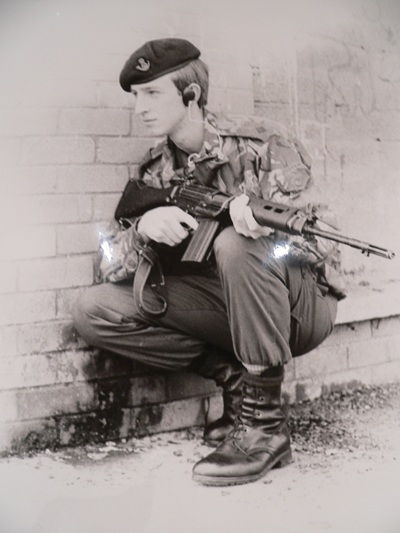
Lieutenant Robert Lyman in the Ballymurphy, 1983, in a photograph snapped by Lieutenant Colonel Bryan Elliott, CO of 1LI at the time. He was driving past in his Landrover and spotted a photo opportunity.
Photo via The War Room
For those who know me well, the idea that I might now be encouraging young men and women not to join the Armed Forces might sound that I had lost my marbles. I can assure you that is not the case. I am deadly serious. This government’s determination, building on the surrender of the previous Conservative government to the varying dictats of the ECHR, will drive an impossible moral and legal wedge between the people who the country ask to do its dirty work, and the government that sends them in harms way. It is an intolerable set of affairs that all sensible people in his country should oppose. What sort of perversity might think that this behaviour is acceptable from any government? I despair, yet it seems that this is precisely what our current morally impoverished government seems to desire.
[…]
The central concern is that the proposed changes will expose servicemen and women, many of whom have already undergone judicial scrutiny for actions undertaken during the Troubles, to further litigation and investigation. In practice, this is likely to encourage a new wave of cases brought by individuals seeking to revisit or reinterpret events from a campaign in which terrorist organisations such as the IRA and INLA were ultimately defeated.
The immediate implications are troubling enough. The longer-term precedent, however, is far more serious. If this legislation proceeds, it will send a clear message to today’s servicemen and women, that even after they have acted lawfully, completed investigations, and fulfilled their duty to the State, they may still face renewed legal jeopardy in later decades. It undermines the fundamental bond of trust between those who serve and the government that sends them into harm’s way.
Every member of the British Armed Forces operates within a strict and clearly defined legal framework. These rules, embodied in the Laws of Armed Conflict and implemented through Rules of Engagement (RoE), govern the use of force in military operations. During my own service, I spent countless hours learning these rules, teaching them to my soldiers, and ensuring they were followed in Northern Ireland, Bosnia, and elsewhere.
This debate is not about whether soldiers should be above the law. Of course they are not, nor should they be. Rather, it is about whether the rules that governed military operations at the time can be retrospectively reinterpreted after a conflict has ended. The concern is that former adversaries will be able to pursue legal action against veterans for actions that were considered lawful under the Rules of Engagement in force at the time.
Today, Policy Exchange published an excellent report examining this issue in relation to former members of the SAS who served in Northern Ireland. The report sets out the problem clearly and persuasively, concluding that the proposed changes should be abandoned. I agree.
Predictably, some MPs have defended the legislation. Diane Abbott, for example, has argued on X that opposition to the changes amounts to “a call for armed forces personnel to be placed above the law.” That characterisation is deeply misleading. The debate has never been about exempting soldiers from the law. It is about subjecting veterans to repeated investigations and additional layers of judicial scrutiny many years after the events in question, often in ways that were never demanded of those they fought against on behalf of the nation.
At its core, this issue is one of fairness. It raises questions about double standards, retrospective judgment, and the constant shifting of the goalposts. Veterans who served under one set of rules are now being told that those rules may no longer be sufficient protection against further legal action.



Forgive me if I misunderstanding another country’s legal system, but this is proposing a retroactive change to the RoE for an event from nearly a generation ago? Against people with training and no doubt ties to people still “under the colors?” Is Parliament trying to start a civil war?
Comment by Clayton Barnett — September 17, 2026 @ 16:35
Yes, that’s exactly what they’re planning to do. It will encourage every activist group in the UK and Ireland (and further afield) to re-litigate the entire course of British Army and police conduct. They especially want to prosecute former members of the SAS/SBS, Parachute Regiment, and Royal Marines for “warcrimes”.
Comment by Nicholas — September 17, 2026 @ 17:06
As the son of a woman who was born in Ireland in 1935, it’s hilarious to see that look of schadenfraude on her face. She’s no fan of anything English.
I still recall wearing an “I support the IRA, England out” button to catholic grammar school on St Patrick’s Day (this is in California, btw). On one occasion, the Monsignore patted me on the head after seeing it.
After what the English did to Ireland, don’t look to me for sympathy. If they want to tear themselves apart, I won’t slow them down.
Comment by James Quigley — September 18, 2026 @ 13:18