In the Panopticon State, the Shadowlands are thriving: a state that presumes to tax and license Joe Schmoe for using the table in the corner of his basement as a home office apparently doesn’t spot the half-dozen additional dwellings that sprout in José Schmoe’s yard out on the edge of town. Do-it-yourself wiring stretches from bungalow to lean-to trailer to RV to rusting pick-up on bricks, as five, six, eight, twelve different housing units pitch up on one lot. The more Undocumented America secedes from the hyper-regulatory state, the more frenziedly Big Nanny documents you and yours.
This multicultural squeamishness is most instructive. Illegal immigrants are providing a model for survival in an impoverished statist America, and on the whole the state is happy to let them do so. In Undocumented America, the buildings have no building codes, the sales have no sales tax, your identity card gives no clue as to your real identity. In the years ahead, for many poor Overdocumented-Americans, living in the Shadowlands will offer if not the prospect of escape then at least temporary relief. As America loses its technological edge and the present Chinese cyber-probing gets disseminated to the Wikileaks types, the blips on the computer screen representing your checking and savings accounts will become more vulnerable. After yet another brutal attack, your local branch never reconnects to head office; it brings up from the vault the old First National Bank of Deadsville shingle and starts issuing fewer cards and more checkbooks. And then fewer checkbooks and more cash. In small bills.
The planet is dividing into two extremes: an advanced world — Europe, North America, Australia — in which privacy is vanishing and the state will soon be able to monitor you every second of the day; and a reprimitivizing world — Somalia, the Pakistani tribal lands — where no one has a clue what’s going on. Undocumented America is giving us a lesson in how Waziristan and CCTV London can inhabit the same real estate, like overlapping area codes. There will be many takers for that in the years ahead. As Documented America fails, poor whites, poor blacks, and many others will find it easier to assimilate with Undocumented America, and retreat into the shadows.
Mark Steyn, After America, 2011.
May 10, 2025
QotD: Undocumented America
August 29, 2024
Pavel Durov’s arrest isn’t for a clear crime, it’s for allowing everyone access to encrypted communications services
J.D. Tuccille explains the real reason the French government arrested Pavel Durov, the CEO of Telegram:
It’s appropriate that, days after the French government arrested Pavel Durov, CEO of the encrypted messaging app Telegram, for failing to monitor and restrict communications as demanded by officials in Paris, Meta CEO Mark Zuckerberg confirmed that his company, which owns Facebook, was subjected to censorship pressures by U.S. officials. Durov’s arrest, then, stands as less of a one-off than as part of a concerted effort by governments, including those of nominally free countries, to control speech.
“Telegram chief executive Pavel Durov is expected to appear in court Sunday after being arrested by French police at an airport near Paris for alleged offences related to his popular messaging app,” reported France24.
A separate story noted claims by Paris prosecutors that he was detained for “running an online platform that allows illicit transactions, child pornography, drug trafficking and fraud, as well as the refusal to communicate information to authorities, money laundering and providing cryptographic services to criminals”.
Freedom for Everybody or for Nobody
Durov’s alleged crime is offering encrypted communications services to everybody, including those who engage in illegality or just anger the powers that be. But secure communications are a feature, not a bug, for most people who live in a world in which “global freedom declined for the 18th consecutive year in 2023”, according to Freedom House. Fighting authoritarian regimes requires means of exchanging information that are resistant to penetration by various repressive police agencies.
“Telegram, and other encrypted messaging services, are crucial for those intending to organise protests in countries where there is a severe crackdown on free speech. Myanmar, Belarus and Hong Kong have all seen people relying on the services,” Index on Censorship noted in 2021.
And if bad people occasionally use encrypted apps such as Telegram, they use phones and postal services, too. The qualities that make communications systems useful to those battling authoritarianism are also helpful to those with less benign intentions. There’s no way to offer security to one group without offering it to everybody.
As I commented on a post on MeWe the other day, “Somehow the governments of the west are engaged in a competition to see who can be the most repressive. Canada and New Zealand had the early lead, but Australia, Britain, Germany, and France have all recently moved ahead in the standings. I’m not sure what the prizes might be, but I strongly suspect “a bloody revolution” is one of them (if not all of them).”
June 9, 2024
Microsoft’s latest ploy to be the most hated tech company
Charles Stross wonders if Microsoft’s CoPilot+ is actually a veiled suicide attempt by the already much-hated software giant:
The breaking tech news this year has been the pervasive spread of “AI” (or rather, statistical modeling based on hidden layer neural networks) into everything. It’s the latest hype bubble now that Cryptocurrencies are no longer the freshest sucker-bait in town, and the media (who these days are mostly stenographers recycling press releases) are screaming at every business in tech to add AI to their product.
Well, Apple and Intel and Microsoft were already in there, but evidently they weren’t in there enough, so now we’re into the silly season with Microsoft’s announcement of CoPilot plus Recall, the product nobody wanted.
CoPilot+ is Microsoft’s LLM-based add-on for Windows, sort of like 2000’s Clippy the Talking Paperclip only with added hallucinations. Clippy was rule-based: a huge bundle of IF … THEN statements hooked together like a 1980s Expert System to help users accomplish what Microsoft believed to be common tasks, but which turned out to be irritatingly unlike anything actual humans wanted to accomplish. Because CoPilot+ is purportedly trained on what users actually do, it looked plausible to someone in marketing at Microsoft that it could deliver on “help the users get stuff done”. Unfortunately, human beings assume that LLMs are sentient and understand the questions they’re asked, rather than being unthinking statistical models that cough up the highest probability answer-shaped object generated in response to any prompt, regardless of whether it’s a truthful answer or not.
Anyway, CoPilot+ is also a play by Microsoft to sell Windows on ARM. Microsoft don’t want to be entirely dependent on Intel, especially as Intel’s share of the global microprocessor market is rapidly shrinking, so they’ve been trying to boost Windows on ARM to orbital velocity for a decade now. The new CoPilot+ branded PCs going on sale later this month are marketed as being suitable for AI (spot the sucker-bait there?) and have powerful new ARM processors from Qualcomm, which are pitched as “Macbook Air killers”, largely because they’re playing catch-up with Apple’s M-series ARM-based processors in terms of processing power per watt and having an on-device coprocessor optimized for training neural networks.
Having built the hardware and the operating system Microsoft faces the inevitable question, why would a customer want this stuff? And being Microsoft, they took the first answer that bubbled up from their in-company echo chamber and pitched it at the market as a forced update to Windows 11. And the internet promptly exploded.
First, a word about Apple. Apple have been quietly adding AI features to macOS and iOS for the past several years. In fact, they got serious about AI in 2015, and every Apple Silicon processor they’ve released since 2016 has had a neural engine (an AI coprocessor) on board. Now that the older phones and laptops are hitting end of life, the most recent operating system releases are rolling out AI-based features. For example, there’s on-device OCR for text embedded in any image. There’s a language translation service for the OCR output, too. I can point my phone at a brochure or menu in a language I can’t read, activate the camera, and immediately read a surprisingly good translation: this is an actually useful feature of AI. (The ability to tag all the photos in my Photos library with the names of people present in them, and to search for people, is likewise moderately useful: the jury is still out on the pet recognition, though.) So the Apple roll-out of AI has so far been uneventful and unobjectionable, with a focus on identifying things people want to do and making them easier.
Microsoft Recall is not that.
May 20, 2024
March 15, 2024
QotD: The ever-growing state
“Inconvenience would seem to be a small price to pay for peace of mind.”
That one phrase sums up all the problems we are having with government in this country. It justifies the humiliating personal searches at airports. It justifies the police state tactics of “sobriety checkpoints” or “identification stops”. It justifies the Patriot Act, and the new Intelligence Reform Act, with all their draconian intrusions on personal privacy, including the repulsive, illegal and un-Constitutional parts, such as no-warrant-required searches, a national ID card, federal snooping into our reading habits at libraries and book stores. It justifies any intrusion into private, personal, or intimate matters. After all, if someone has more than one wife (or husband), doesn’t your peace of mind require that that person be harassed, jailed, or otherwise punished for violation of your religious or moral code? It doesn’t matter that the people involved are adults who freely and willingly consent to live in that situation. For that matter, if two men or women live together, doesn’t your peace of mind require that their “immoral and ungodly” lifestyle be exposed, and the people involved publicly pilloried?
Ron Beatty, “Peace of Mind”, Libertarian Enterprise, 2005-03-06.
February 24, 2024
QotD: Big government
I’m Canadian and have a romantic fondness for the famous motto of the Royal Canadian Mounted Police, the one about the Mounties always getting their man. But the bigger you make the government, the more you entrust to it, the more powers you give it to nose around the country’s bank accounts, and phone calls, and e-mails, and favourite Internet porn sites, the more you’ll enfeeble it with the siren song of the soft target. The Mounties will no longer get their man, they’ll get you instead. Frankly, it’s a lot easier.
[…]
What should have died on September 11th is the liberal myth that you can regulate the world to your will. The reduction of a free-born citizenry to neutered sheep upon arrival at the airport was the most advanced expression of this delusion. So how’s the FAA reacting to September 11th? With more of the same kind of obtrusive, bullying, useless regulations that give you the comforting illusion that if they’re regulating you they must be regulating all the bad guys as well. We don’t need big government, we need lean government — government that’s stripped of its distractions and forced to concentrate on the essentials. If Hillary and Co want to argue for big government, conservatives could at least make the case for what’s really needed — grown-up government.
Mark Steyn, “Big Shift”, National Review, 2001-11-19.
January 3, 2024
They all spy on you, the FBI, RCMP, MI5 … and apparently your Subaru
JoNova linked to this disturbing little article explaining what legal rights you give away merely by being a passenger in a modern Subaru vehicle:
Subaru is a Japanese car company started back in the 1950s. Their all-wheel drive, sporty SUVs and cars are popular with outdoor types and the LGBT+ community (and your privacy researcher’s Mom … Mom swears by Subaru and has since the 1980s). Popular models in the Outback, Forester, Crosstrek, Impreza, Legacy, the sporty WRX, and the electric Solterra. The MySubaru app and Subaru’s Starlink connected services offer up all the usual connected car things like remote start/stop, lock/unlock, honk your horn and flash your lights from bedroom, automatic collision notification, multimedia services like navigation and news, trip logs, and a way to manage other people who might drive your Subaru with boundary, speed, and curfew alerts. So, do we love Subaru’s privacy? Not really. But hey, they aren’t the worst car company we reviewed, so there’s that.
Here’s something you might not realize. The moment you sit in the passenger seat of a Subaru that uses connected services, you’ve consented to allow them to use — and maybe even sell — your personal information. According to their privacy policy, that means things like your name, location, “Audio recordings of Vehicle Occupants“, and inferences they can draw about things like your “characteristics, predispositions, behavior, or attitudes“. Call us bonkers, but we don’t think that simply sitting in the passenger seat of someone’s Subaru should mean you consent to having any of your personal information use for, well, pretty much anything at all. Let alone potentially sold to data brokers or shared with third party marketers so they can target you with ads about who knows what based on the the inferences they draw about you because you sat in the back seat of a Subaru in the mountains of Colorado. We’re gonna really call out Subaru for this, because they lay it out so clearly in their privacy policy, but please know, Subaru isn’t the only car company doing this sort of icky thing.
If you go read Subaru’s privacy policy (or don’t, we did it for you, you can just read our review here), you’ll see at the very start they say this: “This Privacy Policy applies to each user of the Services, including any ‘Vehicle Occupant’, which includes each driver or passenger in a Subaru vehicle that uses Connected Vehicle Services, such as Subaru Starlink (such vehicle, a ‘Connected Vehicle’), whether or not such driver or passenger is the vehicle owner or a registered user of the Connected Vehicle Services. For the avoidance of doubt, for purposes of this Privacy Policy, ‘using’ the Services includes being a Vehicle Occupant in a Connected Vehicle.” So yeah, they don’t want there to be any doubt that when you sit in a connected Subaru, you’ve entered the world of using their services.
December 15, 2023
March 20, 2023
“It amounts to nothing less than a declaration of all-out war between the government and the Big Tech companies”
The editors of The Line have strong opinions on the federal government’s decision to batter Google, Facebook, and other online “giants” over their opposition to the proposed internet legislation in bills C-11 and C-18:
As a result of C-18, both Google and Meta have considered dropping news distribution from their platforms, or have outright promised to do so. To which we have responded: “Well, no shit, Sherlocks.” We have, in fact, warned all of the parties involved with this misguided bill that that’s exactly what was going to happen.
Nonetheless, the dim-witted government officials and corporate media barons who have pinned their hopes of survival to the apparent money spigot of Big Tech didn’t believe us. So when Meta came right out and said it would drop news last week, the ashen-faced Minister of Heritage accused them of using “intimidation and subversion” tactics. And, thus, these demands for private correspondence appear to have been drafted.
It amounts to nothing less than a declaration of all-out war between the government and the Big Tech companies — and, by extension, the many independent media creators like ourselves.
Well. Okey Dokey then.
*cracks knuckles*
Let’s start with two very obvious points: firstly, we at The Line don’t object to forcing these tech companies to disclose funding to third parties for the purpose of opposing C-18 et al. That is perfectly reasonable, in our minds. Further, if these companies are being accused of anything illegal, by all means, investigate away — after you get a warrant.
The rest of these demands are nothing short of banana crackers; it’s an extraordinary interpretation of the committee’s mandate. It’s the kind of overbroad dragnet that will necessarily create privacy breaches for the unknown numbers of ordinary citizens, dissidents and journalists who have corresponded with these companies about these bills.
We will remind the government that private citizens and private companies do not owe the government a full accounting of their private business or communications. The government is subject to this kind of transparency and disclosure because the government works for us. Not the other way around.
We will also point out the irony. The government is demanding years worth of correspondence from private entities within a very short time frame: this is a level of transparency that no government department would subject itself to. Don’t believe us? Just try to draft a similar ATIP request to any ministry; it would take years to get such a request fulfilled, and half if it would come back redacted.
March 19, 2023
Disagree with the Canadian government’s attempt to take over significant parts of the internet? Get ready for administrative punishment, citizens!
Michael Geist, who often seems like the only person paying close attention to the Canadian government’s growing authoritarian attitudes to Canadians’ internet usage, shows the utter hypocrisy of the feds demanding access to a vast array of private and corporate information on a two-week deadline, when it can take literally years for them to respond to a request for access to government information:

Senator Joe McCarthy would be in awe of the Canadian government’s audacious power grab.
Library of Congress photo via Wikimedia Commons.
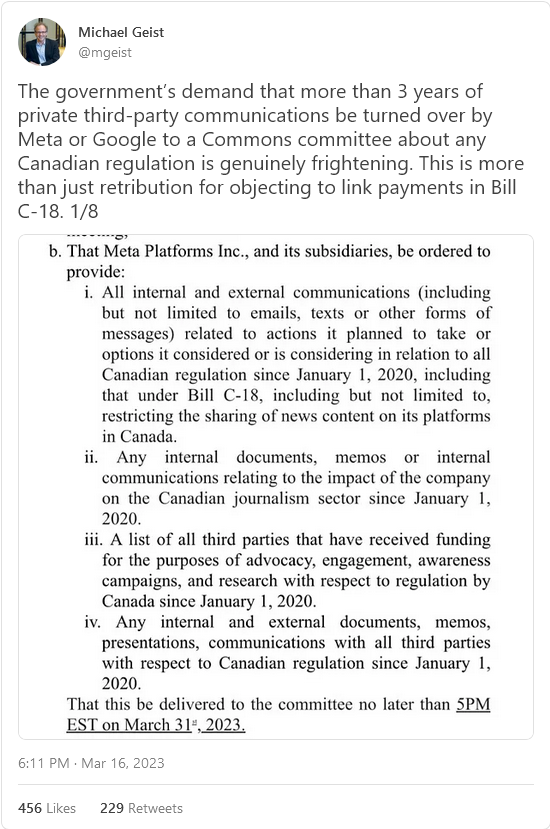
The government plans to introduce a motion next week requiring Google and Facebook to turn over years of private third-party communication involving any Canadian regulation. The move represents more than just a remarkable escalation of its battle against the two tech companies for opposing Bill C-18 and considering blocking news sharing or linking in light of demands for hundreds of millions in payments. The motion – to be introduced by the Parliamentary Secretary to the Minister of Canadian Heritage (yes, that guy) – calls for a series of hearings on what it describes as “current and ongoing use of intimidation and subversion tactics to avoid regulation in Canada”. In the context of Bill C-18, those tactics amount to little more than making the business choice that Heritage Minister Pablo Rodriguez made clear was a function of his bill: if you link to content, you fall within the scope of the law and must pay. If you don’t link, you are out of scope.
While the same committee initially blocked Facebook from even appearing on Bill C-18 (Liberal MP Anthony Housefather said he was ready for clause-by-clause review after just four hearings and no Facebook invitation), bringing the companies to committee to investigate the implications of their plans is a reasonable approach. But the motion isn’t just about calling executives before committee to answer questions from what will no doubt be a hostile group of MPs. The same motion sweeps in the private communications of thousands of Canadians, which is a stunning disregard for privacy and which could have a dangerous chilling effect on public participation. Indeed, the intent seems fairly clear: guilt by association for anyone who dares to communicate with these companies with an attempt to undermine critics by casting doubt on their motivations. Note that this approach is only aimed at those that criticize government legislation. There has been a painfully obvious lobbying campaign in support of the bill within some Canadian media outlets, but there are no efforts to uncover potential bias or funding for those that speak out in favour of Bill C-18, Bill C-11, or other digital policy initiatives.
It is hard to overstate the broad scope of the disclosure demands. Canadian digital creators concerned with Bill C-11 who wrote to Youtube would find their correspondence disclosed to the committee. So would researchers who sought access to data from Google or Facebook on issues such as police access to social media records or anti-hate groups who contacted Facebook regarding the government’s online harms proposal for automated reports to law enforcement. Privacy advocates focused on how Google administers the right to be forgotten in Canada would ironically find their correspondence disclosed as would independent media sites that wrote to Facebook about the implications of Bill C-18.
December 5, 2022
QotD: Open concept house designs
The shift from open concepts demanded by necessity to widespread construction of separate rooms to open concepts demanded by style is relatively recent. Before the 17th century, especially for the poor, “rooms did not have specialized functions”, explains architect Witold Rybczynski in Home: A Short History of an Idea. “Houses were full of people, much more so than today, and privacy was unknown.”
A single room could serve as a study in the morning, a dining room at noon, a living room in the evening, and a bedroom at night. Beds were couches, and couches were beds. Your house was your workspace, and your minimal furniture typically had no fixed arrangement, as it was constantly moved about to accommodate different uses of the only room available. (The French and Italian words for “furniture” still hint at this history: You can see the similarity to “mobile” in meubles and mobilia.)
These open concepts of old were not only motivated by different conceptions of privacy and the expense of building additional walls. They were also required for the lower classes by premodern heating technologies. A single open hearth, or, later, fireplace or stove, could warm one large room but could not do much for other, closed-off spaces. A lord or king could build a heating element into every room, but for the average family, winter warmth required most of life to happen in a single space.
As technology advanced, ideas about privacy changed, and standards of living improved over the last 500 years, ordinary people were increasingly able to move away from an open concept home, and they eagerly did so. “Rooms began to proliferate as wealthy householders discovered the satisfactions of having space to themselves,” notes Bill Bryson in At Home: A Short History of Private Life. Though the transition was slow — toilets long had “multiple seats, for ease of conversation” — rooms were increasingly devoted to particular uses, and those uses were separated from one another as much as resources permitted.
Bonnie Kristian, “Open concept homes are for peasants”, The Week, 2019-05-12.
November 8, 2022
November 6, 2022
The ArriveCAN farce as the poster child for Canada’s vastly diminished state capacity
In The Line, Andrew Potter considers the expensive, ineffective ArriveCAN app the government tried to impose on international travellers as a symptom of Canada’s decreasing state capacity:
There is perhaps no clearer poster child for the current crisis of state capacity than the ArriveCAN app, which was a bad policy initiative, poorly implemented, at great cost, and whose ultimate effect was not to keep Canadians safe and healthy, but rather to annoy users and generate a great deal of hostility towards the government.
The question of state capacity (or more frequently, its absence) became an issue of popular concern during the COVID-19 pandemic when governments, both in Canada and elsewhere, struggled to accomplish basic tasks of pandemic management. Whether it was sourcing enough PPE for the health-care system, scaling up testing or contact tracing, securing the borders, properly staffing long-term-care facilities, taking care of temporary foreign workers, and so on … the authorities struggled to get their act together. This is a well-documented story.
But this all came at a time when we had already started a national conversation about whether Canada had become a place where it was impossible for government to get anything done. Pipelines were the big issue, but we seemed to have turned into a country where crumbling infrastructure and slow and ineffective public services had become simply accepted as a fact of life. “State capacity” just put a name to something that had been in the air for a long while.
And so the pandemic served to both exacerbate and accelerate the concern over state capacity, for two main reasons. First, it raised the stakes. Before the pandemic, the failure of state capacity manifested itself as a slow-motion and genteel sort of generalized decline. With the arrival of COVID-19, it quickly became a matter of life and death. But second, the gusher of money the government printed during the pandemic helped put a point on the problem: the problem didn’t originate in a lack of funds. Indeed, what transpired during the pandemic was a bit of a spin on the old Woody Allen joke about the restaurant with terrible food and such small portions: There was so much government, and so much of it was bad.
So what is state capacity anyway? And why is it so important?
As I’ve said many times, the more the government tries to do, the less well it does everything. More government is worse government … and I’m not even being a pedantic libertarian here, I’m talking objectively about the outcomes of pretty much every new government action.
June 15, 2022
“Privacy” seems to be an archaic concept that doesn’t matter to the Canadian government
Michael Geist wonders why the Canadian government doesn’t seem to care at all about the privacy of Canadians:
Over the past several weeks, there have been several important privacy developments in Canada including troubling privacy practices at well-known organizations such as the CBC and Tim Hortons, a call from business organizations for privacy reform, the nomination of a new privacy commissioner with little privacy experience, and a decision by a Senate committee to effectively overrule the government on border privacy rules. These developments raise the puzzling question of why the federal government – led by Innovation, Science and Industry Minister François-Philippe Champagne, Public Safety Minister Marco Mendicino, and Canadian Heritage Minister Pablo Rodriguez – are so indifferent to privacy, at best treating it as a low priority issue and at worst proposing dangerous measures or seemingly hoping to cash in on weak privacy laws in order to fund other policy priorities.
The privacy alarm bells have been ringing for weeks. For example, the Globe and Mail recently featured an important story on children’s privacy, working with Human Rights Watch and other media organizations to examine the privacy practices of dozens of online education platforms. The preliminary data suggests some major concerns in Canada, most notably with the CBC, whose CBC Kids platform is said to be “one of the most egregious cases in Canada and really all around the world”. The CBC responded that it “complies with relevant Canadian laws and regulations with regard to online privacy, and follows industry practices in audience analytics and privacy protection”. Yet that is the problem: Canada’s privacy laws are universally regarded as outdated and weak, thereby enabling privacy invasive practices with no consequences. Soon after, the Privacy Commissioner of Canada released findings in an investigation involving the Tim Hortons app tracking location data. First identified by then-National Post reporter James McLeod, the commissioner found privacy violations, yet Canadian privacy law does not include penalties for these violations.
Despite the obvious need for privacy reform – outgoing Privacy Commissioner of Canada Daniel Therrien reiterated the necessity for reform in his final speech as commissioner and business groups have made a similar call for privacy reform – the government seems indifferent to the issue. The nomination of Philippe Dufresne as the new privacy commissioner is a case in point. I don’t know Mr. Dufresne and I’m hoping that he proves to be a great commissioner. He certainly said many of the right things in his appearance before committee yesterday. However, the government’s choice is instructive. In choosing someone with no obvious privacy experience, the government sided instead with government managerial experience. Good managerial experience is valuable, but a career spent within government is not a training ground for pushing the policy envelope, pressuring governments to reform the law, and demanding that the private sector comply with it. The Dufresne choice signals that the government may be more comfortable with a well-managed agent of Parliament than with an agent of change.
May 25, 2022
“What is a reasonable general concern?”
In The Line, Paula Simons has a concern that I think is quite reasonable:

“Canadian Border Sign” by jimmywayne is licensed under CC BY-NC-ND 2.0
What is a reasonable general concern?
That’s not a rhetorical question. I really don’t know the answer. I’m not sure anyone else does, either.
And that’s exactly the problem with Bill S-7, a new piece of government legislation, which amends both the Customs Act and the Preclearance Act.
Bill S-7 set a new standard to allow border services officers to search through our cellphones, laptops, tablets, Apple Watches and other personal computers. If the bill passes, it will allow officers who feel a “reasonable general concern” to search through the emails, documents, texts, instant messages, photos or videos stored on our digital devices, to look for evidence that we may have violated customs regulations.
Reasonable general concern. Or, as it says in the French-language draft of the bill, “des préoccupations générales raisonnables“.
It’s an absolutely novel legal threshold. That phrase, be it in English or French, doesn’t appear anywhere else in Canadian criminal or civil law. It’s not a standard borrowed from any other country. It’s a brand new legal test to authorize an invasive search of your most private personal records and correspondence.
A reasonable concern, one might intuit, is a lower standard than a reasonable suspicion, because a concern is less grave, less specific, than a suspicion.
But a general concern? A general preoccupation?
That sounds even more vague, more subjective, than a good old-fashioned hunch or inkling.
It seems counter-intuitive, to put it mildly, to create a lower, broader standard to search our private data on our private devices than to search our conventional mail, or our suitcases, or our car trunks. Yet that is exactly what Bill S-7 does.
How did we get here? The answer is an ironic one.
Back in 2020, the Alberta Court of Appeal ruled unanimously that portions of the Customs Act were unconstitutional.
The court found the act violated the protection against unreasonable search and seizure, because it allowed for what the court called “suspicion-less and unlimited” searches of our personal digital devices.
That violation, held the court, could not be saved by section 1 of the Charter, because it allowed unfettered and unrestricted access to people’s most personal and intimate information, and because it allowed the state almost unlimited latitude to dig around in the what the court called our “biographical core of identity”.