Quotulatiousness

November 18, 2025

Canada’s divide isn’t left versus right, it’s old versus young

Older Canadians seem to be taking joy in sticking up their elbows and robbing younger Canadians of opportunities, jobs, and hope. It’s quite literally un-Canadian, but the Boomers have always been a generation apart and this is merely the latest manifestation of their self-centred worldview. Alexander Brown wonders if this divide can be fixed before the country itself is ruined:

“eLbOwS uP!”

“Talk to your parents,” the host of an event for Pierre Poilievre joked on Saturday in Vancouver — an event I happened to attend. “But be patient. Be kind.” And he’s right.

The cross-talk, the rock’em sock’em robots, the continued slap-fight between warring consultant tribes, it isn’t getting us anywhere, clearly. When the present iteration of the party of the status quo wedges a nation against itself, and denies a reform election after a decade of haphazard redistribution, non-growth, and abject decline, you get a traditional voter-demographic breakdown flipped entirely on its head.

The party of seemingly endless opposition dominated with youth, held strong with the 35-54s, but found itself walloped 52% to 34% among those aged 55+. Since then, those 55+ numbers have only widened, as the “safe” choice, that more stately actor (when he’s not radicalizing those who don’t know any better with claims of false invasion) can do little wrong, even coming out of “middling” budget heading to a vote Monday, and with a nation remaining pessimistic about its future prospects.

If the Liberals are voted down Monday, they would likely relish that opportunity to seize on a majority. The spin is already built in.

    The Conservatives don’t want to stand up against Trump!

    At a time like this, when we should be coming together, it’s un-Canadian …

    We’re supposed to be one Team Canada right now (offer void in British Columbia, Ontario, and Quebec), we can’t afford Pierre Poilievre’s divisive Trumpiness.

On and on. Yada and yada.

Nowhere in that comms exercise, drummed up by those who spend more time in America or the Arab Emirates, or meeting with Chinese proxies than they’d publicly care to admit, would there be a defence of younger Canadians, of those still on the launch pad, worried about, say, supposed ‘fixes’ to immigration riddled with creative accounting and more of the same.

Nowhere would they address housing, set to get much, much worse, under both the federal Liberals and targets they’re admitting they won’t come close to hitting, and Ontario’s ‘Conservative’ premier who leads the galaxy in not getting off his ass to get out of the way on starts and lowering punitive development costs.

Nowhere would one find a stout defence against “deconstruction“, or the daily humiliation ritual of flags flying that aren’t our own, or imagined and inflated woke excess meant to sully the memory of our war dead and marginalize normal people.

Following recent debates sparked by Without Diminishment, where we’ve argued a version of “it’s not just the economy, stupid,” when it comes to what’s animating young people and young conservatives — actually talk to them, and half of them are trending towards fascism with how alienated they feel by a lack of upward social mobility, or a society without rules or those willing to enforce them — it’s been easier for some serving in established camps to mischaracterize these conversations as focusing too much on culture, or, ridiculously, “blood and soil nationalism”. But we’re not. If one is dealing in good faith, it’s plain to see we’re trying to talk about both.

Of course, the Liberals survived Monday’s budget vote … for now:

When I saw Elizabeth May stand up and ask Mark Carney what looks like a completely planted question, I assumed the budget would pass and I was correct. Planted questions normally come from government MPs and are a soft way for the government to push their agenda.

This time, it wasn’t a Liberal MP, well at least not a Liberal MP in name and fact. Instead it was Green leader, or deputy leader, or let’s be honest the lonely lady in the corner who is the only Green MP asking the question.

That statement put the Liberals one vote closer to passing their budget and of course May later confirmed ahead of the vote that she would back the budget. This was after saying couldn’t back the budget, might back the budget, would probably back the budget, definitely wouldn’t back the budget and finally would back the budget.

How anyone can take Elizabeth May seriously is beyond me.

How the other votes went…

Ahead of the vote there were lots of questions about how things would go. Would all MPs show up or be able to vote online? Would people abstain? Would MPs vote for the budget without crossing the floor?

In the end, the budget passed 170 to 168 with two NDPers abstaining. That leaves five votes not accounted for and we will figure out.

Here is how the vote went.

Now, some members who were not in their seats did vote electronically. I didn’t see Matt Jeneroux vote electronically and I’m told that he is in British Columbia with is family. Also not voting, Conservative MP Shannon Stubbs.

Conservatives Andrew Scheer and Scott Reid both voted no but only in the time that is allowed for MPs voted electronically to claim tech problems. They were both in the House, so why were didn’t they vote in person?

Regardless, the NDP rushed out to say they voted against the budget but also made sure that it passed with their two abstensions.

As for all this talk of a Christmas election, had the government lost this vote and the PM gone to see the Governor General tomorrow, the earliest election date would have been December 25.

A Christmas election.

Canada’s major projects announcements are an economic “hostage release” program

On the social media site formerly known as Twitter, David Knight Legg vents about Dear Leader Carney’s penchant for even-more-Trudeauesque-than-Justin performative governing. Far more emphasis is put on the PR value of an announcement than on the common sense practicality of the thing being announced. And Carney is also starting to re-announce already announced “projects” as if speaking it aloud will magically manifest it into reality:

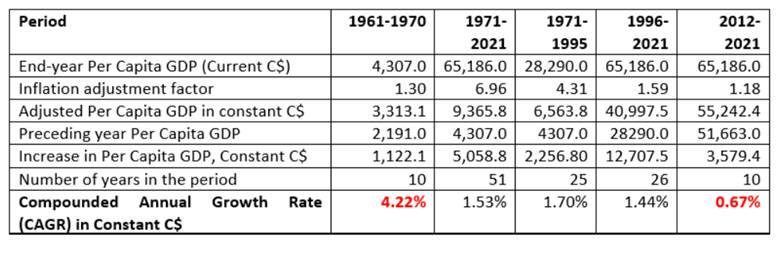
Canada’s major projects announcements are a national embarrassment — an economic “hostage release” program — that tells the world just how uninvestible Canada has become under the Liberal party.

1970s central planning Liberal govt arrogance is at an all time GDP destroying high.

Try naming another OECD nation (we’re at the bottom now) where the press waits with bated breath for a “dear leader” politician who has never built anything in his life to fly in to grant a bureaucratic benediction on a few projects his bureaucrats will allow past the gate of the caps, taxes, green rules and red tape his govt imposes on everything.

Idea: set up the Major Dumb Redtape office in Calgary instead and get rid of the 10 anti-business rules written into law by the Montreal green alarmist fringe that’s holding Canadian energy, ag, forestry, and manufacturing back while other nations grow …

But PM Carney seems to like his bureaucratic power over what used to be a leading free market economy. Even while our GDP grinds down to the worst in the OECD.

The arrogance is breathtaking.

So is the ineptitude. This same central planning genius just punched a record new $78billiom hole through our public finances because he can’t manage basic public service delivery without more crushing debt.

The budget is a train wreck solidifying the final year of a Liberal decade steeply eroding purchasing power, national wealth, personal security and living standards and public services.

The irony is that this has driven Canada to ever-greater 51st state economic dependency. Donald Trump didn’t do that. They did.

But he’s been a too-convenient way to con the elderly with “elbows up” PR.

But should the next generation really be forced to lend this govt another $78bn in addition to the 1 trillion they’ve already taken to fund their failed decade of central planning, green slush funds and EV mandates while real infrastructure projects wait years for the Liberal party to bless them?

It’s not going to last.

Fitch just questioned the sustainability of all this. Unlike our lacklustre press they aren’t buying “net debt” or “operating/investment” Liberal financial illiteracy.

I had high hopes PM Carney would return fiscal sanity to Canada after openly borrowing Conservative policies to get elected by cutting the carbon and cap gains taxes.

But this budget, this major projects farce and his inability to kill a dozen economy killing rules of his own govt is showing the work how uninvestible Canada has become — and it’s accelerating national economic decline.

2026 is the end of the Liberal lost decade. First recession. Then debt downgrade. Then an election. And Carney can go back offshore to his assets and all the other global investors who like him don’t invest in Canada under Liberal mismanagement.

@SteveSaretsky thx for the brilliant line chart as usual.

A day later, after his post got significant attention on the social media site formerly known as Twitter, he posted this follow-up:

This angry post I wrote a day ago got 300,000 views.

Canadians are tired of the fake “major projects” PR by the same people who prevented those projects for a decade with their green taxes and prohibitions.

Announcing the release of 7 hostage projects is a joke. Some of these projects aren’t major and most aren’t new. None needed the govt to do anything but get out of the way from the beginning.

All the several hundred major projects still in purgatory need is for this govt to reverse their anti-job and anti-infrastructure tanker ban, industrial carbon tax, emissions cap, and electricity regs.

Oh — and also clarify by law that in Canada property rights are not overridden by leftist judges and UN wishful thinking.

Then get out of the way so a couple trillion dollars can flow in, major projects can get built and the govt revenue will flow to better public services — and to pay down that debt they just added $78bn to.

November 17, 2025

Yet another example of the Liberal focus on symptoms rather than underlying problems

Filed under: Cancon, Government, Media, Politics — Tags: , , , , , , — Nicholas @ 03:00

The Liberals under both Justin Trudeau and Mark Carney have amply demonstrated that they care far more about appearances than achievements. The immigration crisis is merely the latest example of the government reaching for something that will look good on TV and in the newspapers rather than addressing the root cause of the problem:

Perhaps the most intractable policy disaster handed to Prime Minister Carney by the Trudeau government is the immigration file. The ugliest detail in that file is undoubtedly the astronomic increase in temporary residents (largely foreign workers, international students, and asylum seekers) – a population that expanded from 3.3% in 2018 to 7.5% in 2024. The Carney government’s solution is to limit the inflow of new temporary residents significantly, while at the same time giving permanent residency to many of the ones already on Canadian soil.

The base problem is far too many people entering the country, driving up demand for housing, overloading healthcare facilities, absorbing more and more government assistance at a time the government is running record deficits, and undercutting young Canadians for entry level jobs while youth unemployment is skyrocketing. But this “solution” will look like firm action as it will be presented by the tame media, so from the point of view of the government, it’s “mission accomplished”.

The Carney government’s first annual Immigration Levels Plan commits to “reducing Canada’s temporary population to less than 5% of the total population by the end of 2027”. To this end, Canada’s annual intake of new temporary residents will be cut from 673,650 in 2025 to 385,000 in 2026, and 370,000 in 2027 and 2028. This cut will hit international students the hardest, with annual new study permits cut in half from over 300,000 to 155,000 in 2026, and 150,000 in 2027 and 2028.

This major cut will ease the strain on Canada’s housing, healthcare, food banks, roads, and social services – a strain that is no longer denied by politicians, and is freely acknowledged across the political aisle. But, as is the case with many policies, the devil is the details. It turns out that one of the ways which the federal government intends to shrink the size of the temporary resident population is by making a large number of them permanent residents.

In the recently released 2025 Annual Report to Parliament on Immigration, Immigration Minister Lena Diab says the Carney government intends to “give priority for permanent residence to temporary residents already living and settled in Canada, further reducing the number of new arrivals”.

How many temporary residents will get permanent residency under this plan is unclear, but we can extrapolate from the data we have.

The Carney government’s Immigration Levels Plan sets the annual permanent resident rate at 380,000 for the next three years – or, a total of 1,140,000. The very last Immigration Levels Plan of the doomed Trudeau government – which committed to transitioning many temporary residents to permanent residency – predicted that temporary residents would account for “more than 40% of overall permanent resident admissions in 2025”.

If the Carney government is heralding the idea of transitioning more temporary residents as a way to slow down the catastrophic population growth Canada has experienced in recent years, we can safely assume that this proportion will be at least a little bit higher than the Trudeau government’s rate. A rate of 50%, say, would mean that 570,000 temporary residents will receive permanent residency over the next three years.

See, Canadians are telling the government that there are too many temporary immigrants, so by waving a magic wand and transforming the bulk of the temporary immigrants into permanent residents, the government can pretend they’ve solved the problem. And the sycophants, fluffers, and cheerleaders in the media will laud them to the skies for their brilliant solution.

November 14, 2025

“Conscription if necessary, but not necessarily conscription” 2 – Electric Boogaloo

Filed under: Cancon, Government, Media, Military, Politics — Tags: , , — Nicholas @ 05:00

Canada has only had two brushes with military conscription — after voluntary enlistments couldn’t keep up with casualties in both the First and Second World Wars — and both caused severe resentment in Quebec. Canadian politicians have generally avoided any hint of anything that could be framed as “conscription” for fear of triggering yet another existential crisis between Quebec and the rest of the country. Prime Minister Mark Carney isn’t a typical Canadian politician, and does not seem to have any of the built-up scar tissue that most others do. This might make him prone to saying and doing things that seem quite ordinary to him, but trigger civil unrest … like forcing civil servants to become soldiers against their will.

I floated the notion that this might be Carney’s five-dimensional chess strategy to reduce the civil service without having to fire everyone, but it’s far more likely that he genuinely doesn’t understand Canadians and our shared history.

John Carter is … skeptical about the Laurentian Elite being capable of rebuilding the depleted Canadian Armed Forces, as it’s hard to conceal sixty years of open contempt long enough to fake some sincerity:

The Canadian Armed Forces – which refer to themselves as the CAF, pronounced exactly as it’s spelled – recently leaked its intention expand its reserves from the current, anemic 22,000 to 400,000 soldiers. At first I wondered if an extra 0 was added to that number as a typo, but the plan is to grow the Army reserve to 100,000 and the supplementary reserve (which I hadn’t even known existed, and is currently composed of retirees) from a few thousand to 300,000. Further leaked details are that the 300,000-strong supplementary reserve will be created by essentially drafting civilian Federal employees, training them in driving trucks, marksmanship, and drone flying, which really just sounds like the makings of an absolute clown show.

At the same time, Canada’s prime minister Mark Carney has committed to a considerable increase in the CAF’s budget – over $80 billion spread over the next five years, with 2025-26 spending rising to around $62B from the previous average of around $35B – with the goal of reaching the 2% of GDP level that NATO members are expected to (but in practice usually don’t) maintain. As part of this build-up, the CAF is hoping to reach its authorized strength of 71,500 uniformed personnel.

[…]

A recent Angus Reid poll indicates that there is very little enthusiasm for military service amongst Canada’s population. Only one in five Canadians would volunteer no matter the reason if their country called them, while 40% would refuse service under any circumstances.

Young men are even less likely to be potentially willing to unconditionally volunteer than old men, while being far more likely to refuse to volunteer under any circumstances (of course, women are almost universally aghast at the idea of serving). Contrast this to World War 2, when about 1/3 of fighting-aged men volunteered.

Governments that find it impossible to motivate their young men to volunteer for military service, but need their warm bodies in uniform anyhow, have historically resorted to conscription. Since they are manifestly not interested at the moment, the political class has begun floating trial balloons about mandatory military service in its media.

[…]

Just because conscription would be unpopular doesn’t mean that the government won’t reach for it, of course. More or less by definition, conscription has never been popular. It is, however, very far from ideal. Conscripts don’t tend to make the most enthusiastic troops. Their morale tends to be low, their enthusiasm non-existent, and their propensities to shirk their duties, avoid danger, surrender, and mutiny are all much higher than those of the committed volunteer.

[…]

The Canadian government has worked hard to systemically alienated the native population. Official state ideology is that Canada is a post-national multicultural state with no core identity built on stolen native land by genocidal settler-colonialists. As such, there’s nothing to defend. There’s no there, there: no identity to identify with, no boundaries of culture to justify the borders of political geography, no in-group to defend against an outgroup. No nationalism without a nation; no patriotism without patria.

Reinvigorating Canadians’ willingness to serve their country and rebuilding Canada’s military into a force that can win wars would both require the Canadian political class to repudiate the ideological territory of globalism, feminism, multiculturalism, mass immigration, and gender-bothering that they have made themselves synonymous with. However, they can’t reverse course without discrediting themselves, and so, they won’t. Fixing the recruitment crisis is therefore a coup-complete problem: it cannot be accomplished absent wholesale replacement of Ottawa’s political class. We only need to look south of the border for demonstration of this. Until 2025, the American military was suffering from precisely the same recruiting woes as afflict Canada and Great Britain, due entirely to a collapse in interest amongst America’s traditional warrior class: white rural Southern men.

The ascendant Trump replaced the shapeless blob Lloyd Austin as the Secretary of Defense with the young, energetic, crusader-tattooed Pete Hegseth as the Secretary of War (and that difference in terminology matters). Recruitment rebounded immediately, with the US Army alone exceeding its 2025 goals by 61,000, four months ahead of schedule. Including reserves, the US military as whole recruited about 325,000 new personnel in 2025, with each branch either hitting or exceeding its recruitment targets (which were also 10-20% higher than in 2024). Adjusting for population ratios, this would be the equivalent of the CAF recruiting 32,500 personnel in one year.

Of course, as we’ve noted here before, the CAF doesn’t have the same kind of recruiting problem that the American services faced (please pardon the self-quote here):

We’ve had surprising numbers of media folks paying attention to the crippling recruiting crisis, as even on current funding, the CAF is short thousand and thousands of soldiers, sailors, and aircrew. Sadly, but predictably, most of that media attention looks at the shortfall of new recruits being trained for those jobs, which is true but incomplete. The biggest problem on the intake side of the CAF is the bureaucratic inability to bring in new recruits in anything remotely like a timely fashion. The last time I saw annual numbers, the CAF had huge numbers of volunteers coming in the door at recruiting centres, but getting the paperwork done and getting those volunteers into uniform and on to job training was an ongoing disaster area. More than seventy thousand would-be recruits applied to join the CAF and the system managed to process less than five thousand of those applicants and get them started on their military careers.

At a time that we’re losing highly trained technicians in all branches to overwork, underpay, and vocational burn-out, we somehow lack the competence to take in more than one in twenty applicants? That is insane.

November 12, 2025

The legacy media are still fanatically pushing the “Tories in disarray” line

It’s good to see that sometimes you get good value for your money. In this case, it’s the massive financial subsidies the federal government pay out to most of the Canadian legacy media outlets, so that the media ignores stories that the Liberals look bad but push the living bejesus out of anything that makes the Conservatives look bad … even if they have to distort the story almost out of recognition. Brian Lilley has the details:

I told you this would happen, the legacy media is trying to make this whole floor crossing thing into a PC versus Reform Party thing. As I broke down all of the background information that I could muster and tried to present it in a straightforward way, I said this would be a narrative of the MSM.

The reality is, the frustrations exist for a number of reasons but Pierre being too conservative is not the main issue here, it’s that they didn’t win in April. It all goes back to that and how different people interpret that loss and the leader’s response to the loss.

If you haven’t read that piece, it’s worth your time just to understand some of the nuance that you won’t find from other media.

There is no party divide …

The idea that there is still a schism on the modern Conservative Party between old PC voters or members and those that came from the Canadian Alliance or Reform side is not only false, those pushing it are showing their ignorance. The parties merged more than 20 years ago, they governed as the Conservatives for 10 years, anyone that left over this supposed divide left years ago, but the media can’t give this up and so they play into it with Chris d’Entremont on the weekend.

That was followed by Adam Chambers, the Conservative MP for Simcoe North in Ontario who pushed back against the idea that middle of the road Conservatives like him aren’t welcome in Pierre Poilievre’s party.

A hat tip to CBC Watcher on X who grabs so many of these clips and posts them.

Well done by Adam, not that it will help. This is a narrative some in the media are deciding to run with.

They will ignore that d’Entremont first ran under Andrew Scheer, hardly a Red Tory and in fact a so-con and d’Entremont was comfortable with that. Maybe because as a local French CBC outfit pointed out, d’Entremont is also on the pro-life side, the one the Liberals normally hate.

Oh … and another point on CBC’s reporting here. Remember the claim that a staffer was shoved out of the way … this is at the bottom of the CBC article that made the claim.

The Toronto Star will not be outdone …

This is a headline that I can’t believe the Toronto Star actually ran.

I’m pretty sure that columnist Althia Raj is old enough to remember all the way back to the morning of December 16, 2024. I know that was a REALLLLLLY long time ago, like, literally decades (please read that with a Valley girl upspeak).

If you don’t know that date, you will know what happened, because that is the day that Chrystia Freeland stabbed Justin Trudeau in the front, not the back. On the day that she was supposed to deliver the federal government’s fall economic statement, she issued a scathing resignation letter instead.

This of course also came after months of Liberal MPs pushing Trudeau to resign. A letter had even circulated among caucus members demanding he stepped down.

Liberal MPs couldn’t make Trudeau leave, Freeland’s resignation couldn’t make Trudeau leave, the 20 point lead the Conservatives then enjoyed couldn’t make Trudeau leave – it was Trump that did it.

All of that was wilder, had more drama than last week, but sure, tell people we haven’t seen this in decades. The column penned by Raj doesn’t mention Trudeau, it doesn’t mention Freeland, but it does want you to believe we haven’t seen this in like, FOREVER!

November 7, 2025

Crossing the floor in Parliament

Filed under: Cancon, Media, Politics — Tags: , , , , — Nicholas @ 03:00

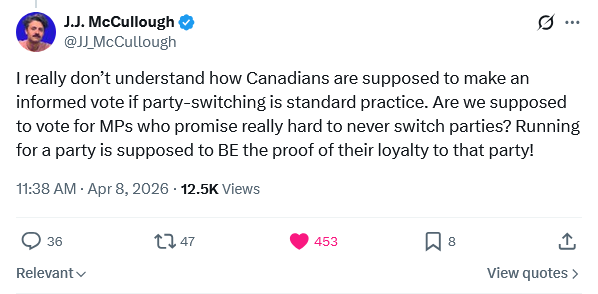
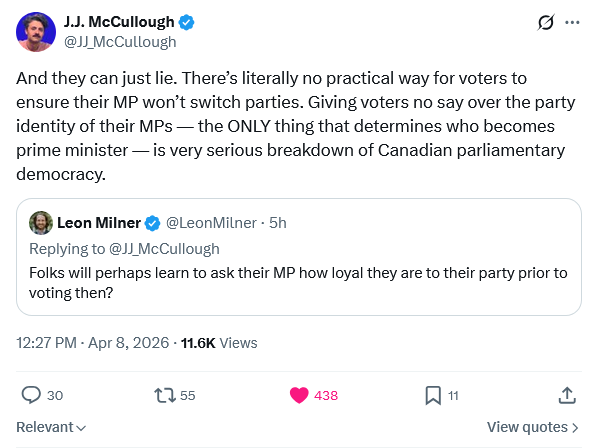
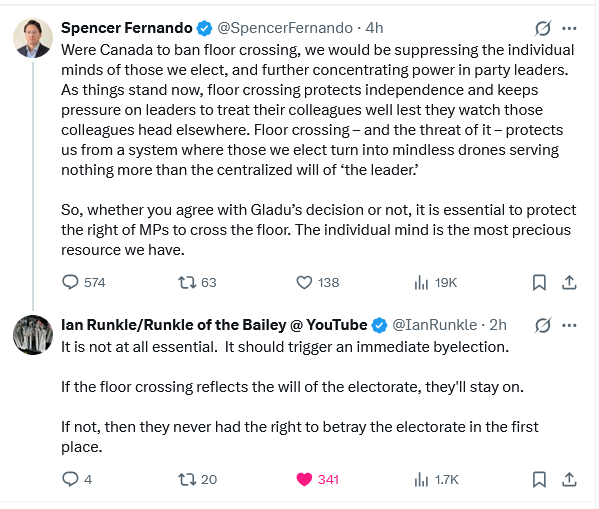
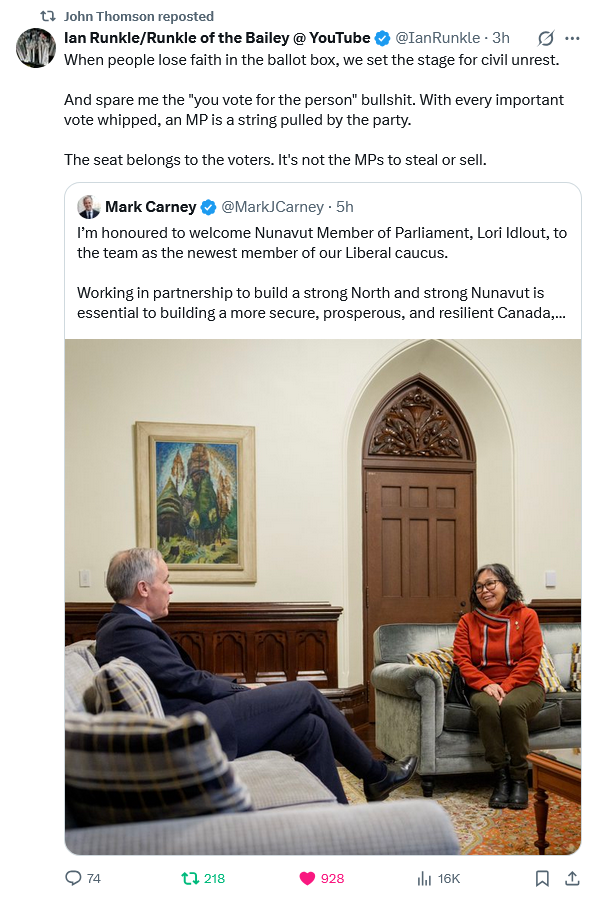
It’s not an everyday thing, but I saw someone mention on social media that there had been over 300 floor-crossings since Confederation. The latest Member of Parliament to switch parties … to literally walk across the floor in Parliament to join Carney’s Liberal party is Nova Scotia’s Chris d’Entremont:

The speculation in Ottawa about floor crossers is getting silly, some of the names being pushed don’t make any sense. Which makes me think that this is really an attempt by the Liberals to try and destabilize the Conservatives.

Sorry, that would be “destablise” in Mark Carney’s new English but more on that shortly.

We have seen Liberals push name after name including Chris d’Entremont who did cross, but others who have said they have no interest in crossing. That was the case for Dominique Vien the Conservative MP from Quebec’s south shore who had to post a video after jerks like me published her name following weeks of speculation.

If you don’t speak French, let me summarize, or sumarise in Carney English. She says that she’s heard the rumours that she would be leaving the Conservative caucus to sit as a Liberal or an independent, but that’s not true. She states clearly that she is and will remain a Conservative and that she doesn’t like Mark Carney’s budget.

Meanwhile, Joël Godin, the MP for Portneuf—Jacques-Cartier a riding northwest of Quebec City, who has been named as a possible floor crosser declined to answer questions entering caucus on Wednesday. Does that mean he’s ready to cross or not just putting up with the BS?

Conservative insiders tell me that he won’t be changing teams anytime soon.

The rumour mill is insane, with Liberals pushing the idea that all kinds of Conservatives are looking to jump ship. I’ve had several Liberals tell me that Michael Chong has been looking to cross the floor, an idea that is so ridiculous that I didn’t even call Chong to ask him because anyone floating that doesn’t know the man or conservative politics.

After I mentioned that on 580 CFRA in Ottawa, Chong called me to assure me that he wasn’t crossing to the Liberals. Michael, I never doubted you.

It’s doubtful that other names Liberals are pushing will come to fruition.

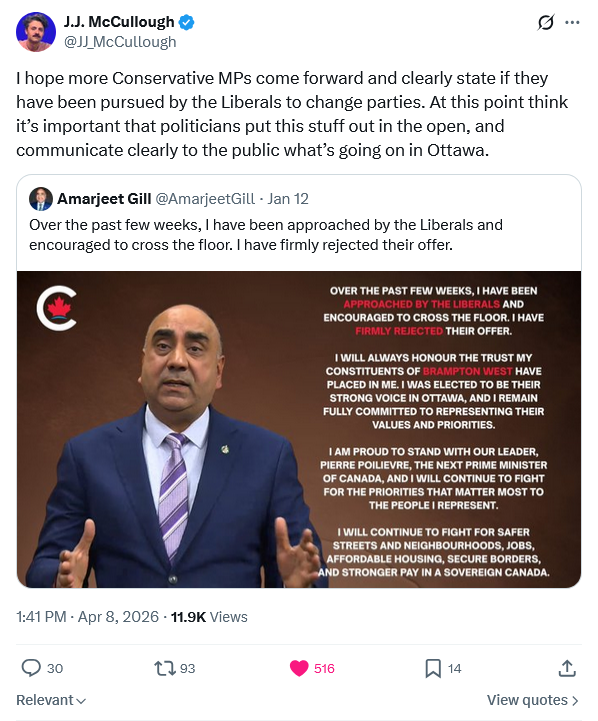
What is clear is that Carney and the Liberals are reaching out to Conservative MPs and making them offers to switch parties. Are they making illegal offers? I’d really like to know what has been put forward.

Is a “comfy landing” being offered for those that will cross? It wouldn’t be the first time that kind of thing has been offered.

As to the particular motivations for d’Entremont decamping to the Liberal benches, discussions on the social media site formerly known as Twitter indicate that he just barely got elected this time around, that he’d been fired by Pierre Poilievre as Deputy Speaker, and he decided he had a better chance of getting back into Parliament as a Liberal in the next election. Quinn Patrick reports that the Liberals had been trying to get d’Entremont to join them for quite some time:

Industry Minister Mélanie Joly said the Liberals had been courting former Conservative MP Chris d’Entremont behind the scenes for five years before he ultimately crossed the aisle.

“We’ve been trying to recruit him for a long time,” Joly told reporters in French on Parliament Hill on Wednesday. “Finally, he saw the light.”

D’Entremont had served as a Conservative MP for six years, after first being elected in the 2019 election.

As several people pointed out, that conveniently meant he’s qualified for the platinum-plated MP pension plan … but I’m sure that’s not why he switched parties.

Liberal MP Kody Blois, who also represents a riding in Nova Scotia, confirmed that he and d’Entremont had been speaking “for a long time about the ways in which we can collaborate.”

“It’s great to see Mr. d’Entremont join. If there’s other members of Parliament feeling the same way, again, I think we’re always welcome to those conversations,” said Blois.

While Blois didn’t explicitly say he had been attempting to enlist d’Entremont, he said the Liberals are a big-tent party with room to accept more “moderate” conservatives.

When asked if the Carney government was actively trying to recruit more MPs, Blois said that “wouldn’t be a conversation I’m going to have right here in front of the media.”

The former Conservative MP met with Prime Minister Mark Carney at a post-budget media conference on Wednesday, saying he didn’t believe his values as a “red Tory” were being “represented.”

“I didn’t find I was represented there … my ideals of an easterner, of a red Tory and quite honestly of trying to find ways to find solutions and help the community rather than trying to oppose everything that’s happening,” said d’Entremont.

He also alluded to the possibility of other Conservative MPs “in the same boat” but stopped short of naming anyone specific, saying he would let them share their stories “if the time comes.”

However, he has been the only one to cross the aisle thus far.

Conservatives and their supporters have accused d’Entremont of betraying his constituents and his values in pursuit of his own ambitions.

October 27, 2025

When announcing something is a substitute for doing something

Filed under: Cancon, Media, Politics — Tags: , , , , — Nicholas @ 03:00

The headline seems to be the most accurate way to describe the habits of the federal Liberals from the start of Justin Trudeau’s first government to Mark Carney’s most recent national media appearance. Peter Menzies describes the bought-and-paid-for national media’s coverage of the big non-event:

It has never been easier, thanks to the internet, for journalists to check if they are being played for fools. But due either to sloth, neglect, habit or servility — pick one — way too many lack the motivation to use a search engine.

Instead, they frequently accept the role of featherheads manipulated by politicians staging one of the oldest scams in the Machiavellian playbook, the recycled “news” announcement. I say “featherheads” (patsies was another option) because, for instance, Prime Minister Mark Carney can book news network time for a full half hour speech that is nothing more than a rehash of everything he’s been saying for the past 10 months and still lead newscasts and make the front pages.

Here, I must pause to credit the Toronto Star. It, like other news organizations, received an embargoed copy of Wednesday’s speech in advance. It read it, saw that it contained no news and did not put a report on its front page. Others such as National Post and the Globe and Mail tried desperately to find a fresh angle within the speech but put it on their front pages anyway. CBC threw everything it had into it and CTV also led with it and tried its best to make it sound like news had happened.

Now, I am a reasonable and fair-minded person, so I would not be reacting were it just this incident that captured my attention. The PM is speaking, everyone gets excited, you review and lock in your story lineup and, ya, I get it. Been there, done that. But this was part of a troubling pattern that has emerged.

For instance, the government’s “plan” to hire 1,000 more Canadian Border Services guards was first announced in the Liberal election platform last spring. It was then, according to Blacklock’s Reporter, re-announced “April 10, April 28, June 3 and August 12”.

That Blacklock’s report was published Oct. 14 and focused on Public Safety Minister Gary Anandasangaree’s insistence he was “not responsible” for the promised hiring that hadn’t happened yet. Two days later, Carney announced that the previously announced and re-announced plan would be announced again in the Nov. 4 budget. And the day after that — Oct. 17 — Anandasangaree announced his ministry would be doing what he said a few days previously wasn’t his responsibility and hiring 1,000 new border guards — over the next five years. A similar pattern of announcement and reannouncements took place regarding the government’s plan to hire 1,000 more RCMP officers, also not immediately but eventually. Then, last week, Finance Minister Francois-Philippe Champagne announced a financial crimes agency would be up and running by next June. This, too, was reported as a new initiative even though the government first committed to that agency in 2021.

While not all news organizations rise to the bait, this widely carried Canadian Press story is an example of how easily the public can be misinformed by reporting that lacks proper context. Re-announcements are presented as “news” despite there being no news other than “politicians repeat what they said before to keep their names in the news”. Media that go along with this pattern of manipulation allow themselves to be accused of defining news as anything the government wishes to present as news, something about which — now that media are subsidized by politicians — they should be more cautious.

The nation needs journalists to tell the whole story or, as Robert Maynard, founder of the Maynard Institute for Journalism Education, put it:

    The first thing about journalism is about accuracy and fairness, but that’s not enough. It has to be about context, it has to be about depth.

October 25, 2025

Foreign interference? In our elections? Say it ain’t so …

Filed under: Cancon, China, Government, India, Media, Politics — Tags: , , , — Nicholas @ 04:00

Oh, but it is, fellow Canadians, and it’s going to continue because our government can’t or won’t lift a finger to stop it:

The cover of the NSICOP special report on foreign interference (PDF – https://nsicop-cpsnr.ca/reports/rp-2024-06-03/special-report-foreign-interference.pdf )

[Vancouver-East MP Jenny Kwan]’s recent comments, which correctly noted the incredible hardship that Canadians targeted by foreign regimes endure, typically with no help from an apathetic Canadian government, are important and deserve amplification — we must all hammer home just how vicious a foreign influence campaign can be for those on the receiving end, and how little help they can normally expect from Canadian officials.

But mystifying? I wish.

A recap of the timeline is useful: The Liberals were “actively considering” such a registry as early as 2021. Late the next year, the magnificent Marco Mendicino, living embodiment of Trudeau-era ministerial excellence, was talking about launching a consultation, to see if it was an idea worth pursuing. A few months later, Justin Trudeau himself said that Mendicino would be “moving forward” to study “various proposals” in the coming weeks.

And then, well. You know. Nothing happened. In short order the government had the foreign interference scandal blow up in its face. A public inquiry was eventually called, after a long, drawn out process of increasingly pathetic attempts to dodge the issue. The initial report by Justice Hogue was released in May of 2024, and that month, the House unanimously passed Bill C-70, the Countering Foreign Interference Act. This gave the government the legal tools to establish the registry, a process they said would take about a year. That year ran out five months ago, and at that point … the office wasn’t even operating yet, even just in preparation for eventually going live. The Carney government then said they’d appoint a commissioner by September of this year. This would mark the beginning of the registry’s work.

It’s now late October, with nary a new-fangled commissioner to be found.

The Hill Times article places Kwan’s comments, and the government’s overall lackadaisical effort on this front, in the specific context of the Carney government’s efforts to offset our lopsided reliance on trade with the United States by improving relations with China and India. These are not countries with which we have lately been swapping friendship bracelets, and a foreign influence registry would largely — not exclusively, but largely — be intended to address their interference. “I am constantly worried about [foreign interference], but that doesn’t mean I’m not also worried about affordability issues for Canadians; I can do both,” Kwan is quoted as telling The Hill Times. “The Carney government needs to be able to walk and chew gum at the same time; they need to address both with the level of seriousness and attention they require.”

Later in the article, Dan Stanton, a former senior CSIS official and current national security expert at the University of Ottawa, adds that the Carney government has likely postponed any further announcements on the registry to avoid complicating ongoing talks with the Asian giants.

Well, yeah. That’s pretty clearly an issue. Kwan and Stanton have the government about dead to rights on that one. You can see the proof of that everywhere — Foreign Affairs Minister Anita Anand’s recent trip to India and China, after which she called China a “strategic partner”, is a pretty clear signal. The latest blowup in U.S.-Canada relations, with Trump cancelling all trade negotiations with Canada because (or so he claims) Ontario ran anti-tariff ads on U.S. TV, will only increase the desire in Ottawa to realign our economy toward literally anyone else but the Americans.

October 23, 2025

The Liberal-funded legacy media all chorus that the Conservatives are collapsing

Filed under: Cancon, Media, Politics — Tags: , , , , — Nicholas @ 03:00

On his Substack, Brian Lilley contrasts what the legacy media are all pushing with the actual conversation among Conservatives:

Pierre and Ana Poilievre at a Conservative leadership rally, 21 April, 2022.
Photo by Wikipageedittor099 via Wikimedia Commons.

Pierre Poilievre stood before his caucus Wednesday morning and was contrite. The Conservative leader has caused himself and his party headaches since his comments about Justin Trudeau and the RCMP on the Northern Perspective podcast last week.

Will it be enough?

Time will tell but his Conservative MPs who are upset will have forgiven him long before the media will. The stories about Conservative MPs or supporters being upset have not abated and hours before Poilievre did his mea culpa, Radio-Canada, the French wing of CBC had a story with MPs sniping at Poilievre.

Of course, none of them were on the record.

Later in the day, the rumour mill started that at least one Conservative MP, most likely a Quebec MP, would cross the floor by the end of the day. I’ll tell you from experience that when rumours start on Parliament Hill, they can take on a life of their own.

Will someone cross the floor?

Perhaps, and I’ve been given names of the potential floor crossers by Liberals, but none of them have done it so far.

We wait.

It’s all part of crafting a larger narrative…

If you only consumed legacy media, you might think the Conservative Party was falling apart, that the Conservatives were falling in the polls and that fundraising had dried up. None of that is true no matter how often they tell you it is while the facts tell a different story.

Were Poilievre’s comments helpful with swing voters? Absolutely not, and while he’s not focussed on them yet, he will need to be one day so he needs to be more careful.

As I’ve stated though, Poilievre was right on the RCMP dropping the ball on SNC-Lavalin and someone should have been charged with obstruction of justice in that case.

But none of this means the Conservatives are falling apart at the seams.

Will you get people grumbling, absolutely. Will some of them turn to the media as anonymous sources, considering many turned to me months ago, sure, it’s going to happen.

I also have my own anonymous sources telling me there is no one in caucus organizing against Poilievre. Speaking to veterans of the Scheer and O’Toole palace coups, they say this is a very different feel.

People are tired, they are tired of losing, but they aren’t looking to replace Poilievre. That’s not just because there is no one waiting in the wings, they genuinely want to give him a second chance.

Given the latest Abacus poll, I’d say he’s doing okay. That poll would show a minority government if an election were held today, one that could go Liberal or Conservative.

October 10, 2025

A POSWID analysis of the contention that “Canada is broken”

It’s my strong opinion that Canada is indeed “broken”, and much but not all the blame for that goes to former Prime Minister Justin Trudeau and increasingly to current PM Mark Carney. It hasn’t all been the direct action or deliberate inaction of the Liberal party and their bureaucratic minions in the civil service, but their fingerprints are on a lot of the damage. Eberhard Englebrecht analyzes Canada using POSWID framing and concludes that “the Purpose Of Canada is What It Does”:

Now, one of the core criticisms made of POSWID by its opponents is that it leans heavily on a consequentialist interpretation of events, completely discarding the roles human intention, error, and agency play in how things transpire.

However, these critiques only hold validity if you take POSWID and make it your singular mode of analysis — something that I don’t encourage, nor intend on doing myself. Rather, POSWID should be understood and used as a specific tool with a specific purpose — that is, to peel back the noxious platitudes, gaslighting, and wishful thinking that envelop our politics, and hinder our ability to view our present situation with clarity and honesty.

And, unfortunately for the citizenry of Canada, Canadian politics is — and has been for some time — a domain chock full of the misguided idealism and obfuscation that POSWID seeks to erase.

It is why many Canadians — despite their country having experienced a precipitous decline in both general prosperity and the integrity of the common social fabric — remain willfully blind to such an absurd degree.

POSWID, as I will be applying it, can tackle many of the polite pleasantries and mindless incantations that have become embedded in Canada’s “consensus” of acceptable political discourse, exposing them as misaligned with reality. This will take one of two forms: the first is to demonstrate that a common belief in the trope in question has led to results contrary to the intentions of those who originally pushed the trope; the second is that the trope was always purely abstract and aspirational, never described reality, and any attempts to align reality with said trope have failed miserably.

Many of these tropes are sacred cows of Canada’s political establishment — ideas that they would insist define “what it means to be Canadian” or are things that “we all believe”. Going against them, or merely questioning their validity or suitability, would be considered “UnCanadian”. These tropes have, in many cases, dictated the direction of Canadian society since the 1960s and created the foundations for the paradigms that currently define Canadian politics. Therefore, the deconstruction of these tropes constitutes the deconstruction of these paradigms — something that would have cascading ramifications for our country.

It is worth noting, however, that my intention in writing this piece is not to make granular policy prescriptions. My job is merely to provide a clear-eyed account of how three of the values and policy programmes of Canada’s chattering class (you could substitute “chattering class” with “professional-managerial class” or “Laurentian Elite”) are out of step with how this country actually exists — a reality felt and experienced at an intuitive level by many, but rarely articulated in public.

September 26, 2025

A ministry for “Heritage” should not be funding hate publications

Filed under: Cancon, Government, Media, Politics — Tags: , , , , — Nicholas @ 04:00

I’m with Dan Knight that the government shouldn’t be funding any private networks, magazines, or newspapers, but since it does provide a lot of funds through various programs, it should at the very least strive to avoid funding open hatred toward ordinary Canadians:

Steven Guilbeault at a happier stage of his life, before joining the Liberal cabinet.

In a fiery exchange at the Standing Committee on Canadian Heritage (CHPC), Conservative MP Rachel Thomas dismantled Liberal Minister Hon. Steven Guilbeault, P.C., M.P., Minister of Canadian Identity and Culture and Minister responsible for Official Languages, over taxpayer money funneled into groups publishing hate-laced screeds and smearing everyday Canadians.

Thomas zeroed in on Cult MTL, a publication receiving federal heritage funds. She read into the record a headline published the very day after reports of Charlie Kirk’s assassination attempt: “To Hell with Charlie Kirk”.

“Minister, do you think that is wrong? Taxpayer dollars are funding this group. Will you revoke their funding?” Thomas demanded.

Guilbeault looked blindsided. He admitted he had no idea the government was bankrolling a tabloid openly celebrating political violence. His answer:

    I have not been made aware of this. I will verify with the department and report back to you. Obviously, spreading hate has no place in Canada, and if this is the case, we will make the necessary verifications and take the necessary steps.

Thomas didn’t stop there. She turned to the Canadian Anti-Hate Network, which she said has already pocketed about $1 million from Guilbeault’s department. Documents show the group paid an “investigative journalist” to hunt down so-called “far-right” targets — defining the term so broadly it included Catholics and pro-life Canadians — before seeding the stories into mainstream news outlets.

[…]

Conservative MP Rachel Thomas quoted former CBC anchor Travis Dhanraj, who launched a human rights complaint this summer […]

    To be honest, this has been the hardest period of my life. What happened at CBC really broke me.

Then she put it directly to Guilbeault:

    Have you reached out to the CEO of the CBC regarding this situation and the toxic work environment that is being accused there?

Guilbeault’s answer? Bureaucratic shrugging:

    The government role is not to get mixed into the daily operations and management of the organization. That is the purview of the organization, in this case, the public broadcaster.

Translation: $1.4 billion of your money flows into CBC every year, but the minister says he can’t pick up the phone when staff say they’re being harassed.

September 24, 2025

It won’t work – the minister responsible knows it, but they’re going ahead with it anyway

The “it” in the headline is the federal government’s gun confiscation program, which they claim will reduce crime but they already know it won’t do any such thing. What it will do is take away from literally the most law-abiding, responsible citizens their legally purchased property and leave illegal guns in the hands of criminals … at an ever-increasing estimated cost to the taxpayer. In The Line, Matt Gurney covers the details:

The federal gun confiscation program […] is illogical. It won’t save lives or make the public safer. The federal government doesn’t really even expect it to work, and is only going ahead with it because they’ve been stuck with a dumb proposal the Trudeau government made almost five years ago. If they could do it all over again, they wouldn’t, but they feel like they’ve blocked themselves in and have no choice but to proceed so that they don’t anger part of their electoral coalition, mainly voters in Quebec.

That might sound like a blistering criticism of the program, the kind of thing you’ve read in any number of my columns before. It’s actually what the public safety minister thinks about it. He just didn’t know he was being tape recorded when he said so. In a 20-minute conversation Gary Anandasangaree had with a firearms owner he rents a home to, which was recorded and then leaked, the minister says all of the above things. (He has also confirmed the recording is legitimate.)

Awkward for the minister, clearly, but I actually give him credit. The minister’s comments on tape are a confession, and an admission of defeat. They’re also, hands down, the most honest thing a Liberal government official has said on the gun control file in five years. Given that the minister responsible is freely telling people the program is a bad idea he’s stuck with and that won’t work, a sensible government would probably take this opportunity to walk away from the program.

Unfortunately, that’s not what this PM has chosen. It’s full speed ahead with an idea so bad Anandasangaree wishes he’d never been saddled with it.

Let’s talk about what this program is for a second. And forgive me, there’s quite a bit of history here. During Justin Trudeau’s first term, his only majority, his government had proposed a series of fairly moderate changes to the gun control laws they had inherited from Stephen Harper. As I’ve written often since, the proposals were a mixed bag. Some were okay. Some were bad. But they more or less left the well-functioning Canadian gun control system intact. They nibbled around the edges enough so that they could tell their voters that they had gotten tougher. But they generally didn’t try to fix what wasn’t broken.

But then politics got in the way, as it always does. Trudeau lost his majority in 2019 and became ever-more dependent on voter efficiency and wedge issues. And then in 2020, there was a horrible massacre in Nova Scotia. That catastrophe had nothing to do with our gun control laws; the weapons used were brought in illegally from the United States, as is typical of guns used in gun crime. But the Trudeau government seized on the opportunity — never waste a crisis, right? — to announce that they were “banning” “assault rifles”.

A lot of quotes above. So let me explain. First of all, there really wasn’t much of a ban. Anyone who owned one of the newly banned rifles was allowed to keep them. And as for assault rifles, actual assault rifles — rifle-calibre weapons that use high-capacity detachable magazines and can fire in fully automatic mode — have been banned in Canada for decades. This isn’t a problem that we actually had. And the government tacitly admitted as much when they began fudging the words they used to describe them. In acknowledgement that there were no actual assault weapons to ban, they started talking about assault-style weapons.

“Style” is a tell. You wouldn’t take medicine-style pills, or munch on a food-style snack. Because you’d know better. Trudeau et al knew better. It didn’t stop them. They needed something to announce, and by God, they were going to announce it!

And as we’ve noted several times, the Trudeau government got addicted to the media high of making big showy announcements. So they started doing repeat announcements over a period of time, and thanks to the spinelessness of Canadian legacy media even before Trudeau started directly subsidizing them, the media sugar high got repeated as well. It didn’t take long for the lesson to be learned that making an announcement was cheaper than doing the thing that was announced, and we quickly transitioned to a world where it was the announcement that mattered, not the thing.

At Junk Economics, Bryan Moir sums up the stupidity:

You want blunt? Fine. Here it is:

Listen: politics is kabuki theater and promises are props. Here we have a government rolling out a nationwide confiscation-style buyback and calling it “voluntary” — which is like calling income tax “optional” if you want to be arrested. The minister tells citizens, in public, “it’s voluntary”, then admits in private he’ll criminalize non-compliance, will “bail you out” if it goes that far, and says the whole exercise exists because the party must keep the promise and because the Quebec caucus wants to show muscle. That’s not statesmanship. That’s PR with a warrant.

They lecture you about being “tough on guns” while refusing to be tough on the people who actually bring violence into our streets. The minister himself says if he could do it over he’d target illegal guns and put criminals in jail — not law-abiding owners. Translation: the policy is ideologically driven and politically performative, not strategically intelligent. You don’t cure gang violence — which the cops tell you comes from illegal trafficking and cross-border smuggling — by borrowing billions to buy back legally purchased rifles. That’s like throwing sandbags into a burning house and patting yourself on the back for “doing something”.

And then there’s the logistics and the cost — the ugly part they don’t want on camera. The federal pot is capped at about $742 million and the program is rolled out in fits and starts. Major police forces are already saying “no thanks”, which means the feds must either stand down, contract a patchwork of municipal services, or try to outsource enforcement. Any of those choices blows up the promise in different ways: it becomes toothless, it becomes wildly more expensive, or it becomes a federal-provincial fight that will make the Notwithstanding clause dust-ups look like backyard squabbles. Pick your disaster.

Remember the math: a capped pool of cash plus a growing list of banned models (hundreds, then thousands) equals many owners getting nothing while the bureaucracy eats up the rest on administration, contracts, security, staffing, and political “bribes” (a nicer word for handouts to get agencies to play ball). If the fund runs out — and the minister openly says “it’s capped; when it’s gone, it’s gone” — you’ll have a bunch of people stripped of legal property, out of pocket, and the state triumphant only in optics. That’s confiscation without fair market compensation; it reads like policy designed by accountants and sold by televangelists.

Worst of all: while Ottawa gamely auctions off the idea of virtue, or was that “Canadian values”, real problems pile up. Fire seasons rage, hospitals are full, kids wait for surgeries, food banks are overwhelmed and the cost of living keeps rising— and Mark and Gary are borrowing money to offer coupons for now-illegal guns. If you wanted a textbook case of political misallocation, this is it: symbolic policy delivered with symbolic money so the party can say it kept a promise, while the public pays the bill and crime networks keep smuggling.

On the gun confiscation program in particular, thank goodness you can always depend on social media to find the funny side of any issue:

June 27, 2025

The fading Boomer Laurentianus

Filed under: Cancon, Media, Politics — Tags: , , , , — Nicholas @ 03:00

Last week in The Critic, Charles Kirwin described the people who saddled us with three terms of Justin Trudeau and hope to continue their reign of error by supporting Mark Carney with his Europhile whims and intolerance for dissent:

Boomer Laurentianus is a Canadian subspecies of Boomerus Senectus, so named because he models himself on the so-called Laurentian Elite, Canada’s governing class that inhabit the “Laurentian corridor”, the narrow strip of land along the Saint Laurence river between Montreal and Toronto that, for a certain kind of Canadian, is the only bit of the country that matters.

In spirit, he is a child of the sixties and still believes he is a radical at heart. Despite this he expects to be treated with the deference reserved for those awarded the Victoria Cross, despite his closest experience to combat being glancing longingly at pictures of the cancelled Avro Arrow or campaigning to defend the local parking lot from being turned into affordable houses.

Like his British and American cousin, he supports progressive policies like safe supply of drugs, lenient sentences and bail conditions for criminals, and whatever economic policies keep his pension fund high and his property values increasing. Naturally, he lives in neighbourhoods untouched by the crime and addiction that are the direct result of the policies he supports.

It is important to note that while his modes of thinking and beliefs are those of the Laurentian Elite, his mind is shaped by the institutions of the Laurentian Elite: The Canada Council for the Arts, the Canadian Broadcasting Corporation, the Governor General’s Literary Award, various other high-minded organisations that form the intellectual life of Laurentian Canada, Boomerus Laurentianus is not necessarily “of” them.

Molson Canadian is the spirit of his patriotism. In 2000, Molson released a beer advertisement in which a typical Canadian played by actor Jeff Douglas shouts into a microphone to an audience of Americans, dismissing various Canadian stereotypes (we say aboot, drive dogsleds, are all lumberjacks and fur traders et cetera) and notes some of the differences that make Canada not the US. “I have a Prime Minister not a President … I believe in Peacekeeping not policing … I can proudly sew my country’s flag on my backpack while travelling”. The advertisement is something of a cult hit in Canada and has been parodied by just about everyone including William Shatner.

This one-minute advertisement swells at the heart of the Boomer Laurentianus view of his country. It is both superficial and, in places, factually incorrect (the equivalent of the US president is not the Prime Minister but the King or Queen of Canada). But he has built his entire sense of nationalism around myths such as peacekeeping or being liked by foreigners more than Americans. This last point is sacred to his sense of identity.

Boomerus Laurentianus exists in a superposition state usually reserved for Schrödinger’s cat wherein he is both completely American and not American at all. It was often claimed of Rhodesians that they were “More British than the British”. Boomer Laurentianus is more Yank than the Yanks. Despite his reverence for the CBC, he gets his recipes from the New York Times and his opinions from CNN. He watches American television, travels to the US frequently, may even own a second home there. He can almost convince himself that they are the same country, sometimes to the point of putting up signs supporting, Democratic political candidates, seemingly unaware that he cannot vote in foreign elections.

June 6, 2025

Marc Garneau, the first Canadian in space, RIP

Filed under: Cancon, Media, Military, Politics, Space — Tags: , , , — Nicholas @ 05:00

The career of Marc Garneau is summarized by Tom Spears for The Line:

Astronaut Marc Garneau, with a camera in hand, floats in the hatchway that leads from Unity to Pressurized Mating Adapter-3 (PMA-3), which leads to Endeavour. Garneau, STS-97 mission specialist representing the Canadian Space Agency (CSA), and his four crew mates went into the International Space Station (ISS) following hatch opening. The photograph was taken with a digital still camera, 8 December 2000.
NASA photo via Wikimedia Commons.

Marc Garneau died Wednesday, at the age of 76. His passing was announced by his wife, Pam, who said that he’d been surrounded by family at the end, and had received excellent care during an unspecified short illness. (Other reports have cited cancer as the ailment.) The news was met with an immediate outpouring of grief from Canadians from across the political spectrum, as befitted a man of his profile and stature.

He had earned that profile gradually over the decades. Back in 1983 Garneau was a young naval officer with a fine pedigree — graduate of Royal Military College, PhD in electrical engineering from Imperial College London — but unknown to most Canadians. Then he joined our country’s first group of astronauts, becoming an instant celebrity.

Even more sudden was his first assignment. He was named to a space shuttle crew that would fly the following year — lightning-fast career advancement, considering he had not yet undergone the usual training as a mission specialist in NASA’s astronaut school.

That vaulted him ahead of many more senior astronauts, and he felt it keenly. He told the Ottawa Citizen years later that he felt his colleagues’ eyes “boring holes in my back” as he walked by them. Crewmate Dave Leestma later recalled how the rookie gained the respect of those around him through quiet competence.

Indeed, Garneau always looked calm, but his mother, Jean, said as he prepared for a second flight in 1996: “There’s a lot of controlled excitement there, and happiness … He figures he’s very, very lucky.”

[…]

“Everybody was always brutally honest about how they screwed up … about how we let the team down,” Garneau says. “If we’re not going to be very honest with each other, if we’re going to find excuses … Nobody tries to evade responsibility.”

Given his background and experience, I wonder how he was able to handle being a member of the Liberal government of the day, where evading responsibility was perhaps their top competency.

June 4, 2025

Arch-statist Mark Carney believes that Canadians “must earn their freedom everyday”

Filed under: Cancon, Government, Media, Politics — Tags: , , , , — Nicholas @ 03:00

At The Intrepid Viking, Roxanne Halverson examines what Prime Minister Mark Carney means when he tosses off comments like “Freedom is something you earn everyday”:

CBC’s David Cochrane interviewing Prime Minister Mark Carney in Ottawa.

It is surprising and disconcerting that so few pundits, commentators or even members of the Conservative Party, and for that matter are, not taking issue with a recent statement from our new Prime Minister in which he asserted, when talking about Canadians, that, “Freedom is something you earn everyday“.

Has anyone asked Mark Carney, this globalist World Economic Forum (WEF) acolyte, who is now Canada’s Prime Minister, what he meant when he made that statement? He made it during an interview with David Cochrane on CBC’s Power and Politics following on King Charles delivering the throne speech. He made the statement while talking about the great “crisis” Canada is and how his government has to get moving on major projects and our economy and solving the housing calamity. Of course he forget to mention that these problems are due to the policies of the previous Liberal government, for whom he was the financial advisor. He also does not explain that why, in the middle of such a crisis, his government has decided to take the summer off and not release of budget of any type, any time soon, but that’s another story.

Now, back to his claim that Canadians “must earn their freedom everyday”. Of course, Cochrane, being one of Carney’s main fanboys at CBC, didn’t probe any deeper to ask him what he meant by that statement. But it is a strange statement coming from the Prime Minister of a country where its constitution essentially says that individual freedom is a God given right. And given that Carney, with his recent visit to Rome to see the new pope, has made it clear that he is a devout practising Catholic, his belief in the Almighty is obviously not an issue. So again, what did he mean by that remark? Strange again, because just six weeks ago, before he was the Prime Minister, Carney posted the following statement on X.

    The Charter of Rights and Freedoms is the embodiment of our principles and our aspirations as Canadians. It must be protected — not wielded for political gain. Forty-three years on, the Charter remains strong — and it’s on all of us to defend it.

This apparently was in response to Conservative Leader Pierre Poilievre’s assertion that he would use the notwithstanding clause to override a judicial ruling against imposing consecutive life sentences on murderers, rather than concurrent sentences.

So given that, it would seem that Mr. Carney believes our rights regarding freedom are enshrined in the Charter. Carney, in his interview with Cochrane also maintained that Canada was still “the true north strong and free”. So then which is it when it comes to freedom from his perspective? Is it enshrined in the Charter, are we the true north “strong and free”, or must freedom be earned, and in what way?

« Newer PostsOlder Posts »

Powered by WordPress