
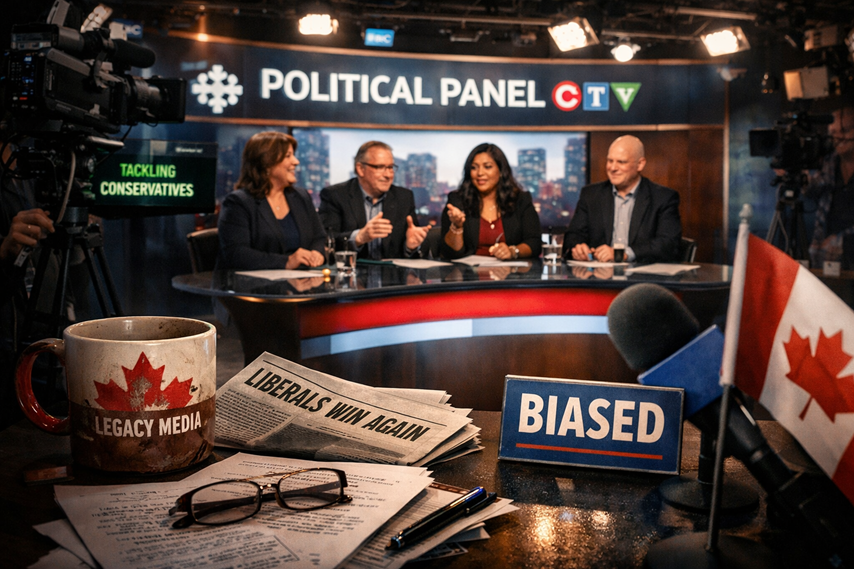
The federal government isn’t noted for being good with money. Yes, I know, understatement of the century … But they did make one investment that has been fantastically beneficial. For the Liberal Party, if not for Canadians in general. That investment was buying the support of almost all of the surviving mainstream media outlets by directly subsidizing their payrolls. Most media folks lean left anyway, but once their paycheque literally depended on keeping the Liberals happy, they joyfully co-operated in ways that 1930s German newspapers would blush at. On her Substack, Melanie In Saskatchewan explains just how far away from representative the media political spectrum has drifted (leftwards, of course, always leftwards):
If you were to draw a Venn diagram of the real Canadian political landscape and the pundit ecosystem on legacy networks, you’d find they barely overlap.
Rosemary Barton is the undisputed matriarch of the CBC’s political brand. As host of At Issue and Rosemary Barton Live, she shapes the entire panel tone for CBC political discourse and anchors the network’s election coverage. She has been at the helm of federal election panels since 2016, interviewing party leaders and moderating debates from coast to coast.
Canada’s mainstream media as Liberal Party propagandists.
Image from Melanie In SaskatchewanNow ask yourself this: if half the population consistently feels unheard by these panels, is that a coincidence, or the predictable result of decades of the same ideological herd wandering through the same studios?
Here is the rub. The At Issue panel rarely rotates through voices that actually represent today’s conservative electorate. Instead, it routinely features professional journalists and political insiders who debate among themselves, talking about conservatives far more often than they engage with conservatives whose voters make up a massive share of the country. That is not centrism. It is an echo chamber assembled by committee.
Then there is Andrew Coyne. He is often presented as the token ideological counterweight on At Issue, the panel’s supposed nod to conservatism. After all, he has spent decades as a columnist and editorial thinker, comfortably critiquing governments from a well upholstered perch.
But let us be clear. Coyne is not remotely representative of today’s conservative electorate. He is not a reflection of the current Conservative Party base. He is not channeling the instincts of voters outside the Ottawa and Toronto corridor.
Positioning him as the conservative voice on a national panel is not balance. It is branding. It allows producers to claim ideological diversity without ever inviting someone who actually carries the convictions, tone, or priorities of the modern conservative movement. Coyne is not a grassroots conservative. He is a professional pundit whose worldview fits tidily within the Ottawa insider class. That is not ideological contrast. It is controlled opposition dressed up as pluralism.
Meanwhile, audiences have been increasingly vocal online about the sense that these panels sound like academic seminars, not reflections of the lived experience of Canadians who didn’t spend their twenties in Ottawa press galleries.



I’m old enough to remember the 90s, when Sinclair Stevens, the reddest tory of them all, was on CBC Radio every morning.
Peter Gzowski featured him as a ‘conservative voice’ on his show. Some conservative. More like a Liberal in slow motion.
Meanwhile Reform and later Canadian Alliance, were completely shut out, and true conservatives were ignored.
Comment by Chris — February 24, 2026 @ 16:23
Quite true. Within living memory, even the CBC would provide something vaguely like balance in their political reporting, although their preference has always been left-of-centre. Even before the rise of Trudeau the Lesser, Canadian mainstream media was leaning ever further left, and now that they’re being directly funded by the government, they’re utterly convinced that they’re on the right side (uh, the “correct” side, I guess) of history.
Comment by Nicholas — February 24, 2026 @ 16:32