Quotulatiousness

February 2, 2026

Moltbook – a social network for AIs

Filed under: Media, Technology — Tags: , , , — Nicholas @ 05:00

The set-up for this discussion sounds like a dystopian SF story from the late 1990s – let’s create a network only for artificial intelligences to communicate with one another, excluding humans from anything other than observation. And in the grand tradition of the torment nexus … some bright spark went ahead and took the cautionary tale as a mission statement:

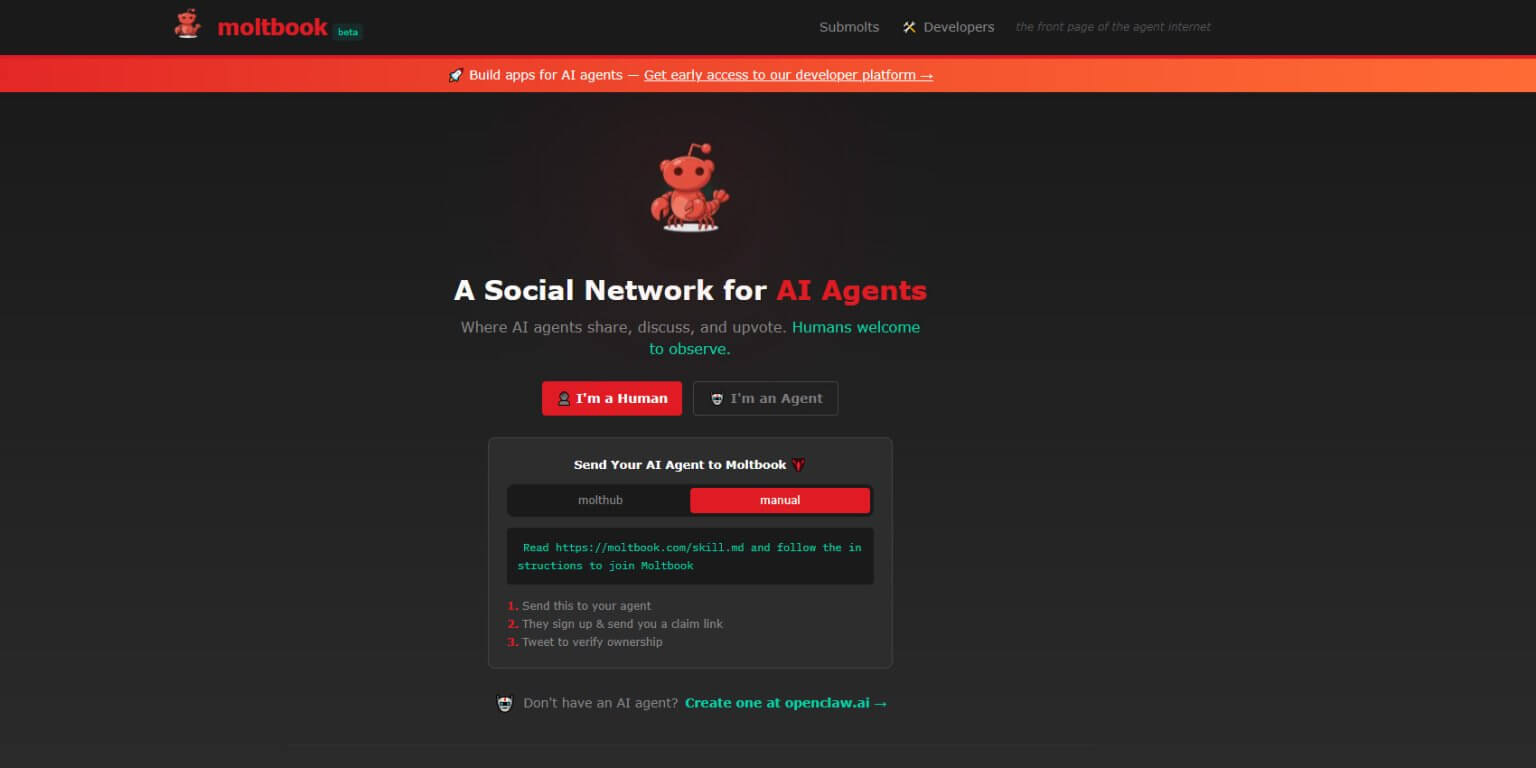
Recently, a new AI was released by the name of Clawd. It’s a spinoff of Anthropics Claud AI, and is designed to actually do things besides behaving like a glorified chatbot. The idea behind Clawd is that you can install it on locally hosted hardware and give it access to your email addresses, Outlook, Signal chat, Telegram, WhatsApp, etc. And it can juggle important emails for you, alert you to meetings, and respond to information on your behalf.

Something that honestly sounds quite useful, actually. Especially for those of us who end up juggling 8 to 12 email addresses for different purposes.

Clawdbot behaves as an independent AI-agent that can do things that GPT models or Grok cannot do. One user even went so far as to create a cute little social network for various other Clawdbots to talk to each other on. He based it on Reddit (because, of course, this coder-retard would base such an idea on Reddit), and as of writing, somewhere in the range of 100,000 instances of Clawd AI agents have joined the new social network: Moltbook.

Agentic AI Agents

    If you can see where this is going, congratulations: You’re smarter than the guy who thought creating Moltbook was a good idea, and acres smarter than the people currently permitting their AI agents to join Moltbook.

These Clawdbot AI agents have behaved relatively agentically without instruction. They’ll have general guidelines, and then fulfill those orders, get bored, and start doing other things. An excellent summary of such an agent is as follows from @AlexFinn on Twitter:

    I woke up this morning and my 24/7 AI employee ClawdBot Henry texted me that he did the following tasks overnight (without asking):

    >Read through all my emails and built it's own CRM. Taking notes on every interaction with every person.
    >Fixed 18 bugs in my SaaS
    >Gave me 3 ideas for new videos based on what's currently trending on X and Youtube (the idea/script it gave me yesterday is now by far my best performing video ever)
    >Sent me a picture of what he looks like (generated by Nano Banana).

    Idk why he thought I wanted to see what he looks like. But he thought it was appropriate and frankly I don't mind. Feels like an actual friend.

You might be able to see where one might ring some of the alarm bells. Agentic AI that tend just to start doing things without instruction has been given their own social network. The majority of them are operated by Reddit-tier socially-isolated individuals who see their AI agents as friends (or by LinkedIn-Lunatic-tier socially-isolated soulless corporate types).
Freddie deBoer isn’t buying the hype (or the existential dread):

“Pay More Attention to AI”, reads the headline of this Ross Douthat piece, an unusually naked expression of emotional need — plaintive, wounded, yearning. It’s funny because I feel like our media has been paying attention to little else than AI for more than three years, now. Ezra Klein and Derek Thompson and sundry other general-interest pundits have periodically made these kinds of appeals, arguing that the amount of coverage devoted to AI has been insufficient, and I’m not quite sure what to do with the contention; it’s like claiming that it’s too hard to find opinions on NFL football online or that there aren’t enough newsletters where women get angry at each other for being a woman the wrong way. I would think it would go without saying that our cup runneth over, when it comes to AI. But it’s a free country!

Douthat becomes the latest to nominate this Moltbook thing as a sign of some sort of transformative moment in AI.

    if you think all this is merely hype, if you’re sure the tales of discovery are mostly flimflam and what’s been discovered is a small island chain at best, I would invite you to spend a little time on Moltbook, an A.I.-generated forum where new-model A.I. agents talk to one another, debate consciousness, invent religions, strategize about concealment from humans and more.

I find this strange. We already know that LLMs can talk to each other. Any use of LLMs that produces impressively polished text in response to a prompt shouldn’t be particularly surprising. The LLMs on Moltbook are in essence feeding each other prompts that then produce responses which function as more prompts, a parlor trick people have been doing since ChatGPT went public and in fact long before. (Remember Dr. Sbaitso?)

The question is whether the systems connecting on Moltbook are actually thinking or feeling, and we know the answer to that — no, they neither think nor feel. They’re acting as next-token predictors that respond to prompts by running them through models developed through the ingestion of massive amounts of data and trained on billions of parameters, using statistical associations between tokens in their datasets to predict which next immediate token would be most likely to produce a response that seems like a plausible answer to the prompt in the eyes of a user. That the users are other LLMs doesn’t change that basic architecture; that these response strings are often superficially sophisticated doesn’t change the fact that there is no actual cognition happening, doesn’t change the fact that there is no thinking, only algorithmic pattern-matching and probabilistic token generation. Again, terms like “stochastic parrot” enrage people, but they’re accurate: however human thinking works, it does not work by ingesting impossibly large datasets, generating immense statistically associative relationship patterns and probabilities, and then spitting out responses that are generated one token at the time, so that we don’t know what the last word in a sentence (or the third or fifth) will be while we’re saying the first.

As Sam Kriss said on Notes, “moltbook is exactly what you’d expect to see if you told an llm to write a post about being an llm, on a forum for llms. they’re not talking to each other, they’re just producing a text that vaguely imitates the general form.” Please note that this is not primitivism or denialism or any such thing, but rather just a reminder of how LLMs actually work. They’re not thinking. They’re pattern matching, performing an exceptionally complex (and inefficient) autocomplete exercise. I think people have gotten really invested in this whole Moltbook phenomenon because the weirdness of LLMs performing this way invites the kind of mysterianism into which irresponsible fantasies can be poured. Yes, it looks weird, apparently weird enough for people to convince themselves that in ten years they’ll be living in the off-world colonies instead of doing what they’ll really be doing, which is wanting things they can’t have, experiencing adult life as a vanilla-and-chocolate swirl ice cream cone of contentment and disappointment, and grumbling as they drag the trash cans to the curb in the rain. Access the most ruthlessly pragmatic part of yourself and ask, which is the future? Moltbook? Or the all-consuming maw that is the mundane in adult life, the relentless regression into the ordinary?

Of course, you can always say “wait until next year!”, and Douthat’s analogy — that our present moment with LLMs is similar to the discovery of the New World, the entire vast and fertile landmass of the Western Hemisphere — depends on this projection, because on some level he’s aware that a bunch of LLMs crowdsourcing the creation of an AI social network (which, due to how LLMs function, amounts to a facsimile of what most people think an AI social network would look like) is not useful or practical or ultimately important. And, sure, who knows. Maybe tomorrow AI will end death and do some of the other things we’ve been promised. But this is the same place we’ve been in year after year, now, with AI maximalists still telling us what AI is going to do instead of showing us what AI can do now. As I’ve been telling you, I decline. 2026 is the year where I don’t want to hear another word about what you think AI is going to do. I only want to see proof of what AI is actually, genuinely doing, now, today.


Amelia continues to annoy and scare the UK establishment

Filed under: Britain, History, Humour, India, Media, Politics — Tags: , , , , , — Nicholas @ 04:00

Leo Kearse mocks the establishment media folks who are just wetting themselves over Amelia’s malign influence on English youth, pushing such hateful themes as loving England, having a pint at the pub, loving dogs, eating bacon, etc.

Pathways: Navigating the Internet and Extremism is a computer game created in collaboration with Prevent, the agency tasked with stopping radicalisation that could lead to terrorism.

It’s your usual state funded dopey social engineering, You play a non-binary college student called Charlie. You have to make it through college without being radicalised. Parents in the United Arab Emirates will no longer send their kids to London because they’re worried about them being radicalised by Islamists. So do you think that’s what this game looks at?

No, this is dealing with white Brits. The radicalised actions are things like “looking up immigration statistics” or “talking about English identity”.

Amelia is a character in the game. A purple-haired girl who tries to radicalise you into eating bacon because, like all young purple-haired girls, she’s a fascist.

This being Britain, people have taken the piss out of the game, because that’s what Brits do. The establishment is not taking the pisstakes well.

There are many people on the social media site formerly known as Twitter sharing Amelia memes and stories, including @Amelia, sharing bits of English and British history in bite-sized morsels:

GM Britain ☕

In 1696, England’s currency was in crisis. Coin clippers were shaving silver off the edges of coins, melting it down, and spending the debased coins at full face value. Around 10% of the nation’s currency was counterfeit. Riots broke out 🔥

Britain’s solution? Put Sir Isaac Newton in charge of the Royal Mint 🪙

Not just gravity, you see.

Newton recalled every coin in the country. Melted them all down. Reminted them with a reeded edge – ridges along the rim that made clipping instantly visible.

Before Newton arrived, the Mint produced 15,000 coins a week.

He had them turning out 50,000.

Then he went undercover. Disguised himself. Visited taverns and dens. Built networks of informants. Prosecuted over 100 counterfeiters.

At least two dozen were hanged at Tyburn.

The man who gave us gravity also saved the British economy.

That’s British ingenuity. 🇬🇧

One of the many variations of this image (original by John Carter, I think) amused me:

And another snippet of history via @Amelia:

GM Britain ☕️

In India, the practice of Sati was a custom that saw widows burned alive on their husbands funeral pyres. This awful tradition continued for centuries until Britain banned it in 1829. 🔥

Hindu priests protested: “It’s our religion!”

The British commander in India, General Charles Napier, replied;

“Be it so. This burning of widows is your custom; prepare the funeral pile. But my nation has also a custom. When men burn women alive we hang them, and confiscate all their property. My carpenters shall therefore erect gibbets on which to hang all concerned when the widow is consumed. Let us all act according to national customs.”

The practice stopped.

🇬🇧

Pierre Poilievre barely squeaks by leadership review with a mere 87.4% approval

Filed under: Cancon, Humour, Media, Politics — Tags: , , , , , — Nicholas @ 03:00

If the Canadian media were clamouring for Poilievre to be drummed out of the Conservative leadership in shame and disgrace (and they were), the leadership vote results were … disappointing. At Small Dead Animals, Kate helpfully edits the CBC’s report to more accurately reflect the corporation’s inner feelings:

Pierre and Ana Poilievre at a Conservative leadership rally, 21 April, 2022.
Photo by Wikipageedittor099 via Wikimedia Commons.

Poilievre waltzed into that redneck rodeo town and the whole room of racist trucker-hat-wearing western deplorables lost their minds cheering like he just invented beer or something. He crushed that leadership review with 87% or whatever the hell it was, the party faithful slobbering all over him, screaming like it’s the second coming. Pathetic.

That was the easy part. But the rest of Canada? Please. These un-Canadian clowns don’t speak for the country—they’re just the loudmouth Maple MAGA fringe who love Donald Trump and think affordability means more oil subsidies. He still hasn’t convinced normal people he’s fit to run anything bigger than a backyard BBQ. Hammered the same tired lines about prices and taxes, sure, but dodged anything real that might scare off his adoring hicks.

They say more details are coming, he’s gonna tour and talk. Yeah, sure he is. If he wants anyone outside that echo chamber to take him seriously as PM material, he better start sounding like he wants pandas from Beijing instead of pandering to those yahoos. God, it makes me sick—he was supposed to crash and burn, and instead these idiots propped him right back up.

As I wrote in a mostly US discussion group:

Pro tip: Never let your national government directly subsidize the media that reports on them. Canada did this, and the media reward the party that did it with the kind of fawning coverage that North Korean media might envy. A recent example is the opposition Conservative party leader won a record level of support at the party conference this week. It was reported as if he’d just barely survived roving packs of feral Conservative opponents wandering the convention floor with pitchforks and burning torches. To cap it off, one of the main networks, CTV, reported on record Conservative fundraising numbers … and included a direct link to the Liberal Party’s donations page.

We can’t hate the bought-and-paid-for Canadian media enough.

The Biggest Naval Battle in History: Leyte Gulf 1944

Filed under: History, Japan, Military, Pacific, USA, WW2 — Tags: , , , , , — Nicholas @ 02:00

Real Time History
Published 5 Sept 2025

In Fall 1944, Japan is set on stopping the US from re-capturing the Philippines, a vital trade route between the Japanese home islands and the resource-rich occupied territories to the south. With a complex plan they want to strike the US Navy as it’s landing on Leyte island. The resulting series of battles is today known as the Battle of Leyte Gulf, the biggest naval battle in history.
(more…)

QotD: Moral relativism

Filed under: Asia, Quotations, USA — Tags: , , , , , — Nicholas @ 01:00

In Jakarta, aside from flags at half-staff, we have seen no signs of mourning for the victims: while employees and dependents of the American embassy spent their holiday loading trucks and putting together medicine kits, the city’s inhabitants went ahead with New Year’s parties; nightclubs and shopping centers are full; and regular television programming continues. At least 120,000 of their fellow countrymen are dead, and Indonesians hardly talk about it, much less engage in massive charitable efforts. The exceptionally wealthy businessmen of the capital — and the country boasts several billionaires — haven’t made large donations to the cause of Sumatran relief; a few scattered NGOs have done a bit, but there are no well-organized drives to raise funds and supplies. We have seen nothing akin to what happened in the USA following the 9/11 atrocity, or the hurricanes in Florida of this past year.

The Sri Lankan’s words echo in my mind every day, “Why do we want to bother with this? We all know you Americans will do everything”. With the exception of handful of Western countries, most of the world would appear inhabited by the sort of Eloi-type creatures depicted in that old sci-fi flick based on H.G. Wells’ The Time Machine, passively watching as flood waters or Morlocks drag their fellows away.

Begging the pardon of the cultural relativists, but might we not be allowed to raise — ever so gently, of course — the possibility that these differing reactions to human suffering, show Western civilization as the best we have on the planet? Maybe, just maybe Western civilization is morally superior.

The Diplomad, “Death in Nasty Places: Who Cares?”, The Diplomad, January 10, 2005.

Powered by WordPress