
On the social media site formerly known as Twitter, Handre points to the state of the German economy after World War 2 and what it took to shock it back to life:
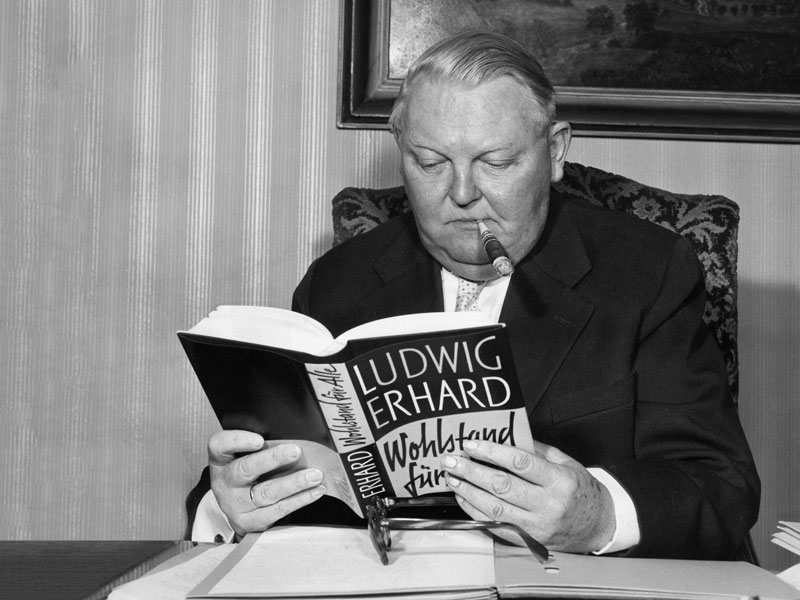
Germany did it before. The question worth asking now, with Europe’s largest economy grinding through its third consecutive year of stagnation, is whether Germany can summon the nerve to do it again.
In 1948, Ludwig Erhard did something that struck most of his contemporaries as insane. He abolished price controls overnight, slashed rationing, and replaced the worthless Reichsmark with the Deutschmark at a brutal conversion rate. The occupying Allied authorities were furious. Labor unions called a general strike. Erhard told the critics to wait two weeks.
They waited. Industrial output jumped 50 percent within months. By 1950, real wages were rising and the black market, which had functioned as the actual German economy under Allied price controls, simply evaporated. Prices fell as production caught up with demand. Consumer goods reappeared on shelves for the first time in a decade.
In a sound monetary environment, rising productivity drops prices and you get richer in real terms without a central bank engineering 2 percent annual inflation to pick your pocket. The Deutschmark held its value. Savings meant something. Capital formation exploded because businessmen could actually calculate future costs without guessing what the currency would be worth next year.
Germany’s neighbors ran the opposite experiment, keeping controls and soft money, and watched their recoveries crawl.
The 2026 German government faces energy costs triple their 2019 levels, a manufacturing sector hollowing out, and a central bank it no longer controls. Erhard’s playbook sits on the shelf. Cut the regulatory burden, restore price signals, stop the spending. This is not complicated; the political will is the only scarce resource.


