
In The Daily Sceptic, David Betz and Michael Rainsborough point out that the British government, in its dealings with the British public, seems to have fallen back on habits developed in the days of the world-spanning British Empire:
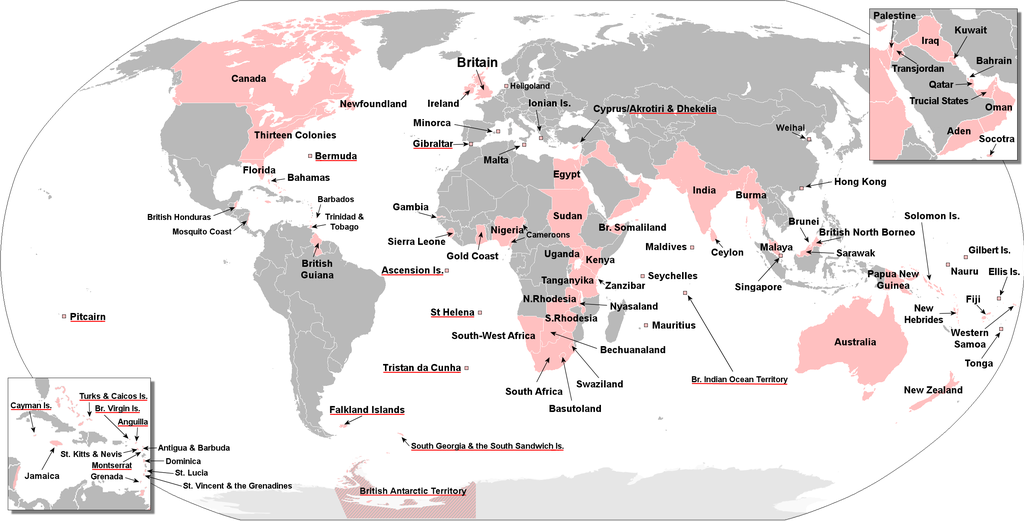
The territories that were at one time or another part of the British Empire. The United Kingdom and its accompanying British Overseas Territories are underlined in red.
Composed by “The Red Hat of Pat Ferrick” via Wikimedia Commons.
Despite spending much of the past half-century apologising for the Empire, the British establishment is rediscovering its favourite method of rule. The old colonial district officer, accustomed to keeping the peace between rival communities, cultivating local notables and reporting troublesome political sentiments to his superiors, would find much to recognise in contemporary Britain. He might struggle with the current terminology, but once someone explained what a Cohesion Support and Interventions Function actually did, he would probably feel quite at home.
In an essay we wrote six years ago called “Empires of Progress“, we argued that Western governing elites were increasingly abandoning the assumptions of the nation-state in favour of an imperial conception of political authority. A nation-state presumes a people sufficiently conscious of belonging together to accept common institutions and obligations. An empire governs different peoples, often possessing competing interests and loyalties, through a combination of accommodation, patronage, arbitration and coercion. Nations require citizens; empires administer subjects.
What we then identified as an emerging tendency has since acquired a more distinct institutional and political character in Britain. Successive governments, having encouraged mass immigration and multiculturalism, increasingly employ methods familiar from imperial administration to manage the communal divisions arising from those policies.
More significantly, these arrangements threaten to transform the relationship between the governing establishment and the historic British population, whose national attachments and political preferences increasingly conflict with the assumptions of those exercising power. Here, we examine how communal brokerage, differentiated accommodation and preventive security contribute to this estrangement, weakening the common national allegiance upon which the legitimacy of the state depends.
The imperial reflex, imported into the British domestic realm, we suggest, will prove considerably more destabilising than its practitioners anticipate.
Divide, rule, cultivate allies
British imperial administration depended upon an intimate knowledge of the populations it governed. Officials classified communities by ethnicity, religion and customary authority, cultivated influential intermediaries and distributed recognition, privileges and patronage to secure cooperation.
Such arrangements reduced the costs of government while giving selected local leaders a stake in the preservation of imperial authority. The British also secured the allegiance of particular populations whose interests became closely associated with the existing political order.
Governing through intermediaries and building dependent constituencies were complementary techniques, although the interests of the two were not always identical. By recognising communal leaders as representatives of distinct populations, imperial administrations could also reinforce the divisions that sustained their authority.
In British Malaya, for example, colonial economic development encouraged large-scale Chinese and Indian immigration, transforming the demographic composition of the peninsula and creating competing communal interests. The colonial economy developed along pronounced ethnic lines, with Malays concentrated in agriculture, Chinese communities prominent in commerce and mining, and Indian labour recruited extensively for plantation work. While not absolute, these divisions established a political landscape in which economic interests and communal identities became closely associated. British administrators also relied upon recognised communal intermediaries, including Chinese leaders known as Kapitan Cina, who mediated relations with Chinese communities and whose commercial privileges and political influence could become closely connected with the colonial power.
After the Second World War, the proposed Malayan Union of 1946 sought to extend citizenship to much of the immigrant-origin population while reducing the authority of the Malay rulers. Malay opposition forced the British to abandon the scheme in favour of the Federation of Malaya in 1948, with more restrictive citizenship provisions. The subsequent establishment of the Communities Liaison Committee in 1949 brought leading Malay, Chinese and Indian representatives together to negotiate questions of citizenship, economic interests and national identity. Political authority rested upon negotiations among recognised communal organisations, culminating in the Alliance between Malay, Chinese and Indian parties that helped secure independence in 1957. The British authorities, in effect, created the demographic and economic circumstances that made communal bargaining an indispensable feature of the constitutional settlement that followed.
At home, the contemporary British state confronts comparable divisions arising from a demographic transformation shaped decisively by the policies of governments of both major parties.


