To produce wine in Portugal, might require only the labour of 80 men for one year, and to produce the cloth in the same country, might require the labour of 90 men for the same time. It would therefore be advantageous for her to export wine in exchange for cloth. This exchange might even take place, notwithstanding that the commodity imported by Portugal could be produced there with less labour than in England. Though she could make the cloth with the labour of 90 men, she would import it from a country where it required the labour of 100 men to produce it, because it would be advantageous to her rather to employ her capital in the production of wine, for which she would obtain more cloth from England, than she could produce by diverting a portion of her capital from the cultivation of vines to the manufacture of cloth.
David Ricardo, On the Principles of Political Economy and Taxation (1817), quoted on the Library of Economics and Liberty site.
July 26, 2024
QotD: Comparative advantage
July 21, 2024
LCBO strike reportedly settled
A tentative deal was announced on Friday afternoon, then un-announced after the LCBO claimed the union had added financial demands to the return-to-work conditions after the contract itself had been agreed, and then on Saturday, re-announced. If the deal is ratified by the union, LCBO stores across Ontario should re-open on Tuesday.
It was the first LCBO strike in Ontario history, and it’s open to debate whether the union members will get all that much for their two-week unpaid break. The National Post‘s Chris Selley thinks not, calling it the “Stupidest. Strike. Ever.”

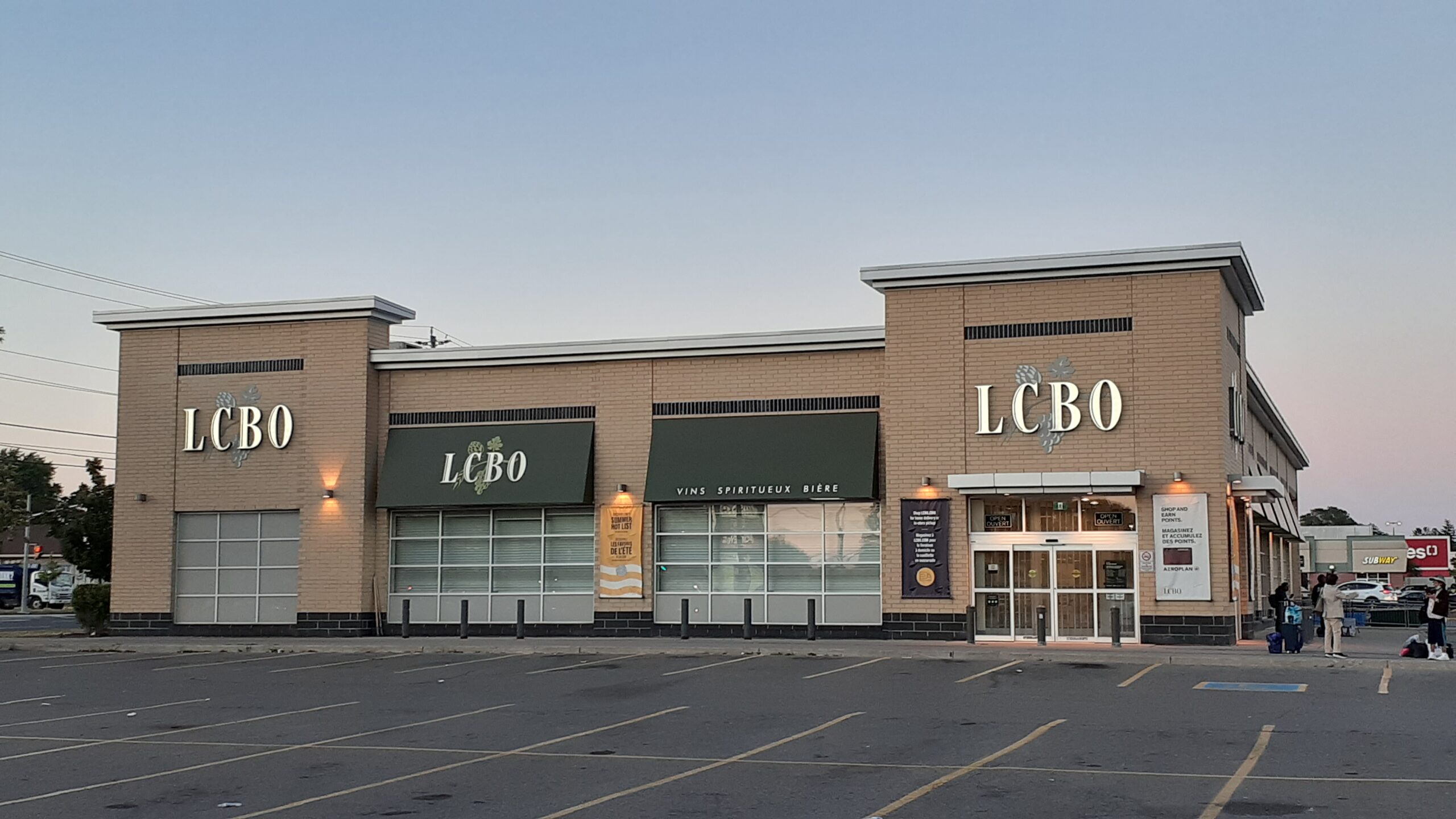
“LCBO at Parkway Mall” by Xander Wu is licensed under CC BY-SA 4.0 .
A week into the strike, a scant 15 per cent of Ontarians told Leger marketing that shuttered LCBO outlets had “affected (them) personally”. Only 29 per cent said they felt the government should legislate or arbitrate LCBO workers back into stores as soon as possible. Eleven per cent said they didn’t even know the strike was happening. And 32 per cent said they had explored “alternative locations” to buy booze, of which there are nowadays myriad.
Many more explored those opportunities in week two of the strike, I suspect, as fridges and wine racks were depleted. That’s potentially bad news for the LCBO’s future retail market share. But you didn’t even need an alternative to the LCBO: With a few days’ planning you could get all your regular brands delivered for free. Delivery and wholesale options were running as normal. Restaurants and supermarkets supplied by the LCBO were still supplied, and though there were reports of empty shelves at some supermarkets, that wasn’t truer than normal at the one I visit.
[…]
So this all looks like a terrible miscalculation by union leadership on behalf of its members — both a fundamental misreading of who had leverage, and a bizarre tactical choice to make the strike first and foremost about expanding the sale of ready-to-drink cocktails and seltzers (RTDs) to supermarkets and convenience stores.
Not wages; not benefits; not the number of full-time positions — things people can at least relate to — but where you can and cannot buy a White Claw or a Caesar in a can. Did they really think people would care?
Near as I can tell, it was an attempt to make this about the LCBO’s retail future: RTDs are a big and growing slice of the alcohol market in Ontario, only accessible (before the strike) at the LCBO. OPSEU wanted us to believe that by allowing supermarkets to sell them, Ontario would make no profit on them. And that’s their baked-in advantage: An incredible number of Ontarians, including far too many journalists, cannot wrap their minds around the notion of the government taking its cut at wholesale rather than retail.
Still, this gambit clearly fell flat.
Update: Fixed broken link to NP.
July 14, 2024
When the Ontario Progressive Conservatives backed away from LCBO privatization
In the National Post, Terence Corcoran posts an excerpt from last year’s The Harris Legacy: Reflections on a Transformational Premier edited by Alister Campbell:

“LCBO at Parkway Mall” by Xander Wu is licensed under CC BY-SA 4.0 .
Almost 30 years ago, in 1995, the Ontario Progressive Conservative government led by Mike Harris promised to privatize the Liquor Control Board of Ontario (LCBO). “We will sell off some assets, such as the LCBO,” said the party’s famed election document, the Common Sense Revolution (CSR). The LCBO could have been a true privatization — a full-fledged divestiture of a government monopoly into a new open and competitive market, but it never happened.
The failure to privatize the LCBO, lamentable from a consumer and economic perspective, remains a significant lost opportunity to demonstrate the benefits of privatization. If Harris had successfully de-monopolized the alcohol market, the whole concept of privatization would have been given a major boost. Instead, the government backed away from privatization of the alcohol market, preferring instead to allow the corporation to substitute modern marketing and retail razzle-dazzle to give the false impression it was offering the public the best of all worlds.
The LCBO failure is also a demonstration of the degree to which the Common Sense Revolution’s starting principles fell short in grasping the essential benefits of private versus public ownership and control. Neo-liberalism isn’t exactly a fine science. The Wikipedia entry on “Neo-liberalism” is a 30-page effort (including 400 footnote links to hundreds of warring academic papers), reflecting an economic and ideological scramble that dates back more than a century. But when the Harris government came to power, major elements of the free-market model were often overshadowed by fiscal policy objectives. With the LCBO, the Harris government veered off the neo-liberal course in pursuit of standard political objectives.
In 1995, the LCBO was a government owned and operated province-wide corporation that controlled liquor and wine wholesale and retail markets. Another private monopoly player, the Beer Store chain, while owned and operated by the brewing industry, was also essentially a government-sanctioned beer monopoly. The CSR neo-liberal objective should have been to privatize the alcohol market by selling the LCBO, deregulating the Beer Store monopoly and allowing beer sales through supermarkets and even corner stores. More importantly, dismantling the LCBO would allow other corporations to enter the alcohol retail business and provide consumers much more choice, which has been the Alberta experience. Notably, Alberta achieved a successful and deregulated approach without sacrificing provincial revenues.
The neo-liberal objective of privatization is to benefit consumers and enhance economic productivity through competition. Instead, the Harris government fell into the fiscal policy trap that routinely captures politicians, bureaucrats and corporate insiders. Instead of aiming to benefit consumers, the objective soon became how to maximize the fiscal return to government. Never mind the consumer and the market. The objective became preserving — and enhancing — government revenues.
At the time, anti-privatization advocates frantically pointed at the Alberta experience of privatization of their provincial liquor monopoly, which (briefly) generated a lot of retail horror stories that Ontario newspapers gleefully republished (and, likely, emphasized out of proportion to the actual Alberta market). You can still hear Ontarians casting aspersions on the Alberta market as if nothing at all had changed after the initial rough patch. From what I’ve heard from Albertans, they have far wider choices of alcoholic beverages in stores much more conveniently sited with better open hours than anyone in Ontario enjoys. The Alberta government still gets at least as much in tax revenues from alcohol sales without needing to be in the distribution or retail business. It doesn’t seem to be the utter disaster that Ontario media portrays it to be … rather the contrary.
July 9, 2024
What it was like to visit a Medieval Tavern
Tasting History with Max Miller
Published 27 Mar 2024Medieval stew with meat, spices, and verjuice, and thickened with egg yolks
City/Region: England
Time Period: 15th CenturySome medieval taverns may have had what is called a perpetual stew bubbling away. The idea is basically what it sounds like: as stew was taken out, more ingredients would be added in so that the stew kept on stewing. In southern France, there was a perpetual stew that was served from the 15th century (around when this recipe was written) all the way up until WWII, when they couldn’t get the right ingredients.
I have opted to not make this stew perpetual, but it is delicious. The medieval flavor of super tender meat with spices and saffron is so interesting, especially with the added acidity and sweetness from the verjuice.
A note on thickening with egg yolks: if you need to reheat your stew after adding the egg yolks, like I did, they may scramble a bit. The stew is still delicious, it’s just the texture that changes a little and it won’t be quite as thick.
Vele, Kede, or Henne in bokenade
Take Vele, Kyde, or Henne, an boyle hem in fayre Water, or ellys in freysshe brothe, and smyte hem in pecys, and pyke hem clene; an than draw the same brothe thorwe a straynoure, an caste there-to Percely, Swag, Ysope, Maces, Clowys, an let boyle tyl the flesshe be y-now; than sette it from the fyre, and alye it up with raw yolkys of eyroun, and caste ther-to pouder Gyngere, Veriows, Safroun, and Salt, and thanne serve it forth for a gode mete.
— Harleian Manuscript 279, 15th Century
July 7, 2024
Ontario’s LCBO strike may be both justified and counterproductive
Ontario’s main importer and distributor of wine, beer, and spirits is now facing its very first actual strike, as the negotiators couldn’t come to an agreement by the strike deadline on Friday morning. On the face of the dispute, the union certainly has some solid grounds for the strike, as pay hasn’t been keeping pace with (official) inflation and far too many of the LCBO’s workforce are on work schedules that keep them from earning full-time wages. On the other hand, over the last decade or so, both Liberal and Progressive Conservative provincial governments have been making piecemeal changes to the market so that the LCBO is far from the only place Ontario drinkers can purchase their preferred booze. Just off the top of my head, here are some of the alternative options now available to Ontario consumers:

“LCBO at Parkway Mall” by Xander Wu is licensed under CC BY-SA 4.0 .
- The Beer Store, Ontario’s other (foreign-owned) booze oligopoly for beer and cider is still operating normally at all their retail locations and agency stores. They also have online ordering for delivery available to ordinary consumers.
- The LCBO is still offering online sales — not same-day, but free delivery.
- Ontario’s vast array of craft brewers are still able to sell individual cans or bottles of beer from their bottle shops or storefront locations (pre-packaged 6-, 12-, 24-container or other types are still limited to the Beer Store oligopoly, of course).
- Ontario’s wineries are similarly still operating normally for retail sales at the winery or (for a few older wineries who still have grandfathered privileges from earlier licensing regimes) stand-alone retail stores.
- Ontario’s much smaller — but growing — number of distilleries are also operating normally and are able to sell their locally produced whiskey, gin, vodka, etc. from their tasting rooms/bottle shops.
- Many, many grocery stores in the province now sell wine, beer, or both, and are all operating normally. They may be slower to replenish the shelves as the LCBO’s limited number of non-union staff will be handling re-supply.
In addition, if the strike continues for more than two weeks, the LCBO will open a select number of their stores for limited hours across the province (again, limited by the number of non-unionized staff available to operate the stores). With all of this (and I’m sure I’m missing some options in my list), consumers may begin to draw the conclusion that the LCBO isn’t as essential as it once was:
On Thursday evening, Colleen MacLeod, chair of the team bargaining on behalf of government liquor-store employees, declared the summer of 2024 utterly ruined.
“Tonight, (Premier Doug) Ford’s dry summer begins,” said MacLeod, of the Ontario Public Service Employees Union (OPSEU), hours before the first ever strike in the Liquor Control Board of Ontario’s (LCBO) history became official.
Desperate? Delusional? That’s up for debate. OPSEU’s press release announcing the strike suggests “delusional.” At one point it claims the LCBO is “Ontario’s best-kept secret.”
What could that possibly mean?
The release then quotes OPSEU president J.P. Hornick as follows: “We told Ford not to ruin everybody’s summer, but now he’s closed the Science Centre and forced a dry summer for Ontarians by refusing to offer a deal that would be good for LCBO workers and Ontario.”
The Ontario Science Centre is a tired old children’s destination in North Toronto that has been neglected in every way by consecutive provincial governments. I’m quite sure few people in Ottawa, Windsor or Thunder Bay have ever even heard of it. Mashing it together with the LCBO, just because OPSEU represents employees at both, suggests the union really doesn’t understand the fight it’s getting into.
If the Ford government is willing to dig in its heels and fight — which isn’t something it’s particularly known for — this could be a great win for the Ontario consumer.
It’s not 1990. The LCBO shutting the doors to its retail stores is really only a minor pain in the rear end, thanks to years of piecemeal, needlessly complex and and too-slow but nevertheless significant liberalization that really kicked into gear under former Liberal premier Kathleen Wynne. (Ford is often mocked for being obsessed with alcohol, but Wynne was nearly beyond parody. If her government woke up in a crisis Monday morning, it was safe to say she’d find herself announcing more beer and wine in supermarkets by Thursday afternoon.)
Anecdotally, as I was in on Thursday picking up a small selection of wine and beer, I overheard a conversation with one of the staffers and another customer where the staffer didn’t believe there’d actually be a strike and that the only result of the brinksmanship at the bargaining table would be that they would have to do more re-stocking next week after the (understandably) higher sales during the past week.
June 27, 2024
The Toronto Star wants Ontario to adopt Scottish booze regulation (but ignore the failure)
The Toronto Star always loves a good moral crusade, and if it also happens to fly in the face of whatever Premier Ford wants to do, then so much the better:
The Toronto Star is looking to Scotland to teach it how to reduce alcohol-related deaths. In an article titled “How Scotland started to kick its alcohol problem — and what Ontario could learn from it“, it pushes back on plans to liberalise Ontario’s state monopoly on alcohol retail, saying:
Ontario officials say they are fulfilling a 2018 election promise to increase “choice and convenience for shoppers and support Ontario retailers, domestic producers and workers in the alcohol industry”.
But Scotland has cut alcohol-related hospital admissions by 40 per cent and deaths by almost half. While in Ontario, alcohol-related admissions have risen by a third and deaths by almost half, according to the Canadian Centre on Substance Use and Addiction.
How did Scotland supposedly achieve this public health miracle?
The key part of Scotland’s landmark policy was aimed at reducing drinking by introducing minimum unit prices to make drinking more expensive.,/p>
Ontario already has minimum pricing and Scotland doesn’t have a state alcohol monopoly, so it is not obvious what lessons Ontarians are supposed to be learning, but put that to one side for a moment and consider the main claim.
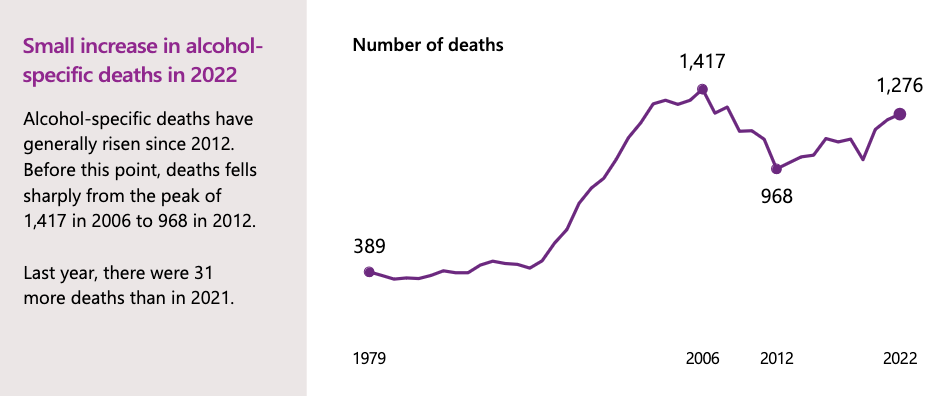
Anyone who has been following events in Scotland knows that alcohol-specific deaths have risen since minimum pricing was introduced in 2018 and have generally risen since 2012 following a significant downturn in the years prior.
It is that drop between 2006 and 2012 that the Toronto Star must be referring to when it claims that deaths fell by “almost half” (actually a third). But the Scottish government didn’t pass any anti-alcohol legislation in those six years and it certainly didn’t have minimum pricing. The newspaper mentions that the drink-drive limit was cut, but that didn’t happen until 2014 and the evidence is clear that it had no effect on road accidents.
Since the Toronto Star doesn’t mention when the decline in alcohol-specific deaths took place, it is leading its readers to believe that it coincided with the introduction of minimum pricing and the lowering of the drink-drive limit. I call that lying.
It is strangely fitting that Canadians are being lied to about the “success” of Scotland’s alcohol strategy since the Scottish public were conned into accepting minimum pricing, in part, on the basis of lies told about the “success” of minimum pricing in Canada. The neo-temperance academic Tim Stockwell, who is quoted in the Star article, published a series of studies in the 2010s making some absurd claims about minimum pricing that were parroted by campaigners in the UK.
June 26, 2024
QotD: Wine criticism
A better way to grasp the essence of something is to look at the bigger picture. Over years of tasting, I’ve been drawn to a direct approach, which consists of jumping into the middle of things. I’ve found that if you start on the outside you often cannot get to the heart, and this is where you want to be. Some of the best descriptions of wine have come from people who could not analyze a wine to save their lives. They simply give an honest response to an experience just as someone would give to a Rolling Stones concert. Or, as Matisse said, they “observed … and felt the innermost nature of the experience.” Many people have difficulty doing this with wine because they believe there is a proper wine language and a correct response to each wine. They fear giving the wrong response.
Billy Munnelly, Billy’s Best Wines for 2005.
June 7, 2024
QotD: Wine labels
One cannot fail to notice the contemporary marketing of wines by means of fun-and-funky labels, with their fractal curves, tropical fruit juice colors, and animals designed to appeal to the inner child, that cretinous monster who lurks inside us all. There is an undeniable increase in animals, for example, on wine labels, a trend which is bound to grow. All one can do to protest this development is to point out that the quality of a wine is probably in inverse proportion to the ferocity of the animal on its label. Beware, therefore, of labels with eagles, tigers, or bears (though I have not yet seen sharks, leopard seals, or velociraptors, it is only a matter of time).
Lawrence Osborne, The Accidental Connoisseur: An Irreverent Journey Through the Wine World, 2004.
May 29, 2024
Ontario’s long and winding (and subsidy-strewn) road to beer in convenience stores
Apparently I’ll have a little bit more to celebrate on my birthday this year as the Ontario government’s glacially slow-to-change alcohol sales rules are being liberalized as of September 5th to allow all the province’s convenience stores to begin selling beer and wine:

“The Beer Store” by Like_the_Grand_Canyon is licensed under CC BY-NC 2.0
Premier Doug Ford promised Ontarians beer in corner stores, supermarkets and big-box stores, and by God he has delivered. As of Sept. 5, all Ontario convenience stores meeting eligibility criteria will be allowed to sell beer, wine, cider and pre-mixed drinks. As of Oct. 31, the privilege will be extended to all grocery and big-box stores. The province says it expects as many as 8,500 new booze-procurement sites to come online under the new regime. By Ontario standards, it’s absolutely revolutionary.
The new regime is also, of course, hilariously complicated. And absurdly, offensively expensive.
It is fair to describe the new regime as somewhat more competitive, and certainly more convenient. In addition to offering potentially thousands of new locations, supermarkets (including the roughly 450 already licensed) will be able to offer volume discounts on beer — i.e., a 24-pack will cost less per bottle than a six-pack. This was a privilege hitherto reserved for The Beer Store, the American-, Belgian- and Japanese-owned conglomerate that dominated beer sales in Ontario from the end of Prohibition until fairly recently.
Private retailers will even be able to set their own prices, which until now has been considered blasphemy.
It is not fair to describe the new regime, as the government does, as an “open” market.
Near as I can tell, Ontario will by 2026 have the following retail environments in place:
- The Beer Store. Smelly, surly, and the best-available value. Only beer — no cider or mixed drinks. It’s in the name.
- LCBO locations. Government-run liquor stores retain their near-absolute monopoly on hard liquor sales, in addition to selling beer (especially craft beer, in which The Beer Store’s owners aren’t so interested), wine and everything else.
- LCBO- and/or The Beer Store-branded “agency stores” in rural areas, which sell everything the LCBO does, but operate inside of convenience stores, small supermarkets and other local businesses, and are staffed by non-government employees.
- The existing supermarkets licensed to sell beer, cider and wine (and in rare cases all three!), plus scores of new outlets — the new 8,500 new locations.
The Beer Store maintains a monopoly (in urban areas) on wholesale for bars and restaurants and on refunding cans and bottles, although its new “master framework agreement” (MFA) doesn’t even oblige it to maintain its current number of locations — which in urban areas have been dwindling rapidly. I’m a 17-minute walk from my nearest Beer Store. The house I grew up in, in the heart of midtown Toronto, is a 45-minute walk. I’m not schlepping a leaky garbage bag full of empty cans either distance.
QotD: Wine
“I don’t mean to sound cynical,” [Antonio Terni] said as he tipped the Conero sideways for a moment and eyed the tint. “But I do hate all this pseudo-intellectual mental masturbation about wine. I make two wines: one for Americans and one for myself. They’re both fine.”
Lawrence Osborne, The Accidental Connoisseur, 2004.
March 4, 2024
QotD: The “ABC” movement in wine
Back in the 1990s when I first got into wine, there was a movement against the growing homogenisation of the world’s wine called ABC: “anything but chardonnay” which handily also stood for “anything but cabernet”. This was at a time when growers from Piedmont to Penedès were planting chardonnay (or cabernet sauvignon for reds) instead of local grape varieties.
There was a worry that in the future all wine would taste the same while the more obscure varieties would disappear. As an ABC enthusiast, I thought it far better and more interesting to drink riesling, or fiano or albariño or esgana cão (a Madeiran grape that means “dog strangler” in Portuguese because of its ferociously high acidity).
Jancis Robinson was also not a chardonnay fan. Recently I’ve been watching her Wine Course made in the 1990s on YouTube. It still holds up well, and the budget by modern standards is mind-blowing; one moment she’s in Burgundy, the next she’s in Australia.
Can we have another series like this again soon please? Each episode is devoted to a grape and in the chardonnay one Jancis (she’s one of the few famous people who it is acceptable to refer to by just her first name, like Britney or Boris) can barely contain her contempt for many wines made from the variety describing them as “sugar water”. She’s also not keen on the world’s second favourite variety, sauvignon blanc, either.
I was with Jancis. In fact, I was with Jancis on most things which points to a possible explanation for my chardonnay conversion. When I started out, I hadn’t developed my own tastes and so I was buying wine that I thought sounded sophisticated — such as Mosel riesling.
But as I’ve got older, I’m now buying bottles purely because I like them. Furthermore, I cook and entertain a lot more than I did when I was in my twenties and chardonnay, especially white Burgundy, goes with pretty much anything. If you don’t know what to order when eating out then a bottle of Mâcon-Villages will cover all your bases (the red equivalent if you’re interested is a bottle of Beaujolais).
But also your average chardonnay has got a lot better since the ’90s, or perhaps I should say that it leans more towards my tastes. I’ve been watching a lot of old episodes of Frasier recently and the chardonnay they drink is nearly orange. This style which is still very popular in the US is based on very ripe, some might say overripe, grapes which are then treated to a pre-fermentation maceration to get colour and body out of the skins.
Following fermentation with a yeast which accentuates tropical fruit flavours, the wine would be perked up with some tartaric acid and then either aged in new oak casks or more likely for cheaper wines have oak chips added.
The finished product would be thick and syrupy with a deep golden colour. Not very chic but a revelation in 1980s Britain when everyday white wine meant Blue Nun or Black Tower. They’re what Oz Clarke called “bottled sunshine” in his colourful slots with Jilly Goolden on BBC2’s Food and Drink programme. Like those loud waistcoats everyone thought were so witty worn with a morning suit or dinner jacket, they were great fun then but a bit embarrassing now.
Henry Jeffreys, “Chard: an apology”, The Critic, 2023-11-14.
February 24, 2024
Feeding Napoleon – Chicken Marengo
Tasting History with Max Miller
Published Nov 21, 2023
(more…)
January 30, 2024
The foul “nudgers” are at it again at Cambridge
Christopher Gage reports on a recent fun-reducing experiment by paid psychological meddlers at Cambridge University:

“Wineglass” by quinn.anya is licensed under CC BY-SA 2.0 .
Researchers found they could “nudge” people into drinking less wine when they denied the unsuspecting blighters a large 250ml measure.
Last summer, these wholly well-adjusted people convinced 21 Cambridgeshire pubs and restaurants to offer only small or medium glasses of wine. The result left the boffins breathless. But sadly, not in the medical sense of the word.
When denied a large, vivifying glass of wine, the subjects drank eight percent less than usual, and the pubs didn’t lose any money — smaller measures cost more. Puritans: two. Oenophiles: nil.
The usual suspects cooked up this obscene waste of time and money. Professor Dame Theresa Marteau, director of the behaviour and health research unit at Cambridge University, boasts lurid form in control freakery.
Her previous studies read like an almanac of neurotic impulses. The mad mullah dreams of shrinking plates and sinking sodas. This finger-wagger-in-chief obsesses with the vinous, porcine masses and what they may slip into their faces when she’s not looking. Marteau chillingly laments that large wine glasses “increase the pleasure of drinking wine”.
The fundamentally nosey swear these are the first murmurs of Utopia. Next, they’ll bend boozing regulations into a truncheon to batter the gastronomic swine over its head. They don’t stop. First, they shrink the large glass. Then, the medium glass affects as the large. What happens next? Take a wild guess.
This is not the work of some rogue Colonel Kurtz. One Daily Telegraph writer seized on the study. Employing the presumptuous “we” beloved of oppressive minds, they offered tips to help us drink less, assuming we drink large wines only because we are weak-willed effigies desperate for professional helpers to show us what’s best for us.
Advocates of “nudging” drive themselves senseless over this psychological thimblerig. The potential to correct “undesirable” behaviour proves too great to resist. They are a species of featherless biped with which I share nothing but the right to a trial before a jury of my peers.
As I write, I’ve just returned from a five-mile jaunt with 33 pounds strapped to my back. Loading a bag with weights burns double the calories. Therefore, whatever I do after that trek is my business alone. On my desk is a large glass of Portuguese red blend. Beside that soul-tingling measure sits a smouldering, hand-rolled, menthol-tipped cigarette.
Why strangers stake their mental well-being on what others put into their bodies, I will never know. Why they wish I’d sit here choking on sparkling water and its vegetable equivalent — celery — I’ve not the foggiest of insights. All I do know, friends, is that I am not the one in dire need of a few sessions with a psychoanalyst. My professional advice: Seven letters. Vulgar slang. A phrasal verb rhyming with “duck cough”.
December 21, 2023
QotD: Wine bores
[…] I have had to deal with the incessant drone of wine bores commenting on how the wine they just bought scored 90 points or higher without actually connecting with wine on their own terms. My favourite was the one who failed to realize his Robert Parker 94-point Bordeaux was 100 per cent corked. When I mentioned that the wine seemed “a little musty” to me, he scurried off in search of Parker’s review. Returning triumphantly, he held the newsletter aloft and proclaimed “Parker doesn’t say anything about this wine smelling musty.”
Pam Droog, letter to Vines magazine, May/June 2005.
December 20, 2023
Eat Like a Medieval Nun – Hildegard of Bingen’s Cookies of Joy
Tasting History with Max Miller
Published 5 Sept 2023
(more…)