
Drachinifel
Published 22 Apr 2026Today we look at some of the worst thought out naval strategies and plans of all time, as selected by me.
00:00 – Intro
00:34 – Selection Criteria
02:17 – The 1914 Dardanelles Bombardment
11:38 – Britain’s post-WW2 Carrier Plan
29:01 – Germany’s High Seas Fleet Build-Up
38:43 – French attempts to invade Ireland
44:16 – The US “we don’t need a navy” plan
August 31, 2026
Terrible Naval Plans – Five of the worst ideas of naval history
Comments Off on Terrible Naval Plans – Five of the worst ideas of naval history
August 25, 2026
The Halftrack That Made Blitzkrieg Possible
World War Two
Published 23 Aug, 2026The tanks get the glory. But Blitzkrieg could not work on tanks alone.
The Sd.Kfz. 251 was designed to solve one of the fundamental problems of armored warfare: how do you keep infantry moving fast enough to fight alongside the Panzers? Germany’s answer was an armored half-track that helped turn infantry from a slow-moving follow-up force into an integral part of the Panzer division’s combined-arms assault.
In this German Rearmament special, we trace the Sd.Kfz. 251 from clandestine development under the restrictions of the Treaty of Versailles to its first production runs on the eve of World War Two. We examine its design, its role in the emerging doctrine of Bewegungskrieg, its deployment in Poland and France, and the extraordinary range of variants that turned it into one of the Wehrmacht’s most versatile vehicles.
But the 251 also exposes the limits behind the image of a fully mechanized German war machine. It was complicated and expensive to manufacture, there were never enough of them, and most German infantry continued to march or rely on horses and trucks. Even as production soared later in the war, Germany’s shortages of fuel, materials, manpower, and industrial capacity increasingly overwhelmed the advantages its engineers and tacticians had created.
The Sd.Kfz. 251 helped make the early German style of armored warfare possible. It also became another example of a sophisticated weapon system serving a war of aggression that Nazi Germany ultimately lacked the resources to sustain.
This is the story of the half-track that made Blitzkrieg possible.
Never Forget.
Comments Off on The Halftrack That Made Blitzkrieg Possible
August 22, 2026
August 20, 2026
The Frankfurt School – The most destructive intellectual project of the 20th Century
People tend to underestimate how influential intellectual movements can be, as they rarely get outside attention until they’re deeply entrenched in the university system. The Frankfurt School‘s damage record is unmatched by any other intellectual movement of the era:
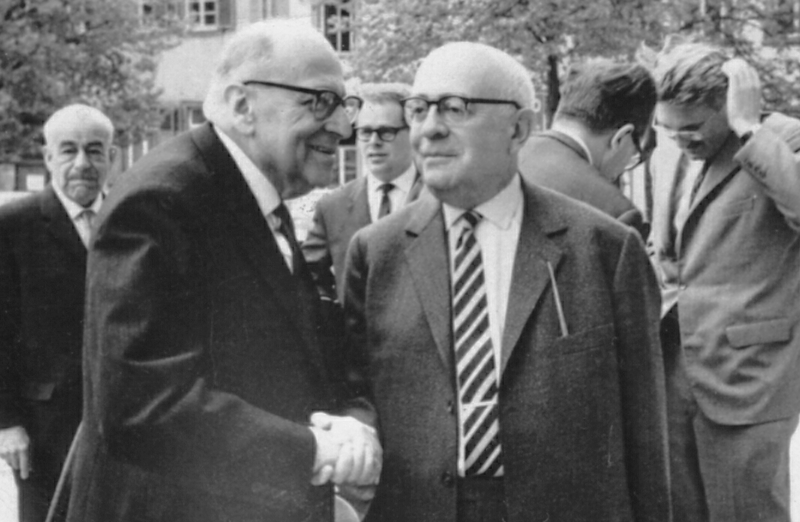
Notable members of the Frankfurt School in Heidelberg, April 1964 at the Max Weber-Soziologentag. Max Horkheimer is front left, Theodor W. Adorno front right, and Jürgen Habermas is in the background, right, running his hand through his hair. Siegfried Landshut is in the background left.
Photograph by Jeremy J. Shapiro via Wikimedia Commons.
The Most Destructive Intellectual Project of the Twentieth Century.
The Frankfurt School. You should know what it was, what it built, and why you are still living inside it.
1. The Institute for Social Research was founded in Frankfurt in 1923 and relocated to Columbia University in 1934 when Hitler came to power. The civilization they had decided to dismantle gave them refuge when another tried to kill them. They spent the next five decades producing the theoretical infrastructure for that dismantling. Western civilization itself was the problem: reason, the Enlightenment, the family, tradition, authority. Not reformed. Dismantled.
2. They called it Critical Theory – and the name is the program. Everything is to be criticized; nothing is to be built. In The Dialectic of Enlightenment (1944), Adorno and Horkheimer argued that Western reason — the reason that produced Newton and the rule of law — contained the seeds of Auschwitz. Not that reason had been misused, but that reason itself, taken to its conclusion, produces the death camp. This was not a critique of institutions. It was an indictment of the civilization itself.
3. Adorno gave them the psychological weapon. The Authoritarian Personality (1950) classified conservatism, religious faith, patriotism, and the traditional family not as political positions but as symptoms of a proto-fascist personality. If you believe in the nation or the father’s authority, you are pre-fascist. The opponent was no longer wrong – he was sick. You don’t argue with a pathology. You treat it. This made dialogue impossible. You don’t persuade someone who is wrong; you diagnose someone who is sick. Politics becomes therapy, and disagreement becomes pathology.
4. Marcuse gave them the political weapon. Repressive Tolerance (1965) argued that tolerating wrong ideas is itself oppression. True tolerance therefore requires suppressing intolerant ideas. The left decides which ideas are intolerant. Everyone else is silenced – not despite tolerance, but “in its name”. Censorship dressed in the vocabulary of liberation.
5. The generation that read Marcuse at Columbia, Berkeley, and Yale went on to run universities, media, foundations, NGOs, content moderation departments, and the EU regulatory apparatus. They implemented the argument sincerely because they had been taught it as philosophy. This was the Frankfurt School’s greatest achievement: it produced true believers.
6. French Theory picked up the tools and made them aesthetic. Foucault made the critique of power literary. Derrida made the critique of meaning philosophical. Deleuze made the critique of identity elegant. A political program became a cultural sensibility. You can argue with a program. A sensibility is in the air you breathe. By the time these ideas reached the American campus through the French conduit, they were no longer ideology. They were the water. The fish did not know they were wet.
7. A civilization stands on three pillars: truth exists and is accessible to reason; good is distinguishable from evil; and there is an inheritance worth transmitting. The Frankfurt School attacked all three – systematically and with considerable intellectual sophistication. It produced a generation that knows how to deconstruct and has forgotten how to build. That sees power everywhere and beauty nowhere. The ultimate achievement was to make destruction feel like progress. Every inherited institution became suspect; every constraint became oppression; every act of preservation became reactionary. Deconstruction became the default, while construction became something that needed to justify itself.
The answer is not another theory. It is the thing the Frankfurt School most feared: the builder who simply builds, the scientist who follows the evidence, the father who transmits what was transmitted to him.
The deconstruction machine runs on the assumption that nothing is worth building.
Prove it wrong.
Tell the truth, have courage, and build.
Comments Off on The Frankfurt School – The most destructive intellectual project of the 20th Century
August 19, 2026
Why The Allied Western Front Offensives in 1915 Failed
The Great War
Published 13 Mar 2026By the spring of 1915, the Western Front had bogged down into trench warfare. Allied offensives tried to break the deadlock in spring and fall 1915. The fall offensives were among the bloodiest of the war. After unprecedented bloodletting and use of munitions, the Western Front was still locked in a stalemate at the end of 1915.
(more…)
Comments Off on Why The Allied Western Front Offensives in 1915 Failed
August 16, 2026
How Not to Be A Nazi – Death of Democracy 28 – Epilogue
World War Two
Published 15 Aug 2026Nazi Germany destroyed democracy in weeks, launched a war that killed tens of millions, and carried racial persecution to industrialized mass murder. But after 1945, Germans and Europeans faced another question: how could they prevent it from ever happening again?
In this final, independently viewable epilogue to Death of Democracy, Spartacus examines how West Germany transformed the lessons of dictatorship and war into the Grundgesetz — a constitutional system built around human dignity, enforceable rights, federalism, judicial independence, social stability, and a democracy empowered to defend itself.
We trace how the Federal Republic combined lessons from Weimar, the United States, Britain, Austria, France, and other democratic traditions; how Konrad Adenauer’s generation tied Germany to a new European order; and how the same determination to restrain power and prevent another continental war eventually shaped the European Union and the Lisbon Treaty.
Finally, we ask how well those democratic fortifications are holding in 2026 — and return one last time to the diarists, victims, witnesses, supporters, and resisters whose voices guided us through Germany’s descent into dictatorship.
From the comments:
@spartacus-olsson
12 hours agoThank you for joining me on this adventure. I hope it has been eye-opening. If you watched to the very end, you will know that I’m soon launching a World War 2 Trivia board game – I’ve been super punny and named it World War IIrivia (2rivia with Roman numerals).
After so many years of studying this and sharing it in the darkest possible way, I felt it was time to look at the whole affair in a way that’s fun, social, and still educational. So a couple of months ago I came up with something. It turned out to be one of those moments when the work seems like extra fun. Before I knew it, I was spending my sleepless nights on the idea, sketching rules in Word, writing questions into lists in Excel, designing the game in Photoshop, testing gameplay against myself, and redesigning. And then there it was — an actual game. It’s a game for both novices and experts, with some unexpected twists and turns. If you’re interested in this period of history and enjoy a night of board games, this is for you. Stay tuned for more updates about the launch.
Once again, many, many thanks to all of you for watching. Thank you to Iryna, Astrid, Anna, and Clara for your great work on the series. Thank you to the TimeGhost Army members for enabling me to do this. With that, as Mr. Murrow would put it:
Good Night and Good Luck,
Your Spartacus
Comments Off on How Not to Be A Nazi – Death of Democracy 28 – Epilogue
August 13, 2026
German democracy from the POV of “Our Democracy Enjoyers”
If you’ve been wondering about the state of democracy in Germany, your first move should be to check the latest update from eugyppius:
“Bundesrat of Germany” by photosteve101 is licensed under CC BY 2.0 
 .
.
In civics class, parties appear as little more than informal election-winning cooperatives. Now and again “the sovereign” – that is to say, “the people” – may grant one or various parties a limited right to govern, but the state is held to be in some sense public property. Politicians and their parties are at best its temporary custodians.1
Our Democracy Enjoyers particularly deplore state systems in which parties have captured the state – a special political form we might call the “party state”. Germany became a party state after 1933, when the NSDAP seized the entire state apparatus and outlawed all competitors. Contemporary states owned and operated by single parties include China, Cuba and North Korea. Our Democracy Enjoyers hate all single-party states because they are not democratic.
Party states need not however be single-party states. While the Socialist Unity Party (SED) effectively owned the DDR, they tolerated an array of subservient bloc parties from the very beginning. None of these parties ever had any chance of governing; they functioned only as extensions or alternative faces of the SED itself. These parties included gutted, early opposition parties like the CDU (Ost) and the Liberal Democratic Party (LDPD), but also SED concoctions like the Democratic Farmers’ Party (DBD) and the cynically post-Nazi National Democratic Party (NDPD). The SED cultivated these parties both as a democratic figleaf and also to integrate “non-proletarian” (particularly Christian) elements within the communist system. The precedent of the DDR shows that the party state can assume various innovative forms and that multiple parties may be useful for political, propaganda or other purposes.
My thesis of the Federal Republic is that it is also a party state. The only difference between the DDR and the BRD is that, in the BRD, several different parties share ownership of the state among themselves.
The three anecdotes at the head of this piece reveal this party ownership in incidental but telling ways. They show, for example, how a substantial portion of the police consider their oath of office to preclude loyalty to a democratically elected opposition party. Should the voters go rogue and install any such party at the state level, a prominent police union functionary openly hopes for insurrection and federal intervention. Periodically voiced ambitions and campaigns to cleanse the civil service of AfD elements come from a similar place. The ownership parties cannot countenance opposition creep into the bureaucracy, because they correctly regard the bureaucracy as their property.
The hysteria surrounding a thwarted SPD nomination to the Federal Constitutional Court reveals that the parties that own the BRD extend their proprietary interests not only to the executive and legislative branches, but also to the allegedly independent judiciary. The ruling parties have divided the prerogative to nominate judicial candidates informally among themselves. This prerogative is so jealously guarded that a leading Union politician cited a single thwarted SPD nomination to make the case for mass censorship and regulation of “alternative” media.
And while it is a minor incident that hardly matters, the dispute over the Otto-Wels-Saal shows that the proprietary feelings of the state parties extend to physical architecture, even specific rooms and buildings, which the parties of the party state regard not as public property but as their very own chambers – to name, possess and use as they see fit.
While progressive liberal political systems are all oligarchies, and this because of the Iron Law of Oligarchy, they are not all party states – far from it. The party state is a clunky and outmoded political system that historically arose out of accident or necessity, generally following a revolution perpetrated by a single party or political movement in a moment of particular ascendance. The Federal Republic was founded as a party state in 1949, mainly to foreclose the possibility that subversive National Socialist or communist elements might return to influence via democratic processes. This is the basic meaning of German “defensive democracy”, which denotes an array of legal or constitutional tools for the parties that own the state to fend off or criminalise competitors.
- Now, we know this is mostly nonsense. “The people” are an abstraction and as such they cannot grant anybody anything. All political systems ultimately redound to the control of more or less stable oligarchies. “Democracy” describes little more than a set of procedures via which the these oligarchies (or their representatives) assume power and enact their will.
August 12, 2026
“Hitler’s socialism wasn’t just an internal economic policy – it was the cause of the war”
On the social media site formerly known as Twitter, Krzysztof Szczawinski explains why socialism — of the left (the Soviet Union) and the right (Nazi Germany) — was the economic driver that pushed Europe into war in 1939. German socialism (in one state) could only continue to grow by annexing resources and manufacturing capabilities from neighbouring states, and by August 1939 it was Poland’s turn:
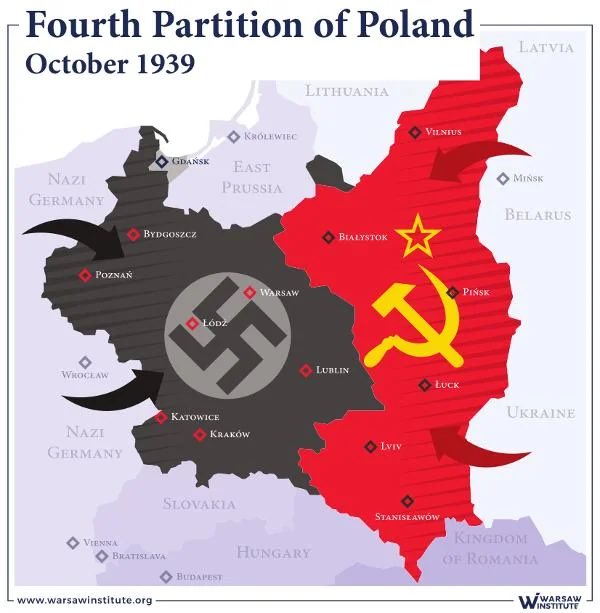
Socialism was at the origin of the war. Not as a coincidence. As a necessity. The socialist economic model generates contradictions it cannot resolve internally – the calculation problem, the misallocation, the stagnation, the mounting failure. War is the exit. It provides the external enemy that explains the internal failure. It justifies the total mobilization the system always wanted. It consumes the surplus population the economy cannot employ. It redirects the resentment outward.
Does this remind you of anything?
The evidence is not subtle. The NSDAP program of 1920 reads like a standard socialist manifesto. The economic reality confirmed it – price controls, industrial planning, state allocation of raw materials, entrepreneurs reduced to government functionaries. Private property in name only. Mises called it Zwangswirtschaft – coercive economy. Hayek dedicated a chapter of The Road to Serfdom to the socialist roots of Nazism. Both writing from observation, not retrospect.
After 1945 the Soviet victors imposed their version and attached the capitalist label to every rival. Western textbooks followed. The lie became the curriculum.
The real divide has never been left versus right. It is collective control versus individual freedom. Once you place National Socialism correctly within the family of collectivisms, the political spectrum becomes legible – and the war becomes explicable.
When the system fails — and it always fails — it needs an enemy. The bigger the failure, the bigger the enemy required.
Imagine being Poland. Squeezed between two socialist systems, both searching for their enemy.
We were it.
Comments Off on “Hitler’s socialism wasn’t just an internal economic policy – it was the cause of the war”
August 9, 2026
How To Launch the Apocalypse – Death of Democracy 27 – Q3 1939
World War Two and Spartacus Olsson
Published 8 Aug 2026This is Step 27 in the Death of Democracy: LAUNCH A WORLD WAR — the moment when the collapse of democracy, diplomacy, and collective security culminated in an attack that would engulf the world.
In July and August 1939, Adolf Hitler turned the destruction of German democracy into the instrument for launching a European war.
While Nazi Germany armed Danzig, mobilized reservists, prepared its U-boats, introduced civilian rationing, and manufactured stories of Polish aggression, Britain, France, Poland, the United States, and the Soviet Union made a final series of increasingly desperate attempts to prevent catastrophe.
At the center of the crisis was the failed effort to construct an Anglo-French-Soviet alliance against Nazi aggression. Negotiations foundered on delay, mutual suspicion, the Baltic states, and the Soviet demand for military passage through Poland. Stalin then chose an agreement with Hitler: the Molotov–Ribbentrop Pact and its secret protocol divided Eastern Europe into German and Soviet spheres of influence and prepared the way for the destruction of Poland.
Inside Germany, there was little repetition of the supposed national enthusiasm of August 1914. Nazi leaders and Wehrmacht commanders ranged from confidence and opportunism to anxiety and fatalism, while many ordinary Germans feared that Hitler had finally pushed Europe beyond the point of no return. Yet propaganda, repression, and six years of dictatorship had stripped the population of any effective means of preventing the war.
The next episode will conclude the series with an epilogue examining what the destruction of the Weimar Republic teaches us about defending democracy today.
Comments Off on How To Launch the Apocalypse – Death of Democracy 27 – Q3 1939
August 2, 2026
How to Make Aggression Sound Like Defense – Death of Democracy 26 – Q2 1939
World War Two
Published 1 Aug 2026By the spring of 1939, Hitler’s Germany is no longer merely threatening war, it is preparing to launch one while insisting that every act of aggression is really self-defense.
In this episode of “Death of Democracy”, we look at Germany in the second quarter of 1939: the launch of the battleship Tirpitz, the secret planning for Fall Weiss — the invasion of Poland — Hitler’s 50th-birthday military spectacle, the renunciation of the German-Polish Non-Aggression Pact and the Anglo-German Naval Agreement, the Pact of Steel with Mussolini’s Italy, and the diplomatic moves designed to isolate Poland before the coming attack.
But behind the military display, Nazi Germany’s economy is still on a knife’s edge. Rearmament, shortages, debt, plunder, and autarky have pushed the regime toward a brutal logic: conquest is no longer just ideology; it has become the regime’s chosen answer to the crisis it created.
Meanwhile, persecution inside the Reich continues to escalate. Jewish tenants are stripped of protection, the refugee ship St. Louis leaves Hamburg in a desperate search for sanctuary, and Ravensbrück opens as a concentration camp for women. As Germany exports terror into annexed Austria and Bohemia-Moravia, Britain and France finally begin to wake from appeasement — but dangerously late.
This is how aggression is made to sound like defense.
Never Forget.
Comments Off on How to Make Aggression Sound Like Defense – Death of Democracy 26 – Q2 1939
July 28, 2026
The establishment pretends not to understand why AfD is still on the rise
Normally, I get my updates on German politics from eugyppius’ Substack, but this article is from the New English Review with Bruce Bawer reporting:
… even as the problematic aspects of Islam become increasingly manifest, mainstream politicians and journalists in Germany feign puzzlement over the growing popularity of AfD, which ever since its founding in 2013 has been characterized by the German establishment as heralding a Nazi renaissance. How, the German elites pretend to wonder, can so many voters transfer their loyalty from seasoned, sensible, upright political leaders to ragtag radicals who bring to mind Munich putsches and Nuremberg rallies? How on earth can they have become so misguided? Such is the coy approach of Jochen-Martin Gutsch in a recent article for Der Spiegel, in which he takes a spin around the former East Germany in purported search for an explanation as to why the “far-right” AfD has won majority backing in that part of the Bundesrepublik.
Gutsch’s first move is to act astonished at the fact that an AfD gathering in Salzwedel, Saxony-Anhalt, drew ordinary-looking families, plus “[a] surprising number of young people in their twenties, smartly dressed in blazers”. What, no Hitler Youth uniforms? Gutsch’s line is that he’s just plain perplexed by the numbers: “in the state of Saxony-Anhalt, the AfD is currently polling at more than 40 percent. In the ARD Deutschlandtrend poll, the AfD is in first place; it’s even the most popular party, nationwide.” But it’s one thing to read the numbers, another thing to see all these – gasp! – ordinary-looking people flocking to show their support. This is what really blows Gutsch’s mind, or so we are meant to believe: the “normalization” of AfD, the party’s growing “acceptance”, its rapid “transformation into a mainstream party in the east”, all of which was, in Salzwedel, brought to vivid, terrible life before his eyes.
Ten years ago, Gutsch recalls, AfD received 20 percent of the vote in Saxony-Anhalt, and he, for one, was sure that it had peaked. He’s from eastern Germany himself, and he thought he knew his neighbors. He was wrong, and now, he claims, he’s alarmed – unlike his “friends and colleagues sitting in Hamburg, Cologne, or Munich, who give a friendly, bored look when I talk about the AfD. For them it’s still far away. Somewhere ‘over there’, whereas for me it’s a reality I can’t escape.” Therefore, he tells us, it’s important for him to make unravel the mystery of the AfD‘s remarkable rise in the polls.
Of course, the reason for the rise of AfD is obvious to anyone who’s been following developments in Western Europe for the last quarter-century or so. More and more voters have been demanding that immigration, especially from Muslim countries, be drastically curbed, if not altogether ended, and that the unassimilated masses who’ve already relocated to Western Europe from the Muslim world – only to swell the welfare rolls and the crime statistics – be sent back to where they came from. We’re told that the Berlin Pride killer, Abdul Ballout, belongs to “Islamist circles” in Germany. Why, ask AfD voters quite reasonably, should there be “Islamist circles” in Germany?
Yet Gutsch is, or pretends to be, blind to such concerns. His initial hypothesis, as he heads into the east, is supposedly that AfD is gaining popularity there because of economic hardship. But no, when he drives through Brandenburg now, he encounters prosperity. The city of Großräschen, once the Ruhr of East Germany, became a “ghost town” after 1990; now it’s thriving again, with the unemployment rate a mere seven percent, the old lignite mine converted into a lake with “a lovely beach” lined by “white houses” with “luxury SUVs parked out front”. Why, then, asks Gutsch, are the residents of these stately homes casting their ballots for AfD?
A veteran local politician tells Gutsch that he travels often to Bochum, in western Germany, which, compared to Großräschen, is an economic basket case. And yet the residents of Bochum are “more easygoing” than those in Großräschen. They possess a “fundamental optimism”. They “trust” and “respect” their political leaders. “What beautiful words”, Gutsch comments. He’s not being ironic. To be sure, he understands why eastern Germans aren’t brimming over with love for their leaders, whether in Berlin or Brussels. Many of them are old enough to remember 1990, when the once-mighty East German state “crumbled … before their very eyes.” One might add that before 1990, that same state was the very picture of totalitarian tyranny, as chillingly depicted in the film The Lives of Others. And before that – well, you know. Then there’s 2015, when Angela Merkel opened the floodgates to insufficiently vetted Muslim immigrants, who proceeded to cause mayhem in both east and west.
But why, then, do so many western Germans still “trust” and “respect” their leaders? It seems baffling. Yet to listen to Gutsch, loyalty to the political establishment remains the way to go – the only intelligent, mature, and reasonable option. When he talks with an AfD politician, Karsten Hilse, to get the latter’s perspective on things, he’s lost at sea. In Hilse’s opinion, mainstream German politicians are too obsessed with “tolerance”; they have at least a degree of hostility toward Germany; and they accept without question the preposterous ideologies of gender and climate-change.
July 26, 2026
How to Provoke a War – Death of Democracy 25 – Q1 1939
World War Two
Published 25 Jul 2026By March 1939, appeasement has failed.
Hitler’s Germany has moved from threats and persecution inside the Reich to the destruction of Czechoslovakia, the seizure of Memel, and renewed pressure on Poland. No shots have yet been fired between the great powers — but Europe is now locked on a course toward war.
In this episode of Death of Democracy, Spartacus Olsson reports from Berlin at the end of Q1 1939: the “Israel” and “Sara” decree, Schacht’s dismissal, Göring’s Central Office for Jewish Emigration, Hitler’s genocidal Reichstag threat, the launch of Bismarck, the coerced occupation of Prague, the Memel ultimatum, and Britain’s guarantee to Poland.
This is the moment when the Munich illusion collapses. Hitler is no longer pretending to unite Germans. He is dismantling states.
Comments Off on How to Provoke a War – Death of Democracy 25 – Q1 1939
July 25, 2026
The last few hundred years of Anglo-German relations
The history of Britain and Germany has certainly had some peaks and valleys since the first “German” king was crowned in London in 1714. Prussia and Britain managed to team up most memorably in 1815 to defeat Napoleon in the Waterloo campaign, but things got much less clear after the Franco-Prussian War that heralded the rise of a unified German state. As long as Prince Bismarck was the guiding hand behind German ambitions, Britain could look at Germany as a relatively reliable continental ally. After the accession of Kaiser Wilhelm II, however, things got rockier quickly. Bismarck got sidelined soon afterwards and the Kaiser decided that the one thing he really, really wanted was to build a navy to rival the British Royal Navy. That, in my opinion, more than anything else pushed Britain into exploring other diplomatic channels and eventually deciding to ally (in all but name) with France. The cover of Jan Rüger’s Great Powers shows the future conflict zone that ensured Britain would view Germany as a threat and not a potentially valuable ally:
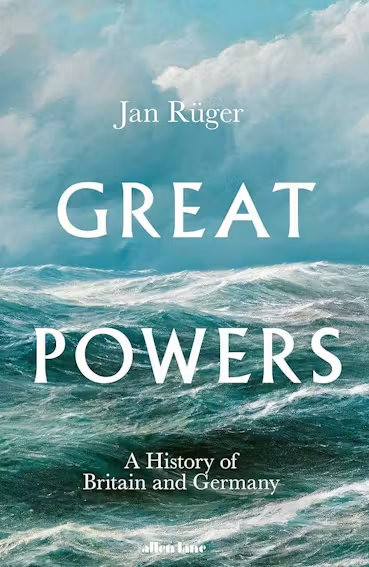
As an explicit criticism of the nonsense of great powers rising and falling as if “a timeless truth”, that offered for example by Paul Kennedy, Graham Allison, and Brendan Simms, Rüger, Professor of History at Birkbeck, emphasises the role of individuals and contingencies. His is a book that emphasises human agency, and at every level from that of nations to individuals.
[…]
For the period on which I am a specialist (and Rüger is not), the eighteenth century, there is a degree of nonsense. For example, George I did not have a “reliably anti-French stance” contributing to British “nation-building”. Instead, there was alliance with France from 1716 to 1731, the deployment of French troops into “Germany” to protect Hanover against Prussia and Austria was sought in 1727 (George II was similarly concerned in 1729), and so on. Nor were British interests successfully ringfenced to protect against their use for Hanoverian ends. Any detailed consideration of British foreign policy, or, indeed, the despatch of warships to the Baltic would suggest otherwise. Nor is Rüger correct to suggest that “at the heart of Britain’s national interest” was Britain choosing both Continental interventionism and trans-oceanic policies. Walpole’s determination to keep Britain out of European war, notably in 1733-35, and the beneficial consequences that flowed from this, demonstrates the contrary; as, indeed, did the earlier non-engagement, as in the Thirty Years’ War or against France in 1675-78. Rüger’s Whiggishness draws on a failure to understand the range of views in and on the eighteenth century.
From a German perspective, I would scarcely describe this book as a Bavarian or a Swabian viewpoint. Nor is there sufficient engagement with the extent to which Germany for long in Britain meant the Empire and thus included Austria. That only really ceased in the nineteenth century. Thus, there is on the part of Rüger a degree of anticipation that is misleading. Prussia takes far too central a position too early. This is linked to his misleading account of Prussia as a great power by the end of the Seven Years’ War. Not so, it was more significant by then than Bavaria and Saxony both of which had had their search for status crippled by defeat. However, Prussia also had had its vulnerability amply displayed, notably so to Russia. Furthermore, in terms of “reach”, Prussia in 1763 in no way matched Austria, Britain, France or Russia. Instead, it only became a great power as a result of developments from the 1860s. 1871 still seems to be the lens through which most Germans view their history. That includes Rüger, and is misleading.
So, lots to the good, particularly (but not only) for the post-1871 period; but with significant weaknesses, and notably so for the eighteenth century.
Comments Off on The last few hundred years of Anglo-German relations
July 23, 2026
QotD: The development of the Main Battle Tank (MBT) and Infantry Fighting Vehicle (IFV)
As we get into the Cold War era, one thing becomes simpler: the distinction between different kinds of tanks (heavy, medium, light, cruiser, infantry, etc) largely drops away. Improved engines, suspension and lighter but more effective composite armor meant that the slightly different roles of the different weights of tank could increasingly be accomplished by a single platform evolving out of late-war medium tanks. You could now fit a heavy tank’s gun and armor on a chassis with a medium tank’s speed and maneuverability. The first of these “universal” tanks was the British Centurion (first deployed in 1945 [but did not see WW2 combat]) and other countries followed suit.
The result is the modern “main battle tank” (MBT), typically between 45 and 75 tons, with a single powerful direct-fire cannon as its primary armament. That’s not to say design differences between militaries drop away; there are still decisions to be made: the level of emphasis between speed, armor and firepower for instance. Another major decision is whether a tank is designed with a three-person turret (one of whom is a dedicated loader) or a two-person turret with an autoloader (that is, a machine that does the loading for you). It used to be that now I’d have to go on about why going autoloaders aren’t simply obviously the best but given the live demonstrations of some of the drawbacks of Soviet/Russian carousel autoloaders going on right now [in Ukraine] I’ll just say that both options have advantages and drawbacks and move on. So there is variety within the idea of an MBT, but by and large most countries field just one type of MBT (or one family of MBTs for countries which can’t afford to retire older systems) and that covers their tank needs.
But of course nothing could easy so just as tanks were getting easier to keep track of, APCs get much more complicated. Even before they were fully enclosed, APCs had generally carried some kind of defensive weapon (usually a heavy machine gun), but you weren’t supposed to fight with it if you could avoid it. Beginning in the 1950s, designers – first in West Germany – began experimenting with the idea that an APC could be armed to not merely deliver the infantry (“dismounts”) but to actually fight when they got there. The thing is, there are a lot of situations where an infantry formation might want more firepower but where a tank would be overkill: armored vehicles lighter than tanks, or enemies with lighter fortifications, for instance. West Germany pioneered the idea by putting a 20mm autocannon on their APC, the Schützenpanzer Lang HS.30, enabling it to put out some meaningful firepower, albeit much less than a tank.
The USSR cottoned on to the idea and liked it, resulting in the Soviet BMP-1 and the subsequent BMP family of what we call “infantry fighting vehicles” (IFV). Initially resistant to the idea (American doctrine was that APCs move troops and should not fight if they could help it), the United States, noticing the effectiveness of these sorts of platforms, got into the act with the Bradley Fighting Vehicle (these days the M2 Bradley). And IFVs, especially the Bradley, look like tanks. And indeed, they are sometimes called on to do the kind of armored reconnaissance and infantry support jobs that in a previous era would have gone to a light tank.
But they are also notably not tanks in several key ways. The primary job of an IFV is to move infantry and support them against lighter targets; some IFVs do maintain some kind of anti-tank capability, but it tends to be more limited (e.g. the Bradley’s pair of TOW AT missiles). The requirement that an IFV needs to be fairly fast but also needs to fit a bunch of dismounts means they can’t carry the firepower or the armor of a tank, often using lighter aluminum armor rather than steel or heavy composites. Finally, the tendency is for IFVs to mount lighter primarily armaments – again, space and weight concerns – like the Bradley’s 25mm M242 Bushmaster chain gun. The BMP-3 is probably the most heavily armed IFV out there with a low-velocity 100mm rifled gun and a 30mm autocannon, which is still a far cry from the firepower of the high-velocity 125mm main gun of a contemporary T-80 or the 120mm high velocity gun of a M1A1 Abrams. Instead, most IFVs would rely on anti-tank missile systems to engage tanks (although IFV autocannons can cause a tank serious problems if they can engage the rear or side armor, which is thinner).
Note that the IFV did not mean the end of the APC just as the APC didn’t bring the end of soft-skinned troop transports. In the US military, the Bradley serves alongside lighter-but-still-IFV Strykers, the venerable M113 APC along with soft-skinned HMMWV (Humvees; to be in theory replaced with the Oshkosh L-ATV) and trucks of various kinds and uses. Likewise, the Russian army has its BMPs (which are IFVs), and BTRs (which are APCs) as well as soft-skinned vehicles – or at least it did until, I am now being told, they were all towed away by Ukrainian farmers. The real Iron Harvest.
The final category worth noting here are variations on the concept of the MRAP (Mine-Resistant, Ambush-Protected): infantry transport vehicles designed to resist the sort of dangers one encounters in counter-insurgency operations, mostly mines, IEDs and small-arms ambushes. In essence, these vehicles are a purpose-built version of the up-armored Humvees designed to operate in a very particular combat environment (insurgencies and particularly urban insurgencies). These sort of vehicles have gotten more visibility in the United States because many of them have been shifted into the hands of law enforcement, where their utility is questionable, to say the least.
Bret Devereaux, “Collections: When is a ‘Tank’ Not a Tank?”, A Collection of Unmitigated Pedantry, 2022-05-06.
Comments Off on QotD: The development of the Main Battle Tank (MBT) and Infantry Fighting Vehicle (IFV)
July 21, 2026
Frederick the Great’s 1741 book, The Anti-Machiavel
At SteynOnline, Tal Bachman continues his look at all things Machiavelli, including Prussian king Frederick the Great’s polemic against the author of The Prince:
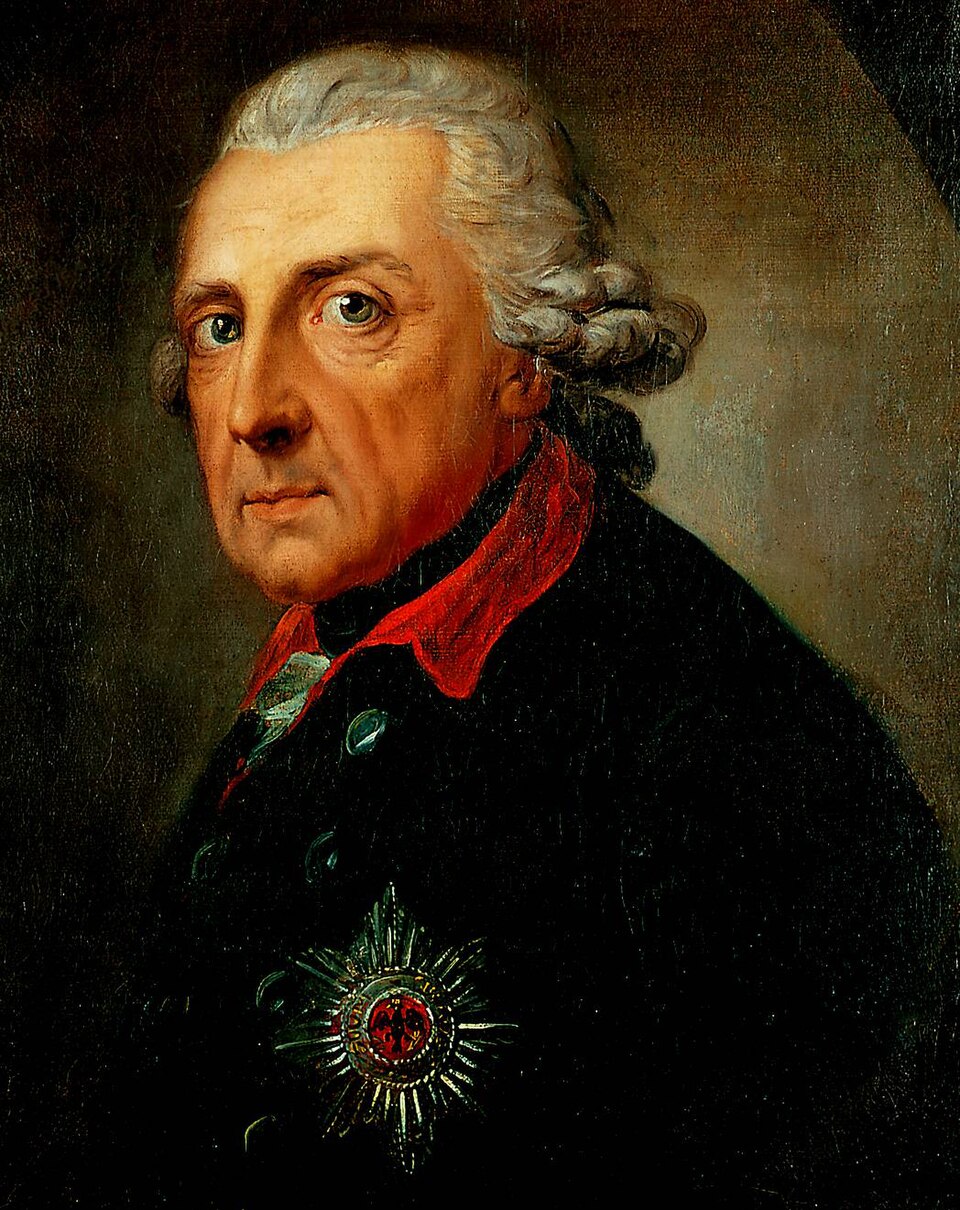
Frederick the Great, 1781
Oil portrait by Anton Graff (1736-1813) in the Sanssouci Palace collection via Wikimedia Commons.
Maybe Machiavelli’s teachings have no relevance in any remotely civilized political system. Maybe they’re far worse than irrelevant: maybe they’re all entirely evil (as they appear), and in addition, would prove the ruin of both the people and their ruler.
This was, as it happens, the view espoused by one important ruler: the Prussian king Frederick the Great. In his 1741 book, The Anti-Machiavel, he claims Machiavelli’s book is “one of the most dangerous that ever appeared in the world”, in that the political crimes it encourages would impose “a lasting misery upon whole nations”. Truly great rulers, says Frederick, aren’t the avaricious, amoral, self-serving, shape-shifting demons that Machiavelli describes. Rather, they are those “whose business it is to administer justice, and to set examples of justice to their subjects; and who, by their magnanimity, mercy, and goodness, ought to be the living images of Deity”. Thus, Frederick sees his rebuttal as “a defense of humanity against a monster who would destroy it”; it is “an antidote to poison”.
Frederick ruled Prussia for nearly 50 years. Most historians rate him a success. On the face of things, he seems like the kind of critic who knows what he’s talking about.
But Machiavelli would say, not so fast. What did Frederick do almost immediately after assuming power? Without any provocation, he launched a war to seize the large, prosperous, populous province of Silesia (now in southwestern Poland) from the Habsburg Monarchy. And he did so on a convoluted, centuries-old dynastic claim which sounded as unconvincing to his contemporaries as it does to us now. In the three Silesian wars which followed (the third turning into the Seven Years War), well over a million soldiers died fighting. Millions more wound up maimed, psychologically scarred, or otherwise ruined. Of course, millions of non-combatants also suffered: wives lost husbands, mothers and fathers lost sons, children lost fathers and uncles and brothers. Those non-combatants also suffered displacement, terror, deprivation, and injury. Over two decades, Frederick’s wars — particularly the Seven Years War — convulsed Europe. Frederick gained 30% more territory and 50% more citizens, but the cost was losing 10% of the Prussian population to combat or disease (the modern equivalent of 35 million Americans, 6 million English, or 3 million Australians). The point is: if his actions are anything to go by, Frederick didn’t oppose Machiavellian power moves as much as he professed, if at all. Machiavelli might even argue that in taking pains to proclaim his opposition to Machiavelli even as his wars of acquisition injured and killed millions, he was doing exactly what Machiavelli had advised: seeming to be good even as he was doing whatever the hell he wanted, for his own purposes. Most people will buy the act anyway, says Machiavelli, so why not?
This brings me back to Machiavelli’s claims about how rulers do in fact act, and how they must act to avoid ruin. And that in turn brings me back to the original wording of The Prince, and what real-world credibility Machiavelli might have as a political commentator.
As it happens, Machiavelli was no armchair quarterback. Even if he hadn’t spent nearly fifteen years at the highest levels of Florentine government (which he did), he might well have qualified as a political expert just by virtue of growing up in the tumultuous time and place he did. Between the jockeying Italian states, the myriad (and ever-changing) foreign alliances and enemies and designs, the political influence of the papacy, and Florence’s own internal politics, Machiavelli’s home city furnished more than enough lessons in how the political world could, and often did, operate.
Comments Off on Frederick the Great’s 1741 book, The Anti-Machiavel


