
“Antimacassar” is such a lovely Victorianism. We still have antimacassars — they’re those pieces of protective fabric you see at the top of your train or plane seat — but do you know why antimacassars are so called? Because in the nineteenth century Rowland’s Macassar Oil became such a popular unguent for gentlemen’s coiffures that the land was full of oily-haired chaps who, upon entering your drawing room, would settle back in your favorite chair — and uh-oh, there goes the fabric. Hence, the vital deployment of the antimacassar. Rowland’s Macassar Oil was one of the first products to be marketed nationally (and, indeed, internationally), and so universally known that Lewis Carroll put it in Alice Through the Looking-Glass:
His accents mild took up the tale:
He said ‘I go my ways,
And when I find a mountain-rill,
I set it in a blaze;
And thence they make a stuff they call
Rowlands’ Macassar-Oil –
Yet twopence-halfpenny is all
They give me for my toil.’Better yet, in Don Juan Lord Byron managed to rhyme it:
In virtue, nothing earthly could surpass her
Save thine ‘incomparable oil’, Macassar!Mark Steyn, “Self-Knitting Antimacassars”, Steyn Online, 2019-08-02.
September 23, 2023
QotD: In which we discover why they’re called antimacassars
September 21, 2023
Iranian Railways, Red Cross Care Packages, and Tail Gunners – WW2 – OOTF 31
World War Two
Published 20 Sept 2023How did the Allies build and manage an enormous railway supplying the Soviet Union through Iran? How did the Red Cross deliver aid parcels through enemy territory to Allied POWs? And, how effective were the rear gunners in ground attack aircraft like the Stuka and Sturmovik? Find out in this episode of Out of the Foxholes.
(more…)
This is York
Jago Hazzard
Published 28 May 2023“Make all the railways come to York!”
(more…)
September 20, 2023
Wire Guided Tank Killer | Swingfire | Anti-Tank Chats
The Tank Museum
Published 2 Jun 2023In this video, Chris Copson looks at the Swingfire, a Cold War period anti-tank guided weapons system. This powerful and hard-hitting missile was mounted on vehicles including Striker, Ferret, and FV 432. With a range of up to 4km, it had the significant advantage that it would outrange tank guns and could be fired remotely by the controller, enabling the launch vehicle to remain in cover.
(more…)
September 19, 2023
For some reason, ordinary Londoners don’t seem to appreciate Mayor Khan’s ULEZ initiatives
It’s hard to believe that anyone could possibly want to avoid London Mayor Sadiq Khan’s Ultra Low Emission Zone (ULEZ) expansion beyond the initial areas of the city, but a quick search of Twit-, er, I mean “X” shows evidence of what Justin Trudeau might characterize as a “small fringe minority … holding unacceptable views”:
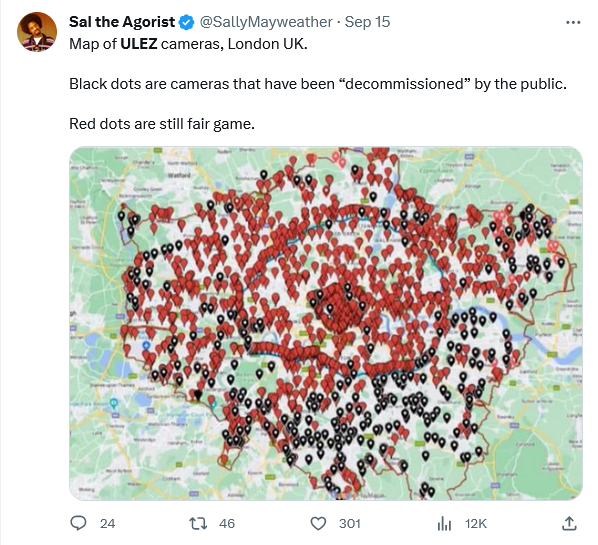
Weird, isn’t it. All those “decommissioned” cameras. And people physically blocking access to workers:
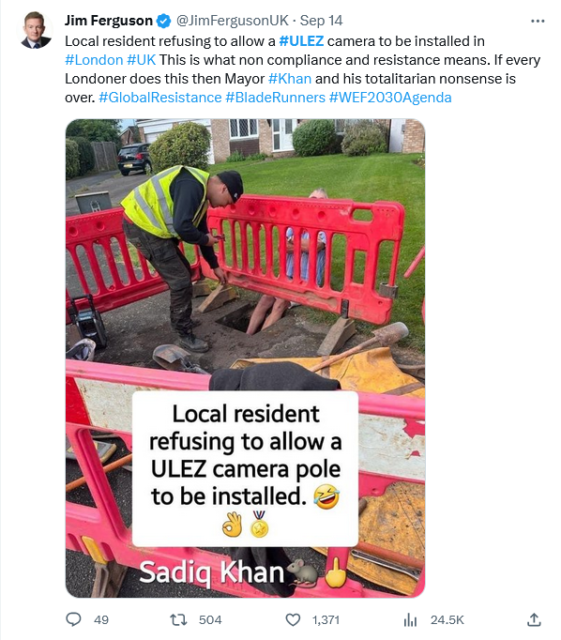
London has put up with a lot over the centuries, but Mayor Khan’s ULEZ somehow seems to have awakened the resistance in a major way:
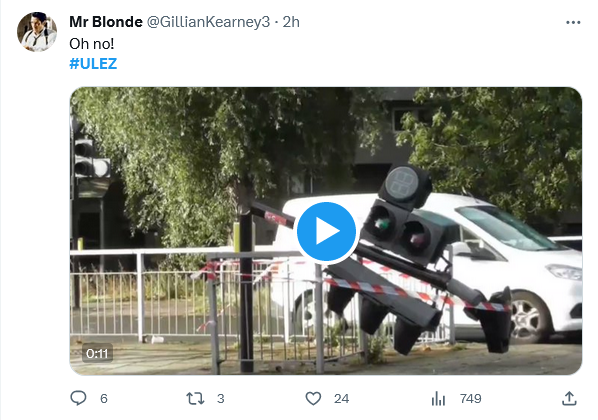
Brian Peckford republished this article from Yudi Sherman on the pushback against London’s ULEZ expansion:
London taxpayers are damaging the city’s surveillance vans in an escalating feud between Mayor Sadiq Khan and the city’s residents.
Last month Khan peppered the city with ultra-low emission zones (ULEZs), areas in London accessible only to low-emission vehicles. Cars that do not meet the city’s environmental standards are charged £12.50 ($16) for entering the ULEZ. Automatic Number Plate Recognition (ANPR) cameras positioned around the zones read license plates and check them against the vehicles’ make and model in real time. If a vehicle does not meet the environmental threshold, the fine is levied against the car owner. Failure to pay can lead to fines as high as £258 ($331).
The ULEZ climate mandate has drawn heavy protests from residents, including hunger strikes and refusal to pay fines. Taxpayers have also taken to disabling the ANPR surveillance cameras which Transport for London (TfL), the city’s transportation department, said will be used both for climate and law enforcement.
In response, the city deployed mobile surveillance vans mounted with ANPR cameras across London in the hopes of evading attacks, but the vans are being targeted as well. Some have been spotted covered in graffiti with their tires slashed, while others have been completely covered in tarp, reports the Daily Mail.
The activists are said to belong to a group calling itself the Blade Runners and have promised not to rest until every ULEZ camera is removed or destroyed “no matter what”. The group is being widely cheered by its compatriots, including media personality and political commentator Katie Hopkins. Over 4,000 people have joined a Facebook group to report ULEZ van sightings.
Between April 1st and August 31st, police recorded 351 incidents of destruction to ULEZ cameras and 159 removals, reports Sky News, an average of over 100 a month. Of those incidents, 171 reportedly occurred since August 17th alone, just before the ULEZ mandate officially expanded to include all outer London boroughs. Two individuals have been arrested in connection with the incidents, one of whom was charged.
One reported Blade Runner said, “In terms of damage it’s way more than what [London Mayor Saidq Khan and TfL] have stated.”
Jeremy Clarkson’s The Greatest Raid of All
North One
Published 4 May 2020Due to copyright restrictions, some music and scenes have been altered or removed in this upload. You can find the original unaltered documentary here: The Story Of The …
Jeremy Clarkson tells the story of the audacious commando raid on the German occupied dry dock at St Nazaire in France on March 28th 1942. Made for the BBC in 2007 by North One.
(more…)
September 18, 2023
Learning lessons from the plight of the British army in 1940
Lessons from history are only occasionally learned easily … they’re more likely brought to our attention by the Gods of the Copybook Headings after we’ve suffered some awful setback. As the latin tag would have it, Si vis pacem, para bellum: if you want peace, be prepared for war. Most western democracies refuse to believe this is true, and one of the easiest things for peacetime democratic governments to do is to short-fund the military and use the “savings” for more politically popular things that will help them get re-elected. The Canadian government has been a shining example of this since the late 1960s, with no end in sight.
A recent book on the British army, tracing its decline from the end of the First World War to the defeat in the Battle of France in 1940 shows just how quickly a world-beating army can be reduced to second-best in its next conflict. Richard Dannatt & Robert Lyman, the authors of Victory: the British Army 1918-1940 to Defeat, had an article in the Sunday Mail, illustrating the parallels between the army in their book and the British army today:
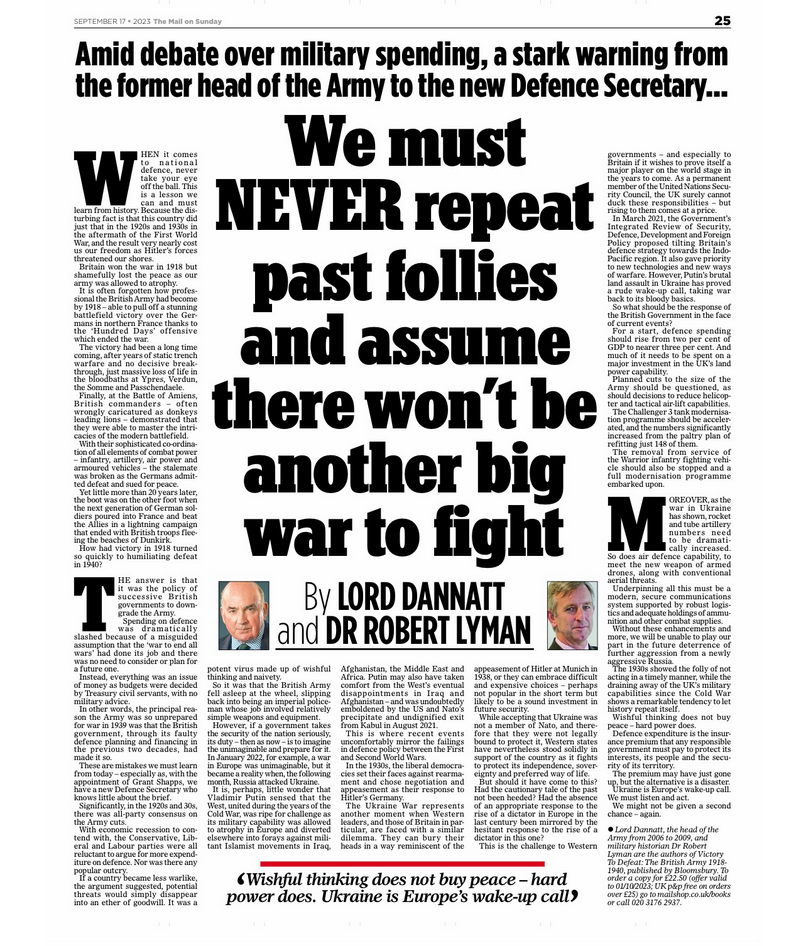
WHEN IT comes to national defence, never take your eye off the ball. That is a lesson we can and must learn from history. Because the disturbing fact is that this country did just that in the 1920s and 1930s in the aftermath of the First World War and the result very nearly cost us our freedom as Hitler’s forces threatened our shores.
Britain won the war in 1918 but then shamefully lost the peace as our army was allowed to atrophy.
It is often forgotten how professional the British Army had become by 1918, to pull off a stunning battlefield victory over the Germans in northern France in the final Hundred Days of the war.
It had been a long time coming after years of static trench warfare and no decisive breakthrough, just massive loss of life in the blood baths at Ypres, Verdun, the Somme and Passchendaele.
But finally, at the Battle of Amiens, British commanders — often wrongly caricatured as dunderheads and “donkeys” leading lions – demonstrated that they were able to understand and master the intricacies of the modern battlefield. With their sophisticated co-ordination of all elements of combat power — infantry, artillery, air power, armour — the stalemate was broken.
Modern war-fighting skills, technology and methods — learned at great cost in lives over the previous three-and-a-half years — secured victory for the British Army and its allies in 1918 as the Germans admitted defeat and sued for peace.
And yet little more than 20 years later, the boot was on the other foot as the next generation of German soldiers poured into France and defeated the Allies in a lightning campaign that ended with British troops fleeing from the beaches of Dunkirk.
How had victory in 1918 turned so quickly to defeat and humiliation in 1940?
The answer is that it had become the deliberate policy of successive British governments to downgrade the Army — a lesson we must learn today, with a new Defence Secretary who knows little about the brief.
Spending on defence was dramatically slashed amid an ill-thought-through assumption that there would not be another major war within ten years and so.
So far as the then government was concerned, the “war to end all wars” (as the Great War was dubbed) had done its job. There was no need to consider or plan for a future one, whether in policy, financial or practical terms. Everything was an issue of money as budgets were decided by Treasury civil servants with no military advice.
The principal reason why the Army was so unprepared for war in 1939 was that the British government, through faulty defence planning and financing in the previous two decades, made it so.
September 17, 2023
The Ballad of Chiang and Vinegar Joe – WW2 – Week 264 – September 16, 1944
World War Two
Published 16 Sep 2023The Japanese attacks in Guangxi worry Joe Stilwell enough that he gets FDR to issue an ultimatum to Chiang Kai-Shek, in France the Allied invasion forces that hit the north and south coasts finally link up, the Warsaw Uprising continues, and the US Marines land on Peleliu and Angaur.
(more…)
Why Operation Market Garden Failed and Its Devastating Consequences
OTD Military History
Published 5 Apr 2023Why did Operation Market Garden fail and what were the consequences of this failure? This video covers the operation, the reasons for the failure, and its devastating aftermath. The impact Market Garden had on the Dutch during the Hunger Winter and Allied soldiers during the Battle of the Scheldt is explored.
There is footage of the 101st US Airborne, 82nd US Airborne, British 1st Airborne Division, and the troops of the British XXX Corps featured in the video.
(more…)
September 16, 2023
France’s Vietnam War: Fighting Ho Chi Minh before the US
Real Time History
Published 15 Sept 2023After the Second World War multiple French colonies were pushing towards independence, among them Indochina. The Viet Minh movement under Ho Chi Minh was clashing with French aspirations to save their crumbling Empire.
(more…)
September 15, 2023
Learning to handle mules to accompany Chindit columns in WW2
Robert Lyman posted some interesting details from veteran Philip Brownless of how British troops in India had to learn how to handle mules and abandon their motor transport in order to get Chindit columns into Japanese territory in Burma:
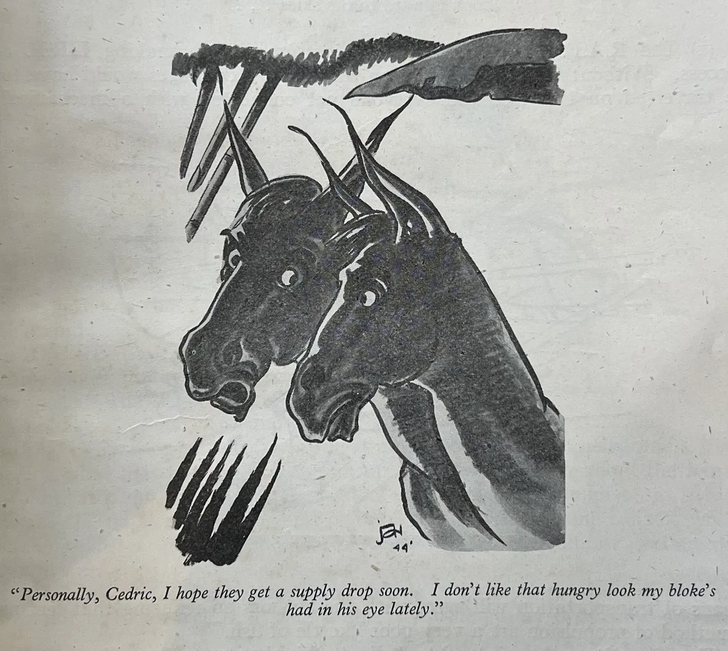
A fabulous drawing from Jungle, Jungle, Little Chindit (1944)
Soon after our return from the Arakan front in the autumn of 1943, we were in central India, and had been told that the whole division was to be handed over to General Wingate and trained to operate behind the Japanese lines. All our motor transport was to be taken away and we were to be entirely dependent upon mules for our transport.
The C.O. one evening looked round the mess and then said to me “You look more like a country bumpkin than anybody else. You will go on a veterinary course on Tuesday and when you come back you will take charge of 44 Column’s mules.”
I had never met one of these creatures before. On arriving at Ambala I reported to the Area Brigade Major who wasn’t expecting me and seemed to have no clue about anything. He said “You’d better go down to the Club and book in”. I reported to the Club, a comfortable looking establishment, and they seemed to have a vague idea that a few bodies like me might turn up on a course and were apologetic that I would have to sleep in a tent but otherwise could enjoy the full facilities of the Club. I was shown the tent, an EPIP tent or minor marquee, with a coloured red lining and golden fleur de lys all over it, (very Victorian) with a small office extension with table and chair in front and another extension at the back with bath, towel rail and a fully bricked floor. Having lived either in a tent or under the stars in both the desert and the Arakan for the last 2 years, this struck me as luxury indeed. Even better, I took on a magnificent bearer, with suitable references, whom I found later was some kind of Hindu priest. I soon got used to having my trouser legs held up for me to put my feet in, and being helped into the rest of my clothes. I had a comfortable 3 weeks learning all about mules.
I discovered all sorts of things like the veterinary term “balls”, which were massive pills which were given to the mule by – first of all grabbing his tongue and pulling it out sideways so he couldn’t shut his mouth on your arm, and then gently throwing the ball at his epiglottis and making sure it went down. Then you let go of his tongue and gave him a nice pat. One of our lecturers, an Indian warrant officer, knew his stuff well and was so pleased about it that when he asked a question he would give you the answer himself. He liked being dramatic and loved to finish a description of some fatal ailment by saying “Treatment, bullet”.
Many of the men in our battalion were East Enders; others came from all over Essex. A few were countrymen, two were Irish and knew all about horses, one sergeant had been in animal transport and one invaluable soldier had been an East End horse dealer. The large majority had had nothing to do with animals: however, the saving grace was that English soldiers seem to be naturally good with animals and soon learned to handle them well. I arranged to get some instruction from the nearby unit of Madras Sappers and Miners and we borrowed a handful of trained mules from them for the men to practise handling, tying on loads and learning to talk to them.
Then came the great day when we were to draw up our main complement of animals, about 70 mules and 12 ponies. We were dumped at a small railway station. It was all open ground and there was a team of Army Veterinary Surgeons to allocate fairly between the three battalions, the Essex, the Borders and the Duke of Wellington’s. Lieut. Jimmy Watt of the Borders was a pal of mine: he and I, with a squad of men were to march them back nearly 100 miles to our camp, sleeping each of the five nights under the stars. As soon as we arrived at the disembarkation site I got all our mule lines laid out, with shackles (used to tie mules fore and aft) and nosebags ready. I had also picked up the tip that the mules would be wild, having spent three days in the train, and almost impossible to hold, so I instructed our men to tie them together in threes before they got off the train. As all three pulled in different directions, one muleteer could hold them. Not everybody had learned this trick so the result was that wild mules were careering all over the place, impossible to catch. When our first handful of mules arrived, they were quickly secured in a straight line and fed. They were familiar with lines like this and cooled down at once, long ears relaxed and tails swishing amiably. When the wild mules careering round saw this line, they said to themselves “We’ve done this before” and came and stood in our lines. We shackled them and I picked out the moth-eaten ones and sent them back to the vets who kept sending polite messages of thanks to Mr. Brownless for catching them. We finished up with a very good set of mules. Jimmy Watt and I had a bit of a conscience about the Duke of Wellington’s so we picked them out a really good pony. We felt even worse a few weeks later when it was sent back to Remounts with a weak heart! The Brigade Transport Officer visited us the second evening so Jimmy Watt and I walked him round rather quickly, chatting hard, to approve the allocation of animals, and he agreed with our arrangement.
In a highly optimistic mood early on, I decided to practise a river crossing. We marched several miles out from camp to a typical wide sandy Indian river, 300 yards across, made our preparations, i.e. assembling the two assault boats, making floating bundles of our clothes and gear by wrapping them in groundsheets, unsaddling the animals, and assembling at the water’s edge. A good sized detachment of muleteers was posted on the opposite bank ready to catch the mules. The mules waded into the shallow water but no one could get them to move off. We tried all sorts of inducements in vain and then suddenly, one sturdy little grey animal decided to swim and the whole lot immediately followed. Calamity ensued! Mules are very short sighted and could only dimly see the opposite bank but downstream was a bright yellow sandy outcrop and they all made for this. The muleteers on the other bank, when they realised what was happening, ran through the scrub and jungle as fast as they could, but the mules arrived first and bolted off into the wilds of India. I swam my pony across with my arm across his withers and directing him by holding his head harness, the gear was ferried across and the mule platoon, with one pony, began the march back to camp. Deeply depressed, I wondered how to tell the C.O. I had lost all his mules and imagined the court martial which awaited me (or, serving under General Wingate, would I be shot out of hand?) An hour and a half later we came in sight of the camp and to my utter astonishment I could see the mules in their lines. When I arrived at the mule lines, the storeman met me and said that the whole lot had arrived at the double and had gone to their places. He had merely gone along the lines, shackling them and patted their noses. Salvation! I kept quiet for a bit but it got out and I was the butt of much merrymaking.
September 13, 2023
At the end of the Axis’ Destiny – War Against Humanity 114
World War Two
Published 12 Sep 2023The imperial dreams of Germany and Japan are in tatters. But the expansionist beasts do their best to drag their enemies down with them. Across Europe the cycle of resistance and retaliation continues. Paris is free but Warsaw burns. V-1s rain down on innocent civilians in London. The Japanese cleanse West Borneo of opposition. The genocide of the Jews continues. For so many people, liberation is now so near yet so far away.
(more…)
Why Do People In Old Movies Talk Weird?
BrainStuff – HowStuffWorks
Published 25 Nov 2014It’s not quite British, and it’s not quite American – so what gives? Why do all those actors of yesteryear have such a distinct and strange accent?
If you’ve ever heard old movies or newsreels from the thirties or forties, then you’ve probably heard that weird old-timey voice.
It sounds a little like a blend between American English and a form of British English. So what is this cadence, exactly?
This type of pronunciation is called the Transatlantic, or Mid-Atlantic, accent. And it isn’t like most other accents – instead of naturally evolving, the Transatlantic accent was acquired. This means that people in the United States were taught to speak in this voice. Historically Transatlantic speech was the hallmark of aristocratic America and theatre. In upper-class boarding schools across New England, students learned the Transatlantic accent as an international norm for communication, similar to the way posh British society used Received Pronunciation – essentially, the way the Queen and aristocrats are taught to speak.
It has several quasi-British elements, such a lack of rhoticity. This means that Mid-Atlantic speakers dropped their “r’s” at the end of words like “winner” or “clear”. They’ll also use softer, British vowels – “dahnce” instead of “dance”, for instance. Another thing that stands out is the emphasis on clipped, sharp t’s. In American English we often pronounce the “t” in words like “writer” and “water” as d’s. Transatlantic speakers will hit that T like it stole something. “Writer”. “Water”.
But, again, this speech pattern isn’t completely British, nor completely American. Instead, it’s a form of English that’s hard to place … and that’s part of why Hollywood loved it.
There’s also a theory that technological constraints helped Mid-Atlantic’s popularity. According to Professor Jay O’Berski, this nasally, clipped pronunciation is a vestige from the early days of radio. Receivers had very little bass technology at the time, and it was very difficult – if not impossible – to hear bass tones on your home device. Now we live in an age where bass technology booms from the trunks of cars across America.
So what happened to this accent? Linguist William Labov notes that Mid-Atlantic speech fell out of favor after World War II, as fewer teachers continued teaching the pronunciation to their students. That’s one of the reasons this speech sounds so “old-timey” to us today: when people learn it, they’re usually learning it for acting purposes, rather than for everyday use. However, we can still hear the effects of Mid-Atlantic speech in recordings of everyone from Katherine Hepburn to Franklin D. Roosevelt and, of course, countless films, newsreels and radio shows from the 30s and 40s.
(more…)
September 10, 2023
Bulgaria at War with Everyone – WW2 – Week 263 – September 9, 1944
World War Two
Published 9 Sep 2023This week the USSR invades Bulgaria … who’ve also declared war on Germany, and who are still at war with the US and Britain, so Bulgaria is briefly technically at war with all four at once. Finland signs a ceasefire, the Germans are pulling out of Greece, the Warsaw and Slovak Uprisings continue, Belgium is mostly liberated, and across the world, the Japanese enter Guangxi, and there are American plans to liberate the Philippines.
(more…)
September 7, 2023
The not-at-all hidden authoritarian desires of the climate activists
Brendan O’Neill on the increasingly blatant wish of the comfortable greenies to impose actual judicial punishment on those who disagree with their agenda:
“Palace of Westminster”by michaelhenley is licensed under CC BY-NC-SA 2.0


Greens have been dreaming about jailing “climate criminals” for a very long time. Climate-change deniers in particular will “one day have to answer for their crimes”, said eco-author Mark Lynas a few years back. Well, Gaia’s authoritarian army might finally be getting its way. The new Energy Bill currently before the UK House of Commons provides for “the creation of criminal offences”, possibly including jail time, where there is “non-compliance” with energy-saving regulations. Shorter version: keep the lights on for too long and you could end up in the slammer.
The Telegraph is reporting that property owners who fail to adhere to “energy-performance regulations” could “face prison” under the government’s crazy plans. There is concern that homeowners, landlords and business bosses could be whacked with fines of up to £15,000 or a year behind bars if they fall foul of regulations on energy consumption. The government says it has no plans to make it a crime to be an eco-unfriendly user of light and heat, but the bill allows for the creation of such crimes. And this has rattled some MPs. They’re concerned that ministers would be able to “create new offences with limited parliamentary scrutiny” thanks to the new bill.
What is the aim of all this tightening of the screws on energy use? Of the possible future criminalisation of us thieves of heat and light? To help Britain reach its Net Zero targets, of course. Like other Western nations, we’re committed to achieving Net Zero emissions by 2050. And if that means strongarming the little folk into reducing their energy use, so be it. Let’s be clear about what the new bill’s provision for the creation of crimes really represents: the state threatening to punish anyone who refuses to convert to the religion of Net Zero and to sacrifice their energy to the jealous god of environmentalism.
We can now see the iron fist in the green glove. There’s been a creeping criminalisation of eco-disobedient behaviour for some time now. In the UK, we’ve had “rubbish police” looking through people’s bags of trash and slapping them with a £100 fine if they are not properly recycling plastic and paper. Under Low Traffic Neighbourhood schemes, officious local councils erect eyesore bollards to stop people from driving on certain roads, and fine them if they fail to comply. In recent years, more than a million such fines have been served on defiers of the LTN regime, raising more than £100million for the Net Zero cultists who rule over us.
Then there’s London mayor Sadiq Khan’s Ultra Low Emission Zone (ULEZ), now expanded to cover every inch of London. Hundreds of cameras have been installed across the capital, a vast infrastructure of Stasi-like watchmen, to ensure that drivers of “dirty” vehicles have paid the daily ULEZ toll of £12.50. A fine of £500 awaits any driver of a sinful car who hasn’t. To those saying “Of course the government isn’t going to fine people for un-green behaviour!”, wake up – officialdom has been doing this for years.


