
It’s a conspiracy. Every piece of worthless advice I ever hear tells me I must, “Read, read, read”. I can’t even try to listen to music on YouTube without entrepreneurs, life coaches and other snake oil salesmen popping up on shouty adverts, posing alongside other people’s Lamborghinis and Learjets, asking me to guess how many books the world’s top fifty “Super Achievers” read each year. (It’s fifty-two, conveniently.) “The more you learn, the more you earn!” these morons confidently claim. As if reading books makes you a billionaire.
I don’t buy it. I bet billionaires don’t read at all. Not only because they don’t have the time, but because every big reader I know is broke. Without exception, books have overloaded their minds, and their lives are in total disarray. When they’re not consumed by tortuous examinations of Socialist Realism in the shallower subsections of the Baltic Canal between late October 1933 and early March 1934, they’re deconstructing turgid translations of 9th Century Glagolitic poetry from the White Carpathian territories of Great Moravia. On weekends, for light relief, they dip into obscure anthologies of critically-acclaimed feminist speculative fiction championing unsung writers born in the shadow of the Chappal Waddi in the Mambilla Plateau. What should have been their office hours are spent haggling with elderly volunteers in Oxfam bookshops over worthless, dogeared volumes of Dietrich Bonhoeffer’s early letters or needlessly exhaustive histories of the Sepoy Mutiny of 1857 in the Ganges-Brahmaputra basin. They own vast stacks of surplus, dust-magnet books, but they never own art, or cars, or houses. Bibliophiles are massive losers — why can’t we just admit that? There’s a clear correlation between reading and underachievement. There’s a reason homeless vagabonds line their coat pockets with paperbacks and newspapers. Our children must be warned, before it happens to them.
Reading is even less helpful to writers. If you write, you are incurably influenced by whatever garbage you happen to be reading at the time. For example, if I’m reading Hemingway, I finish this sentence here. Whereas, in the rare, transcending moments that I am reading, say, Henry James, I find, to my eternal chagrin, that I write — if, indeed, “write” is the morpheme, or mot juste, for which I rightly delve — in my lasting endeavours — my contention, if you will, against the ordained — in a spirit of refined demonstration, or braggadocio, as the case may be, that … Where was I?
Then, of course, there’s the snobbery associated with reading. “Read a book!” command the enlightened few, should you dare disagree with them on any trendy subject. It’s ridiculous, but if you read — or, better still, opine pretentiously about what you read — the chattering classes will clamber to pressgang you into their fanatical ranks. Nobody cares if you write anything, so long as you describe the latest high-status books as “vital”, “necessary”, “required”, or “essential”. Trust me, you can get away for years with pretending that you are “working on something big that I’d rather not talk about for fear of jinxing it” while freely enjoying all the wine and canapes you can stomach. But suggest you don’t read, and people quickly get suspicious.
Dominic Hilton, “All Booked Up”, The Critic, 2020-08-17.
April 21, 2026
QotD: “Bibliophiles are massive losers, why can’t we just admit that?”
April 20, 2026
Civilization-building is gendered, sorry ladies
On Substack, Janice Fiamengo explains why the very different strengths and weaknesses of men and women will always lead to what appear to be unequal results, and fighting against biology is always a bad idea:
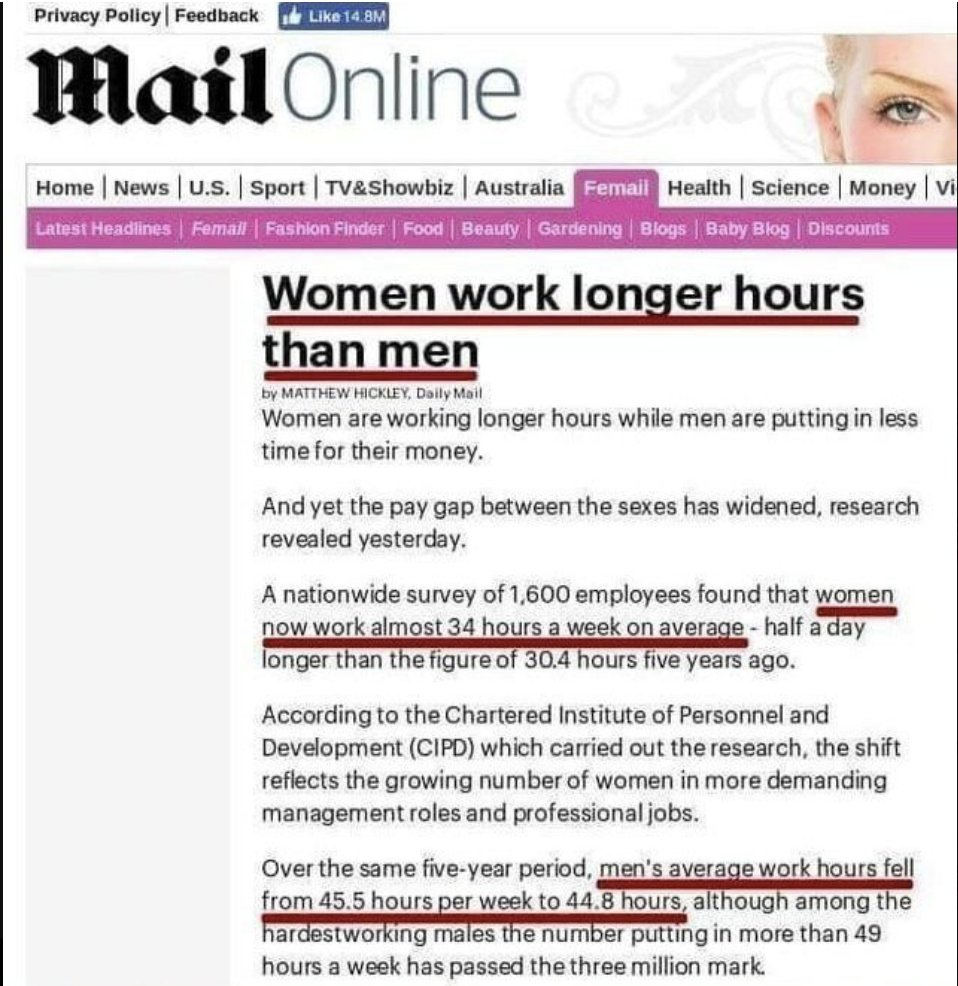
Even if the numbers don’t back it up, women feel that this is so true.
Social psychologist Roy Baumeister explored the relevant research in Is There Anything Good About Men (2010), a cautiously non-feminist book in which the author readily asserted that he, like most everyone else, prefers women to men. Women are more lovable, he claimed, and more pleasant to be around.
But he was not quite willing to accept the now-mainstream thesis that women can replace men in all areas of society.
His thesis is summed up in the book’s sub-title: How Cultures Flourish By Exploiting Men. Men are the foot soldiers of civilization as well as its leaders. They are the ones who make things work or make new things.
Men are the ones who must prove their utility to society. Their drive to be useful has powered centuries of back-breaking work, risk-taking, tool-building, self-sacrifice, and outstanding performance of a sort that has never been expected of women (and still isn’t).
Women in the main tend not to work as hard as men to succeed because they don’t have to. Women developed different strengths and tendencies.
Women’s strength, for good and ill, is in the inter-personal arena: not only in caring for those who are weaker but also in being cared for by those who are stronger. Women are good at reading people’s emotions and desires, and at expressing their own.
Men are not rewarded for expressing emotions and desires; men are oriented to acting, often under pressure to perform competently, in large groups and systems.
“The female brain,” according to Baumeister, “tends to be geared toward empathy, which includes emotional sensitivity to other people and deep interest in understanding them and their feelings. In contrast, the male brain is oriented toward understanding systems, which means figuring out general principles of how things operate and function together, and this applies to inanimate objects as much as social systems” (p. 85).
Baumeister supports his argument in a book-length exploration of men’s system-building. He shows how men are driven to work with, and in competition with, other men to make it possible for large numbers of human beings to live together in complex, efficient networks. The large social institutions that have characterized western cultures, from the army to churches, from corporations to unions, and from market places to police forces, give evidence of men’s system-building.
Women can work well within the systems that men devise, but they rarely devise new systems on their own. This is not because women are, on average, less intelligent than men (except at the very highest levels). It is because women’s motivations and sources of satisfaction are generally different from men’s.
Women’s contribution to culture in nurturing children, providing companionship, and looking after the family home has been a crucial one. But it does not drive innovation or invent new technologies.
Even the most intelligent women are rarely compelled, as highly intelligent men often are, to pursue scientific and other breakthroughs with the single-minded focus necessary for greatness. Often, as in the case involving Matt Taylor discussed above, many women do not seem to value or understand the nature and importance of such breakthroughs.
Women’s main contribution in the male civilizational sphere has been to lobby for admission and then to complain about, and work to undermine, the male culture of competitive excellence.
“Hail, Caesar!” oops we meant “Hail, Carney!”
At The Rewrite, Peter Menzies discusses the unseemly media adulation1 for Caesar Prime Minister Mark Carney after more than a year in power:

Grok illustration of PM Carney as Caesar
Image from The Rewrite.
Thirteen months into his reign as prime minister, we still don’t know who Mark Carney is or how he engineered the removal of Justin Trudeau from office.
Nor do we know what really happened behind the scenes to convince five Members of Parliament to betray their constituents’ democratic decisions and, for the first time in the nation’s history, give Canadians a majority government they didn’t elect.
What we do know is that none of that seems of great interest to most of our media or, as they like to describe themselves when seeking federal subsidies, “defenders of democracy”.
As The Rewrite noted a year ago, the moves behind the scenes to effect the abrupt ouster of Trudeau remain a mystery. And, unlike with other PMs, there have been no Carney family magazine profiles. (Who can forget Justin and Sophie Trudeau‘s sexy Vogue cover?) Yes, there are the books, Values and The Hinge. We have learned he likes hockey, runs, won’t criticize China and is ruthless. But there is a tangible paucity of efforts within MSM to get beyond what is permitted to be known. We don’t even know if he watches Heated Rivalry or why the Brits called him “the unreliable boyfriend”. And yet, as Stephen Maher wrote for Time magazine last week, Canadians adore him.
As for how he has seized power in excess of that granted by the electorate 11 months ago, there wasn’t a hint of concern on the part of CTV News anchor Omar Sachedina when Carney’s majority was confirmed in a couple of “gimme” by-election victories.
The leading voice on Canada’s most-watched newscast, Sachedina appeared awestruck by the “historic” moment and “what the Liberals have been able to achieve in the past year”. When his sidekick, Vassy Kapelos, noted Carney was now out of excuses for not fulfilling the promises that won him a minority government in 2025, Sachedina suggested soothingly that Canadians remember “sometimes ambition does take time, sometimes several election cycles”.
Screencap of CTV News from The Rewrite
The message to Canadians? The Liberals have accomplished great things in the past year, the greatest of which was to do what no one in the nation’s history had ever done before — manufacture a majority without the public’s consent. Oh, and be patient. PMMC’s agenda could take a few more elections. Sit tight and trust.
The next morning, questions were not, as one might expect from defenders of democracy, about whether the PM felt a tad greasy for the way in which he had won unfettered power. Like, in some countries — many actually — that might be considered kind of scary. Here? If you watch the news, it’s dreamy.
The preferred line of inquiry was to ask Carney whether, if he was the Opposition Leader, Pierre Poilievre, he would quit. And so it went for the rest of the week. PMMC wasn’t asked if he worried that his majority would undermine the public’s faith in its institutions. Nor did the press corps pursue their sources to discover what inducements may have been offered to create his Judas Gang of Five.

- Yes, I know … the presstitutes will “love him long time” as long as the government subsidies keep rolling in.
Airline deregulation in the 1970s
The end result — democratizing air travel and enabling far more people to economically travel long distances — also meant that air travel became far more casual (people no longer dressed “properly” for flights) and economy flights began to more closely resemble long-distance buses, but overall it was a win:

The Airline Deregulation Act of 1978 stands as one of the most spectacular vindications of free market principles in modern American history. Before deregulation, the Civil Aeronautics Board controlled every aspect of commercial aviation: routes, schedules, and most critically, prices. Flying remained a luxury reserved for the wealthy elite, with fares artificially inflated by regulatory capture and government-sanctioned cartels.
Within a decade of deregulation, average airfares plummeted by 50% in real terms. The number of passengers more than doubled from 250 million in 1978 to over 500 million by 1990. New airlines like Southwest and JetBlue emerged with innovative business models that prioritized efficiency over bureaucratic compliance. Routes previously deemed “unprofitable” by government planners suddenly thrived under competitive pressure.
The regulatory regime had created exactly what free-market theory predicts: artificial scarcity, price distortions, and a complete disconnection from consumer preferences. Airlines competed on amenities instead of price because the CAB fixed fares at monopoly levels. They served cocktails and full meals while ordinary Americans couldn’t afford tickets. The moment government stepped aside, entrepreneurs discovered countless ways to serve previously ignored market segments.
Critics warned that deregulation would compromise safety and create chaos. Instead, aviation safety improved dramatically as airlines faced real liability for accidents and insurance companies imposed rigorous standards. Competition forced operational excellence in ways bureaucratic oversight never could. Hub-and-spoke networks emerged organically, maximizing efficiency without central planning.
The contrast couldn’t be starker: decades of stagnation under regulatory control versus explosive innovation and democratization under market freedom.
Yet the same politicians who celebrate affordable air travel continue strangling other industries with identical regulatory schemes.
How to sharpen a Thin Scraper | Paul Sellers
Paul Sellers
Published 12 Dec 2025We try to cover every woodworking hand tool we can to pass along the knowledge we have to future generations.
We’ve been asked for this video a few times, so here it is. How to sharpen a thin scraper. It has many uses, and the art should not be lost.
It takes only a couple of minutes to do, and you can approach even the wildest grain with this single tool.
——————–
(more…)
QotD: The quality of evidence problem for historians
And yet, you can’t entirely discount them, either. Crecy (along with of course Agincourt) is supposed to be the triumph of the English longbow, and that’s the thing: We’ve reconstructed English longbows, and put them through all kinds of trials. The results, as I understand it — which, again, ain’t much — were highly variable. A very strong, well-fed, highly trained longbowman, firing an ideally constructed and maintained bow under optimal conditions, really can put X number of arrows up a flea’s ass at Y range in Z time.
Or they could miss the broad side of a barn at twenty feet, depending.
So: What was the weather like in Northern France on 26 August 1346? That’s not an idle question. Rather, it’s the central question. Assume perfect shooting conditions, and you’ve got a far, far different picture of the battle than if you assume poor ones. And if that seems to be giving too much credit to the weather, watch a few baseball games — you’ll quickly discover that quite often, the difference between a home run and a long out is just a few percentage points of relative humidity.
Ultimately it comes down to judgment. More importantly, it’s a judgment on how any particular event fits into the larger argument you’re trying to make. In a way, then, the details really don’t matter very much on their own — the mechanics of how the English won are almost irrelevant, except insofar as they feed into an analysis of why they won. Why did the French king attack uphill, in the mud? Was he stupid? Overconfident? Did he feel he had to, because of political problems inside his host? Did he have faulty information? Did he have accurate information, but just made a bad call?
That’s the art of History, and why, despite what the Peter Turchin (and Karl Marx) crowd keeps insisting, it will always be an art, not a science. We can have a high degree of confidence, most times, in what happened — there really was a battle at Crecy, and the English really did win it. It’s the why that is susceptible to radical reinterpretation.
Severian, “Friday Mailbag”, Founding Questions, 2022-06-17.
April 19, 2026
Simple rules for judging commentary on the Iran situation
You’ve probably noticed that I don’t include a lot of content on Iran or Ukraine these days. That’s largely because the fog of war propaganda is too dense for much reliable information to come to us and be subject to any kind of fair analysis. Lorenzo Warby has a few rules to suggest to those of you trying to sift real information out of the noise — both specifically on the Iran conflict and also more generally for these kinds of low-signal/high-noise conflicts:
There is a lot of poor quality commentary about on the current Iran War — or, as the Chinese call it, the War in West Asia. Fortunately, there are two simple tests that winnows out much of the noise so you can focus on signal.
Locations struck by:
– United States and Israel (blue)
– Iran, Hezbollah, Houthis, and PMF (red)First Easy Test
Would this commentator ever admit that Trump had done something positive?
If the answer is no, ignore them. They are not commenting on the War, they are commenting on Trump. They are just providing anti-Trump talking points for this particular issue.
Second Easy Test
Does this commentator pay any attention to the record of the Islamic Regime? Its record of domestic repression, including various mass executions and mass killings of protesters? Its record in supporting and constructing proxies: in Lebanon, in Gaza, in Yemen, in Iraq, in Syria, in …? The record of those proxies and how they disrupt and degrade those countries? Its record in promoting terrorism across the globe? Its record in massive economic and environmental dysfunction …?
If the answer is no, ignore them. This is especially so if what they do comment on is Israel. They are not commenting on the War, they are commenting on Trump and on Israel. They are just providing anti-Trump, anti-Israel talking points for this particular issue.
The more of a regime of internal exploitation the Islamic Regime has become, the more it has built up its proxy forces. The more it built up its proxy forces, the more disruptive and destructive it has become.
[…]
Third, More Subtle, Test
The third test is about how wars work. Does the commentator understand that good strategy in war is a decision-tree? If you do X and Y happens, then follow up with Z. If you do X and A happens, follow up with B.
If they do not understand that, if they treat successful war strategy as being able to operate according to some plan so what the opponent does in response to it does not matter, then they do not understand war, and you can ignore them.
A classic way to fail in military affairs, is to not treat military action as a decision-tree, but to continue with the previous plan of action despite some crucial change in circumstances.

How to Tank the Economy for War – Death of Democracy 12 – Q4 1935
World War Two and Spartacus Olsson
Published 18 Apr 2026Nazi Germany in late 1935 was becoming more ruthless, more militarized, and more dangerous. In this episode, Spartacus Olsson reports from Berlin on the final months of 1935, when Hitler’s regime tightened its grip through food shortages, propaganda, rearmament, and the continued implementation of the Nuremberg Laws. As ordinary Germans faced rising prices, scarce meat and butter, and mounting pressure to sacrifice for the Reich, the Nazi state pushed its “guns before butter” economy even further. We examine the “fat gap”, Winter Relief, Eintopfsonntag, and the growing burden placed on German families while resources were diverted to war preparation.
At the same time, the First Supplementary Decree to the Reich Citizenship Law gave the regime a bureaucratic definition of who counted as a Jew, accelerating exclusion, dismissal, and persecution. Courts, police, and the Gestapo increasingly enforced the racist order, while Goebbels’ propaganda machine worked to normalize hardship, suppress criticism, and intensify antisemitism.
Against the backdrop of Mussolini’s invasion of Abyssinia and the paralysis of the League of Nations, Hitler found new room to maneuver internationally while consolidating dictatorship at home. This episode explores how the Third Reich turned scarcity into discipline, prejudice into law, and national pride into obedience — bringing Germany one step closer to catastrophe.
Never Forget.
AI’s missing economic impact
On the social media site formerly known as Twitter, Rational Aussie explains at least part of why the expected economic benefits of widespread adoption of artificial intelligence agents are … missing:

It’s funny how AI has made white collar work 10x faster already but there’s been basically no economic impact from it.
The reason is quite simple:
1. Most white collar work is bullshit, so speeding it up by 10x still equals a pile of bullshit at the end
2. Most white collar employees are using AI to do all their work for the week in 4 hours instead of 40, whilst telling their manager the deadline is still 40 hours away
We have been living in a fake economy for the better part of two decades. It is all a fugazi.
People who do real jobs in the real world get paid comparatively crap, and people who do fake jobs in the fiat Ponzi world get paid just enough fiat currency to pretend they are important. None of it amounts to anything productive nor valuable for the world though.
An entire generation doing fake email jobs, slide decks and excel sheets for corporations who ultimately produce nothing.
HMCS Magnificent – Canada’s Forgotten Carrier
Skynea History
Published 13 Nov 2025The Royal Canadian Navy is probably not the first one you think about for naval aviation. You’re more likely to think of lighter ships, like Haida.
However, the Canadians would operate three aircraft carriers during the Cold War. The short-lived (well, short-lived in Canadian service) Warrior. The more famous Bonaventure, that I’ve covered before. And, the topic of this video, HMCS Magnificent.
The middle child and probably the least famous of the three. But the one that is, largely, responsible for building Canadian carrier doctrine. It was Magnificent that built up the Canadian naval air arm. Magnificent trained the pilots that would go on to serve with Bonaventure.
And Magnificent is often overlooked for being the middle child. Hence why I chose to cover her today.
Further Reading:
https://forposterityssake.ca/Navy/HMC…
https://naval-museum.mb.ca/rcnships/c…
QotD: The (only?) man who didn’t fear Margaret Thatcher
Thatcher reacted with cold fury, but Hoskyns was unabashed. Another story tells of his arriving for a meeting with the PM only to be intercepted by Ian Gow, her personal secretary. “Our girl is tired,” said Gow, trying to bar his path. “I’m tired too,” muttered Hoskyns. “It goes with the bloody job. I’m going in.”
Such irreverence to the “Great She-Elephant”, “She who must be obeyed”, “Attila the Hen” is rare enough, but this isn’t the main thing to remember Hoskyns for. Far more interesting – and relevant to now – is the work he did with fellow conservative Norman Strauss in the mid-1970s to diagnose the exact sources of Britain’s economic malaise, and come up with clear policies about how the country could haul itself out of it.
Robin Ashenden, “Thatcher’s ‘Wiring Diagram’ and why we need it once again”, The Critic, 2020-08-25.
April 18, 2026
“The whole thing was one giant attempt to gaslight both young men and the public at large”
On the social media site formerly known as Twitter, Christian Heiens responds to a cover story in The New Statesman:
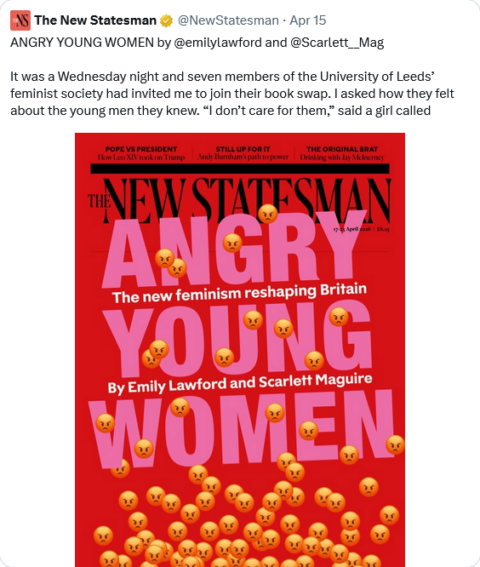
We were subjected to years of “young men are becoming radicalized, what’s driving this and how do we stop it?” discourse when in reality the typical young man saw practically zero change in his political outlook over the last 30 years.
The whole thing was one giant attempt to gaslight both young men and the public at large that they had suddenly moved well outside the Overton window and were either self-radicalizing or falling for extremist propaganda.
In reality, the problem was that young men were staying put rather than adopting increasingly radical progressive views. The real issue was that young women were flying off the rails, espousing views that would lead to the complete dissolution of civilization itself while acting like these were basic normal positions that completely sane people should hold.
That disconnect between what was being said and what was being done became so off kilter with reality that something finally began to break after 2020.
The problem isn’t with young men. The problem is that young women have gone certifiably insane. They’ve made radical progressivism their religion. They’re acting out on the perfectly healthy female tendency to act to uphold and preserve the existing social order.
Young women are trying to conserve an ideology they see as the stable bedrock of society, even if it’s actually an acidic collection of delusions that will inevitably destroy society itself. And they’re upset that young men aren’t doing what they see as their role to uphold that order as well.
In short, women are natural conservatives. They’re trying to conserve progressivism because it’s the reigning social order and theological governing system of Western civilization. And they’re upset and confused as to why young men aren’t stepping up to uphold it as well.
On Substack Notes, John Carter commented on the same New Republic The New Statesman cover story:
Women have never had it better than they do in modern Western countries. They are affluent, thanks to being given every advantage in education and employment; young women now hold more degrees, and make more money, than young men. They can marry whoever they want, from anywhere in the world, or they can marry no one at all. They can sleep with whoever they want, with however many people they want, with no risk of pregnancy, and if they get the ick later they can decide that it was rape and their abuser will be punished. Any opposition to their cultural or political preferences is automatically classified as hate, and every institution acts to denounce and punish this unacceptable hatred on their behalf … in no small part because they have taken over these institutions.
Women have never had it better, and they are absolutely incandescent with fury about that.
Australia’s age verification scheme – a great success!
Every time a politician gets up on hind legs to propose yet another brilliant scheme to ensure little Jaden and little Daenerys don’t access adult content on the internet, I remind myself that it’s going to be pitting the tech know-how of people who need help opening child-proof caps against the youngsters they get to open the child-proof caps for them. In other words, it’s not going to work out quite how the politicians expect:

“Kid-notebook-computer-learns-159533” by LuidmilaKot is marked with CC0 1.0 
 .
.
Among the great many bogeymen of the current moment is social media, which stands accused of making young people anxious and unhappy. Whatever the merits of those charges — and they’re debatable — politicians have predictably tried to address concerns by applying the blunt instrument of coercive law to kids’ online activities rather than simply let parents help their children make better choices. The experience in Australia now shows the subjects of the law have, once again, proven cleverer than law enforcers.
[…]
“There are significant questions about the effectiveness of Australia’s social media ban”, reports the U.K.’s Molly Rose Foundation, which supports internet restrictions, of the results of a poll of Australian young people. “Three fifths (61%) of 12–15 year-olds who previously held accounts on restricted platforms continue to have access to one or more active accounts.”
The group adds that “70% of children still using restricted sites say that it was ‘easy’ to circumvent the ban. In most cases, social media platforms have failed to detect or seek to remove under 16s accounts.”
Importantly, officials agree that young people subject to the law are actively evading its impact. In a compliance update published last month, Australia’s eSafety Commissioner, which enforces the ban, conceded that “a substantial proportion of Australian children under the age of 16 continue to retain accounts, create new accounts, or pass platforms’ age assurance systems”.
Like the Molly Rose Foundation, Australian regulators note that noncompliance is not just a concern for the small platforms with limited exposure in Australia which were expected to become refuges for Australian teens seeking online connections. They also point to large, established companies including Facebook, Instagram, Snapchat, TikTok, and YouTube.
In the majority of cases, according to both reports, young people ignoring the law have not yet been asked to verify their age. But, according to the Molly Rose Foundation, “around a quarter of children still using each restricted platform had been successfully able to get around an age check on a pre-existing account”. Some changed their claimed age, others had older friends and relatives set up accounts for them, and still others gamed technology intended to estimate their age by their appearance.
Another proof of the value of open source
On the social media site formerly known as Twitter, ESR discusses a pre-computer (pre-electronics) proof that open source is more secure than closed source:

“How university open debates and discussions introduced me to open source” by opensourceway is licensed under CC BY-SA 2.0


There’s an old, bad idea that’s been trying to resurrect itself on X in the last couple of days. Which makes it time for me to explain exactly why, in the age of LLMs, open-sourcing your code is an even more important security measure than it was before we had robot friends.
The underlying principle was discovered in the 1880s by an expert on military cryptography, a man named August Kerckhoffs, writing long before computers were a thing.
To start with, you need to focus in on the fact that cryptosystems have two parts. They have methods, and they have keys. You feed a key and a message to a method and get encrypted information that, you hope, only someone else with the same pair of method and key can read.
What Kerckhoffs noticed was this: military cryptosystems in normal operation leak information about their methods. Code books and code machines get captured, stolen, betrayed, or lost in simple accidents and found by people you don’t want to have them. This was the pre-computer equivalent of an unintended source-code disclosure.
Cryptosystems also leak information about their keys — think post-it notes with passwords stuck to a monitor. What Kerckhoffs noticed is that these two different kinds of compromising leakage happen at very different base rates. It is almost impossible to prevent leakage of information about methods, but just barely possible to prevent leakage of information about keys.
Why? Keys have fewer bits. This makes them easier to keep secret.
Remember: this was something an intelligent man could notice in the 1880s, well before even vacuum tubes. Which is your first clue that the power of this observation hasn’t changed just because we’re in the middle of a freaking Singularity.
Security through obscurity — closed source code — means you’re busted if either the source code or the keys get leaked. Open source is a preemptive strike — it’s a way to force the property that your security depends *only* on keeping the keys secret.
What you’re doing by designing under the assumption of open source is preventing source code leakage from being a danger. And that’s the kind of leakage with a high base rate.
As far back as 1947 Claude Shannon applied this to electronic security — he did critical work on the voice scramblers that were used for secure telephone communications between heads of state during World War II. Shannon said one should always design as though “the enemy knows the system”. The US’s National Security Agency still uses this as a guiding principle in computer-based cryptosystems.
If you’re doing software security, always design as though the enemy can see your source code. I’m still a little puzzled that I was apparently the first person to notice that this was a general argument for open source; as soon as I did, my first thought was more or less “Duh? Somebody should have noticed this sooner?”
Now let’s consider how LLMs change this picture. Or…don’t.
An LLM is like a cryptanalyst with a superhuman attention span that never sleeps. If your system leaks information that can compromise it, that compromise is going to happen a hell of a lot faster than if your adversary has to rely on Mark 1 meatbrains.
But it gets worse. With LLMs, decompilation is now fast and cheap. You have to assume that if an adversary can see your executable binary, they can recover the source code. If you were relying on that to be secret, you are *screwed*.
Leakage control — limiting the set of bits that can yield a compromise — is more important than ever. So security by code obscurity is an even more brittle and dangerous strategy than it used to be.
Anybody who tries to tell you differently is either deeply stupid or trying to sell you something that you should not by any means buy.
The First M60 Prototype: FG42 + MG42 = T44
Forgotten Weapons
Published 1 Dec 2025The FG-42 caught the attention of a lot of countries at the end of World War Two. The British and Swiss both used it as the starting point for some developments. The US went one step simpler, and simply cut up a captured FG-42 to make into the T44, the first prototype of what would become the M60 machine gun.
This project was done in 1946 by the Bridge Tool & Die Company, who spent about six months reinforcing an FG42 and adding an MG42 feed system to it to create an unholy hybrid kludge of a gun. It was, however, successful enough to justify continuing the project. Only this one example was made before moving on to much more practical models built from the ground up instead of hacking up captured German guns.
(more…)


