Quotulatiousness

April 24, 2026

Defending Heinlein and his most controversial novel – Farnham’s Freehold

Filed under: Books, USA — Tags: , , , , , , — Nicholas @ 02:00

Grammaticus Books
Published 21 Nov 2025

An indepth review of Robert A. Heinlein’s most controversial novel. A novel sometimes referred to as Science Fiction’s most controversial novel, Farnham’s Freehold.

00:00 Intro
02:30 Why I Read Farnham’s Freehold
04:33 The Plot (Spoilers)
12:48 The Critics’ Complaints
21:40 Is it A Fun Read?

My Video on Time Enough for Love:
Heinlein’s MOST CONTROVERSIAL Novel – Time…

Update, 25 April: Welcome, Instapundit readers! Have a look around at some of my other posts you may find of interest. I send out a daily summary of posts here through my Substackhttps://substack.com/@nicholasrusson that you can subscribe to if you’d like to be informed of new posts in the future.

QotD: Cant

Filed under: Politics, Quotations — Tags: , , — Nicholas @ 01:00

How does one distinguish cant from real concern or real emotion? The authors rightly say that there is no fool-proof test. Some people are more sensitive than others to the wrongs of the world: as Mrs. Gummidge puts it, “I feel it more”. But if I were to say with a pained expression, “I am so concerned about the situation in the Southern Sudan that I cannot sleep at night”, and you knew perfectly well that I slept like a log the night before after dining well, and furthermore that I had no connections whatever with the Southern Sudan, you would know that I was canting.

As the authors point out, canting has an inherent positive feedback mechanism. For example, in the game of more-compassionate-than-thou it is always possible to be outflanked by someone who claims an even wider circle of concern, a deeper fellow-feeling with the downtrodden, than any that you have expressed, so that you feel obliged, in order to come out top in this competition, to go another step beyond your original claim, which was bogus to start with. Once you start canting, it is difficult to stop, at least in the short term.

Theodore Dalrymple, “The Expanding Tyranny of Cant”, The Iconoclast, 2020-08-26.

April 23, 2026

The SPLC in the news

Filed under: Government, Law, Media, Politics, USA — Tags: , , , , , — Nicholas @ 05:00

The Southern Poverty Law Centre (SPLC) is in the news this week for unusual reasons — not SPLC lawyers levelling accusations against individuals, elected officials, or corporate leaders, but the SPLC itself being hit with very serious charges from the US DoJ:

For nearly a decade, the 2017 “Unite the Right” rally in Charlottesville has been portrayed as a defining moral crisis of the Trump era. Across the media and in political speeches, Charlottesville became shorthand for “Trump-era” hate. In his 2019 campaign launch, Joe Biden called Charlottesville “a defining moment for this nation”, describing how “Klansmen and white supremacists and neo-Nazis” marched bearing “the fangs of racism”.1

He condemned President Trump’s “very fine people on both sides” comment. In Biden’s words, the president’s equivocation “assigned a moral equivalence between those spreading hate and those with the courage to stand against it”, and thus signalled a threat “unlike any I had ever seen in my lifetime”.2 Polling at the time showed the public broadly agreed, nearly 60% of voters said Trump had “encouraged” white supremacists by his response, and a majority disapproved of how he handled Charlottesville.3 In short, Democrats and sympathetic media used Charlottesville as a concrete proof-point that Trump had unleashed a racial crisis, and that the country was in “a battle for the soul of this nation”.4 This narrative was presented earnestly by them: far-right violence in Charlottesville would be a national wake-up call about racial hatred that, in their telling, demanded urgent political action.

The Indictment: SPLC Charged

Last week, a new development has upended that narrative. On April 21, 2026, the Department of Justice announced that an Alabama grand jury returned an 11-count indictment against the Southern Poverty Law Center (SPLC), the prominent civil-rights nonprofit best known for its “hate group” lists, charging it with wire fraud, bank fraud, and conspiracy to commit money laundering.5 The indictment alleges that from 2014 to 2023 the SPLC secretly funnelled more than $3 million in donated funds to individuals in violent extremist groups.6 For example, DOJ spokesmen say SPLC paid large sums to figures associated with the Ku Klux Klan, the neo-Nazi National Socialist Movement, the Aryan Nations and others. Crucially, prosecutors claim SPLC used covert methods: it opened bank accounts in the names of “fictitious entities” (with names like “Center Investigative Agency”, “Fox Photography”, and “Rare Books Warehouse”) to disguise payments to its paid informants. By routing donations through these shell accounts, SPLC allegedly hid the true destination of the funds. In effect, donors were told their money was helping to “dismantle” hate groups, but a portion of it was instead being diverted back to the leaders and organisers of those very groups, all while SPLC publicly denounced them.7

The indictment lays out telling examples. One SPLC “field source” reportedly received over $1 million between 2014 and 2023 while affiliated with the neo-Nazi National Alliance.8 Another informant was actually in the inner online circle that planned the Charlottesville rally itself: prosecutors say he “made racist postings” in that chat group and even “helped coordinate transportation” to the August 2017 march, all while being paid by SPLC.9 The DOJ press release quotes FBI Director Kash Patel, who bluntly said SPLC “lied to their donors, vowing to dismantle violent extremist groups” while “paying the leaders of these very extremist groups”.10 Acting Attorney General Todd Blanche similarly charged that “the SPLC is manufacturing extremism to justify its existence”, using donor money not to combat but to “stoke racial hatred”.11 DOJ officials argue that, if proven, SPLC’s actions amounted to an elaborate fraud: donors were intentionally misled, and false statements were made to banks to conceal the program. In sum, the indictment portrays SPLC as doing “the exact opposite” of its claimed mission, funding racial hate rather than fighting it. All of these details are, of course, allegations. The legal question at this stage is whether prosecutors can prove intent to defraud, but the charges alone lay bare a startling claim: that an organisation central to defining and fighting extremism may have been materially involved with it.


  1. https://www.washingtonpost.com/politics/2019/04/25/joe-biden-charlottesville-defines-trump-presidency/
  2. Ibid
  3. Ibid
  4. https://www.jta.org/2019/04/25/politics/biden-makes-trumps-charlottesville-reaction-the-center-of-his-campaign-launch/
  5. https://www.justice.gov/opa/pr/federal-grand-jury-charges-southern-poverty-law-center-wire-fraud-false-statements-and/
  6. https://www.northcountrypublicradio.org/news/npr/g-s1-118275/southern-poverty-law-center-indicted-on-federal-fraud-charges/
  7. https://abcnews.com/US/southern-poverty-law-center-facing-justice-department-probe/story/
  8. https://www.wunc.org/2026-04-21/southern-poverty-law-center-indicted-on-federal-fraud-charges/
  9. Ibid
  10. https://www.justice.gov/opa/pr/federal-grand-jury-charges-southern-poverty-law-center-wire-fraud-false-statements-and/
  11. https://abcnews.com/US/southern-poverty-law-center-facing-justice-department-probe/story/

On a lighter note, The Babylon Bee asks you to donate to the SPLC today to support a needy racist in your community.

They put out propaganda because it works

Filed under: Britain, Cancon, Government, History, WW1, WW2 — Tags: , , — Nicholas @ 04:00

I often find myself commenting on social media posts that the Canadian government’s direct subsidies to most of the mainstream media in Canada has created one of the most effective propaganda machines since 1930s Germany. “eLbOwS uP!” They keep doing it because it clearly is working fantastically well on a large enough share of Canadian voters that the polls (which may or may not be biased) keep touting that Dear Leader Carney and the Natural Governing Party are ever more popular. And most of the people consuming the propaganda message have their preferences re-inforced and the cycle starts again.

At Cracking Defence, Matthew Palmer discusses wartime propaganda during the 20th century, emphasizing that it’s the use to which it is put rather than the mechanism itself that has a moral value:

Propaganda is an absolute favourite subject of mine — probably not surprising considering that one of my roles in the military was psychological operations.1 Despite its very negative connotations thanks to the work of interwar writers like Frederick Ponsonby,2 propaganda really should be seen as a neutral term, perhaps best defined as “the deliberate attempt to persuade people to think and behave in a desired way”.3 Nor does it need to be state-driven; propaganda can come be generated from below as much as being driven top-down from the state or elites.

Some of the best propaganda comes out of wartime, and the First and Second World Wars were absolute goldmines. I also have a particular weakness for propaganda drawn up in early modernist and art deco styles, for which the first half of the 20th century was the high watermark. As such, here are a few of my all-time favourites for your delectation.4


Women of Britain Say — Go!

Women of Britain Say ‘Go!’
Copyright: © IWM. Original Source: http://www.iwm.org.uk/collections/item/object/14592

A true classic that has reverbrated through the ages. Despite First World War propaganda having the reputation of being crudely jingoistic, much of it was in fact consciously aware of the pain and sacrifice being endured by the warring population, and did not try to hide it. This one acknowledges the sacrifice undertaken by the women and children left behind, while the background reminds the viewer of the green and pleasant land of ‘old England’ that they are fighting for.

[…]


Canadiens, Suivez l’Exemple de Dollard des Ormeaux

Canadiens, Suivez l’Exemple de Dollard des Ormeaux [Canadians, Follow the Example of Dollard des Ormeaux] a depiction of Adam Dollard resisting an attack by Iroquois tribesmen. Dollard’s dead comrades lie at his feet.
Copyright: © IWM. Original Source: http://www.iwm.org.uk/collections/item/object/31027

I find this one intriguing, not because I think it is actually a brilliant poster but for what it tells you about historical context and how propaganda was often tailored explicitly for local sensibilities. While Canadian support for the Allies in the First World War was generally fierce, the major exception was Quebec, which saw relatively poor levels of recruitment for overseas service. As such, propaganda aimed at Quebecois often tapped deeply into local traditions, in this case the (extremely dodgy!) myth of Adam Dollard, venerated in the period as a Catholic martyr who died defending Quebec from native Iroquois.5

[…]


Together

Image courtesy of the IWM.

One can of course criticise the imperialism inherent in this poster, but I think it still works exceptionally well as a bold call for unity between the different nations of the British Empire. It shows how British propagandists took pains to highlight the Second World War as a global conflict against fascism.


  1. A job which, if I do say so myself, I was pretty bloody good at.
  2. Ponsonby wrote Falsehood in Wartime in which ironically he basically made up stories about British propagandists in a book supposedly about manufactured atrocity propaganda!
  3. Phillip Taylor, Munitions of the mind: A history of propaganda (Manchester University Press, 2013).
  4. I’m only going to present Allied propaganda. Because, frankly, fuck fascism.
  5. The story of Dollard is mostly myth, and he was more likely an idiot fur-trapper who got himself killed through stupidity.

Arctic defence – Canada can’t “go it alone”

Filed under: Cancon, Military, Technology, Weapons — Tags: , , — Nicholas @ 03:00

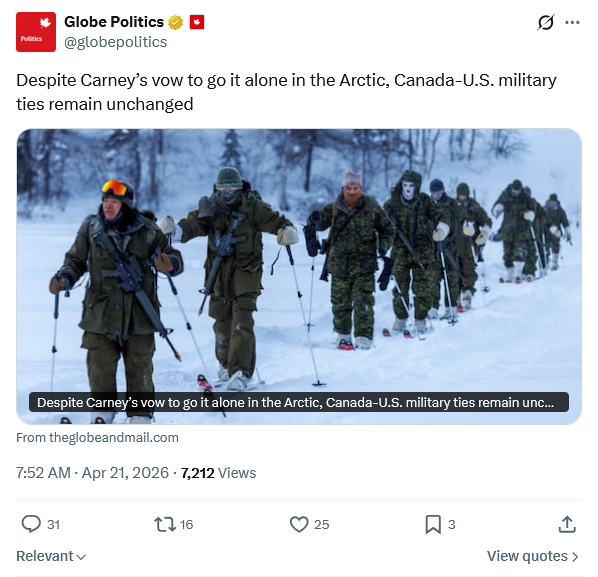
On the social media site formerly known as Twitter, Lee Humphrey explains a few of the reasons that we can ignore Prime Minister Mark Carney’s claims that Canada can defend the north without US assistance:

Canada is not capable of going it alone & is not going it alone. It’s a lie to say otherwise.

The majority of new radars being bought to replace existing radars will be from US companies, all our radars including the Australian built OTH radar will use US military satellites to communicate with monitoring stations in the US & Canada.

The armed drones we are buying are built in the US & will use US military satellites to communicate with their ground based controllers.

The subs we are spending $40 billion on are not capable of safely patrolling under sea ice for more than 11 continuous days before they have to turn around & get to clear water so we will continue to rely on US nuclear powered subs to track Russian & Chinese subs who are in sovereign CDN arctic waters.

Over the last year, US fighter aircraft have had to respond to 3 separate incidents that the RCAF were unable to respond to at all or in a timely way.

CDN’s who still believe Trump is going to invade need to realize just how many opportunities he keeps missing 😎

Reality sucks especially when national security or national sovereignty is at stake but the reality is that not only can we not operate independently at home, we can’t & haven’t been capable of operating independently for 60 years now!

Alexander the Great and Julius Caesar

Adrian Goldsworthy. Historian and Novelist
Published 1 Oct 2025

The first of this year’s video’s in answer to viewers’ questions — today we think about and compare Alexander and Caesar. This is not new, for in the ancient world the pair were often connected, even though they lived centuries apart. Appian compared and contrasted them, Plutarch paired his biographies of them, while Suetonius and others told stories about Caesar’s admiration for the famous Macedonian.

QotD: The problems of a “no first use” nuclear weapons policy

Now, you might ask at this point: why not defuse some of this tension with a “no first use” policy – openly declare that you won’t be the first to use nuclear weapons even in a non-nuclear conflict?

For the United States during the Cold War, the problem with declaring a “no first use” policy was the worry that it would essentially serve as a “green light” for conventional Soviet military action in Europe. Recall, after all, that the Soviet military was stronger in conventional forces in Europe during the Cold War and that episodes like the Berlin Blockade (and resultant Berlin Airlift) seemed to confirm Soviet interest in expanding their control over central Europe. At the same time, the Soviet use of military force to crush the Hungarian Revolution (1956) and the Prague Spring (1968) continued to reaffirm that the USSR had no intention of letting Central or Eastern Europe choose their own fates – this was an empire that ruled by domination and intended to expand if it could.

The solution to blocking that expansion was NATO, the North Atlantic Treaty Organization. Not because NATO collectively could defeat the USSR in a conventional war – the general assumption was that they probably couldn’t – but because NATO’s article 5 clause pledging mutual defense essentially meant that the nuclear powers of NATO (Britain, the United States, and France) pledged to defend the territory of all NATO members with nuclear weapons. But just like deterrence, mutual defense alliances are based on the perception that all members will defend each other. Declaring that the United States wouldn’t use nuclear weapons first would essentially be telling the Germans, “we’ll fight for you, but we won’t use our most powerful weapons for you” in the event of a conventional war; it would be creating a giant unacceptable asterisk next to that mutual defense clause.

So the United States had to be committed to at least the possibility that it would respond to a conventional military assault on West Germany with nuclear retaliation (often envisaged as a “tactical” use of nuclear weapons – that is, using smaller nuclear weapons against enemy military formations. That said, even in the 1950s, Bernard Brodie was already warning that restraining the escalation to general use of nuclear weapons once a tactical nuclear weapon was used would be practically impossible).

Bret Devereaux, “Collections: Nuclear Deterrence 101”, A Collection of Unmitigated Pedantry, 2022-03-11.

April 22, 2026

“Finally authorities gave up and decided to let Timmy the Whaletard die in peace”

Filed under: Germany, Media — Tags: , , — Nicholas @ 05:00

The German media has been breathlessly covering the story of a wandering whale who seems to delight in getting stranded on sandbanks along the northern coast of Germany in the Baltic Sea:

Timmy
Photo from eugyppius

Timmy is the name the German press have given to a confused humpback whale who got himself caught in a fishing net off the coast of Mecklenburg-Vorpommern in early March.

Authorities cut Timmy free in the hopes that he would swim back to the Atlantic like a good whale, but instead he continued to poop around off the German Baltic coast where he does not belong, finally stranding himself on a sandbar near Niendorf like a complete fucking retard.1 An intensive rescue ensued – breathlessly livestreamed by the German press and regrettably also live-tweeted by myself. Ultimately the effort succeeded and Timmy swam free, only to strand himself again, and again, and again, and still again.

Finally authorities gave up and decided to let Timmy the Whaletard die in peace, but soon a whole raft of philanthropists and “whale whisperers” (this is literally what the press called one of them) descended on the problem and the drama of Timmy continues to this moment. The latest subplot unfolded yesterday, as our whale saviours prepared a complex scheme to lift Timmy via air cushions onto a tarp, tie him to pontoons and tug him around Denmark back into the North Atlantic. Alas, a rising tide loosened the hapless Timmy from his sandbar and he swam free, escaping this indignity at least and leaving all the whale-whispering shitheads with nothing to do but give more pointless media interviews. For two hours children across the Federal Republic jubilated as Timmy lurked aimlessly in shallow coastal waters, until of course he beached himself again, provoking a whole new narrative epicycle.

The case of Timmy the Retard Whale is oddly captivating. Most obviously it illustrates the naiveté and neotenous emotional incontinence of Germans today, many of whom have countered the pervasive secularisation of society with an exaggerated and childish faith in the overarching sacrality of the natural world and its creatures. The media have constructed a perverse Disney plot out of the endless ups and downs of Timmy’s plight: Now the whale is free! Now he is dying! Now he must be rescued! Now he is free again! Now he is stranded! Now there is hope! Now he is dying! Not only children but plenty of adults have lost themselves in this transparently repetitive drama. At one point a gaggle of dumb women even protested to demand that authorities do more to save our unsaveable humpback – who is of course merely one of perhaps 100,000 humpbacks across the world, the vast majority of whom will die in complete obscurity with nary a news article.

In my more delirious moments I wonder if Timmy is not also an omen from on high, a metaphor from the heavens to illustrate for us the ridiculous, circular farce that Germany has become.


  1. He was named Timmy for Timmendorfer Strand, where he beached himself for the first time. My efforts to christen him Horst have not caught on. I know the good Timmy is probably disoriented due to illness or injury and not actually retarded but this is how I have chosen to maintain emotional distance from the fate of this particular incorrigible mammal, who is beyond all human capacity to rescue but unfortunately not beyond all of my sympathies.

The Korean War Week 96: Korean Marines Leapfrog the Han – April 21, 1952

Filed under: China, History, Military, USA — Tags: , , , , , , — Nicholas @ 04:00

The Korean War by Indy Neidell
Published 21 Apr 2026

UN Command completes its screening of the 170,000 military and civilian POWs they hold to see how many of them would violently resist repatriation, and it turns out it’s most of them. The Communists are furious. This cannot be good for the armistice negotiations. We also take a look at the defense possibilities the Marines have in their new positions and which Chinese forces oppose them.

00:00 Intro
00:55 Recap
01:32 POW Screening
07:26 The Marines
08:56 The Chinese
13:37 Summary
13:53 Conclusion

Reflections on the life extension of the A-10 – “we ought to be seriously looking at building an A11”

Filed under: Middle East, Military, USA, Weapons — Tags: , , , — Nicholas @ 03:00

On the social media site formerly known as Twitter, ESR admits that there clearly still is a role for the “Warthog” in modern combat … under the right conditions:

Gotta admit I’ve changed my mind about this. I was in the camp that loved the Hog but was grudgingly prepared to concede that its time had passed — not survivable in a modern threat environment stiff with drones and MANPADs.

But damned if the A-10 didn’t turn out to be an effective tool against small-boat swarms in the Straits of Hormuz. And not so expensive to fly or ammo up that you end up with a nasty shot-exchange problem either — not something you can say for putting the F-35 on that job.

The Hog has demonstrated that there is still a tier of missions in between the envelope of an attack helicopter and a fast fighter for which the Hog is excellently fitted. Still. In 2026.

Of course you need to have done SEAD to lower the odds that it will be popped by competent air defense, but the US Air Force is very good at that mission. As it keeps demonstrating.

I was wrong. The Hog deserves its extension. And we ought to be seriously looking at building an A11. Maybe not a manned A11, but a functionally similar instrument with a big fucking gun and the ability to fly low and slow and loiter on a patrol area.

In conclusion: “Let me sing you the song of my people: BRRRRRRRRRT.”

Walther’s Forgotten SMG: The MPK (and MPL)

Filed under: Germany, History, Military, Weapons — Tags: , , , , — Nicholas @ 02:00

Forgotten Weapons
Published 3 Dec 2025

Walther began developing a modern stamped sheet metal SMG in the late 1950s, and it entered production in 1963. It was an open-bolt, simple blowback gun available in a short (MPK; 6.75″ barrel) and long (MPL; 10.25″ barrel) version. It was cheap and simple, but well thought out with a number of quite good features.

The standard design was just safe/full, but a semiautomatic selector position was available if desired by the client. An excellent safety sear prevented the bolt from bouncing open and firing, and the charging handle was both non-reciprocating and capable of also serving as a forward assist if needed. The sights were a bit too clever for Walther’s own good, with a 75m notch and a 150m aperture, both of which were not really great.

Faced with competition from contemporaries like the Uzi and MP5, the Walther never really became massively popular. It did get enough small and medium sized contracts (German police, South African police, Mexican Navy, Portuguese Navy, US Delta Force, etc) to remain in production until 1985 though. Overall a solid and reliable gun even if it failed to really stand out from the other options on the market.
(more…)

QotD: Traditional Chinese approaches to science

Filed under: China, History, Quotations, Science — Tags: , , , , — Nicholas @ 01:00

Those of you who have studied physics know that the laws of motion are usually introduced through the mechanics and dynamics of point particles, or of simple objects acting under the influence of discrete and coherent forces. The reason for this is straightforward: even a tiny bit more complexity, and the system’s behaviour quickly dissolves into a morass that’s analytically intractable and computationally infeasible. The fact that the mutual gravitational influences of just three celestial objects results in chaotic dynamics has entered into popular culture as the “three-body problem”. But even a simple double-pendulum is impossible to predict, even with all kinds of simplifying assumptions (massless rods, no friction, no air resistance, etc., etc.).

It’s not just physics. The central technique of modern science is that of boiling something down to its absolute simplest form, understanding the simplest non-trivial case as thoroughly as possible, and only then building back up to more familiar situations. In physics we start with contrived gedankenexperimenten: “what if two particles collided in a vacuum”, and build experimental apparatuses designed to mimic these ultra-simple cases. In economics we imagine markets with a single buyer and a single seller, both perfectly rational. In political philosophy we imagine human beings in a state of nature, or societies established by a primitive contract. In biology we try to understand the functions of organisms, organs, or other systems by recursively taking them apart and trying to figure out each part in isolation. In every case, what we’re engaging in is “analysis”, ἀνά-λυσις, literally a “thorough unravelling”, understanding the whole by first understanding its parts.

This approach is totally alien to the traditional Chinese understanding of reality, which held instead that no part of the world could be understood except in its relation to the rest of the universe. You can see this in the domains of science where they did maintain a lead. Is it really a coincidence that the Medieval Chinese got frighteningly far with the mathematics of wave mechanics? Or quickly deduced the causes of the tides? Or made great strides with magnetism? In each of these cases, the physical phenomenon in question was compatible with an “organicist conception in which every phenomenon was connected with every other according to a hierarchical order”. Indeed, in all of these cases real understanding was aided by the assumption that a universal harmony underlay all things and connected all things. The tides really are in harmony with the moon, and the lodestone with the earth.

This science, founded on holism rather than on analysis, made great strides in some fields but fell behind in others. It readily imbibed action at a distance, but it could not and would not tolerate the theory of atoms. In this way it serves as a strange mirror of Medieval European science, which also loved the theory of correspondences, also loved alchemy and disdained analysis. The difference is that the glorious intellectual synthesis of Neo-Confucianism was never seriously challenged, it survived the Mongol conquest, it survived the desolation of the civil wars that preceded the Ming founding, it survived everything until communism. In contrast, the eerily-similar Thomistic metaphysics of the High Middle Ages was broken apart by the Reformation, and sufficiently discredited that analytical methods could take their first tentative steps.

This is, to be clear, my own crazy theory, because Needham never really gave a solution to his own puzzle. I came up with it only as a sort of thought-experiment, because I wanted to see if I could find a solution to Needham’s puzzle that disdained material explanations in favour of intellectual tendencies, because I find such theories curiously underrated in our culture. I only half-believe this theory,1 but I find it interesting because twentieth-century Western science has in some ways come back around to the holistic view of things: from Lagrangian methods in theoretical physics, to category theory in mathematics, to systems biology and ecology. It wouldn’t be the first time that a way of viewing the world useful to one age became an impediment to reaching the next one. The question is: what are we missing today?

John Psmith, “REVIEW: Science in Traditional China, by Joseph Needham”, Mr. and Mrs. Psmith’s Bookshelf, 2023-08-14.


  1. The thing about material conditions is they usually are dispositive!

April 21, 2026

The Royal Canadian Navy’s proposed Arctic Mobile Base

Filed under: Cancon, Military — Tags: , , , , — Nicholas @ 04:00

At True North Strategic Review, Noah tries to answer the obvious question “what the hell is an Arctic Mobile Base?”

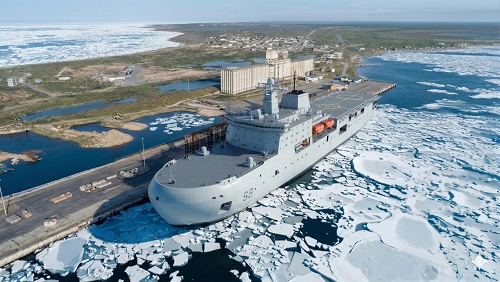
RCN Arctic Mobile Base concept image
RCN via True North Strategic Review

For those that don’t know, the Arctic Mobile Base, as it is currently called, is officially on the books. Despite a few years of conceptualization, the project is still in its early stages.

I always feel the need to reiterate that to folks; it is very much still a concept. It is not funded, not approved, but despite that, we already have a fairly decent vision of what the RCN is sorta looking for as a platform.

[…]

When you hear a name like Arctic Mobile Base, I’m sure a lot of ideas go through your head. Indeed. What exactly is a base in this context? Who or what is it meant to support? What sort of gaps is it designed to fulfill?

To understand the AMB (as I will call it from here on out), you need to understand exactly what the Navy is facing up in the Arctic; more specifically, the difficulty in building and maintaining infrastructure. With the failure of Nanisivik, the RCN is faced with a difficult position.

The first thing you need to know here is fundamental limitations. Canada, unlike our other allies, lacks an available ice-free port to utilize in the Arctic year-round. The closest available major ports that Canada has access to with year-round access are Saint John on the East Coast and Prince Rupert on the West Coast.

Iqaluit, Tuktoyaktuk, and Churchill, the major ports available in the Canadian Arctic, all freeze in the winter. Even Nome in Alaska freezes. The only port facility available year-round would be in Nuuk, where, while work is underway on the Danish side to expand current facilities, it is still not enough to provide ample support for Canadian vessels operating in the Archipelago.

[…]

That brings us to the vessels themselves, or at least the concept as I have been told. I guess one could say they are the true successors to the original Joint Support Ship concept; maybe even ALSC if you want to get deep into the philosophical.

They are an everything vessel. They will be Command and Control centres. They will have large, extensive medical facilities. They will be Replenishment Vessels, able to support the rest of the fleet at sea. They might have some submarine tender capabilities and forward repair capabilities built in. Those two are me speculating, though I’m sure someone is asking those questions.

They will be HADR platforms, able to operate independently of any existing infrastructure like ports. They will have an amphibious capability to support that, and if needed, support the Army in any endeavour they find themselves in. They will be able to reach any other vessel in the fleet, even the Polars if required.

That means that as of now, the Navy is looking at PC 2 for its potential rating, a monumental ask. It is likely to have similar range and endurance requirements to the existing Polar Icebreakers, so perhaps around a 25,000-30,000 Nautical Mile Range (as a general rough figure) and upwards of 270 days endurance.

That will allow for the AMB to maintain a persistent, on-station capability in the Archipelago for an extended period of time, similar to the future Arpatuuq and Imnaryuaq. Again, the AMBs are meant to be a semi-permanent capability in the Arctic, with the desire to have one up there or available to get up there at any given time and stay up there supporting both the fleet and local communities for an extended period of time.

As for what I know? Two are planned. Both will be based on the East Coast, where it is easiest to access the Arctic compared to going from Esquimalt, past the Bering Strait, and over Alaska. It is also the area of most activity for the Navy. So it makes sense, along with the typical desire to consolidate maintenance, crews, training, and additional infrastructure.

While I’m pleased to discover that the RCN seems to be taking the Arctic seriously and doing planning to that end, we should also keep in mind that the federal government is a big believer in the “ice free Arctic by 2050” predictions, they may not be willing to fund hulls built to PC 2 levels of ice-breaking capability. Which would be fine if the predictions come true, but very limiting to the planned ships if the Arctic fails to warm up as the climate models claim it will.


Hungary in the news

Filed under: Europe, Media, Politics — Tags: , , , , — Nicholas @ 03:00

Theodore Dalrymple considers the recent change in government as Victor Orbán was replaced by Péter Magyar, who had been an Orbán supporter until the last few years:

Hungarian Prime Minister-elect Péter Magyar, on 15 March 2026 during a national day demonstration at Heroes’ Square in Budapest. Magyar is wearing a traditional bocskai jacket and a national cockade.
Photo by Norbert Banhalmi and released under CC BY-SA 4.0 via Wikimedia Commons.

It is perfectly normal and healthy that in an electoral democracy a government should be voted out of office after 16 years in power. One of the complaints often heard in such democracies is that “they are all the same”, they being members of the political class of whatever political party.

But there is benefit in a change of government personnel irrespective of all else, for those who remain too long in power come to think of that power as their right, and the citizenry as their servants rather than of themselves as servants of the citizenry.

The recent removal from power by election of Viktor Orbán in Hungary after so long as prime minister (and his full acceptance of the defeat, despite accusations that he was like an authoritarian dictator) was perfectly normal. He had been replaced by a man who is no fire-eating radical, Péter Magyar, a young man who was, until comparatively recently, a supporter of the leader he has replaced.

The electorate, according to polls, was concerned about the state of the economy and the level of corruption in the country. Governments that come into power promising to eradicate corruption often reveal themselves to be no different in this respect from the last: the fruits of corruption are distributed to different people, that is all.

The new prime minister differs greatly from the old in two attitudes: firstly, to the war in Ukraine and secondly to the European Union. Unlike Mr. Orbán, he is no friend of Vladimir Putin’s; and unlike Mr. Orbán, he is more likely to do the Union’s bidding in order to gain access to the latter’s funds. One important question is whether he will be forced to change Hungary’s attitude to mass immigration, opposition to which was a source not only of Mr. Orbán’s conflict with the Union, but of his long domestic popularity.

His policy was regarded as xenophobic, but this was an unjustified slur. Xenophobia is a hatred or fear of foreigners as such, ex officio, and on my visits to Hungary I found none of this. I met, for example, a Kurdish physiotherapist well integrated into Hungary, and a Moroccan academic likewise, who did not complain of personal antagonism to them. Other foreign residents whom I met did not complain of it either. A desire to protect a small country from the effects of mass immigration that have been seen in Sweden (a country of similar size of population), for example, is not xenophobia: it might on the contrary be regarded as both prudent and as a manifestation of love of one’s country. It is part of the malign legacy of Hitler and the Nazis that love of one’s country is now felt by many European intellectuals to be inherently vicious and aggressive. But love of one’s country is not the same as hatred of everyone else’s, though it is true that patriotism can sometimes degenerate into such hatred.

The European Union’s attitude to mass immigration is contradictory. It regards ethnic and cultural diversity as good in themselves, as if what existed before was lacking some important ingredient that such diversity will automatically bring.

Ivan the Terrible – Feeding the Evil Russian Tsar

Filed under: Food, History, Russia — Tags: , , , , , , — Nicholas @ 02:00

Tasting History with Max Miller
Published 14 Oct 2025

Soft buns filled with cabbage, onion and dill

City/Region: Russia
Time Period: 16th Century

In Russian, Ivan the Terrible is Ivan Grozny, and the translation of “terrible” was meant more in the way of “fearsome” or “formidable” rather than “cruel” or “awful”, though Ivan ended up being all of those. What started off as a good reign with military victories, building Saint Basil’s Cathedral, and restricting the boyars‘ (aristocracy) power over the people descended into a reign of terror with a secret police, the massacre of a city, and even killing his eldest son in a fit of rage.

While Ivan truly was terrible, these piroshki are not. They are absolutely delicious. The bread is soft, and the filling is savory and slightly sweet with the dill really coming through. These were made with all different kinds of fillings, so feel free to try out other ingredients, like meat, fish, fruit, or other vegetables, or put in a hard boiled egg for a modern touch.

    Small pies filled with mushrooms, poppy seeds, kasha, turnips, cabbage, or whatever else God sends.
    When the servants bake bread, order them to set some of the dough aside, to be stuffed for piroshki.

    The Domostroi, 16th Century

(more…)

« Newer PostsOlder Posts »

Powered by WordPress