
We were watching the Women’s Euros final, and it had gone to penalties when my spouse suddenly gripped the couch cushion with white knuckles and announced, “Right, we’ve entered squeaky bum time”.
I blinked at them. “We’ve entered … what?”
“Squeaky bum time”, they repeated, as if this was a perfectly normal phrase that everyone uses. “You know, when it’s so tense you’re clenching.”
The first time I heard this phrase, I nearly fell off the couch laughing.
But now?
Now I find myself using it during American sports, muttering it to myself during tense moments, while my American family would have no idea what I’m on about.
This is what happens when you live in a British-American household. Your vocabulary becomes a delightful jumble that sounds slightly off to everyone.
Marianne Jennings, “Squeaky Bum Time and Other British Phrases I Never Knew I Needed”, An American’s Guide to British Life, 2025-10-05.
September 16, 2026
QotD: Squeaky bum time
September 15, 2026
“I will choose a path that’s clear, I will choose free will”
For some reason, the idea that humans don’t really have free will is very popular among progressives, even if they know individually that they have free will they believe most of the rest of humanity somehow doesn’t:
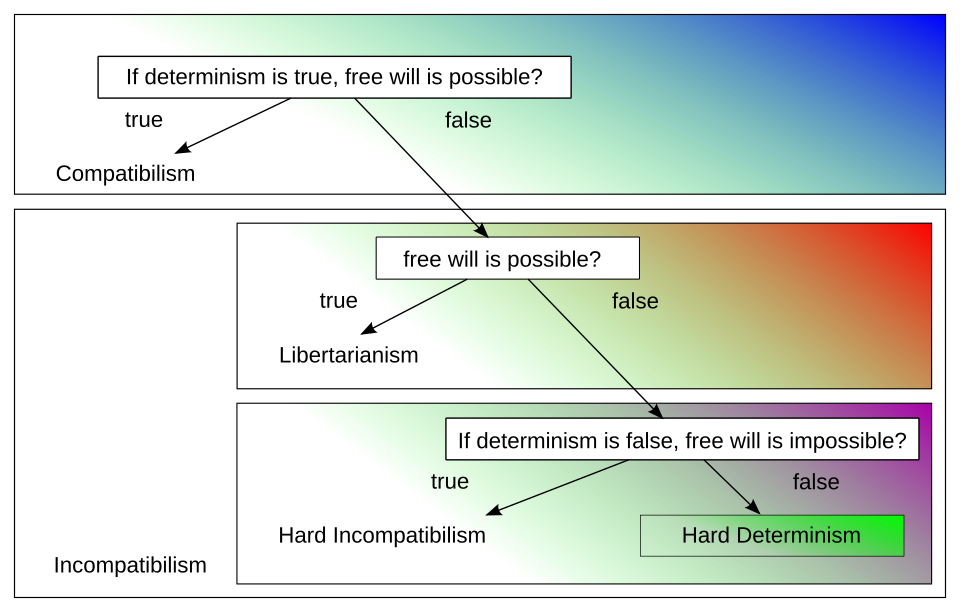
A simplified free will taxonomy
Image by Richardbrucebaxter via Wikimedia Commons.
A fashionable view of human behavior holds that because everything has a cause, no one is truly responsible for their actions.
In his 2023 bestseller “Determined,” Stanford neuroscientist Robert Sapolsky argues that free will is an illusion. “We are nothing more or less than the cumulative biological and environmental luck, over which we had no control, that has brought us to any moment”, he writes. Author and podcaster Sam Harris has spent 15 years making the same case to a popular audience. “Our wills are simply not of our own making,” he writes in Free Will (2012). “Thoughts and intentions emerge from background causes of which we are unaware and over which we exert no conscious control. We do not have the freedom we think we have.”
Common sense pushes back. Consider an example from the psychologist Paul Bloom. Imagine a man who thrashes violently in his sleep and accidentally strikes his wife, breaking her nose. They both wake up, and he is horrified and ashamed. Now imagine a second man who resents his wife and wants to hurt her. He waits until she is asleep and then hits her in the face. When she wakes up, he pretends it was an accident. The difference between these two men is obvious. Any legal or moral system that doesn’t recognize that would collapse.
Yet much of elite discourse encourages us to blur that distinction. Determinists like Messrs. Sapolsky and Harris tell us that behavior can be explained through systems, incentives, trauma, inequality, neurochemistry and social pressure. Much of this is true. But a culture that speaks only this language teaches people that they are spectators in their own lives. The implication, rarely stated outright, is that no one really chooses anything. We are all the first man in the example above, thrashing in our sleep.
The determinists don’t deny that we have wills, or that our actions follow from them. Their argument is that will and action are themselves the products of deeper causes, such as genes, molecules and the environment, and so we can’t really be called free.
Stuart Doyle offers a useful analogy that challenges this claim. Suppose we ask whether an apple is red. The determinist looks closer. He realizes the apple is nothing but atoms. Because no individual atom is red, he concludes the apple can’t really be red. The error is obvious. Color exists at the scale of the apple, not at the scale of an atom.
Free will works the same way. A choice exists at the scale of a person thinking, weighing and deciding. Looking at the molecules underneath and finding no choice there doesn’t prove that choice is an illusion.
A Fall election seems quite likely
One of the advantages of a Westminster-style parliamentary system is that election dates are not fixed, so that the Prime Minister can take advantage of perceived opportunities to win majorities when they arise. It must be very tempting to Mark Carney to call an election as soon as he can, as the Elbozos are still waving their arms and chanting his praises for “standing up to the Bad Orange Man”. His latest notion of trying to add Canada to the European Union as some sort of “associate member” is also popular among people who think that Canada should be more like Europe (the Venn diagram of Elbozos and Europhiles is almost a perfect circle). On X, Jay Currie stares into the abyss of yet another Liberal majority government with a renewed electoral mandate:

The Prime Minister of all the Canadas is prepping for his Davos 2.0 speech to the European Parliament on the 17th when, apparently, he is going to propose that Canada become some sort of associate member of the EU. God help us.
The developed world can be thought of as two camps: the progressives and, for want of a better term the nationalists (could be traditionalists but that is only one strain within the nationalist camp). The supra nationalist institutions, EU, UN etc are progressive to their core.
Progressives see borders as barriers to progress, believe diversity is strength, see international action as the only way to defeat the horror of “climate change”, want international controls on speech, technology and public health.
For progressives individual rights, the rule of law, property are all barriers to the greatest good for the greatest number. Citizenship is an antique concept best left in the 20th century.
Most importantly progressives see the state, rules and regulations, a constantly refreshed “New World Order” and managed decline as both beneficial and inevitable. Arc of History and all.
Nationalists begin with the tiniest unit in society, the individual, and take that unit seriously. What rights does an individual have? If you start there you automatically circumscribe the power of the state. You also set the state’s direction.
Taking individual rights seriously creates a state in which individuals matter, there their voluntary associations beginning with families, matter. “The greater good” is no more than a suggestion when it comes to protecting individual rights.
The Europe of the EU came out of the ashes of a world in which individuals were subjects rather than citizens (with the notable and sporadic exception of post Revolutionary France) and the concept of individual rights was fragile at best.
The progressive intent of the EU was to treat “Europeans” as interchangeable economic units whose value was locked to group identity and which must be prepared to share the burdens imposed for the greater good.
Nationalism was seen as regressive as was patriotism and the insistence that individuals had rights which over rode the “common good”. After all, the horrors of WWI and II were the products of patriotic nationalism.
The progressive European project worked quite well for the first twenty or so years when Marshall plan aid funded the rebuilding of Europe and membership in the EU was relatively restricted. Expansion and mass immigration strained the Community.
Part of the reason the EU worked quite well in the early years was that its goals were relatively modest, a trading bloc with harmonized economic regulation left individual countries to work out their social, legal and rights structures.
As with any progressive institution the modest goals of the early years were gradually replaced with “ambition”. The 1985 Schengen Agreement eliminated hard borders within the EU. The European Convention on Human Rights harmonized the rights of Europeans.
Part of the progressive ambition was the creation of a hitherto unknown entity known as “the European” superficially similar in concept to “the American”. Questions of nationality could be submerged as this new entity stepped into the world.
For the progressive camp the “European” was a giant step forward into a post national future. As indeed it was for a tiny minority of bureaucrats, academics, journalists, financiers and other members of a self appointed cognitive elite.
People who objected to this grand homogenization of the nations of Europe were obviously frightened of the inevitable future because, well, they were not well educated and, entre nous, not too bright.
For the “Europeans” the great cause of the 21st century was laid out in Rio in 1993 when a conference convened by Canadian Maurice Strong sounded the alarm about “global warming” currently rebranded “climate change”.
Now there was a global threat demanding a supra-national response where the “Europeans” could assume a leadership role by…well, by shipping all of their heavy industry offshore and building very expensive windmills and mandating electric cars.
To no one’s very great surprise the Europeans have managed to de-industrialize and regulate themselves to the point of actual poverty. Fortunately, it was all for the global greater good so the Europeans could congratulate themselves.
Not content with climate virtue, the Europeans (though not the regressive nationalist yobs) took it upon themselves to welcome millions of migrants. An act of humanity and also shrewd as the Europeans had given up having children.
Of course, the idea had been trial-ballooned recently to get Carney-friendly headlines ready in advance:

“Napoleon remains the ghost in professional military education”
InfantryDort responds to a complaint that military leaders are taught Clausewitz without the career of Napoleon for context:
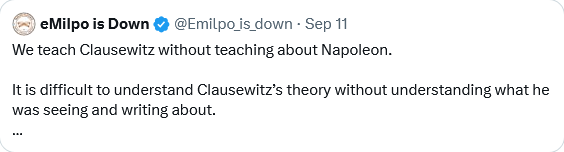
THE THING WE STILL CAN’T TEACH
I’ll bite on this one. Napoleon remains the ghost in professional military education. Why? Let me take a stab at it …
Jomini watched him and tried to turn the phenomenon into rules. Anyone in the U.S. Army has seen this before. If you do something exceptional on the field (especially in training), then you’re often coached that you went outside the lines and need to get back in. You may have succeeded, but it COULD have been a disaster. So we try “putting baby in a corner” because the science of war is safe. The art scares people.
Clausewitz watched the same fire in Napoleon and concluded that rules would never be enough. Two centuries later we are still dissecting the campaigns, naming principles, drawing arrows on maps, and trying to explain what exactly lived inside that man.
Again, why?
There is a part of command that refuses to become curriculum. T.E. Lawrence called it the “kingfisher flash”. Clausewitz reached for the genius. It’s the instant when one mind sees through fog what a hundred educated men cannot see at all, then possesses enough violence of will to act before the moment disappears.
Read that last part again 👆
You can feed that gift with history, sharpen it through hardship. But you CANNOT manufacture it with another degree. It MUST be revealed.
Yet modern institutions are built around the opposite assumption. We stack schools, evaluations, gates, boards, and credentials high enough and convince ourselves that eventually genius will emerge from the assembly line. It won’t. It can’t. Ever.
Worse, the machine often recognizes the dangerous talent and rejects it precisely because it cannot reproduce it. The unusual man is “reckless”. The instinctive one is “unserious.” The officer who refuses the approved path becomes “unqualified”.
READ. IT. AGAIN. 👆 👆 👆
Then war arrives and burns the paperwork. That is the lesson Napoleon keeps trying to teach us from two hundred years away. You can study the flame forever. You still have to recognize it when it walks into the room.
The closest we can come to discovering this genius is testing our officers on it. No more reliance on pure paperwork. I say to these officers: Show us the gift you’re supposed to possess for the highest commands.
Or step aside for someone who will.
The First Military Luger: Swiss Model 1900 s/n 01
Forgotten Weapons
Published 27 Apr 2026The first nation to adopt the Luger was Switzerland, which began testing in late 1898 and formally accepted the Luger in May 1900. Their guns were the first Lugers to be mass produced, as they were the first order received by DWM. The first batch of 600 arrived in Switzerland in May 1901, and today we are taking a look at the very first of that batch — serial number 01. It is the first production military Luger, and that’s a pretty cool landmark.
C&Rsenal Swiss Model 1900 video: • History of WWI Primer 145: Swiss Luger 19…
QotD: Auftragstaktik or “mission-type tactics”
Bret Devereaux, “Miscellanea: A Very Short Glossary of Military Terminology”, A Collection of Unmitigated Pedantry, 2022-03-25.
September 14, 2026
The demands for reparations should be rejected, firmly
Large-scale slavery has been a dead letter in most parts of the world since the Slave Trade Act of 1807 made the transportation of slaves illegal within the British empire and on the high seas where the Royal Navy patrolled. Legal abolition of slavery followed in 1833 with the Slavery Abolition Act. Chattel slavery in the United States was ended by the American Civil War. The last major power to allow slavery was the Ottoman Empire, which was dissolved after the First World War. Slavery still exists … mostly in the Islamic world and in the criminal underworld elsewhere, but is no longer an almost universal condition. (Despite ridiculous recent claims, slavery was not “invented” in 1619: pretty much every civilization we know of had forms of slavery from before the earliest cities were built.)
Despite nearly 200 years since the suppression of the slave trade and the abolishment of the institution, many countries are now presenting claims for reparations to Britain for the history of slavery. And feeble-minded politicians are treating these claims as though they are somehow morally correct despite all the evidence of history. On his Substack, Spaceman Spiff demands that we treat these grifters firmly and refuse any such future claims:
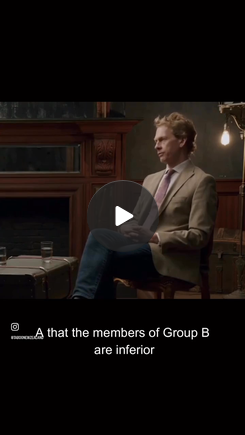
I came across a video that explains how absurd modern views on European colonization are. Accusations of racism aimed at our ancestors are meaningless since everyone was racist. Only one group attempted to be non-racist. Transcript below.
The Maori were racist towards other Pacific Asian tribes. I mean, everyone is a racist if by that term we mean the assumptions by GROUP A that members of GROUP B are inferior and deserve to be conquered if they can be.
That is a universal human phenomenon and it arises from evolutionary needs for basically in-group solidarity. So racism is the standard default position for all peoples.
To say that the Europeans were racist is just to state the obvious because all peoples were racist.
If it is not a statement of the obvious then it’s patently false. And by that I mean that if I were to judge the racism of the Europeans vis-a-vis the places they conquered, compared to the racism of other groups at the time, we find the Europeans much less racist. And if we were going to put it on a spectrum the only anti-racists in the whole world at the time of European colonialism were the Europeans. Because they were the ones who went abroad and said, these peoples have the capacity to be just like us. These people deserve freedoms. These people deserve to be freed from slavery. They deserve to be developed. They deserve to be civilized, which of course is seen as a sort of great racist act but it is quite the opposite.
It is the act of saying all peoples have the potential to be self-governing, to be flourishing, to have a written language, history, arts and culture. This was the great anti-racist campaign that European colonialism represented. So that’s why I say it is simply a statement of the obvious or it is patently false.
The video calmly debunks the notion European colonization was driven by racism. Quite the opposite. It was an early form of anti-racism on a global scale based on a belief everyone deserved a high standard of living like Europeans.
This quirk of Western man has encouraged calls to pay reparations for the slave trade thanks to our continuing concern with the welfare of out-groups, a preoccupation unique to Europeans and shunned by the rest of the world even today.
Pay us in cash, guilty Westerner
It has become fashionable to suggest Britain and America pay reparations for the transatlantic slave trade. This is partly because of Britain’s involvement in European colonization of Africa, and partly the presence of slaves in the USA and some British colonies in the Caribbean.
The facts surrounding the abolition of slavery are well documented. They represent one of the most astonishing acts of decency in history, all the more amazing as one of those countries was the unchallenged global superpower of its day. There was no one else strong enough to make them do it; it was entirely voluntary.
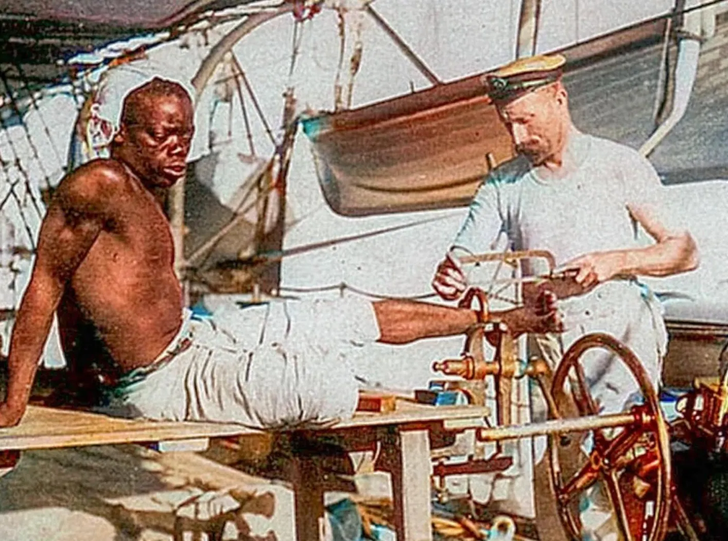
Manacles being removed by Able Seaman Joseph Chidwick in 1907 from an enslaved man who had worn the leg irons for three years. HMS Sphinx operated off the coast of Oman in the Arabian sea and attracted a number of slaves from a nearby slave-trading village whom the British immediately freed.
Britain’s actions were quickly followed by France and then the USA which led to the abolition of slavery throughout most of the world.
And yet reparations have become a rallying call among some. Everyone from the United Nations to individual countries like Jamaica and Ghana are baying for blood.
Underlying the drive is the additional charge of racism, a very modern idea.
Stefan Zweig’s The World of Yesterday
I’d heard a bit about Stefan Zweig but I’d never read any of his work. Ted Gioia’s review of The World of Yesterday certainly makes me a bit more likely to pick up a copy:
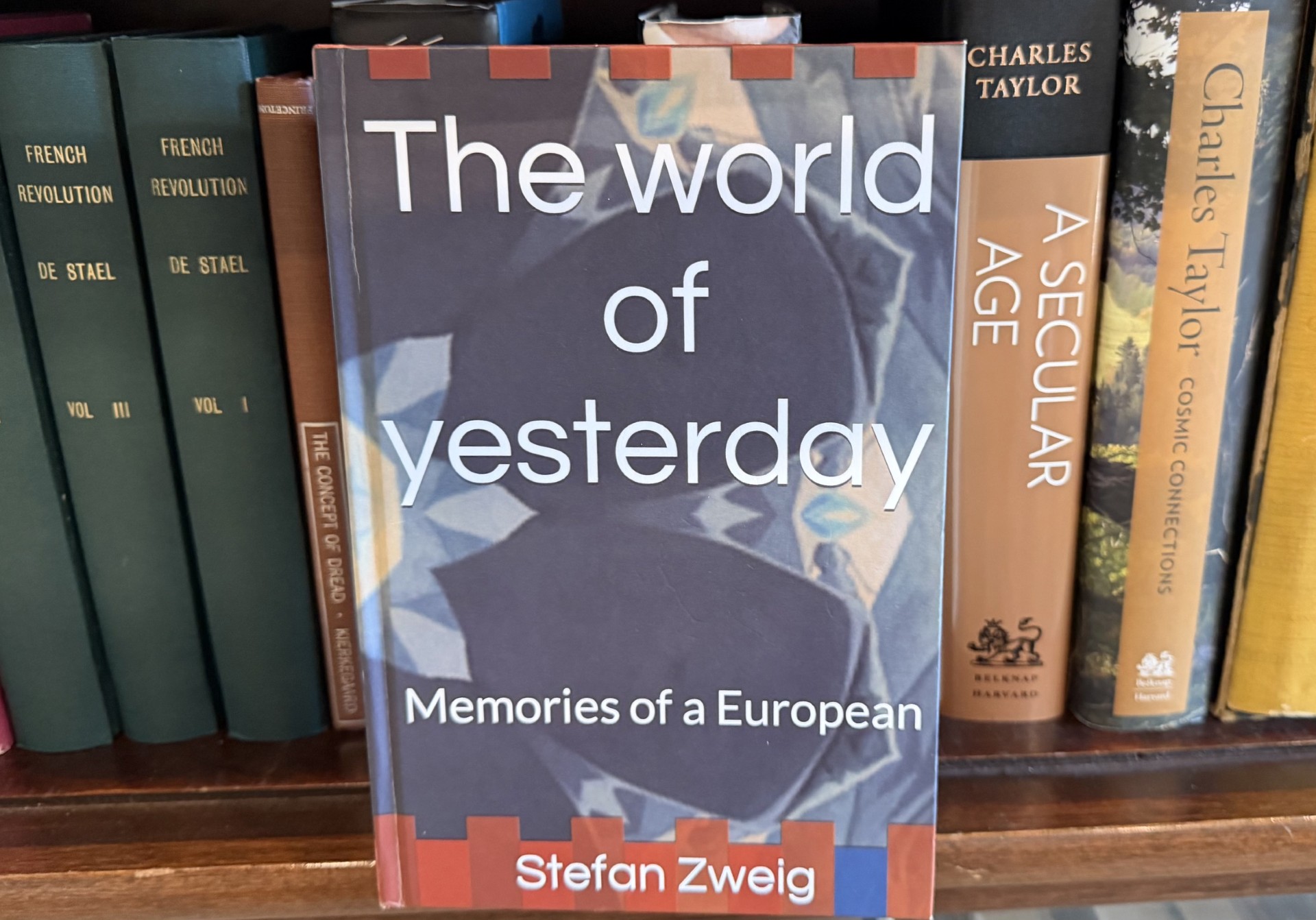
Photo from The Honest Broker
My most recent find is Stefan Zweig’s account of how Vienna went from nineteenth century elegance, prosperity and cultural flourishing to warmongering and hyperinflation. His book The World of Yesterday may be the single best memoir from a survivor of societal collapse from the 20th century — and deserves to be far better known.
I call Zweig a survivor, but that’s not entirely true. He somehow managed to stay alive during World War I (not an easy task for a young man in Central Europe), and the subsequent economic crisis. But World War II forced him into exile, and he committed suicide in Brazil in 1942.
He was a broken man by then — and he feared Hitler was too powerful to stop. So Zweig, one of the greatest writers and thinkers of his generation, ended it all with an overdose of pills.
Just a few years earlier, Zweig had gained renown as the most widely translated contemporary author in Europe. In Germany, his books sold 20,000 copies on the first day — even before a single advertisement had appeared. But that now changed.
“Not a single one [of my books] is available in Germany today,” he lamented at the end of his life. “Those who still possess a copy keep it carefully hidden.” And the same was true in France, Italy and other countries under fascist control.
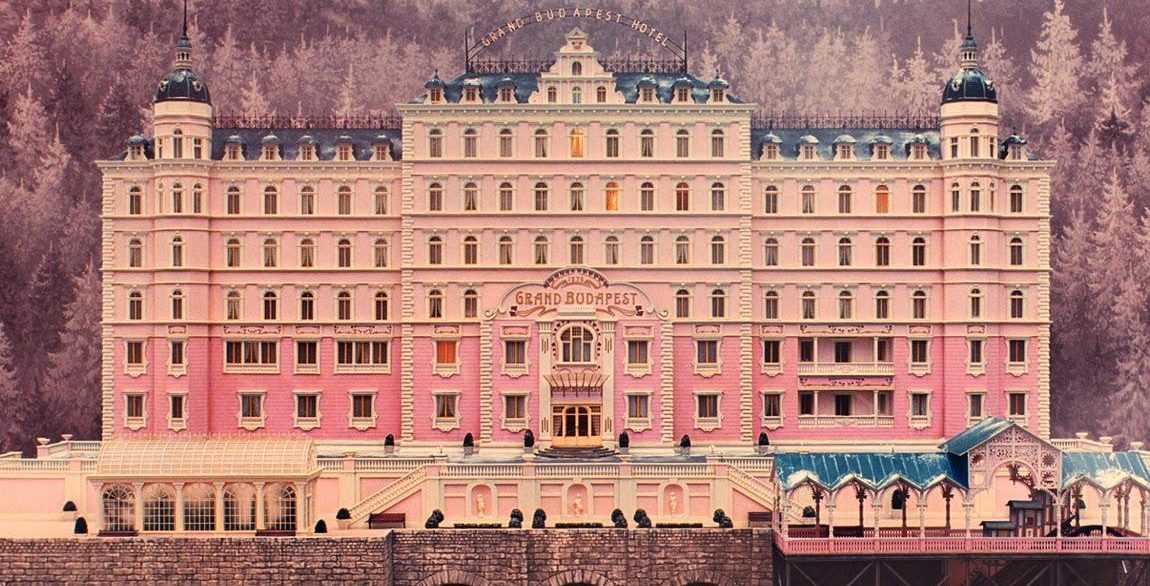
Zweig is best known today as the inspiration behind Wes Anderson’s film The Grand Budapest Hotel. “It’s basically plagiarism”, the director has admitted. But Zweig ought to be remembered more for his writings, especially this final work from his pen.
Stefan Zweig is now remembered as the inspiration for The Grand Budapest Hotel.
His fiction is also sadly under-appreciated. And it’s very readable — Zweig was a specialist in short novels with fast-paced plots. I highly recommend 24 Hours in the Life of a Woman, and Chess as starting points. Zweig also had a knack for mini-biographies (see, for example, his stellar book on Montaigne).
The day before he died, he mailed his manuscript of The World of Yesterday to a publisher. It was released posthumously, and is now recognized as a defining document in how things go bad. Over the course of 500 pages, Zweig starts with the peace, prosperity, and cultural flourishing of the final years of the Habsburg Empire, and then shows, step by step, how a healthy, vital society self-destructed.
The entire book is well worth reading. I will only discuss a small part of it here — covering the hyperinflation following World War I. But this book is so rich in observations and telling details, I could easily devote several articles to it without coming close to exhausting its riches.
Zweig lived through the currency collapse twice — first in Austria (where he lived across the road from an odd young man named Adolf Hitler), when the crown devalued rapidly. Then he moved to Germany, where hyperinflation was even worse.
The stories he tells are so fanciful, you might think he was writing a fable in the style of Jorge Luis Borges. Consider his story of beer-swilling tourists.
The story starts when the Austrian currency collapses in value. Germans quickly learn how to take advantage of this, by crossing the border to buy up cheap merchandise — but with unforeseen consequences:
Finally, at the instigation of the German government, a border guard was appointed to prevent all consumer goods from being bought in the cheaper Salzburg instead of in the home stores … But one article remained free, which could not be confiscated: the beer that one had in the body.
And the beer-drinking Bavarians calculated from day to day on the exchange rate slip whether, as a result of the devaluation of the crown, they could drink five or six or ten liters of beer in Salzburg for the same price they had to pay at home for a single liter.
A more splendid lure could not be imagined, and so crowds of women and children moved over from neighboring Freilassing and Reichenhall to afford the luxury of swilling as much beer as their stomachs could hold. Every evening the station was a veritable pandemonium of drunken, bawling, spitting hordes of people; some who overloaded themselves had to be carried to the carriages on the trolleys usually used to transport suitcases …
Of course the happy Bavarians had no idea that they were in for a terrible revenge. For when the crown stabilized and the mark, on the other hand, plummeted in astronomical proportions, the Austrians crossed over from the same station to get cheaply drunk in their turn, and the same spectacle began a second time, but in the opposite direction.
This imbalance between currencies created other surreal scenes.
Incredible as the fact may seem, I can corroborate it as a witness that the famous luxury Hotel de l’Europe in Salzburg was for a long time rented out entirely to English unemployed people who, thanks to the abundant English unemployment benefits, lived here more cheaply than in their slums at home.
Performative Canadian politics again
Prime Minister Mark Carney came to power promising that he was the best-qualified to deal with the US government on trade issues. Canadians assumed that this meant he’d be able to get as fair a trade deal with President Trump’s administration as possible. What he really meant was that he could do the most damage to cross-border trade relations in order to “pivot” to the EU and to China. He never intended to settle US-Canadian trade conditions, and his actions clearly show he was always putting the negotiations dead last in his priority list. And, thanks to the government’s generous subsidies to the relic media, instead of grilling him and his ministers for their blatant failures, they instead try to hold the opposition to account for things they have no control over.
On the social media site formerly known as Twitter, L. Wayne Mathison points out that it makes no economic sense for Canada to become part of the European Union as Carney now says he’s working toward:
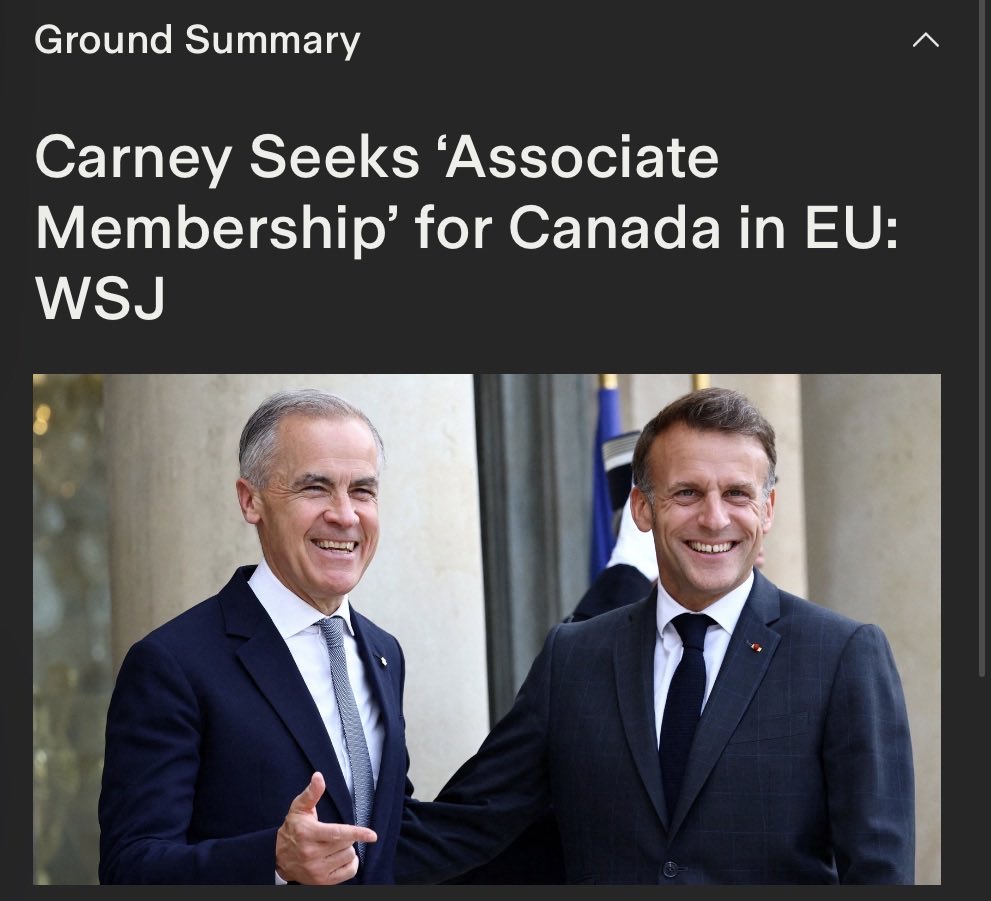
This strikes me as remarkably stupid economic strategy.
Diversifying Canadian trade makes sense. Pretending Europe can somehow replace the economic relationship we have with the United States does not.
The United States is next door. Our railways, pipelines, electricity grids, manufacturing supply chains and energy markets have been integrated for generations. Even after the trade fight intensified, 71.7% of Canadian merchandise exports still went to the United States in 2025.
And Canada already has CETA with the European Union. Roughly 98% of EU tariff lines on Canadian goods became duty-free when CETA took effect, eventually rising to about 99%. If Canadian companies see profitable opportunities in Europe, they already have extraordinarily good market access.
So what exactly do we gain from some invented “associate membership” beyond CETA?
Potentially European regulatory obligations, political entanglements, financial contributions and pressure to harmonize Canadian rules with decisions made in Brussels, all to sell more goods across an ocean to markets that cannot duplicate the geographic advantage of the United States.
Norway rejected EU membership twice. Iceland opened accession negotiations and eventually walked away without joining. Both understood that you can have close economic relations with Europe without surrendering unnecessary national autonomy.
Canada should trade aggressively with Europe, Asia and everyone else who wants our products. But our first priority should be fixing the relationship with our largest customer, removing our own interprovincial trade barriers, building pipelines and ports, and making Canada competitive again.
Picking a fight with the neighbour who buys most of your exports and then announcing that Brussels might become your new best friend isn’t economic sophistication.
It looks like desperation dressed up as grand strategy.
George Orwell according to family and friends – Writers & Wordsmiths
BBC Archive
Published 21 Mar 2026This programme contains attitudes of its time.
Recollections of George Orwell by his wife Sonia Orwell, sister Avril Dunn, and friends Malcolm Muggeridge and Cyril Connolly. [Original billing]
“From early in his writing career, Eric Blair adopted the nom de plume, which he is now universally known. He became George Orwell. In his will, he emphatically directed that no biography of him should be written. And to insure his wishes were respected, effectively covered up his traces. Blair hid behind Orwell.”
The man behind Nineteen Eighty-Four, Animal Farm and The Road to Wigan Pier was elusive, but in this programme family and friends share memories of the influential author.
Clip taken from George Orwell: 1903-1950, originally broadcast on 20 November, 1965.
QotD: “We have Homo Sovieticus in America”
The last numbers from Los Angeles County as a whole were for 2024, when 2,208 homeless people died on the streets. County officials celebrated, because that number was a sharp reduction, and a reflection of the success of programs like overdose intervention teams stationed around public parks.
Remember those numbers, and let’s talk about something else for a moment before we come back to them.
The Soviet writer Aleksandr Zinoviev told a joke that speaks fluent Californian: “In some institution a routine meeting was in progress. There were two points on the agenda: 1) the construction of a barn; 2) the creation of an abundance of consumer goods under communism. As they didn’t have enough planks to build the barn, they moved on at once to the second question.”
Maybe that joke doesn’t land if you don’t live in Los Angeles or Seattle, but from here it’s flawless. Take a quick look at the campaign page for María Elena Durazo, a state senator who just won a seat on the Los Angeles County Board of Supervisors. Infrastructure and fire departments are in bad shape in the place where elected officials think that government exists to provide “economic justice” that restructures communities. When government exists to pay your rent, 911 response times soar.
They can’t fix a street, so they move on at once to managing all of society.
Here’s what Senator Durazo boasts about on her “Meet Maria” page: “Arrested over 13 times for leading non-violent Civil Rights and Worker Rights protests”. It’s the line that appears below “State Senator” on her list of accomplishments. Gentry socialists have high-status-marker arrest credentials, without the burden of low-status prosecution and jail terms.
Zinoviev gave us the term “Homo Sovieticus”, describing the human creature that shaped itself around the postures and predilections of Soviet culture. Humorless, a sanctimonious scold, a deeply selfish schemer while professing adoration for collectivism, comfortable reciting official slogans without feeling the need to believe them or examine them, reflexively conformist, not worried about truth. (X) has been advanced as party doctrine, so (X) is correct, and anyone suggesting (Not-X) is highly suspect. The official account is always correct.
We live among these people. We have Homo Sovieticus in America.
Chris Bray, “Homo Cosmopolitus Won’t Count the Costs”, Tell Me How This Ends, 2026-06-10.
September 13, 2026
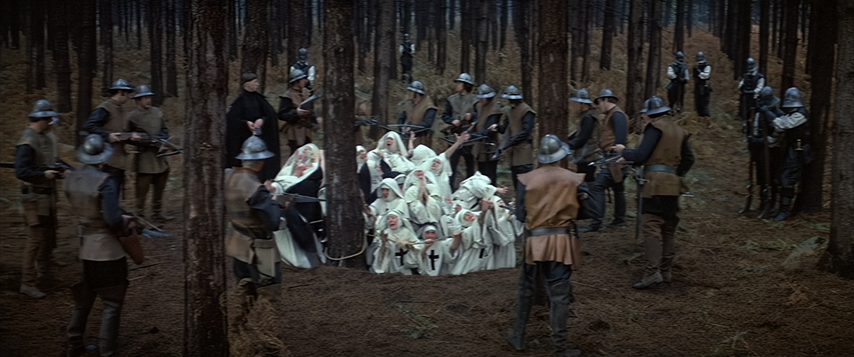
The Devils by Ken Russell
On her Substack, kulak explains why The Devils is the “greatest film of all time”:

What if the 1990s Berserk anime, Warhammer 40k, A Man for All Seasons, The Wickerman (1972), Cromwell, 1984, The Gulag Archipelago, the Rocky Horror Picture Show and the chronically underrated 2012 horror masterpiece Compliance … were all the same horrifying movie?
What if Mel Gibson made a film like Apocalypto, exploring the nightmarish depths of political/religious sacrifice rituals … But about Early-Modern Shakespeare-era Europe?
I’m constantly asked for my “Greatest Film of all Time” … A torturous question for someone who’s seen as many movies as me … And doubly torturous because maybe the best true answer is one its really hard to name:
Ken Russel’s The Devils might be it.
Certainly the best 30 Years War film ever made.
And the Greatest goth movie ever made.
And the Greatest witch hunt movie ever made.
And the Greatest “MeToo” movie ever made.
And the Greatest “insane asylum” movie ever made.
And CERTAINLY the Greatest Exorcist movie ever made.
Yes, I said that. And I mean it. Did I stutter?And maybe the Greatest “Dark Fantasy” film ever made … Except for the fact that the whole thing is true.
And its being rereleased, the full remastered director’s cut in 4K, this October in Cinemas.
(The strobe effect is only in the trailer)
Ken Russel’s The Devil, adapted from Aldous Huxley’s book The Devils of Loudon and the play The Devils by Dan Whiting, is one of my top five films of all time. And certainly one of the biggest films of all time in it’s own weird way. It does things as impressive for the spiritual, psychological horrifying, and historical on film as Sergei Bonderchuk’s Waterloo does for warfare or Akira for Scifi and Animation.
Indeed I think I might be the only one who could give that answer, given I might be one of like 10 people who know 17th Century History/Literature and obscure extreme Horror Cinema well enough to INSIST on its OVERWHELMING historical accuracy.
Indeed I’d struggle to think of a film which captures the Insane deadly hypersexual kaleidoscopic character of the 17th century better.
I’ve been doing this a lot recently … But I feel I need to lay out my qualifications here to talk about this … My two areas of focus in university were 17th and 18th century English Literature (Shakespeare through to Jane Austin), and 17th and 18th century Political theory (specifically the works of Hobbes, Locke, Hugo Grotius and other natural law theorists … Yes, I took the BoomerCons seriously when they said natural law was the basis of our society, Like an idiot) … I’m by no means an expert, but the broad flavor of this era: Culturally, religiously, politically, historically, militarily, theoretically, theologically, poetically … Was what I immersed myself in during the years when I should have been drinking and partying more and repeating nonsense to people in power, and other things that actually advance your career.
I need to establish that off the bat because I feel as if a huge part of the reason this film is not regarded as a contender for “Greatest film ever made” is the simply the fact that audiences and critics do not believe it, and certainly do not GET it.
That it is SO Bizarre, and SO weird, and SO horrifyingly violent, and SO hypersexual, and SO saturated in its colors, and SO religiously discordant … That it has to be a bizarre psychedelic hellscape of Ken Russel’s perverse drug-addled imagination …
They especially had to think this because if they accepted that it was indeed historically accurate, and not a bizarre sexual/psychedelic story of the American 1960s and 70s reading themselves back into history … Suddenly they’d have to accept that the same thing done to Loudon in 1634 was what was being done to America in the middle of the 20th century, and has been done to the west more or less ever since …
That the yo-yo between state-enforced debauchery one the one hand, and moral panic witch-hunts on the other, is not a schizophrenic attribute of mass media or “Moral Progress” or American Culture … But a highly historically precedented and calculated attack meant to destroy and enslave a people without fighting them.
That “Free Love”, “Feminist Criticism”, “Queer Theory”, “No Fault Divorce”, and “Hostile Work Environment lawsuits” rock society between the extremes of sexual license and socio-sexual moral-panic for the same reason one might rapidly rock a boat between it’s port and starboard sides … To capsize it into the devouring abyss.
That we are indeed living through Loudon at scale.
The scandalous The Whispering Gallery published by “The Badly Had” in 1926
In the latest edition of the SHuSH newsletter, Kenneth Whyte recounts the publishing scandal of the 1920s, as The Bodley Head fought off other publishers to obtain the British rights to The Whispering Gallery, written by an anonymous career diplomat with lots of juicy scandal about the great and the good of British public life:
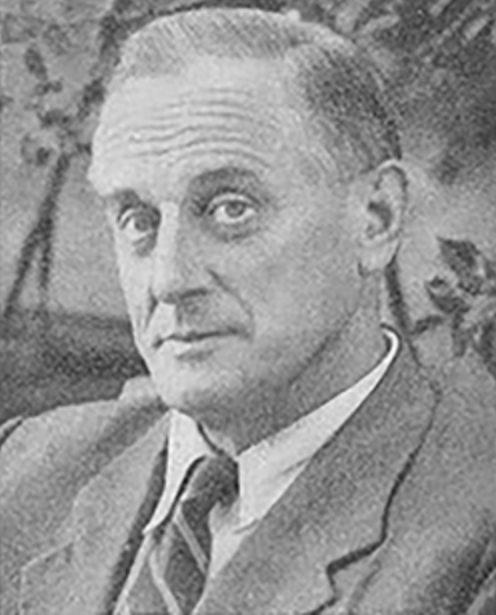
Hesketh Pearson
In 1926, Allen Lane was a young publisher at The Bodley Head, a firm founded by his uncle. He was approached about a manuscript entitled The Whispering Gallery — the diaries of an anonymous retired diplomat or, rather, “envoy extraordinary”. Its pages, writes Lane’s biographer, Jeremy Lewis, were “crammed with scandalous and revealing revelations about assorted politicians, tycoons and literary men, including Lenin, Mussolini, Kitchener, Churchill, the late Tsar, Henry James, and Cecil Rhodes”.
Who wouldn’t want to publish that?
Lane learned that the manuscript had been whipped into shape by Hesketh Pearson (below), an actor, writer, and military hero, who was also the representative of the anonymous diplomat. The US rights had been sold to the prestigious firm of Boni & Liveright. Lane rode his Triumph motorcycle to Sussex where he met the vacationing Hesketh Pearson and learned that his anonymous diplomat had been keeping a diary since his university years and throughout his impressive career. With the backing of colleagues at The Bodley Head, Lane offered £250 for the rights to the manuscript, with the provision that the diarist’s identity be revealed to him and one of the firm’s directors. His offer was accepted. Lane was told that the diplomatic diarist was Sir Rennell Rodd.
An aggressive print run of 5,000 copies was ordered. Lane sold the serial rights to the Sunday Chronicle and assured literary editors at other major newspapers that The Whispering Gallery would be “one of the most talked about books of the autumn season”. He was not wrong.
By publication day, all but about 500 copies had been sold into stores. Another print run was ordered. Lane was not especially concerned when the Daily Mail denounced the book on release as a “scandalous fake”. A conservative paper was never going to respond well to a diplomat who described Lenin as a sympathetic character.
Then the Observer piled on: “a reeking compost of garbage”, it wrote. The Times joined the chorus. Important figures disputed facts in the book. Winston Churchill, for instance, said he was actually on the Western Front when the diarist had him dining with Asquith in Downing Street.
Lane came under pressure from the higher-ups at The Bodley Head. They asked him to coax the anonymous diplomat into responding to his critics, or sue those describing his book as a fraud.
“I do not mind if I am believed or not”, responded the diplomat via Pearson.
Attacks on the reputation of The Bodley Head continued. Lane and a director of the firm decided to confront Pearson. They arranged a meeting. Pearson arrived late and flustered. He said he’d had a difficult time with the diarist who claimed, “among other things, that it is [Pearson’s] fault that the book has got all this publicity, and that he did not want it”. Lane and the director were mollified.
But the Daily Mail kept up its attacks on the publisher: “They have lent themselves to a fraud on the public and have debased the name of their firm. It remains to be seen whether reputable authors will be willing to have their works published by a firm which is capable of such disgraceful conduct.”
Increasingly impatient with young Lane, The Bodley Head’s board increased its pressure on him to find a resolution. He met again with Pearson and demanded to meet the diarist. Pearson said that was not possible. Among other reasons, the timing was inconvenient because Sir Rennell Rodd’s daughter was about to be married. Pearson was indignant at suggestions that the diarist might not exist and that he had written the manuscript himself. Lawsuits were threatened both ways.
The Bodley Head’s board insisted Lane reveal the name of the diarist. Lane at first refused, but then took it upon himself to visit Sir Rennell Rodd at his home in Cavendish Square. A well-regarded former ambassador to Rome and delegate to the League of Nations, Sir Rennell said he had nothing at all to do with The Whispering Gallery. “Had Lane taken the trouble to consult the reference books”, writes Lewis, “he would have discovered that [Rodd] had recently written his memoirs in three volumes; the last of these had appeared only the previous year, which made it all the more unlikely that he would have written The Whispering Gallery“.
Lane confessed all this to his board. Word leaked to the Daily Mail, which celebrated its exposure of “the greatest literary scandal of recent times”. The Bodley Head tried to salvage its reputation by claiming to have been the victims of a fraud by a “miscreant”, i.e. Pearson, and by blaming “our junior director”, i.e., Lane, for guaranteeing the authenticity of the book.
Then the fun started.
Stellantis signs an MOU with Roshel for their Brampton auto plant
On the surface, this seems like excellent news, both for Stellantis who get rid of an auto plant they can’t economically operate and for Roshel who now will get manufacturing capability for their expanding military vehicle lines. But, as Martyupnorth points out, it’s only an MOU and will require placating the auto union:

Image from @Martyupnorth on X
Let’s recap what happened at this old facility in the last 3 years.
The Brampton plant built Chargers & Challengers until December 2023. Then Stellantis (the parent company of Chrysler) shut it down to retool for Jeep Compass. Taxpayers handed over hundreds of millions of dollars to make that happen.
Workers were told it was temporary. They receive a combination of Employment Insurance (EI) and company-paid Supplemental Unemployment Benefits (SUB) that brought most of them up to about 70% of their regular weekly wage, plus continued health benefits. Their contract said they were good for 2 years of benefits.
In February 2025 the work stopped, because U.S. tariffs made building cars in Canada for the American market a losing proposition. October 2025 Stellantis moved the Compass to Illinois. The plant has sat empty ever since. Roughly 2,200 people have been collecting layoff cheques while the building rusts.
Now Stellantis has an MOU with Roshel, a local company that actually wants to use the place. The union’s response? Pause the contract talks. Declare an “impasse.” Demand the company keep pretending the old product plan is still viable.
Unifor spent years extracting benefits and job-security that assumed the world would stay the same. When the world changed, the union treated any other option, like a defence contractor, even just selling the asset so someone else who could hire people, as a betrayal.
The workers are the ones sitting at home. The union leadership is the one treating a mothballed factory like a sacred site that can only ever build Unifor-approved vehicles.
Markets don’t care about the last collective agreement. Tariffs don’t care. Customers don’t care. A plant that produces nothing is just expensive real estate with a Canadian flag out front.
The union’s job was supposed to be representing the people who used to work there. Instead it became another veto on anyone trying to turn the lights back on.
Unions are a scourge on Canada.


