
Quotulatiousness

September 1, 2026

Despite police efforts, the Dominion Society successfully holds their conference

The Dominion Society of Canada had planned to hold their conference at a venue in Hamilton, but Hamilton police took it upon themselves to harass the owners of rental facilities to ensure that the conference could not take place. Despite active police intervention, the organizers found an appropriate site in Burlington and the event went ahead after all:
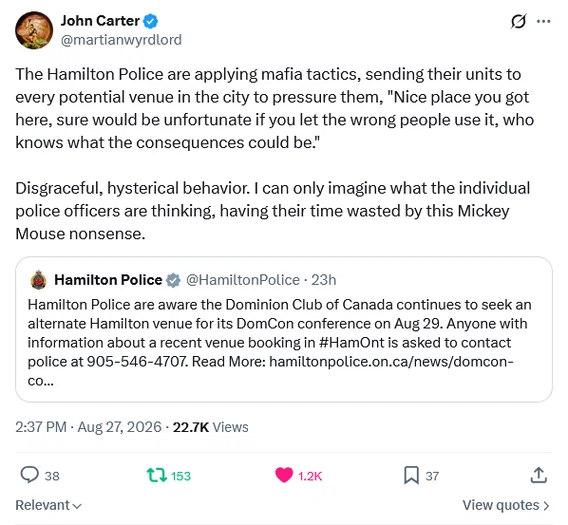
It’s always a good look when the local police are trying to intimidate businesses to prevent a peaceful legal gathering from taking place.

On August 29th, the Dominion Society of Canada (DSC) hosted a sold-out conference bringing together domestic and international speakers.Taking place in Burlington, the event was originally announced for Hamilton and was elevated to the status of international incident by legally dubious political policing, the likely unconstitutional interference of federal agencies, and numerous violations of political neutrality by local municipalities and charitable organizations.

Launched in 2025 and swelling to several thousand members by 2026, the DSC exists to advocate for immigration restriction and Canadian nationalism. Controversially, this includes a ten-year halt to immigration and the deportation of millions of non-citizen residents.

DSC’s first conference, this was a deciding moment for the increasingly notorious organization and was strongly opposed by left-wing and anti-nationalist groups, including local civic and social planning organizations, the Jewish rights and advocacy group B’nai Brith, Hope Not Hate, and the state-backed Canadian Anti Hate Network.

The event nearly passed with little notice. But moderates and liberals across the country were alarmed at a chilling assault on free assembly and expression mobilized against DSC at all levels of power.

Ahead of the event, the Hamilton Police Service urged venues “to consider the impact this event and its messaging may have on the broader community when making decisions about hosting it” and claimed “the messaging associated with DomCon is divisive and exclusionary and can negatively impact the sense of safety and belonging within our community”.

Dominion Society founder Daniel Tyrie condemned the move to use police resources to dissuade venues from hosting the conference: “Today we learn that they are going venue-by-venue to pressure businesses into canceling on us or refuse our booking. Is this an appropriate use of police resources in a city as dysfunctional as Hamilton?”

In a call with Wire Tap Media, Inspector Darren Murphy denied that Hamilton Police Service (HPS) were engaged in political intimidation, and confirmed the steps taken by HPS to keep DSC out of Hamilton.


Marius: The Outsider Who Rose to Command Rome’s Army | Rome’s First Civil War

The Rest Is History
Published 31 Aug 2026

Who was Gaius Marius, one of the two men who would shape the fate of Rome in the first century BC? Why was his road to fame, fortune, and political greatness, from total obscurity, so dangerous? And, would Marius be the man to face down the existential threat facing the empire during this period?

Join Tom and Dominic as they launch into one of the greatest struggles in the history of Rome, as two titanic generals and politicians clash over hegemony of the empire, in an age of tumult.

0:00 Gaius Marius: Rome’s outsider
6:13 Marius goes to war
12:09 Climbing Rome’s political ladder
18:35 Amazon
19:45 The Roman Republic turns violent
27:00 Marius takes on the aristocracy
31:45 War with Jugurtha
37:53 Marius betrays Metellus
40:12 Marius becomes Consul
44:28 A new threat approaches Rome
45:09 Marius meets his future rival: Sulla

“Under Communism, everyone has a job”

Filed under: Economics, History, Politics, Russia — Tags: , , — Nicholas @ 03:00

Sandy Petersen responds to the “Under Communism, everyone has a job” claim that has been circulating recently thanks to the rising popularity of useful idiots:

“Under Communism, everyone has a job”. This is absolutely true.

Here’s what else was true.

1) You were ASSIGNED your job AND the region for that job by the state (i.e., a bureaucrat). You were required to stay in your job at least 3 years.

2) After 3 years, if you wanted to switch jobs, you needed the approval of both your labor board AND your employer. If you switched too often (for example: every 3 years), there were legal penalties, up to imprisonment.

3) Promotions were based on party membership, loyalty, and sucking up. I’ve talked to a lot of former Soviet citizens, and zero of them thought merit was of use. Also many nice jobs were only for party members.

4) Wages were pretty even across the board. A factory worker, engineer, and factory manager had similar salaries, so it was indeed egalitarian, but didn’t have a lot of incentive. The higher-rank workers did get perks to make up for it. They might get a vacation dacha on the Black Sea. Or a “company” car with a chauffeur. That sort of thing. The higher-ups had better stuff.

5) You needed a passport to travel inside your own country. You couldn’t just move to Leningrad and look for work. Or even go on vacation without permission.

6) You had a union. It was state-controlled. You could not go on strike. If you criticized your factory manager, you would be arrested. Yay unions.

If you look at the above, they are an evil capitalist’s wet dream. Think of a movie with a foul imaginary super-corporation so beloved of science fiction movies — they would support every one of those initiatives.

Because that’s what the Soviet Union was — the biggest, most evil corporation that ever existed.

St. Chamond 75mm field gun: From Mondragon to WW1 tanks to Israel

Filed under: France, History, Military, Weapons, WW1 — Tags: , , , , , — Nicholas @ 02:00

Forgotten Weapons
Published 13 Apr 2026

The design for the St Chamond 75mm field gun was initially created by Mexican small arms designer Manual Mondragon, who worked extensively in artillery as well as small arms. As Mexico had no domestic artillery production capability, he worked with the engineering team at St Chamond under Emile Rimailho to complete the design, and Mexico purchased 100 of these guns by 1910, forming the backbone of Mexican Army artillery during the period. The gun is a screw breech rapid fire piece, using fully self-contained ammunition (both shrapnel and HE projectiles). It fires a 12-16 pound shell at about 1650 fps, with a range of about 6500 meters.

In September 1914 the French government panic-ordered a batch of these guns, but then reconsidered and cancelled its order in favor of simplifying logistics with just the more common Mle 1897 75mm guns. That decision changed again in 1915, with an order for 200. These were not formally classified by the French Army, but St Chamond called them the Mle 1915. The gun was identical to the original Mexican pattern except revised to use the same ammunition as the Mle 1897 (the classic “French 75”) instead of its original slightly different cartridge. These guns were initially used for general field service, but pulled off the line when it became apparent that their recoil systems were not really able to handle the stresses of the constant firing required. Instead, they were used as the main armament for the initial 210 St Chamond heavy tanks (less the first 48 that did not receive main guns). After these were used up, the Mle 1897 was used instead.

One final element of combat service for the guns took place in 1948, when Mexico sold 32 of them to Israel, where they were used in Israel’s war of independence. Three examples remain on display in Israeli museums today, more than anywhere else. The one I am looking at today is a Mexican contract piece made in 1904, registered in the US as a live and transferrable Destructive Device.
(more…)

QotD: “Down-line clear …”

Filed under: Britain, History, Quotations, Railways — Tags: , , , , — Nicholas @ 01:00

In 1957, there was still a railway through the village of Stanford-on-Avon on the cross-country line, now sadly vanished post-Beeching, which linked the West Coast Main Line at Rugby with the Midland Railway’s own main line north at Market Harborough. On our frequent Saturday afternoon cycle rides, Dad and I would often pause at the Stanford level crossing in the hope of seeing a train run past.

On one occasion, noticing us waiting by the gates, the signalman slid open his window and asked us if we’d like to come up and see inside the signal box. I was up those stairs almost before he’d finished his sentence and he treated us both to a conducted tour of a fascinating and beguiling little empire.

When bells started ringing, he explained about the bell code system and announced that there was a cross-country passenger train about to pass through Stanford, without stopping, on its way to Rugby. Suddenly, he asked me: “Would you like to signal this train through the station?”

“Gosh, yes! Of course I would!”

The sequence started by closing the gates on the level crossing. These were the traditional, heavy timber gates, rather than the comparatively minimal lifting-barriers seen today. They were opened and closed by turning a huge ship’s wheel-type contraption in the signal box and it took all my strength, plus more than a little help from the signalman, to turn it sufficiently to get the gates completely closed. This reliance on a direct mechanical linkage is the reason why the signal box had to be immediately adjacent to the gates.

Next, it was the signals, which were operated by a system of wires opposed by counterweights. The signalman showed me which levers to pull. I had to pull with all my might to get that red upper-quadrant signal to rise. Pulling the yellow distant signal “off” took even more effort, because its greater distance from the signal box meant that the wire was very long indeed. All these tasks were completed solely by manual devices without any mechanical assistance. It was a technology which hadn’t changed since Victorian times.

After what seemed like a long wait, the train eventually appeared in the distance and I felt so proud, hearing it whistling a greeting. Actually the whistle is a warning device, but I was only eight and I was convinced that the driver was saying “thank you” as he steamed through the station past the signal box, courtesy of my hard work.

And just as it had been with the farm horses, it would not be long before Dr Beeching would sweep away rural railways, together with the way of life which went with them and make such experiences as this impossible.

Whenever I see a railway these days, with everything surrounded by high steel fences, their vertical pales topped with barbarous triple-spikes and further surmounted with coils of barbed wire, together with notices threatening huge fines for trespass, I’m reminded of just how lucky I was to grow up in a time when a signalman could invite a child and his father to join him and give them a singular experience which they would both remember for the rest of their lives.

Brian Meredith, “A 1950s childhood, Part 2: ‘Down-line clear …'”, The Conservative Woman, 2026-05-31.

Powered by WordPress


