Quotulatiousness

September 18, 2026

Worrying about post-combat lawfare will crush initiative and morale

Filed under: Britain, Europe, History, Law, Military, Politics — Tags: , , , , , — Nicholas @ 05:00

As mentioned in Dr. Robert Lyman’s account yesterday, the British government wants to turn back the hands of time to change the rules of engagement under which British Army troops and police conducted themselves during “The Troubles” in Northern Ireland. It may be an exciting prospect for law firms, activists, and other anti-military groups, but it would set a terrible precedent for British use of military force from this moment onwards. At The Critic, Alexander Gray explains why this is a dangerous and stupid idea that should be dropped forever:

“British Army working during the Field Training Exercise” by U.S. Army Europe is marked with Public Domain Mark 1.0 .

The debate about the hounding of veterans through the courts has long been presented in terms of fairness. This is indeed one side of the story. No decent country should tolerate servicemen being dragged through repeated investigations decades after the events in question, often without new evidence and after previous inquiries have already reached their conclusions.

But focusing only on veterans misses an even more urgent point: this has become a national security threat.

Over the past two decades, the legal framework governing military operations has changed. Courts have increasingly applied standards developed for peacetime to scrutinise wartime situations of uncertainty and danger which often demand split-second judgement. Human rights law, designed principally to regulate relations between the state and individuals, has increasingly been applied to military operations, including to situations already governed by the Law of Armed Conflict.

This is having consequences on the battlefield. Personnel who believe that a lawful decision taken in combat may be reconstructed years later in a civilian courtroom are now incentivised to be more cautious, more process-driven and less willing to exercise initiative. That hesitation can slow decisions in situations where delay may place lives and the success of an operation at risk. The prospect of repeated investigations and prolonged legal uncertainty is also damaging morale and contributing to experienced personnel leaving the service, depriving the Armed Forces of skills and judgement that are difficult to replace.

This is why the Prosperity Institute has published the Military Operations Bill, presented to Parliament this week by Sir David Davis MP. It reasserts the principle that combat operations should be judged primarily by the Law of Armed Conflict. Courts have an important role in punishing wrongdoing, but they should not become alternative command structures reviewing military judgement from the safety of hindsight.

“The destruction of the European Civil War traumatized us”

Filed under: Australia, Cancon, Europe, History, Media, Politics, USA, WW1, WW2 — Tags: , , , , , — Nicholas @ 04:00

On Substack Notes, John Carter points out the vast chasm between the capabilities of western nations and their timid aspirations for the future:

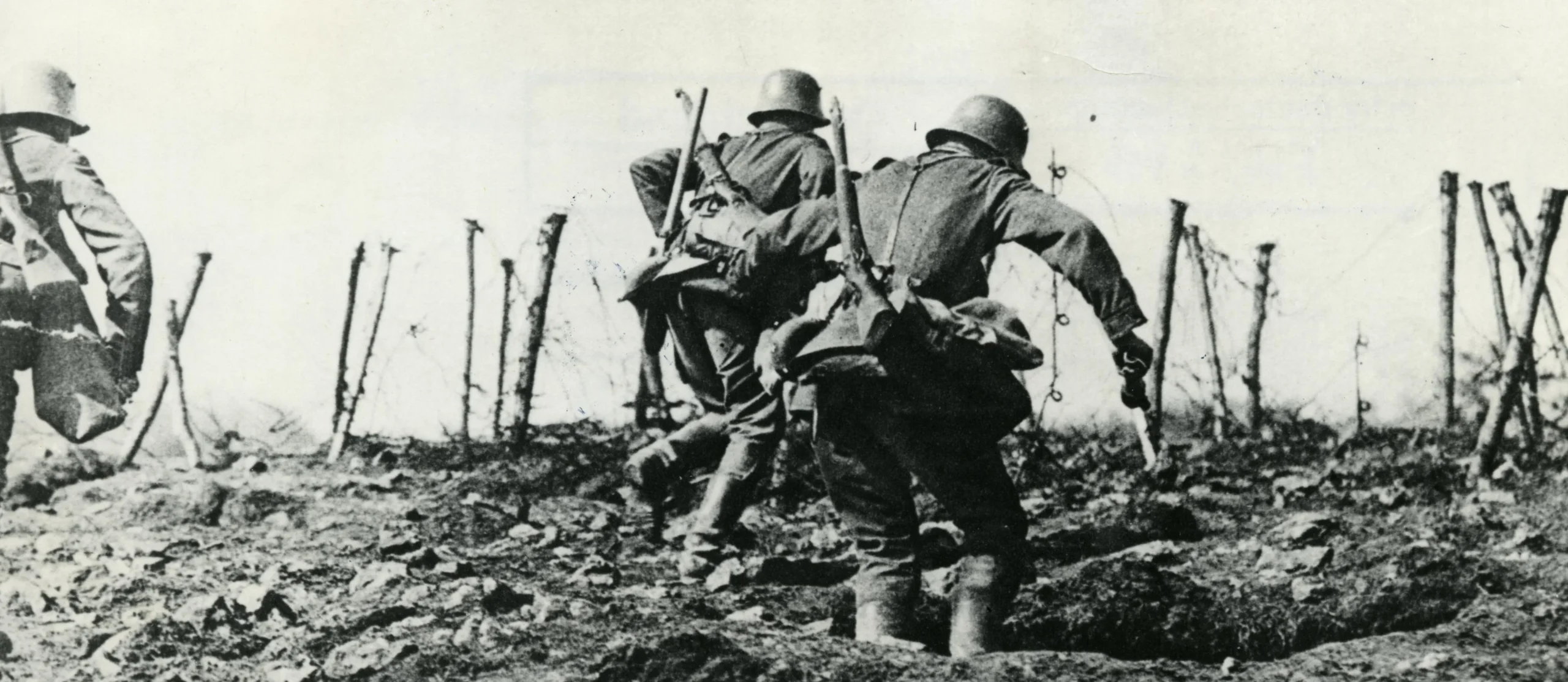
LeMO Erster Weltkrieg – Kriegsverlauf – Frühjahrsoffensive 1918
Photo from dhm.de

Western civilization is terrified of itself. The destructive power of our militaries is unparalleled in history. We can devastate continents in minutes. We can annihilate entire populations. We can reduce cities to rubble.

But we don’t.

The same is true of our industrial capability. We can erase mountains, redirect rivers, carve tunnels deep into bedrock, reshape entire landscapes as we please.

But we don’t.

The destruction of the European Civil War traumatized us. Meanwhile, the unintended consequences of unrestricted development — air pollution, water pollution, soil erosion, habitat destruction, even the sheer rampant ugliness of so much of postwar industry — has left us leery of just doing things.

In the postwar era we began binding ourselves ever more tightly with laws. International law to restrict the use of military force; environmental laws, labour laws, indigenous rights laws, and so on to govern the use of our industrial capacity. We did this for good reason. No one wants nuclear war, or even a repeat of World War Two. No one wants another Three Mile Island, another Chernobyl. With great power comes great responsibility, and no civilization has ever been more powerful.

But the result has been to paralyze us.

Our militaries watch helplessly as supplicants invade us with begging bowls held up as their battle standards, prohibited from shooting the unarmed boats by governments bound by international treaties to respect the human rights of anyone who claims to be seeking asylum. Meanwhile we find that it is almost impossible to build anything. High-speed rail, bridges, highways, housing — all of it is slowed to an imperceptible crawl by a regulatory overburden designed to do precisely that. Gulliver held down by Lilliputian strings of his own design, his flesh swarming with hungry ants.

The emerging political coalition of the right is largely comprised of those factions who have grown impatient with this artificial paralysis of the will. Why shouldn’t we use our military to assert ourselves abroad, and defend our borders at home? Why shouldn’t we turn loose the incredible power of modern, heavily automated, high-tech industry to build wonders on a scale never before known? Why shouldn’t we conquer space? Why shouldn’t we use biomedical science to make ourselves beautiful, brilliant, healthy and fit? Why shouldn’t we allow ourselves to be powerful? Why shouldn’t we allow ourselves to be strong? We shouldn’t we reach for greatness?

The opposition consists of all those factions who are horrified by this, terrified of the strength of Western civilization, intent on slowing it, stopping its engine, dismantling the machine, and salting the biocultural soil from which it grew. Third worldists, climatists, AI safetyists, pacifists, open-borders activists, misinformation censors, DEI ideologues, international human rights NGOs, all of these cooperate to throw sand in the gears, to sabotage the West, to subordinate it and ultimately to destroy it.

One disruptive kid can ruin class for all the others

Filed under: Education — Tags: , , , — Nicholas @ 03:00

I remember talking to the teacher who taught the special needs kids at my middle school … Mr. Gibson was the only black teacher in the school and he was far more qualified than any of the others. It also helped that he had the patience of a saint: I doubt any other teacher there could last more than a day with the kids he looked after. At some point in the decades since I was in school, the powers-that-be decided that integrating all the children together was the right decision. By any sensible reckoning, it has been the worst thing they could have done, both for the special needs children and all the other children, as GenX Anecdotes relates on Substack Notes:

GenX Anecdotes didn’t include this in her post, but I thought it to be appropriate, in a way.

Having worked in schools and hearing my daughter’s experiences, it just can’t be the case that a tiny minority of extremely disruptive kids ruin the learning for all the others. Yet I have seen time and time again how one or two disruptive kids with severe behavioural issues can derail a whole lesson.

The dogged insistence that all the kids must be thrown together regardless of capabilities and behaviour is insane to me.

I have seen the amount of time, effort and extra staff required to deal with just ONE kid who clearly needs “round-the-clock” close supervision.

I have often thought those kids should not be in a “normal” class or school. They need to be somewhere else where they can get specialist support. And I don’t care how many times you shout “inclusivity” at me. Those kids would be better off somewhere else too.

I have watched kids who, during lunchtime, will smash up a whole table of kids’ lunches and try and run out of the school gates; kids continually shouting in lessons; bully and “hit” other kids repeatedly; demand all the other kids play games exactly as THEY want them to be played; derail a whole lesson and be continually brought out of the classroom, but only to be brought back in again!

Then I see the adults pander to the disruptive ones time and time again and expect all the other kids to suck it up and put up with their bullshit. All under the guise of some “neurodivergent” excuse. If their “neurodivergence” continually negatively impacts everyone around them, then they need to be removed from everyone else. Sorry. It’s not everybody else’s responsibility to put up with it.

Time and time again, the needs of a minority of kids prioritise the needs of many.

I remember when I worked in one junior school, attending a training day for teachers and support staff, which was conducted by the school head teacher.

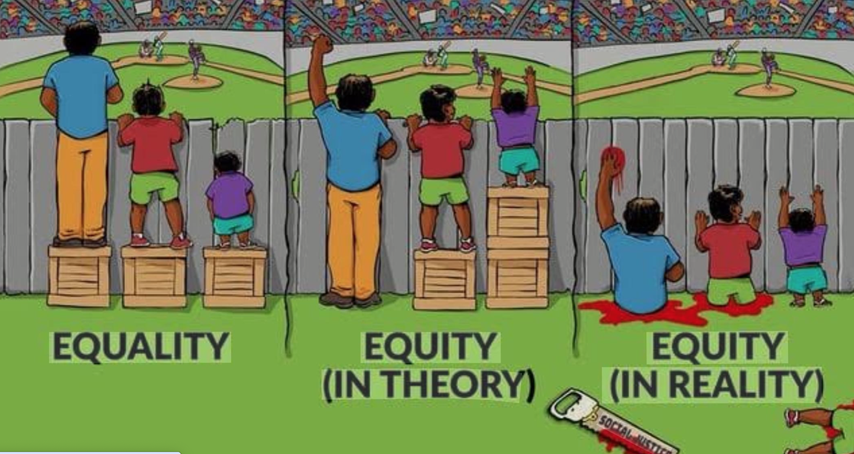
When I raised this issue, he just went over to his laptop and brought up that “equity” meme of the three people standing on boxes looking over a wall onto the big screen and said THIS is why.

He didn’t like the fact that I had brought this up, especially since some of the teachers agreed with me. He very quickly shut me down, and his whole tone was this kind of patronising and smug “you don’t understand at all do you?” Like he was having to explain basics to me. There were a thousand things I wanted to say about it, but I didn’t.

What really got me was how all those teachers who had agreed with me looked at the meme and were nodding! They were impressed by it and acted like they hadn’t seen it before. It was beyond infuriating. I SO wanted to get up and go over to the laptop and find the other “equity in reality” meme, which is far closer to the truth.

But I didn’t, because I didn’t want to derail the whole thing and be the only “disrupter” in the room.

It was close to lunchtime, and it was already running over, and everyone was clearly eager to get out of there, so I didn’t want to turn it into an ideological battle of wits. In hindsight, I wish I did.

But I wasn’t brought up to be that person. And yet, ironically, here we are. Raising a generation of people who WOULD totally hold everyone up and much worse.

I left that job soon after that. It wasn’t just that. It was a lot of things related to this. I watched daily as things that I thought could actually be quite easily made better with some practical adjustments were continually and self-evidently made worse for EVERYBODY because of an adherence to this arrogant and utterly insane ideological bullshit.

It drove me nuts.

Guatemalan Contract St Chamond 70mm Mountain Gun

Filed under: Americas, France, History, Military, Weapons, WW1 — Tags: , , , , , , — Nicholas @ 02:00

Forgotten Weapons
Published 2 May 2026

Despite the French Army adopting a 65mm mountain gun in 1906, several French companies — including St Chamond and Schneider — developed their own mountain gun designs in the years before World War One. These were popular guns for foreign export, being relatively small, light, and inexpensive. St Chamond’s 70mm gun was built on the same breech design as their previous 75mm field gun, at the request of the Mexican military and famous small arms designer Manuel Mondragon. Quantities were sold to Mexico, Guatemala, and Belgium (for use in the Belgian Congo). This example is a Guatemalan one, now in the United States as a live, registered, transferrable Destructive Device.
(more…)

QotD: Higher education as a vast money laundering racket

Filed under: Bureaucracy, Education, Quotations, USA — Tags: , , — Nicholas @ 01:00

Have I mentioned my theory (which I regard as a certainty) that Higher Education is best understood as a massive money laundering operation? We all had a good chuckle, I’m sure, at that title [“fellowship at the International Centre for the Study of Radicalisation at King’s College in London”], just as we’ve had good chuckles at the ridiculous titles of all the Angry Studies programs infesting colleges nationwide. We’ve probably concluded — correctly — that these are just make-work for otherwise unemployable PhDs who check a few of the Diversity quota boxes.

But when you consider just how much money is involved, it’s a lot harder to laugh. Your average tenured prof makes north of $100 K, and for every one of them, there are at least two administrators, four outreach coordinators, and uncountable Special Assistants to the Assistant Provost’s Special Assistant for Diversity and Inclusion. Not to mention all the classroom space, office space, etc. that this requires (including paying the very real people who have to coordinate that stuff — no easy task — the custodial staff and so on). I’d bet that just one of these programs, all in, runs at least a million dollars per year when you throw in bennies and whatnot.

That’s a LOT of scratch, for one or two classes a semester that barely even make their enrollment numbers.

I dunno what nefarious purpose the Angry Studies programs serve (aside from the obvious, perpetual one of “burning down ambient civilization, just because”), but the “national security” ones I’m sure are basically just “diplomatic” cover for cloak and dagger shit. They used to use academic conferences like that back during the Cold War — who else but an officially credentialed diplomatic representative gets to travel around his enemies’ territory? In this case, of course, none of these people are actually going anywhere near war zones (with the exception of Mx. Kagan, of course, who decided to take command of American forces in the field). But academic “conferences” are good ways to make contacts and pass suitcases full of cash and other goodies around …

… I suspect.

Severian, “Klown Kollege”, Founding Questions, 2022-08-28.

Powered by WordPress