
Quotulatiousness

September 8, 2026

We should stop using the terms “capitalism” and “capitalist”

On his Substack, Lorenzo Warby returns to the issue of how we describe the (theoretical) predominant economic system by which the west has risen to wealth and power using terms coined by the man who hated it more than any other:
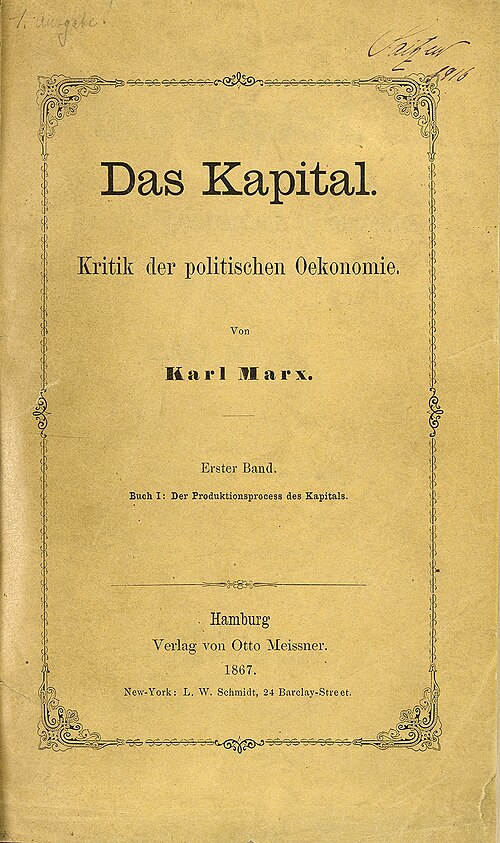
Title page of Das Kapital in the first German edition of Volume 1.
Wikimedia Commons.

It would be a great improvement to our understanding of social dynamics if people stopped using the terms capitalism and capitalist. Given how ubiquitous these terms are, this may seem a strong claim, but it is one that is easy to sustain.

The Marxist definition of capitalism is:

According to Wikipedia:

    Capitalism is an economic system based on the private ownership of the means of production and its use for the purpose of obtaining profit.

The first problem is the ism. There is no role for the state here. The state becomes, implicitly or explicitly, a “reflection” of the economic system, despite the fact that people do not describe non-state societies as “capitalist” even though such societies can have lots of private ownership used for the purposes of gaining income.

Non-state societies cannot manage the scale of economic activity so as to have, for example, firms. Their economic production is overwhelmingly centred on households.

Sedentism — living in dwellings — created households that then became, for millennia, the centre of most economic activity. Even states were governed out of royal or imperial households. It is factories, and offices, that move economic activity out of households.

The mass energy-use take-off we call the Industrial Revolution has brought the arc of economic history that began with sedentism to an end. When economist Robin Hanson writes about the shift from farmer “back” to forager patterns, it is the effects of the supplanting of households from the centre of economic activity that he is pointing to (without fully grasping that).

Note that this shift away from households being central to economic activity is very much about energy use: it applies to both commerce and to state activity (including state production). It is not inherently “capitalist”.

State production also produces commodities: calling such “state capitalism” just shows how much capitalism is a ridiculously protean term.

Eliding the state

The exclusion of the state in defining capitalism is not analytically benign. A classic and continuing use of the term capitalism is to romanticise the state. By viewing the state as a “reflection” of the economic system, all bad things, all disliked features, can be based on the malign influence of “capitalists”, of the dynamics of “capitalism”, with the state reduced to an instrument or reflection of such dynamics. (The same thing can be done in reverse, blaming all bad things on the state — see anarcho-capitalism — but that is much less common.)

The natural — and used — implication of blaming private commerce for all bad things is that, if good people, with good intentions, and proper understanding, run the state, it can do anything needed for their program to be achieved. This is very obvious if one, for example, reads the program of the Democratic Socialists of America.

The term capitalism thereby becomes a vehicle for getting the state profoundly wrong; for not understanding that the state is a fundamental structuring feature of any state society; for not understanding that, across history, states have been the dominant extractor and creator of surplus, and so of class structures. That, when it comes to state societies, the state itself is fundamental.


Sulla Seized Rome… Then Marius Returned for Revenge | Rome’s First Civil War

The Rest Is History
Published 7 Sep 2026

What shocking, unprecedented act did Sulla commit with his legions after having his ambitions frustrated once more by his bitter rival, the tribune Marius? How did Marius escape capture and death? And, would Marius retaliate …?

Join Tom and Dominic as they unfold the mounting rivalry between two Roman generals — Marius and Sulla — as they battle for ultimate control of the empire, and Sulla takes a fateful step that will change the fate of the Republic forever …

0:00 Sulla: The First Roman General to March on Rome
4:31 Marius Seizes Sulla’s Command
11:47 Sulla Marches on Rome
19:50 Mithridates: Rome’s Great Enemy in the East
23:25 The Massacre of the Romans in Asia
26:46 Athens Revolts Against Rome
30:34 Rome’s Generals Become Warlords
34:38 Pressure
35:46 Marius: Fugitive and Outlaw
41:02 Rome Descends Into Political Violence
45:13 Marius Raises a Private Army
48:15 Marius Returns to Rome
49:06 Marius’s Seventh Consulship and Death
51:44 Sulla Goes to War in Greece
53:40 The Siege of Athens
56:59 Sulla Storms Athens
59:51 Sulla Faces Mithridates’ Army
1:00:48 Sulla Makes Peace with Mithridates
1:03:33 Sulla’s Revenge on Athens
1:04:58 Rome’s First Civil War Looms

The legacy of Top Gear

Filed under: Britain, Media — Tags: , , , , — Nicholas @ 03:00

I’m not really a “car guy” … I’ve generally driven pretty unexciting vehicles and don’t have a burning desire to own a “supercar” or even a “sports car”. Yet I always enjoyed being able to catch an episode of BBC’s Top Gear, which was usually years and years after that particular episode had been originally aired. There’s lots of YouTube channels that serve up Top Gear clips and even some multi-episode supercuts. It may well have been the only “car show” whose primary audience were not “car guys”:

The original Top Gear that launched in 1977 was a useful programme. The 2002 reboot, cooked up by Clarkson and producer Andy Wilman, was something else: a studio with a live crowd, a mute racing driver in a white suit called The Stig, celebrities sent around a track in a “reasonably priced car”, and three presenters who treated cars as punchlines, characters and passports.

When James May replaced Jason Dawe in series two, the chemistry locked. Clarkson was the loud, power-obsessed ringmaster. Hammond was the sharp witted, enthusiastic hamster who would try anything. May was Captain Slow, the pedant with the soul of an engineer. Their arguments weren’t bits. They felt like three mates who actually liked each other and enjoyed winding each other up. The show became a sitcom that happened to have supercars in it.

Cars stopped being appliances. They became the excuse for “how hard can it be?” challenges, £1,500 sports cars that immediately exploded, races against trains and boats and planes, and specials that sent three middle-aged men across Botswana, Vietnam, Bolivia, Patagonia and the Arctic. The cinematography — helicopter shots, dusk light, engines echoing off mountains — made a car show look like cinema. People who had never cared about torque curves suddenly cared about whether Hammond would survive the next cheap-car challenge.

The numbers were absurd — In the UK it regularly pulled six million-plus viewers and peaked near seven or eight million. At its height it was the BBC’s most valuable commercial property, worth tens of millions a year in overseas sales, DVDs, tours and merch. The UK version was sold into 170-plus countries. BBC figures put the cumulative worldwide audience around 350 million people — not every week, but over the life of the show, an astonishing reach for a programme that started as a poky little motoring magazine.

Sunday night became a ritual. Families who couldn’t name a camshaft still sat down together. Kids who would never own a Veyron learned what one sounded like. People in countries with no British TV tradition quoted “POWERRRR,” “Oh, cock,” and “Some say …” as if they were local slang.

They invented the template everyone still copies — Look at YouTube car culture. Cinematic reviews. Personality-first presenting. Budget road trips with mates. “We bought three terrible cars and drove them across a continent.” That whole language exists because Clarkson, Hammond and May made it look like the most fun job on earth, years before every 22-year-old had a gimbal and a channel. Writers have argued, not unreasonably, that for a generation they mattered more to car enthusiasm than many of the great manufacturers. Ask a random person to name someone famous associated with cars. They will not say Enzo Ferrari. They will say Jeremy Clarkson.

They also made loving cars socially normal. You didn’t have to be a garage hermit. You could be a bloke who liked engines and jokes and scenery. The specials doubled as travel films. A lot of people booked flights to Vietnam or Botswana because three idiots on BBC Two made the world look reachable.

The impact wasn’t just ratings. It was companionship. For more than a decade, millions of people had three familiar voices in the living room every week. Bad day? Cheap-car challenge. Need wonder? Polar special. Need to laugh at human incompetence? Almost any episode. The friendship on screen — real enough that it survived crashes, controversies, a BBC firing and a move to Amazon — made the show feel like hanging out with people you knew.

They were messy. They caused diplomatic incidents. They said things that would not survive a modern compliance meeting. That is part of why they felt like television from a different era: three men who were allowed to be large, rude, authentic, sentimental and ridiculous in the same hour. When they finally signed off from The Grand Tour, it really did feel like the end of something that television no longer quite knows how to make.

And on that bombshell …

Why The Soviet Union Lost In Afghanistan

Filed under: History, Middle East, Military, Russia — Tags: , , , , , — Nicholas @ 02:00

Real Time History
Published 3 Apr 2026

In February 1989, the last Soviet combat troops leave Afghanistan after almost a decade of war. Despite military superiority, the superpower was not able to establish a stable Moscow-friendly regime in the country. Yet, the mujahedeen are also deeply divided and influenced by outside forces such as Pakistan, Saudi Arabia, and Osama Bin Laden.
(more…)

QotD: Why the revolution envisioned by Marx didn’t happen

[T]he revolution eagerly anticipated by Marx never materialized — at least, not where it was supposed to, in the advanced industrial countries. The great bouleversements of 1830 and 1848 were the results of short-run spikes in food prices and financial crises more than of social polarization. As agricultural productivity improved in Europe, as industrial employment increased, and as the amplitude of the business cycle diminished, the risk of revolution declined. Instead of coalescing into an impoverished mass, the proletariat subdivided into “labor aristocracies” with skills and a Lumpenproletariat with vices. The former favored strikes and collective bargaining over revolution and thereby secured higher real wages. The latter favored gin. The respectable working class had its trade unions and working men’s clubs. The ruffians had the music hall and street fights.

The prescriptions of The Communist Manifesto were in any case singularly unappealing to the industrial workers they were aimed at. Marx and Engels called for the abolition of private property; the abolition of inheritance; the centralization of credit and communications; the state ownership of all factories and instruments of production; the creation of “industrial armies for agriculture”; the abolition of the distinction between town and country; the abolition of the family; “community of women” (wife-swapping); and the abolition of all nationalities. By contrast, mid-nineteenth-century liberals wanted constitutional government, the freedoms of speech, press, and assembly, wider political representation through electoral reform, free trade, and, where it was lacking, national self-determination (“home rule”). In the half-century after the upheaval of 1848 they got a great many of these things — enough, at any rate, to make the desperate remedies of Marx and Engels seem de trop. In 1850 only France, Greece, and Switzerland had franchises in which more than a fifth of the population got to vote. By 1900 ten European countries did and Britain and Sweden were not far below that threshold. Broader representation led to legislation that benefited lower-income groups. Free trade in Britain meant cheap bread, and cheap bread plus rising nominal wages thanks to union pressure meant a significant gain in real terms for workers. Building laborers’ day wages in London doubled in real terms between 1848 and 1913. Broader representation also led to more progressive taxation. Britain led the way in 1842 when Sir Robert Peel introduced a peacetime income tax; by 1913 the standard rate was 14 pence in the pound. Prior to 1842 nearly all British tax revenue had come from the indirect taxation of consumption via customs and excise duties, regressive taxes that take a proportionately smaller amount of your income the richer you are. By 1913 a third of revenue was coming from direct taxes on the relatively rich. In 1842 the central government had spent virtually nothing on education and the arts and sciences. In 1913 those items accounted for 10 percent of expenditures. By that time, Britain had followed Germany in introducing a state pension for the elderly.

Marx and Engels were wrong on two scores, then. First, their iron law of wages did not exist. Wealth did indeed become highly concentrated under capitalism, and it stayed that way into the second quarter of the twentieth century, but income differentials began to narrow as real wages rose and taxation became less regressive. Capitalists understood what Marx missed: that workers were also consumers. It therefore made no sense to try to grind their wages down to subsistence levels. On the contrary, as the case of the United States was making increasingly clear, there was no bigger potential market for capitalist enterprises than their own employees. Far from condemning the masses to immiseration, the mechanization of textile production created growing employment opportunities for Western workers — albeit at the expense of Indian spinners and weavers — and the decline in the prices of cotton and other goods meant that Western workers could buy more with their weekly wages. The impact is best captured by the exploding differential between Western and non-Western wages and living standards in this period. Even within the West the gap between the industrialized vanguard and the rural laggards widened dramatically. In early seventeenth-century London, an unskilled worker’s real wages were not so different from what his counterpart earned in Milan. From the 1750s until the 1850s, however, Londoners pulled far ahead. At the peak of the great divergence within Europe, London real wages were six times those in Milan. With the industrialization of northern Italy in the second half of the nineteenth century, the gap began to close, so that by the eve of the First World War it was closer to a ratio of 3:1. German and Dutch workers also benefited from industrialization, though even in 1913 they still lagged behind their English counterparts.

Niall Ferguson, “Capitalism, Socialism and Nationalism: Lessons from History”, 2020-02.

Powered by WordPress


