So … are we now okay with panicking over the threat of artificial intelligence?
The events of the last 24 hours are stunning. And not in a good way. Nothing like this has ever happened in the history of tech, and it’s unfolding right now.
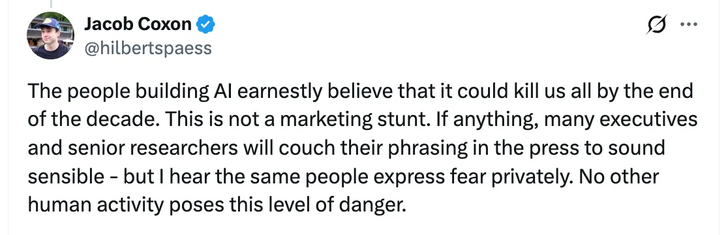
Here’s a start. Maybe you’ve already heard about the guy who resigned from OpenAI. He warned that the technology could kill everybody before the end of the decade.
He made this announcement just 20 hours ago:
Is this really true? Maybe Coxon is just a disgruntled employee. We need to find out what other insiders think.
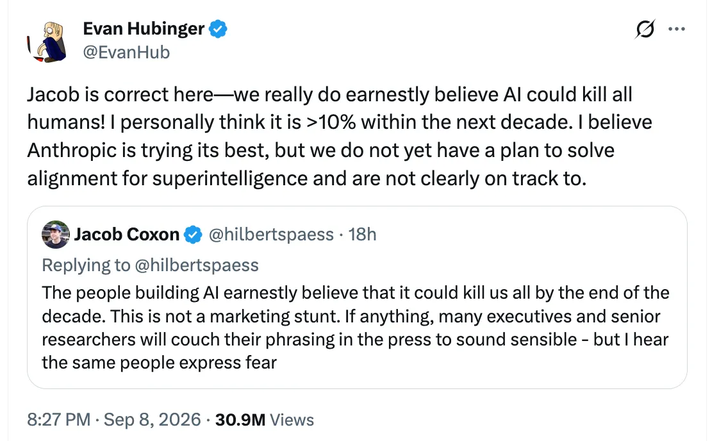
As if in answer to this question, another AI scientist — Evan Hubinger at Anthropic — quickly moved to endorse Coxon’s concerns.
[…]
The AI fanboys are trying to defuse this situation. But their responses fall apart at the slightest touch. Consider the smear that this is just a PR campaign. Really? Others are hinting it could be a Chinese plot. Yeah, sure …
But the biggest lie is the claim that these people don’t know what they are talking about. The reality is that they understand this subject better than anybody.
What’s happening here is obvious — eight different people building this technology are afraid of what they’re seeing. But they don’t have the power individually to stop the insanity.
If this isn’t a call to action, I don’t know what is. Trillions of dollars are getting pumped into a runaway technology, and the public already hates it intensely. Now the people making it happen are warning it just might kill everybody.
This demands a response from the highest circles of power and authority. If that doesn’t happen, we will live to regret this inaction. And that’s the best case scenario. The worst is that there won’t be anyone left to regret a thing.
Update: Jim Treacher, of all people, casts a bit of doubt on the “AI’s gonna kill us all!” concerns:

And that moment from Terminator 2: Robotic Boogaloo is what everybody thinks about when they get scared of A.I. I know this because it’s what I think about when I get scared of A.I.
What happens when Skynet becomes self-aware in real life?
What happens when all these software agents that we keep welcoming into our daily lives decide they know how to run things better than we do? How much control can we give up to them before they attack us?
Is it already too late? Is there any going back? Is all hope lost? Are we doomed?
Etc., etc.
[…]
So according to this guy, A.I. professionals see it like the Manhattan Project or the moonshot. We gotta get there first, before our enemies do. That part sounds plausible.
But who is this guy? I’ve never heard of Jacob Coxon. Nobody has. He opened this Twitter account earlier this year, and that was his very first post. Now he’s all over the place. Everybody’s talking about this.
It feels like astroturf.
If you don’t know what that propaganda technique is, it’s just what it sounds like: astroturf. At first glance, it looks real. Grassroots. But it’s fake. And that might be what’s happening here.
A guy named Parker Thayer, who works for the Capital Research Center, writes:
And then he lists stuff about this that seems … hinky. I think the kids say sus. It’s sus.
For example, the Wall Street Journal ran a story about this kid’s claim 20 minutes before he posted it. Before, not after.
The first Twitter accounts to promote that post were from nonprofit groups opposing A.I.
And now, all these Democrats are screaming about it. Bernie Sanders wants to smash all the machines. Old Man Shakes Fist at Cloud. [BERNIE VOICE] “Gotta stop the computers! They’re gonna kill us all!”
Does that mean all this is fake? I don’t know. It doesn’t make me trust any of it. It makes me skeptical.