Yesterday, the Canadian counter-tariffs to the latest round of US tariffs kicked in. Maxime Bernier put it this way:
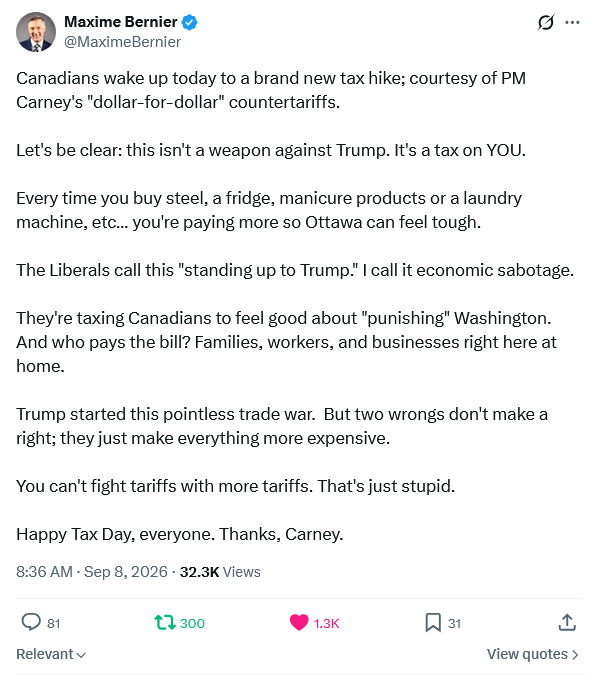
Canadians wake up today to a brand new tax hike; courtesy of PM Carney’s “dollar-for-dollar” countertariffs.
Let’s be clear: this isn’t a weapon against Trump. It’s a tax on YOU.
Every time you buy steel, a fridge, manicure products or a laundry machine, etc. … you’re paying more so Ottawa can feel tough.
The Liberals call this “standing up to Trump”. I call it economic sabotage.
They’re taxing Canadians to feel good about “punishing” Washington. And who pays the bill? Families, workers, and businesses right here at home.
Trump started this pointless trade war. But two wrongs don’t make a right; they just make everything more expensive.
You can’t fight tariffs with more tariffs. That’s just stupid.
Happy Tax Day, everyone. Thanks, Carney.
Carney’s plan all along has been to push Trump into saying and doing things that give Carney and the Liberals even more Boomer support. Pretty much controlling the relic media allows the government to massage the stories so that Dear Leader is never in the wrong and “the Bad Orange Man hates you and wants to destroy you”. Canadian boomers are among the last people in the world to realize that they’ve been systematically gaslighted since Justin Trudeau ran for Liberal leader … and the penny still hasn’t dropped. Enough of them are already psychologically prepared to destroy what’s left of the economy, Thelma & Louise style, if Carney invites them to. And he’s going to.
John Carter responds to a Ben Woodfinden article in the National Post, blaming dissident Canadians for not rallying behind Mark Carney to … do exactly the same sort of performative elbozo pantomime that the Boomer Liberals have been doing for over a year?

This misses the mark in a subtle but interesting way. The author invokes the concept of oikophobia against the Canadian online right for joining in (actually initiating) American mockery of Canada, arguing that Canadian rightists are themselves oikophobic for not instead supporting the Carnites.
This is incoherent. The Liberal regime is itself oikophobic, loudly so. Oikophobia is explicit Canadian government policy, as the author himself tacitly acknowledges by noting that we pointed out the hypocrisy of Canadian politicians decrying Trump’s lame Lake America stunt after a decade-long orgy of renaming every school, square, and street in the country in the name of a Woke ideology imported straight from America. That’s to say nothing of replacement migration, and racial preference systems that make white Canadians second class citizens. You can’t be oikophobic against the oikophobes.
There are certainly slopulist 51st staters out there, but their influence in the Canadian right is actually marginal, largely confined to a rump of lolcow Alberta separatists. The energy is all in Canadian Loyalism, and that is a different animal entirely.
The reason we’re happy to pile on to the Canadian political elite when the Americans mock them isn’t because we want to be America. It’s because we’re disgusted by the state of the country.
Trump can excoriate the Canadian military for being fat and woke because it is. That isn’t Trump’s fault. That’s because of decades of sabotage and social engineering by the Liberal Party.
Trump can joke about annexation because the Canadian military is weak. Again, that isn’t Trump’s fault. That’s the fault of the Laurentian elite, the very people now insisting that they can turn things around.
If Canada had a serious government, we’d be taken seriously. We don’t, and haven’t since Pearson at least. As a direct result of the deeply unserious clowns running the country into the ground, Canada is poor, defenseless, sclerotic, and despondent. Every time Trump makes fun of us, the very fact that his insults land is a condemnation of the elites that brought our beautiful country to this shameful condition.
Saving Canada requires circulating the elite.
And that’s why we pile on.
And since I try not to overtax my non-Canadian readers (the vast majority of you) with too many separate maple-flavoured posts, here are some sensible suggestions from Matt Gurney about fixing our own problems — which are legion, and mostly self-inflicted — rather than pretending that Trump is the problem:
… there’s a bigger issue at play here than just managing the relationship with America. What the hell do we do as Canadians?
Don’t think about the States at all. Don’t think about Trump. Just think about Canadians in Canada. What should we be doing for ourselves? Even if the trade war does eventually end, our relationship with the United States is going to require generations to fix. Some very fundamental assumptions about Canadian, well, everything, now need to be reconsidered. I’m the guy who wrote the column about our expectations being a problem, and I’m still having a hard time keeping up with this.
But if there is one thing that I could suggest we should prioritize, it’s simply fixing the problems we have in this country. Really. Just … do the right things. Fix the problems. Just like virtue is its own reward, making good decisions is always a good decision. It’s bizarrely not something we’ve been good at lately, though, and it’s probably actually going to get harder for a while. In fact, a patriotic rallying-around-the-flag effect is very likely to make it even harder than it already is to get Canadians to actually admit there are major problems in this country, and then insist that the politicians get serious about fixing them.
I’ve been thinking about writing this column for a couple of weeks. Last month I was in the United States for some family business. I was actually there the day Carney called our negotiators home, and I returned to Canada the next day; I joked with some friends that, much like our negotiating team, I was packing up and leaving the United States to show them we meant business.
But one of the things I did notice on my visit to the United States, which included stops in two major cities, was that those American cities were much cleaner than my hometown of Toronto, and in much better repair.
And the especially bizarre thing was, one of these cities was Detroit.
Yes, that Detroit. Astute Line readers — the smartest and best-read people in the whole wide world — will recall that Detroit has not often been held up as an exemplar of civic governance and urban success.
But the downtown looked good. It was safe, clean, well-patrolled; I’m not exactly a regular visitor, but I do pop in often enough to have noted real improvement in the state of things there, even compared to my last visit, which was only about a year ago.
The other major city I visited, Chicago, has always struck me as the best apples-to-apples comparison my hometown of Toronto has with a U.S. city. Chicago has a lot of visible problems. I’m not trying to gloss those over; one thing I quickly noted was a roughly Toronto-esque number of people wandering the streets in evident mental-health crisis, shouting at nothing. But overall, Chicago had much less visible homelessness and was in a considerably better state of repair and cleanliness than my hometown. It wasn’t subtle. Cleaner streets, in better condition, with fewer people obviously living on them. Toronto did not compare well.
And just when the hell did that happen?
We can’t blame Trump for our laughably protectionist inter-provincial trade barriers. We can’t blame Trump because we’re functionally incapable of building a pipeline to bring Canadian oil and natural gas to Canadian markets. We can’t blame Trump for our ever-less-functional public healthcare systems. We can’t blame Trump for our ever-less-appealing market conditions for foreign investment. We can’t blame Trump for our deteriorating relationship with First Nations groups. These are all things that need to be fixed by Canadians. In Canada. No matter who might be occupying the Oval Office in Washington, DC.
Update: Added missing URL to John Carter’s post on X.