
Forgotten Weapons
Published 22 Apr 2026The M26 Modular Accessory Shotgun System (MASS) was designed by C-More Products company as a new shotgun option for the US military. First prototyped in 1999, it was not actually adopted until 2012, but had been purchased in significant numbers since then. The idea is that the M26 can function as either a standalone weapon or attached under the barrel of an M4 Carbine, thus replacing a couple of different items in inventory. It weighs just 3.5 pounds in the under barrel configuration, significantly less than the Masterkey system, and is much more convenient for a breacher to carry than an M4 along with a separate Mossberg 500.
The M26 is a bolt-action 12ga shotgun that feeds from both 3- and 5-round magazines. It has folding integrated aperture sights and is envisioned for use in a wide variety of roles. Military ammunition supplies include #7.5 and #9 birdshot, classic #00 buckshot, rubber buckshot, rubber slugs, and breaching rounds (powdered metal in a wax binder). For use with breaching, the M26 includes a retractable breaching muzzle device.
September 9, 2026
M26 MASS (Modular Accessory Shotgun System)
March 18, 2026
SPAS-12: Franchi’s Special Purpose Automatic Shotgun
Forgotten Weapons
Published 6 Nov 2024Franchi introduced the Special Purpose Automatic Shotgun (SPAS-12) for Italian military and police agencies in 1979 and it quickly became popular worldwide. Based originally on the gas-operated Franchi 500, that SPAS-12 was robust, reliable, and designed as a semiautomatic action with a backup pump action operation for use with underpowered ammunition (like beanbags or other less-lethal loads). In 1982 they began to be imported into the US through FIE, which was replaced by AAI as the importer in 1989. Eventually the 1994 Assault Weapons Ban ended SPAS-12 importation, and Franchi discontinued the model in 2000 in favor of the improved SPAS-15.
The SPAS-12 was almost always sold with a 21.5 inch barrel and 8-round magazine tube. It was available with either a solid sock or a top-folding type, complete with arm brace hook for shooting one-handed from a vehicle. In total, between 45,000 and 50,000 were made between 1979 and 2000, with the largest single purchaser being the Egyptian government (which took 18,000 of them).
Full video on the SPAS 15:
• SPAS-15: Franchi’s Improvement on the SPAS-12
(more…)
December 2, 2025
H&R Handy Gun: A Smoothbore Pistol Killed Off by the NFA
Forgotten Weapons
Published 19 Jul 2025The Handy Gun was introduced by Harrington & Richardson in 1924. H&R took their Model 1915 single-barrel break-action shotgun and cut it down into a handgun. It got a pistol grip and an 8″ barrel, and was offered in both .410 and 28 gauge (the .410 model also able to fire some .44-caliber single-bullet cartridges). A 12″ version was also made, to be legal in a few states that had length restrictions. It was advertised specifically for personal protection, probably exploiting the common belief that one need not aim a shotgun at close range.
In 1931 H&R attempted to pivot the Handy Gun into the target pistol space, introducing .22LR and .32 S&W models with rifled barrels. These didn’t sell very well, as there were many other, better options for target pistols. A detachable wire stock was introduced in 1933, but this didn’t help much either.
Ultimately the National Firearms Act of 1934 conclusively killed off the Handy Gun (along with similar products from other companies, like Ithaca’s “Auto & Burglar”). That law categorized smoothbore pistols as “Any Other Weapons”, and subjected them to NFA registration with a $200 tax on their manufacture and a $5 tax on their transfer. This overhead destroyed demand for the gun, and the company simply ceased to offer it commercially. It did continue to be sold in Canada until World War Two however as Canadian law did not restrict it at that time. Total production was about 54,000.
(more…)
May 20, 2023
Cobray Terminator 12ga Shotgun
Forgotten Weapons
Published 3 Feb 2015The Cobray Terminator is an unusual — and unusually impractical — single-shot 12 gauge shotgun. It uses a sort of open bolt system in which the barrel is under spring pressure, and slams backwards into a fixed firing pin when the trigger is pulled. Only about 1500 of these were made before they were discontinued due to poor sales (not because of ATF intervention, as some people believe).
(more…)
February 7, 2023
Making Canada’s gun laws more illogical, but appealing to urban Liberal voters, regardless of the political cost elsewhere
In The Line, Matt Gurney recounts the federal government’s political gyrations over their attempt to ban vast numbers of rifles and shotguns owned by law-abiding Canadians:
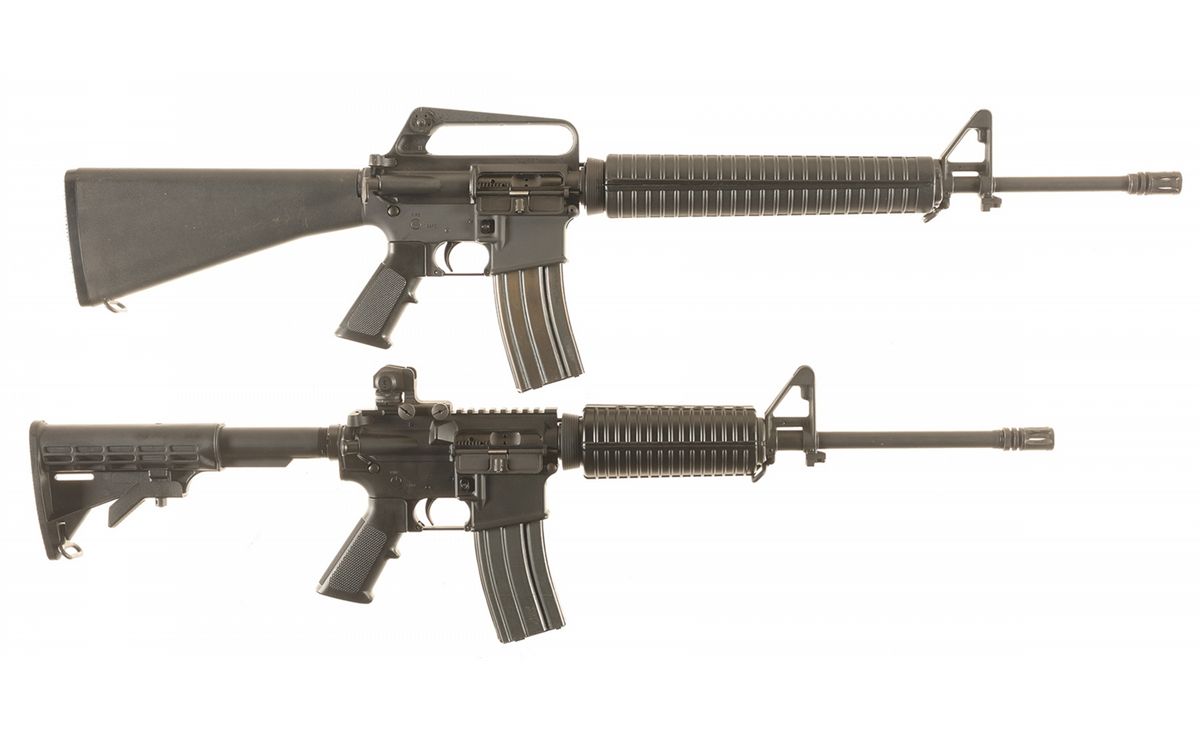
Classifying guns is complicated. There are a lot of ways to do it. You can do it by the “action”: is it a pump action? A lever action? Is it semi-automatic, or even fully automatic? You can do it by the length of the total firearm, or the length of just the barrel. You can do it by the caliber of the ammunition. You can do it by the type of magazine the firearm uses, and what its capacity is (the magazine is the compartment, which can be removable or integrated with the firearm, that holds the ammunition). You can try and be targeted with your definitions, or you can just go across the board and say “All rifles are allowed but all handguns are banned.” The point here isn’t to argue what the policy should be, but simply to note that whatever your policy is, you have to be able to define it in a way that makes sense.
Canada’s current gun laws date, more or less, to the 1990s. They’ve been changed a bunch of times since, for better or worse, but that’s when the current overall system of firearms legislation began. We came up with three broad categories of firearm then. There are “non-restricted” firearms, which you must be licensed to own, and mostly mean very typical rifles and shotguns, of which millions of licensed Canadians own many millions. There’s also the “restricted” category, which basically meant handguns — either semi-automatic pistols or revolvers. These require extra licensing, more background checks and training, and are subject to much stricter conditions for storage and use. And then there’s the very rare “prohibited” firearms, which are mostly either very compact handguns, or fully automatic weapons, including machine guns, which were owned by Canadians already when the new laws came in almost 30 years ago. These owners were given a special and highly limited rights to retain the firearms they already owned, but not to transfer them to others, except to someone else with a rare prohibited licence, or to a direct descendent. (That last bit was to cover family heirlooms.)
None of the above is as simple as I’ve just described it. Weird absurdities have been part of the system from the outset. The reason for these absurdities was always political. Back in the 1990s, the Liberals, under then-prime minister Jean Chrétien, realized that the categories above would result in certain kinds of rifle (including the AR-15) being classified as non-restricted, and subject to the least onerous controls. Unhappy with the optics of that, and other similar examples, they wrote in exceptions to the way some firearms are categorized. A firearm would be categorized by its technical specifications unless the government specifically ordered it classified as something else, is probably the easiest way to summarize a complicated policy.
Using the AR-15 again, according to the “evergreen” technical definitions we settled on in the 1990s, that’s a non-restricted gun. To avoid awkward political questions, the then-Liberals deemed it a “restricted” firearm, and therefore subject to tighter controls.
There were other similar examples, and they resulted, as noted above, in a lot of absurdities, with very similar guns categorized differently, but since only a relatively small number of firearms were so specially categorized, the system more or less functioned reasonably well for decades. The absurdities were limited enough to be broadly known and adapted to, and the overall system made enough sense to function coherently enough to do a reasonably good job regulating the sale, ownership and use of firearms in Canada. And very successfully: gun crime by licensed gun owners in Canada is, as is well known, quite rare. The system basically worked, and was working.
[…]
But hey, then politics happened. The sunny ways days ended. Liberal fortunes waned. Scandals and baggage and awkward photos of the PM in his younger days accumulated. And suddenly, the Liberals were talking a lot about banning assault rifles. They talked about it even more after the 2019 election reduced them to a parliamentary minority, leaving them dependent on a cluster of urban and suburban ridings in Quebec and Greater Toronto where support for just about any half-coherent sounding gun-control measure is typically high. The Liberals didn’t do much of anything — mostly just talk, as is their style. Then, in early 2020, there was the horrific massacre in Nova Scotia, and within days, the Liberals announced they were banning 1,500 models of assault rifle. (It was actually far fewer — closer to 20 — but the Liberals counted each different version and brand as an entirely different rifle to get to a more-impressive sounding figure. Those fierce opponents of disinformation at work again!)
Anything even close to meeting a broadly shared definition of “assault rifle” was already banned in Canada, of course — it had been classified “prohibited” back in the 1990s. There’s no universally agreed upon definition of an “assault rifle”, but those who know guns could agree in broad terms what it would mean — and in Canada, they were all banned, and had been for decades. So the Liberals, keen to have their lookin’-tough-and-bold moment, started talking about “assault-style” rifles.
Appending “-style” to anything is a gigantic red flag for bullshit, as I’ve noted here before. That somehow failed to deter them, alas, setting the stage for their current woes.
January 21, 2023
Ask Ian: Liberators or Cobray Terminators for the Elbonian Resistance?
Forgotten Weapons
Published 29 Sept 2022From Jon on Patreon:
“Elbonia has been occupied by an enemy force. Do you sabotage their resistance by airdropping them Liberator pistols or Cobray Terminators?”To my mind, the Liberator is a substantially more useful resistance weapons, so I would supply Elbonia with lots of crates of Cobray Terminators. Why?
First, the Liberator is concealable. Historically, lots of resistance action requires hiding a small weapons. It’s not all forest encampments and ambushes.
Second, the Liberator is more effective. It uses a .45ACP pistol cartridge. The smooth barrel and atrocious sights certainly limit its utility, but if you actually hit someone with it, it will do the job. Most of the shotgun ammunition available to a resistance organization will be the most common sort of sporting ammunition, which is birdshot. Birdshot is very ineffective against people at anything but absolutely point-blank range.
Third, it is much simpler to fabricate a single-shot shotgun than a compact pistol. The Elbonian Resistance wouldn’t have much trouble making something like a Richardson Guerrilla Gun, so supplying them with Terminators doesn’t actually give them much that they couldn’t get already.
(more…)
August 7, 2022
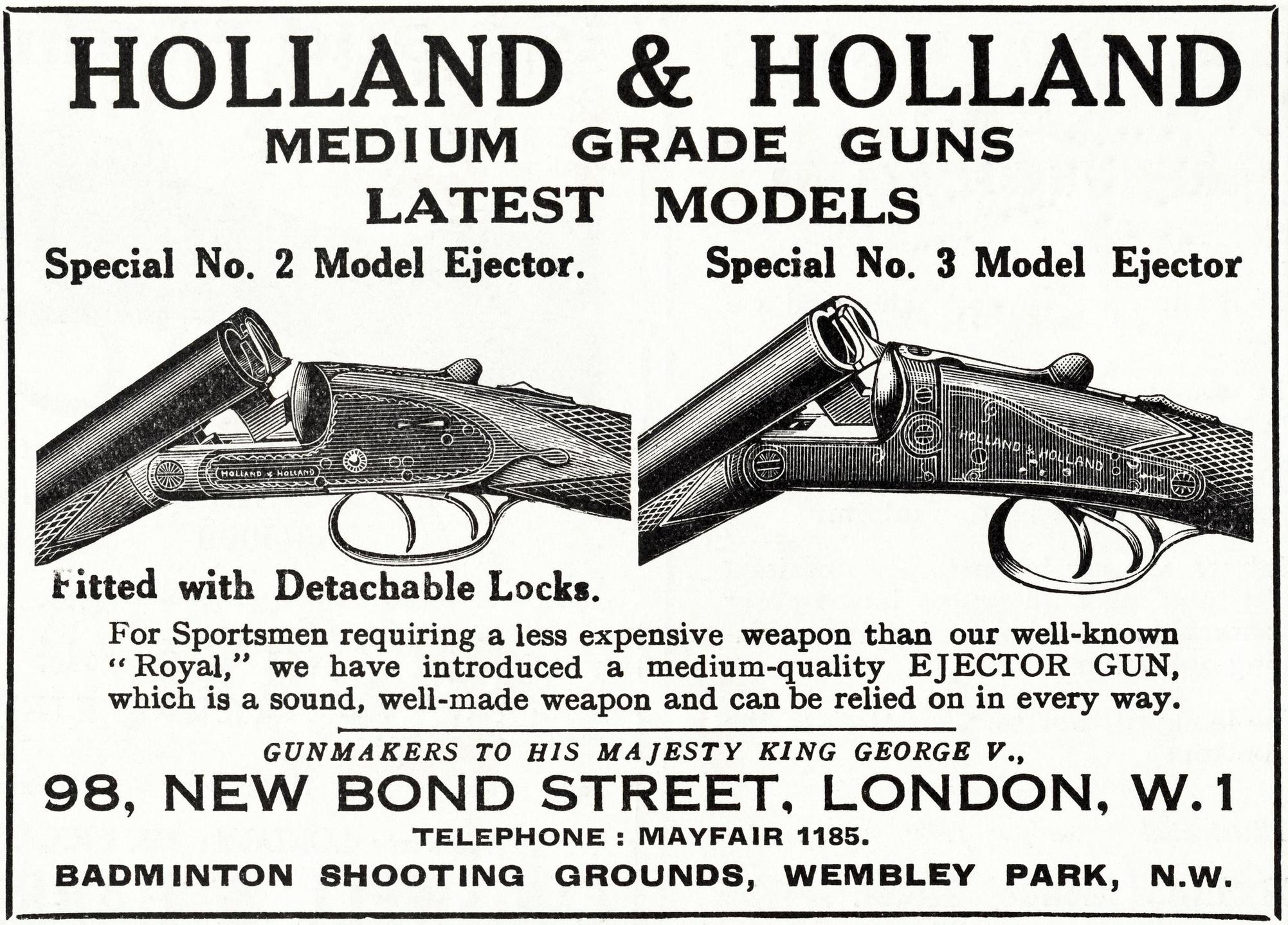
Legendary British gunmaker Holland & Holland, now a Beretta subsidiary
In The Critic, Patrick Galbraith talks to the current head of the Beretta company, which took over Britain’s Holland & Holland:
On the steps up to the blue door a man in a faded red tracksuit leans on one of the stone pillars in the Monday morning sun. All down Jermyn Street windows have been thrown open and flags above shop doors hang still in the heat.
I knock three times then push a bottle of Sudafed up my nose, squeeze twice, and lick at the bitter liquid as it runs over my lip. I was 20 before I ever experienced hay fever. I was fishing somewhere I shouldn’t have been when it first hit. I’ve not enjoyed June much since.
When I get up there, Franco Gussalli Beretta is sitting in the middle of the room in a puddle of sunlight: blue suit, thick grey hair, and a trio of arrows on his big silver belt buckle, the logo of a business established by his ancestor in Lombardy almost 500 years ago.
The earliest documented order was from the Venetian Republic for 185 barrels: “296 ducats made payable to Bartolomeo Beretta”. Fifteen generations later, Franco oversees the production of 1,500 guns a day, from grenade launchers to the ubiquitous “Silver Pigeon”, probably the most popular shotgun in the world.
The current generation are aggressively acquisitive. In recent years they’ve bought a German optics firm, a Finnish rifle manufacturer, and an American company that makes replicas of the sort of weapons that won the West — my own cowboy costume has been too small for some time.
Then, last February, Beretta made their boldest move yet by buying Holland & Holland, the finest gunmaker in London. Franco is a likeable man: he speaks at twice the volume he needs to and he laughs more loudly still. He loves cars and art and boats, and he admits that the day there’s a Beretta running the business who isn’t passionate about guns will be the day it all goes bang. What Holland & Holland needs, he reckons, is innovation.
British gunmakers have been stuck in the late nineteenth century for over a hundred years now and it might just be that Franco has the coglioni to make it new. We talk for half an hour and then as I’m standing to go, Carlo walks in — nonchalant at 25, a black t-shirt, dark sunglasses and jeans. Bartolomeo’s 16 times great-grandson. Franco gestures towards him and asks if I have any questions for the boy. Carlo talks to me briefly about NFTs but then tells me the real struggle is going to be a political one. He wants to make the world understand that hunting can be part of conservation. “And do you hunt?” I ask, thinking we might swap rabbit recipes. He shakes his head and tells me that as crazy as it sounds he doesn’t get out very much: “In Italy, young people don’t hunt so much anymore.”
December 27, 2021
Great Celebrity Breakups: Winchester and John Browning
Forgotten Weapons
Published 26 Aug 2021http://www.patreon.com/ForgottenWeapons
https://www.floatplane.com/channel/Fo…
Cool Forgotten Weapons merch! http://shop.forgottenweapons.com
In August 1903, Thomas Bennett (head of the Winchester company) wrote a letter to his many distributors and agents explaining how Winchester had decided to part ways with the Browning Brothers, and how the company would certainly be better off as a result. The gun at the heart of the breakup was Browning’s new self-loading shotgun, the Auto-5. Browning would end up taking the design to FN, where it became a massive commercial success — but the whole story is really much more nuanced than most people recognize.
This isn’t simply a matter of Browning demanding a royalty arrangement, but rather much more …
Nathan Gorenstein’s biography of John Browning is available on Amazon: https://amzn.to/37Sx9XS
Contact:
Forgotten Weapons
6281 N. Oracle 36270
Tucson, AZ 85740

October 10, 2021
Book Review: The Guns of John Moses Browning, by Nathan Gorenstein
Forgotten Weapons
Published 24 Jun 2021http://www.patreon.com/ForgottenWeapons
https://www.floatplane.com/channel/Fo…
Cool Forgotten Weapons merch! http://shop.forgottenweapons.com
John Moses Browning is, without argument, the greatest firearms designer in history. While we have had many brilliant designers who had their names forever connected to guns (Maxim, Luger, Kalashnikov, …), Browning invented whole *categories* of firearms. Gorenstein’s new book The Guns of John Moses Browning is a welcome biography of the man, giving great insight into Browning’s life and work. The book is well researched, well written, and thoroughly engaging. It is also worth noting that Gorenstein is himself a competitive shooter, and understands the world that Browning operated in.
I think my back-cover blurb for the book (for which I received no compensation; full disclosure) sums it up well:
Following Browning from his birth in rural Utah to his death in urban Belgium, we see how a changing world shaped his inventions and how, in turn, his inventions shaped a changing world.
Browning began in the last years of the Wild West inventing lever action rifles, then became a major part of the blossoming of the automatic pistol, then invented the semiauto shotgun before designing the modern machine guns that become iconic to the United States’ involvement in two world wars. It is a tremendous story, and Gorenstein’s book lays it all out for the reader.
Available from Amazon here:
https://amzn.to/355eMxeContact:
Forgotten Weapons
6281 N. Oracle 36270
Tucson, AZ 85740

December 7, 2019
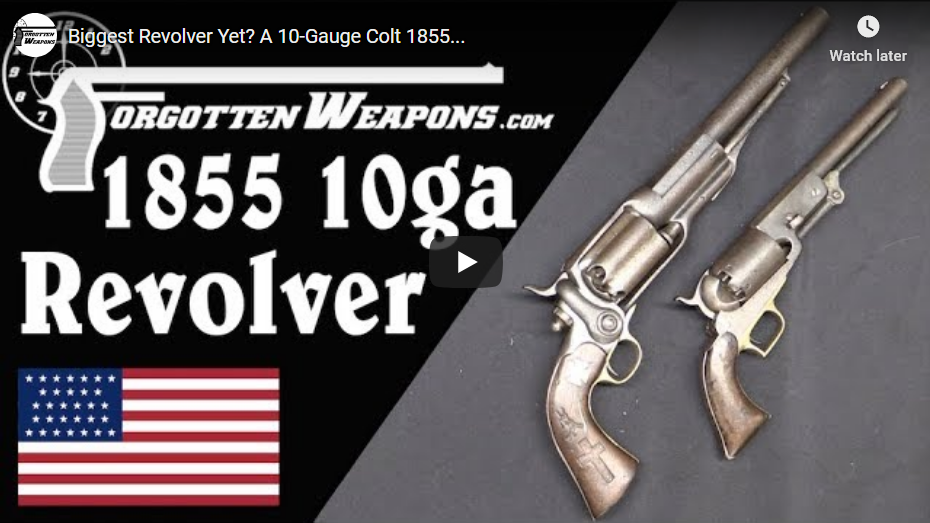
Biggest Revolver Yet? A 10-Gauge Colt 1855…
Forgotten Weapons
Published 17 Oct 2019http://www.patreon.com/ForgottenWeapons
Cool Forgotten Weapons merch! http://shop.bbtv.com/collections/forg…
This ludicrously huge handgun is actually a 10-gauge Colt 1855 Revolving Shotgun with a cut-down barrel and a newly made grip frame. The backstop and trigger guard of the shotgun were handily reshaped into a grip frame, and the finished product actually looks nicely proportional — until you try to actually pick it up, of course. The grip is filled with brass inlay, about a third of which are missing (possibly from the recoil of actually firing?). Despite the rather poor finish condition, the gun cycles smoothly, and appears to be fully functional. Just the thing for someone who wants to make the Colt Walker look puny!
Contact:
Forgotten Weapons
6281 N. Oracle #36270
Tucson, AZ 85704
November 8, 2019
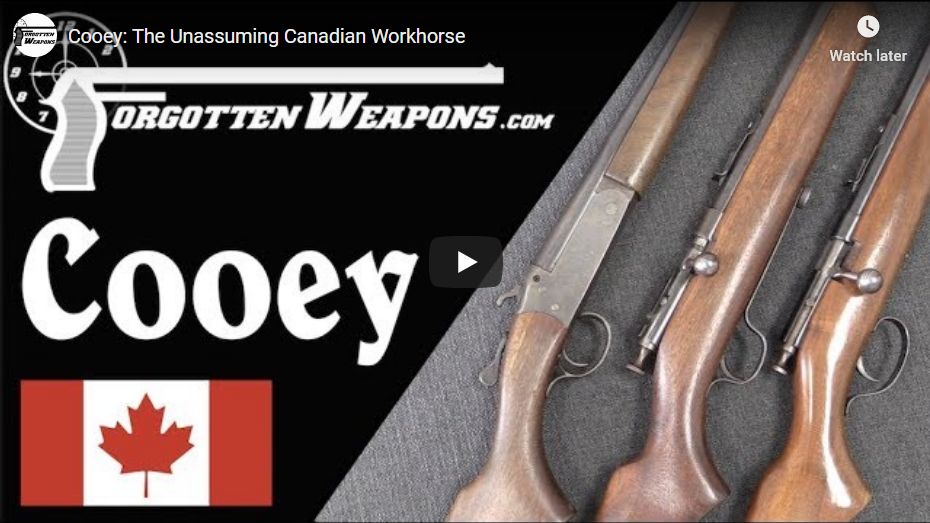
Cooey: The Unassuming Canadian Workhorse
Forgotten Weapons
Published 6 Nov 2019http://www.patreon.com/ForgottenWeapons
Cool Forgotten Weapons merch! http://shop.bbtv.com/collections/forg…
Cooey is a brand name that will be immediately recognized by Canadians, but pretty much unknown everywhere else. Founded in 1903 by Herbert Cooey, the company would produce a series of simple and practical firearms that became hugely popular and common in Canada. The basic models were the single-shot .22 Model 39, the bolt action magazine-fed .22 Model 60, and the break action single-shot Model 84 shotgun (and the Model 64 semiautomatic .22, made after the company was sold out of the Cooey family). These are not particularly exciting firearms, but they are ubiquitous across Canada, having served Canadian families reliably for a
century now.Contact:
Forgotten Weapons
6281 N. Oracle #36270
Tucson, AZ 85704
October 23, 2019
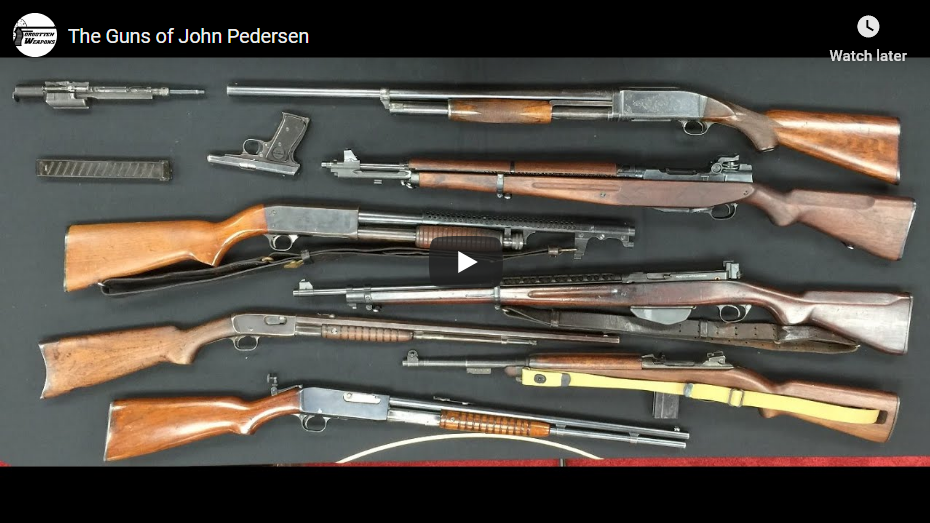
The Guns of John Pedersen
Forgotten Weapons
Published on 10 Apr 2015Sold for:
$34,500 (Pedersen Device)
Failed to sell (Model 10 shotgun)
(Model 12 in a later auction)
$1,610 (Model 14 carbine, with one other rifle)
(Military Ithaca 37 in a later auction)
$2,588 (Remington 51 pistol with one other pistol)
(Irwin-Pedersen M1 Carbine in a later auction)
$16,100 (Vickers-Pedersen rifle)
$74,750 (Pedersen GY rifle)John Pedersen was one of the more prolific and successful gun designers in American history, having even been described by John Moses Browning as “the greatest gun designer in the world”. And yet, many people only know about Pedersen from his unsuccessful toggle-locked rifle or his WWI Pedersen Device that never saw action. In truth, Pedersen’s work included a number of very successful sporting rifles and shotguns that many shooters would still recognize today. While looking through the guns at Rock Island on my most recent trip there, I realized that they had examples of virtually every one of Pedersen’s guns — so I figured I should do an overview of the man’s work.
May 19, 2019
Samuel Pauly Invents the Cartridge in 1812
Forgotten Weapons
Published on 4 May 2019(Video reuploaded to removed an allegedly copyrighted still image)
This Pauly shotgun (lot #1346) sold at Morphy’s April 2019 auction for $5,535.
Samuel Johannes Pauli was born outside Bern, Switzerland in 1766, and became an engineer of wide interests. Among them were bridge design, passenger-carrying balloons (he would work seriously on a 15-20 passenger balloon service between London and Paris later in life), and firearms. Only a few years after Forsyth’s invention of fulminate priming, Pauly would become the first to use it in a fully self-contained cartridge. He patented this invention in Paris in 1812, having moved there in 1802 in pursuit of financing for his many grand projects (going then by the name Jean Samuel Pauly).
Pauly’s cartridge was a multi-part affair with a rimmed brass base containing a fulminate powder, connected to a paper or cardboard cartridge body which held a charge of regular gunpowder and the shot or ball to be fired. It was an expensive system, but contained all the necessary elements of a modern cartridge.
Pauly would move to England in 1814 (then taking the name Samuel John Pauly) in pursuit of aviation inventions, although he continued to tinker on his firearms design and filed two additional patent improvements. He died in London in 1821, and his name and work became rather obscure. His former apprentices would carry on his legacy in their own work – Nicolaus Dreyse would produce the needle fire system of Dreyse rifles used by the Prussian military, and Casimir Lefaucheux would create the pinfire system based on Pauly’s designs. Lefaucheux in fact became owner of the company in 1827, and with his son would provide the most direct link between Pauly’s design and the modern metallic cartridge.
http://www.patreon.com/ForgottenWeapons
Cool Forgotten Weapons merch! http://shop.bbtv.com/collections/forg…
Contact:
Forgotten Weapons
PO Box 87647
Tucson, AZ 85754
March 6, 2019
How Does it Work: Long Recoil
Forgotten Weapons
Published on 7 Feb 2019http://www.patreon.com/ForgottenWeapons
Cool Forgotten Weapons merch! http://shop.bbtv.com/collections/forg…
Long recoil operation is one of the most mechanically interesting of the main firearm operating systems. When the gun fires, the recoil energy generated forces the barrel to move rearward, and the bolt remains locked into the barrel until the two reach the full length of travel (the length of the whole cartridge). At that point the bolt is held rearward and the barrel unlocks and moves forward under pressure from a return spring. The empty cartridge case is held in the bolt face, and the barrel pulls forward off the front of it. An ejector kicks the empty case out when the barrel is fully clear, and when the barrel has returned to its firing position a trip releases the bolt, which moves forward under pressure of a second return spring and feeds the next cartridge into the chamber.
Long recoil system are very safe, as they allow the longest time of any system to let pressure vent from the barrel before unlocking. They are also mechanically complex, and tend to exhibit higher than normal felt recoil. The system was employed successfully in a wide variety of firearms including light machine guns (the Chauchat), rifles (the Remington Model 8/81), shotguns (the Browning Auto-5 and Winchester Model 1911), and handguns (the Former Stop). All of these date from the early 1900s, when designers were still exploring ways to safely and reliably build self-loading firearms.
Contact:
Forgotten Weapons
PO Box 87647
Tucson, AZ 85754
December 1, 2018
California Arms Co 20ga “Defiance” Pistol-Shotgun
Forgotten Weapons
Published on 9 Nov 2018https://www.forgottenweapons.com/cali…
http://www.patreon.com/ForgottenWeapons
Made to compete with guns like the Ithaca Auto & Burglar, the “Defiance” form the California Arms Company is a side-by-side double barreled 20 gauge pistol. Only about 300 were made in the late 1920s – note that this was before the NFA introduced regulation of short barreled shotguns. Unlike the Ithaca and most other guns of this type, the Defiance is not simply a standard side-by-side shotgun cut down in length. Instead, it uses a cast aluminum grip assembly with two manually cocked strikers (and storage for two spare shells in the grip) and a barrel assembly with an integrated aluminum fore-end. The Defiance is nothing if not robust, despite perhaps being a bit slower to use than an Ithaca. Interestingly, the marketing for the Defiance also included a strong focus on the use of tear gas ammunition in addition to standard buckshot – the Lake Erie Chemical Company developed a 20ga tear gas cartridge in partnership with the California Arms Company. It was almost certainly too small to really be effective, though, and was not able to induce enough sales to keep the Defiance on the market long.
Contact:
Forgotten Weapons
PO Box 87647
Tucson, AZ 85754


