Quotulatiousness

September 26, 2026

Jacob Rees-Mogg says the quiet part out loud

Filed under: Britain, History, Media, Politics, WW1 — Tags: , , , — Nicholas @ 05:00

Despite British news popping up here fairly regularly, I don’t closely follow individual politicians, so I didn’t have strong opinions about Jacob Rees-Mogg. I guess I had mild positive feelings about him based on what he’d said on various issues several years ago. I’d rather assumed he’d be out of politics by now with the collapse of the “Conservatives” after the Boriswave, but no, he still thinks of himself as a voice worth listening to … unfortunately.

Thoughts from the Shire suggests that we not blame Rees-Mogg too much, as he merely said out loud what they all think:
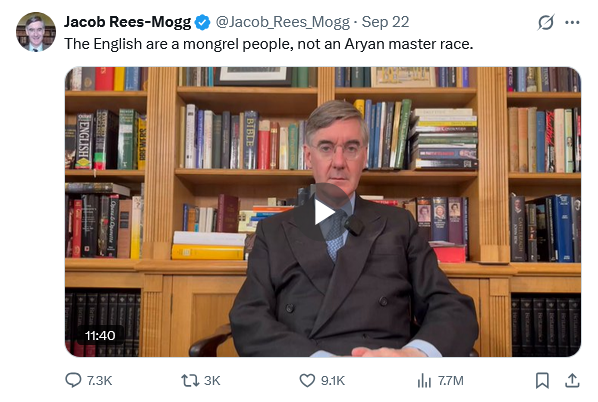
Don’t be too hard on old Jacob Rees-Mogg.

His recent call for the return of duty and the stiff upper lip, along with his warning that some of us may once again have to fight and die for our country, has predictably, and rightly so been met with howls of derision.

But here’s the thing, Mogg isn’t entirely wrong.

Duty does matter, courage matters, and sacrifice matters. A people incapable of defending themselves will eventually find themselves at the mercy of people who can, this is the story of world history. The problem is not the principle, the problem is the state of the nation, and perhaps more importantly, the relationship between those asking for the sacrifice and those expected to make it. People have rightly been pointing out that Millionaire Mogg, and his progeny are not likely to be the ones enlisted for the frontline, and that too often in our history the likes of Jacob have led many millions of good men to war. It is great that many have seen through Moggs BS rhetoric, and are telling him where he can stick his future war.

However we should not think that the masses of working class men that fought in past conflicts all did so out of patriotism, or because they listened to their betters, or were too stupid to see through the propaganda. Most knew their leaders were full of shit, most despised the upper crust types like Mogg.

It’s rather amusing that both the British and Canadian powers-that-be have spent a long time doing things to diminish the patriotism of their people — not least by mass immigration against the will of the voters — and denigrating the patriotic feelings they haven’t managed to fully suppress. Both ostentatiously treat immigrants, especially illegal immigrants better than they treat their own citizens, both with public support and judicial slight-of-hand to minimize or eliminate punishments when they do find themselves in court.

Now, British elites want the downtrodden young white males to ready themselves to go die for Ukraine, while Canadian elites want their downtrodden young white males to become, as John Carter put it, the Hoser Taliban and fight against the Yankee hordes of the Bad Orange Man. As if everyone will just magically forget that they spent the last decade and more actively trying to erase our history and blacken the reputations of the men who built our nation.

Sorry for the interruption, I’ll get off my hobby horse and let’s get back to Thoughts From the Shire:
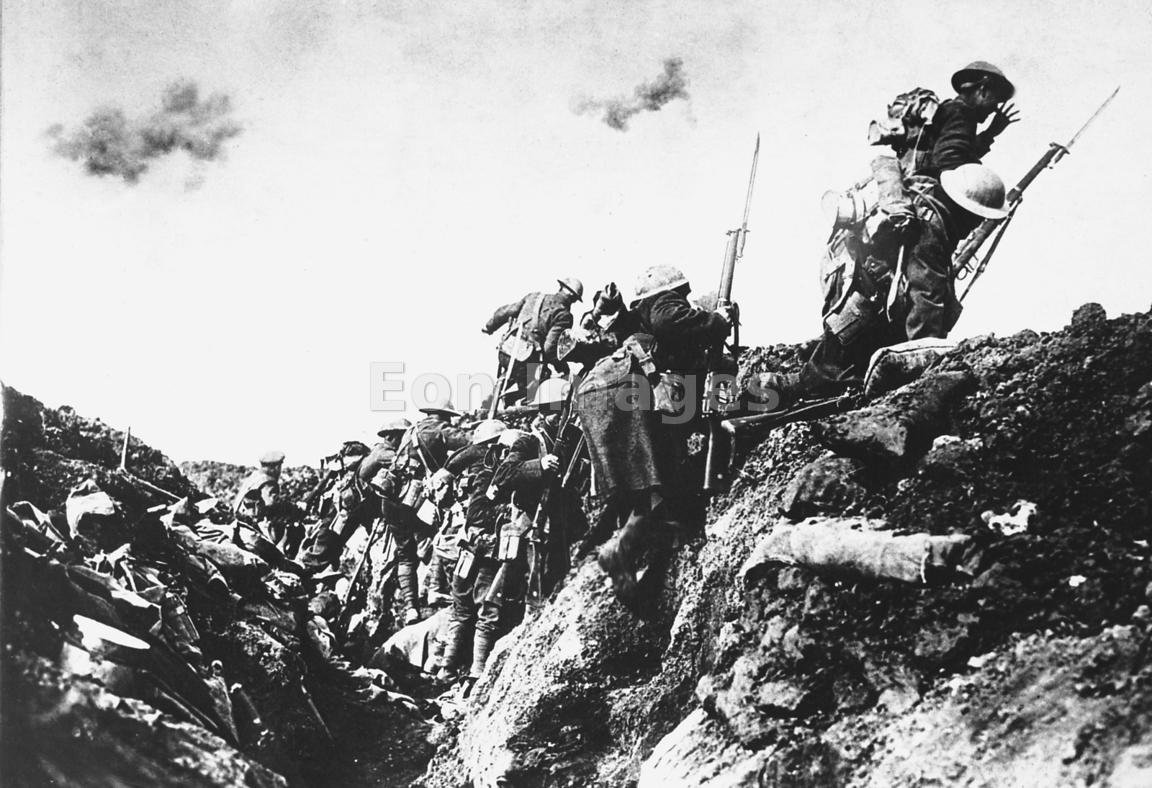
Canadian troops going “over the top”

In the Past, the Upper Crust also Paid a Great Price in War

Nor, incidentally, did the upper classes always remain safely at home like old Mogg, and his ilk today. In the Great War, aristocratic families lost sons in extraordinary numbers. In 1919 the House of Lords recorded 160 sons of peers dead, “in many cases the hopes and heirs of their line”. Prime Minister Asquith lost his son Raymond. Bonar Law lost two sons. Public-school boys died in the same mud as miners and millworkers, and actually in a higher proportion. Go further back and the connection between leadership, and physical danger becomes even clearer. Kings fought, Chieftains fought, aristocrats fought. Martial ability was not the only qualification for leadership, but for much of history its obvious absence could certainly be a disqualification. It would have been unthinkable for a Celtic chief not to have been a great warrior, in fact the greatest warrior was often made chief precisely because he was the best warrior. Put the above into the context of today, the weak effeminate excuses for leaders we have in the West, not one of them would have the backbone to stand and fight for anything, let alone for you or me.

Contrary to common belief, in the past the man saying “Lets go to war” was frequently going with you, and on WWI the junior officer was actually going in front of you.

That matters.

Because the great change in our own age is not that ordinary men have suddenly become cowards (although it’s no doubt many are) and the upper classes armchair generals. It is that the bond between sacrifice, and belonging has weakened. My ancestors lived in mill-owned houses. They knew perfectly well where they stood in the social order, right at the bottom. Yet they fought in both world wars, remember there was no conscription in Ireland so they volunteered.

The thing is they were not fighting for an amorphous administrative machine called “the state”. They were fighting, in however complicated a fashion, for home, hearth, wives, weans, neighbours, streets, churches, towns, regiments, and the men beside them. They knew what was behind them, and beside them, they knew what they were trying to preserve, and that is where Mogg has the problem a bit backwards.

You cannot spend decades hollowing out common identity, weakening attachment to place, treating inherited loyalties as embarrassing, and reducing citizenship increasingly to an administrative relationship, then suddenly reach into the cupboard when war threatens and pull out words such as duty, honour, country, and sacrifice. You cannot look down your nose at the oiks and their gammon like ways, and then suddenly point out that they may have to die with honour and dignity.

Virtues like duty, honour, and sacrifice require roots, common beliefs and identities, a people!!!

So perhaps Mogg is right, we do need to toughen up. Perhaps we have become too comfortable, too passive, and too frightened of hardship. But the courage required of us may not be the courage to march obediently towards the next foreign battlefield for the virtue signalling elite, and their banker friends. It may be the courage to ask our own rulers some very uncomfortable questions first.

On Substack Notes, John Carter links to a Morgoth post on the topic, saying:

Jacob Rees-Mogg has been lecturing Brits about their “duty” to the nation, in particular their duty to die in Ukraine, while at the very same time he denies that the English people even exist as a nation at all. A “nation of mongrels”, he calls them.

He adopts the mannerisms of a grand old lord of times gone by, one of the landed gentry who bled and died en masse when they threw themselves into the trenches of the Great War, answering the very same call of duty to God, king, and country that Rees-Mogg cynically invokes. Will Rees-Mogg die in a slit trench in the Donbass? Will any of his four sons? Peter is 19 — old enough to fight. Will he? To ask the question is to answer it.

Rees-Mogg speaks of duty to fight for a country he will not fight for. He speaks of duty as he smiles upon the invasion of that country by the hordes of third world primitives he and his class continue to invite in. He speaks of duty, as the regime he supports bends itself to persecuting the men and women doing their duty to their country by attempting to fight back against the invasion.


Social media seems to be antithetical to the ability to concentrate

Filed under: Food, Media, Technology — Tags: , , , , — Nicholas @ 04:00

I took over doing the cooking in our household a couple of years ago, so I’ve been paying more attention to cooking channels on YouTube and recipe-oriented blogs than I did before. Substack‘s algorithm suggested that I might enjoy reading this post by Romilla Arber, making the case that “Mirepoix is the antithesis of Instagram, as it values what cannot be seen in the final result over what is superficial and false”:

Photo from Stirring Thoughts

This article is about mirepoix, soffritto, social media, and the secret to a happy life. A lot to cover, but as I often say, everything is interconnected.

I dislike social media, in particular Instagram. I left X many months ago, as did my business. We use Facebook for local connection and, obviously, Substack, which currently I view differently. Instagram is ridiculous. It is a waste of time to be on it, and it is populated with so many lies and misrepresentations that it is difficult to work out what is fact and what is not.

I recently read a Substack article called “Meet All The Middle Aged Women Who Don’t Exist” by Robin Levine Shobin. It exposes the accounts on Instagram supposedly belonging to women in their fifties and sixties who look fabulous but who actually do not exist: an army of AI wellness women, manufactured to make women like me feel we need what they have.

The other tranche of accounts I have noticed multiplying on Instagram, like a terrifying science-fiction virus, are those owned by “successful” entrepreneurs. Most of these are fake, and are being used to sell overpriced masterclasses and mentorships to people who lack confidence and need money. The more our brains see of the same thing, the more likely we are to believe it. This used to be called brainwashing. There is probably another techie term for it now.

These accounts don’t surprise me. But they represent one of the reasons why Instagram is a monumental waste of time.


This feeling was further compounded today when I spent a few minutes watching a video made by someone, the central thesis of which was to make the most of the precious time we have on this planet, and to value those simple experiences that we take for granted at the time. The whole premise of Instagram is to make us envious of others, the way they look and the lives they have, and by consequence not to value the lives we live. It involves endlessly scrolling through videos and images, wasting precious time.

I have also noticed that if I spend time scrolling through short-form content, I find it harder to concentrate on something that requires longer attention, like reading a book. Sad, but true. I am now retraining my brain to concentrate on reading uninterrupted for longer periods. I was surprised at how tough this would be.


This sorry state of affairs brings me to soffritto and mirepoix: the same thing really, the former being Italian and the latter French. Both are the art of chopping aromatic vegetables finely and frying them slowly, in olive oil if you are Italian and butter if you are French. These aromatic vegetables are usually onion, celery and carrot, and the ratio varies country to country. The magic is in the simplicity. They are the flavour foundation for many stocks, sauces, soups and stews all over the world. Other countries may substitute white onion for spring onion, or carrot for peppers, but the point of the process remains the same: to create beauty through time and effort.

Mirepoix is the antithesis of Instagram, as it values what cannot be seen in the final result over what is superficial and false. The preparation of the vegetables takes care and time, and it is the investment in this preparation, the foundational substance, that creates the beauty and taste of the final dish. Instagram is about superficiality. What is not obvious is worthless.

Given how late I started doing serious cooking, I doubt that I even knew what mirepoix was two years ago … but I’ve pretty much always thought of Instagram as a total waste of time among all the various social media sites people use.

Devon Eriksen stakes out the anti-Feminist position

Filed under: Health, Media, Politics, USA — Tags: , , , , — Nicholas @ 03:00

On the social media site formerly known as Twitter, science fiction author Devon Eriksen discusses the “worst and most prolonged psychological torture you can inflict on a woman”:

The worst and most prolonged psychological torture you can inflict on a woman is to convince her she’s as good as any man.

This torture is lifelong, unendurable, and once you set up the initial conditions, the pain becomes self-inflicted.

You see, women are genetically programmed for two things. First, to raise children. Second, to select a man who is superior to her to bear those children for.

Not equal.

Certainly not lesser.

Superior.

There is no point in arguing about this. It is obviously true to anyone who looks around himself without blinders made of wishful thinking.

There is no point in becoming angry at me or anyone else about this. It is true whether I wish it to be or not, and whether you wish it to be or not.

There is no point in trying to talk women out of this. It is not a part of their culture or education. It is not an individual character flaw in them. It is part of their genetic recipe.

Therefore, if you convince a woman she is equal to most men, she will only be willing to bear children to a small percentage of exceptional men.

If you convince her that she is the equal of any man, she will be unwilling to start a family with anyone.

And she will remain genetically programmed to do so.

When I was a child, and again when I was a young man, in high school and college, I noticed that the older adults who staffed the education system seemed to think “girls’ self-esteem” was our most precious resource, perhaps because it’s good for stable nuclear fusion containment, or as a growth medium for cancer-curing fruit trees.

Well, I sure hope they’re making good progress on that nuclear fusion thing, because it sure is hard on the women they grow up into.

Perhaps they thought having a high self-esteem is the same as feeling good.

Perhaps they thought half of humanity’s potential Newtons, Einsteins, and Da Vincis were hidden among the ranks of the fair sex, waiting to be unlocked by “Project Self Esteem”, and no, I did not make that name up.

Perhaps they were retarded.

They did, after all, work for the government.

Self-esteem is not being happy. Self-esteem is not even feeling good. Self-esteem is how awesome you think you are.

And if you think you’re awesome, when you’re mediocre, then you’re miserable, because everyone around you treats you a whole lot worse than you think you deserve.

High self-esteem is great for young men. It makes them take risks. And to thrive men need to take risks, and achieve things, for many reasons, one of which is that women only mate up.

High self-esteem is not so good for young women. It doesn’t get them anything they wouldn’t have already had. It just makes them less happy with it.

Sure, there’s such a thing as self-esteem too low, but if a woman can look you in the eye, instead of in the shoes, when she talks to you, she’s pretty much good to go.

Anything more than that is superfluous at best, and at worst … well, eyeball the video for a moment and you’ll see what I mean.

But the misery isn’t just personal.

This is the fertility crisis in a nutshell. We, Western civilization, have spent the past five or six decades telling little boys that they are worthless sacks of protoplasm, and telling little girls that the sun shines out of their collective girl parts.

And look what’s happened.

The fertility crisis is stupidly simple. When you elevate the status of women by giving them a greater share of respect, and of society’s wealth, which is created by men, they refuse to have children.

You can reverse this by allowing men to keep the wealth they create, instead of giving it to women.

Then they will give it to women themselves, but the women will look up to them, and there will be children again.

During the Trump administration so far, 94% of new job went to women. This is not natural or organic. This doesn’t happen on its own. This is not happening because women are “crushing it”.

Women are the same women they have always been, risk averse, clustered around average intelligence, prone to wait for others to lead.

This is not an accident. This is spin on the ball. Women vote. And pandering is an easy way to get those votes.

But give a moderately pretty one a single email job at a Silicon Valley startup, and pretty soon she thinks that the father of her children should be a “post-economic” jet-setter with the body of a professional athlete who ticks all the boxes her therapist thinks are important.

And she thinks she can pick him off a shelf at age 35.

This is a vote, conscious or not, willing or not, for the extinction of humanity.

Throughout the genetic history of humanity, approximately 80% of women had children, as opposed to 37% of men. Those numbers don’t lie. Most men either weren’t exceptional enough to breed, or died trying to become exceptional enough to breed.

Women just had to not be in the bottom quintile. Not to be horrible, or horribly unlucky.

This bears out what we already know.

And this is why Western civilization told women they were the weaker sex, the dumber sex, the more fragile sex. Why Eve was said to made to serve Adam.

Because this preserved civilization and the species.

Women were actually happier that way, because women don’t want to win. They want a winner.

But even if it didn’t, what choice would we have?

The only nations and tribes in the world which are still breeding are the ones where women are still of low status. And if you try to replace Westerners with them, try to make them into Westerners, not only will you fail, but even if you succeed, they’ll stop breeding, too.

And we know now why there are no matriarchies. Its not because men have superior strength, and enslaved women with violence. It’s because matriarchies don’t breed.

Humans are an animal, like any other animal. Every animal has mating rituals, and if those rituals can’t be conducted, there will be no next generation. This is why some animals can be bred in zoos, and others cannot.

We know what’s wrong.

We just lack the political will to fix it.

Because it’s “not fair”.

Well, of course it’s not fair. But look around you. Look at the universe. Look at history.

Whatever made you expect that things would be fair?

Or, as someone posted in the replies to this:

SIG Manurhin 543 Semiauto: I Really Like This Rifle

Filed under: France, History, Italy, Military, Weapons — Tags: , , , , , , — Nicholas @ 02:00

Forgotten Weapons
Published 23 May 2026

SIG introduced the 540 series of rifles in 1973, which included the full-length 540 in 5.56mm, the 541 in a number of experimental calibers for the Swiss military, the 542 in 7.62mm NATO, and the 543 carbine with an 11.8″ (300mm) barrel in 5.56mm. In 1978 they licensed production of the 540, 542, and 543 to Manurhin in France, to sidestep Swiss export laws. The rifles were sold to a wide variety of small nations in Africa, South America, Asia, and the Middle East — including Lebanon, where this example came from. A batch of 542 and 543 kits came into the US from Lebanon recently, and Troy Ess at TTE Precision Metalwerks developed semiauto receivers for them.
(more…)

QotD: The game of Marbles

Filed under: Gaming, History, Quotations, USA — Tags: , — Nicholas @ 01:00

The rumor went around that trains were throwing steel ball bearings from their wheels. Genuine steelies! Somebody said they saw one that a kid from Detroit brought up. So big that you couldn’t close your fist around it. Nobody else saw it, though.

Nevertheless, we scoured the tracks for endless hours, turning over every likely pebble that caught the sun. No steelies. I did amass a small collection of spikes that had worked their way loose from the ties. Never did figure a use for them. But they were cool.

The game was marbles. Way we played it in upper Michigan was to draw a chalk circle on the cement or scratch one on the sand with a stick, sometimes we even used a length of string. The battleground was set. The players approached cautiously if their stock was low or boldly if their marble bag brimmed.

One boy against one boy. Man against man. A test of skill and mental grit. Incidentally, only boys played against boys, girls against girls: this was back in the day when adults didn’t burst a spleen for kids noticing the obvious differences in the sexes. Besides, boys were daring and cavalier. They were out for conquest. Girls would sometimes — this still baffles me — agree to play to a draw! Even if one girl would outright win she wouldn’t claim her prize. Bizarre creatures.

First boy, if he was a pro, placed his middle finger against his thumb and then snapped it at his marble, aiming to smack it into his opponent’s. If he hit it, he got to keep it. No time outs, no I-wasn’t-readies, no whimpering. Newcomers and cowards could be identified by the anemic way they smacked their marble, say by giving it no more than a half-hearted push with their forefinger.

Strategy was obvious. If you were the better shooter, you attacked attacked attacked. Go right after the other guy. Intimidate him. Like Nelson, ignore all subtleties and blaze away. Cagier boys took advantage of the braggarts and only pretended to be cautious. They let their opponents open with a bold shot or two, answering with a shot away as if in retreat, then when the other boy’s shot would miss and stop close by, the jig was up.

And that was the problem. Too bold and your shots would come close, too close. Countless times the marbles would stop an inch away. It was a goner. This is why it made sense to shoot hard; over-shooting was hardly a risk. Unless you in a sudden-death match where shooting outside the lines meant an automatic loss.

Most of us neither lost too many nor gained too many. But a few kids were easy pickings. Every day they’d come with a new small bag (these were sold in grocery and “dime” stores) and lose them. Rich kids.

Unless by prior agreement, only even matches were allowed. Cat’s eye against cats eye were the lowest, entry-level bouts. Cats’ eyes, for those monumentally ignorant of Americana, are the clear marble with the squiggly, colorful aberration running through the center. These were the general stock, like ten-year-old used cars; useful, but unloved. Why, you could find spare cat’s eye rolling around behind the home room teacher’s desk. What counted was quantity.

Perries, probably a corruption of puries, solid colored beauties. These were always just a shade smaller than the cat’s eyes. Perries, though coveted, had a tendency to chip, sometimes even crack open when hit hard. Clears were solid glass, no color. Steelies were polished ball bearings. I only ever saw two of them. Not the railroad kind, but small ones from who-knows-where. They were said to be unbeatable, which is why we latched onto any rumor of a source.

Then came the boulders, the double-sized version of the normal marble. One of these was worth five to ten of the regular kind, depending on availability. Boulder-on-boulder matches were always closely attended. They were rare, too, especially when they featured perries. (I have since learned boulders are called “shooters” in other areas. But all our marbles were shooters.)

We used to empty our marble bags and compare, holding our treasures up to the light for the kind of close scrutiny used by gemologists sizing up wedding rings. Oddities such as pea-sized perries occasionally showed up. These were said to be from China, then still a mysterious land.

I don’t guess kids play marbles anymore. Unless there’s a marble “app” for their cell phones. But it now makes sense that my favorite adult game is petanque.

William M. Briggs, “Marbles!”, Science Is Not The Answer, 2026-06-23.

Powered by WordPress