Quotulatiousness

September 7, 2026

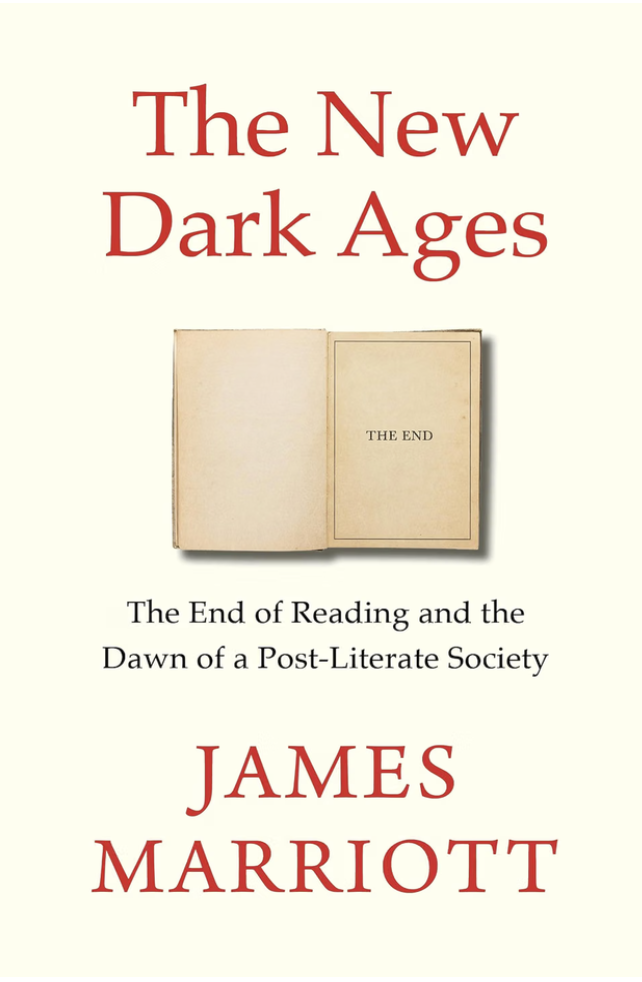
The New Dark Ages by James Marriot

Filed under: Books, Health, Media — Tags: , , , , , , — Nicholas @ 05:00

Ed West reviews James Marriot’s The New Dark Ages, which covers issues that are certainly of deep concern to parents as GenZ and Gen Alpha appear to have almost completely abandoned literacy in any written form:

I’m not the only parent who feels increasingly anxious about their children’s media diet. For teenage boys in particular, entertainment often comes in the form of YouTube, which for any adult briefly glancing at the screen seems to feature an array of thumbnailed gawping imbeciles, besides an invitation to watch the latest work of creativity: “I took a bath full of Diet Coke and Mentos” or “I cemented a microwave to my head”. In comparison to this, the mindless television I watched in the 1990s seems as narratively complex as Dostoevsky.

Most of all, it’s notable that many children aren’t reading anymore, and it’s steadily become a topic of interest among fellow parents, then worry, and now panic. It’s impossible to ignore the fact that something quite bad is happening.

Every catastrophe needs its Jeremiah, and for this we have Times columnist James Marriott, whose increasing anxiety about the decline of literacy was articulated in a hugely popular substack post last year. Having written extensively about how no one reads books anymore, he decided to turn the subject into a book, The New Dark Ages, published this week.

I wouldn’t call the book “urgent” because I usually take that to mean “worthy scolding by an ideological ally”; it’s entertaining, informative, often amusing and makes a coherent case in 50,000 or so words, which many of us can still manage. But the implications he lays out are disturbing, and influence everything around us.

James and I have become friends over the past couple of years, drawn together by a mutual sense of despair, and he’s probably the only person in journalism even more pessimistic than I am. If you believe the media to be a circle-jerk of people helping their mates (which it is, obviously), bear that in mind, but reading his prose one gets a sense of how likeable as well as articulate he is, even if born in the wrong decade. His upbringing will seem as alien to those raised in the coming years as the world of Boethius would have been to Alfred the Great.

    Literature was our religion: the way we explained and interpreted our lives. As a child I quickly learned that every possible event — from a major bereavement to a minor playground contretemps — could be cross-referenced against a novel by Thomas Hardy or a poem by Philip Larkin. There was a quote for everything. I was dragged off to Shakespeare plays at what now strikes me as a rather cruelly young age (“if you’re not enjoying it”, I remember my dad telling me, “you can just read your book instead”). We worshipped pretty much all the canonical English poets but in our pantheon of literary saints, Shakespeare was Jesus or, more probably, God.

    We celebrated his birthday every year with a homemade cake and in the holidays we were taken on solemn pilgrimages to Stratford-upon-Avon. I recall that I was once presented with a Shakespeare-themed stuffed bear (it was wearing a t-shirt with a quotation from Hamlet).

Such a veneration for the written word naturally made him sensitive to disturbing stories about declining literacy that began circulating around the turn of the decade. “The first rumours that something important was happening reached me via friends working in universities”, he writes: “I came close to going into academia myself (though I don’t think the world is a poorer place for the loss of my proposed PhD on landscape imagery in post-war British poetry)”.

Anecdotes were soon backed up by data, showing significant declines in reading comprehension among students, as well as an even sharper drop in the number of adults and children reading for pleasure. The chief suspect seemed obvious: it’s the phones. (Everything’s “the phones”). Yet the more Marriott looked into it, the more he came to believe that the real transformation came with television, as Neil Postman had warned in his 1985 polemic Amusing Ourselves to Death.

“Postman believed that the rise of TV — with its bias towards triviality and charismatic personalities — was beginning to undermine the kinds of reasoned and productive public discourse on which a civilised democracy depends. He was dismissed by some of his critics as a crank and a Luddite. The passing of time has revealed that he was a prophet.”

The Backbone of the Nazi Panzer War – Panzer III

Filed under: Germany, History, Military, Weapons, WW2 — Tags: , , , , — Nicholas @ 04:00

World War Two
Published 5 Sep 2026

The Panzer III was intended to become the backbone of Nazi Germany’s panzer divisions. Emerging from clandestine Weimar-era experimentation and formally developed from 1934, it combined mobility, a five-man crew, a three-man turret, and comprehensive radio communication in one highly effective prewar design.

In this episode, Spartacus follows the Panzerkampfwagen III from secret German-Soviet tank trials at Kama through its production and deployment in Poland, France, North Africa, and Operation Barbarossa. We examine its evolution from the 3.7 cm gun to increasingly powerful 5 cm weapons, the advantages provided by crew specialization and radio-coordinated warfare, and why the Soviet T-34 and KV-1 exposed its diminishing margins in armor and firepower.

By 1943, the Panzer III had been displaced as Germany’s principal gun tank by the more adaptable Panzer IV. Its chassis, however, found an extraordinarily productive second life beneath the Sturmgeschütz III. The Panzer III was not a failed tank. It was an effective prewar design overtaken by an armored arms race it lacked the capacity to survive. Its fate also reflected Nazi Germany’s wider strategic failure: it had built weapons for short campaigns, then unleashed a coalition war whose demands exceeded Germany’s resources.

Watch our episode on the Sd.Kfz. 251: • The Halftrack That Made Blitzkrieg Possibl…

Watch Ten Days in Sedan: • Ten Days in Sedan

An “exit tax”? What next, internal passports?

Filed under: Cancon, Education, Government, Liberty, Politics, USA — Tags: , , , , , — Nicholas @ 03:00

A few months back, there was a brief online reaction to the Liberal Party idea of imposing a ridiculously high “exit tax” on young Canadians taking jobs in other countries — and by “other countries” they really only meant the United States. I dismissed it at the time as just someone letting their Liberal freak flag fly … but:

Jesus Christ. These boomer leaflibs, man.

It doesn’t occur to him to ask why highly trained Canadian engineers would rather work in the US. Actually no, he tacitly admits this: they get paid more. Why is that? Why can’t they get paid well in Canada, putting their skills to work here, developing innovative, world-leading technologies right at home in Canada?

The answer is obvious. Because there is no opportunity in Canada. It’s all but impossible to develop high tech industry here. The regulations are too thick, and all the available investment capital gets sucked up into real estate development.

Maybe Canada should try and fix that, so that Canada is actually an attractive country for talented young Canadians?

But nah fuck those kids, we should just charge them a half million dollar exit tax so if they can’t pay that they can just let their dreams die and get a job at BMO.

Oh and at the same time we should flood Canada with “world leading talent” (from Calcutta), in order to make it that much more impossible for Canadian engineers to find employment in their fields at home.

The Ancient Greeks 05 – The Greeks Fight Back 3 – Plataea

Filed under: Randomness — Tags: , , , , , — Nicholas @ 02:00

seangabb
Published 31 Mar 2026

Greece: A Brief History, c.700 BC – 500 AD

How was the Persian invasion finally defeated on land?

In this lecture, we examine the final phase of the Persian invasion, culminating in the decisive Greek victory at the Battle of Plataea in 479 BC. After the withdrawal of Xerxes, a large Persian army remains in Greece under the command of Mardonius. Through diplomacy and force, he attempts to break Greek resistance — but fails.

We explore:

– Persian diplomatic strategy and the offer to Athens
– The reoccupation and second destruction of Athens
– The mobilisation of the Spartan army under Pausanias
– The Battle of Plataea and the destruction of the Persian land forces
– The simultaneous Greek victory at Mycale

This lecture shows that Salamis was not the end of the war, but the beginning of a final, decisive Greek victory on land and sea.

QotD: “Knackered”, “shattered”, and other useful Britishisms

Filed under: Britain, Humour, Quotations, USA — Tags: , — Nicholas @ 01:00

Some UK expressions just work better than their American equivalents. When I’m exhausted, I’m not just tired anymore, I’m properly knackered. Or shattered, which I reserve for those soul-deep levels of tiredness that only a long week of work and braving British traffic can induce.

The surprised expressions caught me off guard at first. “Blimey!” and “Crikey!” initially felt theatrical coming out of my mouth, as if I were performing in a period drama. But they’ve grown on me. There’s something deeply satisfying about a good “blimey” when you’ve just discovered the cost of your heating bill (although, if I’m honest, my partner would be far more expletive about it).

Then there are the words that capture concepts and objects I didn’t even know I needed:

Faff — The act of fussing around with something, whether it’s organizing (like a “bag faff” when you’re rearranging everything in your bag) or just messing about when you should be just getting on with it. [NR: “Faffing about” is a regular bit of my vocabulary — I picked it up from my wife’s uncle on our first trip back after we got married.]

Cheeky — That delightful word for something (or someone) playfully impudent. A cheeky pint. A cheeky biscuit. A cheeky comment from a cheeky child. Americans don’t have an equivalent that carries the same affectionate mischief. [NR: I use the word occasionally, but only in the “cheeky comment” sense. I suspect the other usages developed after we came to Canada.]

Chinwag — A chat or conversation, usually informal and friendly. “Having a chinwag over tea.”

Wheelie bin — A bin with wheels, which is exactly how I explained it to my sister-in-law when she asked what one was. Somehow it sounds less depressing than “trash can” when you’re dragging it to the kerb in the rain, though I can’t explain why. [NR: My cousin in Edinburgh used this term and we laughed ourselves silly … but it’s a useful phrase as wheelie bins are much more common here now.]

Bits and bobs — Covers all those miscellaneous things better than any American phrase. “I need to pick up some bits and bobs” is so much more charming than “I need to run errands”. [NR: I use this phrase all the time, also referring to accessories, jigs or associated “bits”.]

Picky bits — Those yummy nibbles you put out before a meal or during drinks. Americans would say “appetizers” or “snacks”, but “picky bits” is somehow more fun and less formal.

Lashings — A generous amount of something, usually used with food. “Lashings of butter” sounds so much more indulgent than just “a lot of butter”.

A lie in — Sleeping in, staying in bed late. “I had a lovely lie in this morning” sounds so much more luxurious than “I slept in”.

When I’m pleased about something, I’m chuffed to bits. It’s the British equivalent of my American “tickled pink”, though somehow “chuffed” sounds a bit less old-fashioned. When something’s gone wrong, I’m gutted — which is just more emotionally accurate than “disappointed” when your team loses or your train’s been cancelled. When someone’s being ridiculous, they’re a pillock (an insult that somehow sounds almost friendly).

Daft has replaced “stupid” in most contexts because it’s softer, more affectionate, somehow. Posh carries weight that “fancy” just doesn’t. And I’ve learned that “taking the mick” means teasing someone, though I’m still not entirely confident I’m using it right.

Pants can mean trousers, underwear, or that something’s rubbish (as in “that film was pants”) — that was a confusing first month trying to figure out which meaning applied when.

Speaking of films — it’s always a film, never a movie, and you see them at the cinema, not a movie theater. I still slip up on this one regularly. Pro tip: when browsing Netflix or BBC iPlayer in the UK, search for “films”, not “movies”, or you’ll come up empty-handed.

Dodgy covers everything from suspicious strangers to questionable leftovers. When something’s sorted, it’s all taken care of. My spouse uses “lovely” for everything from a cup of tea to a sunset to the bins being collected on time.

When it’s cold outside, it’s not just chilly — it’s parky. When I mentioned it was “a bit parky” on a call with my family, they immediately asked, “So that means you wear a parka when it’s parky?” Fair question, honestly.

When it’s very windy, it’s blowing a hoolie — which sounds far more dramatic than “blustery”, and right now with Storm Amy hitting the UK, it’s particularly relevant (I hope my readers in Scotland are all ok).

When a place is packed, it’s chocker. The pub’s chocker. The motorway’s chocker. It works for everything, where Americans would say “packed” for a pub or “bumper to bumper” for traffic. These words just have more personality than their American equivalents.

The car vocabulary is starting to creep in, and I have to think about it more now. The boot sometimes wants to replace “trunk”. The bonnet makes sense when I hear it instead of “hood”.

And then there’s reckon, which occasionally slips out instead of “think”. I’m trying to hang onto my Americanisms for as long as I can, but it’s getting harder to resist.

Marianne Jennings, “Squeaky Bum Time and Other British Phrases I Never Knew I Needed”, An American’s Guide to British Life, 2025-10-05.

Powered by WordPress