Quotulatiousness

September 24, 2026

More than you ever wanted to know about the Teapot Dome scandal

Filed under: Government, History, Politics, USA — Tags: , , , — Nicholas @ 05:00

At The Grim Historian, Carlyn Beccia has a long, long post about the scandal that (probably) killed President Harding: the Teapot Dome scandal.
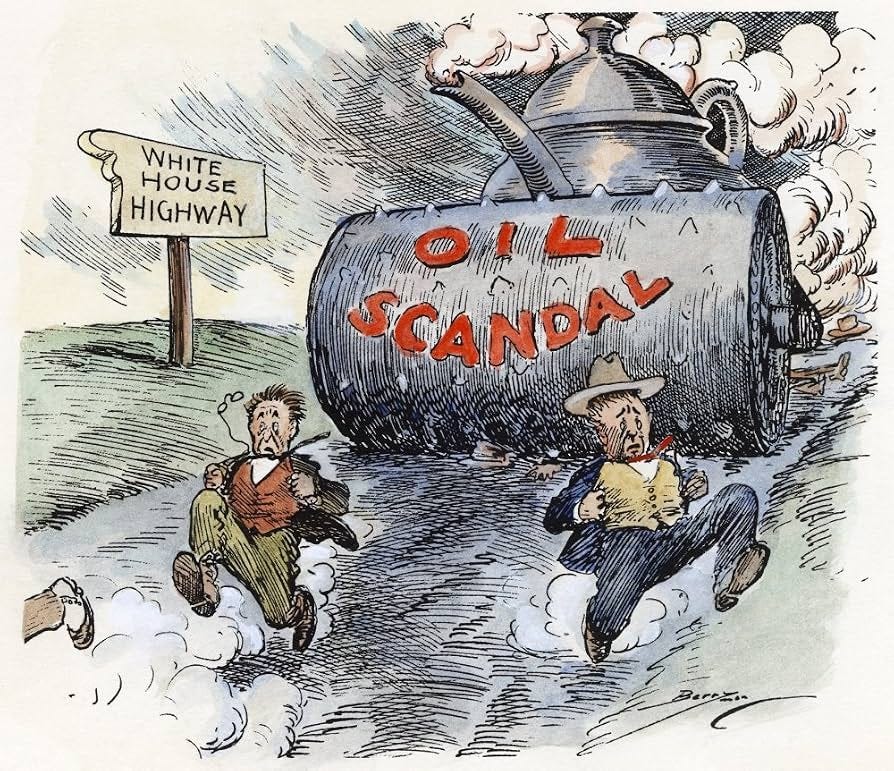
“The Teapot Dome scandal” by Clifford Berryman, 1924
Granger Collection

Washington, 1922. Somewhere around H Street, a piano is still playing after midnight. The car turns off the avenue and slows outside a townhouse with the shades already drawn.

Warren Harding steps onto the sidewalk. Presidential seal on the door he just closed. Another beautiful woman on his arm, history declined to name. He doesn’t look around. He doesn’t have to.

Warren Harding is handsome. Everybody always says so. He was a notorious ladies’ man, carried on a fifteen-year affair with one married woman, fathered a child with another, and left historians enough love letters that we know far too many bawdy details about “Jerry”. (Jerry was the nickname he gave his penis.)

[…]

Either way, Harding’s genial personality probably helped. Harding liked people, people liked Harding. He had what the kids call the rizz. (Or so Jerry claimed.) And he must have had some charisma because 1920 voters handed him one of the biggest landslide victories in American history.

Now, Harding liked bringing his buddies along for the ride. Men seeking government jobs drifted through the rooms alongside men who already had them.

Attorney General Harry Daugherty is here. Daugherty is Harding’s longtime political manager and friend. Daugherty would soon become engulfed in investigations involving influence peddling and government property, and would refuse to surrender records to Senate investigators. Calvin Coolidge eventually forced him out. He later stood trial twice on charges of defrauding the government. Neither trial produced a conviction.

Harding’s unofficial fixer, Jess Smith, was there too. He technically held no federal office but nevertheless had a desk and room inside the Justice Department, used official stationery, dictated to department secretaries, carried government files, and gave orders people obeyed. Jess Smith died by suicide in 1923 while corruption allegations were swirling around the Justice Department.

The cluster of men who swarmed around Harding became known as the Ohio Gang?—?old political friends, poker companions, fixers and assorted hangers-on who had followed him to Washington and discovered that federal office came with considerably better party favors.

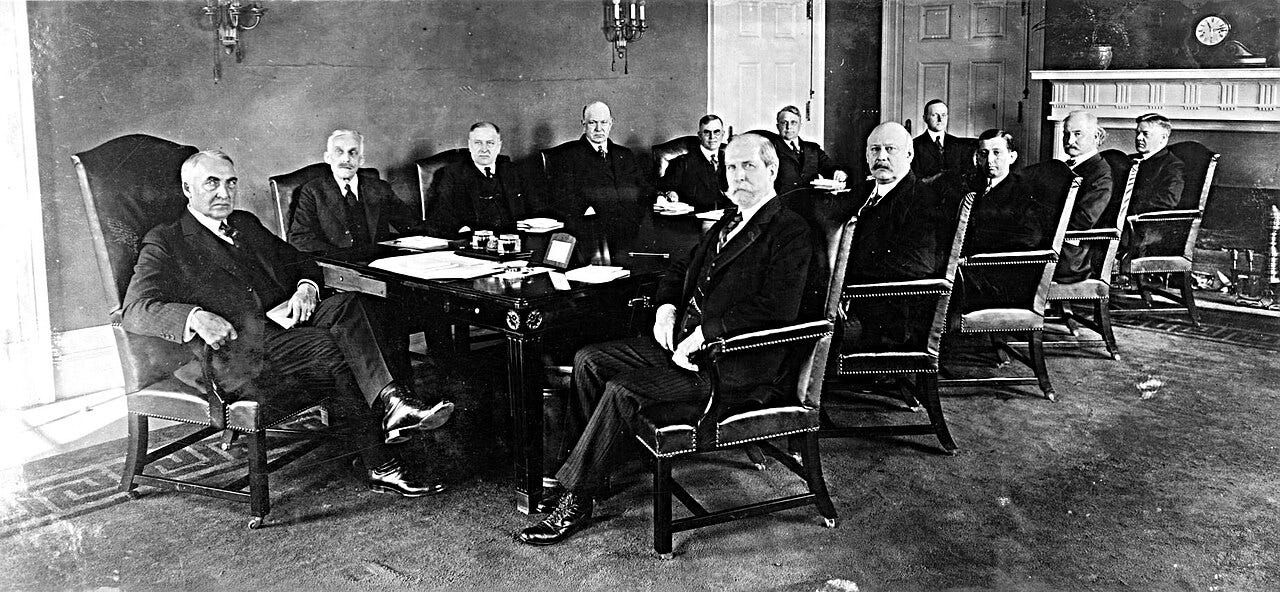
Harding’s cabinet, 1921. A few members of the Ohio Gang are hiding among the respectable people. They look very serious here. After hours was another story.

[…]

For years, Theodore Roosevelt and other conservationists had worried that private companies would simply gobble up America’s petroleum reserves. So Roosevelt ordered federal geologists to identify oil deposits worth protecting. Taft then withdrew millions of acres from private development and established naval petroleum reserves in California. Woodrow Wilson added another in Wyoming. In 1920, Congress gave the Navy power to manage and lease all three.

The reason was not complicated. American battleships were switching from coal to oil. If another war came along, perhaps it would be prudent for the United States Navy to own some oil.

Wild concept.

So the government had locked away huge underground deposits in California and Wyoming as an emergency stockpile. Together, the three reserves were believed to contain roughly 435 million barrels?—?about as much oil as the entire United States produced in a year.

There were two big California fields, Elk Hills and Buena Vista, and one Wyoming reserve called Teapot Dome.

Teapot Dome was not even the great petroleum monster of the group. Elk Hills would eventually become one of the country’s most productive oil fields and produce its billionth barrel in 1992. Teapot Dome, by contrast, occupied just 9,481 acres and produced about 22 million barrels during its later decades of federal operation.

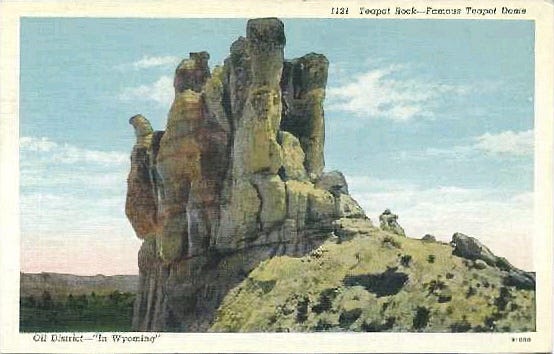
Teapot Dome simply had better branding. It was named for a nearby sandstone formation that allegedly resembled a teapot.

Teapot Rock on an old postcard from around 1922
Public Domain

Yes, that’s a teapot. Apparently, Wyoming whiskey was excellent.

So Fall wanted control of all three reserves, and Harding gave it to him. On May 31, 1921, the president signed an executive order transferring administrative authority from the Navy to Fall’s Interior Department.

Shortly thereafter, Fall undergoes a miraculous financial renaissance. Remember Fall’s ranch with ten years of unpaid taxes and the general Grapes of Wrath ambiance?

Yeah, so by June 2022, Fall pays those taxes. He buys neighboring property. He makes substantial improvements to Three Rivers. The formerly cash-starved rancher suddenly throws money around like he’s discovered oil under the sofa cushions.

He had not. He had discovered oilmen. Two of them, specifically.

[…]

Meanwhile, President Harding was having a truly shitty year. In the spring of 1923, Jess Smith was dead, Charles Forbes had resigned from the Veterans Bureau in disgrace, and Fall had quietly resigned from Interior to work for none other than Harry Sinclair.

For once, it wasn’t Jerry keeping Harding up at night.

So that summer, Harding left on a cross-country speaking tour. During this time, Harding reportedly told a journalist: “I have no trouble with my enemies … But my goddamn friends … they’re the ones who keep me walking the floors nights!”

Those friends would drive him to an early death. On August 2, 1923, Warren Harding died in a San Francisco hotel room, probably of a sudden heart attack. He was only 57 years old.

Then Calvin Coolidge became President, and he wasn’t into playing footsy with poker players.
The benefits to US national security from the Greenland agreement

Filed under: Europe, Government, Media, Military, Politics, USA — Tags: , , , , , — Nicholas @ 04:00

I’m sure some in the Canadian relic media will try to spin the US-Greenland-Denmark agreement as somehow threatening to Canadian sovereignty, but if it does in some way it’s clearly not the main focus from the US viewpoint:

US President Donald Trump diplays the Greenland security deal with Danish Prime Minister Mette Frederiksen and Greenland Prime Minister Jens-Frederik Nielsen.

Photo via CDR Salamander

We’ve kept up reasonably steady reporting the last couple of years on Greenland. I was never quite sure where it would come out, but I was confident that it would be — non-inclusive — in between the two extremes we heard coming out of the overly excitable and narrowly sourced commentariat of the U.S. invading or the U.S. being kicked out … and it did.

I have to give a nod to our Australian friend Liz Buchanan who gave some great observations on the issue on the Midrats Podcast back in September of 2025 and January of this year.

The full text of the agreement can be found here if you want to read it in detail, but let’s stick to the big pixels, as it is really a good news story for everyone … especially NATO.

Rod Martin created a great executive summary … I’m just going to steal it.

Bravo Zulu to the team that kept working this issue. From a national security point of view, everyone got the most important things they wanted — that’s what matters.

As we like to do here, let’s go to the chartroom.

We should start with something I posted five days ago over on X.

Small rift in time brings 2021 dramarama to 2026

Filed under: Business, Health, Media, USA — Tags: , , , , , , — Nicholas @ 03:00

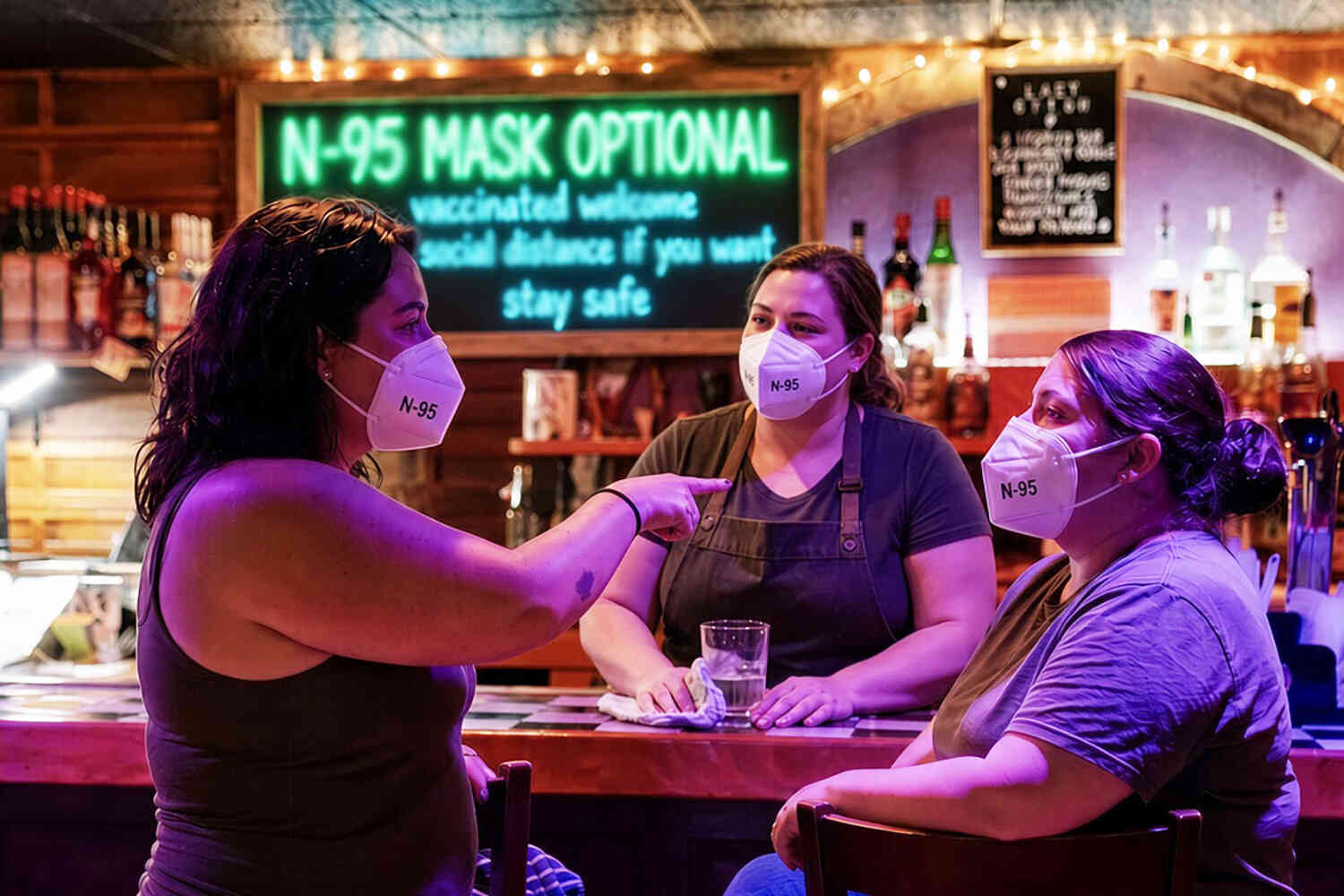
I still occasionally see people going about their business wearing WuFlu masks. I try not to overtly point and laugh, because I’m still pretending to be polite and civilized. Obviously, people should be free to wear or not wear whatever they like so long as it doesn’t harm anyone else. A bar in Greenfield, Massachusetts has apparently been requiring masks for all their patrons since the pandemic but recently decided to ease up the restriction for one night per week, making the masks optional for one day per week. As you might imagine, this move hasn’t gone down well with their customers:

Image via Not the Bee

Crybullying is a way of controlling other people. Predators and psychopaths pose: They deliberately put on sad face or hurt face when they want suckers to lower their guard so they can get what they want.

If you’ve been online today, you’ve probably seen discussion of the mindblowing Boston Globe story about the lesbian bar in Greenfield, Massachusetts that recently decided to start having weekly mask-optional nights, after many years of requiring KN-95 masks or better from patrons. If this is the first time you’re hearing about this, let me just say that no, you haven’t accidentally clicked on an article from 2021. This is happening now.

After the Last Ditch Bar posted their new mask rules on social media, they were immediately buried in rage-inflected comments from people who were in absolute agony over the way the place was just absolutely murdering them.

Sample comment: “You have shattered what I believed your values to be, and you should be ashamed to use the word radical to describe your venue in the same post where you’re announcing a decision to deliberately spread disabling diseases, that we know disproportionately impact marginalized populations, one night each week.”

Did you know that Covid-19 is medically much worse if you’re a politically radical lesbian? Second sample comment: “This is such a stab in the heart to those of us who have no choice but to protect our health. Esp when l0ng c0vid disproportionally affects queer folk.” That’s an interesting observation.

All of the bar’s efforts to calm the storm made it worse, and a community forum hosted by trained facilitators crashed and burned. I’m not going to describe that event or summarize it, because you should read every incredible detail yourself. Here’s the link again, in an archived form that gets you around the paywall and probably requires you to scroll down a bit to get through some blank space at the top. As a preview, though, one of the facilitators was white, which devastated the terrified attendees and made them feel that they were in extreme danger.

The mandatory mask-wearing somehow became a totem of belonging to the patrons of the bar and after so long, they are now reacting very strongly to any attempt to dilute their shared community with non-mask-wearing heathens.

Making 200-Year-Old Mayonnaise – How has it changed?

Filed under: Food, France, History — Tags: , — Nicholas @ 02:00

Tasting History with Max Miller
Published 31 Mar 2026

Thick, creamy mayonnaise made with tarragon vinegar and gelatin

City/Region: France
Time Period: 1828

Mayonnaise (or magnonnaise, as Carême calls it in this recipe from 1828), didn’t really become popular until the early 19th century. First popular in France, by the 1850s, cookbooks in other countries were including recipes for it, sometimes with several variations. Earlier recipes commonly used gelatin, but by the end of the 19th century, the recipe looked very much like what we make today.

Homemade mayonnaise is vastly better than anything you can buy. There’s a nice zing from the vinegar in this one, and even if you don’t like store bought mayonnaise, I think you should give this a try; it’s really delicious. If you’re not worried about historical accuracy, you could make this without the gelatin.

    White Magnonnaise Sauce
    Place into a medium bowl two egg yolks (as pale as possible), a large pinch of white salt, the same of white pepper, and a quarter of a tablespoon of tarragon vinegar. You briskly stir this mixture with a wooden spoon; and as soon as it begins to thicken, you add half a tablespoon of oil from Aix. As soon as the sauce thickens, you add a few drops of vinegar, then oil, and so on, taking care to work it constantly … As it thickens, you add a little oil at a time, as well as vinegar and a small amount of aspic jelly … by adding the oil and vinegar little by little…you see it gradually come together, becoming firm and velvety like a well-set cream. Finally, after having incorporated two glass of oil, half a glass of aspic jelly, and the necessary vinegar to make it pleasantly tangy, you use it immediately.
    — Le cuisinier parisien by Marie-Antoine Carême, 1828

(more…)

QotD: The perpetual progressive underdogs

Filed under: Health, Politics, Quotations — Tags: , , , — Nicholas @ 01:00

[Commenter] Zorost proposes two axes, “empathy” and “abstraction” (or “symbol”). The Leftist is low on both, but for our purposes the “abstraction” part is the most relevant. An autistic, apparently, has trouble abstracting individual items into groups. They over-focus, such that you see lots of OCD-type behaviors. Zorost gives the example of a person being hit by a moving car in a parking lot because he can’t shift his attention away from all the parked cars.

To the autist, each car must be inspected in detail, with full attention … and while the autistic’s attention is laser-focused on one particular parked car – “1998 Ford Taurus, midnight blue, left front tire is a little low, right taillight out, bumper sticker near muffler”, etc. — he fails to notice the moving car that hits him.

As opposed to the non-autistic, who is capable of “abstracting” that situation into a realistic threat assessment. He can’t even give you a ballpark guess of how many parked cars are in the lot, much less any details about any of them, because he has abstracted them out: “a bunch of parked cars” = no threat, so his attention is free to roam around looking for moving cars.

I instinctively want to argue against this, because it appears to me that Leftists are nothing but abstraction. They don’t see individuals; they see huge identity groups. That’s why they see an anti-feminist woman or a conservative homosexual or whatever as not really X. It makes sense to them, somehow, to say that Amy Coney Barrett isn’t really a woman, Clarence Thomas isn’t really black, and so on.

[…]

The non-autistic sees [a child’s drawing of a train as] a rectangle, two wheels, some lines underneath, and thinks “train,” because he’s boiled it down to the essentials — a train is a wheeled vehicle that moves on tracks. That’s good enough to cover pretty much all “train” situations; we can add or subtract details as needed to get to this or that particular train (e.g. electric vs. steam), or a wheeled vehicle which moves on tracks that’s not a train (e.g. a rollercoaster).

So, applied to people: I see a black man walking towards me on the street and I have one set of assumptions in my head. First I see just “person”; then I realize it’s a man; then I realize it’s a black man; then I realize it’s an elderly black man; then I realize it’s Clarence Thomas. All the while I’m dialing in both my perceptions and my behavior — I’m not at much physical risk from an elderly man, and I’m at nearly zero risk from Clarence Thomas, specifically, so I modify my behavior. When I was still just at the “black male” stage of the recognition process, I behaved very differently.

If I’m reading Zorost correctly, the autistic would do something like the reverse. He wouldn’t be able to make any judgments until he’d fully inspected the individual man in front of him at close range and verified that yes, this is Clarence Thomas. And then the confusion kicks in, because he — the autistic — has memorized the rule “black man = Liberal” and here’s Clarence Thomas. Error 404.

Severian, “Why Are They Always Underdogs?”, Founding Questions, 2022-09-07.

Powered by WordPress