Quotulatiousness

September 15, 2026

“I will choose a path that’s clear, I will choose free will”

Filed under: Law, Liberty, Media, Politics, USA — Tags: , , , — Nicholas @ 05:00

For some reason, the idea that humans don’t really have free will is very popular among progressives, even if they know individually that they have free will they believe most of the rest of humanity somehow doesn’t:
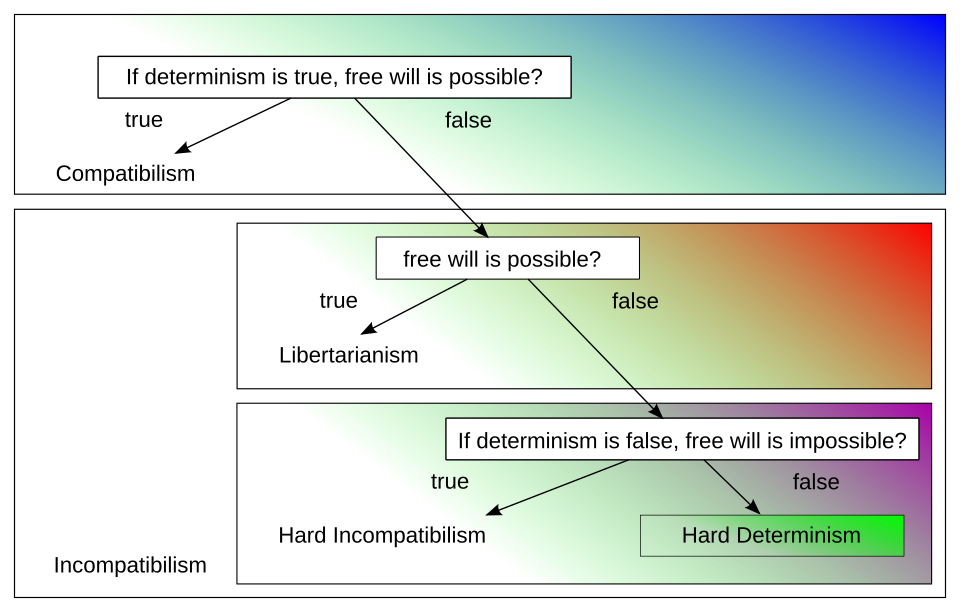
A simplified free will taxonomy
Image by Richardbrucebaxter via Wikimedia Commons.

A fashionable view of human behavior holds that because everything has a cause, no one is truly responsible for their actions.

In his 2023 bestseller “Determined,” Stanford neuroscientist Robert Sapolsky argues that free will is an illusion. “We are nothing more or less than the cumulative biological and environmental luck, over which we had no control, that has brought us to any moment”, he writes. Author and podcaster Sam Harris has spent 15 years making the same case to a popular audience. “Our wills are simply not of our own making,” he writes in Free Will (2012). “Thoughts and intentions emerge from background causes of which we are unaware and over which we exert no conscious control. We do not have the freedom we think we have.”

Common sense pushes back. Consider an example from the psychologist Paul Bloom. Imagine a man who thrashes violently in his sleep and accidentally strikes his wife, breaking her nose. They both wake up, and he is horrified and ashamed. Now imagine a second man who resents his wife and wants to hurt her. He waits until she is asleep and then hits her in the face. When she wakes up, he pretends it was an accident. The difference between these two men is obvious. Any legal or moral system that doesn’t recognize that would collapse.

Yet much of elite discourse encourages us to blur that distinction. Determinists like Messrs. Sapolsky and Harris tell us that behavior can be explained through systems, incentives, trauma, inequality, neurochemistry and social pressure. Much of this is true. But a culture that speaks only this language teaches people that they are spectators in their own lives. The implication, rarely stated outright, is that no one really chooses anything. We are all the first man in the example above, thrashing in our sleep.

The determinists don’t deny that we have wills, or that our actions follow from them. Their argument is that will and action are themselves the products of deeper causes, such as genes, molecules and the environment, and so we can’t really be called free.

Stuart Doyle offers a useful analogy that challenges this claim. Suppose we ask whether an apple is red. The determinist looks closer. He realizes the apple is nothing but atoms. Because no individual atom is red, he concludes the apple can’t really be red. The error is obvious. Color exists at the scale of the apple, not at the scale of an atom.

Free will works the same way. A choice exists at the scale of a person thinking, weighing and deciding. Looking at the molecules underneath and finding no choice there doesn’t prove that choice is an illusion.
A Fall election seems quite likely

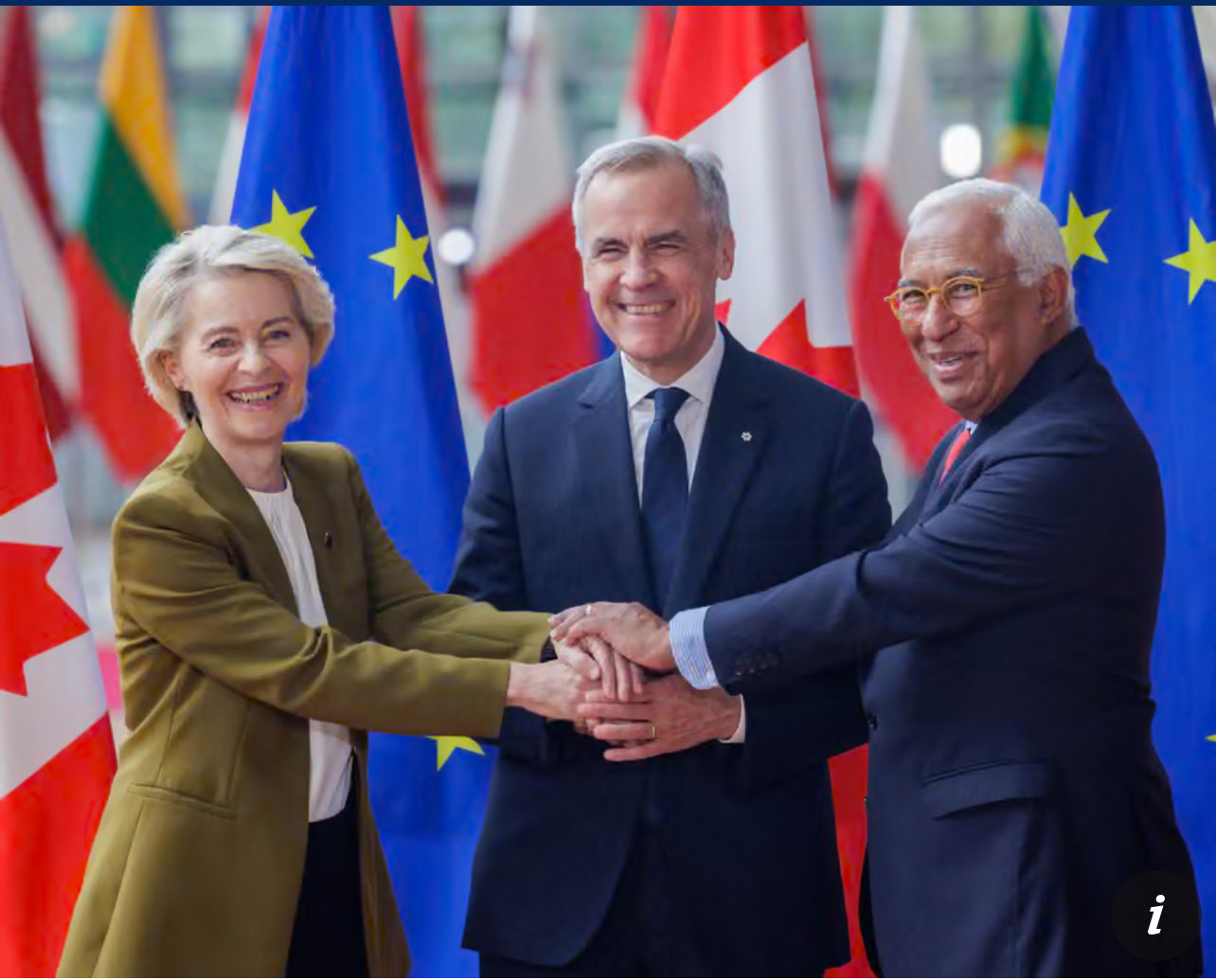
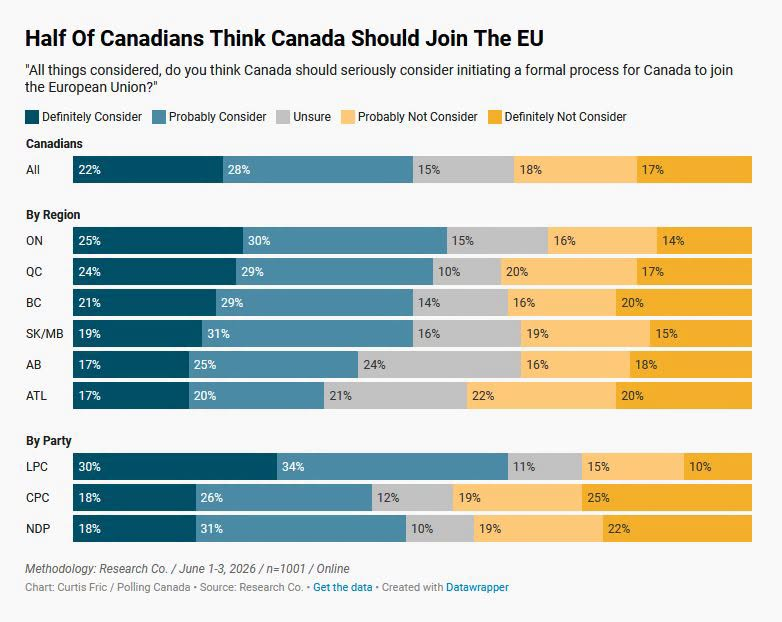
One of the advantages of a Westminster-style parliamentary system is that election dates are not fixed, so that the Prime Minister can take advantage of perceived opportunities to win majorities when they arise. It must be very tempting to Mark Carney to call an election as soon as he can, as the Elbozos are still waving their arms and chanting his praises for “standing up to the Bad Orange Man”. His latest notion of trying to add Canada to the European Union as some sort of “associate member” is also popular among people who think that Canada should be more like Europe (the Venn diagram of Elbozos and Europhiles is almost a perfect circle). On X, Jay Currie stares into the abyss of yet another Liberal majority government with a renewed electoral mandate:

The Prime Minister of all the Canadas is prepping for his Davos 2.0 speech to the European Parliament on the 17th when, apparently, he is going to propose that Canada become some sort of associate member of the EU. God help us.

The developed world can be thought of as two camps: the progressives and, for want of a better term the nationalists (could be traditionalists but that is only one strain within the nationalist camp). The supra nationalist institutions, EU, UN etc are progressive to their core.

Progressives see borders as barriers to progress, believe diversity is strength, see international action as the only way to defeat the horror of “climate change”, want international controls on speech, technology and public health.

For progressives individual rights, the rule of law, property are all barriers to the greatest good for the greatest number. Citizenship is an antique concept best left in the 20th century.

Most importantly progressives see the state, rules and regulations, a constantly refreshed “New World Order” and managed decline as both beneficial and inevitable. Arc of History and all.

Nationalists begin with the tiniest unit in society, the individual, and take that unit seriously. What rights does an individual have? If you start there you automatically circumscribe the power of the state. You also set the state’s direction.

Taking individual rights seriously creates a state in which individuals matter, there their voluntary associations beginning with families, matter. “The greater good” is no more than a suggestion when it comes to protecting individual rights.

The Europe of the EU came out of the ashes of a world in which individuals were subjects rather than citizens (with the notable and sporadic exception of post Revolutionary France) and the concept of individual rights was fragile at best.

The progressive intent of the EU was to treat “Europeans” as interchangeable economic units whose value was locked to group identity and which must be prepared to share the burdens imposed for the greater good.

Nationalism was seen as regressive as was patriotism and the insistence that individuals had rights which over rode the “common good”. After all, the horrors of WWI and II were the products of patriotic nationalism.

The progressive European project worked quite well for the first twenty or so years when Marshall plan aid funded the rebuilding of Europe and membership in the EU was relatively restricted. Expansion and mass immigration strained the Community.

Part of the reason the EU worked quite well in the early years was that its goals were relatively modest, a trading bloc with harmonized economic regulation left individual countries to work out their social, legal and rights structures.

As with any progressive institution the modest goals of the early years were gradually replaced with “ambition”. The 1985 Schengen Agreement eliminated hard borders within the EU. The European Convention on Human Rights harmonized the rights of Europeans.

Part of the progressive ambition was the creation of a hitherto unknown entity known as “the European” superficially similar in concept to “the American”. Questions of nationality could be submerged as this new entity stepped into the world.

For the progressive camp the “European” was a giant step forward into a post national future. As indeed it was for a tiny minority of bureaucrats, academics, journalists, financiers and other members of a self appointed cognitive elite.

People who objected to this grand homogenization of the nations of Europe were obviously frightened of the inevitable future because, well, they were not well educated and, entre nous, not too bright.

For the “Europeans” the great cause of the 21st century was laid out in Rio in 1993 when a conference convened by Canadian Maurice Strong sounded the alarm about “global warming” currently rebranded “climate change”.

Now there was a global threat demanding a supra-national response where the “Europeans” could assume a leadership role by…well, by shipping all of their heavy industry offshore and building very expensive windmills and mandating electric cars.

To no one’s very great surprise the Europeans have managed to de-industrialize and regulate themselves to the point of actual poverty. Fortunately, it was all for the global greater good so the Europeans could congratulate themselves.

Not content with climate virtue, the Europeans (though not the regressive nationalist yobs) took it upon themselves to welcome millions of migrants. An act of humanity and also shrewd as the Europeans had given up having children.

Of course, the idea had been trial-ballooned recently to get Carney-friendly headlines ready in advance:

“Napoleon remains the ghost in professional military education”

Filed under: Education, Europe, History, Military, Quotations, USA — Tags: , , , — Nicholas @ 03:00

InfantryDort responds to a complaint that military leaders are taught Clausewitz without the career of Napoleon for context:

THE THING WE STILL CAN’T TEACH

I’ll bite on this one. Napoleon remains the ghost in professional military education. Why? Let me take a stab at it …

Jomini watched him and tried to turn the phenomenon into rules. Anyone in the U.S. Army has seen this before. If you do something exceptional on the field (especially in training), then you’re often coached that you went outside the lines and need to get back in. You may have succeeded, but it COULD have been a disaster. So we try “putting baby in a corner” because the science of war is safe. The art scares people.

Clausewitz watched the same fire in Napoleon and concluded that rules would never be enough. Two centuries later we are still dissecting the campaigns, naming principles, drawing arrows on maps, and trying to explain what exactly lived inside that man.

Again, why?

There is a part of command that refuses to become curriculum. T.E. Lawrence called it the “kingfisher flash”. Clausewitz reached for the genius. It’s the instant when one mind sees through fog what a hundred educated men cannot see at all, then possesses enough violence of will to act before the moment disappears.

Read that last part again 👆

You can feed that gift with history, sharpen it through hardship. But you CANNOT manufacture it with another degree. It MUST be revealed.

Yet modern institutions are built around the opposite assumption. We stack schools, evaluations, gates, boards, and credentials high enough and convince ourselves that eventually genius will emerge from the assembly line. It won’t. It can’t. Ever.

Worse, the machine often recognizes the dangerous talent and rejects it precisely because it cannot reproduce it. The unusual man is “reckless”. The instinctive one is “unserious.” The officer who refuses the approved path becomes “unqualified”.

READ. IT. AGAIN. 👆 👆 👆

Then war arrives and burns the paperwork. That is the lesson Napoleon keeps trying to teach us from two hundred years away. You can study the flame forever. You still have to recognize it when it walks into the room.

The closest we can come to discovering this genius is testing our officers on it. No more reliance on pure paperwork. I say to these officers: Show us the gift you’re supposed to possess for the highest commands.

Or step aside for someone who will.

The First Military Luger: Swiss Model 1900 s/n 01

Filed under: Europe, Germany, History, Military, Weapons — Tags: , , , — Nicholas @ 02:00

Forgotten Weapons
Published 27 Apr 2026

The first nation to adopt the Luger was Switzerland, which began testing in late 1898 and formally accepted the Luger in May 1900. Their guns were the first Lugers to be mass produced, as they were the first order received by DWM. The first batch of 600 arrived in Switzerland in May 1901, and today we are taking a look at the very first of that batch — serial number 01. It is the first production military Luger, and that’s a pretty cool landmark.

C&Rsenal Swiss Model 1900 video: • History of WWI Primer 145: Swiss Luger 19…

QotD: Auftragstaktik or “mission-type tactics”

Filed under: Germany, History, Military, Quotations — Tags: , , — Nicholas @ 01:00

Mission Command or Auftragstaktik (also “mission-type tactics”) is a style of command and control which stresses flexible decision-making by smaller units pursuing an objective (the “mission” of mission tactics) rather than imposing a single rigid top-down plan on the entire force. Under this framework, upper-level commanders assign objectives to their subordinates, who can then use their better local knowledge and quicker reaction times (being closer to the front) to craft a flexible plan to achieve those objectives; this process is then repeated down the command structure. Originally a German concept, US doctrine embraces mission command as its ideal style of command. Russian doctrine, by contrast, has generally been substantially more top-down in nature (with implications for force structure as well); this has proven a liability in Ukraine as the top-down plan did not go to plan and lower-level Russian commanders and NCOs are not generally trained to deviate from the plan “on the fly”.

Bret Devereaux, “Miscellanea: A Very Short Glossary of Military Terminology”, A Collection of Unmitigated Pedantry, 2022-03-25.

Powered by WordPress