
Quotulatiousness

September 22, 2026

Trumpian economics – making Mercantilism great again

Filed under: Economics, Government, History, Media, Politics, USA — Tags: , , , — Nicholas @ 05:00

President Donald Trump is remarkably inconsistent on a lot of issues, but one thing that keeps coming back is his apparent allegiance to protectionism and mercantilism:
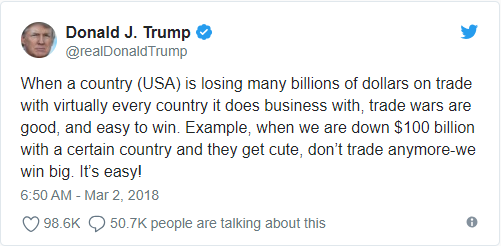
Politics is an industry in which ideas demonstrated to be ineffective and morally reprehensible live on long after they should have died. That’s the case with President Donald Trump’s fondness for mercantilism, as he espouses hoary old nostrums about the alleged benefits of hoarding money and preventing Americans from using their capital to purchase desired goods from other countries. Like a throwback to the 18th century, the president mistakes accumulating the means of exchange for building actual prosperity, as if we’d all be better off with overstuffed wallets than with the things our funds can purchase.

“Losing” Money on Voluntary Transactions?

Last week, when asked about the eternal political bogeyman of “trade deficits”, Trump responded, “If we lose $50 billion a year with a country, and we say, ‘we’re not going to trade with you anymore’, we don’t lose $50 billion a year. It’s very simple. Right?”

The president’s comments continued a theme he’d expounded on Truth Social, where he wrote, “If we stopped Trading with every country that we have a Deficit with, which is most of them, we would make, at least, 1.5 Trillion Dollars a year.”

Earlier this month, the president threatened to entirely stop Americans from trading with businesses in countries with which the Unted States runs a trade deficit — that is, from which we overall buy more than its residents purchase from Americans. His position seems to be that we’re better off hoarding cash than we would be using (or losing, from his perspective) our money to purchase things that we want.

But as the late economist Milton Friedman commented during an earlier incarnation of the eternal debate over the “fairness” or lack thereof of international trade, “the goods and services we import, they provide us with TV sets we can watch, automobiles we can drive, with all sorts of nice things for us to use. The gain from foreign trade is what we import. What we export is the cost of getting those imports. And the proper objective for a nation, as Adam Smith put it, is to arrange things so we get as large a volume of imports as possible, for as small a volume of exports as possible.”

[…]

Everybody Benefits From Free Trade

“Nothing, however, can be more absurd than this whole doctrine of the balance of trade”, Smith warned in An Inquiry Into the Nature and Causes of the Wealth of Nations, published in 1776. “When two places trade with one another, this doctrine supposes that, if the balance be even, neither of them either loses or gains; but if it leans in any degree to one side, that one of them loses, and the other gains, in proportion to its declension from the exact equilibrium. Both suppositions are false.” In fact, he pointed out, “trade which, without force or constraint, is naturally and regularly carried on between any two places, is always advantageous, though not always equally so, to both”.

As Smith’s criticism makes clear, the ideas of “balance of trade” and “trade deficits” are archaic throwbacks to mercantilism, even though they’re still popular among politicians playing to ill-informed voters. Smith’s points prevail among economists even in cases where one country burdens its population with trade barriers while allowing relatively unhindered exports.
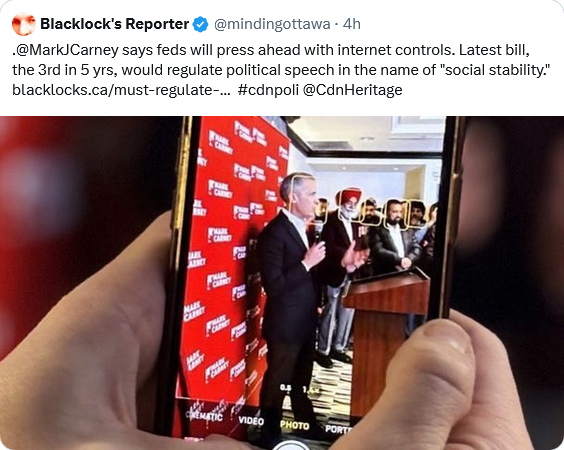

The future of online free speech for Canadians

The Liberals in Ottawa prefer not to hear uppity citizens yapping about Liberal policies, and having a majority in the House of Commons means that there’s very little chance that they won’t be able to ram through a bill to curtail the ability of Canadians to speak freely online — that’s why I put a “warrant canary” in my daily Substack summary of blog posts. On X, John Carter has some advice that may be helpful to Canadians who don’t agree with the government:

Carney is essentially trying to implement Yookay style online speech controls. With his stolen majority government, there’s no way to stop him, and so no reason to expect that he won’t succeed.

Canadian nationalists therefore need to start being smart. Use coded language. Avoid overt “hate speech”. Don’t advocate violence. Use positive messaging, love of country rather than hatred of other. Make their job as difficult as possible.

This is nothing the right hasn’t seen before. The bad old days of Twitter censorship are not so far behind us. Britain and Europe already have very similar laws. That hasn’t stopped their nationalist communities. Censorship doesn’t change the underlying social conditions. At worst it prevents people from being too direct. Furthermore, by forcing dissidents to be clever, it exerts a selective pressure that raises the intellectual level of dissidents, while making the censors themselves increasingly ridiculous.

Censors themselves are usually very stupid people. Coded language tends to go right over their tiny heads. They don’t handle satire well. It’s also very easy to mock a regime like this by parroting its own vocabulary. Elbows up, everyone. Diversity is our greatest strength.

State capacity is another factor. How many censors do they actually have? How competent are they? (diversity is our greatest strength!) How many people can they actually enforce these laws on? Every time someone gets dragged into court the state is burning a significant quantity of time, energy, and attention. The cost-benefit of tasking bureaucrats, police officers, lawyers, and judges to punish random shitposts is math that doesn’t math very well. The entire strategy relies on making an example of a few to cow the many. If the many aren’t cowed, because for instance despite the censorship they can see with their own eyes what’s actually happening to their country on the street, all censorship does is piss people off and further undermine the legitimacy of a regime that would not be resorting to censorship in the first place if its legitimacy was beyond reproach.

This is bad. I’m not looking forward to it. But panic won’t help. Keep your wits about you, stay calm, be smart.

The US Army has an institutional aversion to admitting mistakes

Filed under: Military, USA, Weapons — Tags: , , , , , — Nicholas @ 03:00

Tom Kratman, retired US Army officer, has strong opinions about a lot of topics, but especially on things related to the US military in general and the US Army in particular:

The US Army, all of the US armed forces, can never admit to a mistake, no matter how trivial. The reason the RS71 became the SR71 was because some senior officer had a slip of the tongue when briefing Johnson, called the RS71 the SR71, and the Air Force, rather than admit the mistake, changed the name. The reason there was no resistance training in Ranger School (that’s POW resistance, not weight lifting) was because someone, Navy, I think, said that the only resistance training in US armed forces was Navy run (they do run the big important school graduates are forbidden to talk about), so the Army and Air Force, rather than let Navy be embarrassed, killed their programs until rather recently. The reason the Army kept the OH-58 Kiowa was because, after being browbeaten into buying that recon helicopter, it would have been admitting a mistake, to say nothing of some measure of corruption and moral cowardice, to switch to the OH-6 which EVERY chopper pilot in the Army would tell you was a better bird for the mission.

And then, just for the cherry on top, we can contemplate my old slimy toad of a scum-sucking battalion commander who, as a brigade commander, browbeat his HHC commander [Wiki] into falsifying a PT test for him and, when the HHC commander went to the IG, and the story came out, was allowed to pin on BG stars and retire rather than being sent to play rock hockey, as he should have been, at Leavenworth. Why? Because the Army had made a number of serious mistakes with him; they let him command two infantry (one of them a Ranger) battalions, and had promoted him to colonel, selected him to command a brigade, and then selected him for promotion to brigadier general. That could never be allowed out because the army cannot admit to a mistake, let alone five of them.

Now, with that inability to admit a mistake in mind, roll back the sands of time to the late 1950s, when a certain Airborne Mafia general, serving as Chief of Staff of the Army, Max Taylor, had, as generals will, an incredibly stupid idea, that he, as generals also will tend to, thought was just fucking brilliant. He created the pentomic division [Wiki]. I’ve written on the iniquities and stupidities of this at length and won’t repeat myself here. Suffice to say it was a disaster, a complete, total, unmitigated, moral, operational, administrative, tactical, utter, unbefuckinglievable disaster from every perspective. One feature of the Pentomic Division was that regiments were done away with and replaced by one or more “battlegroups” bearing the same regimental number but not necessarily under the same command.

The Army could not admit that mistake. So they dumped the Pentomic Division and battlegroups as soon as possible but, rather than reverting to regiments, went to brigades [Wiki] composed of different battalions of different arms and regimental numbers. This was nothing but a way to pretend that the Pentomic Division hadn’t been a mistake, that it had been a great idea that just needed a little fine tuning.

Brigades, by the way, also sucked but not as much as the new, Pentomic 2.0, Brigade Combat Teams suck [Wiki].

Wiki links added for those (like me) who are not intimately familiar with US military formations.

The Forgotten Scandal Behind Britain’s Favourite Poem

Filed under: Africa, Britain, History, Military — Tags: , , , , , , — Nicholas @ 02:00

The History Chap
Published 14 May 2026

In January 1896, a small column of mounted men rode into the Transvaal — uninvited, unsanctioned, and about to hand the British Empire one of its most embarrassing scandals of the Victorian era. Their leader was Dr. Leander Starr Jameson, trusted fixer of Cecil Rhodes, and a man absolutely certain he was doing the right thing. Within days, he was a prisoner of the Boers. But this is not simply a story of a military disaster. It is the story of how a disgraced Victorian adventurer — stripped of his reputation, imprisoned in Holloway, and abandoned by the powerful men he had protected — became the inspiration for the most famous poem in the English language.

Rudyard Kipling’s “If—” has been quoted by parents, coaches, and prime ministers for over a century. What almost nobody knows is the man Kipling had in mind when he wrote it — and the extraordinary story of how Jameson faced catastrophe with a silence and dignity that left Kipling genuinely moved. In this video, I tell the full story: the Jameson Raid, the cover-up that reached the highest levels of the British government, the parliamentary inquiry that should have destroyed several careers, and the remarkable rehabilitation of the man at the centre of it all.

It is a story about loyalty, resilience, and the gap between a man’s reputation and his character. Which is, when you think about it, exactly what “If—” is about.

0:00 Britain’s Favourite Poem
1:14 Leander Starr Jameson
2:40 Rhodes’s Plot
4:02 Joseph Chamberlain
4:36 Jameson Loses His Head
5:35 The Jameson Raid
6:31 Battle of Doornkop
8:26 Triumph & Disaster
9:26 Jameson on Trial
10:23 Holloway Prison
11:15 Before Parliament
13:46 Redemption
14:11 “If-” Poem
15:10 Jameson’s Death
16:12 “A Man, My Son”

QotD: Organized activities for children versus informal play

Filed under: Health, Quotations, Sports — Tags: , , , , , — Nicholas @ 01:00

[Jane:] A few months ago I had what I thought was a revelation: all those people who were spending their evenings and weekends shuttling their children to sports practices and games, dance classes and riding lessons and swim meets, must really like this stuff. They must think it was fun and enjoy sharing their passion with their children! It had to be like when I garden or bake with my kids, or read them books I love, or tell them about the proto-Indo-European voice system! (Don’t laugh, it’s important context for Latin deponents.) So the next time a mom I know was complaining about getting her kids out the door for flag football practice, conveniently scheduled for (1) rush hour and (2) dinnertime, I smiled and asked, “Are you guys big football fans generally?” I was all set to inquire about their family’s favorite team, the differences between college and professional ball, how different flag football is from tackle and whether they intended to make the switch when her boys were older — but she grimaced and shook her head. No, she said, not really. They watched the Super Bowl but that was about it. “Ah,” I nodded sagely. “But the kids are into it?” (Lord knows I’ve indulged my children’s enthusiasm for things I don’t care about.) No, she said, not particularly. But they needed a sport for the fall.

I didn’t ask why. I wish I had, because I’m sincerely curious — these were busy, active kids, actually in the process of racing around the playground with their buddies while the adults chatted, so it’s not as though they needed organized sports to keep them from merging with the couch cushions — but at the time it seemed rude and pushy so I changed the subject. Now, obviously not everyone is like this mom: some people, including Tim Carney, really do love sports and delight in sharing that love. But the truth is, people are obsessed with signing their kids up for stuff. Carney calls it the Travel Team Trap, and it’s probably most evident in youth sports culture, but it shows up everywhere. Your kid likes to write? Find a creative writing class! Having fun with chess? Quick, hire a tutor! My local rec center even offers courses in Dungeons & Dragons, taught by a real live professional nerd, because apparently eating Doritos in your mom’s basement while your friends mock you for touching the Sphere of Annihilation isn’t good enough any more.

And it’s a vicious cycle, because all these official activities crowd out informal play. If the artsy kids in your neighborhood are taking a musical theater class half an hour away, there’s no one to join your kids in pulling out the dress-ups and staging a drama of their own. If everyone is off at soccer practice, you can’t meet up at the park to kick the ball around. Sorry, Zerubbabel can’t come over and play Legos this week, he’s got his STEM Makers class on Wednesday and then Thursday afternoon is junior robotics team … Soon even the families who want a more relaxed, unprogrammed life are signing their kids up for things because it’s the only way they’ll ever see their friends.

There’s nothing wrong with formal instruction in its place, especially for things where technique really matters: the world needs basketball coaches and piano teachers, too. And sometimes it’s just fun! A big stage with lights and music and real costumes scratches an itch that Mom’s old prom dress and a dinosaur mask (“Velociraptorella”, currently in previews off-off-off-Broadway) just can’t touch. But when we regard these things as potentially interesting and entertaining, rather than absolutely vital to our children’s well-being, we can make sane tradeoffs about them. A day-trip to the awesome museum in a neighboring city is also potentially interesting and entertaining, but nobody thinks you’re a bad mom if you spend the weekend doing something else.

And what’s more, the push for legible achievement over experience, without regard for what’s good for your family — or even, apparently, whether your kids like it — robs them of the opportunity to motivate and direct their own lives. Basketball practice three times a week surely does more for your jump shot than a pickup game at the local park, but in the long term the ability to take ownership of your time, make and keep plans with your friends, sort out interpersonal disagreements, etc. are going to be a lot more useful. (And, sorry, I’m still stuck on this D&D thing: the threat of your friends losing interest and wandering off to play foosball instead is a much greater incentive to become a good DM than anything you could learn in a class.)

But it’s not actually surprising that people parent like this, because it’s how they grew up: today’s moms and dads are yesterday’s Organization Kids.1 Their image of the good life is tallying up achievement points on some great celestial board. And no wonder they’re desperate to tally up points for their kids, too: they think their futures depend on it! In fact, every time I bring this up, someone tells me that Harvard is full of kids whose parents drove themselves crazy coordinating travel sports schedules and private school dropoffs and chess tutors — all of which is true, and some of which is probably even causal. (Nobody appreciates achievement points tallied up on a great celestial board like a college admissions office.) But a lot of it is also because that’s how smart, conscientious, upper-middle-class parents are expected to raise their kids, and the best way to get into Harvard is to be the offspring of smart, conscientious, upper-middle-class people. (It also helps if they’re neither white nor Asian.)

Jane and John Psmith, “JOINT REVIEW: Family Unfriendly, by Timothy P. Carney”, Mr. and Mrs. Psmith’s Bookshelf, 2024-10-14.


  1. I hadn’t reread the article since I was in college, but revisiting it now it’s an amazing artifact. “No one is political, no one protests.” Things change!

Powered by WordPress



