
President Donald Trump is remarkably inconsistent on a lot of issues, but one thing that keeps coming back is his apparent allegiance to protectionism and mercantilism:
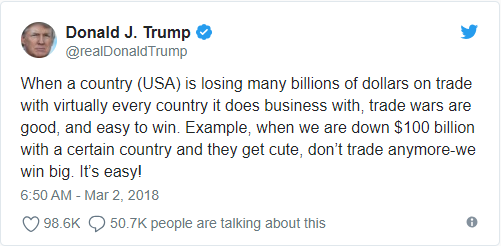
Politics is an industry in which ideas demonstrated to be ineffective and morally reprehensible live on long after they should have died. That’s the case with President Donald Trump’s fondness for mercantilism, as he espouses hoary old nostrums about the alleged benefits of hoarding money and preventing Americans from using their capital to purchase desired goods from other countries. Like a throwback to the 18th century, the president mistakes accumulating the means of exchange for building actual prosperity, as if we’d all be better off with overstuffed wallets than with the things our funds can purchase.
“Losing” Money on Voluntary Transactions?
Last week, when asked about the eternal political bogeyman of “trade deficits”, Trump responded, “If we lose $50 billion a year with a country, and we say, ‘we’re not going to trade with you anymore’, we don’t lose $50 billion a year. It’s very simple. Right?”
The president’s comments continued a theme he’d expounded on Truth Social, where he wrote, “If we stopped Trading with every country that we have a Deficit with, which is most of them, we would make, at least, 1.5 Trillion Dollars a year.”
Earlier this month, the president threatened to entirely stop Americans from trading with businesses in countries with which the Unted States runs a trade deficit — that is, from which we overall buy more than its residents purchase from Americans. His position seems to be that we’re better off hoarding cash than we would be using (or losing, from his perspective) our money to purchase things that we want.
But as the late economist Milton Friedman commented during an earlier incarnation of the eternal debate over the “fairness” or lack thereof of international trade, “the goods and services we import, they provide us with TV sets we can watch, automobiles we can drive, with all sorts of nice things for us to use. The gain from foreign trade is what we import. What we export is the cost of getting those imports. And the proper objective for a nation, as Adam Smith put it, is to arrange things so we get as large a volume of imports as possible, for as small a volume of exports as possible.”
[…]
Everybody Benefits From Free Trade
“Nothing, however, can be more absurd than this whole doctrine of the balance of trade”, Smith warned in An Inquiry Into the Nature and Causes of the Wealth of Nations, published in 1776. “When two places trade with one another, this doctrine supposes that, if the balance be even, neither of them either loses or gains; but if it leans in any degree to one side, that one of them loses, and the other gains, in proportion to its declension from the exact equilibrium. Both suppositions are false.” In fact, he pointed out, “trade which, without force or constraint, is naturally and regularly carried on between any two places, is always advantageous, though not always equally so, to both”.
As Smith’s criticism makes clear, the ideas of “balance of trade” and “trade deficits” are archaic throwbacks to mercantilism, even though they’re still popular among politicians playing to ill-informed voters. Smith’s points prevail among economists even in cases where one country burdens its population with trade barriers while allowing relatively unhindered exports.



The issue is far more complex than this silliness suggests.
Comment by stan — September 22, 2026 @ 23:24