Chris Bray was in Stockbridge Massachusetts recently and discovered that the notorious arch-conservative artist Norman Rockwell … supported the New Deal and FDR … which is unquestionably extreme-right, yet somehow “got woke” in the 1960s:
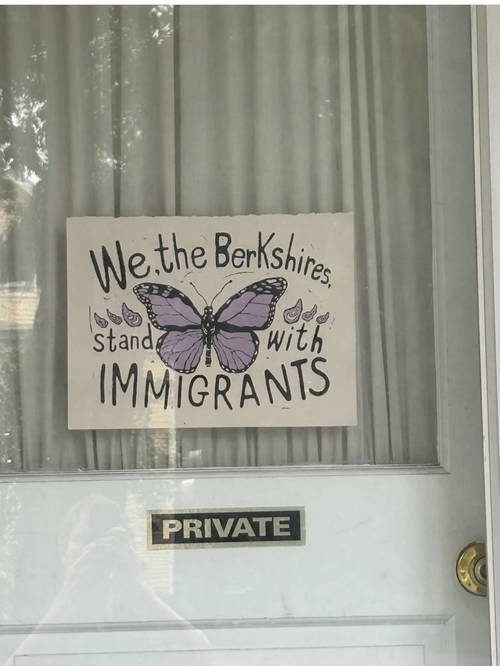
Stockbridge is in the (astonishingly pretty) Berkshires, where you can’t sell a latte or a $14 egg and cheese sandwich without a trans pride flag and a sticker in the window boldly supporting a woman’s right to choose and a “No Kings in America” sign and on and and on and on.
I’m an outsider, so they won’t show me the manual. But it’s a lot of virtue, signaled with a great deal of self-consciousness, and also there are a ton of German SUVs with New York license plates. Status status status. We stand with immigrants / new Mercedes.
Rockwell lived and painted in Stockbridge, and that’s … that’s … (ambiguous facial expression). He painted images that demonstrated a bone-deep fondness for America and Americans, especially small-town Americans, so he was a huge far-right figure, OBVIOUSLY, and also a major white supremacist, but maybe kind of accidentally a big Klan figure?
You can find this stuff everywhere: Rockwell’s name was “a symbol of an idealized, conservative, white American past”. Click on that link: It’s an essay that says Rockwell is known for an idealized conservative past, and it’s illustrated with a 1943 painting that celebrated FDR’s declaration that Freedom From Want is a basic freedom that that all Americans should enjoy. So, to wrap a bow around this amazing cultural artifact, Rockwell’s idealized conservative past was a celebration of the New Deal president’s declaration that government should assure material comfort for everyone. See, huge right-winger.
[…]
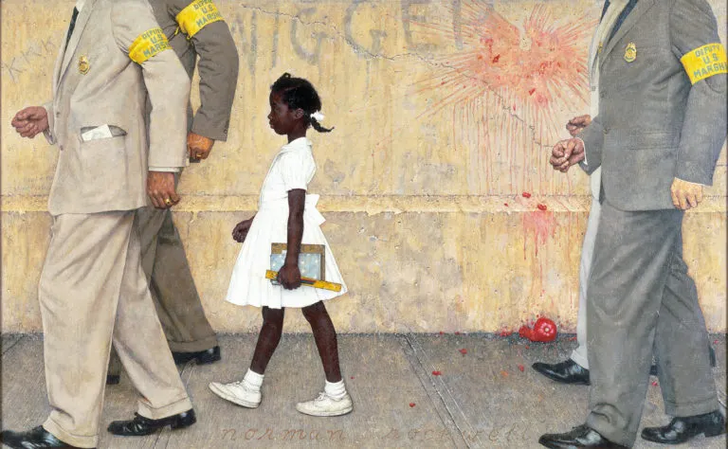
But Rockwell painted a massive quantity of routine shitlibbery alongside his depictions of small-town America as a place he didn’t despise, and, I’m repeating myself, several of his most famous paintings express his affection for that huge far-right figure Franklin Delano Roosevelt. He was a registered Republican who painted Democrats and Democrat political themes with great warmth, and also liked Ike, and then went on to paint important depictions of the Civil Rights Movement. So he’s … he’s … a huge Trumper who didn’t hate black people? Which lawn sign should we display about this? The past has to be sorted into the categories of right now, in ways that should feel comfortable to an NPR personality: This Thucydides person, was he a Trumper?
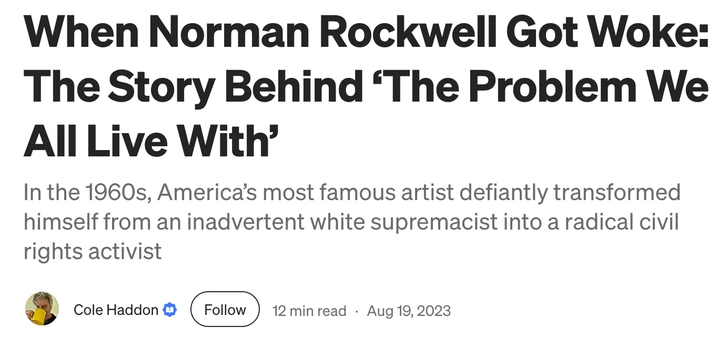
The just absolutely amazing leftist discourse about Rockwell is that he changed: He used to be a brutal Republican Nazi like ORANGE MAN, but then he turned into a good person. These essays tend to have the subtlety of a claw hammer to the face. Go read this example at the reliably boneheaded Vox, which describes Rockwell’s “late-life political transformation” and says that the “tumultuous ’60s would convert Rockwell into an overt social liberal”. He turned from right to left! He became good! See, he had an “awakening!”
The reason all of this confuses them is that Rockwell was a social type that no longer exists: a liberal Republican who thought that America had flaws that needed fixing, but who also at the same time loved the country and loved its people. He was sort of center-left on some stuff and center-right on some stuff, and culturally attuned to a nation that he viewed fondly. He liked FDR and the Four Freedoms and he personally liked Eisenhower, who had him over for dinner.