Quotulatiousness

September 23, 2026

Doctor Who – the early Doctors

Filed under: Britain, History, Media — Tags: , , , — Nicholas @ 06:00

One of my earliest memories of television involve a BBC children’s TV show that began in 1963: Doctor Who. My mother claims I watched every episode from behind the settee, but I wouldn’t let her turn it off even though I was clearly terrified. I was young enough that I don’t remember particular stories — I don’t even remember being surprised when the actor portraying the lead character suddenly changed from William Hartnell to Patrick Troughton. After my family came to Canada, I only occasionally caught an episode on TV, and I don’t think I saw anything produced after the late 1980s, so all the modern casting choices (and the controversy) passed me by.

Millennial Woes provides a helpful guide to the show from the first episode through to the late 1980s, which may be of interest to some of you:
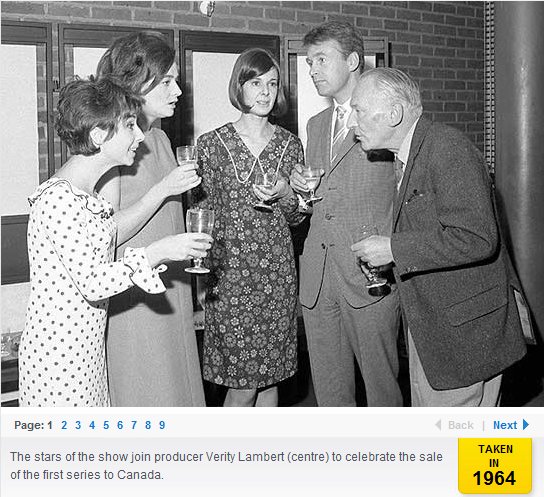
Several people have asked me to write a guide to Doctor Who, so here it is. I think most readers will be familiar with the show so I won’t waste time introducing it. Suffice it to say, we’re talking about a somewhat silly family sci-fi show, but one that frequently had soul, style, humour, and a lot of warmth. As with so much contemporaneous TV drama, Doctor Who had charm that seems to be simply impossible to achieve nowadays.

This guide is a difficult one to write because there are simply so many stories to survey, and because the show has multiple eras which are very distinct — almost different TV shows altogether. (Broadly, I would say the eras are 1963-69, 1970-81, 1982-87, and 1988-89.)

[…]

Something you will notice is that I talk about the incidental music almost as much as the stories themselves. I find Doctor Who‘s music, across the various eras, very stimulating and enjoyable in its own right. (This indicates how big a part it must play in the show itself.)

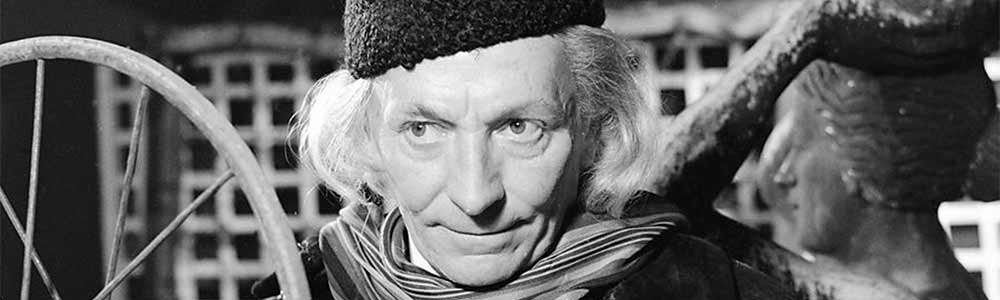
The First Doctor was played by William Hartnell. This was Doctor Who at its very beginnings, in 1963, so it is radically different not only from the modern 2005 show but even from the Pertwee era seven years later, by which time TV production had advanced in leaps and bounds.

I must confess to being barely acquainted with Hartnell’s era, having watched only four or five stories in total. It is too slow-moving for my tastes. However, I can certainly recommend one episode …

“An Unearthly Child”

This is the very first episode. Though it is technically the first of a four-part story, it is really a “standalone” episode to set up the programme. The introduction of now-iconic elements is beautifully done. Everything at this stage seems darker and more mysterious than it will later be. The Doctor is secretive, unfriendly and sinister. The TARDIS is scary and doesn’t seem reliable, its first “flight” being a genuinely unnerving experience.

The atmosphere is terrific throughout. The whole thing is in grainy black & white reminiscent of a 1930s horror film. It is excellent, in my opinion. Had the show continued in this vein it would probably have been much shorter-lived but less lightweight. I guess things are always better while they still have their mystery.

The Second Doctor was played by Patrick Troughton. He was perhaps the most talented — as an actor — of the men who played the role in the classic era. His turn on the character is much more playful and irreverent than Hartnell’s. I am again very unfamiliar with the era, so am somewhat at a loss for recommendations.

“The Three Doctors”

This is a cheat since this story is actually in the Third Doctor’s era, but I think the Second really dominates proceedings so it feels appropriate to cite this story as one of his. You get a strong sense of how different he is from the Third, whom Troughton effortlessly upstages. And it’s a good story.

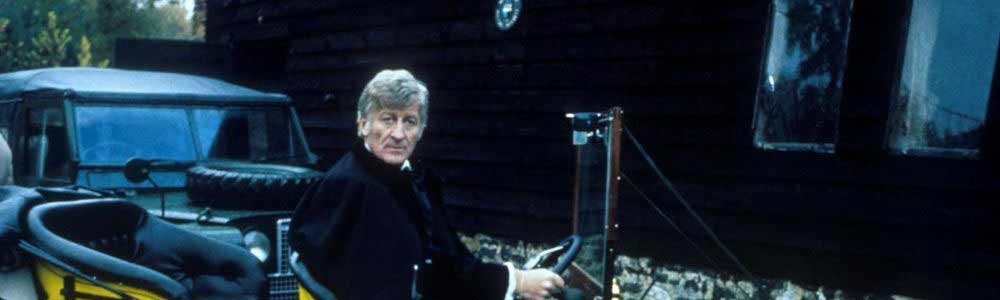
The Third Doctor was played by Jon Pertwee, then known mostly for comedy work. During most of this era the Doctor is confined to Earth, working as “scientific advisor” to UNIT led by the Brigadier, and battling his Timelord nemesis the Master. A lot of the stories are 6 or 7-parters, formats that work very well; there is more world-building than in the 4-parters, which start to seem slightly lacking by comparison.

The third was perhaps the least “alien” incarnation of the Doctor. You can easily imagine him being a heroic leader in the Empire or a maverick figure in British government or business, up to about 1970 (after which such mavericks were tamed or filtered out by bureaucracy). Aristocratic but still practical and “a man of action”, he is constantly innovating and questioning, and being frustrated by the lack of imagination in the lesser men around him. But he is very much a man, not an alien. That choice was probably dictated by Pertwee’s own personality, and it would be reversed when his successor arrived.

Nevertheless, this era was a peak for Doctor Who. The storytelling is very competent, the production style has real charm and the acting (RP galore!) is consistent and endearing. All of this means the stories bear rewatching, remaining enjoyable time after time.

In terms of choice, you can hardly go wrong with this era. The only bad stories are “Carnival of Monsters” and “The Mutants“, with the rest being uniformly great fun.
Friedrich Merz’s rapidly fading political future

Filed under: Germany, Media, Politics — Tags: , , , — Nicholas @ 05:00

On Substack, eugyppius discusses the electoral chasm at Chancellor Friedrich Merz’s feet after terrible showings in recent state elections for his party and the continued rise of the extremely extreme extreme-right Alternative für Deutschland (AfD):

“German flag” by fdecomite is licensed under CC BY 2.0 .

Within months of becoming Chancellor, Friedrich Merz promised an “Autumn of reforms”, which never materialised because the political will to fix Germany’s economic and fiscal problems does not exist within his coalition. Having failed to fix anything and driven support for the once-mighty CDU to historic lows, Merz has instead been served an Autumn of Reckoning. It is unclear whether he will survive it.

The state elections in Sachsen-Anhalt, Mecklenburg-Vorpommern and Berlin that for months have inspired fear and trembling within the German political establishment have come and gone. Each of them has realised our rulers’ worst fears in different ways.

1) In Sachsen-Anhalt, the CDU underperformed polls by more than 20%, while Alternative für Deutschland achieved the highest vote share any party has ever won in that state. The AfD are already in talks with the Bündnis Sahra Wagenknecht, and everyone expects an AfD government under Ulrich Siegmund to take power in the coming months.

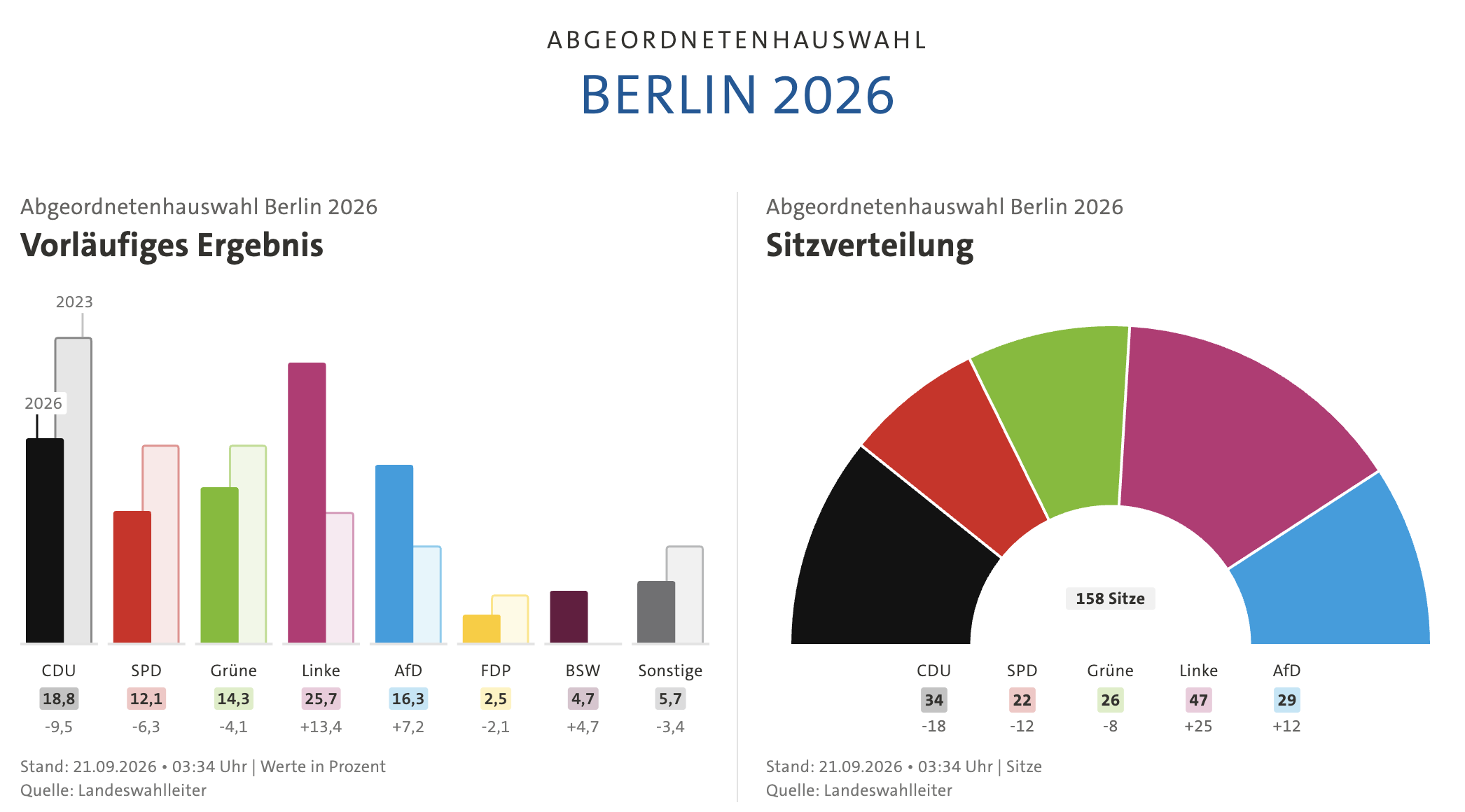
2) In Berlin, the CDU managed to squander the clear polling dominance it enjoyed throughout 2025 to finish in second place with just 18.8% of the vote – nearly seven points behind Die Linke. That is what a series of extremely stupid and unnecessary local scandals alongside association with the most unpopular Chancellor in the history of the Federal Republic can do to a party.

Zohran Mamdani’s advisers and campaign strategists assisted Die Linke in their left-populist Berlin campaign, which enjoyed particularly strong appeal among young voters. Assuming some late-breaking turbulence caused by the corruption and indiscipline that are typical of Die Linke do not derail things, they will form a government with the Greens and the Social Democrats.

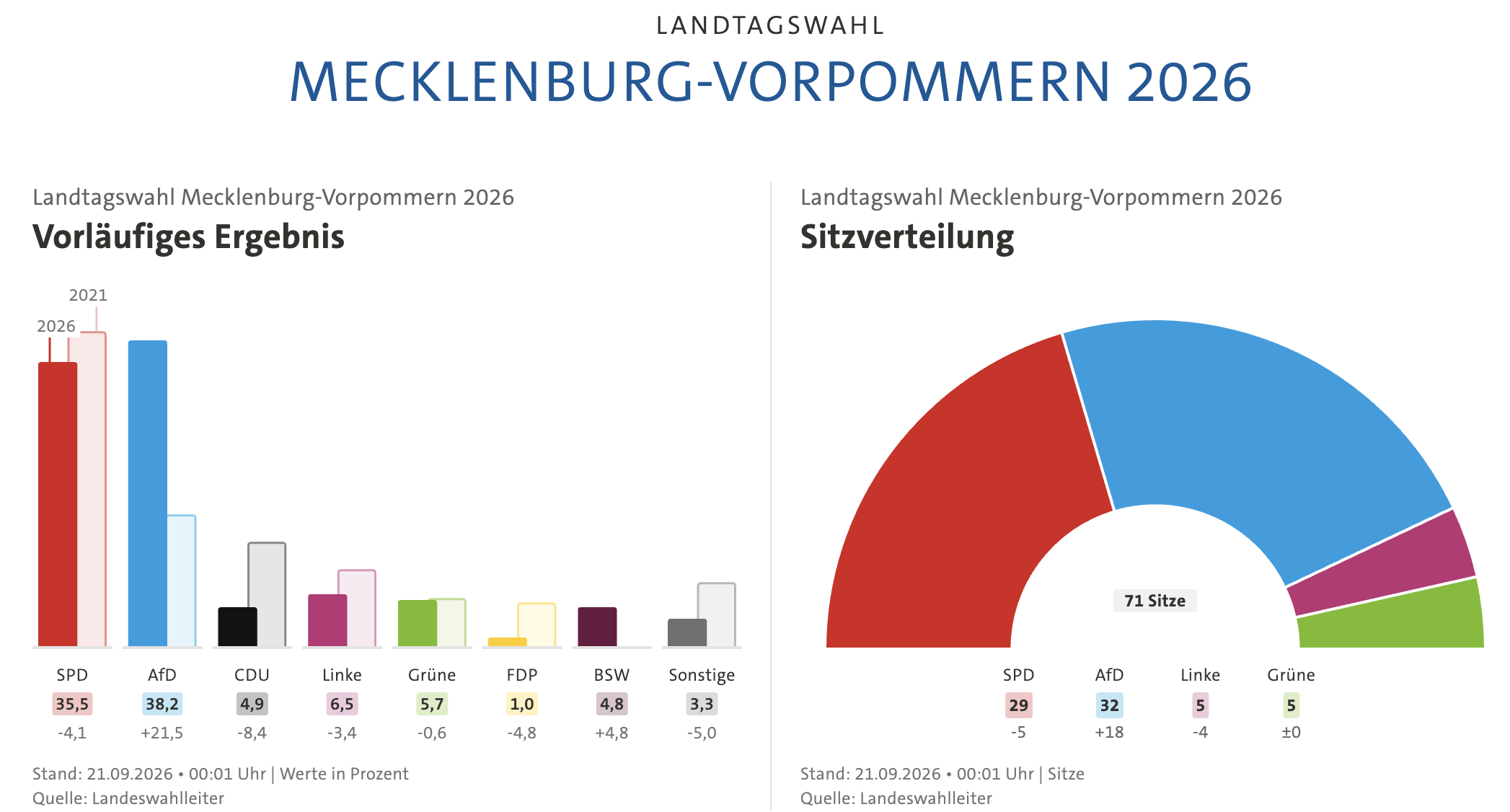
3) In Mecklenburg-Vorpommern, the CDU managed to underperform every last poll, logging their worst electoral result in all of history. With just 4.9% of the vote, they failed for the first time ever to scrape across the 5% hurdle for representation in the Landtag – an outcome I have predicted for weeks. Whereas in Sachsen-Anhalt voters overcame the firewall by making the AfD too powerful to wall off, in Mecklenburg-Vorpommern they abolished it entirely by kicking the party that invented and maintains the firewall straight out of parliament.

Alternative für Deutschland won the largest vote share, but the result will be another coalition of Social Democrats, Greens and Die Linke under the long-serving Minister President Manuela Schwesig. Schwesig enjoys especially strong popularity among women and pensioners, and she will be helped into power by a smattering of leftist students and climate-obsessed urbanites. The AfD will stand alone in opposition to the tepid foolishness of the coming legislature, and the citizens of Mecklenburg-Vorpommern will develop new ways of thinking about the Evil Fascist Nazi Hitler party, which probably cannot be all that evil or fascist or Nazi or Hitler, given that there is no longer any alternative to the left here in the northeast.

The Korean War Week 118 – The Outpost Armor – September 22, 1952

Filed under: China, History, Japan, Military, USA — Tags: , , , , , , , — Nicholas @ 04:00

The Korean War by Indy Neidell
Published 22 Sep 2026

This week we take a look at the hilltop armor used by the UN for the outpost war — the pros and cons. There’s still plenty of fighting this week, for Old Baldy, for Outpost Kelly, and behind the scenes a whole lot of South Korean POWs held by the UN may be soon going home.

00:00 Intro
00:48 Old Baldy
02:50 Outpost Kelly
06:42 The Tanks
09:26 Korean Guerrillas
12:00 Civilian Internees?
15:10 Summary
15:22 Conclusion
15:58 Mobilisation

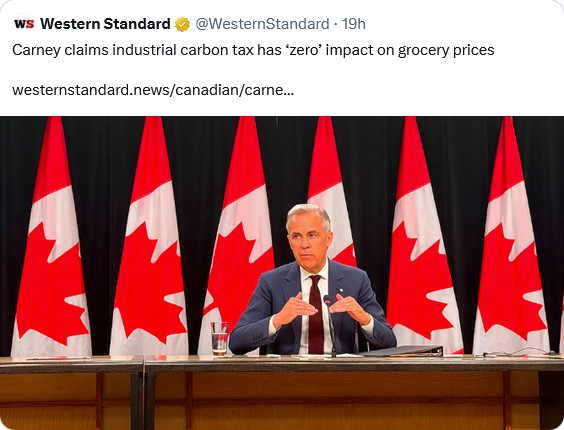
Without massive contradictions, would Canada even have a federal government?

As John Carter notes, the current federal government is committed whole-heartedly to a wide range of initiatives and programs, many of which are directly in contradiction of other initiatives and programs that the goverment is also whole-heartedly committed to:

Setting aside the absurd spectacle of this sheer economic illiteracy spilling forth from the mouth of a man who is supposedly some kind of economic prodigy (please do not look at the state of the British economy btw), pause to savour the conspicuous irony of a government trying to revitalize the Canadian economy while crippling its access to energy (in the middle of a war-driven oil shock no less) in the name of hallucinated climate nonsense no one even believes in anymore.

This is the same government that wants to turn Canada into a research superpower while miring the universities in DEI.

It’s the same government that’s trying to rebuild the military for “warfighting” (it has another purpose?) while going full speed ahead on vaginal maximalism in uniform.

It’s the same government announcing itself as an AI superpower, without a single frontier lab within its borders, while its brains drain south in search of the money, opportunity, and regulatory freedom the government itself ensures that Canada cannot provide.

None of this is real. It’s all press releases and press conferences meant to create the illusion of forward motion towards the achievement of contradictory aims, when no such reconciliation is possible, and no actual movement is taking place.

Corporatism and Fake Mussolini

Filed under: History, Italy, Politics — Tags: , , , , , — Nicholas @ 02:00

Feral Historian
Published 22 May 2026

No direct sci-fi angle here, just a clarification of a widely-held misconception about what Fascists believed, exemplified by an oft-repeated fake quote with some tangents on Eco, Gramsci, and others. Since the subject of Fascism and mythologizing of WWII comes up a lot here, it seems appropriate to address this one.

And here’s a link to Umberto Eco’s essay for those who are interested. https://ia802906.us.archive.org/31/it…

Back to the usual science fiction as cultural artifact essays next week.
(more…)

QotD: The EU as a modern Habsburg Empire

Those in Britain who supported Brexit are often accused of nostalgia for a past in which the country was powerful, but I do not think this nostalgia, if it ever existed at all, was very widespread. One might well say that nostalgia, on the part of France, was and is a driving force in the European Union, since it is only by union with Germany than France can aspire to a semi-Napoleonic role in Europe.

The irony is, of course, that Germany is once again by far the strongest power on the continent. Its interests are complex and no doubt contradictory: it wants the rest of Europe to continue to import its goods, but it does not want to fund, or mutualise, the debts that allow it to do so. The southern countries would like to either to mutualise the debts, or inflate them away by debasing the currency, but Germany will allow neither of these solutions to the imbalances within Europe. There would be no better way to re-awake German nationalism than follow the prescriptions of the southern nations; on the other hand, resentment of Germany will grow if they are not followed.

The author acknowledges the problems within Europe in his last chapter, up till which he has treated Europe as if it were one big happy family with a population gaily marching in unison behind its leadership. The truth is quite otherwise, which is why an example must be made of Britain. But the likelihood is that the more integration there is, the greater will be the tensions, both between and within countries. There is a class within countries that benefits mightily from the present arrangements, which in my opinion explains the paradox of Catalan, Flemish, and Scottish nationalism: for all these nationalisms are firm adherents to the ideal of European Union, namely a dilution of national sovereignty even greater than that which their nations already possess. Again to put it crudely, the leadership of these movements want their place not in the sun, but at the trough. They are pied pipers to their populations.

The book ends by quoting that old Mephistophelian, François Mitterand, to the effect that “Nationalism means war”. And of course this is true if by nationalism is meant an exaggerated and militant love of one’s own country and a hatred of, or disdain for, all other countries, particularly neighbouring ones. Yet at the same time, nation states — at least some of them — have been the only large-scale states able durably to protect the freedom of their populations. Moreover, if nationalism means war, it does not follow that supranationalism means peace. The European Union may be a Yugoslavia in the making, without a Tito to hold it together. As José Manuel Barroso, once President of the European Commission, former Maoist student leader and then Goldman Sachs executive (the thirst for power being the golden thread that runs through this diverse career) put it, Europe — using the word to mean the European Union, which is now more or less standard — is an empire, though of a new kind.

Perhaps not so new, in fact: a kind of Habsburg Empire without the charm and aesthetic sensibility. From the right it is attacked as a socialist enterprise, from the left as a neo-liberal one: corporatist is the word for it, that happy union between regulatory bureaucracy and large corporations.

Theodore Dalrymple, “European Empire, Fractured”, Law & Liberty, 2020-11-10.

Powered by WordPress