Quotulatiousness

September 21, 2026

“The completion of the Parkinsonian cycle”

Filed under: Architecture, Britain — Tags: , , — Nicholas @ 05:00

In The Critic, Ioannes Chountis de Fabbri shows how Parkinson’s Law still applies long after C. Northcote Parkinson’s work:
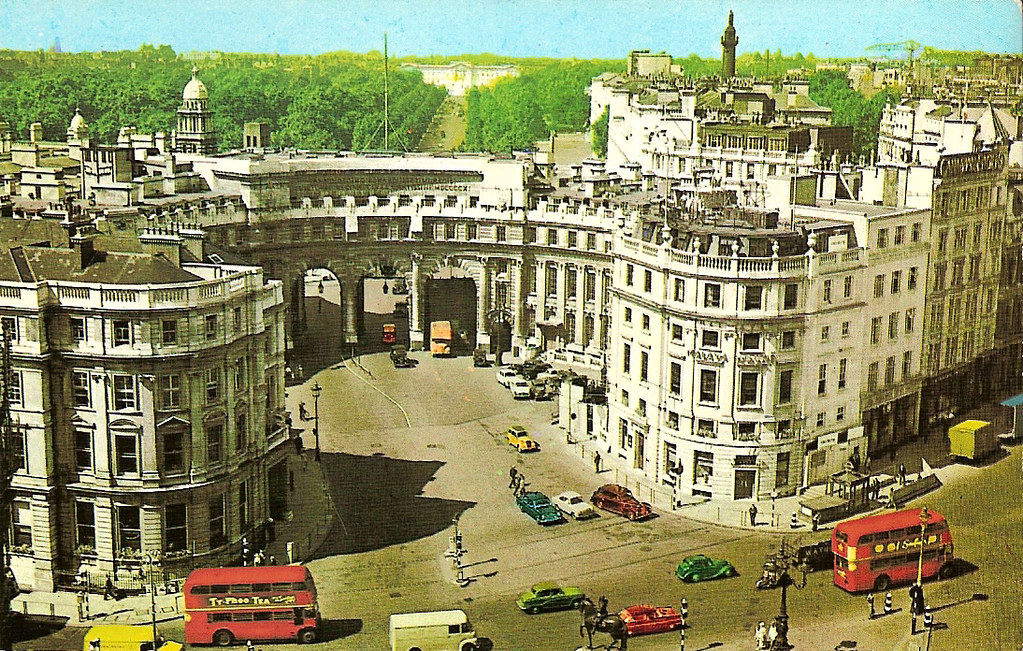
“Admiralty Arch” by Leonard Bentley is licensed under CC BY-SA 2.0 .

In 1958, C. Northcote Parkinson, a prescient observer of bureaucracies, noted how perfection of planned layout is achieved only by public institutions on the point of collapse. Parkinson’s observation is prima facie paradoxical. Yet when an institution is growing during an exciting time of expansion, even adventure, there is little time to design the perfect headquarters. That luxury is afforded later, when all the important work has been completed.

Take St Peter’s Basilica, for example. It was designed only after the political power of the Papacy had been significantly curtailed. Or the Palace of Nations, opened in 1936, when the League of Nations’ failure as an institution was already evident. Even Buckingham Palace was expanded at a time when the monarch had assumed a rather ceremonial role in the constitution.

I’ve written about Parkinson and his sardonic observations in these august pages before, but what brought him to my mind again last week was the sight of the renovated Admiralty Arch. Parkinson might have traced the long arc of decline as far as decay but stopped short of its final stage. We may rejoice, for we have now arrived at the terminus: once a building has become both perfect and symbolic, it is at last available to be sold off for a song or leased out. We might call this the completion of the Parkinsonian cycle.

Admiralty Arch is a familiar fixture of the London landscape. Raised at the initiative of King Edward VII in memory of his mother, it became the home of Britain’s naval command. It was where Sir Winston Churchill designed his not-always-successful naval expeditions. It will soon open its doors again as a new member of the Waldorf Astoria hotel family. Some connection with the past will be at least retained through the Pol Roger champagne served at its bar.

What is happening in the Mall is symbolic of a wider drift. Half a mile down the road, the Old War Office in Whitehall was converted (guess what?) into a luxury hotel. In Covent Garden the old cells of Bow Street are also now a hotel curiosity. The grand County Hall, which continues to stare somewhat antagonistically across the Thames at Parliament, now welcomes not county councillors but visitors as a hotel and, at least more imaginatively, an aquarium.

If luxury hotels are not your cup of tea, fret not, for the tyranny of “adaptive reuse” has a downmarket cousin. The humbler ruins of Middle England have been put to new purposes. A former British Home Stores — that cathedral of the affordable cardigan – in Slough was discovered last year to have been converted into a huge marijuana farm. Seventeen hundred plants thrived under grow-lamps in the same aisle where once school uniforms could be purchased, whilst the cultivators were dozing on a mattress by the fire exit. At least the building was, in the developer’s immortal phrase, “brought back into use”.
A short check-in on what’s happening in Canada

Filed under: Cancon, Europe, Media, Politics — Tags: , , , , , , — Nicholas @ 04:00

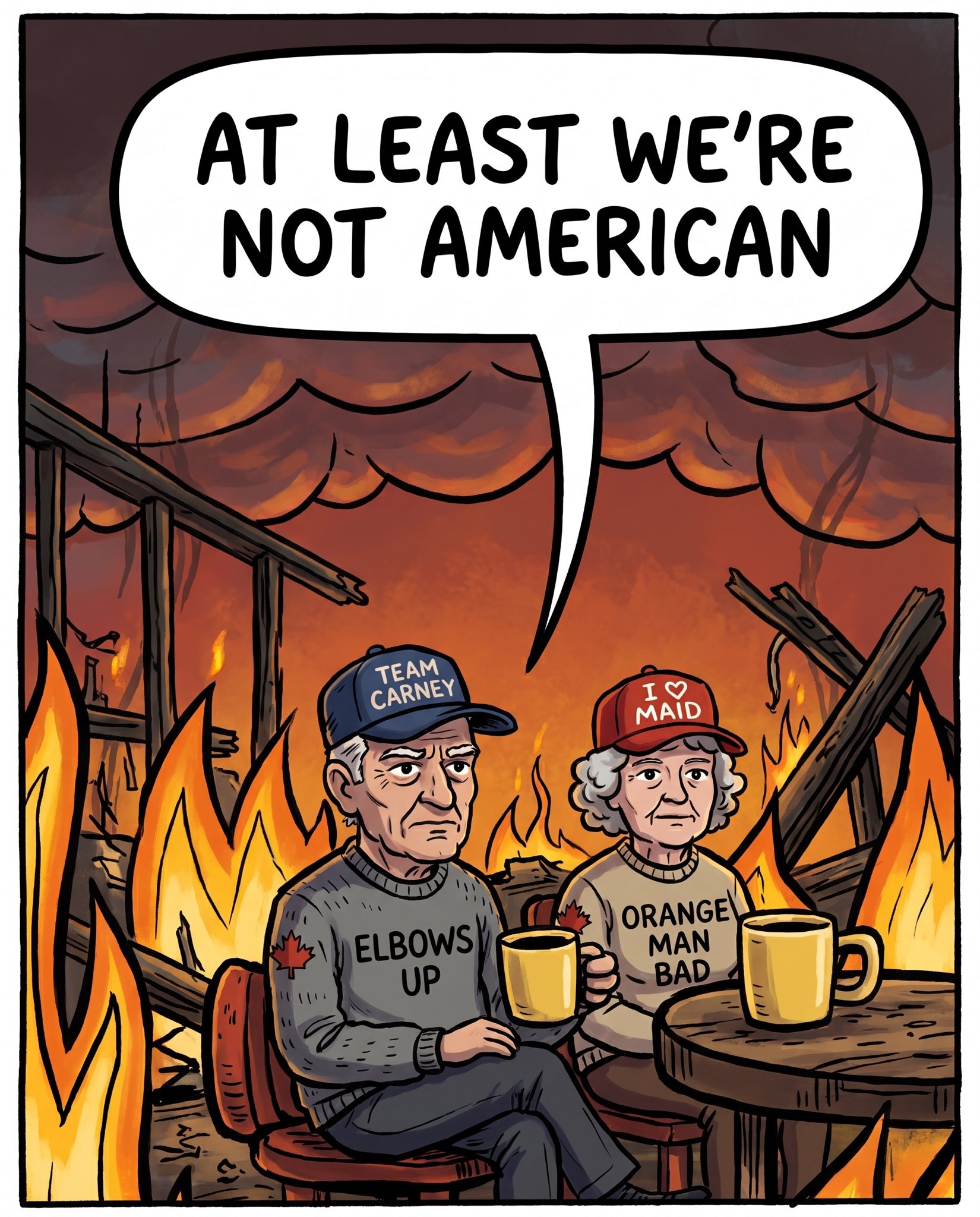
As I’ve mentioned before, even though I’m Canadian I don’t cover a lot of Canadian stories unless it has broader international interest. That said, I do think it’s worth the effort for non-Canadians to occasionally get some insight into what new insanity is going on above the 49th Parallel. The Rewrite has a helpful summary of recent news from the Maple Gulag that may be of interest:

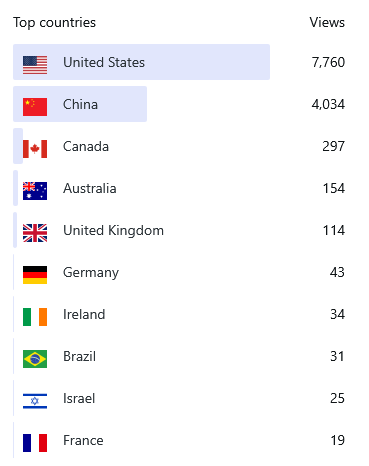
For a Canadian blog, I get a lot more non-Canadian visitors.

It looks like Canadians are about to cheerfully reconnect with what they were taught for a decade is their unforgivable colonial past. First, the Wall Street Journal (WSJ), primarily citing unnamed sources, reported that Prime Minister Mark Carney was hoping to make Canada an associate member of the European Union. But then CTV News, quoting a senior PMO official, reported Canada wasn’t seeking EU membership “in any capacity.” Paul Wells wrote a column explaining how WSJ had torqued the story and then Carney, who tends to get truthy under pressure, as Brian Lilley pointed out, told reporters he wasn’t seeking anything called membership but something something else something something. A couple days later, EU President Ursula von der Leyen disagreed with that line when she declared in a speech that she wanted to join with Canada at the “highest level possible” and she’d be happy to welcome Canada as an “associate member.” In response, the Financial Times reported other EU leaders were thinking, uh, not so much about the whole thing but good luck Canada and the Daily Mail chimed in with news Brussels was in an uproar. Then, proving it was right all along, WSJ quoted a Canadian official saying “We were the ones who proposed associate membership”, which Carney and his office had denied.

US President Donald Trump said if Canada joins the EU with a hostile intent (the qualifier having been omitted in some Canadian reports), the USA will bring in more EU tariffs. Our PM recaptured headlines with a speech promoting an undefined but aspirational union and flew home to a nation that polls indicate is now wildly enthusiastic about embracing settler culture even while the Daily Telegraph said the whole thing was already unraveling.

The challenge for journalists was to make sense of all this prestidigitation while wondering if maybe they should have taken the time to ask who Carney was hanging out with during his recent vacay in Tuscany. Many were left wondering if PMMC could do this without Parliamentary approval which, as every working journalist should know, he can, partly because they let him. When it comes to treaties, it’s a one-man show. Credit the Toronto Star‘s Althia Raj for noting in regards to Carney’s plan to further privatize major airports that “The Liberal government has no mandate to do this”.

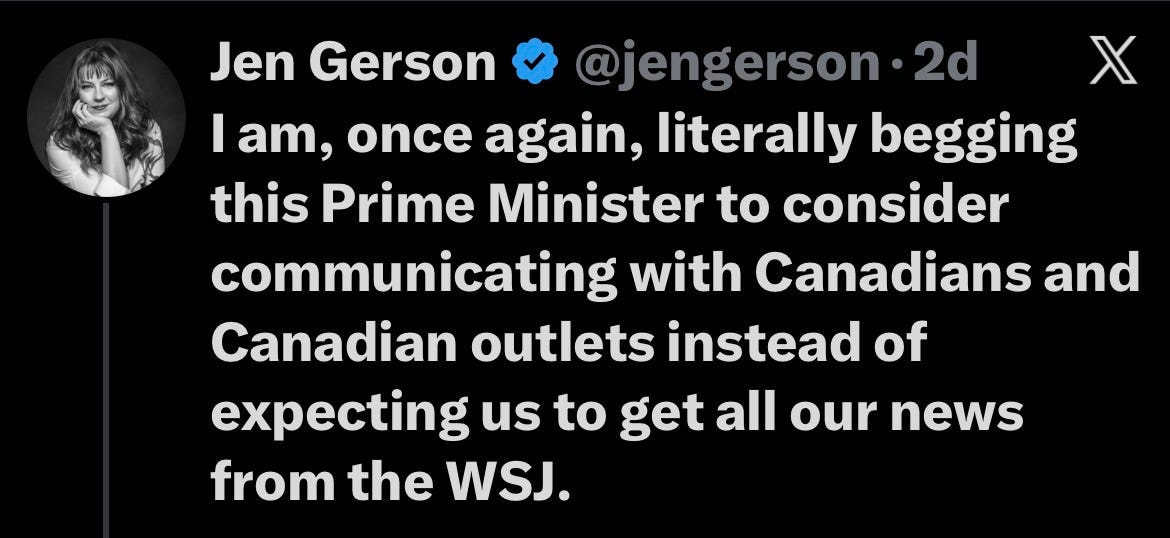
While The Line‘s Jen Gerson and others were taking umbrage with the PMO’s preference for foreign media, John Ivison was getting some decent insider dirt for National Post on how vigorously bureaucrats are resisting the PM’s need for speed — a concept with which they are notoriously unfamiliar.

A further chapeau to Brian Passifiume for the scoop on how, while Carney is urging us to buy Canadian, his government hired an American company to run his Toronto investor match making sessions.

I have frequently pointed out that the mystery of why Germans supported Hitler and the National Socialists in the 1930s comes down largely to the value of non-stop propaganda: ordinary Germans read the newspapers and listened to the radio and the messages they got were increasingly co-ordinated to praise the party and the work of its leader and to demonize enemies of the state. What brought it home to me was just how efficiently Canadian relic media spare no effort to praise our very own Dear Leader and belittle the opposition or private citizens who don’t automatically wave their elbows on demand:

Putting on the neuroscience hat for a minute.

When people are called “traitors” simply for saying Canada should negotiate a workable deal with the United States, something interesting is happening psychologically.

The brain has a fast threat-response pathway and a slower regulatory pathway. The amygdala can detect a perceived threat almost immediately and trigger a stress response.

When people feel they are losing control or fear social judgment, cortisol can rise. Under enough perceived threat, slower prefrontal-cortex functions such as weighing evidence, considering alternatives and regulating emotional reactions can become less dominant.

Now add politics.

If Trump, the United States, Canadian sovereignty and national loyalty become emotionally loaded symbols, a disagreement over tariffs can stop being treated as an economic question. It becomes: “Are you with us or against us?”

That is where tribal thinking can take over.

Calling somebody a traitor because they want negotiations is the fast response. The slower question is: What outcome produces the least economic damage for Canadians? What does retaliation cost us? What can Canada realistically gain through negotiation? What happens to workers, farmers and businesses if there is no deal?

You can oppose a deal after doing that analysis. You can support one. The important part is how you reached the conclusion.

I saw much the same psychological process during COVID. Questions that should have involved evidence, probabilities, costs, benefits and changing information often became tests of political identity and loyalty. Once that happens, people defend the tribe first and examine the evidence second.

The neuroscience doesn’t tell us which political side is automatically correct.

It does tell us why fear, loss of control, social judgment and group identity can push people toward rapid emotional responses, while stepping back and deliberately examining evidence requires more cognitive regulation.

Sometimes the most rational thing you can do is refuse the loyalty test and ask the boring question:

What actually works?

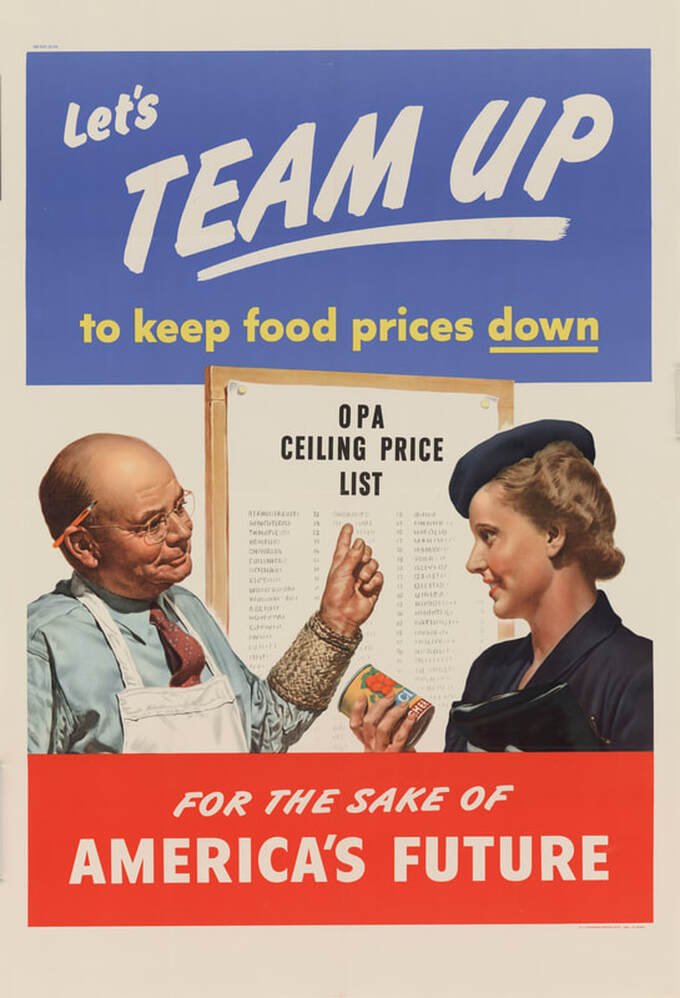
Price controls work … but not the way they’re intended to

Filed under: Business, Economics, Government, History, USA, WW2 — Tags: , , , , — Nicholas @ 03:00

Politicians love to intervene in markets, trying to impose their preferred solution to “problems” like high prices. But markets don’t work the way politicians think they do:

Price ceilings don’t manage markets, they destroy them. In 1946 the US meat market collapsed because of it.

The Office of Price Administration set beef ceiling prices during World War II. Ranchers and meatpackers adapted: some held cattle rather than sell at a loss, others shifted product to black markets, and slaughter volumes dropped. The OPA briefly lifted controls in mid-1946 under pressure. Beef flooded back into stores almost immediately.

Then Congress, drowning in constituent complaints about inflation, reimposed ceilings in August 1946. Slaughter collapsed within weeks. By October 1946, beef virtually disappeared from American grocery store shelves. You could walk into a butcher shop in Chicago or New York and find nothing. Scarcity was manufactured entirely by Washington bureaucrats setting prices below what producers needed to cover costs.

Mises explained the mechanism precisely: a price ceiling creates a shortage, which produces political pressure for rationing and further controls, spiraling into comprehensive economic disorganization. The OPA ran that experiment in real time on the American food supply.

President Truman ended meat controls on November 9, 1946. Beef returned within days. The supply existed the entire time. Ranchers and packers simply refused to sell at confiscatory prices, and they were correct to refuse. Coercive price suppression causes economic destruction, and 1946 proved it at the grocery counter.

Custom-Order Walthers: Model HP and P38 in 7.65mm Parabellum

Filed under: Germany, History, Military, Weapons, WW2 — Tags: , , — Nicholas @ 02:00

Forgotten Weapons
Published 8 May 2026

When Walther first developed the P38, it was designated the Heerespistole — “Army Pistol”. Only after getting official Wehrmacht adoption did it get the designation P38. Walther offered models with both designations for commercial sale, albeit not to just anyone. Army officers, Party members, and other high-placed individuals could get pistols from Walther outside military orders. About 20,000 such guns were made during the war, and a tiny subset of them — just 225 — were made specifically in 7.65mm Parabellum instead of 9mm Parabellum. Today we are looking at two examples of those.
(more…)

QotD: Military doctrine

Filed under: History, Military, Quotations — Tags: , — Nicholas @ 01:00

Doctrine. Something I keep promising to write about and then don’t. Doctrine is, “the body of formal knowledge that tells a fighting force how it is expected to fight” (Parshall and Tully, 83). it is not a plan for a specific war, but the general planning framework a military brings to every war; think of it like a very complex list of “best practices”. This is necessary because war is too complex to make this stuff up on the fly. That said, just because a military has a written out doctrine doesn’t mean they can execute on that doctrine; the doctrine may call for things that military (or its political leaders) are simply not capable or willing to do. That said, a military that finds itself operating well outside its own doctrine is likely in trouble. Russian maneuver warfare doctrine generally goes by the moniker Deep Battle or Deep Operations (Глубокая операция) and to say that the Russian Armed Forces [in the 2022 invasion of Ukraine] have not managed to pull off their doctrine in practice is a significant understatement.

Bret Devereaux, “Miscellanea: A Very Short Glossary of Military Terminology”, A Collection of Unmitigated Pedantry, 2022-03-25.

Powered by WordPress