
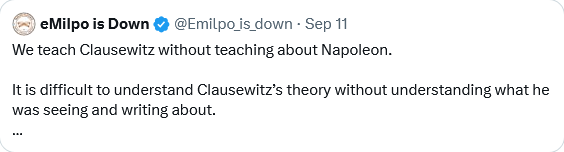
InfantryDort responds to a complaint that military leaders are taught Clausewitz without the career of Napoleon for context:
THE THING WE STILL CAN’T TEACH
I’ll bite on this one. Napoleon remains the ghost in professional military education. Why? Let me take a stab at it …
Jomini watched him and tried to turn the phenomenon into rules. Anyone in the U.S. Army has seen this before. If you do something exceptional on the field (especially in training), then you’re often coached that you went outside the lines and need to get back in. You may have succeeded, but it COULD have been a disaster. So we try “putting baby in a corner” because the science of war is safe. The art scares people.
Clausewitz watched the same fire in Napoleon and concluded that rules would never be enough. Two centuries later we are still dissecting the campaigns, naming principles, drawing arrows on maps, and trying to explain what exactly lived inside that man.
Again, why?
There is a part of command that refuses to become curriculum. T.E. Lawrence called it the “kingfisher flash”. Clausewitz reached for the genius. It’s the instant when one mind sees through fog what a hundred educated men cannot see at all, then possesses enough violence of will to act before the moment disappears.
Read that last part again 👆
You can feed that gift with history, sharpen it through hardship. But you CANNOT manufacture it with another degree. It MUST be revealed.
Yet modern institutions are built around the opposite assumption. We stack schools, evaluations, gates, boards, and credentials high enough and convince ourselves that eventually genius will emerge from the assembly line. It won’t. It can’t. Ever.
Worse, the machine often recognizes the dangerous talent and rejects it precisely because it cannot reproduce it. The unusual man is “reckless”. The instinctive one is “unserious.” The officer who refuses the approved path becomes “unqualified”.
READ. IT. AGAIN. 👆 👆 👆
Then war arrives and burns the paperwork. That is the lesson Napoleon keeps trying to teach us from two hundred years away. You can study the flame forever. You still have to recognize it when it walks into the room.
The closest we can come to discovering this genius is testing our officers on it. No more reliance on pure paperwork. I say to these officers: Show us the gift you’re supposed to possess for the highest commands.
Or step aside for someone who will.



I think this applies to every area in life.
America doesn’t get the best soccer players because they are organized and coached from age 5. Never get to develop on their own.
Medical advances come from rebels, not people who accept the orthodoxy.
We need to have institutions that have a path for rule breakers to stay in the system to challenge it. Seems contrary to the nature of organizations, however.
Comment by Pat McCracken — September 15, 2026 @ 07:18
The function of North American soccer organizations seems to be to provide a very lucrative second career for soccer players who’ve already peaked in the European pro leagues.
Comment by Nicholas — September 15, 2026 @ 13:01
the amazing thing is that Patton and MacArthur both managed to succeed in that environment.
Re soccer. Nicholas’s comment is on well known (at least to soccer fans) players. There is also a subset of US club teams that assume that any Brit or Scot who ever played in any of the professional leagues is now the perfect coach for their kids. My son, who experienced that, will rant about it at some length, given any encouragement.
Comment by yara — September 15, 2026 @ 21:55
I’m doing some reading on the notable figures of the American Civil War at the moment (Lee, Longstreet, Jackson, and currently Davis) and it’s just fascinating how borderline dysfunctional most US Army officers seemed to be in the 1830-1860 era. Braxton Bragg, who conducted an administrative campaign against his worst enemy (Braxton Bragg), is far less of an outlier than I thought when I first read about his career.
When my son was involved in rec. soccer, it did seem that anyone with a strong English, Scottish, or German accent could earn some nice pocket money as a soccer coach.
Comment by Nicholas — September 15, 2026 @ 22:09