
seangabb
Published 8 Feb 2026Greece: A Brief History, c.700 BC – 500 AD
This segment goes straight to the ancient evidence. Using Plutarch’s Life of Lycurgus (with the passages shown on-screen), I explain how Sparta understood itself: infant inspection and exposure, the collective upbringing of boys in the agōgē, deliberate hunger and deprivation, enforced endurance, and the suppression of private loyalties in favour of loyalty to the state.
This is not presented as scandal. Plutarch often writes admiringly, which is precisely why the text is so revealing. The system is coherent. It is also terrifying. Sparta did not merely train soldiers. It manufactured them, beginning at birth.
June 26, 2026
Sparta vs Athens 2(c): Spartan Childhood – The Agōgē, Infant Inspection, and State Brutality
Comments Off on Sparta vs Athens 2(c): Spartan Childhood – The Agōgē, Infant Inspection, and State Brutality
June 25, 2026
Credit card fee cap: a great idea, with the best of intentions … what possibly could go wrong?
Nobody likes credit card fees — except the banks that issue credit cards — so politicians figure that they can please the voters at no cost and mandate limits to the fees that credit card companies can charge. But who is going to suffer for this “at no cost” bit of rule-making?

“Credit Cards” by Sean MacEntee is licensed under CC BY 2.0 
 .
.
Two years ago, Illinois passed crowd-pleasing restrictions on credit card interchange fees, which are better known as “swipe fees”. The ban on charging fees on processing payments for tips and taxes has now been delayed twice by skeptical federal judges and lawmakers worried that they’ve crafted a financial mess. These interventions may be saving the state from itself, as a new report points out that the law threatens to hurt consumers, small retailers, and local financial institutions.
Delayed Ban on Fees for Processing Taxes and Tips
Passed as part of a 2024 revenue bill, the Interchange Fee Prohibition Act (IFPA) defines “interchange fee” as “a fee established, charged, or received by a payment card network for the purpose of compensating the issuer for its involvement in an electronic payment transaction”. It adds: “An issuer, a payment card network, an acquirer bank, or a processor may not receive or charge a merchant any interchange fee on the tax amount or gratuity of an electronic payment transaction if the merchant informs the acquirer bank or its designee of the tax or gratuity amount as part of the authorization or settlement process for the electronic payment transaction”.
“Although merchants have long advocated for this change, banking and payment industry representatives argue that it imposes an undue hardship by forcing them to process certain components of transactions without compensation,” attorneys Thomas V. Panoff and Maxwell Earp-Thomas noted for the National Law Review at the time. They also commented that the law could force Illinois payments to be processed differently than those originating in the rest of the country and the world beyond.
The situation is now being fought in court and in public between advocates who argue the fees are hidden costs and opponents who say they’re an industry-standard means to cover the cost of business.
[…]
Overall, Illinois lawmakers’ attempt to please the crowd by mandating lower costs looks poised to create a mess that could leave the state’s consumers, small banks, and retailers with higher costs and fewer choices if financial institutions leave to avoid headaches.
“To protect the integrity of the checkout experience and avoid driving financial providers from the Illinois market, the IFPA must be either repealed or overturned”, concludes Swedberg.
Credit card fees are undoubtedly burdensome for consumers and retailers. Ultimately the best way to avoid them is the traditional way: Use cash.
Why Britain voted for Brexit
Pat Condell explains some of the reasons British voters chose Brexit over staying in the EU back in 2016:

Why did we vote for Brexit ten years ago? Because we understood that the core purpose of the European Union is to destroy the independent countries of Europe by opening the borders and transforming a diverse continent of sovereign nations into a single homogenous political bloc governed by a committee of unelected bureaucrats, as a model for the planned global dictatorship.
Obviously, you’re not going to get many votes for that if you just lay it out for people, so you start with something innocuous like trade.
You say “Let’s harmonise our trade arrangements and everything will run more smoothly.”
And people say “Yes, that sounds like a good idea.”
Then you say “While we’re at it, let’s give this small group of people the power to organise all this from one place, and everything will run more smoothly.”
“Well, I suppose that makes sense. We want things to run smoothly.”
Then it’s “Actually, let’s give these people the power to make our laws and override our parliament and justice system, and everything will run much more smoothly.”
“Hold on a second, I don’t know about that …”
“You fascist. You racist. You xenophobe. You bigot. You pig ignorant little Englander. You vermin. You scum.”
Although that attitude certainly helped to tip the balance, the most important reason we voted for Brexit is that politicians had no right to sign away the governance of the UK to a foreign entity, but that is what they did, while pretending it was about trade. They lied to us, and they tried to cheat us out of our country.
That is why we voted for Brexit, and it’s why we’re now being punished for our disobedience by traitors who refuse to secure the border and who are allowing our country to be flooded with millions of unwanted and incompatible immigrants and illegally invaded and occupied by an army of dangerous military age men in whose presence no woman or child is safe.
Forced mass immigration from hostile and barbarous cultures is punishment for Brexit. Our country is being purposely destroyed for not voting the way we were told.
Comments Off on Why Britain voted for Brexit
June 24, 2026
The importance of proper maps on strategic thinking
CDR Salamander considers the use of maps — appropriate maps — to be critical for both military and civilian strategists. And the most common kind of map most people encounter is one of the worst, because it conceals more than it reveals:
If I am ever invited into someone’s personal study, office, or library — especially someone who puts themselves forward as a national security type — one of the things I not-so-subtly look for is maps, charts, or better yet, a globe.
Yes, I will judge you. It matters.
I have seen exceptionally credentialed and powerful uniformed and civilian leadership here and in Europe have an almost comical ignorance of the world in which they hold access to levers of almost unimaginable power. From a complete disinterest bordering on criminal unawareness of the bottom topography of the Baltic and Taiwan Strait, to not knowing where the Cape of Good Hope is, or even what a Great Circle Route is.
That kind of ignorance gets people killed.
They got their positions of power and influence for a whole host of reasons, but an understanding of geography and the ability to read a map was probably not one of them.
[…]
If someone says, “When you look at a map of the world …”, more likely than not, what will pop into your mind will be what is at the top of the post, the Mercator Projection.
That may be one of the contributing factors to inadequate strategic thinking in the modern age.
Of course, any attempt to represent a three-dimensional object on a two-dimensional format is going to create some problems.
You need multiple perspectives, and often the one that best serves in helping you understand the challenge of the moment.
As we continue to argue the point here, we don’t need a new force design, or national strategy, we need a national understanding.
We need to understand the fact we are a maritime and aerospace power, and those are the two domains where the majority of fighting in any war against the People’s Republic of China is going to take place.
It has a unique set of challenges that have nothing to do with politics, people, culture or anything from man; it has to do with the interface of land, water, time, and distance.
As we learned and then forgot from WWII, any war in the far reaches of the Pacific requires range, scale, and the logistics system that appreciates both and can sustain the fight forward.
[…]
What are the top-5 even the novice should get?
- AUKUS is a must-succeed. Don’t balk. Don’t stutter. Don’t be difficult. Make it work. It reinforces our left flank. Australia and the Philippines are our shield and redoubt.
- Taiwan is the stopper that keeps the PRC relatively contained. If you lose that, Guam is your new front line.
- A strong Japan and South Korea must be made stronger and closer. They are our right flank.
- What does the PRC want? Once you accept that they want everything from the line drawn from Alaska to New Zealand to their coast under their uncontested control, but are more than happy to let us have everything on the other side, then you understand what they have been doing for decades in the small island nations in the Southwest Pacific.
- People grow up with maps that emphasize Europe and the North Atlantic. This projection breaks that mental fixation, putting Europe and the North Atlantic in a minor corner of the map, almost an afterthought that barely catches the eye.
A slightly more recognizable version [of the Spilhaus Projection] is below.


June 23, 2026
They don’t do “democracy” in Europe for any important issue: the voters might get it wrong
It used to be a joke that voting never matters because the voters can’t be trusted with that kind of power. Over time, the joke stopped being at all funny, because that’s exactly what has happened in most western countries at the national level, but most blatantly in the European Union, where voters can express their will in a clear majority, yet see exactly the opposite policies implemented by Brussels:

EU delenda est
2005: the day they decided your “no” didn’t count
May 29, 2005. The French vote. Referendum on the European Constitutional Treaty.
Result: 54.68% NO.
Turnout: 69%.
Not a vote of abstainers, not a misunderstanding.
A people speaking out, massively, with full awareness.
Three years later, the same text — or nearly so — came into force. Without asking their opinion again.
Here’s how.
The context.
The Constitutional Treaty was the great federal leap: a text that gave the EU the attributes of a state. A flag, an anthem, a “constitution”, a foreign minister, supremacy written in black and white. Chirac, full of confidence, calls the French to the polls. The “yes” campaign mobilizes everything: the state, the major parties, the media, big business, the institutional unions.
And the French say no. For reasons the elite refused to hear: fear of social dumping (the infamous “Polish plumber”, the Bolkestein directive), a sense of a machine slipping out of their control, rejection of a project decided from on high and ratified by acclamation. Five days later, the Dutch say no in turn. 61%.
The treaty is dead. Officially, it’s called a “period of reflection”. In reality, it’s time to find a workaround.
The workaround has a name: Nicolas Sarkozy.
2007 campaign. Sarkozy proposes a “simplified treaty”. And above all, he lays out the adoption method: it will be the parliamentary route. No referendum. Parliament will vote in place of the people.
That’s his promise. He is elected.
And he keeps it against the people who had already decided.
The sleight of hand: the Lisbon Treaty.
Signed in December 2007.
They remove the symbols that scared people: no more “constitution”, no flag in the text, no “minister”.
They keep the essentials: permanent presidency of the Council, extension of qualified majority voting, retreat from unanimity, the Union’s legal personality, European diplomatic service. The institutional substance of the rejected text, repackaged.
The most cynical part is that they admitted it. Valéry Giscard d’Estaing, the architect of the Constitution, wrote it himself: the tools are the same, we’ve simply changed their order in the box. The stated goal: make the text unreadable so no government would be forced to submit it to a referendum. Technique replacing the popular verdict.
February 2008. Versailles.
Congress convenes to amend the French Constitution and allow ratification. Then Parliament ratifies Lisbon. The government left, which had campaigned for “no”, abstains and lets it pass. The French, they are never consulted again.
The “no” of 2005 has just been converted to “yes” by procedure.
And for those who might doubt the method: Ireland, for its part, was constitutionally required to vote. It says no in June 2008. They make it revote in 2009 until they get the right result. Vote until you get it right.
And that’s where it all connects.
This isn’t a procedural anecdote. It’s the founding act of a legitimacy problem that France has never settled.
Because the question of 2005 is exactly the one today. When Brussels signs 96 billion in development aid, when the NDICI directs billions to foreign “civil societies”, when the Global Gateway promises 300 billion the real question is never “should we do it?”.
It’s: who decided, and with what legitimacy?
The answer, we’ve known it since 2005: an administration that believes the people, when they answer wrong, must be circumvented, not heard. Hayek called it the fatal conceit.
The idea that a center knows better than the peoples what is good for them including against their explicit vote.
The French never accepted Lisbon. They were never asked.
And a structure built by going over the head of a lost referendum doesn’t carry a democratic deficit: it carries a birth defect.
The American Constitution starts with “We the People”.
Ours, the European version, started with a people who said no and an apparatus that decided it didn’t count.
Auto-translated by X from Brivael Le Pogam’s original French post.
Comments Off on They don’t do “democracy” in Europe for any important issue: the voters might get it wrong
June 22, 2026
Two-tier Keir resigns as UK Prime Minister
History will not be kind to Sir Keir Starmer’s time in office, both for his actions and his failures-to-act. The Labour Party will now select the next person to live at Number 10 Downing Street, as they still hold a majority in the House of Commons and are not required to go back to the people for a new mandate, regardless of who is their party leader.
Rupert Lowe, the leader of Restore Britain, greeted the news on the social media site formerly known as Twitter:
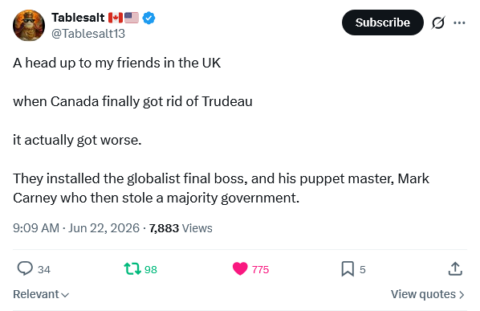
I reposted this on my other social media accounts, saying “Sadly, this is completely true. We belatedly ditched the clown prince of progressivism … only to install Mark Carney, who believes all the same progressive shibboleths that Trudeau did, but he’s far more capable of implementing them by hook or by crook.”
Starmer resigns — he has been a truly disgraceful Prime Minister.
I do not believe him to be a good man or a patriot.
He has deliberately and rapidly accelerated the destruction of our Britain, of our home.
History will not remember him kindly, nor should it.
I sat in Parliament, looking him in the eye, listening to him attempting to justify his decision to block a national inquiry into the mass rape of young British girls.
I will never forgive him. For that, and so much else.
What comes next, I do not know.
Whatever that is, Restore Britain will be ready to offer the British people a democratic route out — a better way, the only way.
But Starmer is gone.
And that is a good thing.
Enjoy it.
Former Manchester mayor and recently elected Member of Parliament for Makerfield Andy Burnham is the most likely successor to Starmer.

Then-Prime Minister Sir Keir Starmer visiting Holy Trinity Church of England Primary School in Manchester on 13 April 2026 with Andy Burnham, Mayor of Greater Manchester.
Picture by Lauren Hurley / No 10 Downing Street via Wikimedia Commons.
Comments Off on Two-tier Keir resigns as UK Prime Minister
Sparta vs Athens – 2(b): Ostracism, Demagogues, and Why Athenian Democracy Worked (Until Rome)
seangabb
Published 8 Feb 2026Greece: A Brief History, c.700 BC – 500 AD
Athenian democracy is often dismissed as mob rule. This segment explains why that is too simple. Athens developed habits and structures that stabilised debate: frequent Assembly meetings, repeated exposure to the same issues and speakers, and a politically literate citizen body shaped by practical participation.
I also cover the darker logic: fear of tyranny, fear of dominance, and why Athens accepted instability and even injustice as the price of preventing permanent concentrations of power. Ostracism is discussed as a precautionary tool, and demagoguery as a permanent risk that the system managed rather than “solved”.
Finally, I explain how Athenian democracy ended — not because it decayed internally, but because Rome rendered the institutions meaningless. Empire does not tolerate participation.
Comments Off on Sparta vs Athens – 2(b): Ostracism, Demagogues, and Why Athenian Democracy Worked (Until Rome)
June 21, 2026
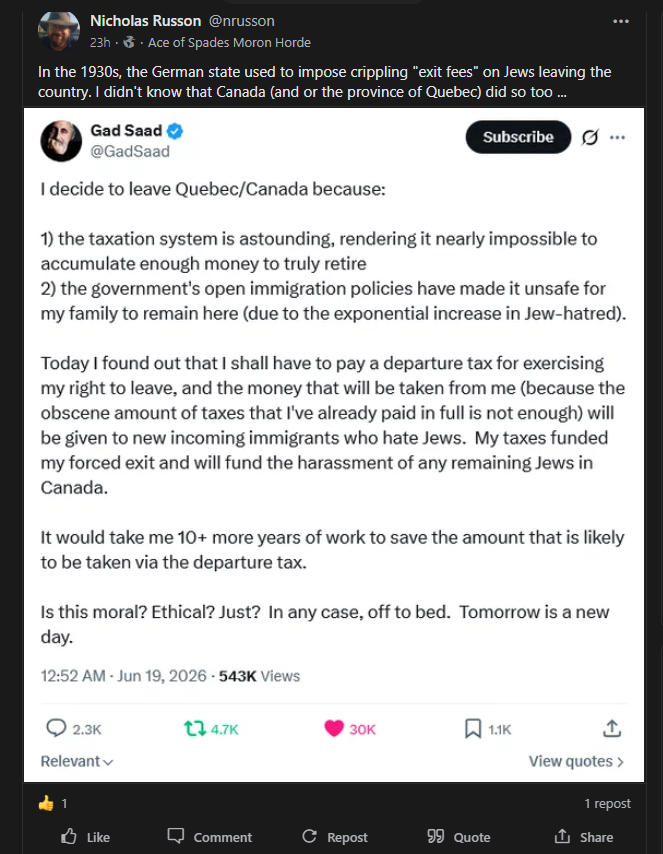
Gad Saad discovers that Canada has an “exit tax” … and it’s insane
The other day, I shared a post from Gad Saad that alerted me to something I’d never heard of before: a steep tax the federal and provincial governments levy when a Canadian emigrates to another country:
On the social media site formerly known as Twitter, Vesper provides more information:
The Great Scam
After what @GadSaad posted yesterday, something I had no idea existed … an “Exit Tax” I did some digging. This is what I found.
Canada’s departure tax is one of the biggest scam taxes on the books. Apparently when you leave the country, the government treats you as if you sold every investment you own, even if you sold nothing.
You get hit with a tax bill on money you never touched, never withdrew, never spent. They literally invented a fake sale to justify taking your money.
Here’s what makes it even worse. The stocks they’re taxing? Those are foreign companies. Apple, Samsung, whatever you hold, those grew because of what those businesses did in their own countries, their own markets, with their own workers.
Canada had absolutely nothing to do with it. Zero. But they still want a cut just because you happened to live here while you owned them. They did nothing and still want to be paid like they did.
And before 1996 this didn’t even exist the way it does now. Chrétien’s government expanded it that year and buried it in section 128.1(4)(b) of the Income Tax Act like they hoped nobody would notice. Italy doesn’t do this. Portugal doesn’t. Belgium, Switzerland, the UK, none of them pull this shit.
You paid income tax every year. You paid sales tax. Property tax. You held up your end of the deal the whole damn time. And when you decide to go live somewhere else, they hit you with a bill for money that was never real to begin with.
Canada under any Liberal is a Scam!
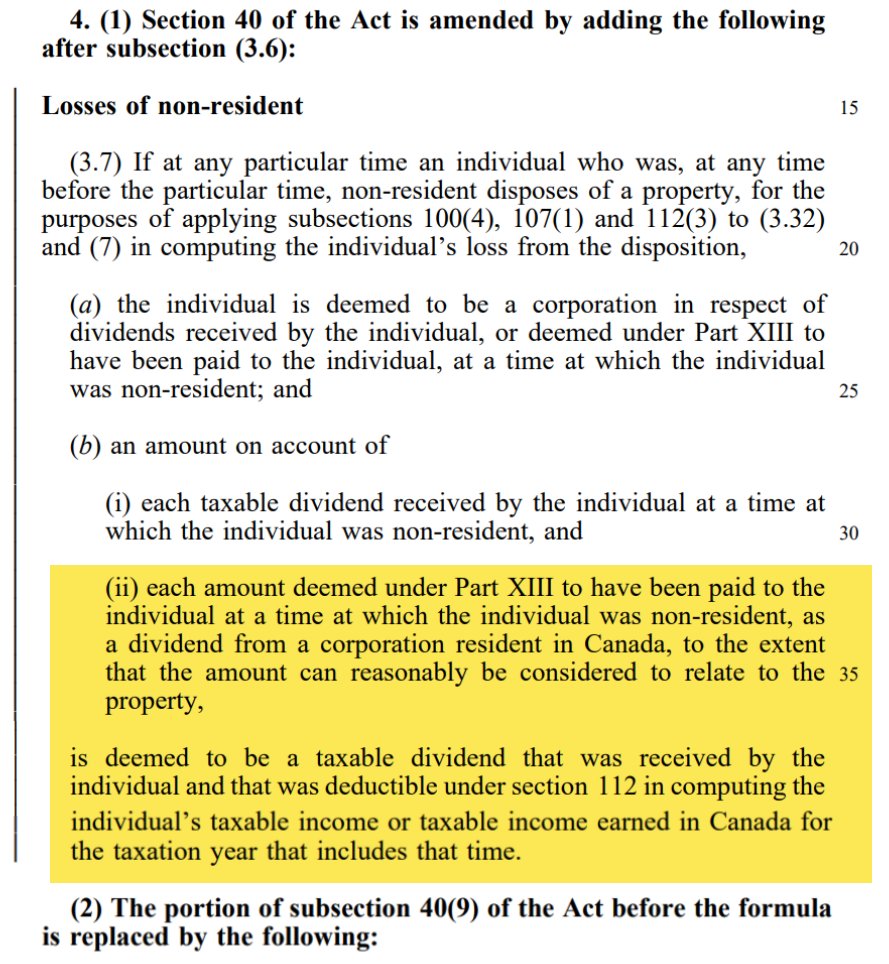
And followed up with:
FYI- Just to make clear why I posted that image instead of Clause 17 it was meant to make an additional point, that I’m not sure Gad was informed about. The system is one-directional and rigged.
That image explains that The exit tax locks in your gains the day you leave at whatever the market says that day. You have no choice, no timing, no flexibility.
If your portfolio drops 30% the week after you leave, too bad. Canada already took their cut on the higher number. The gain was real to them the moment you packed your bags. The loss that came after is entirely your problem.
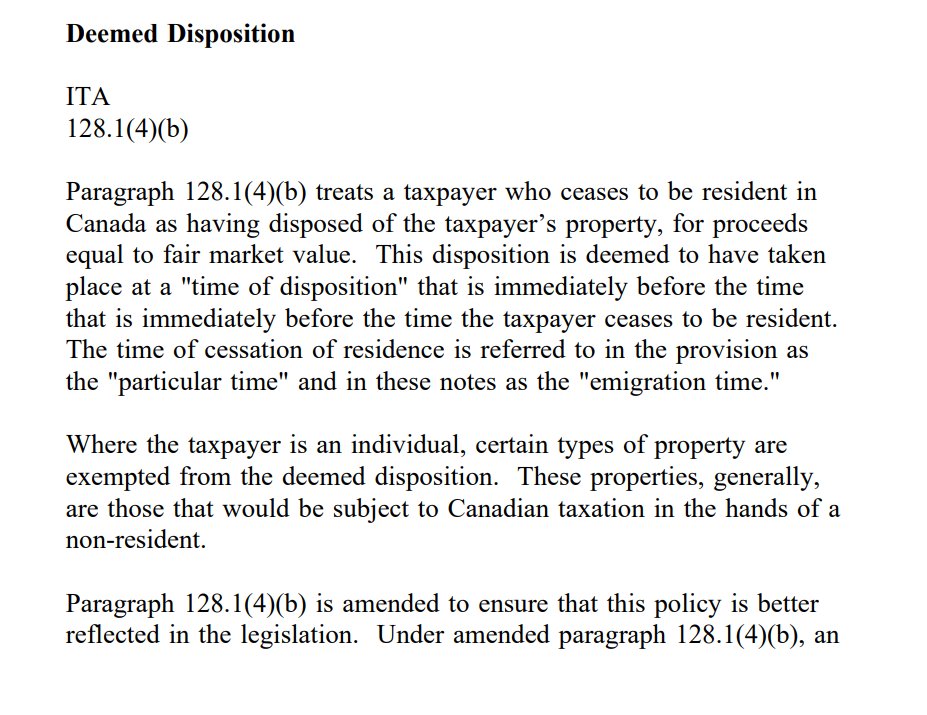
If you want to see the stocks section it’s this
You can read it for yourself:
Update: After some online mockery, Gad Saad explains that he’s not just upset on his own behalf.
People are astoundingly stupid. My comments about the departure tax is not that I should be treated differently from anyone else. I am making a point about the extent to which taxes are confiscatory. As I have previously explained, there was a time when ZERO cents of income tax were levied in Canada and the US. Then bit by bit, that “temporary” measure, to be applied to only a few, and at a very low percentage rate of your income, becomes a mammoth monster that takes more than 50% of your earnings. It can occur because there are no repercussions if governments do not balance their budgets (other than voting them out). Hence, what starts off as a small temporary tax on a few becomes an existential theft that is orders of magnitude larger than the so-called illegal extortion tax of the Mafia. It can exist only because the great majority of people BENEFIT from this form of parasitic taxation. But someone has to pay for everyone else, and when you are that someone, you are not necessarily pleased to be funding the ultimate Ponzi scheme. I’m making a moral, philosophical, and ethical argument. It’s not just about me.
Comments Off on Gad Saad discovers that Canada has an “exit tax” … and it’s insane
How To Make War Inevitable – Death of Democracy 20 – Q4 1937
World War Two and Spartacus Olsson
Published 20 Jun 2026By late 1937, Nazi Germany’s rearmament economy had trapped itself. Autarky was failing. Hjalmar Schacht was pushed aside. Göring’s Four-Year Plan dominated economic policy. And at the secret Hossbach meeting of November 5, Hitler turned economic impossibility into an argument for territorial conquest.
This episode covers Q4 1937: the Hossbach Memorandum, Schacht’s resignation, the Anti-Comintern alignment, Lord Halifax’s visit, Himmler’s police-state consolidation, the December “Preventive Crime Fighting” decree, and the antisemitic propaganda exhibition Der Ewige Jude.
The argument is not that war was metaphysically inevitable. It is that the Nazi regime built an ideological, economic, and police-state machine that made war look increasingly necessary to its own leadership. This is a historical analysis of Nazi dictatorship, antisemitic propaganda, and war planning. It condemns Nazism and uses extremist material only for educational and documentary context.
Chapters:
0:00 Q4 1937 Intro
0:53 The world at the end of 1937
1:36 Germany’s quarter of acceleration
3:30 Himmler Tightens Police Power
6:26 Der Ewige Jude and dehumanization
8:30 Hossbach: autarky fails
11:16 Halifax and diplomatic confidence
13:03 Mood inside Germany
15:09 Mein Kampf has become policy
17:16 Conclusion: the politics of beasts
Comments Off on How To Make War Inevitable – Death of Democracy 20 – Q4 1937
Explaining our failure to expand beyond Earth to an alien
Devon Eriksen pens an ultra-short story in response to Senator Elizabeth Warren’s claim that “we” need to take a lot more money from Elon Musk to benefit “everyone”:

This-individual has an outstanding query for you-individual.
Yes, Dee-six-twenty-four-prime? Ask your question.
When we-collective initialized language-idea-exchange with you-collective, you-collective had no settlements on the surface of other planets in your-collective own star system.
Yet you-collective possessed advanced chemical propulsion technology sufficient to leave your-collective native gravity well. For over a hundred cycles around your-collective star, you-collective possessed this.
Why did you not use it?
Well, all that technology was worth a lot of money.
Value-consideration-tokens, yes. Continue.
So we decided to take it away from the really talented geniuses who built, break it up for parts, sell the parts, and throw a big free stuff party.
A … free stuff party?
Yeah, for like, average dudes. The kind of guys who don’t know calculus or anything. The ones you’d want to have a beer with. We thought we’d buy them some stuff.
Instead of leaving your home planet?
Yeah.
This-individual understands, now. Conclusions have been submitted to collective-thought-matrix. Please line you-collective up in an orderly fashion for processing, classification, and reassignment and/or biomass reclamation.

Comments Off on Explaining our failure to expand beyond Earth to an alien
June 20, 2026
Lessons learned: “In Ballymena and Belfast, violence worked; in Epping, peaceful protest did not”
The flare-up of anti-immigrant/anti-government violence in Belfast has drifted out of the headlines lately, as state-oriented media try to get their audiences back onto safer topics like footy and hissing at the Bad Orange Man. But the situation in Northern Ireland has not resolved itself in the preferred way — preferred, that is, by the British government. John Carter responds to some American social media users who loudly wonder why British men generally are not “doing something” now:

In response to the migroid atrocity du jour, one often hears Americans ask “why haven’t British men done anything?”, to which Americans will flatteringly reply to themselves, “It’s because those BRITCUCKS have gone SOFT, they gave up their GUNS like little BITCHES, but you won’t see anyone trying THAT in a SMALL TOWN”. Which conveniently elides the awkward detail that American men, armed to the teeth as no other people on Earth, have allowed themselves to be pushed around this way and that since the sleep of the good Reverend Doctor Martin Luther King, Junior (PBUH) was disturbed by his little dream. “Just you wait”, Americans will promise when this is pointed out, “The electric boogaloo will come any day now, you’ll see!” Sure we will. In the meantime, all those guns have done precisely nothing to prevent the relentless incursions of Section 8 housing, disparate impact, affirmative action, DEI, anti-discrimination training, Title IX, human resources, and all the rest of the soft tyrannies that flew out of the Pandora’s box of America’s ersatz race communist constitution. There was no resistance to any of this. Heavily armed red state Americans abandoned the cities for the suburbs rather than standing and fighting for them, and then stolidly watched as their kids were sidelined in education and employment while being terrorized by black criminals.
American speech is protected by the first amendment and backstopped by the second, yet nevertheless you will not find many Americans daring to even so much as mutter the forbidden word of power. This is not because white Americans don’t understand the problems. They have developed an elaborate vocabulary of “bad neighbourhoods” and “good schools” and “urban crime” and “troubled youth” and so on and so forth with which to discuss, in whispers, after glancing twice over their shoulders, the realities of life in the USSA. There is no law against parrhesia [Wiki], technically an American citizen may say whatever he pleases without consequence, but of course frank speech in this Greek sense requires courage by definition, and there has been a great shortage of that. You can say whatever you please, yes, of course, fill your boots, but you will find yourself ostracized, divorced, unemployed, and homeless if you speak too directly, so you know, shut up. The unspoken strictures of the longhouse are a more effective prison than iron bars for those whose spirits have been cowed.
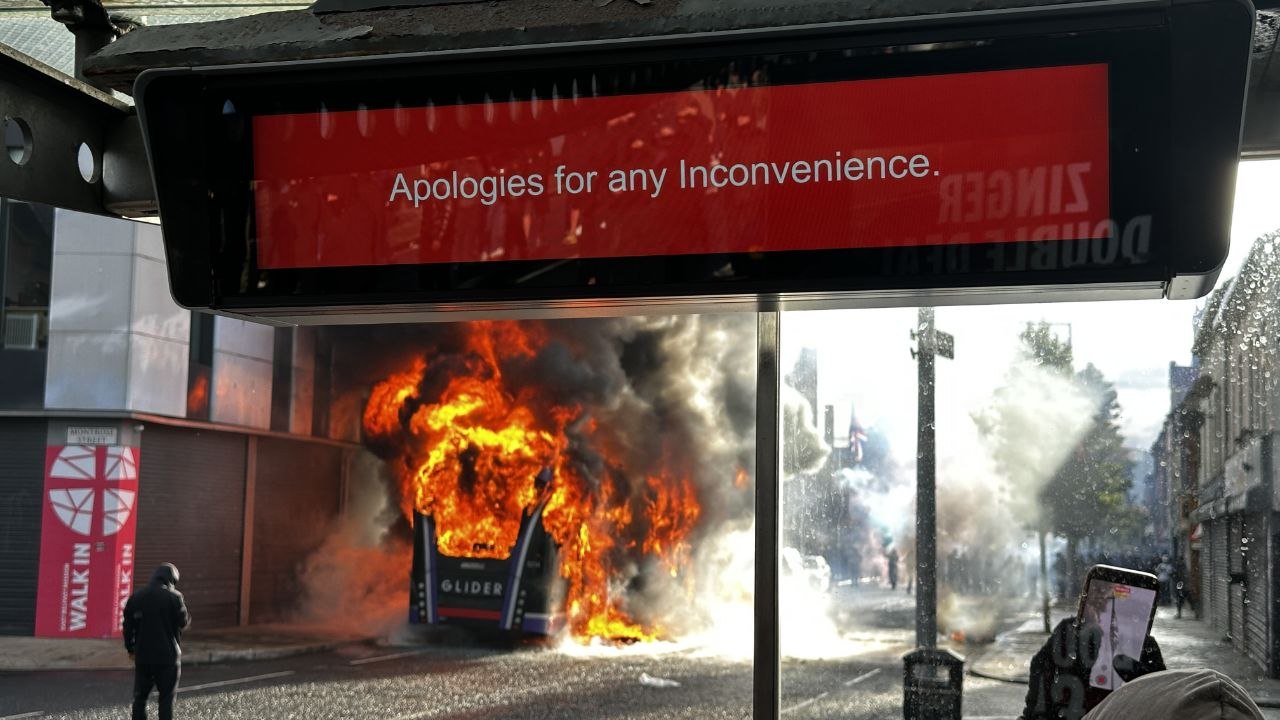
Meanwhile, last week there was a minor uprising in Belfast. Hadi Alodid, a gentlemen of Sudanese extraction, enriched the face of Stephen Ogilvie, a local bloke with special needs, providing him with extensive tribal scarring in a generous act of cross-cultural exchange, and only claiming two of his eyes in payment. The entire incident was caught on video. Ogilvie’s life, though not his sight (and he was already hard of hearing) was saved by three Irish men who rushed in to beat the innocent Sudanese rocket surgeon off with their hurling sticks. In the aftermath, it emerged that Ogilvie had helped Alodid move in to his new accommodations just a few days before. No good deed, etc.
[…]
The uprising was variously described as a protest and as a riot, but it was neither of these. A protest is when an angry crowd gathers to chant some slogans and wave around some signs, pretending that their numbers are a display of power, and deluding themselves that Power will redress their grievances because a noisy lump of quivering biomass is somehow intimidating to Power. A riot is an explosive release of emotional energy that results in some property destruction and futile confrontations with armoured riot police, typically ending with the rioters being rounded up and jailed. In some cases, it’s true, protests and riots appear to produce political change, but this is almost invariably because Power has orchestrated these little carnivals in order to sanctify the policies it’s already decided upon under the guise of “bowing” to “pressure” from the “public”. The Canadian government, by the way, has long since mastered a non-violent variant of this dark art: practically every “public policy research group” in the country is funded by the government to pressure the government to do what the government already wants to do. Show me what Our Democracy looks like; this is what Our Democracy looks like.
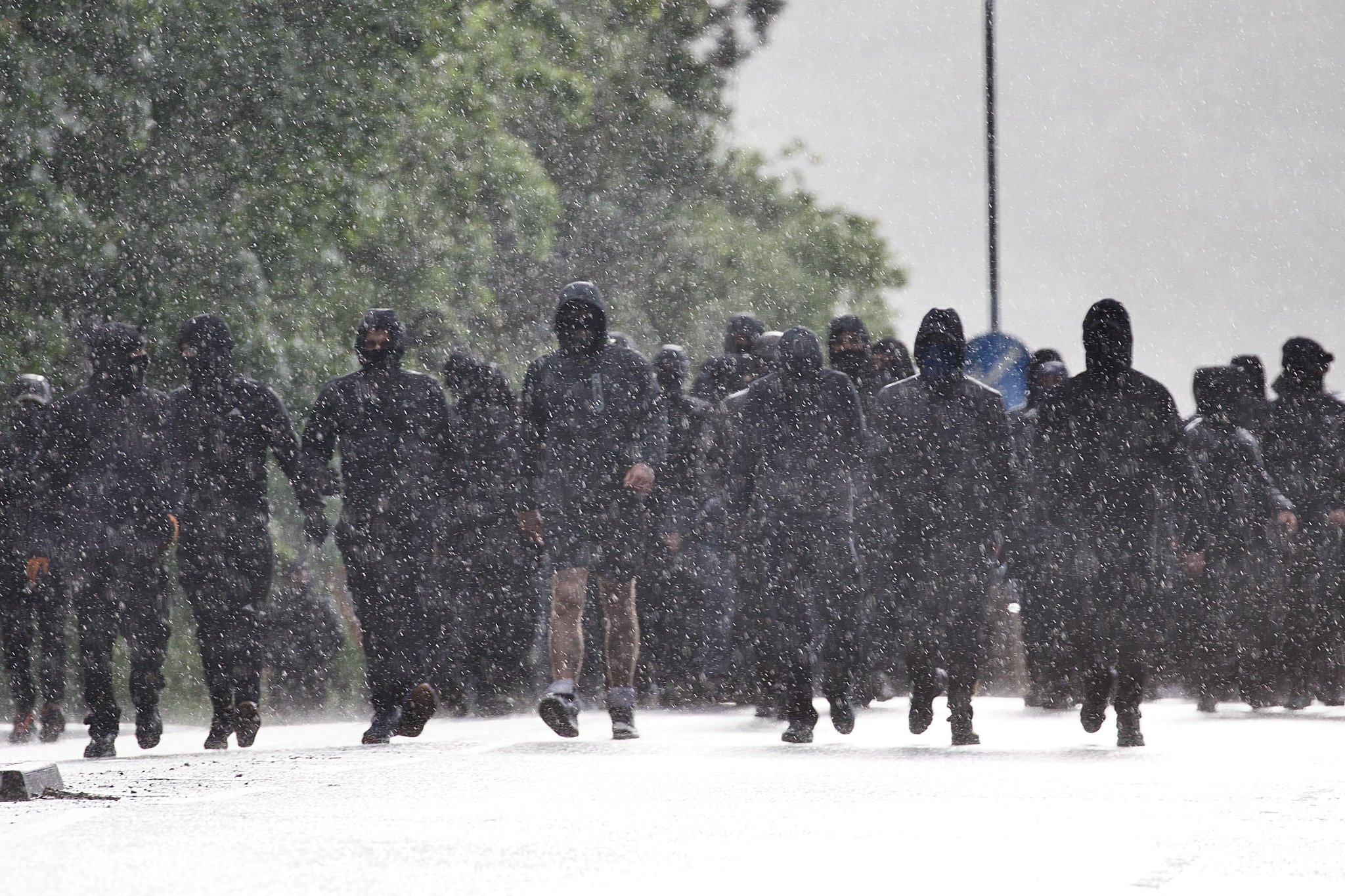
There were no signs being waved around in Belfast, no chanting of slogans. While there was a great deal of violence, it was not random and senseless, but methodical and carefully targeted. It unfolded with the tight discipline of a coordinated military operation.
The day before the uprising started, a communique was sent out to local businesses, instructing them to close before the fun started. At the appointed hour loose formations of young men, indistinguishable in black hoodies, fanned out across the city.
[…]
The uprising in Belfast was not nihilistic violence for the sake of violence, though I’ve no doubt the lads were enjoying the opportunity for mayhem. It was violence towards a specific political objective: driving the foreigners out. Migrants whose domiciles were destroyed were directly deprived of housing. Migrants who managed to avoid this were made to worry that they will be next. Landlords taking government money to house migrants, or even thinking about doing so, now need to worry about the immediate cost of repairs and the ongoing expense of higher insurance premiums, making the Home Office’s lucre a lot less attractive. Landlords also need to worry about escalation: reportedly, letters were circulated which heavily implied that bricks and petrol bombs were just the first step on the violence ladder, and that the paramilitaries would be quite happy to take more decisive measures against the landlords themselves should the message not be received.
All of this is very sad, and I don’t want to seem heartless. The immigrants whose houses were destroyed were probably innocent; there was one particularly touching video of a nurse from Ghana or somewhere. Unfortunately, that is the nature of these things. They were brought in by the government en masse as a form of biological warfare against the native population. The government wants them there, the people want them gone, and the government refuses to listen, so, this is what happens.
Only 27 migrants were actually made homeless by the arson, but reportedly, quite a few are already clearing out on their own. The British government quite naturally condemned the violence, organizing a rally against racism in the aftermath, but it also responded by instructing the media to emphasize that it would be cracking down on illegal immigration into Northern Ireland. Underneath the condemnation, there is a clear message to all of this: in this case, violence worked.
That message has been sent before in Northern Ireland. Exactly one year to the day before the uprising in Belfast, there were riots in the small town of Ballymena after the courts let two gypsy boys off with delicate wrist taps for raping an Irish girl. The rioting went on for two weeks, and resulted in two thirds of the gypsy population clearing out. Again: violence worked.
Contrast Ballymena with the other major British protest movement last summer: the anti-migrant hotel protest in Epping, a London exurb populated largely by Londoners driven out of their city by diversity, which started when one of the migrants diversified a teenage girl. In contrast to the eruption in Ballymena, the protest in Epping was explicitly non-violent: the only violence came at the hands of the cops arresting people for flying Union Jacks. The mothers of Epping spent months gathering outside the migrant hotel, holding signs and raising awareness. The council also fought the migrant hotel in the courts, and enjoyed early success when a judge found that the location was zoned as a hotel but not as a migrant dormitory, essentially telling the Home Office that they didn’t have a loicense for that. This legal victory was short-lived. The decision was overturned almost immediately by a higher court judge, who explicitly found that whatever the concerns of the people of Epping as to their children’s safety, these were outweighed by the human rights of the mystery meat that had washed up on Britain’s shores, and by the government’s interest in housing them. As a result, parallel lawsuits that had been launched by councils across the country were dropped. The migrant hotel in Epping was eventually shut down, but this likely had more to do with the government’s switch to “Operation Scatter” in which migrants were garrisoned in smaller houses all over the country, rather than concentrated in a few large centres, than it did with the government responding to the concerns of British subjects.
In Ballymena and Belfast, violence worked; in Epping, peaceful protest did not.


Update, 22 June: Welcome, Instapundit readers! Have a look around at some of my other posts you may find of interest. I send out a daily summary of posts here through my Substack – https://substack.com/@nicholasrusson that you can subscribe to if you’d like to be informed of new posts in the future.
Bill C-22 passes the Commons “as MPs raced for home for the summer”
Canadian Members of Parliament care more for their summer vacations than they do for the rights of Canadian citizens. While this isn’t really news, it’s just the latest proof that our elected representatives are … well, I was about to describe their moral failings in great detail, but that could get me arrested and jailed if-and-when the many authoritarian measures the Liberals want to enact become law. Instead, here’s Michael Geist‘s summary of the way Bill C-22, the Lawful Access Bill, got sent to the Senate on Thursday night:
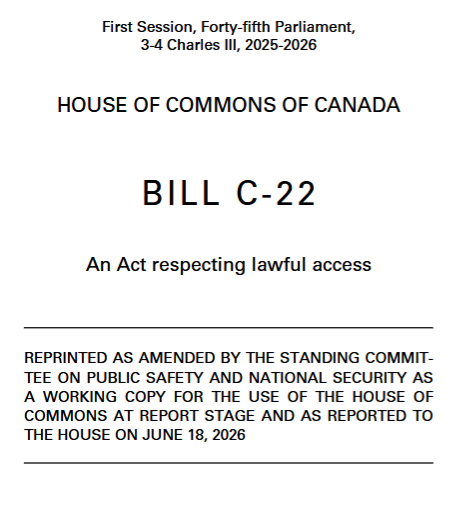
Bill C-22, the lawful access bill, passed the House of Commons yesterday with the government invoking a single motion to approve several bills without further debate or individual votes as MPs raced for home for the summer. Bill C-22 will now head to the Senate, where it can expect a rougher ride when study begins in the fall. Rather than use the final days of the House session to answer the privacy, security, and oversight concerns raised by the Privacy Commissioner, academics, technology companies, and civil society groups, the government spent the time ensuring it would not have to, rushing the bill through committee, cutting off debate, and maligning critics with tactics that they once decried when in opposition.
The final days of Bill C-22 in the House marked a genuine abrogation of democratic norms. The government moved a motion to shut down the clause-by-clause study in the Standing Committee on Public Safety and National Security, preventing the committee from adjourning until the bill had been pushed through. That led to a session that stretched past midnight, as MPs were barred from introducing new amendments and were left to vote on amendment after amendment without any discussion, debate, or even public disclosure of their contents. By the end of the committee session, no one could have known the contents of the bill that MPs had duly approved and sent back to the House for final approval. As noted, once back in the House, there was no further debate, discussion or even a vote. Just a motion that said the deal was done.
If the process was troubling, the rhetoric was embarrassing. I wrote earlier this week about Public Safety Minister Gary Anandasangaree’s Vic Toews moment, as he said it was time for opposition parties to “choose” whether to stand with law enforcement and victims of crime (a refrain that sounded a lot like Toews’ 2012 comment to Liberal MP Francis Scarpaleggia, who is now the Speaker of the House, that he could “either stand with us or with the child pornographers”). Government House Leader Steven MacKinnon pushed that posture further on Thursday by dismissing the bill’s critics as wearing “tinfoil hats” engaged in “paranoia.” The charge fits a broader pattern in which this government treats independent privacy scrutiny as an obstacle rather than a safeguard, seen most clearly in the Bill C-36 approach to strip the Privacy Commissioner of authority over private-sector privacy law altogether.
The committee did approve some government amendments to the bill that improve aspects of the lawful access plan but they are still likely to leave companies, security experts, and privacy advocates concerned. For example, the maximum metadata retention period the government can impose drops from one year to six months, and a category of metadata can now be mandated only where the Minister is satisfied that the category and all of its elements are essential to investigations. That is better, but still not good enough as it is not tied to any actual evidence about why six months is needed and both the costs and risks associated with metadata retention, which is not a requirement in the U.S., are largely unchanged.
As The Reclamare explains, this bill is yet another likely irritant in US/Canadian affairs, as it will expose US citizens’ data to Canadian government oversight:
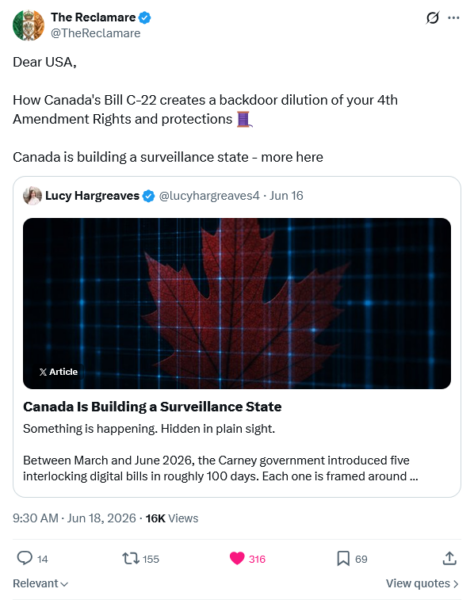
– A USA person creates/maintains a social media account — lets call it “XXX”
– Using its new C22 law, Canadian RCMP develops a “reasonable grounds to suspect” of “XXX” to a CDN investigation (a low investigative hunch standard under C-22).
– RCMP obtains a Canadian judicial authorization (an “Order”) and sends the Social Media company an International Production Request, which is not a USA warrant, not a §2703(d) order, and not routed through full MLAT (Mutual Legal Assistance Treaty) review.
– The social media company is bound by US law (SCA/ECPA), treats the request as a formal foreign inquiry.
– The social media company discloses limited metadata: summary of login IP ranges, account country setting, and other classification signals to prove USA origin
– This disclosure happens at Canada’s “reasonable suspicion” threshold, which is lower and less scrutinized than the US domestic requirement of “specific and articulable facts showing relevance and materiality” under 18 U.S.C. § 2703(d) for the exact same type of data.
– The USA user’s metadata, which would normally enjoy stronger 4th Amendment derived judicial protections, if sought directly by US authorities, is handed to a foreign government on weaker foreign grounds, without the same level of US court filtering or notice that a purely domestic US request would trigger.
– The 4th Amendment protection is effectively diluted because the platform’s good faith compliance with the foreign lower bar creates a new, easier pathway around domestic US constitutional safeguards for accounts that platforms classify as American
Canada’s Liberal government continues to chip away at our “Charter of Rights”, under the guise of “Protecting Citizens” and we are moving towards authoritarianism
While I loathe to create friction, I also hope your Rights can help slow Canada’s devolvement
It impacts you too
Comments Off on Bill C-22 passes the Commons “as MPs raced for home for the summer”
June 19, 2026
Nobody voted for this kind of dystopian nightmare, Mr. Carney!
The Liberal Party, having engineered themselves a majority in the House of Commons, are on a speed-run to the kind of dystopian police state we used to read about in science fiction novels:
Millions of Canadians are beginning to see the similarities between communist regimes and the direction of current government policy.
The pattern is always the same.
It begins with noble promises: safety, equality, compassion, protection, the greater good.
It ends with censorship, coercion, surveillance, prisons, ruined lives, and a police state.
Always.
It comes wrapped in slogans, experts, committees, emergency powers, censorship, enemies of the people, and the belief that the state has the right to crush the individual for the greater good.
Consider…
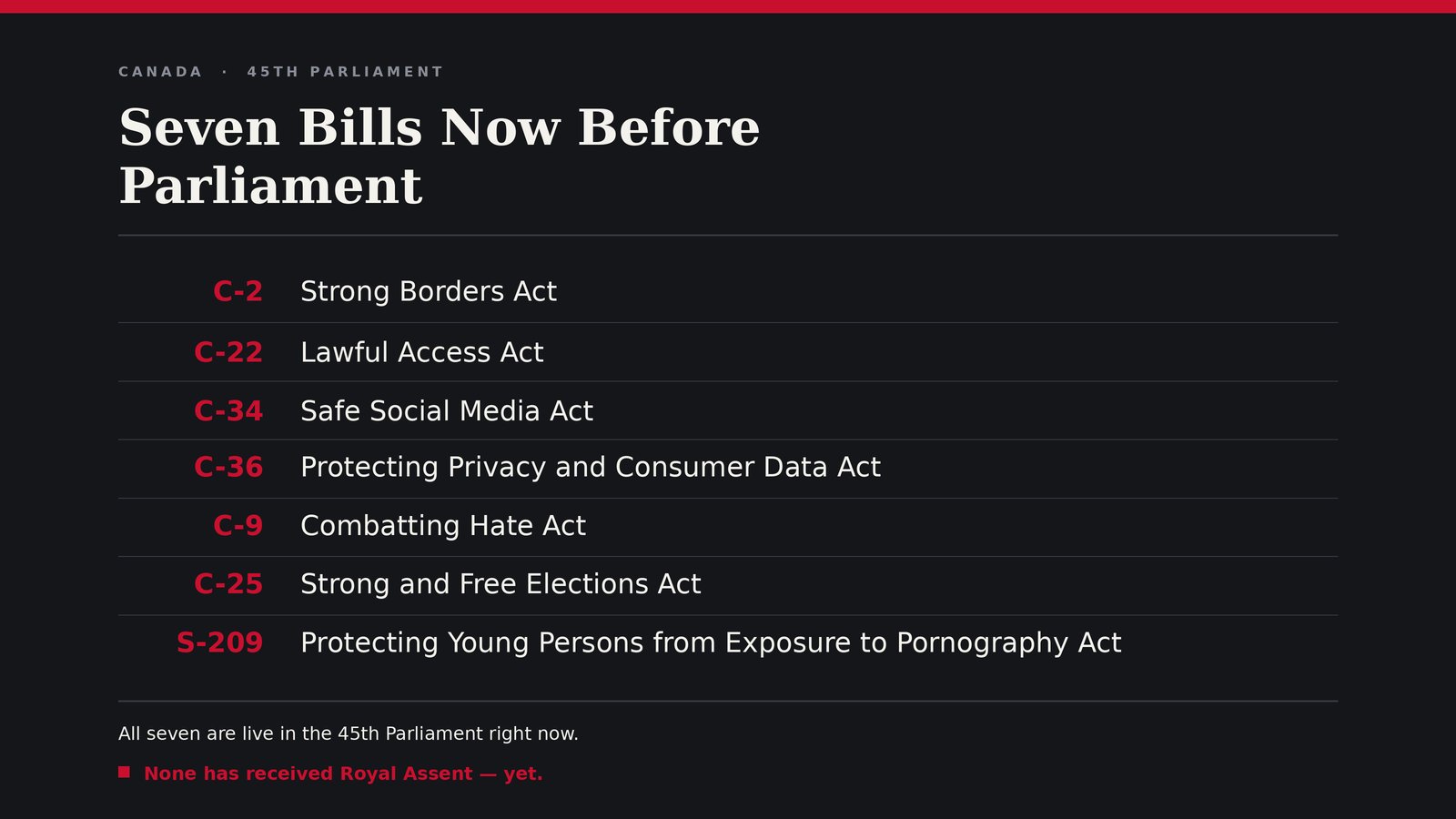
C-2 – Strong Borders Act
C-22 – Lawful Access Act
C-34 – Safe Social Media Act
C-36 – Protecting Privacy and Consumer Data Act
C-9 – Combatting Hate Act
C-25 – Strong and Free Elections Act
S-209 – Protecting Young Persons from Exposure to Pornography ActAll seven are live in the 45th Parliament right now. None has received royal assent yet.
Consider that good, law-abiding Canadians are being gradually and systematically disarmed.
This is not a warning about some distant future.
In 2022 the federal government invoked emergency powers it did not have, froze the bank accounts of citizens over their political views, and banned Canadians from funding a protest. Two levels of court have since ruled it unconstitutional — a violation of the very Charter rights every one of these bills now circles.
That was the trial run. It needed an emergency as the excuse.
The seven bills above are the permanent version — the same reach, made routine — so that next time, no emergency need be declared at all.
A free country is not lost in a single day. It is legislated away in pieces, each one introduced with a reassuring name and defended as necessary, while good people keep assuring themselves it could never happen here.
It already did. The only question is whether enough Canadians notice before it becomes permanent.
Read every bill. Watch every one of them. Because this is the stage where it can still be stopped … and perhaps our last chance.
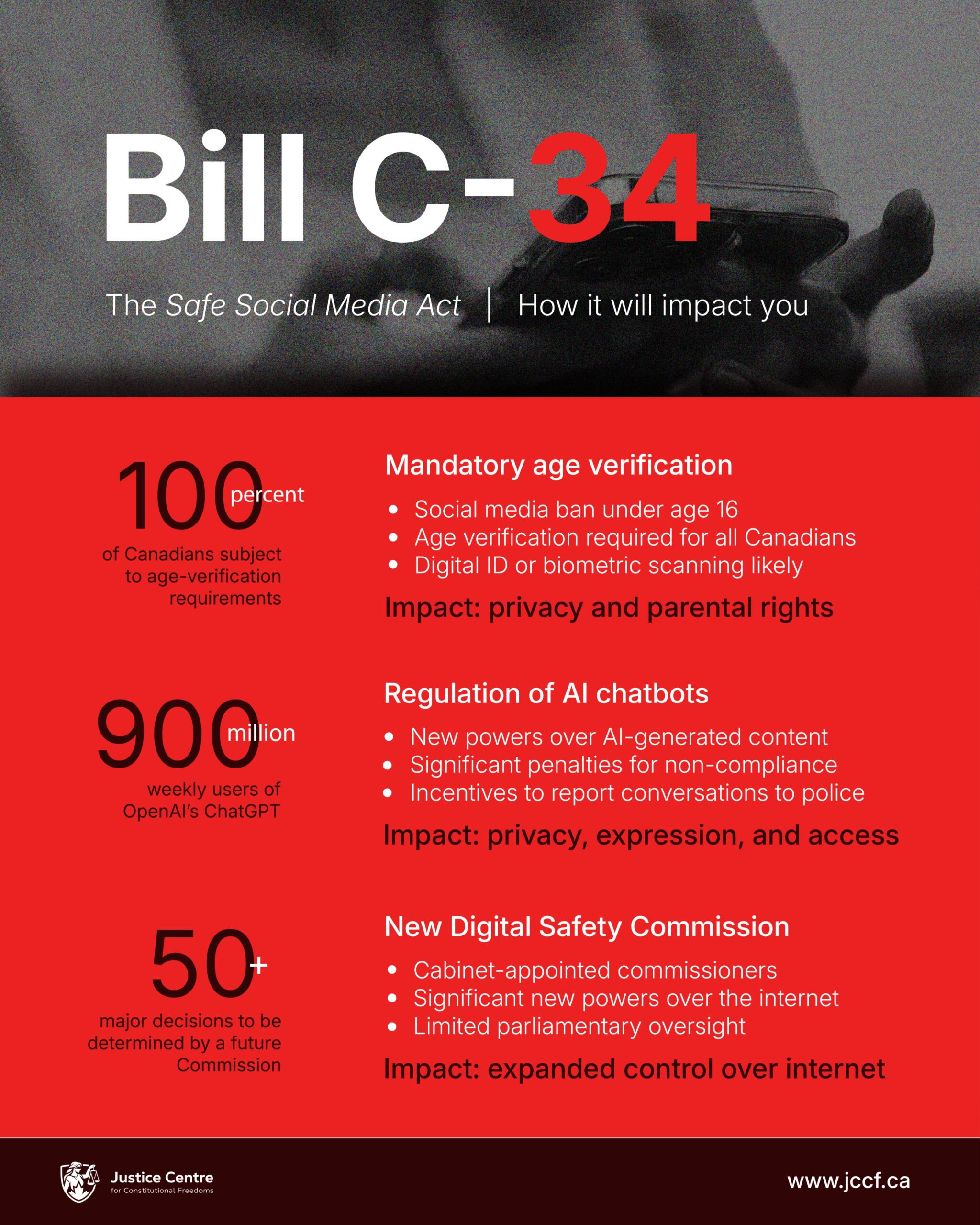
The Justice Centre for Constitutional Freedoms is trying to get Canadians to pay attention to what just one of these bills will do:
Bill C-34 will affect every Canadian. Age verification. AI regulation. A new Digital Safety Commission. Most Canadians have never heard of it. Here’s what it will do.
Michael Geist posts a Substack Note about bill C-22:
Bill C-22, the lawful access bill, has been reported back from committee and is headed toward passage. There are some amendments, but many concerns remain. The updated bill with changes is at
There are two changes to metadata retention. First, the maximum retention period the government can impose drops from 1 year to 6 months. Second, it can now mandate a category of metadata only if satisfied the category and all its elements are essential to investigations.
The committee rewrote the definition of systemic vulnerability. A “substantial risk” becomes a “credible risk, based on recognized international technical standards”. But it also added a carve-out: a flaw exposing only a target’s data is not “systemic”.
Added a new section on decryption that says nothing in the Act can be read to compel a provider to decrypt user-encrypted data, unless the provider supplied the encryption and holds the key. Borrowed from US law, but doesn’t fit the same way.
Compliance with ministerial orders is now expressly subject to the systemic vulnerability exception. That addresses a contradiction in the original text, where the duty to comply appeared to be unconditional.
The original bill set no maximum duration on these ministerial orders. This now changes to a two-year cap without the open-ended review-and-extend mechanism.
The amendments will rightly leave many still concerned. Companies considering exiting Canada due to Bill C-22 are unlikely to conclude that it fully addresses their issues. Yet the government is likely to push it through the House today.
Comments Off on Nobody voted for this kind of dystopian nightmare, Mr. Carney!
QotD: The Prince is a … satire?
When I was a lad, I was told that Machiavelli’s The Prince is a satire. I don’t believe it, personally — I know a few things about Renaissance Italy, and I think he meant every word — but I learned something important from the people who insist it’s a satire: They’re wishcasting.
Let me back up. The occasion where I first heard the “it’s a satire” thesis was an “advanced placement” History class back in high school. They probably don’t have those anymore as part of the regular curriculum — dat be rayciss — so in case you’ve never endured one, it’s a bunch of mega-nerds who only care about pleasing Teacher trying to do History. For our unit on “The Renaissance”, we had to read both The Prince and More’s Utopia, and do our term paper on one or the other.
Naturally I picked The Prince, and since you all know the kind of kids who were in that kind of class, naturally everyone else picked Utopia. I might’ve been the only kid who ever did his paper on Machiavelli; certainly the teacher acted like she’d never seen one before. We didn’t have the phrase “trigger warning” back then, but that’s what it amounted to — Teacher hastened to inform everyone in the class that The Prince was really a satire, and so of course I was just kidding too, ha ha, because otherwise we were in the presence of very, very, very bad thought …
“Yes, kidding, ha ha ha,” I muttered, because while I obviously wasn’t the quickest on the uptake back then — I should’ve just done the stupid paper on goddamn Utopia like the rest of the sheep — even I could figure out that I was gonna get sent to the school counselor if I didn’t get with the program …
… and that’s when I learned the aforementioned lesson. Kidding? You think Machiavelli’s kidding? Didn’t we just do this whole unit on the Renaissance? Your main man Thomas More was burning people at the stake, for fuck’s sake! And as for the Italians, they were straight whacking people out in church, with the active connivance of the fucking Pope himself. Satire, fuhgetaboudit, that’s Godfather shit, Machiavelli’s as serious as cancer. You just don’t want to believe that people are actually the way they so obviously are, so you’ll tell yourselves he’s kidding … and Teacher will back you up on it, because she doesn’t want to believe it either.
(Meanwhile, I’ll get an A for my excellent “satire”, in exchange for which I will never ever bring it up again or I’ll fail the rest of the semester).
Severian, “End States and Inverted Incentives”, Founding Questions, 2022-06-22.
Comments Off on QotD: The Prince is a … satire?
June 18, 2026
Unexpected increase in legal gun ownership in Canada
The federal government has been doing everything it can to curtail Canadians’ access to firearms since 2015, most recently imposing bans on literally thousands of different gun models and almost completely restricting purchase, sale, or transfer of legal handguns. Under these circumstances, you’d expect that interest in legal gun ownership would be on a pretty steep decline. But that’s emphatically not the case:
Here is something the government does not talk about.
Canada’s handgun freeze took effect on October 21, 2022. Since that date, very few people who have exemptions have been able to buy, sell, gift, or inherit a handgun. The market for new restricted handguns is effectively closed.
So you might expect the number of Canadians holding a Restricted PAL (the licence required to own handguns and other restricted firearms) to be flat or declining. Why bother completing the restricted component of the Canadian Firearm Safety Course if you can’t use it to buy a handgun?
The data says otherwise.
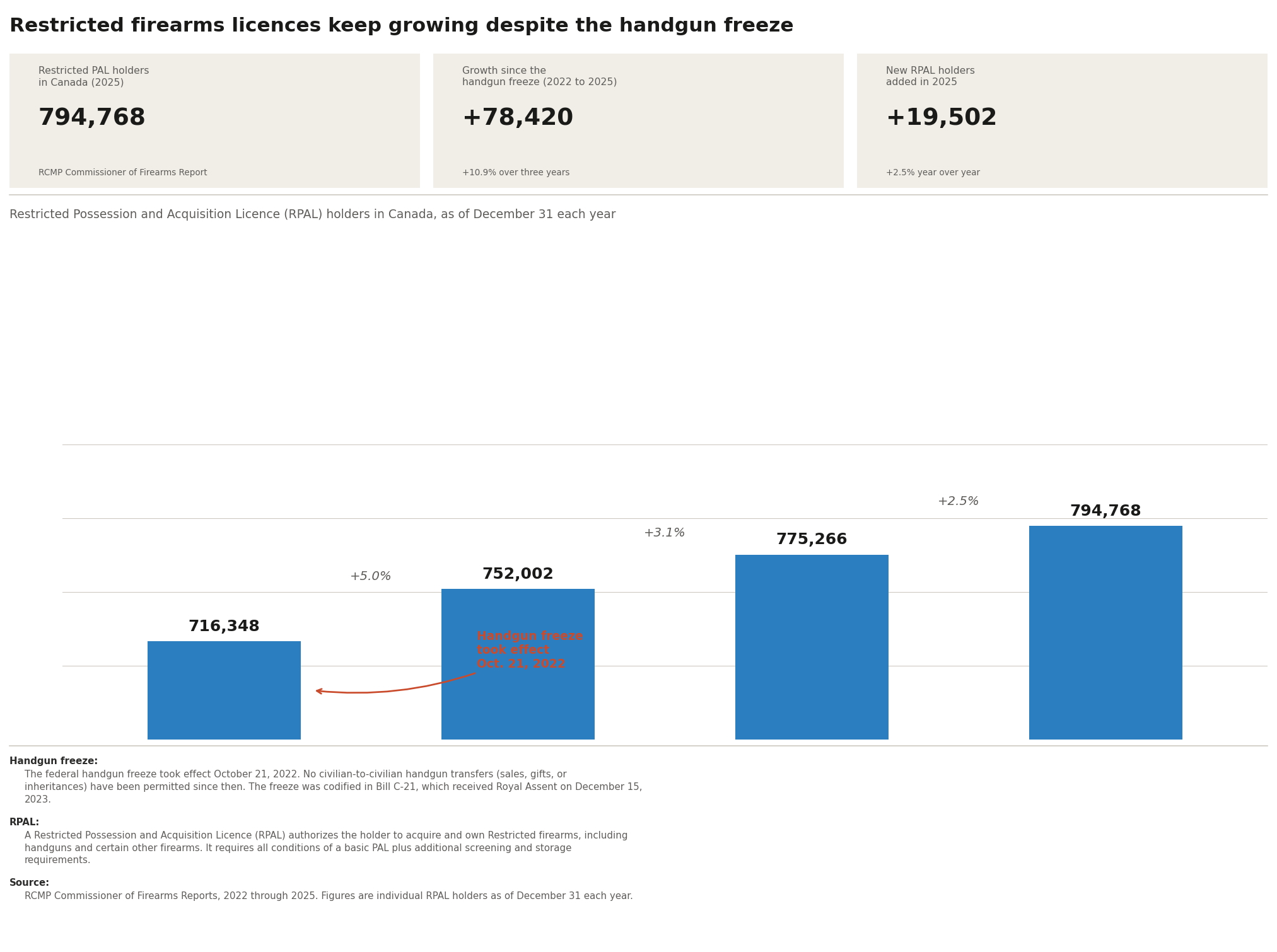
According to the RCMP Commissioner of Firearms Reports, the number of RPAL holders has grown every year since the freeze:
2022: 716,348
2023: 752,002 (up 5.0%)
2024: 775,266 (up 3.1%)
2025: 794,768 (up 2.5%)That is a net gain of 78,420 restricted firearm licence holders in three years, a 10.9% increase, all during a period when the primary reason most people get the restricted designation on their PAL (to buy a handgun) was legislated away.
Canadians are still taking the safety course, submitting to the background checks, and getting licensed. The freeze did not stop the demand for restricted licences. It just stopped the legal market from serving the people who hold them.
Source: RCMP Commissioner of Firearms Reports, 2022, 2023, 2024, and 2025.
Comments Off on Unexpected increase in legal gun ownership in Canada


