Quotulatiousness

December 17, 2025

“The ‘liberal international order’ – a technocratic oligarchy sustained by tightly interlocked institutions”

Last week, Len D. Pozeram wrote about how the real (but mostly unacknowledged) American empire is facing unprecedented challenges and may indeed be in serious decline:

“The Empire’s Mask is Slipping”, The Libertarian Alliance

For generations, Americans were sold a saccharine myth: that our nation’s vast global presence — its military bases on every continent, its endless wars, its economic interventions — was all done in the name of “freedom” and “human rights”. This was the sales pitch. Washington, we were told, was the benevolent policeman of a dangerous world, upholding a Pax Americana designed to uplift humanity.

But for those willing to look beyond the rhetoric, the truth was never hidden — only ignored. This narrative was never more than a sophisticated marketing campaign, engineered to pacify a domestic public and legitimize imperial conquest abroad. From the very beginning, the post-WWII global order was not about freedom, but about power — and who would control it after the collapse of the old European empires.

With the fall of the British Empire, America did not merely “step up” to defend the West — it seized control of the imperial machinery and rebranded it. The British financial aristocracy gave way to a new though related American elite, its nucleus formed around Wall Street banks, the military-industrial complex, Big Oil cartels, and, increasingly, a rising Zionist lobby with ambitions stretching far beyond Tel Aviv.

Under the guise of “containing communism” or “defending democracy”, this new managerial class waged a quiet war against genuine national independence movements across the globe. Countries seeking to control their own resources, chart their own destinies, or resist Western financial domination were systematically targeted for destabilization or outright annihilation.

Guatemala in 1954. Iran in 1953. Indonesia in 1965. The Congo. Chile. Nicaragua. Greece. Even Australia, whose 1975 constitutional crisis remains a textbook case of covert Anglo-American regime change. The public, of course, was kept in the dark. History books were rewritten. Journalists who strayed from the script were destroyed or silenced. CIA fingerprints are now visible in dozens of these cases — operations sanctioned not to spread freedom, but to preserve a system of elite extraction and control.

This system — often referred to in polite company as the “liberal international order” — is, in fact, a technocratic oligarchy. It is sustained by tightly interlocked institutions: the Federal Reserve, the IMF, the World Bank, NATO, and a sprawling Intelligence Community whose true loyalties lie not with the American public, but with transnational networks of finance, energy, and geopolitical strategy. To the extent that ideology plays a role, it is the convergence of evangelical apocalypticism and messianic Zionism — two religious currents that have dangerously informed U.S. foreign policy since the Reagan era.

Yet today, this system is beginning to eat itself. The ideology of endless war, and top-down control has run up against hard limits: financial, and political. The de-dollarization trend in the Global South, the rise of multipolar alliances like BRICS, and the exposure of elite criminality — from Epstein to the endless intelligence scandals — are all symptoms of imperial overstretch and rot.

We are watching the slow collapse of an empire built not on democratic values but on lies, coercion, and institutionalized greed.

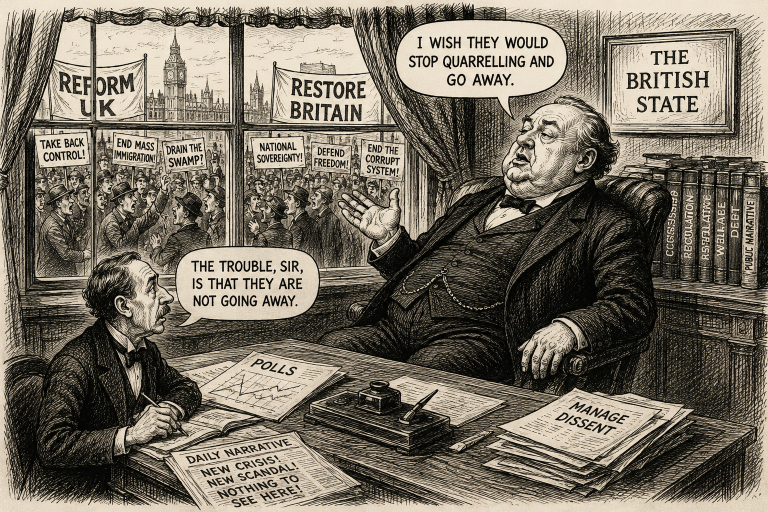
From a slightly different viewpoint, Spaceman Spiff maintains that the narratives that have been used to direct and control political thought in the west are in the process of collapsing:

Image from Postcards from the Abyss

As reality intrudes the naivety behind many sacred cows is exposed. The emperor is naked and his supporters look equally naked. The narratives driving their fantasies are failing.

The big three issues common in the West illustrate why people are noticing.

Diversity and immigration

The promotion of diversity as a strength is a consequence of blank slate thinking, a belief disparate populations are substantially the same with most observable differences due to environment only.

This is at odds with what we observe, the significant range in ability and proficiency between distinct groups that becomes apparent when we interact. So artificial variety is sold as a positive in an attempt to downplay the homogeneity that gets better results.

The consequence of this is quotas, where arbitrary rules are enforced to ensure a diverse outcome.

This destroys competency even if we ignore the potential for conflict when foreigners are imported in large numbers.

The main effect of pushing this absurd policy seems to be the rise of ethnic awareness among those who must step aside to accommodate it. How could it not? When people are excluded because of their ethnicity it becomes important to them.

This is not what advocates of diversity intended but is already happening.

Climate

Climate and energy policy is based on anti-scientific magical thinking. With the current emphasis on carbon dioxide we are told a tiny portion of our atmosphere is responsible for most of the future changes that will cause widespread harm. There is no evidence for such claims.

The reality of climate is different from the narrative. It is resilient, as many things are. Our obsession is arrogance. A belief we matter more than we do.

Intellectuals are prone to get lost in their theories of how the world ought to work. Activists then latch on to their utopian ideas to gain some sense of meaning in their lives.

Society also has people lacking conscience who will profit from anything no matter how much damage it causes. Combining these two, dreamers with schemers, is often lethal. Seemingly opposing forces, left-wing activists and capitalist profiteers, can cooperate even if they embrace distinct beliefs.

As many memes remind us, if you have corporate sponsorship you are not the resistance. This is precisely what we see.

Narratives begin to collapse as we witness ruthless corporations promote feelgood nonsense about climate while fleecing taxpayers in the background. Many are noticing.

And the effects of suicidal climate goals are difficult to hide. Every closed factory or power station kills another element of credibility.

Socialism

Socialism is based on the idea an educated elite can make decisions for us all while simultaneously conditioning us to be better versions of ourselves. It ignores all of history and everything we have learned of human psychology to embrace a literal fantasy utopia that no one has even come close to realizing.

Nothing sums up the bankruptcy of our intellectuals more than their inability to reject this failed ideology.

But it also shows us the Anglo-Saxon instinct to restrict others’ control over us is the only way to counter it.

It teaches us of the wisdom of documents like Magna Carta or the Bill of Rights, designed to constrain the powerful regardless of their motives, ambitions or mental state. Rare moments of historical sanity that remind us what effective countermeasures can look like.

It would seem this lesson must be relearned every few generations. But we are learning it. Real life is reminding us why we must limit government and its agents no matter how inconvenient.

Bad ideas are inevitable. It is the ability of activists and the powerful to enact them many are now waking up to as narratives visibly fail.

December 16, 2025

If your military embraces “Net Zero”, you’ve actually got a civil service in uniform, not a military

Filed under: Britain, Environment, Government, Military, Russia — Tags: , , , , , — Nicholas @ 05:00

In The Critic, Maurice Cousins points out the painful truth (painful that is to policians and career bureaucrats) that no serious military can prepare and carry out their prime duties if they also tout their allegiance to “Net Zero” bullshit:

Two developments explain the shift in tone. The first is the protracted US–Russia peace talks conducted largely over Europe’s head. The second is the publication of Donald Trump’s National Security Strategy, which makes explicit that Europeans must now assume far greater responsibility for their own defence. None of this should surprise anyone who has been paying attention. The Trump administration has been saying the same thing, bluntly and repeatedly, since its inauguration.

Speaking at the NATO Defence Ministers’ meeting in February 2025, the US War Secretary, Pete Hegseth, put it plainly: “To endure for the future, our partners must do far more for Europe’s defence. We must make NATO great again. It begins with defence spending, but must also include reviving the transatlantic defence industrial base, prioritising readiness and lethality, and establishing real deterrence.”

After nearly eighty years of relying on American power to underwrite their security, European leaders are being forced to relearn the fundamentals of hard power and grand strategy. It is difficult to overstate how profound a challenge this represents for both Europe and the UK. It demands a rethink across policy areas that, for decades, have been treated as marginal to national security.

Since the 1990s, Britain’s political and intellectual elite has operated within a fundamentally different paradigm. The “end of history” has become a cliché, but it is worth recalling just how deeply it shaped elite thinking. In the aftermath of the Soviet Union’s collapse, Anthony Giddens — one of the intellectual architects of New Labour — argued in The Third Way that the West no longer faced “clear-cut enemies”. Cosmopolitanism, he claimed, would be both the “cause and condition” of the disappearance of large-scale war between nation-states. The “strong state”, once defined by preparedness for war, “must mean something different today”. They believed that post-material and post-traditional values, including ecological modernisation, human rights and sexual freedom, would come to dominate politics.

For realists, this utopian worldview was always naïve. In her final book, Statecraft (2003), Margaret Thatcher warned that the post-Cold War world was far more likely to vindicate Samuel Huntington’s “clash of civilisations” than Francis Fukuyama’s progressive vision of an “end of history”, in which liberal democracy emerged as the inevitable global victor.

Clearly, the liberal internationalist illusion should finally have been shattered by Russia’s annexation of Crimea in 2014. Alas, it was not. Instead of prompting a fundamental strategic reset, Britain’s governing class doubled down on the same post-material, cosmopolitan assumptions that had shaped the 1990s and 2000s. In 2015, Europe and the UK embraced the Paris Climate Agreement. In 2019 — a year after the attempted murder of Sergei Skripal on British soil with a chemical weapon — ministers enshrined Net Zero in law and banned fracking. Each decision reflected the same belief: that geopolitics could remain subordinate to “climate leadership”, and that the material foundations of security could continue to be dismantled.

That worldview is now colliding with reality.

The US National Security Strategy contains a series of blunt truths about Europe’s condition. British commentary has focused on its remarks about culture, migration and defence spending. But one critical area has been largely overlooked: energy and industry.

The document begins from a hard material premise: that dominance in dense and reliable sources of energy — oil, gas, coal and nuclear — is essential to the ability of the United States, and its allies, to project power. From that foundation it draws a sharper conclusion, rejecting what it describes as the “disastrous ‘climate change’ and ‘Net Zero’ ideologies” that have hollowed out Europe’s industrial base while subsidising its adversaries. The result, it argues, is a defence problem that runs far deeper than military budgets. Alongside cultural weaknesses, myopic energy policy and de-industrialisation — exemplified by Germany’s recent offshoring of its chemical industry to China — are identified as anti-civilisational forces that directly erode Western hard power.

This makes Carns’s most important observation all the more sobering. While armies, navies and air forces respond to crises, he said, it is “societies, industries and economies [that] win wars”. He is unequivocally right.

On his Substack, Niccolo Soldo discusses the contents of the Trump administration’s new National Security Strategy:

Egyptian President Gamel Nassar had some choice lines to describe US foreign policy too:

    The genius of you Americans is that you never make clear-cut stupid moves, only complicated stupid moves which make the rest of us wonder at the possibility that we might be missing something.

    With the Soviet Union, you know where you stand today and where you will stand tomorrow. With the United States, you never know where you will stand tomorrow—and sometimes not even today.

    America is like a beautiful woman who changes her mind every night. You can love her, you can fear her, but you can never be sure what she will do in the morning.

And then there is this recent classic from Russia’s chief diplomat, Sergey Lavrov:

    The USA is agreement non-capable.

The point of sharing these quotes is to highlight the obvious fact that US foreign policy has long been unpredictable. This wouldn’t be too much of an issue if it were a middling power. When a superpower routinely upends the table, it makes life very, very difficult for those countries that have become “states of interest” for the Americans. Creating and pursuing foreign policy strategies require a lot of time and effort, meaning that they are very rarely predicated on short-term trends. When the predictability of foreign actors is removed from the strategic equation, the foundation of any plan becomes very weak.

Earlier this month, the White House issued its 2025 National Security Strategy vision in a 33 page .pdf document available for all to see and read here. This is an action that the US Executive Branch is mandated to do, ever since the Goldwater-Nichols Act of 1986. The point of this exercise is to articulate the vision of the President of the United States of America regarding foreign policy, so as to effectively communicate said vision to Congress and the American people. It does not mean that it is an official foreign policy strategy, since this area of governance is the responsibility of both the executive and legislative branches of the US Government.

Because this is the Trump Administration, and because of the fever pitch that has coloured both of his terms in office, a lot of attention is being given to this iteration of this mandatory document. This document is intentionally high-level (meaning that it purposely doesn’t drill down into specifics), keeping within the tradition of previous administrations. However, attention is warranted this time, because the vision outlined by President Trump per this document indicates a significant break in both the USA’s approach to and philosophical arguments regarding how and why it conducts its foreign policy. Despite the obvious Trumpist (think: transactional) touches interspersed throughout this document, what it does represent is a stated desire to break with certain idealist practices of recent administrations in favour of a more realist approach and worldview, one that stresses respect (if we accept the document at face value) for national sovereignty, and an admission that US global hegemony is simply not possible.

So what we are left with is a document that outlines a new vision for US foreign policy, one that has determined that taking on both Russia and China simultaneously is the wrong approach to securing American national interests. This makes it very worthy of closer inspection and analysis (something that I have been thinking about deeply since it was first made available to the public a fortnight ago). Before we begin to dive into it, I am asking you all to temporarily suspend your cynicism and take the strategy outline at face value for the sake of this analysis. I will once again repeat that this is not official policy, and there is a very strong chance that it will never be adopted as that.

December 15, 2025

The wrong way to address the credit card debt issue

Filed under: Economics, Government, Politics, USA — Tags: , , , , , — Nicholas @ 03:00

Daniel Mitchell says that US politicians seem to have identified a real problem and they’re proposing solutions. Unfortunately, the biggest proposal not only won’t solve the problem … it’ll make it worse for the most vulnerable credit card debtors:

“Credit Cards” by Sean MacEntee is licensed under CC BY 2.0 .

According to a new report from the New York Federal Reserve, Americans have accumulated over one trillion in credit card debt, an all-time high. It’s a record that would make financial advisor Dave Ramsey lose the remaining hair on his head, but even worse, the share of balances in serious delinquency climbed to a nearly financial-crash level of 7.1%. In other words, Americans are borrowing more and paying back less.

This alarming trend has naturally drawn the attention of politicians eager to offer a quick fix.

Unfortunately, the solution gaining bipartisan traction is a blanket cap on credit card interest rates. Like most political quick fixes, it is an economic prescription guaranteed to harm the very individuals it claims to protect.

The impulse to cap rates is rooted in a fundamental economic misunderstanding. It treats the interest rate as an arbitrary fee levied by greedy banks rather than the essential economic mechanism it is: the price of risk. This misguided philosophy is embodied in the legislation introduced by the populist duo of Senators Josh Hawley (R-MO) and Bernie Sanders (I-VT), which seeks to impose a nationwide cap on Annual Percentage Rates (APRs), sometimes as low as 10%.

Make no mistake: two politicians don’t know better than the marketplace and the law of supply and demand that governs it. The consequences of imposing a price ceiling on credit are not debatable. They are historically certain. Interest rates on credit cards are higher than on mortgages, for instance, because credit cards are unsecured debt. If a borrower defaults, the bank cannot seize collateral to cover the loss. The interest rate must therefore be high enough to reflect the expected default rate across the entire high-risk pool.

It’s wrongheaded. Faced with the possibility of a government-imposed price cap, credit card companies would of course respond as any company would. They will stop extending credit to those who will possibly not pay them back. Studies show that even a cap as high as 18% would put nearly 80% of subprime borrowers at risk of losing access to credit. In other words, the 10% cap proposed by the Hawley–Sanders alliance would have truly devastating effects for credit access, potentially eliminating millions of accounts.

The victims of this policy will not be the wealthy, who already qualify for prime rates; nor will they be the financially literate, who pay their balances in full. The victims will be the economically vulnerable, the working-class single mother needing a short-term buffer, the recent immigrant attempting to build a credit score, or the young person trying to establish his or her financial footing. For these individuals, the Hawley–Sanders policy will deliver not cheap credit, but no credit at all.

December 14, 2025

Where does all the money go for so many First Nations bands?

Filed under: Bureaucracy, Cancon, Economics, Government — Tags: , , , , , — Nicholas @ 03:00

Earlier this month, I shared a long thread highlighting some incredible findings from the audit of a single First Nations group in Saskatchewan (here). On the social media site formerly known as Twitter, @Martyupnorth discusses how the federal government has gone out of its way not to ensure that First Nations funding is transparent:

    Cory Morgan @CoryBMorgan
    The Siksika reserve got $1.3 billion a few years ago and the housing is still predominantly shit.

    It’s not lack of government funding folks.

    It’s a broken system of racial apartheid.

    This ruling won’t help a bit.

Let’s talk about transparency in First Nations reserve finances in Canada. It’s topic that’s sparked a lot of debate.

Back in 2013, the Harper government passed the First Nations Financial Transparency Act (FNFTA), which required chiefs and councils to publicly disclose their salaries, expenses, and audited financial statements. The goal? To ensure accountability for the billions in federal funding going to reserves, empowering community members to hold leaders responsible and curb potential corruption.

But the Act was controversial from the start. Critics, including many First Nations leaders (no surprise there), called it paternalistic, imposed without proper consultation, and an infringement on Indigenous sovereignty. Some argued it violated privacy by forcing the public release of sensitive financial details, like personal remuneration schedules.

Enter Justin Trudeau. During his 2015 campaign, he promised to repeal the FNFTA, saying it wasn’t “respectful” to First Nations and needed replacement with a co-developed approach. Once in power, his government didn’t formally repeal the Act, but effectively reversed it by suspending enforcement. They stopped withholding funds from non-compliant bands, halted court actions, and reinstated frozen money. Compliance rates plummeted afterward, with fewer bands disclosing info publicly.

See the screen shot below. The Siksika Nation, to whom Cory refers to, hasn’t dislosed financial data since 2013.

The Liberals’ rationale? Building “mutual accountability” through partnership rather than top-down rules, addressing privacy concerns and respecting self-governance. But a decade later, as of 2025, the Act remains on the books unenforced, while polls show most Canadians still want transparency in how reserve funds are mis-managed.

What do you think? Does ditching enforcement help or hinder real accountability?

Update: At some point, the audits have to start and the government and the courts will then have their hands full:

QotD: Why are Castles?

Filed under: Europe, Government, History, Military, Quotations — Tags: , , , — Nicholas @ 01:00

Castles differ from that other standby of medieval fortifications — city walls — in one crucial way, and that difference sheds a lot of light on their military application.

The walls of Cittadella, Italy (photo by Edoardo Bortoli, CC BY-SA 4.0).

A massive city wall, like the one shown above, has the very clear purpose of limiting access to a city or town. Close the gates, and no one can get in. Try to get in, and we’ll shoot you! The walls are meant to protect the settlement, both its inhabitants as well as its structures and physical wealth.

A castle, on the other hand, has a much smaller footprint than a city. It might only be a few buildings and a courtyard. Indeed, as we’ll see later in the series, the earliest castles (the classic “motte and bailey” design) were relatively small fortifications of earth and timber, capable of being built in a matter of days.

Image of a motte and bailey style castle. This particular one would take much longer than a few days to make, but it’s worth noting that even this “primitive” castle of timber and earth would have been a serious problem for any attacker. (Duncan Grey – Display Board of Huntingdon Hill Motte and Bailey Castle – CC BY-SA 2.0).

Especially if a lord was not in residence, a castle might only have a garrison of a few dozen, a far cry from the walls around urban centers that protected thousands or tens of thousands of lives!

So why bother?

Because, unlike a city wall which is meant to defend everything within it, a castle isn’t built in order to protect a tiny bit of land on top of a hill. Instead (say it with me, class): a castle is built to deny an enemy freedom of movement.

It’s not about what’s inside the walls. It’s about what’s outside the walls.

A castle allows you to control a disproportionately large area of land.

That control matters a great deal, because land was the source of wealth in pre-modern contexts. In societies where 80-95% of the populace were farmers, wealth and power came from controlling arable land. Capital did not derive principally from urban centers — wealthy and valuable as those were.1

Before we go further into how that impacts war and politics, I want to take a moment and dig deeper into why a castle allows its owner to control the land, because it’s something that’s usually glossed over, and understanding this dynamic will have a significant bearing on everything else we talk about here.

The Ugly Nature of Rule

As I’ve explained before, in order to actually rule an area, the ruler needs to have a monopoly on legitimate violence within that area. The emphasis here is on legitimate violence, which is significantly different than just “brute force”; force alone will always be a temporary and unstable method of rule. [You can read this explainer for more on that.] A ruler’s legitimacy allows that monopoly to continue unopposed.

One of the main reasons why a ruler needs that monopoly is that it allows for the collection of resources for use by the state. I’m going to lump all this together under the word “taxes”, but to be clear: in pre-modern societies, “taxes” could include manual labor commitments, payments in kind (in crops, in material, etc.), or in cash.

For all that, the ruler needs his agents to have unfettered access to the country he aims to rule; his tax collectors, law enforcers, merchants, judges, and certainly his lords and military all need to be able to move freely throughout the realm in order to do all the necessary business of maintaining law, order, and the collection of taxes.

Those are the most basic elements of statehood, the most basic mechanism of ordinary, everyday governing.

Castles fit into that system the same as any other governmental or administrative center: it’s a place to collect and store resources, a place for state agents to shelter, a locale for arbitration of justice, a residence for a lord … A castle can be a courthouse, police station, secret service listening post, governor’s mansion, and revenue service office all in one.

And a castle is fortified for much the same reasons that governmental buildings across history have always been fortified.

Even if the majority of a subject populace believes your rule is legitimate — a big if! — then there will still be people who chafe at the collection of taxes and who feel wronged by the administration of justice. Those outliers — if indeed they even are outliers — might try something stupid, like taking back their resources or stabbing your thugs peace-loving tax collectors. Better to have everything locked up, right?

And if the castle is large, and visibly imposing? Well that doesn’t hurt, does it?

That’s the every-day purpose of castles, at least in the sense that on any average Tuesday morning, that’s what the castle is for. That’s what people in the castle are doing. Ruling.

Eric Falden, “What Were Castles Actually For?”, Falden’s Forge, 2025-07-29.


    1. There are exceptions, of course, such as thassalocratic polities. But sea-faring societies don’t built castles and are therefore WAY outside the bounds of this discussion.

December 12, 2025

British Columbia’s embrace of UNDRIP entails vast unintended consequences

Filed under: Cancon, Government, History, Law, Media, Politics — Tags: , , , , , — Nicholas @ 05:00

The government of British Columbia may have downplayed or even deliberately lied about the impact of incorporating the United Nations Declaration on the Rights of Indigenous People (UNDRIP) into BC’s legal system, but I suspect even they are suddenly realizing just what a legal disaster they have unleashed on their province (and indirectly, on the rest of Canada):

A map showing the Cowichan title lands outlined in black. These lands were declared subject to Aboriginal title by the BC Supreme Court earlier this year, in accordance with the UNDRIP provisions added to BC law in 2019.

When the B.C. NDP introduced a 2019 act committing the province to the United Nations Declaration on the Rights of Indigenous People (UNDRIP), they very specifically assured critics that it would not be a “veto” over existing laws.

“The UN declaration does not contain the word veto, nor does the legislation contemplate or create a veto”, Scott Fraser, the province’s then Indigenous relations minister, told the B.C. Legislative Assembly.

Fraser explained that it was not “bestowing any new laws”, it would not “create any new rights” and it certainly wouldn’t make B.C. subservient to a UN declaration.

Fraser would even explicitly assure British Columbians that there was no conceivable future in which, say, a private landowner could suddenly see their property declared Aboriginal land.

“We are not creating a bill here that is designed to have our laws struck down,” he said.

That it only took six years for all of these scenarios to take place may explain why there is so much panic in B.C. right now.

The newly appointed head of the B.C. Conservative Party is calling for an emergency Christmas session of the legislature to excise UNDRIP from provincial law, saying it has become an anti-democratic tool.

Even B.C. Premier David Eby — a onetime champion of the legislation — has said that “clearly, amendments are needed”.

And British Columbians, whose support for the UN law was already not great, are growing restless. According to an Angus Reid Institute poll released on Wednesday, Eby ranks as one of the least popular provincial leaders in the country.

What changed was a Dec. 5 B.C. Appeals Court ruling that not only struck down a B.C. law (the Mineral Tenure Act) on the grounds that it violated UNDRIP, but effectively ruled that any law or government action could similarly be overturned if it wasn’t in line with the 32-page UN declaration.

By writing UNDRIP into B.C. law, the province had adopted the Declaration as “the interpretive lens through which B.C. laws must be viewed and the minimum standards against which they should be measured”, read the majority decision.

Although UNDRIP is mostly filled with uncontroversial declarations about languages and traditional medicine, its clauses are pretty uncompromising when it comes to issues of land use or resource development.

“Indigenous peoples have the right to the lands, territories and resources which they have traditionally owned, occupied or otherwise used or acquired”, reads a subsection of Article 26. It also states that Indigenous peoples “own, use, develop and control” any land that they’ve held traditionally.

Eby is saying that the courts took it too far, and that writing UNDRIP into B.C. law was only ever meant as a holistic decision-making guide, rather than a law superceding all others.

As Eby told reporters this week, by signing onto UNDRIP, B.C. wasn’t intending to put courts “in the driver’s seat”.

December 10, 2025

Murmurs of dissent from within Canada’s supply management cartel

At Juno News, Sylvain Charlebois shares a sign of internal dissent inside the supply management system that prioritizes protecting producers at the cost of significantly higher prices and reduced choice for Canadian consumers — not to mention getting Trump’s attention (and anger) for shutting out American competitors:

Every once in a while, someone inside a tightly protected system decides to say the quiet part out loud. That is what Joel Fox, a dairy farmer from the Trenton, Ontario area, did recently in the Ontario Farmer newspaper. In a candid open letter, Fox questioned why established dairy farmers like himself continue to receive increasingly large government payouts — even though the sector is not shrinking, but expanding. His piece, titled “We continue to privatize gains, socialize losses“, did not come from an economist or a critic of supply management. It came from someone who benefits from it. And yet his message was unmistakable: the numbers no longer add up.

Fox’s letter marks something we have not seen in years — a rare moment of internal dissent from a system that usually speaks with one voice. It is the first meaningful crack since the viral milk-dumping video by Ontario dairy farmer Jerry Huigen, who filmed himself being forced to dump thousands of litres of perfectly good milk because of quota rules. Huigen’s video exposed contradictions inside supply management, but the system quickly closed ranks. Until now. Fox has reopened a conversation that has been dormant for far too long.

In his letter, Fox admitted he would cash his latest $14,000 Dairy Direct Payment Program (DDPP) cheque, despite believing the program wastes taxpayer money. The DDPP was created to offset supposed losses from trade agreements like CETA, CPTPP, and CUSMA. These deals were expected to reduce Canada’s dairy market. But those “losses” are theoretical — based on models and assumptions about future erosion in market share. Meanwhile, domestic dairy demand has strengthened.

Which raises the obvious question: why are we compensating dairy farmers for producing less when they are, in fact, producing more?

This month, dairy farmers received another 1% quota increase, on top of several increases totalling 4% to 5% in recent years. Quota — the right to produce milk — only increases when more supply is needed. If trade deals had truly devastated the sector, quota would be falling, not rising. Instead, Canada’s population has grown by nearly six million since 2015, processors have expanded, and consumption remains stable. The market is expanding.

Understanding what quota is makes the contradiction clearer. Quota is a government-created financial asset worth $24,000 to $27,000 per kilogram of butterfat. A mid-sized dairy farm may hold $2.5 million in quota. Over the past few years, cumulative quota increases of 5% or more have automatically added $120,000 to $135,000 to the value of a typical farm’s quota — entirely free. Larger farms see even greater windfalls. Across the entire dairy system, these increases represent hundreds of millions of dollars in newly created quota value, likely exceeding $500 million in added wealth — generated not through innovation or productivity, but by regulatory decision.

December 9, 2025

The age of Trump – “America has ‘walked away’ from its allies”

Filed under: Cancon, Government, Military, USA — Tags: , , , , , — Nicholas @ 05:00

In The Line, Matt Gurney talks about last month’s annual Halifax International Security Forum, where the biggest change from previous events was the official absence of US government representation:

Late last month, attending the Halifax International Security Forum, I was having the damndest feeling. Can you have déja vu for something that you only experienced via fiction? Because it was kind of like that.

The fiction in question was a novel by an Australian, published during the Second Iraq War. Anti-American sentiment was running rampant all over the world. The premise of the novel is out there in the realm of sci-fi — America disappears. Specifically, Americans disappear — some mysterious wave of energy scours most of North America clean of life. Virtually all of the U.S. is wiped out; most of Canada and Mexico, too. Somewhat to the surprise of the anti-Americans, this does not result in an improvement in life on Planet Earth.

Standing around at the forum, eating the delicious snacks and drinking the good coffee and chatting with friends old and new, that was what I kept thinking about. Where are the Americans? And what the hell are we going to do without them?

And, in case you’re wondering what’s up with that headline, here’s another question — what will we do if they one day try and come back?

The forum is an annual gathering of senior military officers, defence and intelligence officials from across the free world, and representatives from the media, think tanks, large companies and civil society organizations whose work relates to defence and security issues or in some way seeks to promote and preserve a healthy democratic world. Funded by NATO, the Canadian government and private-sector sponsors, the event is a major part of Canada’s “soft power” offering to our allies — we host the big party and show everybody a good time. The actual schedule is split between on-the-record panel talks or presentations, off-the-record sessions, and informal time for mingling and schmoozing. I am grateful to have been invited to participate again this year.

Especially this year. I’ve been going to the forum for years, and the event always had a strongly American flavour.

Not anymore! Yankee went home.

Like, literally. He was ordered to go home, or stay there. Secretary of Defense Pete Hegseth ordered the Pentagon to avoid a series of high-profile annual defence summits. That includes Halifax, and others in places like Munich and Singapore, and even inside the United States itself. The reason, according to the Pentagon’s press apparatus, was that, and I swear to God this is the actual quote, such events promote “the evil of globalism, disdain for our great country and hatred for the president of the United States”.

Oh. Well, then.

That’s what made the forum so fascinating this year. As I told my colleague Jen Gerson while I was in Halifax, the entire event felt a little bit like the first Thanksgiving after a divorce. It’s great to see everyone, but there’re some notable absences, is the thing.

Auditing where the money goes, First Nations edition

I don’t think many Canadians would argue with the government providing funding to First Nations groups in remote areas so they have access to services and amenities that most of us take for granted. But the government has been giving so much money for so long with very little evidence that the money is actually making a difference. Surely, a regular system of audits would show what happens to the money after the feds cut a cheque and why conditions in First Nations communities aren’t improving? Well, on the social media site formerly known as Twitter, @The Reclamare shares a thread detailing some of the findings of a recent audit of a First Nations NGO and it’s kind of disturbing:

Where our taxes go, First Nations Edition

KPMG audited the Federation of Sovereign Indigenous Nations (FSIN) representing 74 First Nations in Saskatchewan

They analyzed spending between April 2019 and March 2024

Hang on🧵


#1 – COVID Funding

$26 million was audited
KPMG found $23.5 million was questionable
** an 89% failure rate**

– no records
– missing contracts
– missing invoices


# 2 – Travel expenditures

$800K of travel spending was audited
$316K was flagged by auditors, a 39% failure rate

Half the travel bookings couldn’t be justified, either policy violations or they couldn’t explain the purpose. And one Vice Chief was billing personal trips


# 3 – Executive Pay Raises during Covid

On November 5, 2020, a briefing note went to FSIN’s Treasury Board recommending:

$60,000 pay raise for the Chief
$40,000 pay raise for each Vice Chief

Retroactive 8 months prior


(more…)

December 8, 2025

If Britain’s political leadership were trying to destroy the country, what would they have done differently?

My Canadian readers — and possibly the occasional Aussie or Kiwi — can read Spaceman Spiff‘s essay and feel it applies almost 100% to our respective nations as well:

Image from Postcards from the Abyss

Britain is a disaster. The country seems to be in terminal decline.

Not only do we see a lack of ability to turn things around we witness leaders and prominent decision makers evidently clueless about normal life and the hardships many now face.

The political and media classes best reflect this phenomenon. Their views are insular, fictional and at odds with reality. They promote unorthodox ideas that are widely derided yet their enthusiasm is evident as are their hostile responses to being challenged.

Minor comments about immigration are treated as precursors to genocide. Criticism of a biased media unwilling to report events is dismissed as conspiracy. No discussion of climate policy and its unaffordable costs is tolerated. Deviation from the establishment view means excommunication and social exile.

Those in leadership positions drive Britain’s descent into authoritarian governance. Attempts to discuss changes to society leads to extreme overreactions, including jailing noticers, something they now boast about.

Britain has become a madhouse. Our leaders are unable to think like normal people. None of them are facing reality. They seem crazy.

Or, rather, they seem neurotic.

Neurosis is everywhere

Britain has degenerated into a technocratic regime that views the public as its enemy. Normal people disgust the country’s leaders and it shows. They no longer hide their contempt.

But there is a palpable sense of fear emanating from the powerful. Their reactions to normal events paint a troubling picture of who is leading the country, particularly the political and media classes.

If the British establishment were a person we would think them mentally unstable. The qualities we see most are those of a neurotic individual, a type that is well understood.

Here are some features visible in Britain’s ruling class.

Chronic anxiety and worry

A key attribute of neurosis is persistent fear or worry. Rumination is commonplace, circling around and around the same problems. There is also a tendency to overreact, with the response disproportionate to the issue at hand.

The current British regime is wracked with anxiety and worry. This defines them. They are vocal about their concerns.

We are reminded of an endless series of horrors we must attend to; systemic racism, lack of diversity, an imperial past and our cultural dominance along with our impact on the world.

One simple example illustrates the degree to which minds can become distorted by excessive worry.

James Watt perfected the steam engine in 1769 which kickstarted in the industrial revolution, changing the world forever. This would ultimately elevate most nations on earth and led eventually to the establishment of cheap abundant energy for almost everyone.

Until recently these events were viewed as an epoch-defining moment of engineering brilliance. Now this has been recast as a dark stain on Britain’s place in the world, with climate zealots keen to blame the British for all pollution caused by industrialization.

Instead of pride we now see embarrassment and even anxiety about the “damage” Britain has done to the world because it ushered in an era of cheap widespread energy for everyone.

Any rational person would understand this extreme view to be a distortion of reality and excessively negative, yet it permeates everything. Those who rule Britain are ashamed of our past. They worry about it. Only they do this, normal people are proud of our history.

[…]

Welcome to the madhouse

A system of governance driven by neurotics takes on their characteristics. Britain has become a neurotic bureaucracy; a neurocracy.

Neurotics overthink and live inside their heads. They lack the calm, detached strength needed to govern sensibly. Power structures inevitably take on these qualities.

The British government has become paranoid. Digital IDs, internet regulation, censorship. They jail normal people for social media posts. Dissenting views are increasingly punished with custodial sentences.

These are not the actions of the mentally strong. This is an embattled minority fighting reality and becoming desperate.

A gulf is opening between the rulers and the ruled. Increasingly no common ground is even conceivable as the fictions needed to maintain narratives grow. They become overtly false but are needed to feed the neurosis.

One of the things I like about the social media site formerly known as Twitter is how quickly authoritarian bullshit like this can get called out:

Update, 9 December: Welcome, Instapundit readers! Please do have a look around at some of my other posts you may find of interest. I send out a daily summary of posts here through my Substackhttps://substack.com/@nicholasrusson that you can subscribe to if you’d like to be informed of new posts in the future.

“Canadian culture” apparently doesn’t include books anymore

Filed under: Books, Business, Cancon, Government — Tags: , , — Nicholas @ 03:00

In the latest SHuSH newsletter, Ken Whyte considers what the omission of financial goodies for the Canadian publishing industry in the latest federal budget (unlike the CBC, music, film and TV subsidies) says about the government’s view of what “Canadian culture” actually is:

You might have noticed that last month’s federal budget introduced a whack of new cultural spending. The CBC got another $150 million, the Canada Music Fund took $48 million, film and television raked in over $300 million. Books? Nothing.

The budget’s rationales for this new spending are to foster a sense of cultural identity and belonging in Canada, to sustain an informed citizenship, and to protect vulnerable industries. The unwritten context is the recent American assault on Canada’s independence. You would think there would be room for books in this sort of budget. Is there anything more foundational to Canadian identity and an informed citizenry than books by Canadians and about Canada?

Yet somehow our political leadership overlooked the literary sector. It’s odd. The first thing our politicians do when they want to explain or advance their own careers is knock on a publisher’s door.

Granted, it’s usually the door of an American publisher, because the net result of our government’s efforts to nurture the publishing sector in Canada over the last several decade has been to drive Canadian-published books from more than 20 percent of those sold in Canada to less than 5 percent. We have the weakest domestic publishing industry in the developed world. Our prime ministers think nothing of taking their books to New York-based Penguin Random House or Simon & Schuster. Most of our most prominent fiction writers give all their North American rights to US publishers instead of separating out Canadian rights and leaving them with a Canadian publisher. It’s a travesty.

I have a solution. In fact, I have many solutions. I have a whole book of solutions coming in January from Canadian public policy guru Richard Stursberg. It looks like this:

Richard’s solutions are not the same as my solutions. I like his, too. I’m not picky. I’m going to flood the zone with solutions and hope people in Ottawa wake up to the fact that we have a problem. The solutions will almost all involve more public support of the industry, not because I’m keen on public support of the industry, but because we have ample proof that the alternative to more public support is no domestic book publishing industry. Also, if you’ve been following us here (see SHuSH 232, The Wasteland), you know this is a “you broke it, you own it” moment for our federal government.

So here’s my solution de jour. Given that books are fundamental to any notion of Canadian identity, given that our domestic publishing sector is pathetically weak, given that any self-respecting country needs to be able to publish its own stories rather than rely on the branch plants of an increasingly difficult neighbour to do it for us, we arrange the following.

We massively expand Canada’s public lending right program (PLR). At present, the ridiculously underfunded PLR pays out about $15 million a year to some 20,000 authors whose books are circulated in Canada’s public libraries. The distributions are based on a complicated formula that mostly notices how many libraries hold the author’s book. It’s capped at $4,500 an author, and most receive only a few hundred dollars annually.

We expand the PLR’s spending envelope by a factor of ten: $150 million. Does that sound like a lot of money? It’s not. It comes to about $3.75 per capita. That’s about a tenth of what we spend annually on the CBC, which employs roughly the same number of people as book publishing. It’s about a tenth of what we spend in direct funding and tax credits on film & television. It’s less than half what we’re spending on newspaper and magazine subsidies. A small price to rebuild a decimated publishing sector.

I think you could argue that the dollar amount should be much higher. As a society, we believe that books are more important than the products of other media. The governments don’t give you free cable or a free opera pass or a free spotify subscription: they give you free books through public libraries, because books are that important to the well-being of our citizenry. We’re so good at promoting the value of our public libraries that four out of every five books read in Canada are borrowed rather than bought. If books are that important, $150 million is a bargain.

QotD: Austerity versus “austerity”

Filed under: Economics, Government, Media, Quotations — Tags: , , — Nicholas @ 01:00

Too great attention to the use of language is a distraction from the essential and easily becomes mere pedantry; but to pay too little is to risk being deceived or manipulated by those who use language wrongly. Words, Aristotle said, should not bear more precision than possible; but neither should they bear less than possible.

Words have connotations as well as denotations, and one way of insinuating an untruth into someone’s mind is to disconnect the two, so that the denotation and the connotation are at variance and even opposite. An excellent example of this is in the use of the word austerity as applied to certain government economic policies. Frequently one reads, for example, that the difficulties of countries such as Britain and France in the matter of responding to the Covid-19 epidemic were caused by previous government austerity, that is to say, failure to spend more. But irrespective of whether, had the governments spent more (and France already devotes a greater proportion of its GDP to healthcare than the great majority of countries at the same economic level), the epidemic would have been more easily mastered, their policies in restricting their expenditure cannot be called austerity, because they still spent more than their income: as, in fact, they had done almost continually for forty years.

Supposing I were to say, “This year I’m going in for austerity. Last year I spent ten per cent more than my income, but this year I am going to spend only five per cent more,” you would think I were uttering a sub-Wildean paradox. But if I were to say only, “This year I’m going in for austerity,” you would think I were going to wear a hair shirt and subsist on locusts and honey. To say that the British and French governments have exercised austerity is to mean the first and imply the second, which is clearly dishonest: though we should note that the proper term, reduction of the deficit, is neutral as to whether it is economically wise or unwise. After all, I can borrow equally to start a business or drink champagne for breakfast.

Theodore Dalrymple, “Controlling Thought”, New English Review, 2020-06-09.

Update, 9 December: Welcome, Instapundit readers! Please do have a look around at some of my other posts you may find of interest. I send out a daily summary of posts here through my Substackhttps://substack.com/@nicholasrusson that you can subscribe to if you’d like to be informed of new posts in the future.

December 6, 2025

Canada – a subsidiary of the Brookfield Corporation

Filed under: Cancon, Government — Tags: , , , , — Nicholas @ 03:00

Melanie in Saskatchewan reminds us that Prime Minister Mark Carney’s interests seem to align far more with those of the Brookfield Corporation than with those of ordinary Canadians:

Canadians are tired of being treated like an afterthought. Eight months ago, Mark Carney parachuted into the safe Liberal seat of Nepean, shoved aside a long-serving MP, and promised voters he would be their voice in Ottawa. Today, there is still no constituency office open in the riding. Residents who need help with immigration files, CRA problems, or passports are told to send an email and wait, sometimes for several weeks. That betrayal starts at home, and Nepean is living proof that Carney’s priorities lie somewhere else entirely.

That “somewhere else” has a name: Brookfield Asset Management.

A $500-million federal “green steel” subsidy was rushed through cabinet for Algoma Steel in Sault Ste. Marie. Nothing wrong with helping steelworkers, except the electricity for the project comes almost exclusively from wind farms owned by Brookfield Renewable Partners. Mark Carney still holds roughly $6 million in unexercised Brookfield stock options that vest based on the company’s renewable-energy profits. In other words, every tax dollar sent to Algoma flows through to the bottom-line gains that Carney himself pockets.

The Parliamentary Budget Officer has already flagged the transaction as one of several in Carney’s $78-billion deficit budget that rely on “creative accounting” to hide the true cost.

This isn’t a conspiracy theory; it’s on the public record in Carney’s own ethics disclosure filed with the Conflict of Interest Commissioner Konrad von Finckenstein. The same disclosure that conveniently claims his former advisory role was “exempt” from stricter rules, rules that apply to every other cabinet minister.

While Canadians wait 33 hours in emergency rooms, watch their real wages shrink, and see layoff notices pile up at Stellantis, CAMI, and Algoma itself, the Prime Minister’s old firm is doing just fine. Brookfield’s stock is up 18 per cent since the subsidy was announced. Coincidence?

Hardly.

The hypocrisy runs deeper than one subsidy. Carney spent years on the world stage lecturing banks and governments about “climate risk and the urgent need to phase out fossil fuels”. Yet the same Alberta energy memorandum that triggered Steven Guilbeault’s resignation quietly allows new pipelines and extends oil recovery through carbon-capture tax credits, credits that, once again, flow disproportionately to companies in which Brookfield has major stakes.

Green Party Leader Elizabeth May says Carney personally assured her those provisions would never see the light of day. Nine Liberal MPs are now telling reporters, off the record, that they feel betrayed by the same broken promise.

December 4, 2025

The Swiss vote overwhelmingly against a new wealth tax

Filed under: Europe, Government, Politics, USA — Tags: , , , — Nicholas @ 04:00

As the California government wants to impose a new wealth tax, it’s worth checking how similar schemes are viewed in other jurisdictions. The Swiss voters were given an opportunity to scalp their very richest citizens and permanent residents with a proposed wealth tax, but it went down with 78% voting against it:

“Switzerland on Sunday overwhelmingly rejected a proposed 50% tax on inherited fortunes of 50 million Swiss francs ($62 million) or more, with 78% of votes against the plan, an outcome that even exceeded the two-thirds opposition indicated in polls,” Reuters reported this week.

All Swiss cantons already tax assessed gross worldwide assets, minus debts and with exceptions, making it one of the few countries in the world to retain a wealth tax. But competition among cantons keeps the tax burden relatively low and, as the Tax Foundation notes, “the Swiss wealth tax acts as a substitute for a capital gains tax and an estate tax, which are common in other countries”. The referendum would have imposed an additional and very steep national tax.

This was actually the second recent failed attempt to impose a national wealth tax on inheritances. Seventy-one percent of Swiss voters rejected a 2015 proposal for a 20 percent tax on estates and gifts of over 2 million francs. The revenues would have been earmarked for old-age pensions.

‘Inequality in Opulence is Better than Equality in Poverty’

The 2025 tax scheme openly played to envy. It was targeted at combating “inequality” by seizing half the assets of the rich and allocating proceeds to offset the climate damage they allegedly cause.

Finance Minister Karin Keller-Sutter opposed the proposal, warning that “many wealthy people would simply emigrate to avoid the tax and keep their wealth”. She also pointed out that while all but two of the country’s 26 cantons tax inheritances, “the people have abolished inheritance tax for children and spouses in many cantons”. She added, “I think it is right that what was developed in the nuclear family can be passed on”.

Philosopher Olivier Massin, a professor at the University of Neuchâtel, criticized the motivation driving much of the campaign for the tax. He wrote that “inequality is by nature neither good nor bad” and that envy is the main driver of egalitarianism. “Envy being inglorious, we grimace in indignation, making what is ultimately only the expression of resentment a moral cause.”

Massin added that “inequality in opulence is better than equality in poverty”.

And Switzerland is undoubtedly “opulent” — or, at least, prosperous — with a per capita gross domestic product of $103,669 as compared to $85,809 for the U.S., according to the World Bank. It builds that wealth with a second-place score in the current Index of Economic Freedom (the U.S. is now ranked at 26), suggesting that less government meddling in economic matters is the best way to increase prosperity.

Don’t put a lot of trust in the “surging Canadian GDP stories” they’re pushing

Filed under: Cancon, Economics, Government, Media — Tags: , — Nicholas @ 03:00

On the social media site formerly known as Twitter, Stephen Punwasi put together an interesting thread on the latest “rosy scenario” GDP numbers the state media have been making such a big deal about:

2/ What do we see? Imports contributed 0.7 points out of 0.6 points of Q3 GDP growth. The rest of the economy was a net drag.

Imports contribute to GDP as a part of net exports: exports minus imports.

Smaller imports boost net exports. Imports made the biggest drop since 2022.


3/ What we’re seeing is a phenomenon called import compression: the balance was boosted by falling imports.

It’s a superficial improvement due accounting mechanics. The only growth is actually weakness.

We figured it out. But wait — how do they get import/export data? 😬


4/ Let’s start with imports. I recalled reading about the CBSA’s new customs & revenue management (CARM) platform.

Totally normal bedtime reading for weirdos, I know.

CARM delayed data to StatCan, who had to estimate on trend & revise. I can’t recall the issue being resolved.


4/ I contact StatCan. Delays have improved but recent data is heavily impacted.

They warn to expect larger than usual revisions to September — a third of Q3. 😅

It gets funnier: 🇺🇸’s gov shutdown means 🇨🇦 can’t get data for ~75% of its exports. Trend estimate again.


5/ so all GDP growth was imports, which fell faster than exports.

Imports & exports are estimates based on trend.

But wait — what exactly is a trend? It’s based on seasonal adjustments — smoothing predictable variation.

In 🇨🇦, that means suppressing summer & boosting winter.


6/ non-predictable variations to consumption like recession & trade wars can’t be filtered out.

The adjustment over/understates. e.g. 🇺🇸 Fed research shows this overstated recovery & lengthened the financial crisis. Ditto with COVID.

It can’t be fixed until years later.


7/ let’s put this together:

– 🇨🇦’s GDP grew exclusively due to the trade balance.

– import compression — a weakness that overstates growth

– trade had to be inferred via trend

– trend overstated by irregular shock

Yup.


8/ just to clarify — none of this is StatCan’s fault.

They’re tasked w/a deadline over the past year & 🇨🇦 decided to overhaul its trade data during a trade war.

They told me Dec 11th will be when revisions for imports come in & we’ll get an update on CARM.


9/ Bonus fun facts for the pros:

– by pushing it back to the 11th, this overstatement helps suppress yields for the GoC cash management program

– the 11th is after the last auction data is provided to dealers

Fascinating combo while 🇨🇦 is asset cycling for short-term optics.


10/ anyway, full write up, direct quotes from StatCan, & a fun bonus GDP fact for the kiddos.

Also, follow @BetterDwelling if you found this interesting.

We take research & insights reserved for deep-pocketed investors & give it away to normies w/plain english explanations.

« Newer PostsOlder Posts »

Powered by WordPress