Quotulatiousness

June 24, 2025

Political violence increases as the power of the state increases

Filed under: Government, Media, Politics, USA — Tags: , , , , — Nicholas @ 05:00

Many people note that they don’t remember political conflicts being quite so nasty in years past as they are now, but the more power that accretes to the state the higher the perceived — and actual — risk of allowing the state to fall into the hands of your opponents. We’d be far better off if partisans would consider the possibility that the latest addition to state power they support will be used by their political opponents after the next partisan shift in electoral fortunes … if you fear this power in the hands of a Trump, you shouldn’t put it in the hands of a Biden.

As should be obvious to anybody following news about riots, assassinations, and arson attacks, politics have become far too important in America. With government large, growing, and reaching into every nook and cranny of our lives, Americans perceive politics as too much of a high-stakes game to lose. And so, they have divided into hostile camps to make sure their side comes out on top — and some turn ideological conflict into literal war.

A Surge in Political Violence

That point came home to me after Israel launched its preemptive attacks against Iran’s nuclear facilities. My wife’s rabbi (she’s Jewish and I’m not) called me and asked if I was willing to work security during services on Saturday. “No Kings” protests were planned across the country for the day, with the potential to turn nasty at the hands of people who insist anybody wearing a Star of David bears responsibility for the Israeli government’s actions. Tensions were already high after the Molotov cocktail attack on Jews in Boulder, the murder of two Israeli embassy staffers in Washington, D.C., and the firebombing of Pennsylvania Gov. Josh Shapiro’s official residence on the first night of Passover.

So, I spent much of Saturday standing in front of the synagogue, wearing a ballistic vest, with a pistol holstered on one hip and pepper spray on the other.

Underlining the point was that two Minnesota state lawmakers were targeted by an assassin the same Saturday — fatally in the case of one legislator and her husband. The day’s protests were predominantly, but not entirely, peaceful. That’s better than we’ve seen at recent protests against immigration enforcement that turned violent in Los Angeles and Portland, and at some pro-Palestine demonstrations.

That’s all recent. If we go back in time just a little, there’s the bombing of a fertility clinic by an “anti-natalist”; attacks on Tesla cars, dealerships, chargers, and owners by people opposed to Elon Musk’s temporary role in the Trump administration; and, notably, the murder of Brian Thompson, the CEO of UnitedHealthcare. The alleged assassin, Luigi Mangione, has become something of a celebrity.

“Targeted violence is becoming normalized online and in the real world,” warned a December 2024 report from the Network Contagion Research Institute, affiliated with Rutgers University. “Memes, viral content, gamification and the lionization of Luigi Mangione are constructing frameworks that endorse and legitimize violence, encouraging harassment and further acts of violence against corporate figures.”

The report added that “the spread and scope of justifications for murder have significantly eroded what was once a barrier between mainstream society and fringe online communities that supported violence and glorified killers.”

“Britain’s bill for Caribbean slavery comes to £19 trillion – fifteen times the current annual budget of the UK government”

Filed under: Africa, Britain, Economics, Government, History, Media, Politics — Tags: , , , — Nicholas @ 03:00

The demands for reparations for historic wrongs will continue to grow, but the chances of any of the hustlers making the demands are remarkably slim, and thank goodness for that, because if the principle ever gets established we’ll be on a never-ending beggar-my-neighbour jag:

Britain’s bill for Caribbean slavery comes to £19 trillion — fifteen times the current annual budget of the UK government — according to the 2023 Brattle Report. And if the “Glasgow — City of Empire” display at the Kelvingrove Museum is anything to go by, Scotland owns a large share of that, since Glasgow was “one of the major port cities” involved in the slave-trade, whose profits played “a crucial role” in its economic development and prosperity.

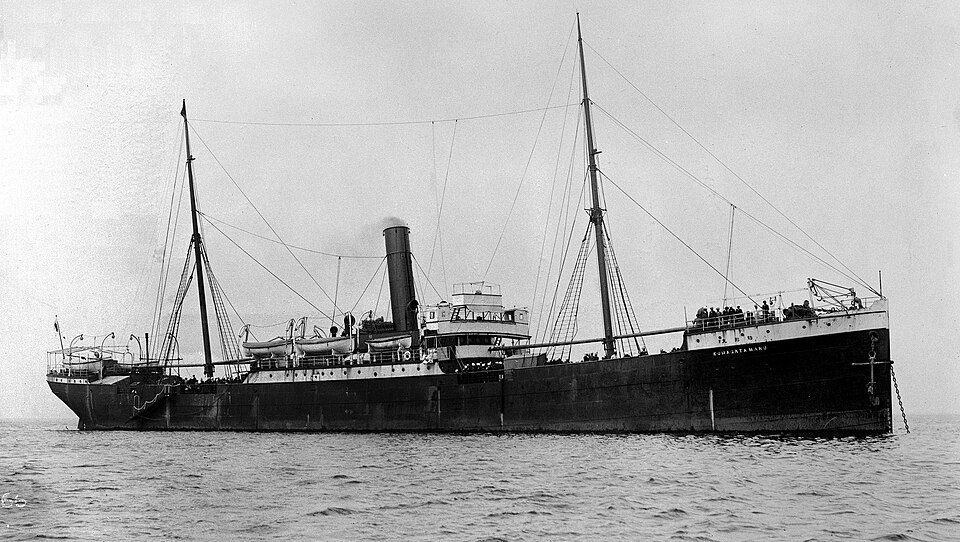
The Tall Ship in Glasgow Harbour

The debt-collectors are already knocking at the door. In March 2023, Clive Lewis, MP and shadow Foreign Secretary under Jeremy Corbyn, called for the UK government to start “meaningful negotiations” over reparations with Caribbean countries. The following autumn, Lewis’s parliamentary office became the centre of a reparations-campaign, funded by Irish billionaire Denis O’Brien. And in April this year, Sir Keir Starmer received the Prime Minister of Barbados, Mia Mottley, into No. 10. “We’ve known each other many years as good colleagues and now as leaders who think alike”, said Starmer. Mottley has stated that Britain owes Barbados £3.9 trillion and it was she who pushed for reparations onto the agenda of the Commonwealth Heads of Government summit last year.

But the case for reparations doesn’t add up. Yes, some Britons were involved in inhumane slave-trading and slavery, mainly from about 1650 to the early 1800s, when they transported over 3.2 million slaves from Africa to the Americas. Yet, while campaigners portray British involvement as uniquely dreadful. It wasn’t.

Up until the end of the 18th century AD slavery and slave-trading were universal institutions, practised since the dawn of time on every continent by peoples of every skin colour. In North America, indigenous societies in the Pacific North-West were built on slave-labour, since subsistence required the rapid processing of salmon, and the quantity of work outstripped the supply of female labour. So, raiding for slaves was endemic. Thousands of miles to the south, the Comanche ran “the largest slave economy” in the 1700s — according to Oxford’s Pekka Hämäläinen. Meanwhile, on the other side of the Atlantic, Arabs had been busy slave-raiding and -trading since at least the 7th century AD. According to one authority, the Muslim trade transported 17 million slaves mainly from Africa, but also from Europe, to the southern and eastern coasts of the Mediterranean. This is one context out of which reparations-advocates like to abstract British slavery.

Another is African complicity. British slave-ships off the coast of West Africa didn’t have to raid inland to obtain their slaves. They just waited on the coast for them to be brought. Africans had been busy enslaving and trading other Africans for centuries, first to the Romans, then to the Arabs, and finally to the Europeans. As early as 1550 the Kingdom of the Kongo was exporting up to 8,000 African slaves annually to the Portuguese.

The final context that campaigners studiously ignore is the fact that Britain was among the first states in the history of the world to abolish slave-trading (in 1807) and slavery (in 1833) throughout its territories. It then used its dominant power to suppress both slave-trading and slavery from Brazil, across Africa and India, to New Zealand for the second half of the British Empire’s life. In the 1820s and ’30s, the Slave Trade Department was the Foreign Office’s largest unit. By mid-century the Royal Navy was devoting over 13 per cent of its total manpower to stopping transatlantic slave-trading. The cost of this alone to British taxpayers was at least the equivalent of up to £1.74 billion today or 12.7 per cent of the UK’s current expenditure on development aid — for half a century. According to the eminent historian, David Eltis, the nineteenth-century costs of slavery-suppression exceeded the eighteenth-century benefits.

The West Africa Squadron, which freed 150,000 African slaves.

June 18, 2025

Canada’s Supply Management system – protecting us from cheaper milk, eggs, and chicken

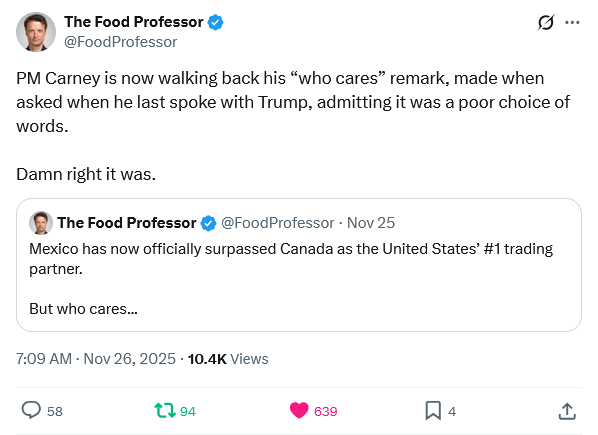
On the social media site formerly known as Twitter, The Food Professor celebrates the latest achievement in Canada’s omni-competent supply management system:

The Chicken Crisis Supply Management Won’t Admit

Canada’s supply management system—once heralded as a pillar of food security and agricultural self-sufficiency—is failing at its most basic function: ensuring reliable domestic supply.

According to the latest figures from the Canadian Association of Regulated Importers (CARI), Canada imported over 66.9 million kilograms of chicken as of June 14 — a 54.6% increase from the same period last year. To put that in perspective, this volume could feed 3.4 million Canadians for an entire year, based on per capita poultry consumption. That’s roughly 446 million individual meals — meals that, under a tightly managed quota system, were meant to be produced domestically.

To be fair, the avian influenza outbreak in Canada has disrupted poultry production, and it partially explains some of the shortfall. But even accounting for that disruption, the numbers are staggering. Imports under trade quotas established by the WTO, CUSMA, and CPTPP are all running at or near pro-rata levels, signaling not just opportunity — but urgency. Supplementary import permits — meant to be emergency tools — have already surpassed 48 million kilograms, exceeding the total annual import volumes of some previous years. This is not a seasonal hiccup. It is systemic failure.

Canada’s poultry sector is supposed to be insulated from global volatility through supply management. Yet internal shocks — like the domestic avian flu outbreak — have shown how fragile the system truly is. When emergency imports become routine, we must ask: what exactly is being managed?

The original intent of supply management was to align production with domestic demand while stabilizing prices and farm incomes. But that balance is clearly off. The A195 production period, ending May 31, 2025, showed one of the worst underproduction shortfalls in more than 50 years. Producers remain constrained by rigid quota allocations, while consumers continue to face rising poultry prices. More imports. Higher costs. Diminished confidence.

Some defenders will insist this is an isolated event. It’s not. This is the second week in a row Canada has reached pro-rata import levels across all chicken categories. Bone-in and processed poultry products — once minor parts of emergency programs — are now central to keeping the market supplied.

The dysfunction extends beyond chicken. Egg imports under the shortage allocation program have already topped 14 million dozen, up 104% from last year. Just months ago, Canadians were criticizing high U.S. egg prices — yet theirs have fallen. Ours haven’t.

All this in a country with $30 billion in quota value, intended to protect domestic production and reduce reliance on imports. Instead, we are importing more — and paying more.

Meanwhile, Bill C-202, now before the Senate, aims to shield supply management from future trade negotiations, making it even harder to adapt or reform. So we must ask: is this what we’re protecting? A system that fails to meet demand, relies on foreign supply, and costs Canadians more at the checkout?

Our trading partners are seizing the moment. Chile, for instance, has increased its chicken exports to Canada by over 63%, now representing nearly 96% of CPTPP-origin imports. While we double down on rigidity, others are gaining long-term footholds in our market.

It’s time to face the facts. Supply management no longer guarantees supply. And when a system meant to ensure resilience becomes the source of fragility, it’s no longer an asset — it’s an economic liability.

Fixing the CAF will require a lot more than just money

The Canadian Armed Forces are in a dire state. I could literally have written that in any year since I started blogging in 2004 … with brief, unsustained funding boosts for unplanned military commitments here and there that actually made the overall situation worse rather than better. Canada’s military procurement system seems incapable of doing anything quickly … or inexpensively, so pouring billions more into a broken process won’t work out well. There used to be a meme about being able to get whatever you wanted — “good, fast, cheap … pick two”. The CAF can’t even get one of those options.

We’ve had surprising numbers of media folks paying attention to the crippling recruiting crisis, as even on current funding, the CAF is short thousand and thousands of soldiers, sailors, and aircrew. Sadly, but predictably, most of that media attention looks at the shortfall of new recruits being trained for those jobs, which is true but incomplete. The biggest problem on the intake side of the CAF is the bureaucratic inability to bring in new recruits in anything remotely like a timely fashion. The last time I saw annual numbers, the CAF had huge numbers of volunteers coming in the door at recruiting centres, but getting the paperwork done and getting those volunteers into uniform and on to job training was an ongoing disaster area. More than seventy thousand would-be recruits applied to join the CAF and the system managed to process less than five thousand of those applicants and get them started on their military careers.

At a time that we’re losing highly trained technicians in all branches to overwork, underpay, and vocational burn-out, we somehow lack the competence to take in more than one in twenty applicants? That is insane.

In the National Post, Michel Maisonneuve says much the same as I just did, but rather more coherently:

I’m told the Treasury Board has already approved the new funds, making this more than just political spin. Much of the money appears to be going where it’s most needed. Pay and benefit increases for serving members should help with retention, and bonuses for re-enlistment are reportedly being considered. Recruiting and civilian staffing will also get a boost, though I question adding more to an already bloated public service. Reserves and cadet programs weren’t mentioned but they also need attention.

Equipment upgrades are just as urgent. A new procurement agency is planned, overseen by a secretary of state — hopefully with members in uniform involved. In the meantime, accelerating existing projects is a good way to ensure the money flows quickly. Restocking ammunition is a priority. Buying Canadian and diversifying suppliers makes sense. The Business Council of Canada has signalled its support for a national defence industrial strategy. That’s encouraging, but none of it will matter without follow-through.

Infrastructure is also in dire shape. Bases, housing, training facilities and armouries are in disrepair. Rebuilding these will not only help operations but also improve recruitment and retention. So will improved training, including more sea days, flying hours and field operations.

All of this looks promising on paper, but if the Department of National Defence can’t spend funds effectively, it won’t matter. Around $1 billion a year typically lapses due to missing project staff and excessive bureaucracy. As one colleague warned, “implementation (of the program) … must occur as a whole-of-government activity, with trust-based partnerships across industry and academe, or else it will fail.”

The defence budget also remains discretionary. Unlike health transfers or old age security, which are legally entrenched, defence funding can be cut at will. That creates instability for military suppliers and risks turning long-term procurement into a political football. The new funds must be protected from short-term fiscal pressure and partisan meddling.

One more concern: culture. If Canada is serious about rebuilding its military, we must move past performative diversity policies and return to a warrior ethos. That means recruiting the best men and women based on merit, instilling discipline and honour, and giving them the tools to fight and, if necessary, make the ultimate sacrifice. The military must reflect Canadian values, but it is not a place for social experimentation or reduced standards.

They finally did retire the Sea King, long after almost everyone else did. All CAF equipment is expected to have far longer working lives than any of our allies’ equipment.

June 17, 2025

BC is buying ferries from China … to spite Trump!

Filed under: Cancon, China, Government, Media, Politics — Tags: , , , — Nicholas @ 03:00

After all the “buy Canadian” blather of the last federal election campaign, it was only a matter of time before the feds or one of the provinces did something astoundingly out-of-step with the mantra. Smart money was always on Quebec being the first (because that often makes sense for internal provincial political reasons), but no, this time it’s British Columbia going a long way out of their way to not buy Canadian for a huge government purchase:

BC Ferries’ MV Spirit Of Vancouver Island between Galiano Island (Bluffs Park) and Mayne Island, en route from Tsawwassen to Swartz Bay, BC on April 6, 2022.
Photo by Gordon Leggett via Wikimedia Commons.

British Columbia’s transportation minister claimed Friday that buying new ferries from European shipyards would have cost roughly $1.2 billion more than buying them from a Chinese government-owned shipyard in Weihai, Shandong province, which is a city roughly the size of Montreal that I had never heard of until this week. China knows how to build cities. They burst into existence from nothing, like popcorn. China also knows how to build ships, and highways, and high-speed rail, and just about anything else you would care to name, better and more efficiently than the Canadian public service can realistically comprehend.

The four ships B.C. Ferries is fixing to replace, of 1960s and 1970s vintage, were built at Seaspan in North Vancouver (which is an active shipyard), at the Victoria Machinery Depot (which is no longer an active shipyard), and at the Burrard Dry Dock (which is also defunct). Canada’s shipyards, for better or worse — certainly for expensive! — are very busy building things for the navy.

B.C. Ferries has plenty of experience with foreign-built vessels. Its current fleet includes ships built in Romania, Poland, Germany and Greece. Other than the Baynes Sound cable ferry on Vancouver Island — which is not especially popular — the Crown corporation’s newest Canadian-built boat went into service in 1997. So “foreign” obviously isn’t the problem.

But China is China, and that’s legitimately another thing. China is not a Canadian ally. They try to screw with our democracy, and most other democracies by the sounds of it. And right now we are in a profoundly protectionist moment: Across the political spectrum, mostly because of President Donald Trump, “buy Canadian” is the only philosophy really on offer.

But does that make sense? We should pay over the odds for ferries … because of Trump? There wasn’t half of all this foofaraw when Marine Atlantic on the East Coast bought its newest ferry from Weihai. Since last year it has safely been shepherding Canadians between Nova Scotia and Newfoundland, without a whisper of controversy in the Rest of Canada.

I don’t quite get the Trump angle, which is perhaps why I’m more interested in Dean Broughton‘s take:

… I’m not just disappointed — I’m furious — about the NDP government’s decision to award the construction of four new BC Ferries vessels to a Chinese state-owned shipyard. This isn’t just outsourcing. It’s betrayal dressed up as budget management.

Back in 2021, the NDP government unveiled a “Made-in-B.C.” shipbuilding strategy with great fanfare. They formed a Shipbuilding Advisory Committee, posed for cameras, and promised to rebuild a long-neglected industry. It was supposed to be a turning point, a real investment in local jobs and industrial capacity.

Now, many of those same politicians have turned their backs on everything they claimed to support. Not only did they ship the contracts overseas, but, according to Eric McNeely, president of the BC Ferry and Marine Workers’ Union, they didn’t even give B.C. shipyards a fair shot. The procurement process was so rushed and restrictive that no local yard could realistically compete. They didn’t lose the bid — they were boxed out.

That’s not fiscal prudence. That’s political cowardice.

The hypocrisy is staggering. This is the same government that talks endlessly about investing in clean industry and supporting working families, and they just handed a massive public contract to a country with a well-documented record of environmental abuses and human rights violations.

They talk about reconciliation and sustainable development—and then funnel hundreds of millions to an authoritarian regime.

Worse still, they did this knowing full well that B.C.’s industrial base is already in decline.

We have so little left beyond resource extraction. Shipbuilding could have been part of our economic renewal. Instead, it’s another casualty of government optics and empty promises.

I remember my father’s outrage in 1990 when the federal government cancelled the Polar 8 icebreaker — a Canadian-built vessel meant to defend our Arctic sovereignty. That decision was dismissed as a “cost-saving measure” and today our claim to the North has never been weaker.

The BC Ferries decision reeks of the same short-sighted logic.

June 16, 2025

The Machine of Terror: How the Soviet Secret Police Ruled – W2W 32

Filed under: Government, History, Russia, WW2 — Tags: , , , , , , — Nicholas @ 04:00

TimeGhost History
Published 15 Jun 2025

From Tsarist Russia to Stalin and the Cold War, the Soviet secret police evolved through endless name changes — but their mission never wavered: repress, control, and terrify. Discover how these agencies — from the Okhrana to the Cheka, GPU, OGPU, NKVD, and eventually the KGB, shaped Soviet life with ruthless efficiency. Torture, purges, and mass surveillance weren’t just tactics; they were the system.
(more…)

Why Orwell’s choristers wouldn’t solve the CBC problem

Filed under: Britain, Bureaucracy, Cancon, Government — Tags: , , — Nicholas @ 03:00

Peter Stockland was looking for a George Orwell quote in the four-volume Essays, Journalism and Letters collection, but instead he found something that painfully briefly gave him hope on how to resolve the eternal CBC problem:

Orwell had been employed by the BBC for about nine months at the time. He writes of the Beeb’s “atmosphere (being) somewhere halfway between a girls’ school and a lunatic asylum (where) all we are doing is useless, or slightly worse than useless”. But that didn’t prevent him observing the following and writing it down for potential reference:

    The only time one hears people singing in the BBC is in the early morning, between 6 and 8. That is the time when the charwomen are at work. A huge army of them arrives all at the same time. They sit in the reception hall waiting for their brooms to be issued to them and making as much noise as a parrot house, and then they have wonderful choruses, all singing together as they sweep the passages. The place has quite a different atmosphere at this time from what it has later in the day.

There’s no overt opining. No proselytizing. No being a loud mouthed schnook. No. Instead, there’s quiet observing. Passerby paying attention. After the fact drafting of an attempt at understanding. All of it brings us journalistically face to face with the vitality – the potential for beauty – of ordinary, practical work using the tools available. It stands in stark contrast to the “useless or slightly worse than useless” abstractionism going on among the great, the good, and the self-important in the BBC bureaucracy.

When I first read the diary entry, it stirred me with eureka-like enthusiasm. That’s it! That’s the solution! We can finally let go of the never-never-land fantasy of abolishing the CBC/Radio Canada. Parliament can instead issue an immediate edict for Mother Corp to hire a “huge army” of cleaning persons, issue them brooms, and unleash them to sing their hearts out. They would soon sweep away the journalistic detritus and parrot droppings in the Corpse’s downtown Toronto and Montreal buildings. A little bit of hallway husbandry married to some glorious working class song: That would fix the GD CBC.

Alas, I was quickly shaken by remembering: This is Canada. Bureaucratism is the irreversible necrosis of the national spirit.

Within months – weeks? – there would be a follow up Clean Canada Choristers Control Act. A federal agency with a $50 million annual starter budget would police against misinformation being sung by the cleaners. It would deploy a gender equitable intersectional analysis to prevent settler colonial bias affecting distribution of bass, tenor, alto and soprano voices. Above all, it would regulate the size and status of the brooms to prevent any unionized chorister feeling unsafe or excluded.

I exaggerate? Not so much. Consider this week’s confirmation that Prime Minister Mark Carney’s urgency to “fast track” projects deemed of “national interest” is about to spawn its own Major Federal Projects Office – a bureaucracy to reduce the bureaucracy of getting down to work and building Canadian things that Canadians need.

You might think some journalist somewhere might ask, like, you know, “Why can’t they just reduce the bureaucracy instead of, like, you know, creating another one with more bureaucrats? Kind of, you know, play DOGE Ball North: ‘You! Bureaucrats! You’ve been tagged! You’re out!!'”

But no. Remember, as I was obliged to, this is Canada. Those kinds of questions aren’t asked even by journalists who should be asking them because … those kinds of thoughts are no longer thunk here. (I don’t think they’re actually illegal. Yet.)

June 15, 2025

Militarizing the Canadian Coast Guard (or not?)

Filed under: Cancon, Government, Military — Tags: , , , — Nicholas @ 03:00

Noah tries to get some solid information on the recent announcement by the Prime Minister that as part of changes to bring Canada into line with our decade-old NATO commitments, the Canadian Coast Guard would be moved from the civilian oversight of the Ministry of Fisheries and Oceans to the military oversight of the Ministry of National Defence. Oddly, the government seems to have been caught rather flat-footed by the PM’s announcement:

When Monday came I was invited to take part in a Media Briefing before [the PM] took questions. My immediate goal was to bring this topic up and get some sort of official words on what these plans were, especially after it wasn’t mentioned in [Carney’s] speech beforehand.

[…]

What we were told was that no such move was taking place, nor plans to arm the Coast Guard and that the current plan was to focus on augmenting their capabilities through new sensors and further collaboration with the RCN.

It was a definitive statement, one that we all agreed was cut and dry. I even reached out to other journalists before adding it to the livethread to make sure we were on [the same] page.

So imagine my surprise when Steven at the G&M came out blazing with a straight no, the plan is to move them. He even came backed up with a statement from the PMO, and credit to Steven, he was quick on this:

Credit to Steven Chase at the Globe & Mail

So as you can imagine my new goal was to figure out what exactly the hell was happening to the Coast Guard, with multiple competing statements on the subject. I made it my mission to have a definitive answer.

So it was back to asking, and emailing, everyone, from the DND to the PMO, CCG to the DFO. I got in contact, I dug into sources, even went as far as to ask people in industry if they had heard anything.

What I got for the first few days was chaos. Multiple statements saying that info wasn’t available, more time was needed. I got outright denial from the DND, only to be told they would email me back with info (they never did)

The PMO also told me info would be available when they had it. Evidently as of the time of this writing they have not responded. The only one to stay in contact and provide an answer to my question:

So as far as I was concerned this was a deal closer. The Coast Guard will be moving under the leadership of the Minister of National Defence. What will this look like? We don’t know. I had hit a dead end at this point, where sadly my reach was no longer wide enough for info.

Thankfully, there were others also keen on this, and wanting to get to the bottom of this, and they got farther than me. I will highly recommend my boy Stuart’s article on this as he got farther than me.

What has become evidently clear is:

  1. The Coast Guard is moving
  2. The idea is facing stiff resistance

This isn’t a shock at all. The DFO folks I talked to felt very caught off guard by everything, and the general reaction I have talking around was that this was a bit unexpected.

If accurate, then it is clear that this is the choice of the Prime Minister. He is the one who wants this, and so is making the final push. That isn’t to say he is the only one, but this has his backing and he will push that through.

June 13, 2025

QotD: The Subaru BRAT

Filed under: Business, Government, History, Japan, Quotations, USA — Tags: , , , — Nicholas @ 01:00

Imagine, if you can, a truck with factory-mounted seats in the bed — and spotlights the size of a 747’s landing lights mounted on its T-topped roof.

If you know this truck, you also know why it’s no longer available.

Such fun things are no longer allowed.

They are not saaaaaaaaaaaaaaaaafe! “Moms” are “concerned”!

But in 1977, the Safety Cult — which ended such fun things — was still a backwater aberration, like dancing with rattlesnakes — and most people still esteemed fun over fear. There were roofless Broncos and K5 Blazers — and cars with beds.

You could buy all kinds of different stuff back when America was still a fairly free country — and the Subaru BRAT was as different as it got.

BRAT — all caps — was short for Bi-Drive Recreational All-Terrain Transporter. It was superficially similar to other small import pickups of the ’70s, such as the Datsun 620 and similar models from Toyota (SR5), Mazda (B210), and Chevy (via Isuzu) Luv.

But unlike them, it was a four seater — with two of the four in the bed, facing the other way. The seats were made of all-weather plastic and far from the most comfortable — but the view was spectacular. Watching the world recede as you progressed is another one of many freedoms denied today in the name of “safety”.

Subaru wasn’t “unconcerned” about “safety”. Grab handles — to keep passengers from bouncing out of the bed — were included. Though holding onto them made it harder to reach for a cold one in the cooler. That was another fun thing people did in pickups back in the day — before the Safety Cult put the kibosh on that, too.

The seats were actually a dodge — of a federal fatwa known as the “chicken tax”, which was a retaliatory tariff of 25 percent applied to import-brand pickups manufactured outside the United States as tit-for-tat for tariffs applied by foreign countries to American chicken exported outside the United States.

The “chicken tax” hit trucks with just two seats — at the time almost exclusively the small import models, which didn’t offer the extended and crew cab configurations that are commonplace today.

By adding the extra seats in the bed, BRAT qualified as a passenger vehicle rather than a “light truck”, and thus Subaru evaded the chicken tax on a happy technicality — and was also able to sell the BRAT for less than two-seater rivals that had the cost of the tax folded into their MSRP.

Eric Peters, “Doomed: Subaru BRAT (1977-87)”, The American Spectator, 2020-04-26.

June 12, 2025

Why it’s economically impossible for Walmart to “eat the tariffs” as Trump demands

Filed under: Business, Economics, Government, Politics, USA — Tags: , — Nicholas @ 04:00

At FEE, Peter Jacobsen shows the clear financial reason why Walmart and other big US retailers are passing along the price increases due to Trump’s tariffs rather than “eating them”:

Recently, a post from President Trump on Truth Social went viral. An attempt to convince retail giant Walmart to keep prices down despite the tariffs, it read:

    Walmart should STOP trying to blame Tariffs as the reason for raising prices throughout the chain. Walmart made BILLIONS OF DOLLARS last year, far more than expected. Between Walmart and China they should, as is said, “EAT THE TARIFFS”, and not charge valued customers ANYTHING. I’ll be watching, and so will your customers!!!

Trump’s demand here is, simply put, unreasonable, and it reflects a basic misunderstanding of how pricing decisions are made in a market economy. Let’s unpack why.

Walmart’s Thin Margins

The biggest problem with the President’s view is that it doesn’t pass a basic numbers test. To break it down, let’s look at Walmart’s financials.

It’s true that Walmart generates billions of dollars in revenue each year, but revenue alone doesn’t tell us how much Walmart makes.

To understand that, we need to consider profit, which accounts for the company’s costs. More specifically, we want to look at Walmart’s net profit margin, because that’s an extremely important indicator of whether Walmart could realistically “eat the tariffs”.

Depending on the source, Walmart’s net profit margin is somewhere between 2% and 3%. Let’s split the difference and say it’s 2.5%. What does that mean?

That means, if Walmart sells you $1 of goods, it only keeps 2.5 cents in profit. That’s right, 97.5 cents goes toward inventory, employee wages, store maintenance, and a variety of other operating costs.

Put another way, if you spend $100 at Walmart, they make $2.50 in profit.

Now let’s say you buy a $100 television that Walmart imports. A $20 tariff is imposed — an added cost Walmart has to pay to import the TV. Before the tariff, Walmart was making $2.50 in profits. After the tariff, it’s now taking a $17.50 loss.

The only way Walmart can still sell this TV is by raising the price.

At this point, a tariff supporter might respond: “The easy way to fix this is to buy US-made TVs instead!”

Sure — you can avoid tariffs by only buying domestic, but the problem is that domestic TVs tend to be more expensive. If they weren’t, Walmart wouldn’t be importing them in the first place. So even if Walmart pulls international TVs off the shelves and replaces them with US-made ones, the prices still increase.

Here’s the key point: “eating” the tariffs is not an option. Walmart operates on slim margins, barely making pennies on the dollar — there isn’t room to eat 20% cost increases!

June 10, 2025

Mark Carney’s big defence spending announcement

Filed under: Cancon, Government, Military — Tags: , , , , , — Nicholas @ 05:00

On Monday Morning, Prime Minister Mark Carney was in Toronto to make a major announcement on Canada’s military spending. After being one of the worst freeloaders in the western alliance, Canada was spending far less on the Canadian Armed Forces than the 2% of GDP we’d promised our NATO partners several years ago. Of course, at the same time that Canada seems to be finally getting serious about defence priorities, the rest of our allies are talking seriously about raising the agreed-upon target to 5%:

Chris Lambie in the National Post says it’s a C$9 billion bump in direct military spending in this (unbudgeted) year:

Canada’s plan to add more than $9 billion to defence spending this year was praised by military watchers Monday, but they cautioned that the country is shooting at a moving target.

Prime Minister Mark Carney announced the country would meet its commitment in this fiscal year of hitting the two per cent of gross domestic product mark that was agreed upon by NATO countries more than a decade back.

“It’s very encouraging that the prime minister has come out this early in his mandate and made such a strong commitment to defence,” said Vincent Rigby, a former top intelligence adviser to former prime minister Justin Trudeau, who spent 14 years with Canada’s Department of National Defence.

“You’ve gone from the former prime minister talking about the two per cent as a crass mathematical calculation to the current prime minister saying, no, this is actually a serious commitment. We committed to it 10 years ago and even before that. And we have to do it because we owe it to our allies. But we also owe it to the Canadian people. He made it quite clear this is about protecting Canada, protecting our national interests and protecting our values.”

New spending could do a lot to improve crumbling military infrastructure, said Michel Maisonneuve, a retired Canadian Army lieutenant-general who has served as assistant deputy chief of defence staff, and chief of staff of NATO’s Allied Command.

“The housing on bases is horrible,” Maisonneuve said.

He’s keen on Carney’s plan to participate in the $234-billion ReArm Europe program.

“This will bolster our ability to produce stuff for ourselves” while also helping the Europeans to do the same, Maisonneuve said.

“All the tree huggers are going to hate that, but that’s where we are today in the world.”

Carney’s cash injection includes $2.6 billion to recruit and retain military personnel. The military is short about 13,000 people. It aims to boost the regular force to 71,500 and the reserves to 30,000 by the end of this decade.

“There is no way we can protect Canada and Canadians with the strength that we have now,” Maisonneuve said.

Later in the day, Matt Gurney made some preliminary comments on the social media site formerly known as Twitter (I imagine he’ll have more to say in an upcoming Line post):

I’ve had a chance to actually look at some of the details of what was announced today for Canada’s defence. Overall, I am very supportive of everything that’s been announced.

There are some caveats. Or at least notes.

1. The new spending is mostly aimed at flushing out existing capabilities, not adding new ones.

That’s fine! We need to do that, definitely. I just don’t know if the public understands how much money we could sink into the military without actually adding any new capabilities. All we would do is backfill capabilities that we currently claim to have that don’t really exist.

2. Billions of additional dollars are going toward very basic things. More money to retain existing personnel. Apparently more money to build out recruitment. Spending more money to bring equipment and facilities up to state of proper repair.

Same as above. All good! Needed. Smart.

3. Some of what’s being announced today is entirely a matter of how we’re budgeting stuff. Certain existing expenditures are being redesignated as defence expenditures.

That’s okay! Some of our allies count things toward their defence total that we don’t. Everybody cooks the books a little bit, and I have no objection to this.

4. Everything being announced today should have been done years ago.

The only note I really have to add here is how the longer [Mark Carney] is Prime Minister, the harder it gets to explain away some of the shocking inactivity of his immediate predecessor.

5. None of this is going to be enough.

Remember, all we’re doing here is building out existing capabilities so that they are actually real things, not just things that exist on paper. That’s good. But the actual work of recapitalizing, expanding and adapting the military for 21st-century conflict hasn’t really begun yet. Everything announced today is a necessary start to getting that done. But the hard work is still to come.

And so are the really eye-watering numbers.

Of course, there are definite downsides to just opening up the spending taps the way things currently are set up:

He’s not wrong.

QotD: From Witan to Magna Carta

Filed under: Britain, Government, History, Quotations — Tags: , , , , , , — Nicholas @ 01:00

About 1,500 years ago, in Saxon England, the nobles of the realm, the bishops, abbots (and abbesses) and the ealdormen and thegns and others would gather, fairly regularly, in an assembly to advise and, sometimes, to constrain the king. In a very typically English manner, they hit upon the notion that the kings were not, generally, wicked or stupid, but they did too many dumb things just because they could. The reason that kings could, too often, do whatever they wanted was simple: they had an almost unlimited power to levy taxes.

After a few hundred years of trial and error, and given a king who really was wicked and stupid, too, they, the barons as they were then known, went to war with their king and bent him to their will by forcing him to agree to a great charter of their rights. There was a bit of ringing language about no free man being taken except after a trial by a jury of his peers, but, basically, in very typically English fashion, the rights about which the great charter was most concerned were property rights because the barons had learned, over the centuries that only by controlling the pursestrings could they really control the king.

A few hundred years later, one of liberalism’s and democracy’s greatest voices told us that we have three absolutely fundamental, natural rights: to life, to liberty and to property. These rights were not and still are not unlimited. There were and are ways to lawfully and properly deprive a person of his property and his liberty and, in some countries, even his life.

A few centuries after John Locke another philosopher wanted to do away with the right to property: “From each according to his ability, to each according to his need”, Karl Marx wrote, and many, far too many, believed. The only real problem with Marx’s notion is that it requires that humans are perfect … and most of us know how rare that is. Here in Canada, especially since the early years of the 20th century, we have had far too much Marx and far too little Locke.

Ted Campbell, “Democracy is in peril”, Ted Campbell’s Point of View, 2020-06-12.

June 9, 2025

The federal Minister of Public Safety admits he knows literally nothing about Canadian gun laws

Filed under: Bureaucracy, Cancon, Government, Media, Politics, Weapons — Tags: , , , , , — Nicholas @ 03:00

Prime Minister Mark Carney’s cabinet may actually be worse than any line-up of ministers under Justin Trudeau, with the Minister of Public Safety as a poster child for ignorance and apathy:

[…] Then we have the Minister of Public Safety, Gary Anandasangaree — a Trudeau–Carney loyalist freshly installed under the new Liberal minority regime — who made headlines not for bold leadership, but for a shocking display of ignorance on the very file he’s been assigned to oversee: firearms policy.

During a session of debate on the current spending bill, Conservative MP Andrew Lawton posed a basic question:

    “Do you know what an RPAL is?”

An RPAL, or Restricted Possession and Acquisition Licence, is a standard certification required by law for any Canadian who wants to own restricted firearms, such as handguns or certain rifles. It’s a core element of Canada’s legal firearms framework.

The Minister’s response?

    “I do not.”

Lawton followed up with another foundational question:

    “Do you know what the CFSC is?”

The CFSC, or Canadian Firearms Safety Course, is a mandatory course required for all individuals seeking to obtain a firearms license in Canada — including the RPAL. It’s the very first step every legal gun owner in the country must complete. This is basic civics for anyone involved in firearms policy.

Anandasangaree replied again:

    “I do not know.”

This wasn’t a “gotcha” moment. It was a revealing moment. The Minister of Public Safety, the individual charged with implementing gun bans, overseeing buyback programs, and crafting firearms legislation, has no familiarity with the fundamental licensing and safety processes every Canadian gun owner must follow.

In any other profession, this level of unpreparedness would be disqualifying. If a surgeon couldn’t name a scalpel, he’d be pulled from the operating room. But in Ottawa? It qualifies you to oversee a multi-hundred-million-dollar national gun seizure operation.

And that brings us to the next moment of absurdity.

Lawton asked the minister how much money had already been spent on the federal firearms buyback program, the centerpiece of the Liberal government’s Bill C-21, which targets legally acquired firearms now deemed prohibited.

Anandasangaree’s answer?

    “About $20 million.”

But that doesn’t match the government’s own published data. In a report tabled by Public Safety Canada in September 2023, it was disclosed that $67.2 million had already been spent on the buyback as of that date. The majority of that spending was attributed to “program design and administration” — before a single firearm had even been collected.

So what happened? Did the government refund tens of millions of dollars? Were contracts cancelled? Of course not.

They just reframed the accounting — separating so-called “preparatory costs” and implying they don’t count as part of the buyback, even though they exist entirely to implement it.

It’s not transparency. It’s political bookkeeping — a deliberate attempt to make a costly, unpopular program appear manageable.

And it didn’t end there. When Lawton asked for the number of firearms that had actually been collected under the buyback, the response was yet another dodge. The Minister and his department couldn’t provide a number.

That’s right: after spending over $67 million, the federal government can’t even say how many guns have been retrieved. Yet they’re moving full steam ahead, with the support of a minister who doesn’t understand the system he’s responsible for.

This isn’t policymaking. It’s blind ideology strapped to a blank cheque. And the people paying the price are law-abiding citizens — not criminals, not gangs, and not smugglers.

At this rate, I can’t imagine how he’ll still be in cabinet by the end of summer.

June 8, 2025

Managerialism – threat or menace?

Filed under: Bureaucracy, Business, Government, USA — Tags: , , , , — Nicholas @ 05:00

In the New York Times (don’t worry … link is to an archived version), Nathan Levine explains to NYT readers why there is such a push back against the over-mighty technocratic organizations that have been running more and more of our fading civilization:

It is the culmination of a once marginalized, now transformative strand of political thought about who really holds power in the modern American system. Namely, that our democracy has been usurped by a permanent ruling class of wholly unaccountable managers and bureaucrats.

Anti-managerialism is back. Well positioned to answer decades of frustration with mainstream conservatives’ failure to deliver results, this old idea has become the central principle of the new right.

In fact, much of what is commonly called “populist” politics can be more accurately described as part of an anti-managerial revolution attempting to roll back the expansion of overbearing bureaucratic control into more and more areas of life.

Though it has so far met with limited success amid stiff resistance, grasping the nature of this anti-managerialism is essential to understanding the Trump administration’s effort to transform America’s institutional landscape, from government to universities and major corporations.

The idea’s intellectual history begins with the political philosopher James Burnham, who argued in his seminal 1941 book, The Managerial Revolution, that the aristocratic capitalist class was in the process of being overthrown by a revolution — just not, as the Marxists predicted, by the working class.

Instead, the exponential growth of mass and scale produced by the Industrial Revolution meant that in both corporation and state it was now those people cleverest at applying techniques of mass organization, procedure and propaganda — what he called the managerial class — who effectively controlled the means of production and would increasingly come to dominate society as a new technocratic oligarchy.

The book made an especially significant impression on George Orwell, who remarked that a managerial class consisting of “scientists, technicians, teachers, journalists, broadcasters, bureaucrats, professional politicians: in general, middling people”, hungry for “more power and more prestige”, would seek to entrench “a system which eliminates the upper class, keeps the working class in its place, and hands unlimited power to people very similar to themselves”.

Orwell was particularly struck by Burnham’s observation that the major political systems of the day — fascism, Communism and New Deal-era social democracy — were fundamentally similar in their turn toward the bureaucratic management of society. He observed that everywhere “laissez-faire capitalism gives way to planning and state interference” and “the mere owner loses power as against the technician and the bureaucrat”. Believing that accelerating managerial control risked dragging every society inexorably into totalitarianism, Orwell made Burnham’s ideas the basis of his novel 1984.

While the Cold War persisted, the view that America’s government might share some traits with the Soviet Union unsurprisingly proved unpopular, especially among Washington’s conservative establishment.

Nonetheless, the managerial class continued to grow, regardless of which political party controlled the government. Cold War defense budgets drove a relentless expansion of security state bureaucracy and the military-industrial complex. The advent of Great Society welfare programs and the Civil Rights Act demanded a re-engineering of social relations, prompting a dramatic proliferation of lawyers, regulatory bureaucrats and corporate compliance officers throughout much of public and private life. An ever-greater proportion of Americans began funneling through the credentialing machinery of higher education, inflating demand for yet more upper-middle-class managerial jobs.

June 5, 2025

German judges seem to be dedicated to ensuring that the government never changes policy, regardless of voter preference

Filed under: Germany, Government, Law, Media, Politics — Tags: , , , , , , — Nicholas @ 05:00

The times I despair of the pathetic Canadian government, I look to Germany where eugyppius helpfully explains that German judges are even more dedicated to thwarting the will of the voters than Canadian judges are (and that’s a major achievement):

“German flag” by fdecomite is licensed under CC BY 2.0 .

At the start of May, CSU Interior Minister Alexander Dobrindt effectively abolished asylum as a path into Germany, empowering federal police to push back all illegal migrants at our national borders.

There ensued a period of messaging chaos, in which Chancellor Friedrich Merz assured our neighbours and the EU that nothing much was happening, while Dobrindt quietly insisted that yes, indeed, he was serious. He gave police orders to step up border checks and to send back all illegal migrants regardless of asylum claims – save for pregnant women, the underage and the sick.

These new borders policies have yet to exercise any significant influence on asylum statistics. It is relatively easy to cross into Germany despite the police spot checks, and we don’t yet know how many asylees are managing to evade them.

The deeper legal issues are much more significant right now. We want to know whether Dobrindt’s intervention is workable in theory, and whether our judges will swallow it. Unfortunately, he is already under siege from asylum advocates on the left and the broader migration industry, who have set and sprung a very telling trap, with the aim of getting courts to overturn even these preliminary and quite meagre interventions.

To understand the issues here, we need a brief legal primer: According to German law (the so-called Asylgesetz), foreigners who enter Germany from “secure” states do not get to claim asylum. They are to be sent straight back to wherever it is they came from. Because Germany is surrounded entirely by secure states, that should really be the end of this insane problem. Alas, this sensible law has been superseded since 1997 first by the Dublin Convention, and later by the Dublin II and now the Dublin III Regulation. The latter forbids the Federal Republic from using her own laws, holding that foreigners entering Germany from secure third states must be welcomed pending a procedure to establish which EU member state is actually responsible for them. Effectively, this means that almost all of these aspiring asylees remain in Germany indefinitely, because deporting people who do not belong here is beyond the meagre capacities of our enormous bureaucracy.

Dobrindt sought to get around Dublin by appealing to Article 72 of the Treaty on the Functioning of the European Union (TFEU), which allows member states to set aside EU regulations when this is necessary to maintain order and security.

Many have eyed this Article 72 strategy for a long time, but nothing is easy, particularly not in countries unduly enamoured of “the rule of law”, which is a lofty euphemism for “the rule of obscure crazy people in robes for whom nobody ever voted and who enjoy lifetime appointments”. These days the government cannot do anything at all except what it was already doing (and sometimes not even that), or unless it is obviously stupid, expensive and inadvisable, because lurking around every corner is a clinically insane judge eager to explain why sensible things are not allowed. In recent years, our extremely learned and far-sighed judiciary has explained why combating climate change is anchored in the German constitution and why basically everybody is entitled to exorbitant social welfare. All that remains for them is to explain why everybody on earth is also entitled to live in Germany and draw benefits from the state, and they will have completed their suicidal triad.

On Monday, 2 June, the Berlin Administrative Court struck the first blow in this direction. Effectively, they called the whole basis for Dobrindt’s new border policy into question, issuing what amounts to a preliminary injunction in the case of three Somalis (two men and one woman) who had crossed from Poland into Germany on 9 May. Federal police intercepted the trio at the train station in Frankfurt an der Oder; they claimed asylum and the police, in line with Dobrindt’s order, sent them back to Poland anyway. Lawyers from the advocacy organisation Pro Asyl then helped them bring suit in Berlin, and the court intervened in their favour. They get to be professional asylees in Germany now.

« Newer PostsOlder Posts »

Powered by WordPress