
The History Underground
Published 20 Oct 2024Battle of Arras: Part 2
When it comes to the legendary actions of the Canadian soldiers in WWI, Vimy Ridge looms large above all of the others. This is where the four division of the Canadian Corps would fight side by side for the first time in The Great War. In this episode, we’re walking the ground on the left flank of the Canadian line, looking at the memorial and showing a few things that typically get overlooked in the Vimy Ridge area.
For more on the Battle of Arras, check out The Old Front Line Podcast with Paul Reed & his YouTube channel, @OldFrontLine.
This episode was produced in partnership with The Gettysburg Museum of History. See how you can support history education & artifact preservation by visiting their website & store at https://www.gettysburgmuseumofhistory…
Map animations by @SandervkHistory
November 11, 2025
Vimy Ridge: Canada’s Finest Hour | History Traveler Episode 386
November 10, 2025
Somalia comes to Minnesota
Ian at The Bugscuffle Gazette provides a useful thumbnail history of modern-day Somalia and how this impacts Minneapolis, Minnesota:
In Africa national borders — and thus nations — are matters of political convenience, if not flat-out arbitrary. Only newbies to Africa even think about nationality, old hands know that tribal affiliation trumps all.
I had forgotten that.
In Somalia the borders were drawn in the late 19th century by Great Britain1 and Italy2. Make a mental note of that in case it comes up in a trivia contest somewhere, but understand that tribes and clans in that misbegotten part of the world are far more important than lines drawn on a map by 19th century British and Italian diplomats.
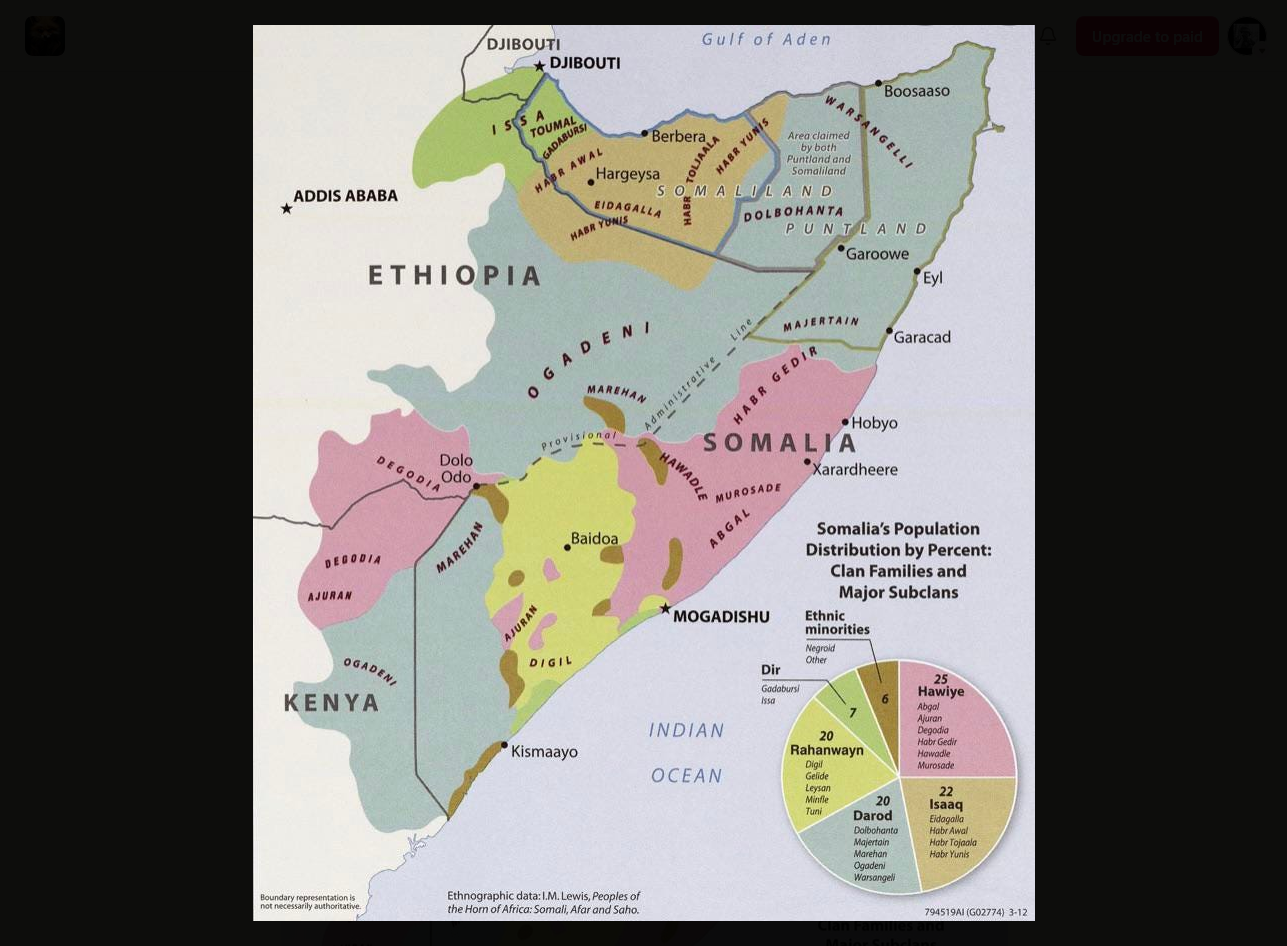
As a “for instance” let us take a look at a couple of these clans: The Daarood and the Hawiye.
The patriarch of the Daarood showed up in East Africa in the 10th Century3, and founded a clan that has become one of the largest in East Africa, and the second4 largest of the Somali clans actually in Somalia. They were the clan ruling Somalia when folks rebelled and kicked off the Somalian Civil War.5 Their current turf is sort of hourglass-shaped, with a chunk in northern Somalia, and another chunk in southern Somalia.
The Hawiye showed up in the 12th Century6, and have become the largest clan in Somalia. Their turf in Somalia is a chunk of seaside property starting at Mogadishu7 and heading north.
Yes, I know it says “Darod”. It’s properly “Daarood”.
In 1969, a Daarood bugsnipe name of Mohammed Siad Barre found hisself as HMFIC of Somalia following a bloodless8 coup-d’etat, but a whole bunch of folks Had Thoughts regarding his ascension9, and Somalia was pretty much in a constant state of rebellion from 1978 to 1991, when the full-scale Somali Civil War kicked off.
Okay, great. Fascinating even … so what does this have to do with Minneapolis of all places?
In the aftermath of that little dust-up, we imported a lot of Somali refugees. And since the clan most in need of refugee-ing was the Daaroods, we brought in a lot of Daaroods, and — being clannish — they consolidated in a clan-like fashion in Minnesota.
As a “for instance”, Ilhan Abdullahi Omar, the U.S. Representative for the 5th District of Minnesota, is a Daarood.
Things were trundling along the way they always do10 — except we’ve since imported another wave of Somalis … and these aren’t Daaroods. Any guesses as to clan affiliation? Yes! They’re Hawiye.
So. A second-generation dacoit of Daarood descent name of Omar Fateh decides he wants to run Minneapolis as warlord mayor, and he’s got the backing of his clan-mate Ihlan Omar — he’s a shoo-in!
Except a whole bunch of Hawiye in Minneapolis went, “Sod that for a game of soldiers”, and voted for the white guy.
Yay, tribal loyalty! Brings a tear to my eye, it does.
Which is all well and good11, but Omar Fateh, Ihlan Omar, and a whole bunch of Daaroods in Minnesota are capital “P” Pissed, capital “O” Off about the whole thing.
I know full well and certain how … spicy … tribal conflicts can get — and you couldn’t pay me enough to live in Minneapolis for the next few years.
- British Somaliland — actually a protectorate — starting in 1884, Crown Colony starting in 1920, self-governance in 1960.
- Italian Somaliland starting in 1884, then the Italians made the mistake of picking the wrong side during WW2, Brits took over in 1941, passed it off to the UN (whee) in 1950 (with the Italians mucking about), and formally united with British Somaliland in 1960 to form present-day Somalia.
- Maybe 11th — we’re not real sure.
- Or third, depending on whom you ask.
- This is important.
- Damned newcomers.
- We’re getting there.
- Hah! The assassination of the previous boss was insanely thorough.
- The fact that he styled himself “Victorious Leader” and loved himself some Marxism probably didn’t help.
- “Send lawyers, guns, and money …”
- For certain values of “well”, and certain values of “good”.
Food in the Trenches of World War One
Tasting History with Max Miller
Published 3 Jun 2025Mashed potatoes over a corned beef and onion filling with gravy
City/Region: United Kingdom
Time Period: 1914Many of the young men headed to fight in World War I didn’t already know how to cook, so the British government set up army schools of cookery to teach some of them how to make the most of the rations they were given. Even that ancient army standby, hardtack (clack clack), is better when you can cook it into a stew or pudding.
This potato pie, kind of a simplified preserved meat version of shepherd’s pie, isn’t half bad. If I were to make changes, I would leave out the additional salt (canned corned beef is plenty salty on its own) and add some more onions. While relatively tasty as-is, if you have any HP Sauce lying around, it makes this pie delicious, and many troops would have had access to it during World War I. Delicious and historically accurate: a win-win!
Potato Pie.
16 1/2 lbs. meat, 20 lbs. potatoes, 1 lb. onions, 3 ozs. salt, 1/2 oz. of pepper.
Cut up and stew the onions with jelly from the meat added; boil or steam the potatoes; when cooked mash them. Line the sides of the dish with one-third of the mashed potatoes; place the meat and cooked onions in the centre; season with pepper and salt; cover over the remainder of the mashed potatoes, and bake till the potato cover is brown. As the mashed potatoes absorb the moisture of the meat and render it dry, about 2 pints of gravy prepared from the liquor in which the onions were cooked, should be poured into the pie before serving.
— Manual of Military Cooking. Prepared at the Army School of Cookery, 1914
November 9, 2025
Sir Arthur Currie, commander of the famous Canadian Corps in WW1
As a counterpoint to the OTT summary of Sir Arthur posted last week, here’s The Black Horse with part one of a two-part look at the man’s early career before joining the Canadian Expeditionary Force in Europe:
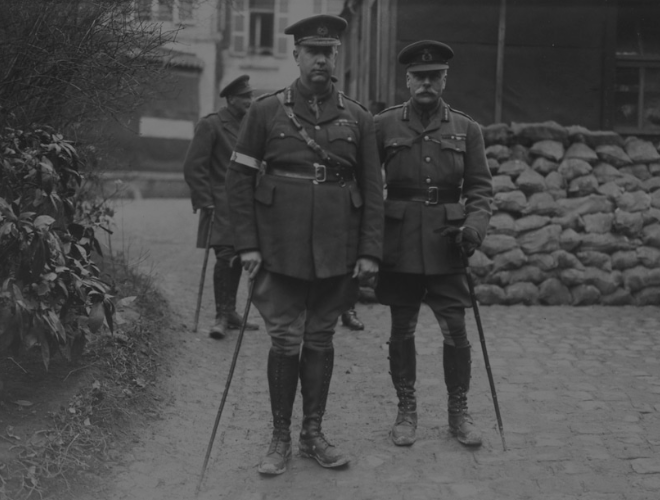
Sir Arthur Currie with Field Marshal Sir Douglas Haig, February 1918.
Libraries and Archives Canada item ID number 3404878.
The Red Ensign is a publication deeply interested in leadership; the good, the bad, and the ugly. For this reason, this Remembrance Day, I have chosen to draw the audience’s attention to the life and times of Sir Arthur Currie, the first Canadian commander of the Canadian Corps during the Great War. This presents an opportunity to both on honour and reflect upon the courage and sacrifice of the men who have fought under the flag of this great nation, but also offers the language to articulate the task facing any who would attempt to lead Canada today. As Currie’s war was defined by the challenge [of] leadership of Canadians in the context of the shifting priorities of the late British Empire, any who would seek to lead Canadians today face will struggle to harmonize efforts on behalf of the Canadian people and the priorities and policies of the American power block which he cannot eschew.
Dulce et decorum est pro patria mori; but when your country is an Imperial Dominion, who and what is “pro patria“, and how can one spend their life for them?
The Man Before the Great Man:
Arthur Currie was born in 1875 in Napperton, Ontario [50 km West of London], the third of eight children living on a homestead belonging to his grandfather. Raised with a the vigorous discipline of a Methodist home, Currie would remain a convicted Christian for his entire life, though he converted to Anglicanism as an adult. Currie was a good student, intending to pursue a career in law or medicine but dropped out of school twice, first temporarily because of the financial constraints brought on by the death of his father, and then for a second time at 19 because of a quarrel with one of his teachers. After leaving school he went West; after a string of failed efforts to establish himself via entrepreneurship and real-estate speculation he joined the Canadian militia as a gunner in 1897 in Victoria B.C. at the age of 23. A giant man (6’3″ at a time when the average Canadian height was 5’7″) with a noted eye for technical detail and, in the words of his son, a “tremendous command of profanity”, he quickly distinguished himself and was promoted to corporal before earning a commission as an officer in 1900. As an officer in peace time Currie was noted for his detailed inspections and his rapid transformation from “one of the boys”, into a rigid disciplinarian. This duality, an officer raised from the ranks, who could both embody the rigid tradition of the British military and who had an intimate familiarity with the life and ways of the enlisted men would become a defining feature of his career.
During Currie’s peace-time career as an officer he maintained a second career as a real-estate [agent]. After becoming head of Matson Insurance Firm 1904, he and the firm invested aggressively in the Victoria real-estate market. In 1913 Currie’s financial situation began to rapidly deteriorate as a consequence of price declines in the real-estate market. Currie’s financial problems nearly led him to refuse to stand up the 50th Regiment Gordon Highlanders of Canada in 1913. In July 1914 Curry used $10,833.34 of regimental funds intended for the purchase of uniforms and kit to pay his personal debts, and found himself facing forcible retirement just as the Canadian Army was being mobilized for war. At the intervention of one of his subordinates, Major Garnet Hughes, he instead accepted promotion as brigadier-general of the 2nd Brigade of the 1st Canadian Division, and ignored correspondence from the new commander of the 50th regiment, Major Cecil Roberts, about the missing funds until he was overseas.
Currie arrived at camp Valcartier on September 1st, 1914 to find himself charged with 10x as many men as he had ever led before, no staff, a shared tent as a command center, and the duty to prepare these men for one of the most difficult theatres of war the world has ever seen. The six months between taking command and the arrival of his brigade in the trenches near Ypres were marked by two mud besotted poorly supplied training camps, shoddy kit, rampant disease, and the company of a certain bear that was to become beloved by children around the world. Through this period Currie was well liked by the men, but known as a disciplinarian with an eye for technical detail. In March 1915 the brigade was deployed to what was expected to be a quiet part of the front with the intent of allowing the men to gain some experience with trench warfare before they were relied upon for action. Nobody anticipated what would happen next.
North Africa Ep. 7: Hitler says No! Rommel doesn’t care!
World War Two
Published 8 Nov 2025Rommel is called to Berlin, where he’s told to wait until May and settle for Benghazi, but he rejects that plan and decides to strike sooner. In Cairo, Wavell reads ULTRA decrypts and realizes the Luftwaffe is preparing something, while admitting he has almost nothing left to hold Cyrenaica. On the ground, the Australians storm Giarabub in a sandstorm, El Agheila is snatched after a botched British ambush, and Rommel orders preparations to hit Mersa Brega before the British can dig in.
(more…)
November 8, 2025
November 6, 2025
Lines of Fire: Operation Market Garden Part 1 of 2 – WW2 in Animated Maps
TimeGhost Cartographic
Published 5 Nov, 2025September, 1944. Soviet forces push ever westwards, slicing their way through Poland en route to Berlin. In the west, the Allies have made great strides after the invasion of Normandy, but now face a winter of relative stagnation as supply issues threaten to undercut their momentum. At this time, British Field Marshal Bernard Montgomery believes has a plan to carve a corridor through occupied Netherlands and get his forces into Germany within days, striking at the heart of the German war economy, and maybe, just maybe, ending this war before 1945 dawns. In Part 1 of 2, we look over the plan, the forces involved, and the colossal effort required to make Monty’s vision a reality.
00:00 Intro
01:12 Background
04:40 Planning
07:07 Disposition of Forces
09:05 Geographic Overview
11:30 Conclusion
(more…)
QotD: The Reformation
[W]e can thank Henry VIII (really Thomas Cromwell, I suppose, and Thomas Wolsey, and ironically Saint Thomas More) for giving us a good look at how Church administration actually functioned in the late Middle Ages. England was by far the best-governed major polity in Europe, even before the famous “Tudor revolution in government“. Lots of paperwork in Merrie Olde, and so Henry VIII’s little cock-driven temper tantrum gives us a priceless picture of how the Reformation went down.
It’s easy to get lost in this stuff — I had a long bit about Cardinal Wolsey, Thomas Cromwell, the Supplication Against the Ordinaries, the Annates Bill, and so on here — but the upshot is, pulling the Church down in England revealed the massive scale of its corruption. I want to say that the Annates Bill alone doubled the King’s revenue, and the dissolution of the monasteries (well underway in Cardinal Wolsey’s time, incidentally) unlocked unimaginable wealth. But it also fatally undermined the regime, because now an attack on the existing Church structure was also an attack on the King … and vice versa.
What you got, in short, was a total social conflagration. The “Reformation” wasn’t really about theology. Nothing Luther said was particularly new. Jan Huss and John Wyclif said basically the same things 100 years earlier; hell, St. Augustine said them 1000 years before. There’s still an irreconcilable “Protestant” strain in Catholicism now — Cornelius Jansen was just a Catholic Luther, and in a lot of ways a much better one; he was declared a heretic because reasons, and “because reasons” was good enough in Jansen’s time (the very nastiest phase of the Thirty Years’ War), but since he’s just quoting St. Augustine …
The point is, the undeniable rottenness of the Catholic Church made it a convenient whipping boy for any conceivable beef against society as a whole. Because it wasn’t just the Church that was too decadent, depraved, and corrupt to go on — it was the entirety of Late Medieval society. Again, stop me if this sounds familiar, but Late Medieval society looks a lot like spoiled, histrionic children playing dress up. They look like kings, and they act like kings (popes, bishops, etc.), but it’s obvious it’s just an act — they know they’re supposed to do these things (put on tournaments, hold jubilees, preach sermons, fight wars, etc.) but they have no idea why.
Severian, “Reformation”, Founding Questions, 2022-03-07.
November 5, 2025
Hands To Flying Stations (1975)
David Bober (Royal Navy Films)
Published 25 Jun 2013Official govt film uploaded as “fair use”. Naval Instructional Film A2690.
Royal Navy documentary from 1975 featuring aircraft carrier HMS Ark Royal (R09). The film details flight operations aboard the Ark. Aircraft in the film include the Phantom FG1, the Buccaneer S2, the Gannet AEW3, the Wessex HAS1 and the Sea King HAS2.
HMS Ark Royal (R09) was an Audacious-class aircraft carrier built by Cammell Laird, Birkenhead and commissioned into the Royal Navy on 25 February 1955. She was decommissioned on 14 February 1979 after 23-years service. She was the last operational RN aircraft carrier to use “cats and traps” (conventional catapult launch and arrested landing). The Ark featured in the 1976 BBC television series Sailor.
November 2, 2025
“Why not go all the way and order His former Royal Highness to wander the streets as Mr Sarah Ferguson?”
Mark Steyn has a bit of fun at the expense of the artist formerly known as Prince Andrew, His Royal Majesty King Charles III, and the current British government:
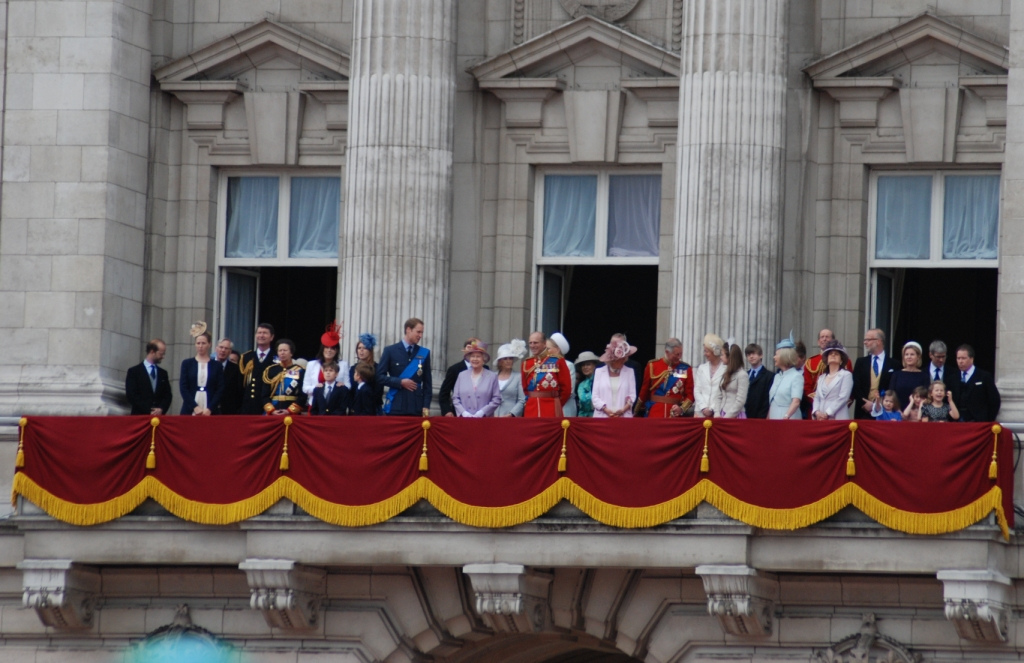
The royal family at Buckingham Palace for the Trooping of the Colour 2010, 30 June, 2015.
Photo by Robert Payne via Wikimedia Commons.
Last night, HM The King announced that his brother, until recently HRH The Duke of York KG KCVO, will now be formally stripped of all his titles, styles and dignities and will be reduced to trying to book fashionable London restaurants — or even Pizza Express in Woking — as plain old Mr Andrew Mountbatten Windsor. As longtime readers may recall, I dined at Buckingham Palace, midst princes, dukes, earls, viscounts and knights, as the only mister at the table and rather enjoyed it — although, even at that lowly rank, the sense of remorseless imperial decline down the decades is palpable: from Mr Gladstone … to Mr Steyn … to Mr Mountbatten Windsor … Why not go all the way and order His former Royal Highness to wander the streets as Mr Sarah Ferguson?
Be that as it may, it was the final sentence in the Palace’s 109-word statement that caught my eye:
Their Majesties wish to make clear that their thoughts and utmost sympathies have been, and will remain with, the victims and survivors of any and all forms of abuse.
Had the King said that to me in person, I would have had great difficulty in restraining myself from punching him on the nose. Their Majesties have never expressed any “utmost sympathies” for the thousands upon thousands of their own young subjects in virtually every town up and down what passes for the spine of England gang-raped, sodomised, urinated on, dangled off balconies, doused in petrol, burned alive, fed into kebab mincers, etc. A decade ago, when I first met “grooming gang” victims in Rotherham, one of Sammy Woodhouse’s chums told me that “Charles and Camilla” were said to have expressed interest in meeting with survivors — although Sammy herself, ground down by official dissembling even then, expressed some cynicism as to the likelihood of any such Royal audience ever happening.
It never did. The Prince of Wales has his Earthshot campaign to save the planet, and for a while the Duke of Sussex had his HIV-Aids charity in Botswana and Lesotho. You would think one’s “utmost sympathies” for such uncontroversial apolitical causes as climate change and Aids could be easily extended to little girls taken as sex slaves — particularly when it’s visible from the sod-bollocking turrets of Windsor Castle. Just to pluck at random, less than three miles from St George’s Hall, where the King uncontroversially celebrates Ramadan iftars and where equally uncontroversially Princess Beatrice’s masked ball once hosted not only Jeffrey Epstein but also Harvey Weinstein … how does the old song go? “I Danced with a Perve who Danced with a Girl who Danced with the Prince of Wales“? Anyway, less than three miles from Windsor Castle lies Diamond Road in Slough, where a chap called Azid Ahmed was found to have engaged in “five acts of sexual activity with a child”.
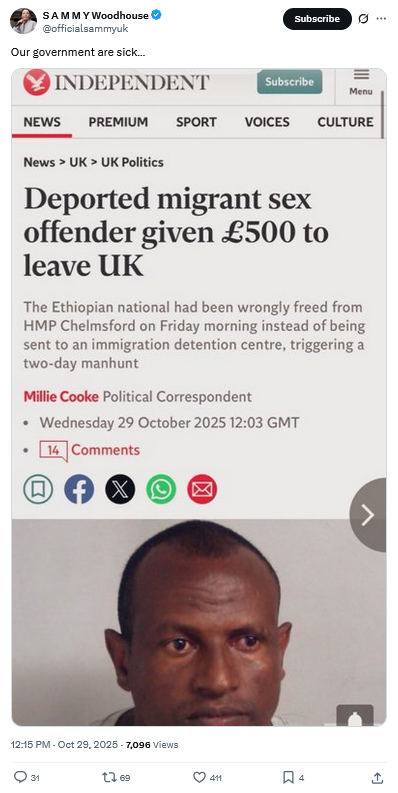
Any “utmost sympathy” for that victim, sir? Or does your sympathy in such matters not extend beyond the territorial waters of Epstein Island? England is a land that, literally, rewards sex predators. If you want the Andrew Formerly Known as Prince to bugger off out of sight, why not give him a year’s salary as the British state has just done to Hadush Kebatu? Mr Kebatu is the Ethiopian who two days after arriving by dinghy sexually assaulted a fourteen-year-old schoolgirl in Epping and set off the summer of “far-right” “racist” protests. He was convicted and imprisoned at HMP Chelmsford, which then managed to release him — “accidentally”. He spent two days wandering around the most surveilled city on earth and piling up enough camera footage to outpace the director’s cut of Lord of the Rings. So, for the crime of embarrassing Sir Keir Starmer, he was immediately put on a flight to Addis Ababa and given five hundred quid if he would agree not to contest his deportation.
Average annual salary in Ethiopia: 524 pounds sterling. So Hadush Kebatu is back home living large and telling friends he had a great holiday in England and this King Charles guy paid him a year’s wages for raping a fourteen-year-old.
Next time (he’ll be back by Christmas) he should make like Harvey Weinstein and hold out for a CBE.
The taqiyya mayor of London, soon to be joined by the taqiyya mayor of New York, claims that the “King apologised for taking so long to knight me“. I can well believe it. So Sir Sadiq Khan now outranks Mr Mountbatten Windsor at state banquets (my palace dinner was a little more informal, so I got to sit between Sir Angus Ogilvy and the Earl of Carnarvon). Is that because Sir Sadiq has also expressed his “utmost sympathies” for “victims and survivors”? Not at all. As the political overseer of the Metropolitan Police he has consistently lied about the existence of any Pakistani Muslim rape-gangs in London. The official position of the British state was that “grooming gangs” may all very well be operating in Newcastle, Middlesborough, Blackpool, Bolton, Manchester, Rotherham, Sheffield, Nottingham, Telford, Leicester, Birmingham, Coventry, Banbury, Aylesbury, Oxford, High Wycombe … but that it all mysteriously grinds to a halt once you hit the outskirts of the Metropolitan Line.
Alas, there are now so many dark secrets swept under the rug even Scotland Yard has noticed the bulge. So the Met has just announced they’re “reviewing” one or two … er, actually, no, nine thousand cases of “grooming”.
The striking feature of the end-phase Yookay is its total lack of “utmost sympathies”. Earlier this week, in Uxbridge (where, as it happens, the Metropolitan Line does end), an apparently pleasant fellow called Wayne Broadhurst was taking his dog for a walk when he was fatally stabbed by an Afghan who’d arrived in Britain in the back of a lorry and had, as is traditional, been given “leave to remain” — because of his potential contribution to GDP through increased machete sales.
North Africa Ep. 6: Do You Smell What The Fox Is Cooking?
World War Two
Published 1 Nov 2025Rommel pushes his HQ toward the front, seizes the oasis at Marada, and sends a long-range Italo-German column deep toward Murzuk to harden his forces for true desert warfare. A brutal Ghibli sandstorm shows how the Sahara itself is a third enemy, choking engines, wrecking vehicles, and nearly killing Rommel in the air. At the same time, ULTRA intelligence finally reaches Wavell, Malta’s bombers are forced off the island under relentless Luftwaffe pressure, and Rommel is already ordering preparations to hit El Agheila despite supposedly leaving for Berlin.
(more…)
October 31, 2025
Halloween Special: Doctor Jekyll and Mister Hyde
Overly Sarcastic Productions
Published 31 Oct 2019Some monsters are undead creatures of the night. Some monsters are cosmic horror nightmare gods. Some monsters are existential personifications of dread and decay. But perhaps the greatest monster of all… is man.
Have a very spooky Halloween! And don’t forget the explicit moral of Jekyll and Hyde — that the greatest danger you’ll ever face comes from wealthy middle-aged white men who get away with their crimes because society refuses to believe they would ever do such horrible things. … Hm. Are we SURE this was written in 1886 …?
(Topic originally requested by patron Kyakan!)
MERCH LINKS: https://www.redbubble.com/people/OSPY…
OUR WEBSITE: https://www.OverlySarcasticProduction…
October 30, 2025
Cowardice & Courage – Fear, Flying & Combat Stress
HardThrasher
Published 24 Oct 2025Just getting into a bomber took guts. To do it twice required balls of steel. What happened when men wouldn’t or couldn’t continue to fly? We’ll look at the dangers they faced, what the RAF and the USAAF did to tackle the problem and talk about the infamous “LMF” cases in the RAF
00:00 – Come with Me
03:51 – Intro
04:16 – Shell Shock
06:00 – Inter War vs Early War
09:17 – Night Terrors
10:31 – Death in the Daylight
11:00 – Common Fears
13:22 – Raw Numbers
14:55 – The Mew Who Flew
16:35 – In The Hands of the CO
18:53 – LMF
21:01 – Combat Stress in the USAAF
22:03 – Attempts at treatment
24:47 – Wrap up and Closing Message
(more…)
October 29, 2025
The Making Of Modern London – The Heyday of London Transport 1914 – 1939
Classic Vehicle Channel
Published 15 May 2020A lovely documentary telling the story of the development of the London transport system from 1914 to 1939 — The heyday of London Transport. This film features awesome archive footage of buses, trams and London street scenes from the time. It’s one of a number of episodes this one featuring London’s transport system.
I’ve cut out the LWT adverts but I have left two in that I think you’ll love!
This film was broadcast by London Weekend Television in 1984 and later by CH4.
Written, Directed & Narrated by Gavin Weightman
October 28, 2025
Whitechapel protest – “an unholy union of witless leftists and menacing Islamists”
In Spiked, Brendan O’Neill discusses the weekend protest in the Whitechapel area of London, after the police had prevented a UKIP event in the same part of the city:
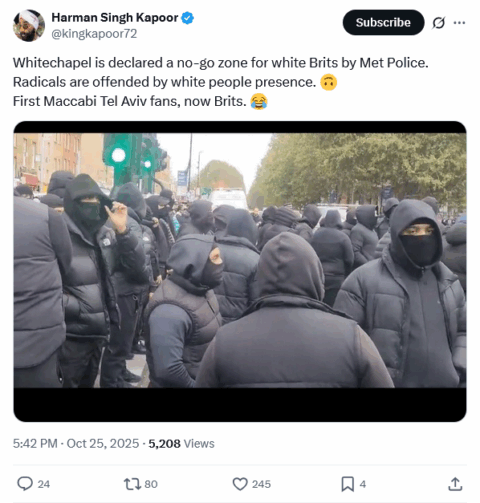
The next time someone asks what we mean when we say “Islamo-left”, I’m going to show them footage from yesterday’s protest in Whitechapel in East London. What a morally suicidal schlep that was. What an unholy union of witless leftists and menacing Islamists. “Refugees welcome here!”, cried the granola-fed grads of the limp-wristed left. “Allahu Akbar!”, barked the masked mob of religious hotheads. Rarely has the lethal idiocy of the left’s bed-hopping with Islamism been so starkly exposed.
This assembly of godless genderfluids and Koran-botherers was ostensibly a march against UKIP. That knackered old party had hoped to hold its own protest in Whitechapel yesterday. It was clearly a provocation: they targeted Whitechapel precisely because it has a large Muslim population. A Ukipper’s wet dream is to wang on about “Islamist invaders” and the need for “remigration” as Bangladeshi Brits look on with alarm. A wind-up masquerading as a march. The Metropolitan Police, fearing “serious disorder”, put the kibosh on it and told UKIP to do their wailing elsewhere.
So they went to Whitehall instead. Around 75 of them gathered outside the London Oratory with their flags and their hernias. And Whitechapel was left to the Islamo-left, to that seething mob of plummy radicals and gruff Islamists who love to scream blue murder about “Zionists”. And there you have it: in the eyes of the Met it is an offence against decency to let a handful of Ukippers traipse through Whitechapel, but it is absolutely fine to surrender those same streets to columns of black-clad fanatics raging against “Zionist scum“. The hypocrisy stinks to heaven.
The anti-UKIP counter-demo in Whitechapel was not an anti-racist march. We all know it. The dogs in the street know it. It was an orgy of intolerance dolled up as tolerance. It was a display of Islamist arrogance wearing the thin veil of “anti-racism” to fool the overeducated idiots of the bourgeois left. Well, if they’ll believe someone with a cock can be a lesbian, they’ll believe Islamist fanatics who dream of annihilating the Jewish homeland are anti-racists.
For those of us who still have a quaint attachment to the virtues of reason and secularism, it was a sickening spectacle. Mobs of men in black masks hollered Islamist slogans in a distinctly menacing manner. They denounced “Zionist scum” and darkly promised to hound them “off our streets”. They yelled “From the river to the sea” (translation: destroy the Jewish homeland) and sang the praises of “our martyrs” (translation: the Jew-killers of Hamas). And all the while, the pricks of the new left who think it’s bigotry to say “he” about a fella in a dress just stood there smiling.
Anyone who says “They were just criticising Zionism” is going to get slapped. Our crisis is too pressing for pussy-footing. When the devotees of a hardcore species of Islam take to the streets to fume about “Zionists”, we know who they mean. We know they don’t mean people like me – Gentiles who support Jewish nationhood. It’s not the likes of us they want to drive out of Britain, 1290-style. It’s them. Those Zios. The kippah people. Are we really going to do that dumb dance of saying, “Criticising Zionism is not the same thing as hating Jews”? Stop it. I’m tired.
Here’s my question: why is it racism for Ukippers to dream of expelling “Islamist invaders” from the UK, but anti-racism for Islamists and their posh simps on the left to agitate for the expulsion of “Zionists” from Britain’s streets? I agree UKIP’s chants were racist. To brand Muslims “Islamist invaders” and demand their “remigration” is vile bigotry. But why can’t the left say the same about the Zio-bashing that we all know is Jew-bashing? Far from calling that out, they snuggle up to it. They fancy themselves as the righteous enemies of racism when in truth they are the obsequious fluffers of Islamist bigotry.
Andrew Doyle on the “useful idiots” at the protest:
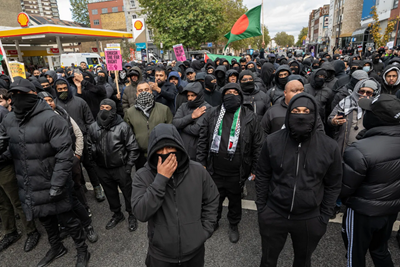
There is a species of leftist that is so blinded to the lack of compassion in its enemies that it sees them as friends. The Chinese even have a word – baizuo (白左) – to describe white Western liberals whose generous nature leaves them open to exploitation. I am reminded of Nietzsche’s remark in Beyond Good and Evil (1886): “There is a point in the history of society when it becomes so pathologically soft and tender that among other things it sides even with those who harm it, criminals, and does this quite seriously and honestly”. For the most egregious example of recent years, look no further than the absurdly self-defeating phenomenon of “Queers for Palestine”.
What happened at Tower Hamlets this weekend was a show of strength. The video footage makes that clear enough. Men blocked the streets to pray to Allah in public as a sign of religious dominance, while other men roamed aggressively, virtually daring anyone to object. Women were notably absent.
These chest-thumping, territorial displays followed the Metropolitan Police’s decision to ban a UKIP march through the East End under the banner of “reclaim Whitechapel from the Islamists”. With a significant Muslim population in the area – 40% in Tower Hamlets – this was always bound to provoke. Of course, protests are by their nature provocative, or they wouldn’t be protests. Islamic supremacists are likewise permitted to march peacefully, but we shouldn’t be foolish enough to ignore what this demonstration portends.


