
Real Time History
Published 4 Jul 2025In the summer of 1940, the British Empire faces German attacks against the home islands a new Italian adversary in the Mediterranean Sea, the lifeline to its colonies around the globe. In a series of campaigns the British beat back the Italians and eliminate parts of the French fleet. But the service of its overseas subjects won’t come for free.
(more…)
November 23, 2025
Battle for the Mediterranean, 1940
Comments Off on Battle for the Mediterranean, 1940
November 22, 2025
“Whig history”
If you’ve read any history books written before the Second World War (aside from explitly Marxist interpretations), you’ll probably recognize the worldview which, subtly or overtly, informed the stories being told (and those not mentioned). On her Substack, Mary Catelli discusses “the Whig interpretation of history”:
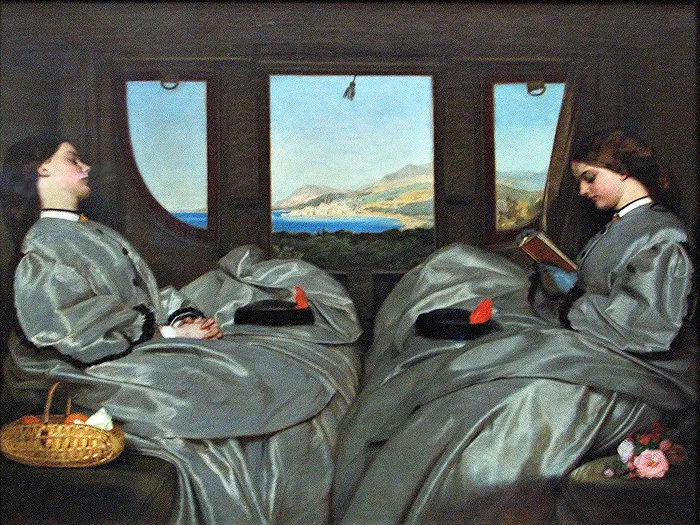
Among the many perils of viewpoint that lurk in your path when you read history, one of the nastiest is the Whig Interpretation of History, and its variants, and other teleological views.
The original interpretation, popular in British history writing of the 19th century, was that all of history had been aiming for the wonderfully wonderful wonder that was 19th century Britain. And if it was not quite so smooth as a train ride gliding over well-laid tracks, it was unnecessary to point out minor details.
The most disastrous effect, for the reader, is that the things of the past are described for their presumed effect on the progress toward that aim. They were not described for their actual effect on the era, or how they appeared to the people of that era (possibly more important for the fiction writer), which is what a reader using them for that era needs. Down to and including excluding vital details as unimportant.
(Obviously, “development of what they regard as progress” books are more or less resistant to this, though they can press some very odd things into the service of their thesis, and sandpaper off quite a bit of things they deem anomalies. It is when it colors works about something else — or nominally about something else — that the peril really arises.)
Plus of course any coloring the viewpoint gives them in regarding the people of the era as stepping stones toward the ideal future. In particular, the heroes and villains are assigned not for the moral character of their deeds but whether they sped history along the right path. Frequently enough, any openly and clearly stated motives by the historical figures will be breezed over for the “real” motives according to the historian’s agenda. Some quote the primary source and not even apparently noticing that it contradicts the agenda before writing as if the historical figures’ intentions matched the agenda.
H. G. Wells, in The Outline of History, gets all starry-eyed about any attempt, or success, at union between countries because he’s looking forward to the beneficent World State, regardless of how the union was imposed, and what its consequences were, and again looking with a jaundiced eye on any division regardless of how justified.
It would be easier if the issue were limited to the historians of that school, but, of course, anyone who regards history in light of a progress toward the wonderful present — or future — will have the same issues. World War I hit the original Whig interpretation quite hard, but the Marxist interpretation kept roaring along, and is not quite dead yet.
Comments Off on “Whig history”
November 20, 2025
Our free-speech documentary has been cancelled! | A London cinema has banned Think Before You Post
spiked
Published 19 Nov 2025Our new documentary, Think Before You Post, about the rise of the British speech police, was due to have its premiere in London next week. Last night, the venue got in contact to say it would be cancelling our booking, because the event does not align with its “values”.
Here, spiked‘s Tom Slater tells all.
We are working flat-out to find a new venue for the same night. So if you bought tickets, do bear with us. But if we can’t find somewhere else in time, we’ll refund everyone and postpone it for a later date. If you’d like a refund now anyway, get in touch and we’ll process it.
At least they’re proving our point …
About spiked:
Founded in 2000, spiked was a pioneer of 21st-century journalism – the first online-only political magazine in the UK.
Now edited by Tom Slater, spiked reaches millions around the world with hard-hitting articles, incisive essays and a growing roster of podcasts and videos.
Comments Off on Our free-speech documentary has been cancelled! | A London cinema has banned Think Before You Post
November 19, 2025
Ken Burns’ The American Revolution gets the Howard Zinn seal of approval
CDR Salamander is persuaded, against his better judgement, to watch the latest Ken Burns documentary … and discovers that it’s somehow still 2018-2022 in Burns’ world:
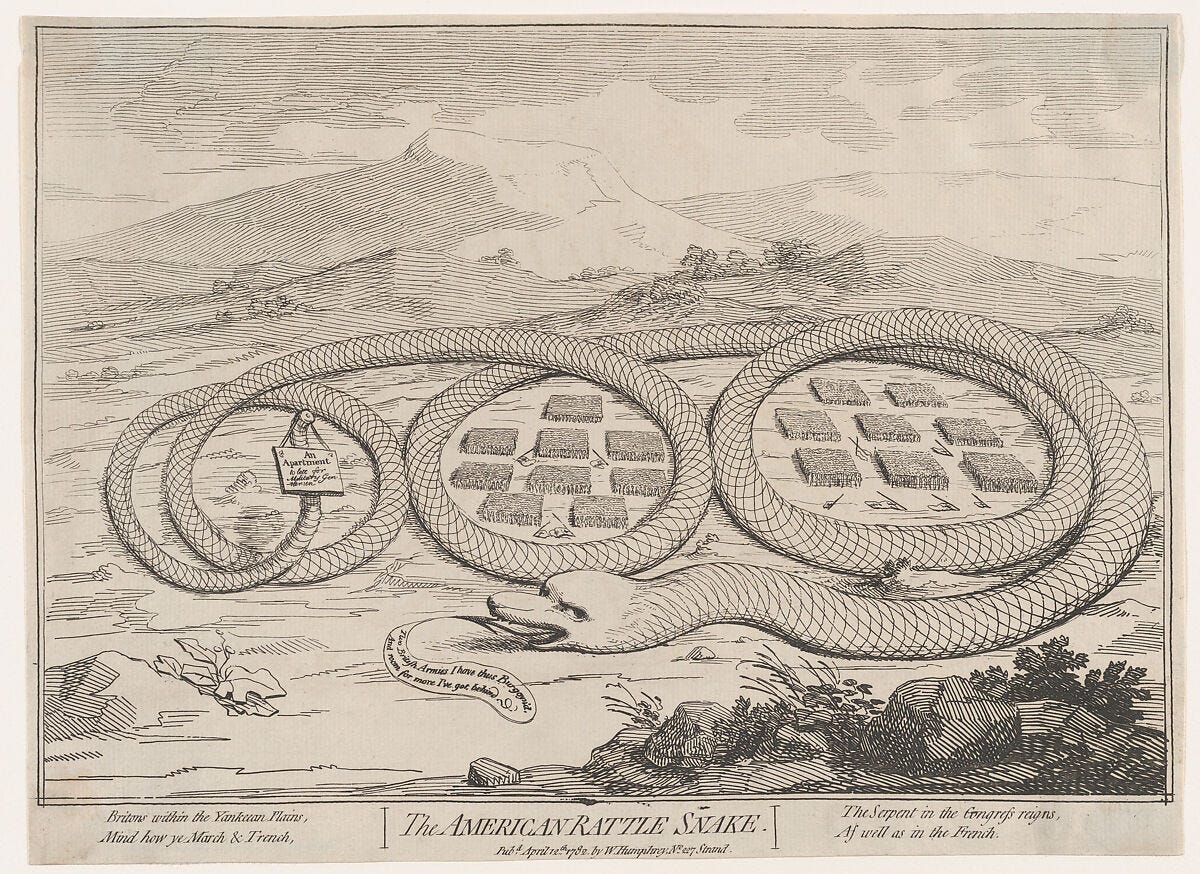
So, I’ve watched the two episodes of Ken Burns’s documentary, The American Revolution, in spite of my stated zero desire to do so. Why? If you are not up to speed with the MSNBCification of Ken Burns over the last decade, catch up.
Anyway, as Mrs. Salamander knows more about the American Revolution than 99.7% of people out there, she insisted we watch it. I’ve been married for over three decades for a reason, so I sat down with her to watch.
FFS.
… and … it started with a land acknowledgement. ISYN.
It doesn’t get better.
By the end of episode two we’ve gotten through the Battle of Bunker Hill, yet there has been no mention of John Locke, Montesquieu, or any of the other philosophical drivers of the revolution. They have plenty of time to quote the memories of an old man about what he thought of George Washington when he ran into him when he was 8 (it wasn’t good).
Let’s pause there a bit. It is clear that they made a decision that for every good thing they say about GW in the first two episodes, they insist on finding a way to smear him with presentism. It is also clear that he really wants to do a documentary on African Americans in the Revolutionary War, but couldn’t get the funding for that. Instead there is a constant referring back to slavery and racial issues. Just overdone to the point of being obvious, given that they were, at best, tertiary issues during the war. It deserves mention, but not in this ham-fisted, patronizing manner it is being done … and done mostly to smear GW up.
The presentism and biased scholarship is not shocking if you’ve read my reports at my Substack over the years about the absolute woke-soaked state of American historical organizations such as the American Historical Association. (see my FEB 2021 Substack, “The War on (Military) History: Half a Century In” for reference.)
The smearing of GW like this is more than “balance” — it is emblematic of the presentism that makes so many modern virtue signaling tiresome — and exactly meets the low expectations I had for this documentary.
There is also the pettiness of their choices of what to comment on, and how — the smug New England perspective of the Acela Corridor that is Ken Burns’ intellectual terrarium. Just one example from the second episode: the arrival of the Virginians to support the patriot forces around Boston. Might as well have called them rednecks.
Even Mrs. Salamander, halfway through Ep. 2, had about enough of the shoehorned in identity politics of “inclusion” … as if everyone ever got over the fever of 2018-2022.
Comments Off on Ken Burns’ The American Revolution gets the Howard Zinn seal of approval
Julia: A Feminist Retelling of 1984?
Feral Historian
Published 11 Jul 2025Julia, a 2023 novel by Sandra Newman, does more than just retell Orwell’s 1984 through Julia’s eyes. That perspective switch presents an Oceania that is both more mundane and more familiar. It’s certainly a companion piece more than a stand-alone work, but it does have something to offer both in how it examines Orwell and a few times, how it contradicts him.
00:00 Intro
02:18 a Different Perspective
09:30 Caught in a Trap
12:45 Backstory
15:40 Departures
20:18 Endings and Beginnings
(more…)
Comments Off on Julia: A Feminist Retelling of 1984?
QotD: Rum Sodomy & the Lash
Released 40 years ago by London Irish legends the Pogues, the album is named not after a decent night in old Soho, as the title would suggest, but an apocryphal quote of Churchill’s. “Don’t talk to me about naval tradition,” he’s purported to have said. “It’s nothing but rum, sodomy, and the lash”. For many years, listening to the album while writing and drinking in this adopted riverside local, I’d no idea it was recorded a stone’s throw away in Elephant Studio, in the basement of Metropolitan Wharf. Or that the pubs of the area, such as this one, were frequented by Pogues musicians: their frontman and chief songwriter Shane MacGowan and the album’s producer Elvis Costello.
The album was even launched on the river, upstream, on board HMS Belfast with the band wearing Nelson-era naval regalia. They’d been ferried to the moored cruiser from Traitor’s Gate, arriving to find the assembled journalists (one of whom ended up, temporarily, in the Thames) already tearing into the drink. After the gig, MacGowan’s admiral’s hat vanished; in one story settling onto the river bed with all that other historical debris. At the time, the album felt like a raucous act of vandalism. Now, it’s viewed almost universally as a stone-cold classic.
The cover, a remade version of Géricault’s The Raft of the Medusa, where the band themselves are among the wretched shipwrecked crew, acts as a framing device. What Rum Sodomy & the Lash does is allow erased, abandoned or sidelined histories to erupt — the piratical and press-ganged, the adventurous and the damned — in a way that gracefully, modestly hides the band’s self-taught virtuosity and the lyricist’s songwriting genius. It was an album that, at that time, socially and politically, shouldn’t have existed, but through courage and sheer force of nature had to.
The Thames may not forget, but society is all too willing to. There are, alas, few signs of gratitude or even recognition of the colossal impact the Irish have had on London. A statue of Oliver Cromwell, the Butcher of Drogheda, stands pride of place outside the House of Commons, but there’s scarce trace of his Hibernian victims. It took the London Irish Centre to erect a plaque in Camden Square, in 2017, to the “Forgotten Irish”, “who left their homes, counties and country … to work and rebuild this city and country, ravaged and destroyed by war … Many would never return to Ireland”.
[…]
Even at the time of the album, in fact, the Pogues ran into opposition, and not just among musical snobs and gatekeepers in England. In Ireland, their adversaries were two-fold — traditionalist embalmers of folk music, and cringe-beset “cosmopolitans” who were mortified with anything too Irish, too plebian, too diasporan. Ironically, it turned out that the Pogues were far more effective custodians of Irish traditional music, and more authentic examples of cosmopolitan hybrid-culture, than their adversaries, exemplifying the maxim that, “Tradition is not the worship of ashes, but the preservation of fire”.
At the heart of Rum Sodomy & the Lash‘s success and legacy is embrace of apparent opposites: high and low culture, Ireland and England, city and rural, home and exile, intellect and soul, sacred and profane, debauchery and dignity, stars and gutter. So you get “Navigator”, a tribute to the Irish workers who built the railways, and MacGowan’s rowdy “Sally MacLennane”, a tribute to his uncle’s Irish pub in Dagenham, the Irish car-making workforce it served and the real-life characters he encountered, some less than salubrious. There’s also a fierce and atmospheric instrumental, “The Wild Cats of Kilkenny”, inspired by Spaghetti Westerns, or else the industrial hangover of Ewan MacColl’s “Dirty Old Town”, especially poignant at a time of deindustrialisation.
The true legacy of the Pogues exists not in print, of course, but in music. Their inheritors include the drone and conscience of the modern band Lankum, the otherworldly transformations of the past in the music of Lisa O’Neill and John Francis Flynn, and the pulse of the new in Fontaines DC. But the album also impels its listeners to articulate discontent, defy the rot, preserve the fire, to genuinely transgress, to face reality in surreal or raw terms, to lament and howl not in the transience of placards or social media, but in an art form that hits far deeper, than rusting plaques, and lasts much longer. It’s all out there, more than ever, out of sight, below decks or at the bottom of the river, waiting to escape.
Darran Anderson, “The Pogues soundtracked Irish London”, The Critic, 2025-08-05.
Comments Off on QotD: Rum Sodomy & the Lash
November 18, 2025
Vickers Heavy Machine Gun
Forgotten Weapons
Published 14 Dec 2016I may be a bit biased here, but I believe that the Vickers gun is one of the best all-around firearms ever made. It was designed during an era of experimentation and craftsmanship, with a quality and care that would make it today prohibitively expensive. It was exemplary in action, and served in every environment on earth through six decades and in the hands of 50 different nations. It was an infantry gun, an aircraft gun, an armored vehicle gun, and a shipboard gun.
Captain Graham Hutchison recorded this account of the Vickers in action during an attack on High Wood in August 1916 (exerpted from “The Grand old Lady of No Man’s Land by Dolf Goldsmith):
“For this attack, [ten] guns were grouped in the Savoy Trench, from which a magnificent view was obtained of the German line at a range of about 2000 yards. These guns were disposed for barrage. On August 23rd and the night of the 23rd/24th the whole Company was, in addition to the two Companies of Infantry lent for the purpose, employed in carrying water and ammunition to this point. Many factors in barrage work which are now common knowledge had not then been learned or considered. It is amusing today to note that in the orders for the 100th Machine Gun Company’s barrage of 10 guns, Captain Hutchison ordered that rapid fire should be maintained continuously for twelve hours, to cover the attack and consolidation. It is to the credit of the gunners and the Vickers gun itself that this was done! During the attack on the 24th, 250 rounds short of one million were fired by ten guns; at least four petrol tins of water besides all the water bottles of the Company and urine tins form the neighborhood were emptied into the guns for cooling purposes; and a continuous party was employed carrying ammunition. Private Robertshaw and Artificer H. Bartlett between them maintained a belt-filling machine in action without stopping for a single moment, for twelve hours. At the end of this time many of the NCOs and gunners were found asleep from exhaustion at their posts. A prize of five francs to the members of each gun team was offered and was secured by the gun team of Sgt. P. Dean, DCM, with a record of just over 120,000 rounds.”
The attack on the 24th of August was a brilliant success, the operation being difficult and all objectives being taken within a short time. Prisoner examined at Divisional and Corps Headquarters reported that the effect of the Machine Gun barrage was annihilating, and the counterattacks which had attempted to retake the ground lost were broken up whilst being concentrated east of the Flers Ridge and of High Wood.
In 1963 in Yorkshire, a class of British Army armorers put one Vickers gun through probably the most strenuous test ever given to an individual gun. The base had a stockpile of approximately 5 million rounds of Mk VII ammunition which was no longer approved for military use. They took a newly rebuilt Vickers gun, and proceeded to fire the entire stock of ammo through it over the course of seven days. They worked in pairs, switching off at 30 minute intervals, with a third man shoveling away spent brass. The gun was fired in 250-round solid bursts, and the worn out barrels were changed every hour and a half. At the end of the five million rounds, the gun was taken back into the shop for inspection. It was found to be within service spec in every dimension.
During its service life, the Vickers was made in .303 British, .30-06, 0.50 Vickers, .50 High Velocity, 7×57 Mauser, 7.65×53, 8mm Mauser, 8mm Lebel, 7.7 Japanese, 6.5×54 Dutch, 7.9x57R Dutch, 7.62 NATO, 7.62x54R, 8x52R Siamese, 11mm Vickers, and three different 40mm cartridges.
The Vickers was retired from British military service in 1968, having finally become obsolete. Its GPMG role was taken over by the FN MAG, and its long range indirect fire role performed by 3″ mortars. The Vickers was a weapon which required training and dedication to master, but rewarded its users with phenomenal endurance and a wide range of capabilities. Among all contenders, only the Browning machine gun can attempt to compare to the outstanding qualities of the Vickers, and even the Browning fails to match the elegance of the stalwart Brit.
QotD: Echoes of the Thirty Years’ War
The analogy only extends so far, of course. Hillaire Belloc has argued that the dissolution of the monasteries in England kicked out one of the three legs supporting English culture — by putting all that land and money under the State’s direct control (that “Tudor revolution in government” again), the State and the Economy are inextricably merged. It’s proto-fascism (recall that The Servile State was written in 1912). Not only is this true, it doesn’t go nearly far enough. Back in 1912, the Church was still alive as a cultural force. The Media was still at least somewhat capitalist — in competition for eyeballs — and in many cases led The Opposition, which also still existed as a cultural force.
Nowadays, of course, not only are the State and the Economy indistinguishable, they’re also indistinguishable from The Media. There IS no “opposition”; whatever anemic resistance to The State is stage managed like pro wrestling. Real dissidents are in the positions of recusants in Tudor England, except that the Church, instead of sending priests to minister to us in secret, is sending battalions of Inquisitors to help hunt us down.
In short, there’s no entry point for a new “Reformation”. As bad as the Period of the Wars of Religion was, gifted leaders had structural ways to achieve their objectives and keep the peace. Henry of Navarre could proclaim that “Paris is worth a mass”; Cardinal Richelieu could proclaim raison d’etat; the old Peace of Augsburg system — cuius regio; eius religio — could work well enough with a prince who understood his people and chose not to push too hard. “Separation of Church and State” wasn’t articulated as a formal political principle until the 19th century (and only there because it was badly misconstrued), but as a practical solution to politico-cultural problems it works just fine …
… provided you’ve got the structures in place to handle it, and we don’t. The Church, the State, the Economy, the Media, Academia, Technology … who can say where the one ends and the other begins? It’s all Poz, and there’s no aspect of our lives that the Poz doesn’t touch, because instead of separate and often competing socio-governmental structures, they’ve all merged. They’re ALL Poz.
Severian, “Reformation”, Founding Questions, 2022-03-07.
Comments Off on QotD: Echoes of the Thirty Years’ War
November 17, 2025
Cyprus on Fire: The 3-Way War That Broke an Empire – W2W 053
TimeGhost History
Published 16 Nov 2025Cyprus, 1950s–60s. An island divided between Greek Cypriots, Turkish Cypriots, and the British Empire becomes the battleground for one of the Cold War’s most explosive regional crises. What begins as a struggle for independence soon spirals into a three-way conflict of nationalism, colonial strategy, and clashing identities — with Archbishop Makarios III, paramilitary groups, Athens, Ankara, and London all pulling in different directions.
In this episode of War 2 War, we uncover how Cyprus became:
- A central front in the decline of the British Empire
- A stage for espionage, guerrilla warfare, and political assassinations
- A diplomatic nightmare for NATO
- A struggle where UN peacekeepers become critical to preventing total collapse
- A conflict whose consequences still shape Europe and the Eastern Mediterranean today
We’ll trace the rise of EOKA, the reaction in the Turkish Cypriot community, the impossible balancing act of Makarios III, and how superpower pressure from the USA and USSR escalated an already volatile situation.
This is the hidden story of how one island’s crisis reshaped the politics of an entire region — and marked the end of Britain as a global imperial power.
(more…)
Comments Off on Cyprus on Fire: The 3-Way War That Broke an Empire – W2W 053
November 16, 2025
North Africa Ep. 8: The Forgotten Battle of Mersa El Brega
World War Two
Published 15 Nov 2025At Mersa Brega a thin British screen, one reinforced battalion with guns, holds a superb defensive choke point until Stukas, artillery, and Panzer Regiment 5 grind it down. Cemetery Hill falls under bombardment, counterattacks stall, and a northern flank probe finally forces a retreat: Rommel’s first major victory in the desert, bought against strong ground and stubborn infantry.
(more…)
Comments Off on North Africa Ep. 8: The Forgotten Battle of Mersa El Brega
November 14, 2025
Why didn’t the Allies Attack Germany in 1939? (The Phoney War)
Real Time History
Published 20 Jun 2025On September 1, 1939, Germany invades Poland, setting off the Second World War. Two days later, Britain and France declare war on Germany. As the German army races towards Warsaw, many German generals are worried the French might simply walk into western Germany, and there’s not much the Wehrmacht can do about if they do. But instead of a powerful Allied counteroffensive, the French and British mostly sit back and wait during the so-called Phoney War – so why didn’t the Allies attack Germany in 1939?
(more…)
Comments Off on Why didn’t the Allies Attack Germany in 1939? (The Phoney War)
November 12, 2025
Bike lanes are only the start
Spaceman Spiff explains how aspirational schemes proposed by our technocratic governments at all levels seem to quickly and effortlessly shift from a nice non-intrusive improvement in life to an overbearing imposition of ever tighter controls on our lives:

Bike lanes on Yonge Street north of Bloor Street in downtown Toronto.
Image from Google Street View
The adoption of cultural novelties follows a predictable path. Some bright idea is proposed and there is nominal support or at least not widespread opposition.
Soon after implementation begins its opposite is condemned. This is the first warning the lunatics have taken over the asylum. We move from a positive, optimistic drive to condemning a perceived negative. By then the intolerant are amassing, attracted to a secular pulpit with which to lecture the rest of us.
More time passes and condemnation of the opposite is not enough. We are commanded to behave in ways more pleasing to our public servants. We learn a key aspect of our future has been decided by a shadowy committee we have never heard of. A well-meaning experiment has become an imperative used to control us.
This absurd sequence is more common than it should be.
A common example in Britain is the creation of bike lanes.
The idea sounds benign. Let’s build cycle lanes to encourage exercise. It is broadly popular, a kind of inoffensive fad to encourage better health despite the weather being an impediment for most.
Few people actively object which is taken to mean they endorse these projects.
It is not long before support for helping cyclists degenerates into discouraging cars since people should be cycling more anyway. The initiative lends moral weight to an otherwise fringe view. The construction of the bike lanes accelerates these ideas as roads are narrowed and traffic slows, frustrating many. There are too many vehicles on the road we are told, all the more reason to get on your bike.
Soon suggestions are made to ban cars completely. The new idea proposed is to shut down the congested roads and replace them with even more bike lanes and pedestrian zones.
Some even openly discuss intentionally making driving awkward and expensive as an explicit goal. The technocratic mind often forgets its charges are people not slaves.
Before long everything shifts, then we wonder how we got to the point our own paid employees can openly gloat we will soon be banned from travelling in ways they dislike as if they are our controllers.
An idea appealing to a minority is imposed on all. Acquiescence to novelties becomes weaponized and subsumed into the ambitions of others. No one ever votes for these things. They seem to just appear.
The end result is often the destruction of goodwill as popular initiatives are rammed down our throats and used to berate us for failing to live up to the standards our public servants impose upon us.
We then tire of the lectures. We wonder where these lunatics come from.
A moment of complacency means unwanted bike lanes but before long it is banned cars, government-controlled IDs and digital currencies. Those who pay attention to the activist world often sense they’d build concentration camps if they could get away with it and all thanks to some benign-sounding scheme we didn’t object to.
Comments Off on Bike lanes are only the start
QotD: Horror Victorianorum and the anti-Wilhelminites
Which is fine, if you’re an art student (or in that most unemployable of majors, Art History). But we need to know what “mainstream” art looked like under Wilhelm II, and for all intents and purposes it was Biedermeier.
Everyone with me? I’m oversimplifying, but not too much, when I say that you can make a pretty good case that the ultimate cause of World War One was “tradition”. At least, the people who were there sure as hell thought so. If you’re not familiar with Wilhelmine culture — and I am very, very far from Expert — consider the analogous case in Great Britain. Horror Victorianorum has its own Wiki entry, and isn’t that odd? It’s great to see David Stove getting some of the credit he deserves, but if he hadn’t coined it, somebody would’ve, because the shift in English culture was so massive, so in-your-face, that you can see the 20th century being born, in whatever medium you choose: art, architecture, literature, music, interior design, whatever, it’s all stupendously, tremendously, egregiously anti-Victorian.
Imagine “Victorian culture” is Donald Trump. That’s how against it they were. By the end of Edward VII’s brief reign, anything and everything Victorian was not just wrong, not just outdated or silly or whatever, but THE WORST THING EVER. If the Victorians liked it, Edwardians hated it, for any and all values of it; if they’d discovered that any of the guys in Eminent Victorians had really enjoyed metabolizing oxygen, the entire Edwardian Smart Set would’ve asphyxiated themselves on principle.
At that point, Modernism was inevitable, because Modernism was all there could be.
Severian, “PoMo, P-O-M-O PoMo …”, Founding Questions, 2025-08-07.
Comments Off on QotD: Horror Victorianorum and the anti-Wilhelminites
November 11, 2025
Four battles of the Canadian Corps
Following on from part one (excerpted here), The Black Horse outlines four major battles that the Canadians fought on the western front during the First World War:
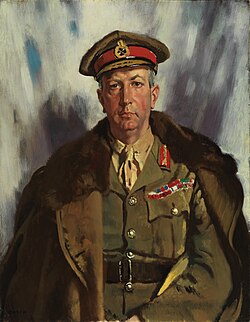
Sir Arthur Currie
Portrait by William Orpen, 1919.
The first part of the series was a political biography of Currie; the second part attempts to tell the story of the Canadian Corps at war through somewhat detailed account of four important battles. The piece is only partly biographical, it partly tells the story of Currie’s war, and partly tells the story the Canadian men who fought for the British Empire in the Great War. It’s a story of incredible martial prowess, but the careful reader will also observe a story of warring duties placed upon the leader of a colonial army; duty to his men, duty to the political leadership of his colonial people and the future of that nation, duty to the objectives of the imperial power on whose behalf he fought, and finally duty to glorious Victory. Currie ended his life understood by those with eyes to see as a great warrior and a military genius; but disliked by his men and hated by the leadership of his people because he prioritized the needs to the Empire and of Victory; but after the war the Empire was of limited service to Currie and to the Canadian people. I leave to the reader, to history, and to God, to decide the value of Victory.
[…]
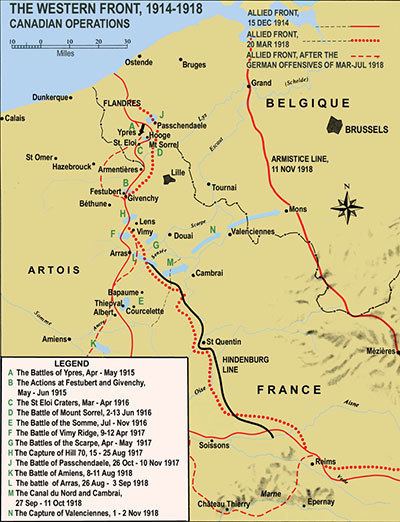
2nd Battle of Ypres
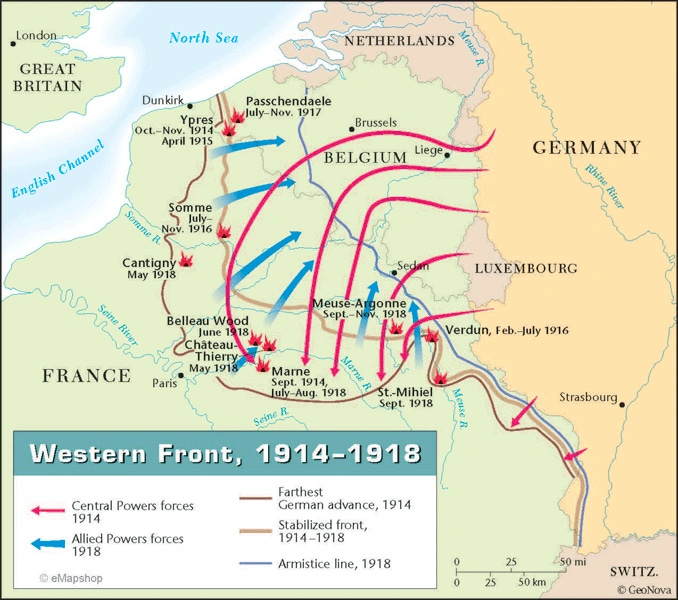
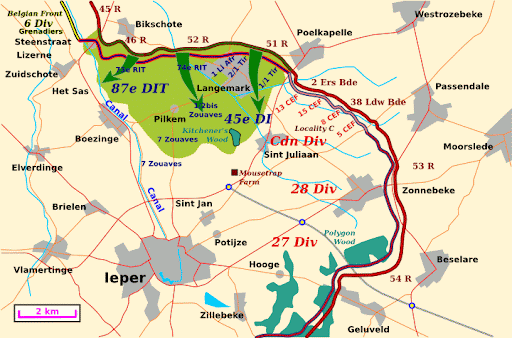
In the spring of 1915 the early dynamic advances of the German army were a distant memory faded behind the great defeat at the First Battle of the Marne. Through the winter both sides had dug in; and many German troops were redeployed to the Russian front. German chemists Walther Nernst and Fritz Haber brought forward the idea of using heavier-than-air Chlorine gas, carried on the wind, to overcome the mathematical impossibility of conventional attack. On April 22, 1915, Albrecht of Württemberg led 7 German divisions to attack 8 Allied divisions, including the 1st Canadian Division under the command of Sir Edwin Alfred Hervey Alderson. The attack began with the release of 168 tons of chlorine gas at about 1700h along a 4 mile stretch of the front around Langemark.
[…]
Vimy Ridge
For a year and a half after Ypres, Currie & the Canadian Corps continued to fight desperate engagements along the Western front with no clear strategic conclusion. After heavy losses and a lot of hard-learned lessons at the Somme from Sept 1915-Sept 1916, the Canadian Corps and Currie with them had become both hardened by bitter experience, and desperate to find better ways to prosecute the war. In September 1915 he was recorded to have said “I did not care what happened to me, but to my men, to their wives, their mothers, their children and to Canada I owed a duty which I wanted to fulfill to the very best of my ability”. Later that year as the division struggled with desertion, he ordered the execution of a deserter despite a three hour plea for clemency by the divisional cleric. The decision restored discipline, but haunted Currie’s dreams long afterwards.
In May 1916 Julian Byng took command of the Canadian Corps, replacing Sir Edwin Alderson. In the fall of that year, after heavy losses in a series of engagements at the Somme, Byng was given the opportunity to reorganize and refit the Canadian Corps; he looked to Currie as a key partner in the effort. They replaced the ineffective Ross Rifle with the Lee Enfield, reorganized the platoon structure to include heavy weapons within each platoon [machine guns, mortars, etc.], and implemented new training and tactics like rehearsals for advances, and the “creeping barrage”, carefully coordinated intended to keep artillery shells landing slightly ahead of advancing men.
[…]
Hill 70
After Vimy, Julian Byng was promoted. Currie was promoted in turn to lead the Canadian Corps. He would lead the Corps that he and Byng had made into one of the most effective fighting forces on any side of the conflict and lead it to bloody victory again and again. There is perhaps no better example of the mastery of the Canadian Corps, from top to bottom, than the battle of Hill 70. “Hill 70 was as close to a perfect battle as was ever fought on the Western Front” wrote historian Tim Cook.
[…]
The Hundred Days Offensive & the Pursuit to Mons
As the winter of 1917-18 passed, a new set of highly political decisions concerning whether and how to reorganize the Canadian Corps for the next round of fighting were taken. As noted in part one, Currie opted to split up the newly formed 5th division to reinforce the four divisions of the Canadian Corps and triple the size of the field engineering element. The decision optimized the Canadian Corps as an attacking force; and when they returned to the front that’s exactly how they would be used. Between August 8th and November 11th, 1918, the Canadian Corps fought nine major battles advancing 86 miles, and suffering 45,835 casualties [The force that began the offensive was ~100,000]. By comparison, the substantially larger American Expeditionary Force, over this same period, advanced only 34 miles while capturing only half the number of prisoners, suffering roughly twice the casualties per German division defeated.
Comments Off on Four battles of the Canadian Corps
In memoriam
A simple recognition of some of our family members who served in the First and Second World Wars:
The Great War
 Private William Penman, Scots Guards, died 16 May, 1915 at Le Touret, age 25
(Elizabeth’s great uncle)- Private Archibald Turner Mulholland, Argyll & Sutherland Highlanders, mortally wounded 25 September, 1915 at Loos, age 27
(Elizabeth’s great uncle) - Private David Buller, Highland Light Infantry, died 21 October, 1915 at Loos, age 35
(Elizabeth’s great grandfather) - Private Harold Edgar Brand, East Yorkshire Regiment. died 4 June, 1917 at Tournai.
(My first cousin, three times removed) - Private Walter Porteous, Durham Light Infantry, died 4 October, 1917 at Passchendaele, age 18
(my great uncle, who had married the day before he left for the front and never returned) - Corporal John Mulholland, Argyll & Sutherland Highlanders, wounded 2 September, 1914 (shortly before the First Battle of the Aisne), wounded again 29 June, 1918, lived through the war.
(Elizabeth’s great uncle) - John Eleazar (“Ellar”) Thornton, (ranks and dates of service unknown, served in the Royal Garrison Artillery, the East Surrey Regiment, and the Essex Regiment (dates of service unknown, but he likely joined the RGA in 1899). Put on the “Z” list after the war — recall list. He died in an asylum in 1943.
(my grandfather’s eldest brother) - Henry (Harry) Thornton, (uncertain) Lancashire Fusiliers. (We are not sure it is him as there were no identifying family or birth date listed. Rejected for further service.)
(my grandfather’s second older brother)
The Second World War
- Flying Officer Richard Porteous, Royal Air Force, survived the defeat in Malaya, was evacuated to India and lived through the war.
(my great uncle) - Able Seaman John Penman, Royal Navy, served in the Defensively Equipped Merchant fleet on the Atlantic convoys, the Murmansk Run (we know he spent a winter in Russia at some point during the war) and other convoy routes, was involved in firefighting and rescue efforts during the Bombay Docks explosion in 1944, lived through the war.
(Elizabeth’s father. We received his Arctic Star medal in July, 2024.) - Private Archie Black (commissioned after the war and retired as a Major), Gordon Highlanders, captured during the fall of Singapore (aged 15) and survived a Japanese POW camp (he had begun to write an autobiography shortly before he died)
(Elizabeth’s uncle) - Elizabeth Buller, “Lumberjill” in the Women’s Timber Corps, an offshoot of the Women’s Land Army in Scotland through the war.
(Elizabeth’s mother) - Trooper Leslie Taplan Russon, 3rd Royal Tank Regiment, died at Tobruk, 19 December, 1942 (aged 23).
Leslie was my father’s first cousin, once removed (and therefore my first cousin, twice removed). - Flight Sergeant Kenneth Alexander Porteous, Royal Air Force, air gunner in a Lancaster bomber of 15 Squadron, Bomber Command. Died when his plane was shot down at Wormlitz 10 miles northeast of the target during a raid on Magdeburg, 21 January 1944 (aged 28).
Kenneth was my first cousin, twice removed. - Reginald Thornton, rank and branch of service unknown, hospitalized during the war with shellshock and was never discharged back into civilian life. He died in York in 1986.
(my grandfather’s youngest brother)
My maternal grandfather, Matthew Kendrew Thornton, was in a reserved occupation during the war as a plater working at Smith’s Docks in Middlesbrough. The original design for the famous Flower-class corvettes came from Smith’s Docks and 16 of the 196 built in the UK during the war (more were built in Canada). My great-grandmother was an enthusiastic ARP warden through the war (she reportedly enjoyed enforcing blackout compliance in the neighbourhood using the rattle and whistle that came with the job).
For the curious, the Commonwealth War Graves Commission the Royal British Legion, and the Library and Archives Canada WW1 and WW2 records site provide search engines you can use to look up your family name. The RBL’s Every One Remembered site shows you everyone who died in the Great War in British or Empire service (Canadians, Australians, New Zealanders, South Africans and other Imperial countries). The CWGC site also includes those who died in the Second World War. Library and Archives Canada allows searches of the Canadian Expeditionary Force and the Royal Newfoundland Regiment for all who served during WW1, and including those who volunteered for the CEF but were not accepted.
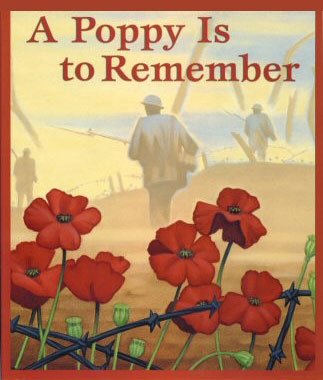
In Flanders fields the poppies blow
Between the crosses row on row,
That mark our place; and in the sky
The larks, still bravely singing, fly
Scarce heard amid the guns below.We are the Dead. Short days ago
We lived, felt dawn, saw sunset glow,
Loved and were loved, and now we lie
In Flanders fields.Take up our quarrel with the foe:
To you from failing hands we throw
The torch; be yours to hold it high.
If ye break faith with us who die
We shall not sleep, though poppies grow
In Flanders fields.Lieutenant Colonel John McCrae, MD Canadian Army Medical Corps (1872-1918)
Here is Mark Knopfler’s wonderful song “Remembrance Day” from his Get Lucky album, set to a slideshow of British and Canadian images from World War I through to more recent conflicts put together by Bob Oldfield:
Comments Off on In memoriam


