
Rex’s Hangar
Published 13 Aug 2022Today we take a look at the top 10 ugliest aircraft every to grace the skies of the United Kingdom. Some were failures, some were hugely successful, but all were lacking in the good looks department, lets check out these ugly planes!
(more…)
December 11, 2025
Britain’s Top 10 UGLIEST Aircraft
Comments Off on Britain’s Top 10 UGLIEST Aircraft
December 8, 2025
If Britain’s political leadership were trying to destroy the country, what would they have done differently?
My Canadian readers — and possibly the occasional Aussie or Kiwi — can read Spaceman Spiff‘s essay and feel it applies almost 100% to our respective nations as well:
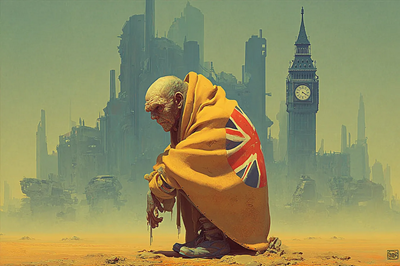
Image from Postcards from the Abyss
Britain is a disaster. The country seems to be in terminal decline.
Not only do we see a lack of ability to turn things around we witness leaders and prominent decision makers evidently clueless about normal life and the hardships many now face.
The political and media classes best reflect this phenomenon. Their views are insular, fictional and at odds with reality. They promote unorthodox ideas that are widely derided yet their enthusiasm is evident as are their hostile responses to being challenged.
Minor comments about immigration are treated as precursors to genocide. Criticism of a biased media unwilling to report events is dismissed as conspiracy. No discussion of climate policy and its unaffordable costs is tolerated. Deviation from the establishment view means excommunication and social exile.
Those in leadership positions drive Britain’s descent into authoritarian governance. Attempts to discuss changes to society leads to extreme overreactions, including jailing noticers, something they now boast about.
Britain has become a madhouse. Our leaders are unable to think like normal people. None of them are facing reality. They seem crazy.
Or, rather, they seem neurotic.
Neurosis is everywhere
Britain has degenerated into a technocratic regime that views the public as its enemy. Normal people disgust the country’s leaders and it shows. They no longer hide their contempt.
But there is a palpable sense of fear emanating from the powerful. Their reactions to normal events paint a troubling picture of who is leading the country, particularly the political and media classes.
If the British establishment were a person we would think them mentally unstable. The qualities we see most are those of a neurotic individual, a type that is well understood.
Here are some features visible in Britain’s ruling class.
Chronic anxiety and worry
A key attribute of neurosis is persistent fear or worry. Rumination is commonplace, circling around and around the same problems. There is also a tendency to overreact, with the response disproportionate to the issue at hand.
The current British regime is wracked with anxiety and worry. This defines them. They are vocal about their concerns.
We are reminded of an endless series of horrors we must attend to; systemic racism, lack of diversity, an imperial past and our cultural dominance along with our impact on the world.
One simple example illustrates the degree to which minds can become distorted by excessive worry.
James Watt perfected the steam engine in 1769 which kickstarted in the industrial revolution, changing the world forever. This would ultimately elevate most nations on earth and led eventually to the establishment of cheap abundant energy for almost everyone.
Until recently these events were viewed as an epoch-defining moment of engineering brilliance. Now this has been recast as a dark stain on Britain’s place in the world, with climate zealots keen to blame the British for all pollution caused by industrialization.
Instead of pride we now see embarrassment and even anxiety about the “damage” Britain has done to the world because it ushered in an era of cheap widespread energy for everyone.
Any rational person would understand this extreme view to be a distortion of reality and excessively negative, yet it permeates everything. Those who rule Britain are ashamed of our past. They worry about it. Only they do this, normal people are proud of our history.
[…]
Welcome to the madhouse
A system of governance driven by neurotics takes on their characteristics. Britain has become a neurotic bureaucracy; a neurocracy.
Neurotics overthink and live inside their heads. They lack the calm, detached strength needed to govern sensibly. Power structures inevitably take on these qualities.
The British government has become paranoid. Digital IDs, internet regulation, censorship. They jail normal people for social media posts. Dissenting views are increasingly punished with custodial sentences.
These are not the actions of the mentally strong. This is an embattled minority fighting reality and becoming desperate.
A gulf is opening between the rulers and the ruled. Increasingly no common ground is even conceivable as the fictions needed to maintain narratives grow. They become overtly false but are needed to feed the neurosis.
One of the things I like about the social media site formerly known as Twitter is how quickly authoritarian bullshit like this can get called out:

Update, 9 December: Welcome, Instapundit readers! Please do have a look around at some of my other posts you may find of interest. I send out a daily summary of posts here through my Substack – https://substack.com/@nicholasrusson that you can subscribe to if you’d like to be informed of new posts in the future.
December 7, 2025
“Anglofuturism” – slogan or beacon of hope?
At Without Diminishment, Robert King argues for Anglofuturism as the most hopeful path forward from the morass all of the Anglosphere seems to be bogged down in:

(From the Ministry of Space, created by Warren Ellis, 2004.)
Born in the digital backwaters of podcasts and Substacks, Anglofuturism has climbed into public view like a rocket nearing the King Charles III Space Station, gathering both attention and indignation as it ascends.
The New Statesman mutters about it being rooted in “nostalgia“, while the far-left activist group Hope Not Hate insists it is something deeply sinister. Yet their agitation merely confirms a familiar sequence. First, they ignore you, then they laugh at you, then they fight you, and then you win.
At its essence, Anglofuturism is a project of civilisational renewal.
It begins with the conviction that Britain’s decline is not destiny but a decision, and the consequence of decades of political miscalculations that consider the national story to be over, Britain’s very own “end of history”.
Just turn on the news and you will see evidence for this everywhere. Strategic islands like the Chagos Islands surrendered to the vassals of hostile powers. A once-thriving energy sector crippled by the ritual self-flagellation of net zero policies, despite abundant North Sea oil resources.
The capital city of London, once envied for its composure, now deafened by the shrill chants of imported grievances, “From the river to the sea”. Britain was once a country whose streets were said to be paved with gold, according to the legend of Dick Whittington.
Today, they are paved with boarded banks, betting slips, and vape shops. The country’s future is already playing out in London, a place where the nation of Britain has faded into the idea of “the Yookay”. Britain is told that because it once colonised, it must now invite colonisation, that because it once conquered, it must now submit.
The result is a people bending ever lower in the hope of forgiveness from a self-appointed virtuous minority at home, and from the ever-growing numbers of strangers who now claim the country as their own.
Anglofuturism is the vanguard against this ideology. It insists that love of one’s civilisation is a duty, not a sin. It binds identity to optimism, and pride to ambition. It seeks to remind Britons that its best days may yet lie ahead, but only if it learns once more to have confidence in itself.
[…]
The policy of splendid isolation simply will not work for the twenty-first century.
Enter CANZUK, the proposed alliance of Canada, Australia, New Zealand, and the United Kingdom. Four constitutional monarchies, four democracies, and four maritime powers linked by law, language, and lineage. Together they would represent over 140 million people and a combined GDP exceeding $6 trillion. It would be a realm on which, once again, the sun would never set.
Our shared day of remembrance on November 11 is a reminder that we partake in traditions born of shared sacrifice.
Such a bloc would not be a re-creation of empire, but a confederation of equals who share the responsibilities of defence and trade, coordinating space and science, and projecting stability from north to south and east to west.
It could stand apart from American turbulence, Chinese authoritarianism, and European stagnation, and be a new civilisational pole rooted in innovation and freedom under common law. It could even be a new contender to lead the free world.
Britain is still a nation successful at exporting ideas like capitalism, liberalism, and, regrettably, Blairism. Anglofuturism could be its most powerful export to the Anglosphere yet.
For those of us at the edge of that world, in Cape Town, Perth, or Vancouver, the message of Anglofuturism is that our story is not over. Our civilisation may be weak, even fading, but it can be revived. Doing this will demand the same courage that built it, in the spirit of the pioneers and soldiers, the engineers and thinkers who shaped continents and defended freedom when it was under siege.
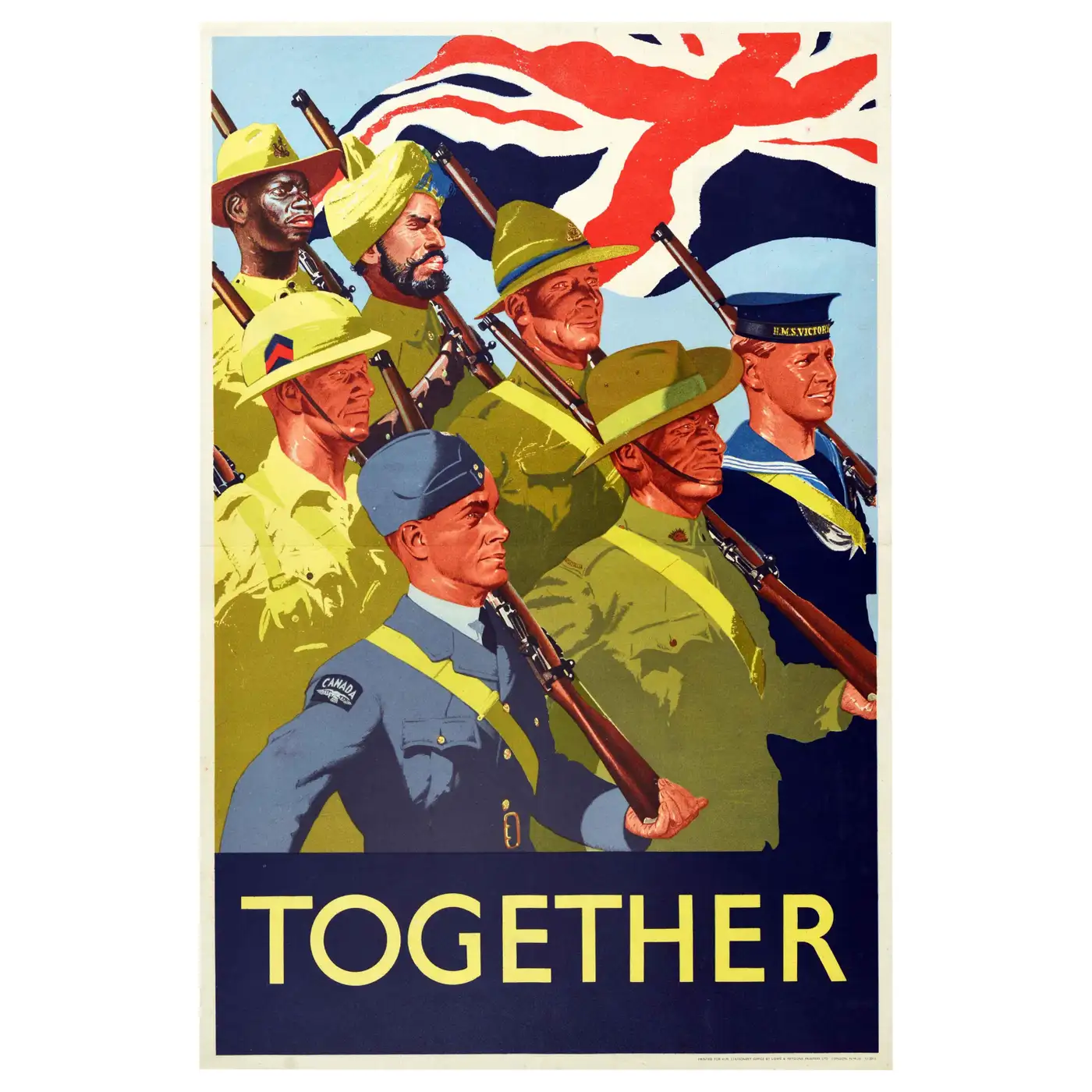
Like this, but better.
Comments Off on “Anglofuturism” – slogan or beacon of hope?
History Summarized: Quebec’s Architectural Memory
Overly Sarcastic Productions
Published 1 Aug 2025Congratulations, you just got Chateau’d.
Ten years ago I visited Quebec City with my dad, this summer the two of us went back, and today I bring you the analytical fruits of a visit well spent. (Let it be known I did my best attempt at Quebecois, recalling pronunciation differences like Frontenac condensing to “Frotnak”, but otherwise defaulting to Metropolitan French when I wasn’t sure of local pronunciations. Alas, any attempt to “split the difference” between Quebecois and Metropolitan French will invariably result in utter disaster. For this, je suis désolé.)
(more…)
Comments Off on History Summarized: Quebec’s Architectural Memory
December 6, 2025
The least offensive kind of soft power – The Rest is History
Ed West recounts his (very) early discovery of The Rest is History, a podcast featuring Dominic Sandbrook and Tom Holland (not that Tom Holland, I’m told). I’ve been a (free) subscriber on YouTube for the last year or two, but Ed got there much earlier than I did:

The Rest is History must be the only thing of which I can say that I was into it before it was popular, my sole experience of being an early adopter. I remember listening to the very first episode as soon as it was released, during Lockdown 2, because I had been a fan of Tom Holland for years and followed him on Twitter. Straight away, I knew that it would be an enormous success, because even people who rarely watched history documentaries or read history books would find it entertaining.
And now, as they say, “the rest is history” (ho ho). The programme has just been named Apple Podcasts Show of the Year 2025, the first ever British winner, and is beyond successful, into the realm of “phenomenon”. When television writers in the distant future make dramas set in the 2020s and wish to give immediate shorthand to establish the decade, they’ll put The Rest is History soundtrack somewhere in the background, just as they always have Tears for Fears playing on the radio during any drama set in the 80s.
It became such a huge part of my life that, when cooking or cleaning and unresponsive to questions, the children came to learn that I must be listening to “Tom and Dom” on my AirPods. Initially, of course, when I mentioned that I had actually met Tom Holland a few times, they’d respond with awe until they realised that I was not talking about the Spiderman actor. It became a running joke about “your Tom Holland” rather than the “famous” one.
During the golden years of television there were a number of shows which became so commonly popular in one’s friendship circles that they were routinely talked about – The Sopranos, The Wire, Breaking Bad or Game of Thrones – but there were always plenty of people who had never watched them; there’s so much choice, after all, and the media culture has fragmented.
As Tom and Dom discussed on an old episode about the 1990s, that was the last period when the whole country had a common popular culture. Yet The Rest is History is approaching something close to that. It’s become so all-pervading that literally everyone I know, or ever speak to, listens to it. Perhaps I live in a bubble, but it’s a warm and cosy bubble filled with chat about the Kaiser’s deck shoes and Costa Rica’s infamous Dr Valverde, a sick and twisted psychopath who liked to torture frogs. The word I’d use to describe the show is “wholesome”, a term they’re fond of, an escape from the modern world, without rancour, hectoring or — crucially — swearing.
I realised that it must have become something more than popular when I read that it was the biggest podcast in Finland. Admittedly the Finnish market is not globally important, but this obviously wasn’t some quirky localised fanbase, like Norman Wisdom in Albania. It had become big everywhere, including the largest market of all; to use an analogy that Holland might appreciate, they’d reached their Ed Sullivan moment.
[…]
All the great drama series of the 2000s I mentioned were American, and I’d even go as far as to argue that The Rest is History is now Britain’s main cultural export and proponent of soft power. While the case might be made for the Premier League or Warhammer, the Goalhanger production has far more sway on international elites and how educated, cultured people around the world see our country.
Foreigners tend to value an idea of Britishness characterised by classiness and erudition, but also humour and modesty. Yet the global popularity of our national brand is out of tune with what our own cultural elites value, which reflects their sense of cringe but often comes across as strangely parochial and inward-looking. Two erudite historians who wear their scholarship lightly, whose interests are openly Anglocentric but reflect a passionate interest in the world beyond our island, talking to the audience like a pair of friendly academics in a cosy pub in Oxford – that’s the fantasy they want.
Fans are always conscious that any show will pass its peak, and then start to decline as everyone runs out of ideas. There’s no sign of it yet, and the good thing about history is that it’s literally endless, and you can always return to the subject at greater length. Their recent series on Nelson was outstanding, despite covering previous ground, and nothing says the holiday season like that festive subject, the Nazis. I can’t wait for the eleven-episode series about the Costa Rican Civil War.
Comments Off on The least offensive kind of soft power – The Rest is History
QotD: King Henry wants a divorce
So, it’s 1532 and Henry VIII’s divorce case is at a critical juncture. The King’s former chief minister, Cardinal Wolsey, has failed to pull it off. The King was about to have Wolsey tried for treason (technically, for a crime known as praemunire, file that away for now) when he, Wolsey, died, but the fact that Wolsey was on his way to London for trial was a signal to the jackals: Open season. Every gripe anyone ever had about the Church in England fell on Wolsey’s head.
In 1532, then, Parliament presented the King with the Supplication Against the Ordinaries. “Ordinaries” means “members of a religious order” — basically, the Supplication is everyone’s beefs with the Church. You can read the list at the Wiki link, but they all boil down to this: The Church was effectively a state-within-the-State, operating a different system of law, taxation, etc. And that’s what praemunire means, too — “a 14th-century law that prohibited the assertion or maintenance of papal jurisdiction, or any other foreign jurisdiction or claim of supremacy in England, against the supremacy of the monarch”. By accusing Wolsey of it, Henry VIII was saying that he, Wolsey, was ultimately working for the Church, not the King … which is kinda what you’d expect from a Cardinal, no?
That’s the problem.
Long story short, by 1532 the state-within-the-State that was the Church was blocking the upward mobility of new men like Thomas Cromwell.1 There was an entire secular education system; it was cranking out talented, ambitious men; in short, there was an “overproduction of elites”, since there were limited spaces in the nobility and the Church and they were all already occupied by either bluebloods, or guys like Wolsey who had jumped on the gravy train much earlier.
But this was an artificial bottleneck. The Tudor state had plenty of room to expand; they needed far more educated bureaucrats than the old system was capable of supplying. The old system needed to go, on order to make room for the new, and in many ways that’s what the Reformation was: A brushfire, clearing off the deadwood. A political and administrative brushfire, disguised as a theological dispute. It’s no accident that the most Reformed polities — late Tudor England, the Netherlands, the Schmalkaldic League — were the most politically and economically efficient ones, too.
And by Reforming the Church, the brushfire could extend to the rest of the depraved, decadent, moribund, fake-and-gay culture. The Renaissance is obsessive about the old, but it is, obviously, something very very new. People raised in the Late Medieval world were emotionally incapable of a total break with the past — I don’t think any culture really is, but a culture as hidebound as the Middle Ages certainly isn’t. But so long as they could find some warrant for change in the Classical past (and being the inventive types they were, they’d always find such a warrant), they could purge the culture, root and branch, in the guise of “returning ad fontes“.
Severian, “Reformation II”, Founding Questions, 2022-03-08.
- This is where the analogy breaks down, because Late Medieval men were not Postmodern men — Cromwell was actually loyal to Wolsey almost to his, Cromwell’s, literal death. Men had honor back then. It also speaks to the kind of man Wolsey must’ve been, to have inspired the loyalty of a guy like Cromwell despite it all. Cromwell was a ruthless motherfucker, even by Tudor England’s Olympic-class standards; he’d stab his own mother if he found it politically necessary; but he still stayed loyal to his man even when it looked like that would cost him his life.
Comments Off on QotD: King Henry wants a divorce
December 5, 2025
QotD: The Anglosphere
Ironically – and this must drive those of a pro-EU frame of mind nuts – it is still North America, with its rawer culture and politics, its legal similarities to the UK (for good and for ill) that resonates, even in the minds (for want of a better noun) of the sort of folk going on BLM demos. What goes on in France, Germany or Italy tends not to have the same grip on the mind. The Atlantic is wide and the Channel is narrow, but in every other sense, it is the other way around. To that extent, then, the Anglosphere lives, even in the hearts and minds of the far Left.
Johnathan Pearce, “The Anglosphere and our present discontents”, Samizdata, 2020-06-08.
Comments Off on QotD: The Anglosphere
December 2, 2025
QotD: Brutalism “is to architects what propaganda was to communist leaders: It serves to make them feel powerful”
I have long suspected, but cannot prove with an indisputable argument, that this architecture has played its part in the brutalization of daily life and social behavior in the country. Certainly, it has dehumanized the appearance of many towns and cities; its harsh surfaces and willfully austere and jagged designs leave the mere human being feeling that he is about as welcome as an ant on a kitchen counter — which, indeed, he now much resembles.
This architecture is to architects what propaganda was to communist leaders: It serves to make them feel powerful, not despite the fact that so many people detest it, but because so many people detest it. They are like the doctors of old, who, if they could not cure their patients, could at least make them take the most repellent and noxious medicine, on the grounds that a little bit of what revolts you does you good.
The projected museum is in a former school in the north of London, designed in 1968. Here is fairly typical commentary on the building:
Despite decades of wear and some unfortunate interventions, the raw concrete structure has remained a cherished example of socially driven modernist design.
It is to be noticed that the cherishing done here is independent of anyone who cherishes; as for “socially driven modernist design”, we might read “totalitarian”. Indeed, the building exudes totalitarianism, as raw reinforced concrete exudes ghastly stains after a short time.
Le Corbusier, one of the founders of this kind of architecture, was indeed a fascist in the most literal sense, though he had no real objection to communist totalitarianism, either. What he most hated was what he called the street, that is to say the place where people behave spontaneously and without direction from above, and where they are not corralled into functions imposed on them by all-wise socially driven architects. It was for this reason that he and his acolytes preferred to build urban wildernesses of the kind that have now been built the world over, but especially in Britain.
The architects who have been given the task of renewing the school building where the museum dedicated to architectural brutalism is to be housed have “noted its distinct geometry, as well as its symbolic presence reflecting the ideals of the school’s broader 1960s Brutalist architecture conceived in an era of social progress”.
Apologists for such architecture write a pure Soviet langue de bois — or perhaps I should say langue de béton, since concrete rather than wood is their favorite material:
Consultation with the school, families and local stakeholders has underpinned the project from the outset, ensuring that the building’s next chapter remains tied to its founding ethos centered on architecture as a tool for collective learning and expression.
Does anyone, after the death of the late, not much lamented, Leonid Brezhnev, have thoughts that correspond to, or are couched in, words such as these? By their language shall ye know them.
Theodore Dalrymple, “Architects of Our Own Destruction”, New English Review, 2025-08-08.
Comments Off on QotD: Brutalism “is to architects what propaganda was to communist leaders: It serves to make them feel powerful”
November 30, 2025
North Africa Ep. 10: Rommel’s Desert Cannae – The Trap at Mechili
World War Two
Published 29 Nov 2025This episode, Rommel sets up a “Cannae, modern style” at Mechili, a three-pronged encirclement with Wechmar pressing from the west, Schwerin/Ariete and MG 8 driving up from the south, and Olbrich’s panzers meant to close the center. A Ghibli, fuel chaos and delays upset the timing, but Ponath cuts the Derna road and captures Generals Neame and O’Connor. And after failed breakout attempts against Fabris, the Bersaglieri and Streich, Gambier-Parry surrenders about 1,700 men and Mechili falls, opening the road to Tobruk.
(more…)
Comments Off on North Africa Ep. 10: Rommel’s Desert Cannae – The Trap at Mechili
Canada’s growing Islamist problem
At Juno News, Joe Adam George points to the problems Britain is having with their well-established Muslim extremists and says Canada has exactly the same issues here:
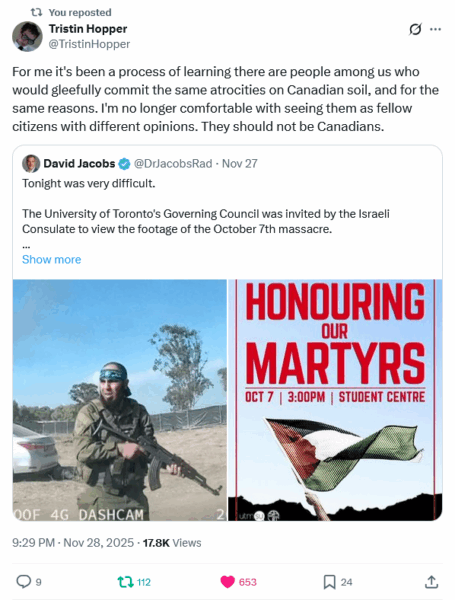
When 35-year-old Jihad al-Shamie terrorized a Manchester synagogue last month on Yom Kippur pledging allegiance to ISIS, few were shocked by what investigators later uncovered. He attended a Salafi-inspired mosque where extremist rhetoric was routine. His father had praised Hamas’s October 7 attackers as “Allah’s men on earth”. Years of indoctrination taught him that violence was virtue, resistance was glory, and terror was faith.
What unfolded in Manchester is a warning to Canada, where similar currents of Islamist radicalism have been manifestly gathering strength. Across Canadian cities, extremist narratives are taking root among young people through community networks, activist circles, and online echo chambers.
A prominent Shia mosque in Windsor, Ontario, recently held a memorial service for slain Hezbollah leader Hassan Nasrallah — for the second year running — where youths eulogised the notorious terrorist as a “hero” and “martyr”. The Toronto Metropolitan University’s arts faculty funded a research paper which argues that Canada’s designation of Islamist groups as terrorist organizations is deeply flawed because of “systemic Islamophobia” and racism. Such episodes do not merely glorify violence; they sanctify terrorism and rebrand militancy as a necessity.
Earlier this year, Canada’s spy agency, the Canadian Security Intelligence Service, warned it was “increasingly concerned” about the threat of ISIS-inspired attacks. That concern is well-founded. The Royal Canadian Mounted Police reported a staggering 488 per cent rise in terrorism-related charges between April 2023 and March 2024, much of it driven by ISIS-motivated youth radicalisation. In the same period, antisemitic incidents surged by more than 670 per cent. An ISIS-inspired teenager was arrested in Montreal in August for terrorism offences. These are not isolated events but symptoms of a cultural shift — where extremism masquerades as activism and hate is sold as justice.
Since the breakout of the Israel-Hamas war, unrestrained radicalisation has seeped into mosques, schools, charities, and universities — often protected by Canada’s own liberal frameworks. Islamist networks have mastered the art of exploiting the Charter of Rights and Freedoms to propagate radical ideologies while deflecting scrutiny. Wrapped in the language of “human rights” and “anti-racism”, they advance intolerance behind a façade of moral virtue.
As former FBI agent and counter-terrorism expert Lara Burns noted, it’s a tactic that echoes the Muslim Brotherhood’s “sabotage strategy” in North America — infiltrating institutions to steer public debate and soften attitudes toward Islamist causes.
Campaigns to institutionalize so-called “anti-Palestinian racism” (APR) is turning Canada’s classrooms and government offices into laboratories for grievance politics. Marketed as anti-discrimination, APR in reality brands any criticism of Palestinian militancy as racism, giving extremists a moral shield and silencing dissent. Even Canada’s Islamophobia czar, Amira Elghawaby, has been accused of abusing her taxpayer-funded post to conjure up Islamophobia and APR where none existed. During a visit to London in June, she reportedly met officials shaping the UK’s own Islamophobia legislation — a troubling sign of cross-pollination between partisan ideologues.
Comments Off on Canada’s growing Islamist problem
November 28, 2025
QotD: Life is not a race to some arbitrary “finish line”
I wrote:
The hostility to inheritance also comes from a mistaken sense of fairness. As Robert Nozick argued in Anarchy, State and Utopia (I quote from memory), people wrongly think life resembles an athletics race, where the racers compete to hit the finishing line. As a result, those “lucky” athletes endowed by nature/god whatever with stronger muscles etc must be handicapped by having weights in their shoes, for example. Just as a child of rich parents must be deliberately held back to give poor kids a more “fair” chance of winning. But as Nozick said, life isn’t like that. It is about people exchanging goods, services and ideas with one another. There’s no fixed end-point to which we are all racing.
Also, the idea that there is some “prize” that humans compete for implies that someone or some entity has created that “prize” in the first place. But that’s smuggling in a sort of communitarian assumption into the actions of individuals. In an open society, the prizes on offer are varied and multiply constantly.
I should add that the second section of Nozick’s renowned book dissects and ultimately rejects forced redistribution for egalitarian or other forms of “patterned” notions of justice, and he robustly defends what he calls an “entitlement” concept of justice.
One of the approaches that the late Prof. Nozick used was the thought experiment, such as the example referenced above about a fictitious athletics race in which the entrants are hampered/favoured to make the race more “even”, and then assuming that society in general should be like this. A race, held by people who know the rules and seek to abide by them, is not like an open society. “Open” is the key word here: there is no single end to which persons are heading, such as winning the race.
And yet a lot of the metaphors one comes across around discussions around equality, including equality of opportunity as well as outcome, seem to borrow, perhaps unwittingly, from this “race competition” worldview. To give another example, I remember reading some months ago about a university professor (Warwick) who suggested that when parents read stories to their children, this is a form of privilege. This also plays to the idea that life has a fixed end-measure of success, so that anyone giving a value to someone else is giving the latter an unfair “head start” on someone else. It would require a State to exercise totalitarian control of our actions from the moment we wake up to go to sleep lest our actions unfairly advantage/hamper someone in the “race” they are considered, by this worldview, to be on. (It also, by the way, shows that today’s Higher Ed. is full of certifiable fools and worse.)
Johnathan Pearce, “The assault on inheritance and the assumptions that drive it”, Samizdata, 2025-08-21.
Comments Off on QotD: Life is not a race to some arbitrary “finish line”
November 27, 2025
Operation Catapult: The Royal Navy’s day of infamy?
Lindybeige
Published 28 May 2025Operation Catapult took place on July 3rd 1940 at Mers El Kebir on the Algerian coast. It remains a point of controversy in the relations between the British and the French. Who was to blame for the sinking of the French ships and deaths of French sailors? You be the judge.
Erratum: Acting Rear Admiral Onslow, captain of the aircraft carrier Hermes, was not “Rodney” Onslow as I named him, but Richard Francis John Onslow, M.V.O., D.S.C. (29 March, 1896 – 9 April, 1942).
(more…)
Comments Off on Operation Catapult: The Royal Navy’s day of infamy?
November 25, 2025
QotD: British Socialism in the 1930s
George Orwell, The Road to Wigan Pier (1937)
November 24, 2025
What is Spotted Dick?
Boiled pudding with plenty of currants and a simple butter and brown sugar sauce
City/Region: England
Time Period: 1854While the name “spotted dick” makes us giggle today, its likely origins are just an amusing circumstance of language evolution. The Old English word for dough is dāg (sounds very similar to dog), which probably led to a version of the word that sounds like dick. Funnily enough, another name for spotted dick is spotted dog. So in all likelihood, the name is a holdover from Old English meaning spotted dough.
Whatever you call it, this boiled pudding is really good. It’s sweet, but not too sweet, with an almost crumbly texture and is very moist. The butter and brown sugar sauce isn’t necessary for it to be tasty, but it’s so easy and delicious that I highly recommend making it.
Spotted Dick.
Put three-quarters of a pound of flour into a basin, half a pound of beef suet, half ditto of currants, two ounces of sugar, a little cinnamon, mix with two eggs and two gills of milk; boil in either mould or cloth for one hour and a half; serve with melted butter, and a little sugar over.
— A Shilling Cookery for the People by Alexis Soyer, 1854
Comments Off on What is Spotted Dick?
November 23, 2025
North Africa Ep. 9: Rommel tightens the Noose around Cyrenaica
World War Two
Published 22 Nov 2025April 1941, North Africa. The British forward line at Mersa Brega has collapsed, 2nd Armoured Division is in retreat, and Erwin Rommel’s Afrika Korps is on the move. What was supposed to be a cautious blocking force has turned into a fast-moving desert offensive threatening Benghazi, Mechili, and all of Cyrenaica.
In this episode of our WW2 in Real Time – North Africa miniseries, we follow:
- Rommel as he ignores Hitler’s orders and pushes east after Mersa Brega
- The chaotic British retreat and fuel-starved tanks abandoning the desert
- The fall of Benghazi without a fight
- Wavell’s misjudgements and late reactions from Middle East Command
- The race for Mechili, a vital crossroads and supply dump
- The brutal reality of desert logistics – where sand and distance destroy more vehicles than enemy shells
While Rommel drives his reconnaissance units toward Benghazi and Mechili, British commanders try to trade ground for time and avoid encirclement. At the same time, Italian commanders warn Rommel about overstretch, and German divisional leaders complain about fuel and breakdowns – warnings he largely ignores.
By the end of this week in 1941, the Desert Fox is deep inside Cyrenaica, the British are burning their own supply dumps, and both sides are racing for the next key position. A clash at Mechili is imminent – and so is a showdown at the Er Regima pass with the “Devil’s Own” Australians waiting in ambush.
This is Episode 9 of our North Africa 1941 miniseries – part of our larger effort to cover WW2 week by week, in real time.
If you want to support this work and get deeper into the war in the desert and beyond, join the TimeGhost Army at timeghost.tv or patreon.com.
Excelsior!
Comments Off on North Africa Ep. 9: Rommel tightens the Noose around Cyrenaica


