
TimeGhost History
Published 26 Oct 2025Egypt nationalizes the Suez Canal, Israel strikes under a secret Sèvres pact, and Britain and France launch Operation Musketeer, only to meet U.S. and UN pressure that forces a ceasefire at midnight.
UN peacekeeping is born, Nasser’s stature soars, and Eden’s government collapses as Suez ends the illusion of old imperial power.
(more…)
October 28, 2025
The End of European Superpowers? The Suez Crisis – W2W 050
Comments Off on The End of European Superpowers? The Suez Crisis – W2W 050
October 27, 2025
“The Church of England has lost 80 per cent of Anglicans on the planet”
In The Conservative Woman, Daniel Jupp considers the recent schism in the Church of England, which has left the original church shorn of the vast majority of Anglican worshippers across the globe:
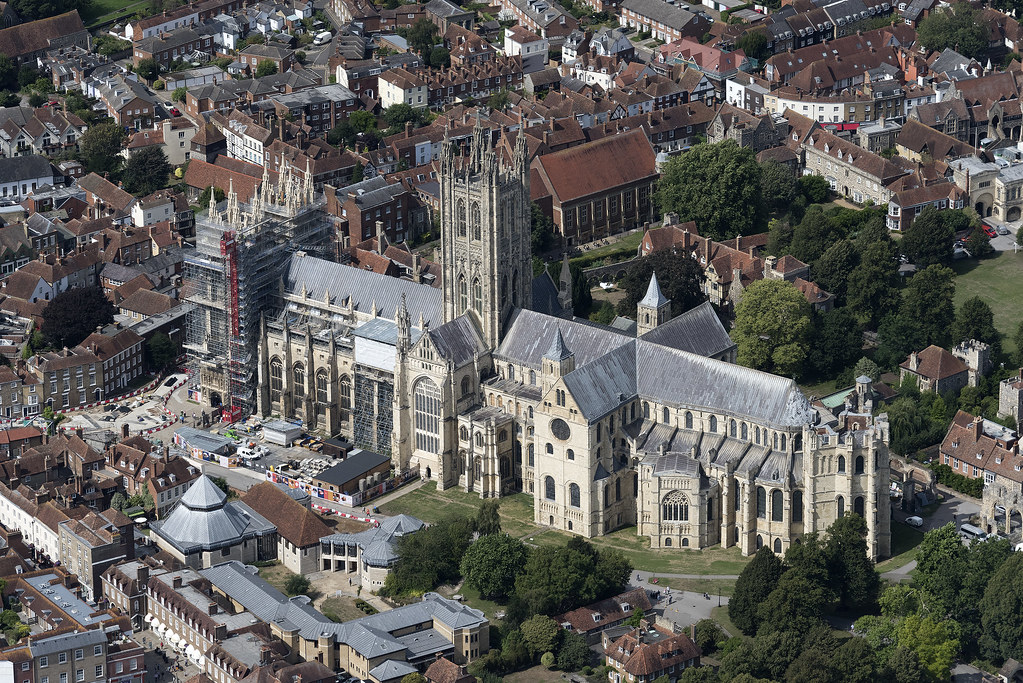
“Canterbury Cathedral aerial image” by John D Fielding is licensed under CC BY 2.0 
 .
.
Today, though, the English Church is broken. The Anglican Communion, which encompassed all the places across the world touched by English exploration, discovery, trade and power, where English Christian missionaries often led the way, has witnessed a devastating schism. At the start of this month Dame Sarah Mullally was appointed the first female Archbishop of Canterbury. As is tradition, the appointment was approved by the Prime Minister and the King, but the nomination came from the Church.
Whether Anglican Christians worldwide approved doesn’t seem to have been considered. Based on multiple past fissures between the part of the Church active in the United Kingdom and the (much larger) Anglican communities globally which had each time been papered over, it may be that the hierarchy in England assumed that the same would happen again.
If so, they were wrong.
The Global Fellowship of Confessing Anglicans (also known as Gafcon) represent the Anglican faith in Africa. Their response was to declare publicly that they would no longer send delegates to Church meetings in the United Kingdom, no longer consider the Archbishop of Canterbury as first among equals or a seat of authority to which they deferred, and no longer consider themselves in the same communion as the Bishops and clergy of the Church of England within England. Perhaps even more tellingly, they asserted that they were the true Anglican communion, more loyal to the instructions of the Bible and Anglican interpretation of those than priests in England. There’s a subtle but powerful distinction there – they were saying not that they had broken away from an Anglican vision of Biblical instruction and Christian identity but that the Church in England had done so.
African Anglicans now assert that they are the true Anglicans, and that the organisation within the UK is not. And in terms of the number of people who follow their message, they are right to assert this.
In losing the African churches and the global, more conservative branch of Anglicanism, the Church of England has lost 80 per cent of Anglicans on the planet.
Imagine a company that lost 80 per cent of its customers. Or a political party that lost 80 per cent of its voters. Or a nation state that lost 80 per cent of its territory. These would in each case be recognised as unmitigated disasters.
Now imagine this following a previous disaster, which was the end of Justin Welby’s period as Archbishop over a scandal based on not being firm enough and honest enough about paedophile cases in the clergy. One would think the Church might be looking for a non-controversial appointment intended to restore moral trust immediately and defuse criticism.
They did not do this. Knowing the much more conservative and traditionalist stance held by the majority of Anglicans, they chose not to listen to those people, and did something it knew to be passionately opposed by them.
There is an intense irony here that gets to the heart of the self-inflicted problems of the Church of England today. Sarah Mullally has been very clear on the kind of Church she believes in – she’s a supporter of LGBTQ+ rights and activism, she has strongly backed asylum and migration, she is a self-declared feminist, and she is both politically and it seems religiously progressive. As Bishop of London, she boasted about representing a diverse and multicultural city, and put her experience in handling diversity as one of the key qualifications and evidence of positive experience she could bring to being the Archbishop of Canterbury.
This was an intensely reality-averse selling-point. London’s slightly lower trend on the relentless decline of Christian faith and attendance compared with the UK as a whole is based not on Mullally’s competence and persuasion. It is based on traditionalist, conservative-minded members of the African Anglican communion in London being more likely to go into a church.
And these people hate woke attitudes and politics.
Update, 28 October: Welcome, Instapundit readers! Please do have a look around at some of my other posts you may find of interest. I send out a daily summary of posts here through my Substack – https://substack.com/@nicholasrusson that you can subscribe to if you’d like to be informed of new posts in the future.
Britain and the Claudian Invasion – The Conquered and the Proud 17
Adrian Goldsworthy. Historian and Novelist
Published 28 May 2025Today we look at Roman relations with island of Britannia between Caesar and the invasion sent by Claudius in AD 43. We discuss the motives for that invasion, the campaigns fought to take control of the south east, before considering the rebellion of Boudica and the expansion in the north under the Flavians.
Comments Off on Britain and the Claudian Invasion – The Conquered and the Proud 17
October 26, 2025
North Africa Ep. 5: Desert Fox Prepares to Pounce
World War Two
Published 25 Oct 2025Tripoli hums as staff and both battalions of Panzer-Regiment 5 bolster Rommel; Ariete is formally pulled under his hand to guard the rear while he eyes Marada. Malta’s Wellingtons and Sunderlands withdraw under X. Fliegerkorps pressure, a British war council prioritizes Greece, and HMS Greyhound bags Anfitrite as both sides struggle to hit each other’s convoys.
(more…)
Comments Off on North Africa Ep. 5: Desert Fox Prepares to Pounce
October 24, 2025
British and Irish media try to hide the crime that triggered Dublin riot
In Spiked, Brendan O’Neill on the complicity of British and Irish media in trying to cover up the reasons behind the violence in Dublin outside a hotel housing migrants:

Last night, the BBC told one of the grossest lies of omission I have ever seen in the mainstream media. It published a report about the disturbances outside a migrant hotel in County Dublin and nowhere did it mention what triggered the riotous behaviour. Three hundred and eighty-seven words pumped into the gadgets of the masses, every one of them devoted to damning the “thuggery” of those who assembled at the hotel. Not one of the words – not one – addressed the thing that angered them.
What was that thing? It was the alleged sexual assault of a 10-year-old Irish girl by a failed “asylum seeker” on the grounds of the hotel. An alleged assault so serious that the girl was hospitalised. What’s more, this is a highly vulnerable girl in the care of the state. Maybe none of that matters to the BBC. Perhaps the alleged violation of a defenceless innocent by a man who was meant to have been deported from Ireland is immaterial to the aloof scribes of Britain’s public broadcaster. How else do we explain that they essentially redacted this information, one of the most salient parts of the story, from their initial dispatch on the fury gripping a community across the Irish Sea?
The irony of the BBC’s seeming indifference to the alleged horror that provoked last night’s disturbances is that it will compound the unrest on the streets. Indeed, it will confirm the sense that the media classes, in Dublin and beyond, give not one toss for the safety of people’s children or the validity of their own views on immigration. In so heartlessly erasing that girl from its early reportage, the BBC will have intensified the fiery anger of the very “thugs” it hates.
The disturbances made for unpleasant viewing. They took place outside Citywest Hotel in Saggart, a town in County Dublin about 12 miles from Dublin city. This is a hotel that just last month was sold to the state for €148million for the purposes of housing migrants. Then this week, an assault of the most appalling kind allegedly took place either on its grounds or in its vicinity. A girl was hospitalised, and a man in his thirties was arrested.
The details are distressing. The 10-year-old girl was in the care of the Irish Child and Family Agency. She reportedly absconded from staff during a recreational trip to Dublin city. She was reported missing to An Garda Siochana (the Irish police). She was later found close to Citywest Hotel and reported that she had been assaulted. As part of their investigations, the Gardaí have arrested a man who arrived in Ireland six years ago, who failed in his application for asylum, and who has been the subject of a deportation order since March.
Everyone must let the investigation take its course and the truth be ascertained. The anger of the people of Saggart is wholly understandable but riotous violence is never the answer. Cops outside Citywest were pelted with a volley of bottles. Brick walls were dismantled to turn into projectiles to hurl at the guards. At one point, Irish lads even charged the police lines with horse-drawn sulkies (carts). These were grim scenes, echoing the riot that rocked Dublin city in November 2023 following the stabbing of three children by a man from Algeria.
Not the Bee has some video clips of the scenes outside the Citywest migrant hotel.
Update, 27 October: Welcome, Instapundit readers! Please do have a look around at some of my other posts you may find of interest. I send out a daily summary of posts here through my Substack – https://substack.com/@nicholasrusson that you can subscribe to if you’d like to be informed of new posts in the future.
October 23, 2025
A39 Tortoise: The Forgotten Super Heavy
The Tank Museum
Published 13 Jun 2025The A39 Tortoise. The last complete survivor of a World War Two project that arrived just a little too late. Some have called it “The British Jagdtiger” – but is that actually a fair comparison?
Tortoise was a part of the strategy the Allies would need to defeat Germany during the Second World War. It was recognised that total victory could only occur on German soil – and that meant smashing through the imposing defences of the Siegfried Line. The Allies would need a Heavy Assault tank. Many designs were put forward for this role, including the Valiant, the A33 and the T14 Assault tank.
The A39 is extremely well-armoured. Its casemate construction could withstand a hit from an 88mm gun at close ranges. But at 78-tons, this lumbering beast was both slow and heavy – and is one of the largest and heaviest vehicles in the museum’s collection. In terms of firepower, the impressive 32pdr gun was extremely effective against both concrete and enemy armour. It even has room inside for 7 crew!
In the end, the Tortoise arrived too late to see any action on the battlefield. It was intended to form a part of the 79th Armoured Division – making it one of Hobart’s Funnies. Whether Tortoise would have become the stuff of legend, or a bit of a joke – well, we’ll leave that question up to you.
00:00 | Introduction
00:39 | What is a Heavy Assault Tank?
03:45 | Why a Heavy Assault Tank?
09:24 | The A39: As Good as it Gets?
17:55 | A Solution Without a Problem
(more…)
Comments Off on A39 Tortoise: The Forgotten Super Heavy
October 20, 2025
The Julio-Claudians and the Empire – The Conquered and the Proud 16
Adrian Goldsworthy. Historian and Novelist
Published 2 Apr 2025This time we look at the empire under the Julio-Claudians, and address the broader question of why conquest became so rare after the death of Augustus. Along the way, we take a look at the campaigns in Germany in AD 14-16, the subsequent arrangements of the Rhine frontier, and Corbulo’s campaign during Claudius’ reign. We touch a little on the invasion of Britain, but will deal with that in more detail in a separate video. Other topics covered include North Africa, Egypt, and the relationship with the Parthian Empire to the east.
Comments Off on The Julio-Claudians and the Empire – The Conquered and the Proud 16
October 19, 2025
North Africa Ep. 4: Quiet Week Before the Desert Storm
World War Two
Published 18 Oct 2025Late Feb–early Mar 1941: convoys from Naples build up 5th Light as MG Battalion 8 and artillery arrive; Rommel wins deployments and edges the line from Nofilia toward Arco dei Fileni. Luftwaffe raids batter Malta, mines choke Suez, RAF assets drain to Greece, and Axis forward probes tighten the noose around El Agheila while Britain improvises under strain.
(more…)
Comments Off on North Africa Ep. 4: Quiet Week Before the Desert Storm
QotD: The Indian Civil Service
There’s actually a great book called The Ruling Caste. It’s a “collective biography”, for lack of a better term, of the Indian Civil Service (ICS), by Sir David Gilmour. You can of course find biographies of the individual Governors-General (Gilmour wrote one, also excellent, on Lord Curzon), but this is the only study I know of the lower levels — i.e. the guys who really ran the Raj. Gilmour is literally a gentleman amateur, so while he’s also an excellent historian (and The Ruling Caste conforms to all the canons of scholarship), he tells an engaging story, too.
I think about The Ruling Caste often when I think about the turds in the Apparat. Looked at from the outside, the ICS were apparatchiks, too. Indeed, even more so than actual apparatchiks, since “apparatchik” means something like “expert without portfolio” and while the ICS had two broad “tracks” (if I recall correctly), “civil” and “legal”, in practice most every ICS man was supposed to be able to do pretty much everything, including (again IIRC) assume military command of local forces if necessary.
Given that there were never more than 200K Britons in the Raj at any one time, how could it be otherwise?
And the ICS was as fully ideologized as the Soviet (or AINO) Apparat. The French gave us the lovely phrase mission civilisatrice, but that’s what the ICS was doing, too. Lord Macauley was the big mover behind the English Education Act of 1835, which explicitly designed to
form a class who may be interpreters between us and the millions whom we govern – a class of persons Indian in blood and colour, but English in tastes, in opinions, in morals and in intellect. To that class we may leave it to refine the vernacular dialects of the country, to enrich those dialects with terms of science borrowed from the Western nomenclature, and to render them by degrees fit vehicles for conveying knowledge to the great mass of the population.
There were two huge differences between the ICS and the Apparat, though, that really come out reading Gilmour’s book. First, and actually least important, was the obvious fact that English education was superior. Macauley really gave “native” literature both barrels — nobody condescends like an Englishman — but he wasn’t wrong. In 1835 you could take the “scientific” literature of every other race on the planet combined and get … the Iron Age? Maybe? 200K Britons could dominate 750 million Indians because
whatever happens, we have got
the Maxim gun, and they have not.Or “steam power” or “replaceable parts” or “calculus” or what have you. Season to taste.
The second — and far, far more important — difference between the ICS and the Apparat, though, was that the ICS was in general composed of decent people. In a very real sense, all imperialism is “cultural imperialism”. Rome became an empire by whomping all its enemies, but it stayed an empire by giving its enemies a great deal. Life was simply better — orders of magnitude better — inside the Empire than outside.
And the reason for this is simple, so simple that you need many years of long and hideously expensive training, by highly skilled and fanatically motivated indoctrinators, to miss it. Macauley, Caesar, Confucius, anyone who wrote anything on barbarian management at any point, anywhere in the world, well into the 20th century, said basically the same thing: Our material culture is the result of our cultural culture.
You can learn to operate our stuff. Obviously so — with only 200K Britons throughout the Subcontinent, the Raj was quite obviously run by Indians. And they did a bang-up job, too, such that India at independence had the real potential to become a first world country (note to folks getting ready to break away from a globe-spanning empire: Never elect a lunatic socialist yoga dude as your first prime minister. He’ll go full retard and set you back 50 years … and he’ll be shooting for 500). You might even learn how to maintain our stuff, maybe even build a few cheap knockoff copies of our stuff.
But it’ll never be more than that — shitty knockoff copies, gruesomely expensive, and available only to the elite — unless you embrace as much of the culture that created the stuff as you can stand. The English themselves are a great example: They were blue-assed savages when Caesar found them, but they got with the program, and look how well that worked out. Ditto the Gauls (“Our ancestors, the Gauls!”) and all the rest.
It’s the culture, stupids. The culture of the ICS was English culture — “play up, play up, and play the game!” sounds like baloney to jaded Postmodern ears, but listen:
The sand of the desert is sodden red,—
Red with the wreck of a square that broke; —
The Gatling’s jammed and the Colonel dead,
And the regiment blind with dust and smoke.
The river of death has brimmed his banks,
And England’s far, and Honour a name,
But the voice of a schoolboy rallies the ranks:
“Play up! play up! and play the game!”As poetry it’s shit, but if that doesn’t make you want to get up out of your chair and take a swing at somebody, then you, sir, have no hair on your scrotum, and will never know a woman’s touch (trannies don’t count).
They really believed that, those Eton schoolboys out there East of Suez. Or, at least, they behaved as if they did, and everything else flowed from that behavior. Recall that it was a coin flip, going East of Suez — chances are you wouldn’t be coming back, or if you did, it would be as a malarial ruin. But they went anyway, though England’s far and Honour a name, because that’s just what they did. Even at their worst — and their worst was very bad; Gilmour pulls no punches — you can’t help but admire them a little, the arrogant bastards. Their convictions were sometimes awful, but they had the courage of them … and courage is magnificent.
Severian, “Ruling Caste II”, Founding Questions, 2022-03-10.
Comments Off on QotD: The Indian Civil Service
October 18, 2025
The Battle of Sedan: The Anatomy of Failure
World War Two
Published 17 Oct 2025In May 1940, a period of ten days flipped the world order on its head. France, the titan of the Great War, was carved apart by the armored fist of the Wehrmacht: Panzergruppe Kleist. Now, in this new feature-length production, we explore why it happened, whether this was ever avoidable, and whether France’s flaws stemmed from incompetence, or something far more sinister.
(more…)
Comments Off on The Battle of Sedan: The Anatomy of Failure
Gerät Potsdam: Mauser Copies the Sten Gun
Forgotten Weapons
Published 2 Jun 2025In the fall of 1944, the Mauser company was given a contract to develop drawings of a direct copy of the British Sten gun (code named Gerät Potsdam), and to manufacture 10,000 of them. In fact, they were to make two different sets of drawings; one suitable for large factory use (like their own) and one for use with distributed small shops making parts for final assembly elsewhere (which is how much of British Sten production was done). The contract was fulfilled and 9972 guns in total were produced and accepted by the German military in November and December of 1944.
Why would Germany was a copy of the Sten? Well, they actually had a decent number of them. The Allies were air-dropping Stens all over Europe, and a lot of those drops were captured by German troops, not the resistance fighters they were intended for. By the end of the war the Germans were in desperate need of arms, and the Sten was both simple and already in some German use with the Volkssturm … so it actually was not a totally unreasonable idea to produce more of them.
Today, the Potsdam is an extremely rare gun to find. The two visible identifying features are the magazine well and barrel shroud, which are both made with a folded and spot welded seam. The barrels are also identifiable as they have 6 groove rifling, which the British did not use in the Sten.
Before the Potsdam production was finished, Mauser began working on further plans to simplify the design. That would be the Gerät Neumunster, aka the MP 3008. For that part of the story, see my video on the MP 3008:
• German Sten Copy: MP 3008, aka Gerät Neumü…
(more…)
Comments Off on Gerät Potsdam: Mauser Copies the Sten Gun
October 15, 2025
The Korean War Week 69: Conquered … But At What Cost? – October 14, 1951
The Korean War by Indy Neidell
Published 14 Oct 2025The Battle of Heartbreak Ridge ends with victory for the UN forces, though the casualty count is alarmingly high for both sides. One must wonder, is that sustainable? It’s a week of action, as Operation Commando continues further west. The Commonwealth Division takes Maryang-San, but taking it and holding it are two different things. A 9th Corps offensive kicks off as well, slowly grinding forward. There’s a breakthrough away from the battlefield, as both sides finally agree on a site for any future peace talks- Panmunjom.
Chapters
00:00 Intro
00:29 Recap
00:47 Operation Commando
03:01 Heartbreak Ridge Ends
07:44 Comparing the Two Ridges
10:25 9th Corps Attacks
11:24 The Belgians
12:17 Panmunjom
13:19 Summary
13:39 Conclusion
Comments Off on The Korean War Week 69: Conquered … But At What Cost? – October 14, 1951
October 14, 2025
The Thatcher Centennial
Monday was Thanksgiving Day in Canada, Columbus Day in the United States and — at least for some — the Margaret Thatcher Centennial in Britain:

Former British Conservative Prime Minister Margaret Thatcher in 1983. She was in office from May 1979 to November 1990.
Photo via Wikimedia Commons.
One hundred years ago – October 13th 1925 – Margaret Hilda Roberts was born in Grantham, Lincolnshire, an English market town in the East Midlands. She was raised in the flat above her father’s grocery shop. That’s to say, she came from the same class as the ladies out on the streets of Epping and elsewhere protesting the rape of their children and their demographic dispossession in one of the oldest nation-states on earth, and despised by Starmer et al for not getting with the death-by-diversity programme.
Young Margaret grew up to become a research chemist, a barrister, and finally a politician called Mrs Thatcher — always “Mrs Thatcher”: I cannot claim to have given her any other specific advice but I did suggest she should not accept her alleged upgrade to “Baroness Thatcher”, as if one of the rare consequential members of the political class was of no greater rank than such wretched figures as Harold Wilson and Jim Callaghan. The only guy who got any mileage out of it was CNN’s Larry King, who took to introducing her as “Margaret The Lady Thatcher”, like Sammy The Bull Gravano. She achieved greatness as a missus, and should have remained so, like Mr Gladstone rather than Mr Gravano.
Mrs Thatcher shaped events as opposed just to stringing along behind them. There have been nine prime ministers since, but, like a guest on my Saturday music show, I can’t name them, can you? Trimmers and opportunists, charlatans and at least one traitor (Johnson). Her present successor has momentarily thrilled the pseudo-Tory press by being marginally less disastrous in her conference speech than she was expected to be, so weird kinky mummy fetishists like the Telegraph‘s Tim Stanley are now drooling excitedly if dementedly that “Mummy is back“. The Conservative Woman is rightly contemptuous. Mrs Badenoch seems a pleasant enough lady after a fashion, but a third-of-a-century ago, when I last lived in London, certain types of women would put their business cards in red telephone boxes offering, ah, specialised services to middle-aged men whereby one could be fitted with an oversized nappy and put in a giant pram to throw your toys out of, after which Nanny would have to discipline you. It does not seem to me a useful political framing.
It does, however, testify to the long shadow of Mrs Thatcher. At the Tory conference, she was much invoked — for the same reason pre-Trump Republicans used to cite Reagan: he was the last good time before Bush/Dole/more Bush/McCain/Romney … So it goes with Maggie, the last good time before Wossname/Whoozis/Whatever/the “Heir to Blair”/Fat Blair/the Hindu Hedge-Funder … It is forty-six years since Mrs T arrived in Downing Street. She quite liked “Winston”, as she was wont to refer to him (although whether to his face remains unclear), but she would have found it odd had the 1986 Conservative conference banged on about him incessantly. That is not an encouraging sign, either for the party or for the country.
Mrs Thatcher’s success bred a lot of resentment, not least among the resentful twerps of her own party, who eventually rose up and toppled her — over her attitude to Europe, of course. Just after the Fall of Thatcher, I was in the pub enjoying a drink with her daughter Carol after a little light radio work. A fellow patron, the “radical” “poet” Seething Wells, decided to have a go at her in loco parentis, which is Latin for “in the absence of her loco parent”. After reciting a long catalogue of Mrs Thatcher’s various crimes, he leaned into Carol, nose to nose, and summed it all up: “Basically, your mum just totally smashed the working classes”.
Carol was a jolly good sport about it, as always, and bought him a pint. And it has to be said that this terrible indictment loses a lot of its force when you replace the word Thatcher — or “Vatcha!”, as the tribunes of the masses liked to snarl it, with much saliva being projected down the length of the bar — with the rather less snarl-worthy formulation “your mum”.
Comments Off on The Thatcher Centennial
QotD: The trade in fake doctor’s notes
A reporter for the Daily Telegraph newspaper managed to obtain a certificate from the company to excuse him from work for five months, because he claimed (falsely) to be suffering from the long-term effects of COVID. He obtained the note without providing any medical evidence whatsoever.
The only thing that surprised me about this was that anyone thought that it was necessary in Britain to buy or pay for such a certificate. I thought of the famous lines of Humbert Wolfe, the otherwise all-but-forgotten England man of letters:
You cannot hope
to bribe or twist,
thank God! the
British journalist.
But, seeing what
the man will do
unbribed, there’s
no occasion to.The same might almost be said of British doctors, many of whom, I suspect, issue such certificates incontinently, for one of two reasons: fear of their patients, and sentimentality.
Not surprisingly, doctors do not like unpleasant scenes in their consulting rooms, and refusal of requests for time off sick can easily lead to such scenes, and occasionally to threatened or actual violence.
Naturally, no doctor likes to think of himself as a coward, the kind of person who caves in to such threats. The best way to avoid so humiliating a thought is never to risk having to think it, that is to say by granting the patients’ wishes in this matter immediately.
But in order to do this without feeling self-contempt, it is necessary to rationalize, that is to say to find supposed reasons for why everyone who wants a certificate should be given one. The English philosopher F.H. Bradley once said that metaphysics is the finding of bad reasons for what we believe on instinct, adding however that it was a human propensity to do so. In like fashion, we could say that doctors find bad reasons for giving sick certificates when they suspect that not to do so might lead to a confrontation with a patient.
Thus they convince themselves that if a person tells them that they are unfit for work, for whatever reason, it would be wrong to question it. No one would make a claim to be unable to work unless he were in some way discontented, unhappy, depressed, anxious, stressed, in a word suffering, and it is the object of doctors to reduce human suffering.
The doctor is aided in this train of thought by the looseness of psychiatric diagnosis, so that practically all forms of distress can be fitted into the procrustean bed of diagnosis. Even outright faking can now be construed as an illness or disorder, provided only that it goes on for long enough or is deceptive enough.
Does this mean that the patients seeking sick notes are all faking it? The matter is more complex than this would suggest. There is, of course, conscious, outright fraud, but this is comparatively rare. Just as doctors don’t like to think of themselves as cowards in the face of their patients, so patients don’t like to think of themselves as frauds.
Distress can be conjured out of almost anything and is not necessarily proportional to whatever causes it. Dwelling on the ill treatment one has suffered — and who has not suffered ill treatment at some time in his life? — can magnify something minor into something major, to the point at which it seems almost to have ruined one’s life. And it is certainly capable of rendering a person unfit for work in his own estimation — though in fact continuing at work would be a remedy for, rather than an exacerbation of, the problem.
However, where economic loss is not too severe when stopping work on medical grounds is possible, medical grounds will be both sought and found. In the days of the Soviet Union, the workers had a saying: “We pretend to work, and they pretend to pay us.” In our kinder and more enlightened societies, we pretend to be ill, and they pretend to treat us — except that the word “pretend” does not quite capture the subtlety of the transactions between doctor and patients.
Theodore Dalrymple, “Make Me Sick”, New English Review, 2025-07-04.
Comments Off on QotD: The trade in fake doctor’s notes
October 13, 2025
North Africa Ep. 3: Stukas, Submarines … and a Trap
World War Two
Published 11 Oct 2025Feb 19, 1941 — North Africa flares up as German air and naval pressure around Tripoli and Benghazi intensifies and the first ground clashes break out near El Agheila. This episode follows X Fliegerkorps strikes, Royal Navy submarine successes (including the sinking of the cruiser Armando Diaz), and the shipment of men and matériel that leads to the new Deutsches Afrikakorps. British command, distracted by events in Greece, underestimates Axis moves, setting the scene for an ambush of Commonwealth patrols and the opening shots of the Desert War.
(more…)
Comments Off on North Africa Ep. 3: Stukas, Submarines … and a Trap


