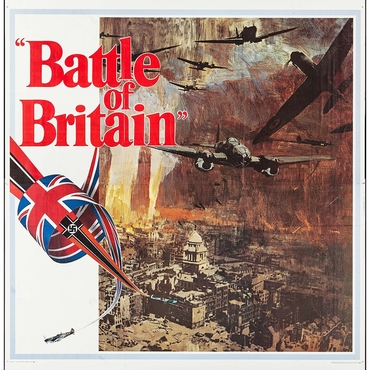
At SteynOnline, Rick McGinnis discusses the 1969 film The Battle of Britain, which was considered a financial flop at the time it was released and only turned a profit once home VCR sales provided a new revenue stream — it was how I first watched the movie, although I do remember seeing posters for it at the cinema while it was in theatrical release.
The best recent depictions of the war – my subjective list includes Band of Brothers, The Pacific, Saving Private Ryan, Dunkirk, Das Boot, Greyhound and Letters from Iwo Jima – were mostly made with veterans advising on historical accuracy and mostly being heard. This wasn’t always the case: for at least two decades following the war, when veterans were still thick on the ground, historical accuracy was frequently sacrificed in the interest of adventure, drama, comedy or romance.
(My subjective list includes Kelly’s Heroes, The Dirty Dozen, The Guns of Navarone, D-Day The Sixth of June, Where Eagles Dare, Operation Petticoat, From Here to Eternity and Von Ryan’s Express. Not that these aren’t entertaining, enjoyable films; they just shouldn’t be considered history.)
If there was a turning point – a film that struggled and mostly succeeded in telling a plausibly accurate story about the war to audiences likely to contain not just veterans but civilians with lived memories – it was probably Guy Hamilton’s Battle of Britain, released in 1969, barely thirty years after the event it commemorates.
While in pre-production for the film, 007 producer Harry Saltzman and his co-producer (and veteran RAF pilot) Benjamin Fisz realized that their American backers at MGM were nervous about making a film about something Americans knew little about. This led to The Battle for the Battle of Britain, a short TV documentary about the film and the event that it was based on, hosted and narrated by one of the film’s stars, Michael Caine.
Included with the 2005 collector’s edition DVD of Hamilton’s film, The Battle for the Battle of Britain begins with a series of “man on the street” interviews conducted outside the American embassy in London. Older interview subjects talk vaguely about how they’d admired the British for standing alone against Nazi Germany at the time; younger ones almost unanimously admit that they don’t’ know anything about it. One woman states that she doesn’t wish to give an opinion since she works for the embassy. At the time these interviews were made the average age of a British pilot who fought in the battle and survived would have been around fifty, as the vast majority of the young men who flew to defend England in the summer of 1940 were on either side or twenty.
Making Battle of Britain felt like a duty in 1969; it attracted a cast of big stars who were willing to work for scale just to be involved, but that didn’t stop the film from going massively over schedule and over budget. Historical accuracy was so important that Saltzman and Lisz ended up collecting what became the world’s 35th largest air force, rebuilding wrecked airframes and making planes that had sat on concrete plinths outside museums and airfields flyable again.
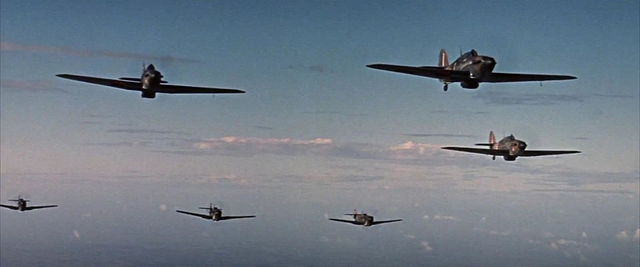
Still from The Battle of Britain
The film begins with the fall of France in the spring of 1940, and British pilots and air crew struggling to get back in the air ahead of the rapidly approaching German army. We meet the three RAF squadron leaders who will be at the centre of the action: Caine’s Canfield, Robert Shaw as the curt, intense “Skipper”, and Colin Harvey (Christopher Plummer), a Canadian married to Maggie (Susannah York), an officer in the Women’s Auxiliary Air Force.
Back across the channel we meet Sir Laurence Olivier as Air Chief Marshal Sir Hugh Dowding, the head of Fighter Command and the man who will lead the English in the air battle to come. Blunt and charmless, Dowding had the unenviable task of telling Sir Winston Churchill, only just appointed Prime Minister, that he doesn’t support his promise to send more fighter squadrons across the Channel to aid the French as they would be squandered in a lost cause and, in any case, he needs every plane and pilot he has to fight the German invasion that’s doubtless coming.