Quotulatiousness

May 5, 2025

Post-election Bullshit Bulletin from The Line

Filed under: Books, Cancon, Media, Politics — Tags: , , , , — Nicholas @ 05:00

Last week’s federal election has left us in the weird, unresolved situation of being not significantly different than the situation before the writ dropped. We still have a Liberal minority government, probably supported by the rump of the NDP caucus (minus Jagmeet Singh) and a reliable vote from the Green MP, which is enough to pass at least an initial confidence vote in the Commons. Before The Line‘s editors put the Bullshit Bulletin back into mothballs, we get a useful wrap-up post:
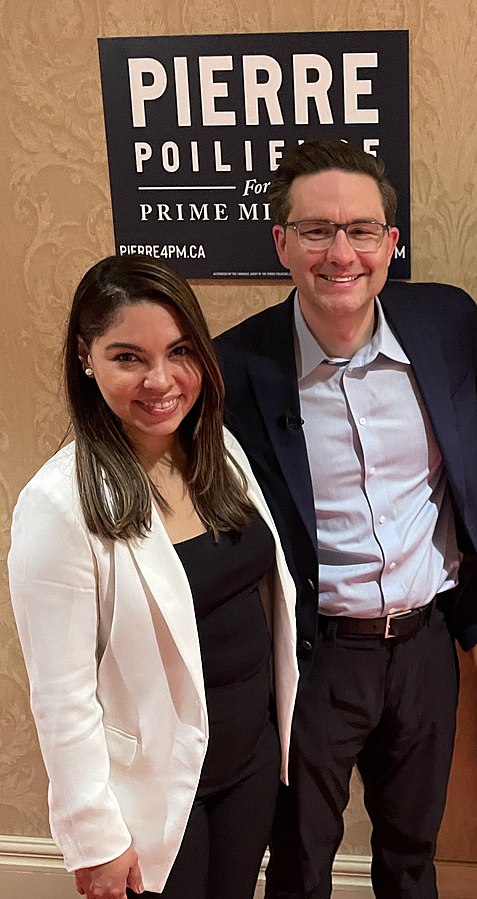
Pierre and Ana Poilievre at a Conservative leadership rally, 21 April, 2022.
Photo by Wikipageedittor099 via Wikimedia Commons.

We want to now offer some advice to Pierre Poilievre: grow up.

Seriously. Because not calling your opponent to congratulate him is bullshit.

We don’t mean Mark Carney! We do think Poilievre should call Carney and offer congratulations and also test the waters to see what extent, if any, there is room for cooperation. We aren’t naive idealists. We know neither man is going to want to hop into the sack — politically speaking — with the other. But there are still norms in a democracy, and they should be observed. Poilievre did congratulate Carney in his remarks on election night, and did so with professionalism and grace, and that’s good.

But we’re actually talking about Bruce Fanjoy, the newly elected Liberal MP for Carleton, the riding that had been held for many years by … Pierre Poilievre. Fanjoy defeated Poilievre on Monday, and by a decisive margin. In an interview with NewsTalk 1010 in Toronto, Fanjoy said that he hadn’t received a call from Poilievre to congratulate him. Calls to the winners of a riding race by the opponents in that riding are routine. Fanjoy doesn’t seem much fazed by the lack of a call, but still. It’s not a great look.

Indeed, we might go so far as to say that not making a call will be seen as confirmation in the eyes of some voters of what they already thought about Poilievre. We aren’t the first to note that the Conservative leader is polarizing and has high “negatives” — Canadians tell pollsters that they dislike him. We understand that congratulating the guy that beat you must be like pulling your own teeth out. We also think we have a good enough read on Poilievre’s personality to know why this is particularly difficult for him.

Too bad. A would-be national leader is expected to sometimes do unpleasant things. And we’re calling about a two-minute phone call here, not making a decision to send troops into battle (some of whom will die) or a decision that will alter the trajectory of our national history.

Make the call, offer congratulations, wish him well, offer any cooperation you can, and get it over with. And if you don’t, Canadians will be right to call bullshit on that.

In the latest SHuSH newsletter, Ken Whyte notes the oddly incurious attitude of the Canadian mainstream media toward the man who became Trudeau’s successor as PM and leader of the Liberal Party:

Then-Governor of the Bank of Canada Mark Carney at the 2012 Annual Meeting of the World Economic Forum in Davos, Switzerland.
WEF photo via Wikimedia Commons.

Mark Carney became prime minister of Canada in March without our media delivering a single meaningful profile of him.

There was a time, only recently ended, when every party leader and most prospective party leaders (and most senior cabinet ministers and chiefs of staff) were subjected to scrutiny the moment they were deemed serious players. A reporter, usually a high-ranking feature artist, would be assigned by Maclean’s, Saturday Night, Report on Business, The Walrus, The Globe & Mail, The National Post, a CBC documentary desk, or any number of other outlets, to dig into the person’s past, read everything on the record, speak to friends and enemies and knowledgeable observers, weigh all the evidence and craft a narrative to give readers (or audiences) a sense of what made the person tick, and some idea of how to think about him or her in relation to public office. At their best, these profiles would provide a welcome counterpoint to how political actors chose to define themselves and how they were defined by their opponents. They were an arbiter of sorts, a first draft of history depended upon by participants in the political process, other media, and the informed public.

No one bothered to profile Carney, even though his advent in our politics had been rumoured for years. It was as though the press gallery in Ottawa assumed he was a known quantity because he’d shown up at the Politics & The Pen Gala for several years in his capacity as governor of the Bank of Canada.

Carney was not only sworn in as prime minister without sustained scrutiny, he made it all the way to the last week of a national campaign before the Globe landed what read like a well-intentioned but hastily assembled and not terribly revealing profile of him. Also in the last week, The Logic, a very good upstart business news site, produced a better one, but for a relatively tiny audience behind an expensive paywall.

Thinking and reporting in depth about the careers and characters of our leaders is perhaps the most important thing that journalists do. Yet Carney’s experience is not unique. If you want to know anything about our last two prime ministers, Stephen Harper and Justin Trudeau, you won’t find much in newspapers, magazines, or documentaries. You’ll need to read the books about them: Stephen Harper by John Ibbitson, Right Side Up and The Longer I’m Prime Minister by Paul Wells, Party of One by Michael Harris; Trudeau by John Ivison, Promise and Peril by Aaron Wherry, The Prince by Stephen Maher, Justin Trudeau on the Ropes by Paul Wells. There is a whole other shelf of aggressively critical takes on the two leaders which offer valuable insights amid their axe-grinding: Tom McMillan’s Not My Party (Harper), Mel Hurtig’s The Arrogant Autocrat (Harper), Brooke Jeffrey’s Dismantling Canada (Harper), Mark Bourrie’s Kill The Messengers (Harper), Yves Engler’s The Ugly Canadian (Harper), Ezra Levant’s Libranos (Trudeau), Candice Malcolm’s Losing True North (Trudeau). Additionally, there are books by the leaders themselves, Harper’s Right Here, Right Now, and Trudeau’s Common Ground, and a range of others written about particular issues or by other participants in their governments.

The past year has brought a wealth of books on our political leadership. Justin Trudeau on the Ropes (Sutherland House) and The Prince (Simon & Schuster) chronicled the last days of Trudeau’s prime ministership. Catherine Tsalikis’s Chrystia (House of Anansi) profiled the woman who ultimately brought him down. Andrew Lawton’s Pierre Poilievre (Sutherland House) and Mark Bourrie’s Ripper (Biblioasis) treated the Conservative leader who sought to replace him. Carney, seemingly intent on dominating the conversation about himself, was ready with another book this spring. The election delayed it until summer.
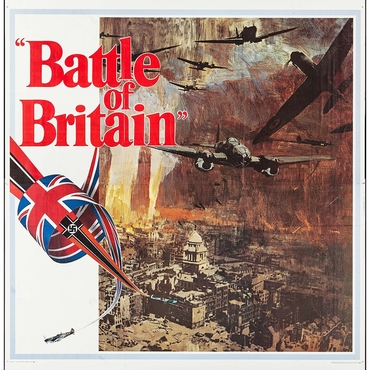
Remembering The Battle of Britain (1969)

Filed under: Britain, History, Media, Military, WW2 — Tags: , , , — Nicholas @ 04:00

At SteynOnline, Rick McGinnis discusses the 1969 film The Battle of Britain, which was considered a financial flop at the time it was released and only turned a profit once home VCR sales provided a new revenue stream — it was how I first watched the movie, although I do remember seeing posters for it at the cinema while it was in theatrical release.

The best recent depictions of the war – my subjective list includes Band of Brothers, The Pacific, Saving Private Ryan, Dunkirk, Das Boot, Greyhound and Letters from Iwo Jima – were mostly made with veterans advising on historical accuracy and mostly being heard. This wasn’t always the case: for at least two decades following the war, when veterans were still thick on the ground, historical accuracy was frequently sacrificed in the interest of adventure, drama, comedy or romance.

(My subjective list includes Kelly’s Heroes, The Dirty Dozen, The Guns of Navarone, D-Day The Sixth of June, Where Eagles Dare, Operation Petticoat, From Here to Eternity and Von Ryan’s Express. Not that these aren’t entertaining, enjoyable films; they just shouldn’t be considered history.)

If there was a turning point – a film that struggled and mostly succeeded in telling a plausibly accurate story about the war to audiences likely to contain not just veterans but civilians with lived memories – it was probably Guy Hamilton’s Battle of Britain, released in 1969, barely thirty years after the event it commemorates.

While in pre-production for the film, 007 producer Harry Saltzman and his co-producer (and veteran RAF pilot) Benjamin Fisz realized that their American backers at MGM were nervous about making a film about something Americans knew little about. This led to The Battle for the Battle of Britain, a short TV documentary about the film and the event that it was based on, hosted and narrated by one of the film’s stars, Michael Caine.

Included with the 2005 collector’s edition DVD of Hamilton’s film, The Battle for the Battle of Britain begins with a series of “man on the street” interviews conducted outside the American embassy in London. Older interview subjects talk vaguely about how they’d admired the British for standing alone against Nazi Germany at the time; younger ones almost unanimously admit that they don’t’ know anything about it. One woman states that she doesn’t wish to give an opinion since she works for the embassy. At the time these interviews were made the average age of a British pilot who fought in the battle and survived would have been around fifty, as the vast majority of the young men who flew to defend England in the summer of 1940 were on either side or twenty.

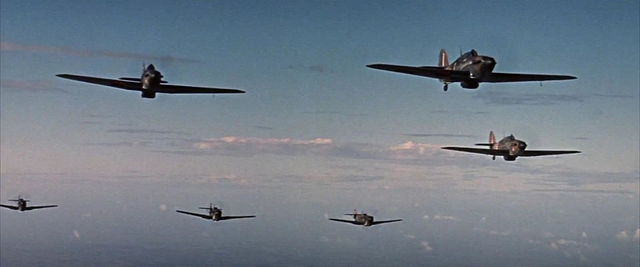
Making Battle of Britain felt like a duty in 1969; it attracted a cast of big stars who were willing to work for scale just to be involved, but that didn’t stop the film from going massively over schedule and over budget. Historical accuracy was so important that Saltzman and Lisz ended up collecting what became the world’s 35th largest air force, rebuilding wrecked airframes and making planes that had sat on concrete plinths outside museums and airfields flyable again.

Still from The Battle of Britain

The film begins with the fall of France in the spring of 1940, and British pilots and air crew struggling to get back in the air ahead of the rapidly approaching German army. We meet the three RAF squadron leaders who will be at the centre of the action: Caine’s Canfield, Robert Shaw as the curt, intense “Skipper”, and Colin Harvey (Christopher Plummer), a Canadian married to Maggie (Susannah York), an officer in the Women’s Auxiliary Air Force.

Back across the channel we meet Sir Laurence Olivier as Air Chief Marshal Sir Hugh Dowding, the head of Fighter Command and the man who will lead the English in the air battle to come. Blunt and charmless, Dowding had the unenviable task of telling Sir Winston Churchill, only just appointed Prime Minister, that he doesn’t support his promise to send more fighter squadrons across the Channel to aid the French as they would be squandered in a lost cause and, in any case, he needs every plane and pilot he has to fight the German invasion that’s doubtless coming.

Make America Austere Again?

Filed under: Economics, Government, Media, Politics, USA — Tags: , , , , — Nicholas @ 03:00

The first 100 days of the BOM haven’t been quite what anyone expected. Close allies and trading partners were shocked at the new administration’s devotion to 1920s tariff “diplomacy”, supporters were dismayed to not get lots and lots of perceived wrongdoers of the Biden administration getting perp-walked for the cameras, and ordinary Americans were presented with a much worse domestic economy than they were promised:

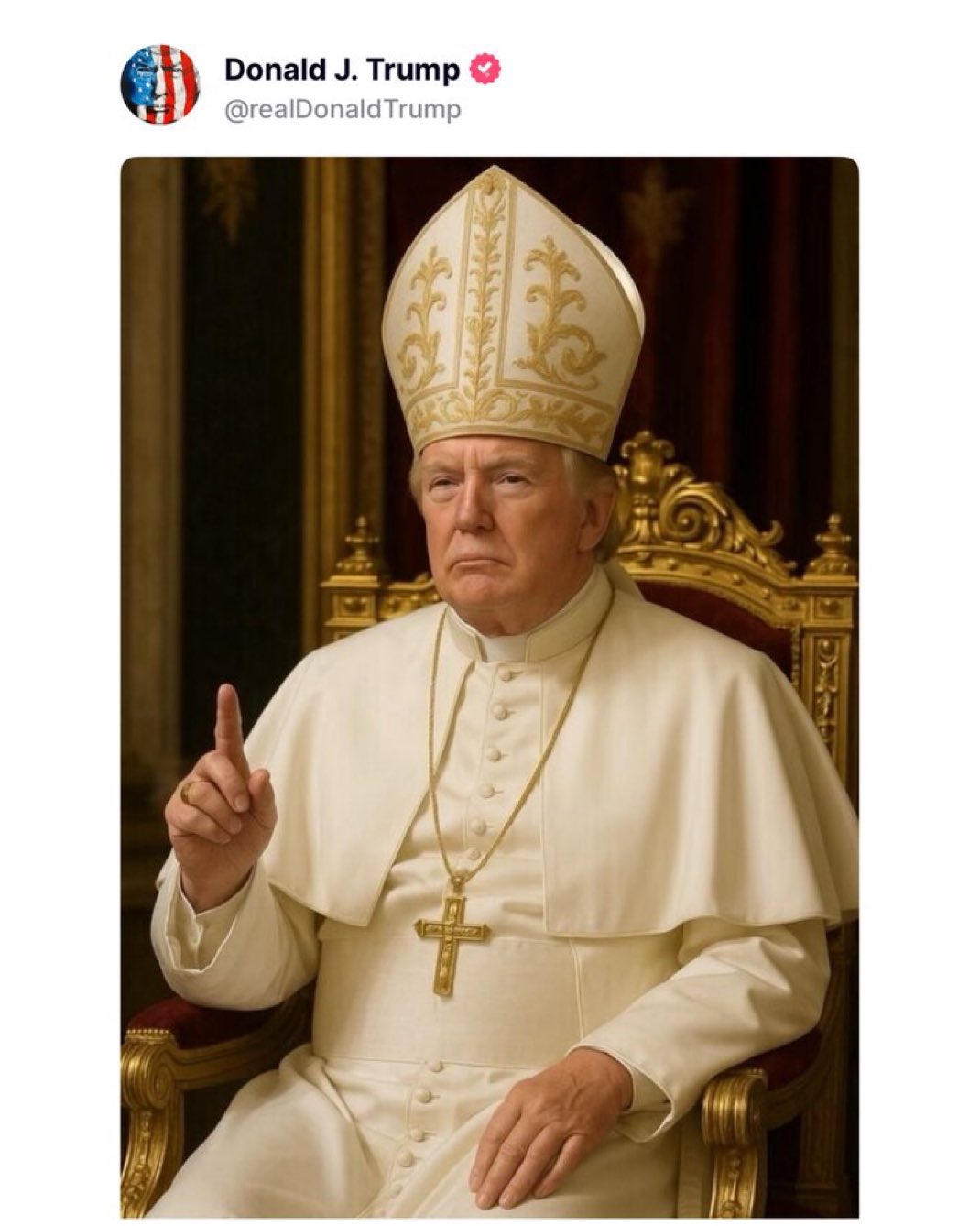
Trump wasn’t totally fixated on economic matters … he still found time in his busy schedule to troll Catholics on his Truth Social platform.

On Wednesday, in the prelude to a cabinet meeting, U.S. President Donald Trump made yet another remark to chill the blood for those concerned about his country. Trump’s cat-and-mouse game of arbitrary changes to American import tariffs is starting to raise concerns about prices and supply chains for consumer goods. The American economy has unexpectedly shrunk in the first 100 days of Trump 2.0, even though workers and businesses are scrambling to make purchases before the effects of Trump tariffs set in. The underlying state of the economy is probably worse than the short-term numbers.

Trump says this is all a matter of “get(ting) rid of the Biden ‘Overhang'”, i.e., it’s his immediate predecessor’s fault. And let’s face it: no other politician on Earth would say anything else 100 days into an executive term. If that was as far as Trump went, it wouldn’t be of unusual concern. What struck me was his separate remark implying that, yeah, tariffs might foul up supply chains a little in the transition to the glorious economy of the future, but haven’t we Americans had it too soft for too long?

“Maybe the children will have two dolls instead of 30 dolls,” the president mused. “So maybe the two dolls will cost a couple bucks more than they would normally.” The message, which brazenly puts the contentment of children front and centre, is one you can’t imagine any other American leader delivering so directly in peacetime: have you all considered being happy with less?

The answer one would expect the median American voter to give is “Hell no”. It’s crazy that I should have to write this, but consumer abundance is a defining feature of the United States! During the Cold War, American supermarkets were the unanswerable argument for economic freedom: you could summarize the United States pretty reasonably as “It’s the country that coined the word ‘super-market'”. In our hyper-interconnected social-media world, I see a dozen conversations a week in which some European boasts of affordable healthcare, walkable neighbourhoods and having July and August and half of September off work every year: the inevitable answer from Americans is “OK, but have you been inside a Buc-ee’s, Gustav?”

Of course, it’s been a very long time since media-decried austerity in government has actually meant any kind of actual reduction in outlay … it’s usually just a (very) slight decrease in the rate of increase rather than actual dollar-value reduction. But, as Chris Bray points out, this time for sure:

I was planning to spend $100 on groceries this morning, but then I decided to slash my grocery budget, so the amount I actually spent on groceries plummeted to just $99.97, plus a small eight dollar supplemental on previously deferred grocery needs, bringing the total to a shockingly parsimonious $107.97. These major cuts caused serious alarm in my household.

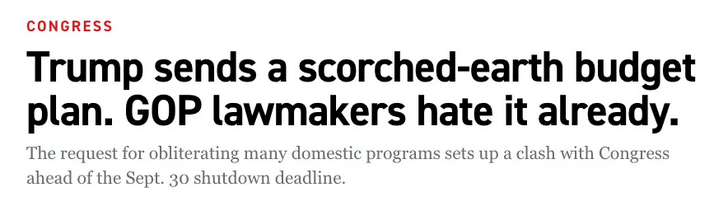
Donald Trump, Politico warns, is scorching the earth:

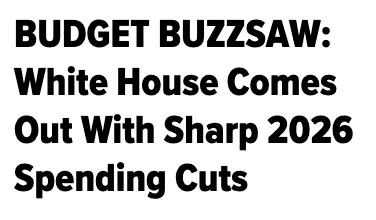
This is the common theme everywhere, as the administration offers the first not-very-detailed hints about its plans for FY ‘26 discretionary federal outlays. The Huffington Post concludes that Trump is pulling out the BUZZSAW:

The Federal News Network sums up the size of the hit, and compare the topline number to the language about scorched earth and buzzsaws:

    Overall, the administration is looking to increase national security spending next year by 13% and decrease non-defense discretionary spending by 7.6%, meaning the White House is asking for $1.7 trillion for the discretionary budget down from $1.83 trillion this year.

While the White House plans don’t get into the subject of total federal spending, focusing narrowly on discretionary spending, the implication is that federal spending overall will go from about $7 trillion to about … $7 trillion. But TBD.

You can read the entire White House proposal for discretionary funding here. Trump is proposing deep cuts in some federal departments and programs, but is also proposing to offset those cuts with sharp increases in military spending and “homeland security”, meaning border security and sending poor gentle immigrants to places where Chris Van Hollen will fly to stare into their beautiful eyes.

The Bloody Battle of Agincourt | Animated Episode

The Rest Is History
Published 30 Nov 2024

“We few, we happy few, we band of brothers”.

The Battle of Agincourt in 1415 endures as perhaps the most totemic battle in the whole of English history. Thanks in part to Shakespeare’s masterful Henry V, the myths and legends of that bloody day echo across time, forever enshrining the young Henry as the greatest warrior king England had ever known. So too the enduring idea of the English as plucky underdogs, facing down unfavourable odds with brazen grit. And though the exact numbers of men who fought in the two armies is hotly contested, the prospect was certainly intimidating for the English host looking down upon the vast French force amassed below them the day before the battle. Hungry and weary after an unexpectedly long march, and demoralised by the number of French that would be taking to the field, the situation certainly seemed dire for the English. One man amongst them, however, held true to his belief that the day could still be won: Henry V. An undeniably brilliant military commander, he infused his men with a sense of patriotic mission, convincing them that theirs was truly a divinely ordained task, and therefore in this — and his careful strategic planning the night before the battle — he proves a striking case of one individual changing the course of history. However, the French too had plans in place for the day ahead: total warfare. In other words, to overwhelm the English in a single devastating moment of impact, sweeping the lethal Welsh archers aside. So it was that dawn broke on the 25th of October to the site of King Henry wearing a helmet surmounted by a glittering crown and bearing the emblems of both France and England, astride his little grey horse, and riding up and down his lines of weathered silver clad men, preparing them to stride into legend … then, as the French cavalry began their charge, the sky went black as 75,000 arrows blocked out the sun. What else would that apocalyptic day hold in store?

Join Tom and Dominic as they describe the epochal Battle of Agincourt. From the days building up to it, to the moment that the two armies shattered together in the rain and mud of France. It is a story of courage and cowardice, kings and peasants, blood and bowels, tragedy and triumph.

00:00 What is to come …
00:50 Shakespeare and Henry V
02:53 Agincourt is exceptional
04:15 The battle is a test of God’s favour
05:27 The English see the French forces …
09:30 The French aren’t offering battle
10:40 Why the French delay
11:13 The French think they’re going to win
11:35 An ominous silence
12:35 Henry’s plan
20:50 The French plan
24:28 How big were the armies
28:49 The lay of the land
34:50 Henry makes the first move
37:00 The French charge into darkness
38:57 The French army advances
45:50 Reaction to the slaughter
(more…)

QotD: English intelligentsia and the Soviet Union

Filed under: Books, Britain, History, Politics, Quotations, Russia, WW2 — Tags: , , , — Nicholas @ 01:00

It is important to realize that the current Russomania is only a symptom of the general weakening of the Western liberal tradition. Had the M.O.I. chipped in and definitely vetoed the publication of this book, the bulk of the English intelligentsia would have seen nothing disquieting in this. Uncritical loyalty to the U.S.S.R. happens to be the current orthodoxy, and where the supposed interests of the U.S.S.R. are involved they are willing to tolerate not only censorship but the deliberate falsification of history. To name one instance. At the death of John Reed, the author of Ten Days that Shook the World — a first‐hand account of the early days of the Russian Revolution — the copyright of the book passed into the hands of the British Communist party, to whom I believe Reed had bequeathed it. Some years later, the British Communists, having destroyed the original edition of the book as completely as they could, issued a garbled version from which they had eliminated mentions of Trotsky and also omitted the introduction written by Lenin. If a radical intelligentsia had still existed in Britain, this act of forgery would have been exposed and denounced in every literary paper in the country. As it was, there was little or no protest. To many English intellectuals it teemed quite a natural thing to do. And this tolerance of plain dishonesty means much more than that admiration for Russia happens to be fashionable at this moment. Quite possibly that particular fashion will not last. For all I know, by the time this book is published my view of the Soviet regime may be the generally-accepted one. But what use would that be in itself? To exchange one orthodoxy for another is not necessarily an advance. The enemy is the gramophone mind, whether or not one agrees with the record that is being played at the moment.

I am well acquainted with all the arguments against freedom of thought and speech — the arguments which claim that it cannot exist, and the arguments which claim that it ought not to. I answer simply that they don’t convince me and that our civilization over a period of 400 years has been founded on the opposite notice. For quite a decade past I have believed that the existing Russian regime is a mainly evil thing, and I claim the right to say so, in spite of the fact that we are allies with the U.S.S.R. in a war which I want to see won. If I had to choose a text to justify myself, I should choose the line from Milton:

By the known rules of ancient liberty.”

The word ancient emphasizes the fact that intellectual freedom is a deep‐rooted tradition without which our characteristic Western culture could only doubtfully exist. From that tradition many of our intellectuals are visibly turning away. They have accepted the principle that a book should be published or suppressed, praised or damned, not on its merits but according to political expediency.

And others who do not actually hold this view assent to it from sheer cowardice. An example of this is the failure of the numerous and vocal English pacifists to raise their voices against the prevalent worship of Russian militarism. According to these pacifists, all violence is evil, and they have urged us at every stage of the war to give in or at least to make a compromise peace. But how many of them have ever suggested that war is also evil when it is waged by the Red Army? Apparently the Russians have a right to defend themselves, whereas for us to do so is a deadly sin. One can explain this contradiction in only one way — that is, by a cowardly desire to keep in with the bulk of the intelligentsia, whose patriotism is directed toward the U.S.S.R. rather than toward Britain.

I know that the English intelligentsia have plenty of reason for their timidity and dishonesty; indeed, I know by heart the arguments by which they justify themselves. But at least let us have no more nonsense about defending liberty against fascism. If liberty means anything at all, it means the right to tell people what they do not want to hear. The common people still vaguely subscribe to that doctrine and act on it. In our country — it is not the same in all countries: it was not so in Republican France, and it is not so in the United States today — it is the liberals who fear liberty and the intellectuals who want to do dirt on the intellect: it is to draw attention to that fact I have written this preface.

George Orwell “The Freedom of the Press”, 1945 (written as the preface to Animal Farm, but not published in Orwell’s lifetime).

Powered by WordPress