
World War Two
Published 12 Aug 2023The Germans launch a counter-attack to sabotage the Allied positions in France. In the Baltics the Soviet advances grind to a halt, but the Soviets are busy making plans to invade Romania in the south. Meanwhile in the center the Warsaw Uprising continues. Across the world the siege of Hengyang comes to its end with a Japanese victory, but the Battle for Guam ends with a Japanese loss.
[Promoted from the comments]: An increasingly persistent challenge for us at TimeGhost is that a growing number of our videos are being age restricted. While this was always the case with War Against Humanity, it’s started affecting this weekly series now too. This most recent video was restricted before it was even publicly published. As such we made the difficult decision to publish a censored version instead this week.
Why is it such a big issue? Well it doesn’t only limit the access to educational content for young people, but also to adult audiences. Age restricted videos have a barrier to viewing that ranges from territory to territory, with some countries requiring viewers not only to have a YouTube account, but to link it with their credit card. Even if an account belongs to a verified adult, it’s still less likely to be recommended an age restricted video.
Our core mission at TimeGhost is making the lessons of our past free and accessible to people around the world. While it’s challenging, especially with the new obstacles from YouTube, it’s still possible thanks to everyone in the TimeGhost Army who backs these videos. To all of you that signed up, or who watch regularly, thank you for joining us on this mission.
August 13, 2023
Panzer Revenge in Normandy – WW2 – Week 259 – August 12, 1944 (CENSORED)
August 12, 2023
The urge to compare our own culture to the declining Roman Empire
In UnHerd, Alexander Poots wants pundits to stop comparing this or that country in the West to the latter stages of the Gibbonian decline of Rome:
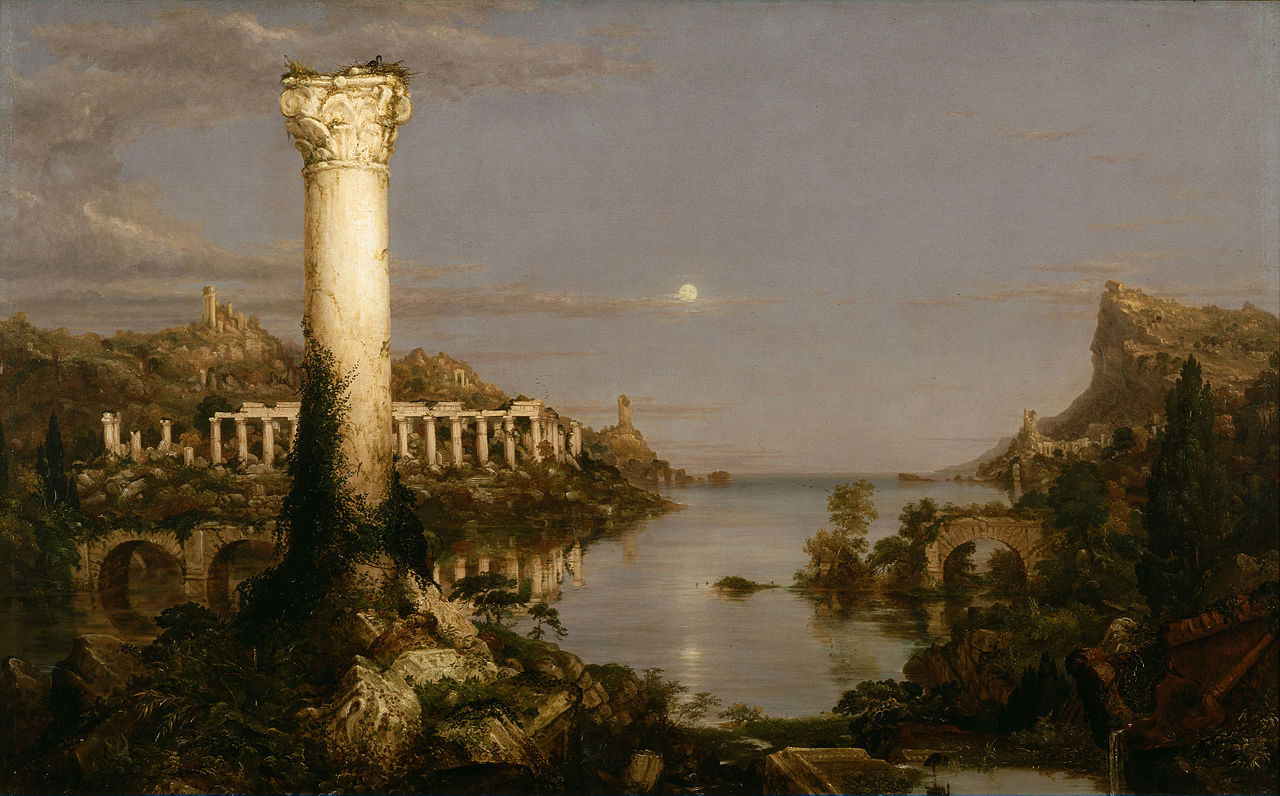
“The Course of Empire – Desolation” by Thomas Cole, one of a series of five paintings created between 1833 and 1836.
Wikimedia Commons.
On both sides of the Atlantic, hysterical comparisons between the collapse of the Roman Empire and the senile polities of the modern West have become the journalistic norm. Every major problem facing our society — from climate change to Covid to inflation — has received the Gibbon treatment.
There are, of course, regional variations. The British, tied by geography to Europe’s fortunes, tend to favour the definitive fall of the Western empire in AD 476. The Americans, ever fearful of an over-mighty executive, linger on the collapse of senatorial authority in 49 BC. And it is also more than a journalistic trope, with the unacknowledged legislators of our world also playing the same game. Elon Musk recently suggested that today’s baby drought is analogous to the low birth rates of Julius Caesar’s dictatorship. Marc Andreessen has compared California to Rome circa AD 250. Joe Rogan, meanwhile, is beginning to suspect that all this gender business might have a worrying ancient precedent.
Such appeals to the past are only human. The fourth word in Virgil’s Aeneid is Troiam. This is the first fact that we learn about Aeneas: he is from Troy. Virgil does not even bother to tell us his hero’s name until the 92nd line. Doubtless, the poets of Ur and Hattusha had their own Troys. And perhaps the first men who placed one mud brick upon another sang of flooded valleys, choked caves and herds that no longer ran. But Rome has been our common loss since the early Middle Ages. As Virgil looked back to Priam, so we look back to Virgil. In 1951, it was perfectly natural for W. H. Auden to compare a dying Britain with a dead Rome: “Caesar’s double-bed is warm / As an unimportant clerk / Writes I DO NOT LIKE MY WORK / On a pink official form”
But journalists and billionaires do not work in a poetic register. They deal in facts and lucre. When they say that Britain or America is following imperium Romanum down the dusty track to oblivion, they seem to be speaking literally. This is not a mistake that Virgil would have made. It is all very well to evoke Rome as an elegiac warning. But if we believe that there are concrete lessons to learn from the Roman Empire’s decline and fall, then we will have to examine the mother of cities as she really was. The results are surprising.
In AD 384, 400 years after Virgil composed his Aeneid, Quintus Aurelius Symmachus had a bridge problem. Symmachus was Urban Prefect of Rome, a role of huge responsibility. By the fourth century, the city of Rome was no longer the imperial capital of the western empire; it had been replaced in 286 by Mediolanum (modern Milan), which was a good deal closer to the empire’s febrile northern borders. But Rome remained the nation’s hearthstone. Her good governance was of the highest priority. The Urban Prefect dispensed justice, organised games, fed the mob and looked after the material fabric of the city. It was not an enviable position. One man had to keep the vast, turbulent metropolis ticking over with the minimum of rioting. Symmachus was well aware of the touchiness of the Roman pleb. His own father had been burned out of his house and chased from the city after making a catty remark of the “let them eat cake” variety during the wine shortage of 375.
The bridge problem went like this. Around 382, the emperor Gratian ordered that a new bridge be built across the Tiber. It soon became clear that construction was taking too long and costing too much. Two years later, as the project neared completion, one span collapsed. Such waste of public funds could not be ignored, and so an inquiry was launched. A specialist diver was engaged to examine the structure; he discovered that the job had been bodged. The engineers responsible for the project, Cyriades and Auxentius, were summoned to account for their failure. Each blamed the other, before Auxentius, who had been caught backfilling sections of the bridge with bales of hay, fled the city — pockets doubtless jingling with public gold.
On the face of it, this sounds like a very late Roman story: a nation once famous for its engineering prowess could no longer build a bridge across the Tiber without everything going horribly wrong. But I’m not sure that’s true. Problems arise all the time, and in themselves tell us very little about a society. What matters is the response to those problems. And Symmachus’s dispatches to the imperial court make it clear that his response was considered and comprehensive. The bridge was completed in the end, and stood for over 1,000 years until its demolition in 1484. Now think of 21st-century London: remember what happened the last time we tried to build a bridge across the Thames?
QotD: Scientific management and the work-to-rule reaction
Scientific management, a.k.a. “Taylorism”, was all the rage around the turn of the 20th century. At its crudest (and I’m only exaggerating a little), you’ve got some dork with a stopwatch and a camera standing behind you while you do your job, and after some observations and a little math, the dork tells you you’re pulling the lever wrong. There’s a scientifically optimized way to pull that lever, one that shaves 0.6 seconds off each of your work “processes”, and henceforth you shall be required to do this exact sequence of steps, every time … and if you disagree, too bad, why do you hate science? Similar regulations follow, until the whole plant is “scientifically” optimized.
And since this is the great age of “Progress”, you’ve got umpteen government regulations to deal with now, too. And then as now, the august personages in Congress wouldn’t dream of soiling even their shoes, let alone their hands, by going anywhere near anyplace labor is actually performed, so all these regulations have been promulgated ex cathedra. Suddenly the straightforward, mindless job of lever-pulling — the one that was already so insulting to the human spirit, so “alienating”, as Marx put it, something to be endured because one has no choice — is bound up with reams of regulations, too. If you don’t like it, build your own factory.
But in this, the workers saw opportunity. You’re going to tell me how to do my job? Fine, but you’d better tell me how to do all of it. Is there anything the Policies and Procedures manual leaves unexplained? Where to place my feet as I stand in front of the lever, for example? I’d better not do anything until the manager tells me exactly what to do, in writing, in a fully-vetted update to the P&P, and have you run that by Compliance, sir? Perhaps the lawyers in the Environmental Division should take a gander, too, since who knows what might contribute to Global Warm … errrrr, whatever, you get the point. It turns out that even back then, when there was no such thing as OSHA or the EPA or the rest of the Federal alphabet soup, the “scientific managers”, let alone Congress, simply weren’t able to envision the nuances of everyone’s day-to-day job. Or, for that matter, the very basics of everyone’s job. Work ground to a halt because everyone was following the rules.
Severian, “A History Lesson”, Rotten Chestnuts, 2021-01-14.
August 11, 2023
The Weirdest Boats on the Great Lakes
Railroad Street
Published 5 May 2023Whalebacks were a type of ship indigenous to the Great Lakes during the late 1890s and mid 1900s. They were invented by Captain Alexander McDougall, and revolutionized the way boats on the Great Lakes handled bulk commodities. Unfortunately, their unique design was one of the many factors which led to their discontinuation.
(more…)
August 10, 2023
“… most boys start being treated as second class citizens around middle school … boys are treated as defective girls”
Sarah Hoyt on the plight of boys and young men these days:

It’s far worse for the kids, because most of them are not even working at what they trained for. Or if they are, they are working at a level as though they were never trained.
But there is a bigger problem: most boys start being treated as second class citizens around middle school. If you’re older than me, you might think I lost my mind. Heck, if you’re younger than me, and never looked closely at what your kids’ school is doing, or you have no kids, you might think I’m nuts.
Well, I might be nuts but not on this. Starting at about middle school, boys are treated as defective girls. Because women are the majority and treated like a protected minority, every school is afraid of not “treating them fairly” which means giving them primacy. Now just your boy’s behavior as a boy will be punished, but assignments are geared for how girls/women think (which means they also annoy the living daylights of atypical females like myself), they are oriented to group work (which by and large punishes males, though again, atypical females ain’t too happy either), and they’re geared to at least external compliance (which again is a female trait.) Most of the teachers are not just women, but they’re women indoctrinated in a system that tells them that male work is superior and that women are unfairly discriminated against for “being kept out of it.”
If at this point you’re puzzled over my referring to male and female characteristics, and to male work, let’s take the gloves off and speak like adults, instead of the mush most of us have been fed our entire lives.
While we’re rational, thinking creatures, and creatures with our own will power, and therefore can work on a lot of our characteristics and change them: there are differences between men and women. Innate, inborn differences, starting in the uterus with the “hormone baths” that guide development of different sexes. Period.
No real scientist would ever deny that, unless of course he/she feared for his/her job.
… and because we live in retarded times, let me explain that though our bodies and brains are completely different and run on two models, yes, how much that difference manifests is a spectrum. First, because development has glitches. I.e. some people don’t get the right hormones at the right time, and might outright have a brain that leans more the way opposite their body. This is very rare. It is also, btw, not covalent with gender dysphoria. It’s mostly 100% living frustrated by the rest of humanity and assumptions made. But there are other issues. Other types of characteristics might emphasize/mitigate/mimic the way of thinking of the opposite sex. Autistic females tend to think more like males (go figure) and ADHD women might appear to (though it’s not necessarily true.)
Also, like every gendered characteristic, there is a spectrum. Gender doesn’t exist on a spectrum (mostly because it’s a grammatical construct and those are very binary/trienary) but GENDER EXPRESSING CHARACTERISTICS do. Every adult knows tall, hairy men with deep voices, and slight, almost hairless males who are tenors. And every combination thereof. This without regard to maleness/fertility/orientation. And every adult knows vavaboom females that look like they should be painted on the nose of WWII planes, and tall, broad shouldered, practically no hips or breasts females and every combination in between. And these women might or might not be straight/fertile without regard to those combinations.
And yes, all of us know strong women and weak males, though testosterone unreasonably favors males from early development.
[…]
Look, to level set: if you have a son, even a relatively high performing one, chances are he’s working under a level of throttling-down. And most boys are checked out. They no longer care. They’ve been told they’re oppressors and evil by reason of being born male from the moment they were conscious of being male. They no longer care. They no longer want to do anything. Burned out before they even start their lives.
And under it, because they’re males, with testosterone, there’s a level of anger that women will never understand, unless they live surrounded by males and really, really work at understanding. This means that this treatment of boys is creating that much ballyhooed “toxic masculinity” which idiots confuse with “being male”.
Yes, some boys are finding their way into professions the feminists have no interest in, and bless Mike Rowe, whatever his issues, for showing the way to a bunch of males.
But that’s not going to solve our problems as a society in general. Because, sure, we need machinists and HVAC technicians. But we also need engineers who are more fascinated with the “thing” that is the main part of their job, than with office politics. We need researchers who will work hard at figuring the problem, and not spend most of their time figuring out on whom to step to get higher. We need doctors who are gruff and not particularly good at “customer service” but view disease as an enemy to be conquered. (I could go for days about medicine. I’m not going to. But part of our favoring women in medical school is that we are importing most of the people involved in actual day to day doctoring — a dirty, unpalatable position educated women tend to disdain — from countries without the same standards of training. This is one of the idiotic consequences of denying biology in favor of bizarre Marxist social engineering. And not that, yes, I have several female doctors among the regulars. Yes, females can be good and passionate doctors. And several of them are. But those who read here are old enough they were admitted on an equal footing with males. No one was trying to make it 80% female, which is what I’m complaining about. That level of discrimination distorts everything down the line.)
We are INTENTIONALLY blocking males from pursuing their interests and talents, while pushing women to pursue what are traditionally male interests and talents.
This extends from professions to modes of behavior. Women are encouraged to join the hook up culture, with no emotional attachments and behave like BAD and IRRESPONSIBLE men of the 50s (or at least the popular image of those. None of us lived them. Wait. Some of you did. But I didn’t. And those who did as adults are, at this point, a minority.)
The only possible conclusion is that our culture has gone insane and thinks that male modes of work, and male modes of social behavior are VASTLY superior to females. And that females would normally behave like males, unless they were prevented. So, women must have been prevented for MILLENNIA. MILLENNIA. And now, we’re taking revenge for all those oppressed women, by making men behave like women and women like men. Ah. See how they like being oppressed!
Stated like this, openly, it sounds completely insane. It’s like these people are bizarrely misogynistic aliens, who never met a human. Which is largely true. They’re Marxists, for whom every human is a widget, interchangeable with every other human.
August 9, 2023
America Plans to Incinerate Japan – War Against Humanity 107
World War Two
Published 8 Aug 2023The Allied Strategic bombing campaign has claimed hundreds of thousands of civilian lives across Europe and has made little real impact on the Axis war machine. Even so, the United States is determined to extend the campaign to Japan. Until now, the vast distances of the Asia-Pacific theatre have protected the imperial enemy. That all changes when the USAAF unleashes the Superfortress.
(more…)
“Soon, they say, white America will be over”
At Oxford Sour, Christopher Gage considers the prominent media narrative about the inevitability of a “majority-minority” America within the next twenty years:

According to both the Daily Stormer and the Washington Post‘s Jennifer Rubin, white people will be a minority sometime in the 2040s.
In 2008, the U.S. Census Bureau projected that “non-Hispanic” white Americans would fall to 49 percent by the year 2042.
Since then, breathless media-politicos have taken the coming “majority-minority” as gospel. Some on the left celebrate the forthcoming date as the first day of their permanent dominance. Some on the right employ the doomsday date to encourage lunatics to rub out innocent people in a synagogue.
The 2020 census continued the theme. Breathless, lazy journalists took the clickbait. Ominously, they said the white population was “shrinking”. According to the Census Bureau, the white population shrunk to just 57.8 percent. Michael Moore did a little dance.
On white nationalist forums, users with names like WhiteGenocide88 were traumatised, and tooling up for war. No doubt, there are a few Robert Bowers with monstrous campaigns lurking around their skulls.
The problem with this theory, or so my Jewish puppet masters instruct me to say, is that it’s nonsense.
Firstly, the white population didn’t “shrink”. Not unless one believes the Jim Crow “one-drop” rule meaning one non-white ancestor renders one non-white. Secondly, the census ignores millions of white Americans who check the “Hispanic” box. These Americans more than cover any white decline.
According to the census, only those of one hundred percent white European ancestry are white. The Ku Klux Klan tends to agree.
For the first time on the census form, white people could include their varied multi-racial ancestry. Over 31 million whites did so. When we count these white people as white, the white population climbs to 71 percent. So, rather than “shrinking”, the white population has since 2010 increased by four million.
With a sensible definition of white, even by 2060, America remains around 70 percent white.
Professor Richard Alba, a sociologist at the City University of New York, says that definition means America remains a majority-white nation indefinitely — no doomsday clock, no murderous rampages, no primitive bloodsport over a faulty horoscope.
I’m no demographer but counting all white people as white people means there are more white people. I’m no sociologist either but revealing the increase in white people means fewer Robert Bowers keen to pump shotgun rounds into human flesh.
At Not the Bee, Joel Abbott is concerned about the obvious glee displayed by legacy media folks when they push the “replacement” story line:
You can practically feel the excitement here from the quivering fingers of the journalist that wrote this.
Ah.
Hmm.
Well, this is awkward.
See, I’m told this isn’t happening. White people aren’t being “replaced,” they’re just simply being phased out with a percentage that isn’t white at the same time all our institutions, companies, and leaders are pushing to eradicate things like “whiteness” and “white rage” in the name of equity.
For the record, I really couldn’t care less about the skin color of who lives in America. I care an infinite amount more about the spiritual worldview and values of my neighbor than whether their physical DNA gave them dark skin, blue eyes, or a big nose.
This is why I find it weird that the media keeps reporting, with abject glee, that people who look like me will be in the minority soon.


QotD: The “Merry Pranksters”
To make ends meet, he got a job as an orderly at the local psych hospital. He also ran across some nice people called “MKULTRA” who offered him extra money to test chemicals for them. As time went by, he found himself more and more disillusioned with the hospital job, finding his employers clueless and abusive. But the MKULTRA job was going great! In particular, one of the chemicals, “LSD”, really helped get his creative juices flowing. He leveraged all of this into his Great American Novel, One Flew Over The Cuckoo’s Nest, and became rich and famous overnight.
He got his hands on some extra LSD and started distributing it among his social scene – a mix of writers, Stanford graduate students, and aimless upper-class twenty-somethings. They all agreed: something interesting was going on here. Word spread. 1960 San Francisco was already heavily enriched for creative people who would go on to shape intellectual history; Kesey’s friend group attracted the creme of this creme. Allan Ginsberg, Hunter S. Thompson, and Wavy Gravy passed through; so did Neil Cassady (“Dean Moriarty”) Jack Keroauc’s muse from On The Road. Kesey hired a local kid and his garage band to play music at his acid parties; thus began the career of Jerry Garcia and the Grateful Dead.
Sometime in the early 1960s, too slow to notice right away, they transitioned from “social circle” to “cult”. Kesey bought a compound in the redwood forests of the Santa Cruz Mountains, an hour’s drive from SF. Beatniks, proto-hippies, and other seekers – especially really attractive women – found their way there and didn’t leave. Kesey and his band, now calling themselves “the Merry Pranksters”, accepted all comers. They passed the days making psychedelic art (realistically: spraypainting redwood trees Day-Glo yellow), and the nights taking LSD in massive group therapy sessions that melted away psychic trauma and the chains of society and revealed the true selves buried beneath (realistically: sitting around in a circle while people said how they felt about each other).
What were Kesey’s teachings? Wrong question – what are anyone’s teachings? What were Jesus’ teachings? If you really want, you can look in the Bible and find some of them, but they’re not important. Any religion’s teachings, enumerated bloodlessly, sound like a laundry list of how many gods there are and what prayers to say. The Merry Pranksters were about Kesey, just like the Apostles were about Jesus. Something about him attracted them, drew them in, passed into them like electricity. When he spoke, you might or might not remember his words, but you remembered that it was important, that Something had passed from him to you, that your life had meaning now. Would you expect a group of several dozen drug-addled intellectuals in a compound in a redwood forest to have some kind of divisions or uncertainty? They didn’t. Whenever something threatened to come up, Kesey would say — the exact right thing — and then everyone would realize they had been wrong to cause trouble.
Scott Alexander, “Book Review: The Electric Kool-Aid Acid Test”, Slate Star Codex, 2019-07-23.
August 8, 2023
How the Battle of Amiens Influenced the “Stab in the Back” Myth
OTD Military History
Published 7 Aug 2023The Battle of Amiens started on August 8 1918. It started the process that caused the final defeat of the German Army on the battlefield during World War 1. Many people falsely claimed that the German Army was not defeated on the battlefield but at home by groups that wished to see German fall. One person who helped to create this myth was German General Erich Ludendorff. He called August 8 “the black day of the German Army”.
See how this statement connects to the stab in the back myth connects to Amiens and the National Socialists in Germany.
(more…)
August 7, 2023
Legacy media puzzled at falling levels of public trust in the scientific community
Given the way “the science” has been politicized over recent years and especially through the pandemic, it’s almost a surprise that there’s any residual public trust left for the scientific community:
Sagan’s warning was eerily prophetic. For the last three-plus years, we’ve witnessed a troubling rise of authoritarianism masquerading as science, which has resulted in a collapse in trust of public health.
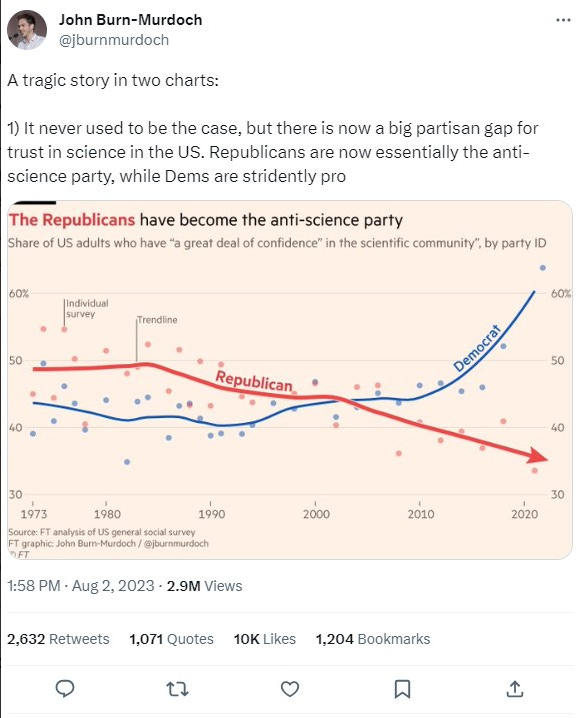
This collapse has been part of a broader and more partisan shift in Americans who say they have “a high degree of confidence in the scientific community”. Democrats, who had long had less confidence in the scientific community, are now far less skeptical. Republicans, who historically had much higher levels of trust in the scientific community, have experienced a collapse in trust in the scientific community.
John Burn-Murdoch, a data reporter at The Financial Times who shared the data in question on Twitter, said Republicans are now “essentially the anti-science party”.
First, this is a sloppy inference from a journalist. Burn-Murdoch’s poll isn’t asking respondents if they trust science. It’s asking if they trust the scientific community. There’s an enormous difference between the two, and the fact that a journalist doesn’t understand the difference between “confidence in science” and “confidence in the scientific community” is a little frightening.
Second, as Dr. Vinay Prasad pointed out, no party has a monopoly on science; but it’s clear that many of the policies the “pro science” party were advocating the last three years were not rooted in science.
“The ‘pro science’ party was pro school closure, masking a 26 month old child with a cloth mask, and mandating an mrna booster in a healthy college man who had COVID already,” tweeted Prasad, a physician at the University of California, San Francisco.
Today we can admit such policies were flawed, non-sensical or both, as were so many of the mitigations that were taken and mandated during the Covid-19 pandemic. But many forget that during the pandemic it was verboten to even question such policies.
People were banned, suspended, and censored by social media platforms at the behest of federal agencies. “The Science” had become a set of dogmas that could not be questioned. No less an authority than Dr. Fauci said that criticizing his policies was akin to “criticizing science, because I represent science”.
This could not be more wrong. Science can help us understand the natural world, but there are no “oughts” in science, the economist Ludwig von Mises pointed out, echoing the argument of philosopher David Hume.
“Science is competent to establish what is,” Mises wrote. “[Science] can never dictate what ought to be and what ends people should aim at.”
August 6, 2023
The Warsaw Uprising Begins! – WW2 – Week 258 – August 5, 1944
World War Two
Published 5 Aug 2023As the Red Army closes in on Warsaw, the Polish Home Army in the city rises up against the German forces. Up in the north the Red Army takes Kaunas. The Allies take Florence in Italy this week, well, half of it, and in France break out of Normandy and into Brittany. The Allies also finally take Myitkyina in Burma after many weeks of siege, and in the Marianas take Tinian and nearly finish taking Guam. And in Finland the President resigns, which could have serious implications for Finland remaining in the war.
(more…)
What’s in a (tech) name?
Ted Gioia isn’t a fan of all the recent rebrandings of social media platforms, and tries to explain “why web platforms keep changing their names like criminals in the Witness Protection Program”:

“Automotive Social Media Marketing” by socialautomotive is licensed under CC BY 2.0

When I first heard that Twitter was renaming itself as X, I thought it was a joke.
Not a funny joke, just a goofy one. Elon Musk has a taste for schoolboy humor — and on many occasions has posted something undignified for a laugh. I assumed X was another example of this.
Who could take that name seriously?
Just consider the significations of X:
- The crossbones you put in front of a skull on a bottle of poison;
- A mistake on a test, marked by the teacher in red;
- How you sign your name if you can’t read or write;
- Something you haven’t figured out in algebra;
- A movie that’s dirty, raunchy, or offensive in some manner;
- A mark on a map where stolen wealth has been buried by pirates or criminals;
- The street name for an illegal drug (MDMA) with various adverse long-term effects — including depression, anxiety, and impairments of cognition, memory, and learning;
- A symbol of betrayal (i.e., a double cross);
- In marketing language, an inferior product, as in “Brand X”;
- A radioactive ray so dangerous that it killed the people who invented and developed it.
Given these associations, nobody in their right mind would replace a familiar, proven brand name with X. Mr. Musk must be joking again. Or so I thought.
But I thought wrong.
If this were an isolated event, I would dismiss it as just one more quirk on the part of an eccentric CEO. But these horrible rebrands are now standard practice in Silicon Valley, especially among dominant Internet platforms.
Why did Google change its corporate name to Alphabet? Why did Facebook change its corporate name to Meta? These were two of the best known brand names in the history of capitalism. Why get rid of them?
And consider this bizarre coincidence. The very same month that Twitter became X, Instagram launched its own text posting option. But it refused to use the familiar Instagram name, instead calling this new feature Threads.
Threads is another word that has all sorts of negative connotations. It refers to something old and torn. It’s associated with poverty and an embarrassing appearance.
What gives?
Do you remember the carefree early days of the web? Brand names were innocent and playful — they sounded like something from a nursery rhyme: Yahoo, Google, Tumblr. Twitter was one of those cutesy names.
Its symbol was a chirping bird. So sweet. So innocent.
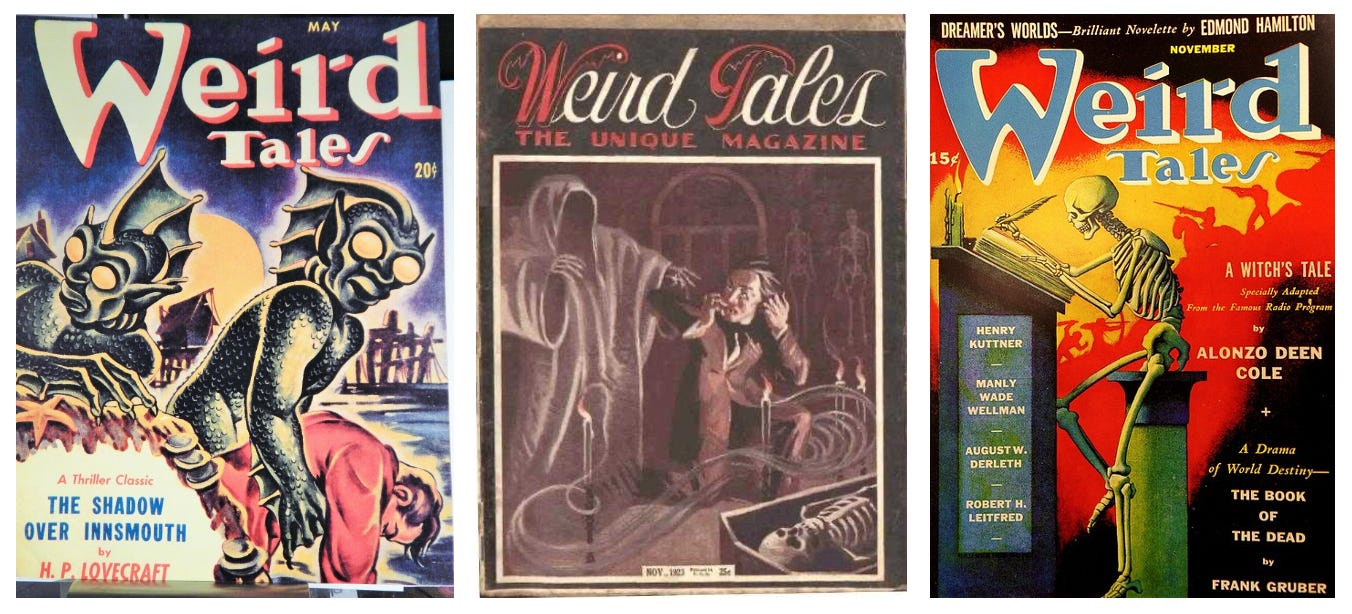
But nowadays, web platforms take on names straight out of an H.P. Lovecraft horror story — Threads, X, Ghost, Twitch, Discord, etc.
Today’s writing prompt: Use all of those words in the opening lines of a story. Then send it off to an editor at Weird Tales.
Current day techno bro vibe
Chaffee Reece Model 1882: A Good Idea on Paper …
Forgotten Weapons
Published 29 Aug 2017Patented in 1879 by Reuben Chaffee and General James Reece, the Chaffee-Reece rifle is an excellent example of how an idea that seems good on paper can easily become untenable in a fielded rifle. The main design premise of the rifle was to have a tubular magazine in the buttstock which held the cartridges out of contact with each other, as opposed to being pressed together by a magazine spring as in a conventional design. This would notionally prevent any possibility of recoil or other forces causing the bullet of our round to impact the primer of another and cause a detonation in the magazine.
In initial testing by the Army in 1882, the prototypes were appealing, and a field trial of 750 rifles was requested. Chaffee and Reece were unable to find a commercial manufacturer willing to take on the production (except Colt, which offered to make just 200, and at the cost of $150 etc), and they ultimately turned to the government-operated Springfield Arsenal to build the guns. A total of 753 rifles were made by Springfield in 1883 and 1884 (interestingly, not serial numbered) and delivered for testing.
That testing went quite badly. The magazine was a very complex system, using two sets of basically reciprocating racks to shuttle cartridges up the magazine as the bolt was cycled, without allowing them to contact each other. It proved very prone to jamming and breakage, and was both extremely difficult to keep clean and very susceptible to, as they would have called it at the time, “derangement”. It was handily beaten by the Winchester Hotchkiss 1885 pattern rifles (among others) in field trials, and that was the end of its potential for adoption. The rifles were eventually sold as surplus, and bought by the Bannerman company, where they remained in stock and available for purchase until at least 1907.
(more…)
August 5, 2023
In the “New World Order”, China was expected to become more democratic. Instead, the west is rapidly becoming more like China
N.S. Lyons discusses the unhappy convergence of Communist China with the post-democratic western world, led by the United States:

Differences and tensions between the United States and China have never been greater. The whole world is dividing itself between the blocs of these two opposing superpowers. A new Cold War is dawning, complete with a global ideological “battle between democracy and autocracy“. Freedom is on the line. The future of global governance will be determined by the winner of this extended competition between two fundamentally opposed political and economic systems – unless a hot war settles the question early with a cataclysmic fight to the death, much as liberal democracy once fought off fascism.
This is the simple and easy narrative of our present moment. In some ways it is accurate: a geopolitical competition really is in the process of boiling over into open confrontation. But it’s also fundamentally shallow and misleading: when it comes to the most fundamental political questions, China and the United States are not diverging but converging to become more alike.
In fact, I can already predict and describe the winner set to prevail in this epochal competition between these two fiercely opposed national systems. In this soon-to-be triumphant system …
Despite a rhetorical commitment to egalitarianism and “democracy”, the elite class deeply distrusts and fears the people over whom it rules. These elites have concentrated themselves into a separate oligarchic political body focused on prioritizing and preserving their rule and their own overlapping set of shared interests. Wracked by anxiety, they strive constantly to maximize their control over the masses, rationalizing a need to forcefully maintain stability in the face of dangerous threats, foreign and domestic. Everything is treated as an emergency. “Safety” and “security” have become be the watchwords of the state, and of society generally.
This elite obsession with control is accelerated by a belief in “scientific management”, or the ability to understand, organize, and run all the complex systems of society like a machine, through scientific principles and technologies. The expert knowledge of how to do so is considered the unique and proprietary possession of the elite vanguard. Ideologically, this elite is deeply materialist, and openly hostile to organized religion, which inhibits and resists state control. They view human beings themselves as machines to be programmed, and, believing the common man to be an unpredictable creature too stupid, irrational, and violent to rule himself, they endeavor to steadily condition and replace him with a better model through engineering, whether social or biological. Complex systems of surveillance, propaganda, and coercion are implemented to help firmly nudge (or shove) the common man into line. Communities and cultural traditions that resist this project are dismantled. Harmfully contrary ideas are systematically censored, lest they lead to dangerous exposure. Governing power has been steadily elevated, centralized, and distributed to a technocratic bureaucracy unconstrained by any accountability to the public.
All of this is justified by a utopian ideological dialectic of historical progress and inevitability. Those more in tune with the tide of history (i.e. elite interests) are held to be morally and intellectually superior, as a class, to backwards reactionary elements. Only certain views are stamped “scientific” and “correct,” although these may change on a political whim. An economism that values only the easily quantifiable reigns as the only moral lodestar, and frictionless efficiency is held up as highest common good; the individual is encouraged to fulfill his assigned role as a docile consumer and cog in the regime’s machine, not that of a self-governing citizen. The state regularly acts to stimulate and manage consumer demand, and to strategically regulate and guide industrial production, and the corporate sector has largely fused itself with the state. Cronyism is rampant.
The relentless political messaging and ideological narrative has come to suffuse every sphere of life, and dissent is policed. Culture is largely stagnant. Uprooted, corralled, and hounded, the people are atomized, and social trust is very low. Reality itself often feels obscured and uncertain. Demoralized, some gratefully accept any security offered by the state as a blessing. At the same time, many citizens automatically assume everything the regime says is a lie. Officialdom in general is a Kafkaesque tragi-comedy of the absurd, something only to be stoically endured by normal people. Yet year by year the pressure to conform only continues to be ratcheted higher…
Which country does this describe? If you can’t quite tell, well, that’s the point. For many citizens of the West, the systems of governance under which we live increasingly feel uncomfortably similar to what appears offer in the People’s Republic of China.
Tempting Armageddon: Soviet vs. NATO Nuclear Strategy
Real Time History
Published 4 Aug 2023Since the inception of the nuclear bomb, military strategists have tried to figure out how to use them best. During the Cold War, this led to two very different doctrines but on both sides of the Iron Curtain the military wasn’t sure if you could actually win Nuclear War.
(more…)


