
Secret Base
Published 8 Aug 2023This is the second episode of our seven-part docuseries, The History Of The Minnesota Vikings.
For the Vikings, the 1970s were so full of comedy, drama, and doomed snowmobiling expeditions that we had to split this decade into two episodes. And we STILL had to leave stuff out! What a team.
(more…)
August 21, 2023
What the parades are for | Dorktown
Comments Off on What the parades are for | Dorktown
Baby Boomers – “a marketing category is not an age group”
Sarah Hoyt (who’s a few years younger than me) tackles the generational conflict that always seems to flare up on social media, if not so much in real life:
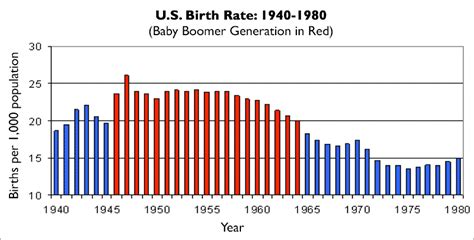
I’m going to write about boomers, why a lot of us blame them for … almost everything, why my generation (roughly 55 to 64) not only are not boomers, but tend to be the most vociferous in “D*mn it, I’m not a boomer.” Why I’m vaguely amused that millennials call everyone older than them “boomer”. And why I find it bizarre that my kids both hate millennials and identify as millennials, though they both are d*mn close to z and closer to z in attitudes. (And the younger one in date of birth, I think.) And why all this is unfair, because a marketing category is not an age group, and yet, perfectly fair in aggregate, because demographics is not destiny, but it sure as heck is economy. And economics shapes your life in a way you probably can’t think about too deeply without becoming enraged.
So, yeah, friends, in-betweeners, X, millenials and Zers, lend me your ears. I come not to bury the boomers and not to praise them, but to explain to everyone, including the sane boomers in the audience why the fractiousness exists, and to give — under the heading of giving perspective on the lives of others that we normally keep quiet about — an idea of how my non-generation (We certainly are not Jones. We don’t jones for anything that the boomers had. We just aren’t them) has gone through. Without blaming the boomers, because an accident of birth is not their fault.
First of all, and taking in account that I’m the one who says the population is not booming out of control, let me dismiss the idea the baby boom wasn’t real. That’s goofy. (To put it mildly.) You can argue the causes, but for about ten years — no, not the twenty five claimed. Marketing generations are not demographic generations — after World War II, families grew. Blame it on prosperity, which allowed one parent to stay home and raise the sprogs. Blame it on tax credits (it has been argued if the comparable applied today, people would have families of five or six too.) Sure, blame it on the move rural to city, which was tied to prosperity too, and the fact that the newly independent nuclear families didn’t have to put up with grandma’s critique of their child bearing or raising. Or blame it on the men having been away and the relief of the long war being over.
Blame it on whatever you want, but even without looking at the numbers, just by looking at family histories, families of five or six weren’t rare. And three was about average, I think. Four not anything to remark on.
But, you’ll say, that’s fairly normal for the past period. Sure. My mom, who was almost a boomer comes from a family of five (should be six, one lost in infancy) and dad from a family of four. And I’m almost sixty, and both dad and I were very late children. So, yeah “But that was normal before.”
Yes, it was, but now throw in prosperity, moves to the cities and … It’s not the babies who were born, you see, it’s the ones who survived. Even mom who was raised, for brevity of explanation, in a slum where going to your playfriend’s funeral, or more likely his infant sibling’s funeral was absolutely normal, had more of her friends survive than was normal for her parent’s generation.
To put it another way. Up until the late 19th century, women routinely bore 10 children and didn’t get to raise a single one to adulthood.
Even in the nineteenth century, women at the upper class level Jane Austen wrote about, routinely made two or three baby shrouds as part of their trousseau. Because that many deaths were expected. By my parent’s time that had improved — no, not medicine, sanitation. Better drains, a weekly bath, and washing your clothes more than twice a year — to the point that you would regularly raise about half of what you bore. (My family, having steel constitutions rarely lost a child. To compensate, we were always relatively low fertility.)
The improvement brought on by rudimentary sanitation and washing up was such that in the nineteenth century Europe burst at the seams with kids, which led to rapid invention, expansion, and yes, the adoption of a lot of half baked ideas. Because that’s the result of a lot of kids suddenly in a society. Baby busts … well, most of the Middle Ages, lead to slow innovation, a tendency to ossify the social structures, laws and regulations increasingly made by old men, for a world they only imagine exists. Stop me when this sounds familiar.
The baby boom happened at the intersection of the discovery of antibiotics and their popularization and also inoculation of school aged kids, both of which meant an unexpected number of children surviving childhood and surviving it in good health. And people having about the number of children their parents had. BUT — and this is very important — those children grew to adulthood and did so without any significant physical impairment.
What it caused was the same effect as if everyone alive had decided to have double or more the number of children. It was a massive demographic elephant moving through the societal snake.
Comments Off on Baby Boomers – “a marketing category is not an age group”
Cunk on America – Historian Reacts
Vlogging Through History
Published 9 May 2023
(more…)
Comments Off on Cunk on America – Historian Reacts
QotD: Effrontery, snake oil and TV preachers
… effrontery has made great strides as a key to success in life, and indeed quite ordinary people now employ it routinely. There are consultants in effrontery training who not only commit it themselves but teach others how to commit it, and charge large sums for doing so. There was a time when self-praise was regarded as no praise, rather the reverse; but now it is a prerequisite for advancement.
The other day I was sent a video of a young woman — elegant, attractive, and very self-confident — giving a seminar on how other young women, one of them the daughter of a friend, could and should change their lives for the better. In a way, I admired the leader of the seminar’s effrontery (just as I secretly admire Thomas Holloway’s). She spoke in pure, unadulterated clichés, practically contentless, but with such force of conviction that, if you discounted what she actually said, you might have thought that she was a person of profound insight with a vocation for imparting it to others. Her audience was as lambs to the slaughter, or at least to the fleece; they had paid a large sum of money to listen to mental pabulum that would make the recitation of a bus timetable seem intellectually stimulating.
On catching glimpses in the past of American television evangelists, it was always a cause of wonderment to me that anyone could look at or listen to them without immediately perceiving their fraudulence. This fraudulence was so obvious that it was like a physical characteristic, such as height or weight or color of hair, or alternatively like an emanation, such as body odor (incidentally, pictures of Guevara always suggest, to me at any rate, that he smelled). How could people fail to perceive it? Obviously, many did not, for the evangelists were very successful — financially, that is, the only criterion that counted for them.
But the attendees of the seminar of which I saw a video clip were well educated, and still they did not perceive the vacuity, and therefore the fraudulence, of the seminar that they attended at such great expense to themselves.
But was not my own surprise at their gullibility a manifestation of my own gullibility, in supposing that intelligence and education make a man wise, rather than more sophisticated in his foolishness?
But at least most of their victims were uneducated, relatively simple folk.
Theodore Dalrymple, “The Way of Che”, Taki’s Magazine, 2017-10-28.
Comments Off on QotD: Effrontery, snake oil and TV preachers
August 20, 2023
Hitler Has a Bad Day – WW2 – Week 260 – August 19 – 1944
World War Two
Published 19 Aug 2023This week the Allies invade Southern France, and do so very successfully. They’re also successful in the north, closing the Falaise gap and trapping huge numbers of Germans. In the East, however, the Germans manage to stop the Soviet drive on Riga with a counter attack, and in Warsaw they continue to brutally put down the Warsaw Uprising.
(more…)
Comments Off on Hitler Has a Bad Day – WW2 – Week 260 – August 19 – 1944
August 19, 2023
One Day in August – Dieppe Anniversary Battlefield Event (Operation Jubilee)
WW2TV
Published 19 Aug 2021One Day in August — Dieppe Anniversary Battlefield Event (Operation Jubilee) With David O’Keefe, Part 3 — Anniversary Battlefield Event.
David O’Keefe joins us for a third and final show about Operation Jubilee to explain how the plan unravelled and how the nearly 1,000 British, Canadian and American commandos died. We will use aerial footage, HD footage taken in Dieppe last week and maps, photos, and graphics.
In Part 1 David O’Keefe talked about the real reason for the raid on Dieppe in August 1942. In Part 2 David talked about the plan for Operation Jubilee. The intentions of the raid and how it was supposed to unfold.
(more…)
Comments Off on One Day in August – Dieppe Anniversary Battlefield Event (Operation Jubilee)
“Twitter used to work well, but now he receives negative comments, which means that it has stopped working”
Chris Bray on the claims that Twitter, er, I mean “X” is broken from people who are suddenly being exposed to unfriendly opinions that the old platform used to kindly keep out of their very comfortable bubbles:
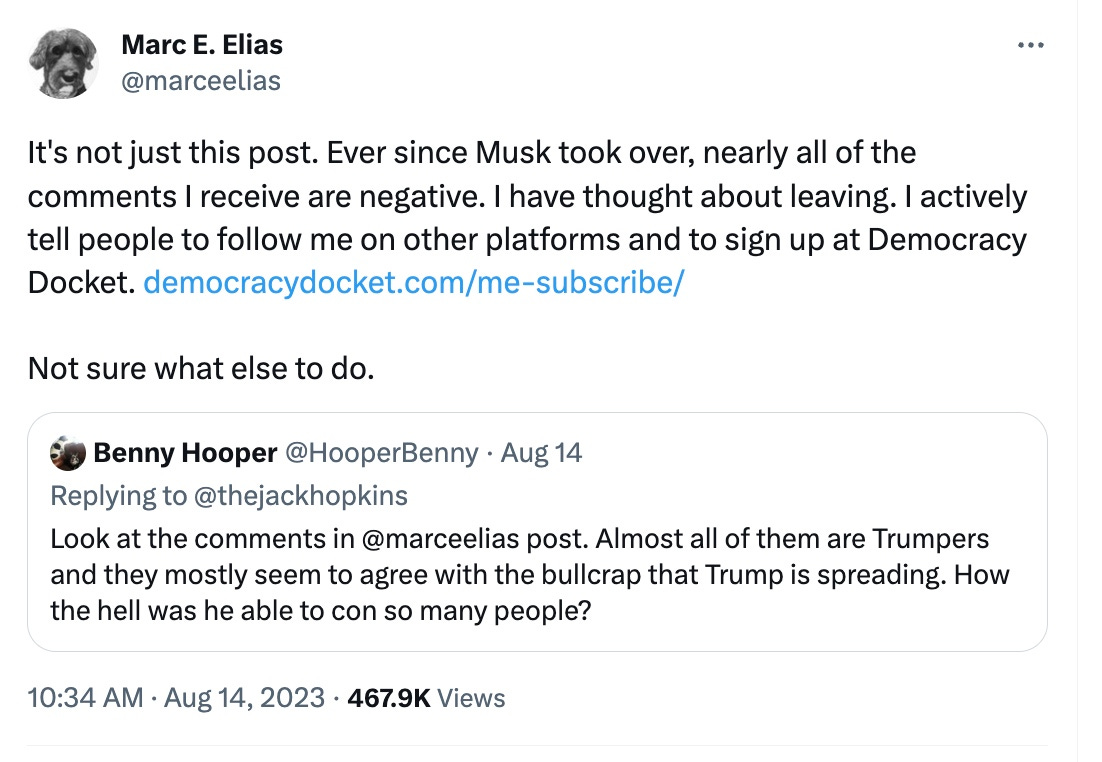
The Democratic Party’s go-to election lawyer, Marc Elias, is disturbed by the decline of Twitter:
Twitter used to work well, but now he receives negative comments, which means that it has stopped working. People can criticize him and express disagreement, so the platform is broken. If it worked, he would only be praised.
“Epistemic closure” had its pet rock moment in 2010, as the news media looked back on the George W. Bush years and the Iraq War and concluded that American neoconservatives had simply lost their ability to think.
[…]
It was supposed to mean this:
It’s rather about information, and what counts as evidence about the real world … if one only gets information from a narrow set of sources that feed back into each other but do not engage beyond themselves, that one will have a closed mind … regardless of what one does with that information.
And this:
Epistemic closure is a fancy term for the practice of defining – or redefining – reality in ways that support your pre-existing ideological preferences. Most of us think of it as “creating and living in a bubble”.
It was a fair enough point, as Bush watched sectarian brutality continue in post-Saddam Iraq and kept drawing the conclusion that everyone everywhere really yearns for democratic pluralism, honest elections, and a free press.
But that era’s epistemic closure is bush-league — sorry — compared to the sealed-in-a-jar-in-a-closed-box-in-a-deep-cave closure of the “mainstream” mind in 2023. If you’ve been on social media since roughly the night of November 8, 2016 and you’ve expressed disagreement with a politician, academic, or media figure, you’ve been a Russian bot, and Putin told you to say that. Criticism of institutions can’t simply arise from authentic grievances, or even from an authentically felt but misperceived grievance; rather, criticism is an op, a calculated string-pulling effort by manipulative forces. The far-right Putin-aligned Nazi grifters are tricking you into believing that you’re unhappy with the Biden administration. Your brain has been fooled by cognitive warfare, see?

Comments Off on “Twitter used to work well, but now he receives negative comments, which means that it has stopped working”
August 18, 2023
One Day in August – Dieppe – Part 2 – The Plan
WW2TV
Published 17 Jan 2021Part 2 – The Plan With David O’Keefe
David O’Keefe joins us again. In Part 1 he talked about the real reason for the raid on Dieppe in August 1942. In Part 2 we talk about the plan for Operation Jubilee and David will share his presentation about the intentions of the raid and how it was supposed to unfold.
A final show sometime in the summer will come live from Dieppe to explain how the plan unravelled and how the nearly 1,000 British, Canadian and American commandos died.
(more…)
Comments Off on One Day in August – Dieppe – Part 2 – The Plan
QotD: Everyone’s a woke cop
I read about the PWR BTTM accusations. They’re disturbing. I take them seriously. But these guys have had their careers erased overnight, and the idea that we have any responsibility to give them the chance to defend themselves is treated like you took part in their alleged crimes. You simply cannot say, in polite society, “basic fairness requires us to avoid a rush to judgment and to give people the right to respond to accusations”. To do so gets you lumped in with the criminals. Like a friend of mine said, “the only acceptable reaction to an accusation is enthusiastic and unqualified acceptance”. I don’t know how people can simultaneously talk about prison abolition and restoring the idea of forgiveness to literal criminal justice and at the same time turn the entire social world into a kangaroo court system. Like I wrote once, we can’t simultaneously be a movement based on rehabilitation and restorative justice AND a viciously judgmental moral aristocracy. You know who thinks everybody’s guilty until proven innocent? Cops. You know who thinks people don’t deserve the right to defend themselves? Cops. You know who says those who defend basic fairness and due process are as bad as criminals themselves? Cops.
Freddie deBoer, “Planet of Cops”, reposted by Jesse Singal, originally published 2017-05-17.
Comments Off on QotD: Everyone’s a woke cop
August 17, 2023
Lawfare as politics by other means
Chris Bray explains why getting rid of the Donald Trump candidacy wouldn’t even begin to solve the real problems in US politics today:
Donald Trump has been charged with crimes, so the Republican Party should drop him as a candidate and move on to someone else who hasn’t been indicted. That’ll solve the problem!
It won’t. The problem is lawfare. The Republican governor of Wisconsin defeated a recall effort, so Democratic district attorneys launched a long series of predawn raids on his supporters — until the courts made them stop. The Republican governor of Texas won four terms, but then was indicted by the office of a Democratic district attorney — for a budget veto, an action within his constitutional authority. Again, the courts intervened, and the legally absurd charges were dismissed.
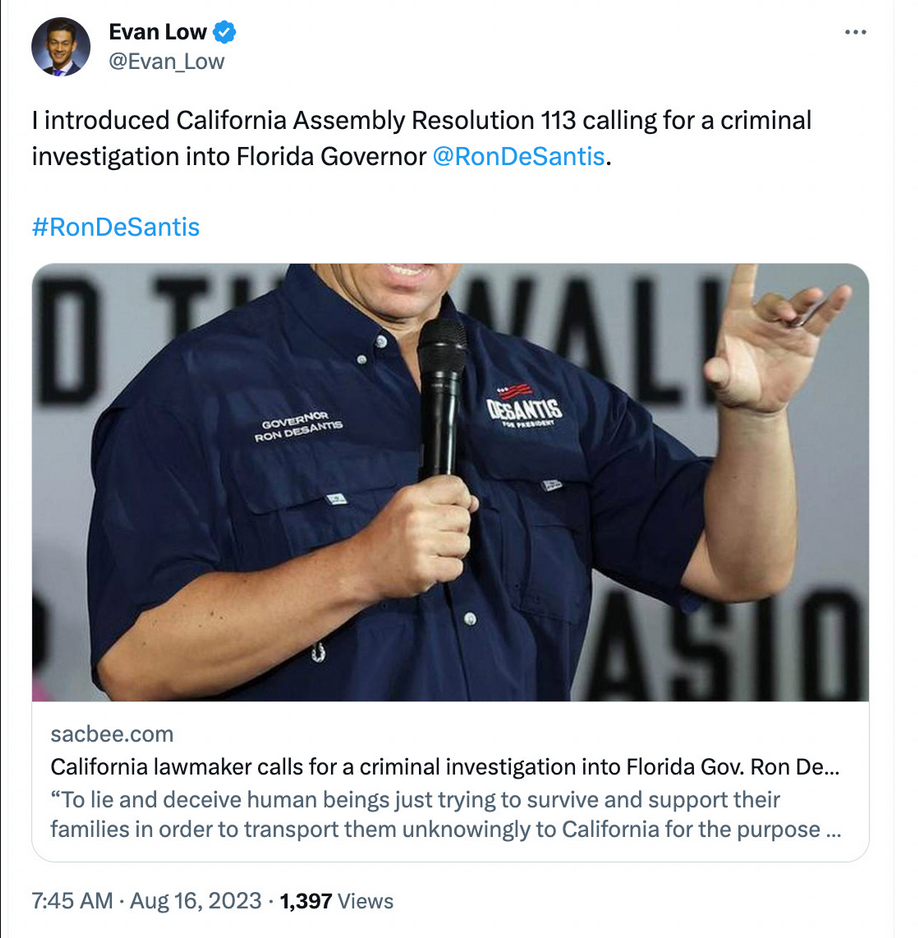
Today, scumbag California Assemblyman Evan Low, a uniquely craven publicity chaser even by the local standards, proudly announces that he’s just introduced a legislative resolution calling for the federal government to open a criminal investigation into Florida Governor Ron DeSantis.
So. Get rid of Trump and nominate DeSan— oh, wait. Okay, name someone, anyone: Chris Christie, Vivek Ramaswamy, a utility nominee to be named later in exchange for three rookie infielders. Oh no, it turns out that the new nominee is under criminal investigation for [TBD]! As of, uh, tomorrow.
I have mixed feelings about Donald Trump, who supported pandemic lockdowns and school closures and the rushed development of mRNA injections with limited testing. Dumping him as a candidate because he’s been indicted misses the point. No Republican candidate will run for the presidency without being indicted, unless he’s a court-eunuch Mitt Romney figure, too safe to bother attacking.
Comments Off on Lawfare as politics by other means
August 16, 2023
QotD: Cognitive dissonance, or when cultists retcon reality
For those with even a moderate level of commitment to the cult (and I’ll leave it to you to speculate what moderate commitment to a cult might be; Festinger’s work is not without its critics), disconfirmation of the cult’s central belief led, astoundingly, to an even greater commitment to the cult. “The world will end on X date” was immediately retconned into “the world didn’t end on X date because of our righteousness“.
You know you’re really onto something when it seems head-slappingly obvious in retrospect. Yeah, of course they did that. Everybody does that to a degree. You expect something isn’t going to work out, then it does work out — it must be because you’re special, right? It’s another way of assigning yourself agency in a world where you’re basically powerless over the big stuff. Humans are wired to believe they have agency, that things happen for a reason. It sounds like I’m giving Festinger at best a backhanded compliment, but I’m very seriously singing his praises — “everybody knows” this stuff, but no one had isolated and described it before. That’s a major achievement — if I could have the equivalent of “discovered cognitive dissonance” on my tombstone, I’d die an ecstatically happy man.
Severian, “Quick Takes: Festinger Edition”, Rotten Chestnuts, 2021-01-19.
Comments Off on QotD: Cognitive dissonance, or when cultists retcon reality
August 15, 2023
History must be forced to fit the narrative
Chris Bray revisits an older article from the Obama years:
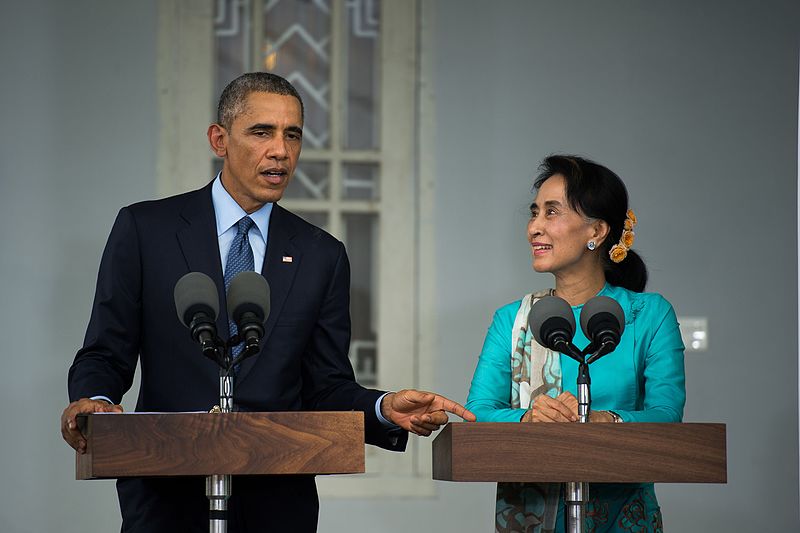
President Barack Obama and Aung San Suu Kyi in 2014.
Photo via Wikimedia Commons
There is no question that authoritarianism is descending on the United States of America, quickly. There is also no question where it’s coming from, as you quickly learn from the current social media musings of the most wonderfully progressive people. Trump must be silenced NOW! Why is the authoritarian being ALLOWED TO SPEAK? Ruth Ben-Ghiat, please call your office.
How have we gotten here?
I’ve mentioned before a looooong essay I wrote, more than ten years ago, about the cottage industry in Barack Obama hagiographies. Obama’s fellatiographers noted, for example, that Obama’s stepfather, Lolo Soetoro, had been ordered back to Indonesia in 1966, and that photos of him from that time show him in the uniform of the Indonesian army. They also mention, with remarkably disingenuous vagueness, that there was maybe some political trouble going on in Indonesia while Obama was there as a child and his stepdad was a soldier.
But what was happening in the mid-1960s in Indonesia is that the Indonesian Communist Party tried to restructure Sukarno’s careful balancing of competing forces in the new country with the kidnapping and killing of a group of right-wing flag officers by leftist soldiers, beheading conservative military power — after which the military responded with the wholesale killing of hundreds of thousands of communists, often with machetes and with a serious commitment to doing the job as grimly as possible: bodies in rivers, heads on pikes, slow killing in front of mass graves. Here’s my last paragraph from that section on the Obama biographies:
And the lesson? Indonesia was where “Ann was Barry’s teacher in high-minded matters—liberal, humanist values”, Remnick concludes. It’s where she taught him the values of “honesty, hard work, and fulfilling one’s duty to others”, where she lectured him about “a sense of obligation to give something back”, Scott adds. It’s where she “worked to instill ideas about public service in her son”. Because Indonesia in the late sixties was the perfect place and time to learn about liberal humanist values and public service.
Barack Obama was a Democrat who attained the presidency, which means that journalists knew he had to be a sainted figure, and he was the first black president, which means that journalists knew he had to be brilliant and extraordinary. So they assembled the threads of his story — Barack Obama went to Indonesia in 1966 with his stepfather, a soldier, during a long period of extraordinarily brutal political retribution by the Indonesian army — and then, pro forma, wove those threads into the foundation of “liberal, humanistic values”.
If Barack Obama had spent his childhood torturing kittens to death and eating their eyeballs in front of a sobbing crowd of kitten-loving toddlers, the Obama biographies would have said that Barack Obama spent his childhood torturing kittens to death and eating their eyeballs in front of a sobbing crowd of kitten-loving toddlers, a heartwarming experience that taught him the value of democratic pluralism and fundamental human decency. The story was written before anyone began working on it: Barack Obama [experience TBD] and [experience TBD], the formative experiences that made him the kind and wonderful genius he is today.
See also this recent discussion with David Garrow, a historian who
has written a new(corrected: published a post-Obama-presidency) biography — and who found, as he researched his subject, that he was often looking at evidence no one had ever pursued before. The hagiographers of the Obama presidency-era weren’t looking for evidence; they already knew the story they meant to write. They came up with some evidence-simulating objects for form’s sake, to assemble their liturgy in the apparent form of biography. Their “Barack Obama” was never Barack Obama.Their “Donald Trump” is not, now, Donald Trump. There’s a formula; they apply it. There’s a narrative to be written. Donald Trump said he would repeal two federal regulations for every new regulation he implemented — textbook authoritarianism! Donald Trump said that America has fought a bunch of “dumb wars”, and should be much more careful about foreign military involvement — JUST LIKE ADOLF HITLER!!!!!!
It’s beside the point to note that the conclusions never matched the evidence. They were never meant to.
This is crazymaking behavior. Constantly spinning narratives that have nothing to do with anything in the actual, physical world is a recipe for a psychotic break. And we have multiple layers of institutional actors who cosplay “elite” — in media, in academia, in government, and in corporations — who’ve been playing with their shadow puppets for so long that they’ve forgotten they’re shadow puppets. They believe themselves.
That’s how you get to we need a single-party ballot to prevent authoritarianism and we have to arrest the opposition leader to prevent authoritarianism. It’s socially distributed insanity, a real descent into the world of false symbols. And it’s becoming incredibly dangerous.
Comments Off on History must be forced to fit the narrative
August 14, 2023
56 pounds of beer | Dorktown
Secret Base
Published 1 Aug 2023In the early years, the Minnesota Vikings were like many new franchises of the time: dysfunctional, bad at football, and often intoxicated. And then a former NBA champion came back home to Minnesota and changed the identity of this franchise forever.
This is the first episode of Dorktown’s seven-part docuseries, The History of the Minnesota Vikings.
(more…)
Comments Off on 56 pounds of beer | Dorktown
The Mighty Carl Gustaf MAAWS: A King Among Weapons
Interesting Engineering
Published 3 May 2023The Carl Gustaf recoilless rifle, produced by Saab Bofors Dynamics, is an adaptable and portable weapon system designed for anti-tank and anti-structure operations. Its original design was widely adopted by European armies as a primary anti-tank weapon before being replaced by the superior Carl Gustaf M2 in 1964.
In the early 1990s, the U.S. Army took an interest in the M3 model due to its lightweight design, versatility, and powerful anti-tank and anti-structure capabilities. It was initially adopted by the Army’s Special Operations Command (USASOC) and gained popularity among soldiers for its ease of use, accuracy, and effectiveness against a range of targets.
Compared to other weapons like the AT-4 and the FGM-148 Javelin, the M3 offers the advantage of reloadability thanks to its rifled metal/carbon fiber launch tube. At 22 lbs (10 kg), it is more manageable than the Javelin’s 50 lbs (22.7 kg), allowing for faster engagement compared to waiting for mortar support. It is also more cost-effective than the Javelin and artillery shells when targeting enemies in hard cover.
Overall, the Carl Gustaf recoilless rifle is a powerful and effective weapon system that has been widely adopted by militaries around the world. Its continued development and advancement in technology ensure that it will remain an important tool in modern warfare for years to come.
(more…)
Comments Off on The Mighty Carl Gustaf MAAWS: A King Among Weapons
QotD: The US Army in the Korean War
The Army needed legions, but society didn’t want them. It wanted citizen-soldiers.
But the sociologists are right — absolutely right — in demanding that the centurion view of life not be imposed upon America. In a holy, patriotic war — like that fought by the French in 1793, or as a general war against Communism will be — America can get a lot more mileage out of citizen-soldiers than it can from legions.
No one has suggested that perhaps there should be two sets of rules, one for the professional Army, which may have to fight in far places, without the declaration of war, and without intrinsic belief in the value of its dying, for reasons of policy, chessmen on the checkerboard of diplomacy; and one for the high-minded, enthusiastic, and idealistic young men who come aboard only when the ship is sinking.
The other answer is to give up Korea-type wars, and to surrender great-power status, and a resultant hope of order — our own decent order — in the world. But America is rich and fat and very, very noticeable in this world.
It is a forlorn hope that we should be left alone.
In the first six months America suffered a near debacle because her Regular Army fighting men were the stuff of legions, but they had not been made into legionaries.
America was not more soft or more decadent than it had been twenty years earlier. It was confused, badly, on its attitudes toward war. It was still bringing up its youth to think there were no tigers, and it was still reluctant to forge them guns to shoot tigers.
Many of America’s youth, in the Army, faced horror badly because they had never been told they would have to face horror, or that horror is very normal in our unsane world. It had not been ground into them that they would have to obey their officers, even if the orders got them killed.
It has been a long, long time since American citizens have been able to take down the musket from the mantelpiece and go tiger hunting. But they still cling to the belief that they can do so, and do it well, without training.
This is the error that leads some men to cry out that Americans are decadent.
If Americans in 1950 were decadent, so were the rabble who streamed miserably into Valley Forge, where von Steuben made soldiers out of them. If American society had no will to defend itself, neither did it in 1861, at First Manassas, or later at Shiloh, when whole regiments of Americans turned tail and ran.
The men who lay warm and happy in their blankets at Kasserine, as the panzers rolled toward them in the dawn, were decadent, by this reasoning.
The problem is not that Americans are soft but that they simply will not face what war is all about until they have had their teeth kicked in. They will not face the fact that the military professionals, while some have ideas about society in general that are distorted and must be watched, still know better than anyone else how a war is won.
Free society cannot be oriented toward the battlefield — Sparta knew that trap — but some adjustments must be made, as the squabbling Athenians learned to their sorrow.
The sociologists and psychologists of Vienna had no answer to the Nazi bayonets, when they crashed against their doors. The soldiers of the democratic world did.
More than once, as at Valley Forge, after Bull Run, and Kasserine, the world has seen an American army rise from its own ashes, reorient itself, grow hard and bitter, knowledgeable and disciplined and tough.
In 1951, after six months of being battered, the Eighth Army in Korea rose from its own ashes of despair. No man who was there still believes Americans in the main are decadent, just as no man who saw Lieutenant General Matt Ridgway in operation doubts the sometime greatness of men.
T.R. Fehrenbach, This Kind of War: A Study in Unpreparedness, 1963.
Comments Off on QotD: The US Army in the Korean War


